
EMERGING TRENDS IN INDIAN BANKING INDUSTRY
Sakshi
M.Phil Scholar
Kurukshetra University, Kurukshetra
ABSTRACT: The banking industry plays a crucial job for the improvement of any country‘s economy. The development of banking industry depends upon the facilities granted by them to the clients in different perspectives. The developing drift of banking industry is found noteworthy after the financial and economical betterment in India. Nowadays, India contains a reasonably well created banking framework with diverse classes of banks –public segment banks, private segment banks, foreign banks, – both the traditional and modern era, co-operative banks and regional rural banks with the Reserve Bank of India as the wellspring starting of the framework. These days banking segment acts as a spine of Indian economy which revolved as a supporter amid the period of boom and recession. From 1991 different patterns and advancements in banking segment are credited. It moreover showed the different changes were caused to move forward their facilities to convince the clients.
KEY WORDS: Current trends, financial segment, developments, security, banking industry etc.
INTRODUCTION:
The banking framework in India is altogether distinctive from other Asian countries since of the country‘s interesting social, geographic, financial and economical characteristics. India includes a huge population, a different culture, huge area and extraordinary inequality in wage, which are stamped among its areas. There are giant levels of lack of education among a huge rate of its people but simultaneously, the nation encompasses a huge supply of administrative and mechanically progressed endowments. Between around 35 and 40 percent of the population of India dwells in metro and urban cities and the rest is spread in a few semi-urban and rustic areas.
The country‘s financial and economical arrangement system combines communist and capitalistic highlights with an overwhelming predisposition towards public segment venture. India has taken after the way of growth driven exports instead of the export driven growth of other Asian economies, with accentuation on self-reliance through import substitution. These characteristics are showed within the system, area, structure and differing qualities of the country‘s banking and financial division. The banking framework had to serve the objectives of financial and economical arrangements articulated in progressive five year advancement schemes, especially focusing on the evenhanded wage dissemination, adjusted territorial financial and economical development and the decrease and disposal of private division monopolies business models in exchange and industry.
household needs, particularly gigantic department extension and pulling in more individuals to the structure. Additionally, the segment had doled out the part of giving assistance to other financial and economical divisions such as small-scale businesses, trades and agribusiness and banking exercises within the developed commercial areas like urban and a constrained number of semi-urban areas.
The banking structure‘s universal segregation was too because of severe department authorizing controls on foreign banks previously working within the nation as well as section confinements confronting modern foreign banks. A measure of correspondence was needed for any Indian bank to open a branch of their bank in foreign countries. These highlights had cleared out the confusion of Indian banking division‘s shortcomings and qualities. An enormous challenge confronting Indian banks was how beneath the current proprietorship system, to achieve operational proficiency appropriate for contemporary financial intermediation. On the other side, it had generally simple for the public segment banks to recapitalize, provided the increments in nonperforming resources because their Government overwhelmed proprietorship system had diminished the clashes of intrigued that private banks would confront.
OBJECTIVES:
To study about the rising trends in banking sector.
To explore the current patterns and improvements in banking segment.
To show the innovative and technological improvements in Indian banking segment. RESEARCH METHODOLOGY:
The nature of study is conceptual. Data was collected from secondary sources like reports of RBI, journal, magazines and online websites.
RECENT TRENDS IN INDIAN BANKING SEGMENT:
Nowadays, we are having a reasonably well created banking framework with diverse classes of banks – private segment banks, public segment banks, regional rural banks, foreign banks and co-operative banks. The Reserve Bank of India is the predominant of all the banks.The RBI‘s (Reserve Bank of India) most vital objective is to preserve money related steadiness in India and for this purpose the RBI utilizes monetary policy to preserve cost steadiness and a satisfactory flow of credit. The rates utilized by RBI to realize the repo rate, bank rate, cash reserve ratio and reverse repo rate. Decreasing inflation has become one of the foremost critical objectives of RBI at a few point of time.
Development and enhancement in banking segment had risen above limits all over the globe. In 1991, the Government unlocked the entryways for the foreign banks to begin their activities in India and impart their wide extent of prerequisites, subsequently giving a solid competition to the household banks, and making a difference for the clients in providing the leading facilities of the banks. The Reserve Bank offered to move towards the leading universal banking facilities will advance hone the prudential standards and fortify its administrator component.
started factoring trade. So, following are the current trends which we can see in the functioning of each and every bank in India.
BANK NET:
Bank net could be to begin with national level framework in India, which was contracted in February 1991. It is communication framework built up by Reserve Bank of India on the premise of proposal of the committee scheduled by it beneath the chairmanship of the official chief T.N.A. Lyre. Bank net had two stages: Bank net-I and Bank net- II.
INTERNET:
Web may be a mesh of computers. In this promoting technique, any message and any information can be exchanged and accepted around the globe. In no time, internet can do numerous works for us, like the net can work as electronic mailing framework. It had eruption of remote database, which may be a daily newspaper, magazines of another nation. Clients can transmit their thoughts through Web and can make link with anybody who could be connected with internet.
On web, one can transmit any kind of data like numerals, letters, diagrams, picture, video and any kind of audio like music recording. Internet could be a quick creating net and is of most extreme imperative for public division undertaking, Research Institutions, financial Institutions and educational organization etc.
TELE-BANKING:
Tele banking is a major development in banking sector, which given the service of 24 hour banking to the client. Tele banking depends on the voice handling service accessible on bank computers. The caller more often than not a client calls the bank anytime and can ask about the balance in his account or other exchange details happened previously. In this framework, the computers at bank are associated to a phone interface with the assistance of a modem. Voice processing service given within the software. This computer program recognizes the voice of caller and gives him appropriate reply. Some banks utilize telephonic replying machine but usually constrained to a few brief capacities. This can be as it were phone replying framework and presently known as Tele-banking. Tele banking is getting to be well known since inquiries at Automated Teller Machines are presently getting to be as well long.
AUTOMATED TELLER MACHINE:
Automated Teller Machine (ATM) is an electronic machine, which accessed by the client himself to operate the functions of withdrawals, deposits and other financial exchanges. ATM could be a step of advancement in providing facilities to clients. ATM service is accessible to the clients 24 hours a day. The banks provided an ATM card to clients. It is usually a plastic card, coded magnetically which can be easily recognized by the ATM and it had the client‘s name.
Each cardholder is given with a confidential personal identification number (PIN). When the client needs to utilize the card, he needs to embed his plastic card within the opening of the machine. After the card may be acknowledged by the ATM, the client enters his PIN. After setting up the verification of the clients, the ATM takes after the client to enter the sum to be pulled back by him. After preparing that exchange and finding adequate equalizations in his account, the yield space of ATM grant the specified cash to client. When the exchange is completed, the ATM expels the customer‘s card.
PHONE BANKING:
dial the code number of facility needed by him and appropriately answers him. By utilizing Automatic voice recorder (AVR) for straightforward inquiries and exchanges and staff phone terminals for complicated questions and exchanges, the client can really do whole non-cash relating banking on phone: Anytime, Anyplace.
MOBILE BANKING:
Mobile banking service is an expansion of web banking. The bank is in affiliation with the cellular facility suppliers provide this service. For this facility, mobile phone ought to either be SMS or WAP empowered. These services are accessible indeed to those clients who had credit card accounts with the bank.
INTERNET BANKING:
Web Banking empowers a client to do banking exchanges functions through the bank‘s website with the help of internet. It could be a framework of retrieving accounts and common data on bank services, products and different facilities by a computer or mobile phone while the client sits in his home or office.
Moreover, it is typically called virtual banking. It is just like escorting the bank in to your home whether by computer or by mobile phone. In conventional banking one should approach the department in individual, to deposit money, to deposit a cheque, to withdraw cash or ask an articulation of accounts etc. but now internet banking had modified the way of banking.
Presently everybody can easily work out all these sort of exchanges through website of bank on his mobile phone or computer with the help of internet. All these sort of exchanges are encoded utilizing advanced multi-layered security design, consisting firewalls and filters. The client can be rest guaranteed that his exchanges are assured and secret.
CASH DISPENSERS:
Taking out your deposited money is the fundamental facility provided by the branches of banks. The money given to client by cashier or teller of money dispensers is an interchange to save the time. The functions performed by this machine are so economical as compared to manual functions and this machine is inexpensive and quick as compared to Automated Teller Machine. A plastic card issued to client, which had coated magnetically. After fulfilling the conventions, software permits the machine to perform the exchanges functions for needed sum.
CHIP CARD:
The client of the bank is given an uncommon sort of credit card which had a special code and client‘s name etc. The credit sum of the client account is recorded on the card with magnetic strategies. The software in the bank‘s machines or bank‘s computer can easily recognize these magnetic spots. At the time, when client utilizes this credit card, the credit sum recorded on the card begins diminishing. After utilize of number of times, at one organize, the total amount gets to be nil on the card. At that point of time, the card lost its utility. The client should deposit money in his bank account for availing the service of again utilizing the card. Once more the credit sum is recorded on the card with the help of magnetic strategies.
ELECTRONIC CLEARING SERVICE:
little worth remittance like discount, compensation, interest, monthly installments, salary, pension, commission and dividend.
it was too prescribed by the committee that one more function of electronic clearing service which is debit clearing may be launched for pre-authorized charges for remittance of insurance premium, segments of leasing, utility bills, and financing institutions. RBI had taken vital movements to launch these plans, at first in Chennai, Mumbai, Calcutta and New Delhi.
SOCIETY FOR WORLDWIDE INTER-BANK FINANCIAL
TELECOMMUNICATIONS :
SWIFT is an acronym of society for worldwide inter-bank financial telecommunications. It is a co-operative society was established in May 1973 with 239 engaging banks from 15 nations with its central command offices at Brussels. It had begun working in May 1977. Reserve Bank of India and 27 other public segment banks along with 8 foreign banks in India had gotten the association of the SWIFT. SWIFT gives fast, reliable, dependable and fetched compelling mode of communicating the financial information around the globe. Nowadays, more than 3000 banks are the participants of this system. To serve to the improvement in information, SWIFT was overhaul within the 80s and this form is pronounced as SWIFT-II.
Indian banks are snared to SWIFT-II framework. SWIFT can be a strategy of the advanced information communication of universal notoriety. This technique is super economical, dependable and secure method of money exchange. It encourages the communication of information regarding the interest installment, fixed deposit, debit-credit articulations, foreign trade etc. This facility is accessible all through the year, 24 hours a day. It guarantee against any misfortune of disfigurement regarding exchange. It is evident from the above stated advantages of SWIFT that it is exceptionally advantageous in viable client facility. SWIFT had expanded its scope to clients like dealers, institutions and other organizations.
REAL TIME GROSS SETTLEMENT :
Real time gross settlement system acts as a money exchange framework. Settlement in real time implies the exchanges occurred nearly promptly and gross settlement implies exchange is cleared one to one premise not at all like national electronic fund transfer (NEFT), where the exchange occurred in large size at a given point of time amid the whole day. It is typically primarily utilized for exchange which is huge in value and ought to be cleared promptly. In this procedure the bank that gets cash must credit the sum within the account with in 30 min after accepting it. Facilities of RTG‘s window for exchange are accessible to banks from 9.00 am to 4.30 pm in a week and 9.00 am to 4.00 pm in Saturday‘s for clearance at from RBI‘s segment.
CONCLUSION:
Within the days to come, banks are supposed to romp a really valuable part within the financial and economical improvement and the rising market will produce the trading openings to saddle. As banking in India will gotten to be increasingly information backed, capital will appear as the finest resources of the banking segment. Eventually banking is individuals and not fair numerals. Conclusively, the banking segment in India is advancing with the expanded development in client base, because of the recently enhanced and inventive services provided by banks.
responsibility of it resides within the potential of the Reserve Bank of India as a central administrative specialist, whose approaches had protected Indian banks from intemperate clouting and creating major risk capitations. By the government assistance and a cautious re-examination of subsisting trade techniques can made the platform for Indian banks to gotten to be greater and more powerful, subsequently making the platform for developments into a worldwide client foundation.
REFERENCES:
Reddy, Y.V. (2010). Banking Sector Reforms in India: An Overview. Reserve Bank of India Bulletin, June.
Jayaratne, J. &Strahan, P.E. (2010). The finance-growth nexus: evidence from bank branch deregulation. Quarterly Journal of Economics, 111, 639-670.
Mittal, A. & Gupta, S. (2013) Emerging role of information technology in banking sector‘s development of India. Acme International Journal of Multidisciplinary, 1(4).
Walter, Ingo &Gray, H.P. (1983). Protectionism and international banking, sectoral efficiency, competitive structure and national policy. Journal of Banking and Finance, 7, 597-607.
The Government of India (2008) Report of the Committee on Banking Sector Reforms (Chairman: M Narasimham).
Reddy, Y.V. (2010): Credit Policy, Systems and Culture. Reserve Bank of India Bulletin, March.
http://www.hsbc.comhk/personal/way-to-bank/e-cheque.html
http://info.shine.com/industry/banking-financial-services/8.html
http://searchwindowsserver.techtarget.com/definition/electronic-funds-transfer-EFT
http://www.time4education.com/career_in_banking.asp
http://www.yourarticlelibrary.com/essay/role-of-banks-in-the-development-of-indianeconomy/42577/
EMPLOYEE: A VALUABLE RESOURCE (CONCEPTUAL STUDY)
Deepak KakkarAssistant Professor Department of Commerce
Mukand Lal National College, Radaur
Employees gives an identity to the organization and makes it distinct from others. In the organization, engagement of employees in the workplace resulting in the right conditions to give of their best at every moment, committed to their organisation's objectives and vision, motivated to contribute to organisational success, with a best sense of their own well-being. It is a measurable degree of an employee's emotional attachment to their job work, and organization that profoundly influences their willingness to learn and perform at work. Thus engagement is distinctively different from employee satisfaction, motivation and organisational culture. The employees are the real assets of an organization. They are the ones who contribute effectively towards the successful functioning of any organization. Role of employees was described in the academic literature by
Schmidt et al’s A modernized version of job satisfaction, His definition of engagement was "an employee's involvement with, commitment to, and satisfaction with work. Employee engagement is a part of employee retention."
Smith et al’s This integrates the classic constructs of job satisfaction. and organizational commitment.
Harter and Schmidt's most recent meta-analysis can be useful for understanding the impact of employee‘s engagement in the organization. Employee engagement is the level of commitment, involvement, satisfaction & enthusiasm, an employee has towards their work, organization and its values. An engaged employee is aware of business context, and works with colleagues to improve performance within the job for the benefit of the organization by utilizing their natural talents.
According to a study conducted by Hewitt Associates in 2009, the software giant HCL Technologies was ranked as the best Indian employer in that year. The reasons being, creation of a positive work culture and its long term approach in the midst of challenging conditions. The other companies who made to the list of top employers were Hindustan Zinc, Taj Hotels, Resorts and Palaces, Cisco Systems, ITC Welcome Group, Eureka Forbes, LG Electronics India, Domino‘s Pizza India and Marriott Hotels India.
Infosys in year 2011 plans to have its own radio in establishing a healthy and quick interaction and communication amongst employees. The company also plans to host talk shows where top management would interact with the employees. Besides this, the company also has a social networking portal like Facebook. Named as Bubble, it helps employees connect to their colleagues, seniors, subordinates and top management. Infosys had also created Infosys Television.
between some conceptualizations of engagement, worker performance and business outcomes while there is much interest in engagement, there is also much confusion. There is no consistency in definition, and engagement has been operationalised and measured in many diverse ways. Engagement may be a global construct as it appears to be a combination of job satisfaction, organizational commitment and intention to stay. Indeed, some argue that engagement is a multidimensional construct, in that employees could be emotionally, cognitively or physically engaged. However, despite this confusion in the literature, many companies and research firms see engagement as a powerful source of competitive advantage. Corporate results have demonstrated a strong link between some conceptualizations of engagement, worker performance and business outcomes. This is because corporate results have reportedly demonstrated a strong link between some conceptualizations of engagement, worker performance, job satisfaction, employee turnover and business outcomes Great organizations win business by engaging the complex emotions of employees and customers. It is the psychology of how each employee connects with customers and with the organization, it is an instant, and constant, competitive edge. Gallup defines it as a significant predictor of desirable organizational outcomes such as customer satisfaction, retention, and profitability some of the management literature defines it as ‗a positive, two-way relationship between employee and their organization‘ where both parties are aware of their own and the other‘s needs, and support each other to fulfill these needs. Engaged employees and organizations go the extra mile, and both reap mutual benefits.
Role of Employee
Andrew J. Wefald, in his study ―An Examination of Job Engagement, Transformational Leadership, and Related Psychological Constructs‖, he sought to critically examine the concept of engagement as well as provide empirical evidence regarding its place in the homological network of job attitudes. Both theoretically and empirically, engagement has been linked to personality and leadership variables; however, no research to date has attempted to examine all three concepts together. This research additionally sought to link engagement, personality, and leadership in a theoretically based model. Participants at mid-sized financial institution completed a survey comprised of demographic items, attitude measures, a leadership measure, and a personality measure. Results indicated that the Schaufeli and Britt measures of engagement substantially overlap with job satisfaction and affective commitment; however, the Shirom measure (called vigor) is not redundant with job satisfaction or affective commitment. Hypothetical models of engagement, personality, and leadership were not good fits with the data; however, two modified models (one with Schaufeli‘s engagement and one with Shirom‘s vigor) had marginally acceptable fits. Further, hierarchical regressions indicated a strong connection between engagement and leadership and between engagement and personality. He investigated the factor structure of W. B. Schaufeli et al.‘s measure of engagement and academic engagement‘s relation to academic satisfaction and found the Employee Engagement and Job Satisfaction to be highly related constructs. The Previous researchers found a 3-factor structure of engagement that comprises vigor, dedication, and absorption. The authors administered to a sample of university students a questionnaire on their level of engagement in academic work and various other measures. The results did not confirm the 3-factor structure. He investigated the factor structure of W. B. Schaufeli et al.‘s measure of engagement and academic engagement‘s relation to academic satisfaction and found the Employee Engagement and Job Satisfaction to be highly related constructs. The Previous researchers found a 3-factor structure of engagement that comprises vigor, dedication, and absorption. The authors administered to a sample of university students a questionnaire on their level of engagement in academic work and various other measures. The results did not confirm the 3-factor structure, which three dimensions of workplace spirituality (transcendence, community, and spiritual values) relate to employee engagement through four psychological conditions (meaningfulness in work, meaningfulness at work, safety, and availability). Categories of role of employee There are three different type of people in organization based on their level of commitment, involvement & satisfaction. Engaged Employee --"engaged" employees are builders. They want to know the desired expectations for their role so they can meet and exceed them. They're naturally curious about their company and their place in it. They work with passion and they drive innovation and move their organization forward by performing at high levels. Not Engaged Employee--“not-engaged” employees tend to concentrate on tasks rather than the goals and outcomes they are expected to accomplish. They want to be told what to do just so they can do it and say they have finished. They focus on accomplishing tasks versus achieving an outcome. Actively disengaged Employee--the "actively disengaged" employees are the "cave dwellers." They are "consistently against virtually everything." they're not just unhappy at work; they are busy acting out their unhappiness. They sow seeds of negativity at every Opportunity.
Main Factor Influence the Role of Employee in the Organization Attract
industry. This phase involves creating a positive impression about the work culture and employee career as a potential employer. It is all about carefully creating an authentic, genuine and crafted image as an employer. This is although an indirect yet the first impression that attracts a big pool of candidates to apply for the job vacancies in an organisation. The first phase is the most important phase of the employee engagement cycle. Another aspect spreading the reputation of an organisation is its employees. They are not only the employees but also are regarded as internal customers. Their job and career satisfaction speaks about their workplace. Therefore, they should not be taken for granted. Besides attracting the talent from the outside, it is important to keep the existing employees attracted towards the organisation.
Acquire The acquire image involves more than one thing. It includes (1) the way the potential candidates are interacted while advertising a position; (2) keeping the promises that were made while hiring them and (3) providing the new joiners a right kind of work culture. When an organisation advertises a position, interested candidates apply. The way their applications are created, the reaction of the organisation and the manner in which they are approached speak a lot about the image and work culture of an organisation. Hiring the best talent not only serves the purpose. During their honeymoon or initial period with the organisation, the company must try to keep all the promises that were made during the selection process. Besides this, they should feel happy and satisfied when their expectations are tested against the reality. Providing the right kind of culture also plays an important role in keeping them engaged. The whole idea is to prepare them to perform their best by giving them challenging tasks right from the beginning. It‘s like developing a habit or culture right from the time they decide to work with the organisation.
Advance
Continuous moving the talent is the last but an unending phase. It not only involves promoting the employees to a higher designation along with salary increments but also growing them in other tangible and intangible ways. Job rotation can help them grow in experience, responsibility and belongingness but only when it is done right. Advancing the employees in every aspect, be it monetary or non-monetary, is the key to retain people and develop their overall personality.
Importance of Employees
globalize and become more dependent on technology in a virtual working environment, there is a greater need to connect and engage with employees to provide them with an organizational ‗identity.‘ These are all good things that prove that engaging and involving employees make good business sense and building shareholder value. In contrast organizations with least engaged employees are much more likely to have high employee turnover, low customer loyalty, less productivity and earnings. Negative workplace relationships may be a big part of why so many employees are not engaged with their jobs. Employee engagement also affects the mindset of people. Engaged employees believe that they can make a difference in the organizations they work for. Confidence in the knowledge, skills, and abilities that people possess – in both themselves and others – is a powerful predictor of behavior and subsequent performance. Thus, consider some of the results of the Towers Perrin survey cited earlier:
Drivers of Role of the Employee
While it is possible to measure engagement itself through employee surveys, this does not assist in identifying areas for improvement within organizations. There are a range of factors, known as drivers that are thought to increase overall engagement. By managing the drivers, an organization can effectively manage engagement levels of its employees. Drivers such as communication, performance clarity and feedback, organizational culture, rewards and recognition, relationships with managers and peers, career development opportunities and knowledge of the organization‘s goals and vision are some of the factors that facilitate employee engagement. Role of Employee has transcended from being the latest business buzzword to being recognized by organizations as a tool that positively influences business performance. This linkage between organization performance and employee engagement was researched by ISR in 2006 by means of world-wide survey. The ISR(International Survey Research) study reveals that companies with high engagement scores saw an increase of more than 25% in EPS (Earnings per Share), while companies with low engagement scores saw a decrease of 11% in EPS. The results confirm the belief of many that engagement positively influences business performance. Hence, it is vital for companies to understand what ―causes‖ employee engagement if they want to influence the ―effect‖ i.e. employee engagement. By understanding these drivers and leveraging them, organizations can try and manage engagement levels of their employees. So what drives employee engagement? Several theories have been propounded that focus on the rational and emotional aspects of engagement. Some even focus on the tangible and intangible aspects of engagement. Mercer’s ‗What‘s Working‘ studies reveal that engagement drivers differ by geography, by industry and even by time.
While there is no one panacea for leveraging employee engagement, there are some broad drivers which are presented below:
o Employee perceptions of job importance - An employee's attitude toward the job's importance and the company had the greatest impact on loyalty and customer service than all other employee factors combined.
o Employee clarity of job expectations - If expectations are not clear and basic materials and equipment are not provided, negative emotions such as boredom or resentment may result, and the employee may then become focused on surviving more than thinking about how he can help the organization succeed.
where employees initiated changes in order to reap the bonuses generated by the subsequent cost savings.
o Regular feedback and dialogue with superiors - Feedback is the key to giving employees a sense of where they‘re going, but many organizations are remarkably bad at giving it." What I really wanted to hear was 'Thanks. You did a good job.' But all my boss did was hand me a check.
o Quality of working relationships with peers, superiors, and subordinates - if employees' relationship with their managers is fractured, then no amount of perks will persuade the employees to perform at top levels. Employee engagement is a direct reflection of how employees feel about their relationship with the boss.
o Perceptions of the ethos & values of the organization - Inspiration and value is the most important of the six drivers in our engaged Performance model. Inspirational leadership is the ultimate perk. In its absence, [it] is unlikely to engage employees.
o Work/Job Role - Employees must see a link between their role and the larger organization goal. Understanding this linkage provides an intrinsic motivation and increased engagement. Most employees will come to work on time without possessing a sense of belonging and will try and complete assigned tasks even without possessing that sense achievement on completion of task. However, an employee that sees a clear linkage on how his/her role contributes to the organization will go the extra mile and help create organization wealth.
o Work Environment/Organization Culture - The bond between an employee and the organization is cemented when the employee identifies with the culture of the organization. An employee is engaged and motivated to stretch beyond the call of duty if he/she finds the work environment enabling and supportive.
o Rewards and Recognition - The bottom line is that people work to earn which helps fulfill ambitions. Equitable pay coupled with rewards and recognition programs enhances motivation and leads to commitment and engagement.
o Learning and Training Opportunities - As Lawyer put it - ―People Enjoy Learning.‖ This is especially true in the case of today‘s millennial workforce that constantly looks at enhancing knowledge and skill. Skill and Knowledge enhancement is not just important for the employees but providing a learning culture is essential for organizations to remain relevant in the constantly changing business landscape.
o Performance Management - An effective performance management system contributes positively to employee engagement. Goal setting lies at the root of any performance management system. Clearly articulated goals, a fair and just means to judge performance and timely, rational feedback are critical elements in creating a bond between the employee and his/her organization.
o Leadership - It is a well recorded fact that most resignations happen because the employee is not satisfied with his/her ‗boss.‘ An organization that spends time and effort in grooming leaders who are aligned to its goals, culture and people invests well. New age industries have a young and dynamic workforce that looks for autonomy in decision making, increased responsibility and accountabilities.
employee engagement. The highly productive and the most reputed companies across the world have understood the fact that it was employee engagement that made them stand apart from all other companies.
Different companies had taken different initiatives to enhance the level of engagement among employees towards their jobs and the organisation.Some offer custom-made incentives while some stick to provide extra facilities like crèche for kids, schools for children of employees, pick and drop, provision of food, movie tickets and many other things. Each company has its own reasons to establish a specific type of reward-motivation programme depending upon their financial status, region in which they are operating and level which they function at and the backgrounds of the employees. In the year 2015, an annual study conducted by the research arm of Kenexa, a leading global HR solution provider, revealed that Indian giants rank highest as compared to their peers in other countries when it comes to employee engagement and effectiveleadership. When compared on the national level, India with 71% employee engagement ratio secured the topmost rank while Japan was at the lowest position with 38% ratio. This was a surprising fact as it is believed that Indian companies have miles to cover in order to achieve what global companies have done already. Factors that made India stand apart from rest of the countries were employee recognition, emphasis of improvement of quality, show of genuine responsibility of organisation towards employees and opportunities to grow. The research conducted by Kenexa included India, US, UK, Brazil, Australia, Canada, Denmark, China, France, Finland, Germany, Japan, Spain, Russia, Sweden, The Netherlands, Switzerland, Italy, Mexico and Gulf countries. The most surprising fact is that the Indian companies took creative and unique initiatives to enhance the level of engagement and involvement of their employees. Indian giants like Mahindra & Mahindra, Mercer, KPMG and Wipro offer democracy to choose their wages and perks depending upon their lifestyles. It is done to decrease as well as prevent dissatisfaction amongst employees. It has worked out very well and companies are successful in drawing and retaining the best talent. The trend began in these IT giants can now be seen in FMCG, banking and other industries.
BIBLIOGRAPHY
Aurya Prakash Pati& Pankaj Kumar (July 2010) ―The Indian Journal of Industrial Relations‖ Employee Engagement: Role of Self-efficacy, Organizational Support & SupervisorSupport,
TARA SHANKAR & JYOTSNA BHATNAGAR(JULY 2010) ―The Indian Journal of Industrial Relations‖ Work Life Balance, Employee Engagement, Emotional
Consonance/Dissonance & Turnover Intention, VOL. 46, NO. 1,PP NO.74-87
Jyotsna Bhatnagar&SoumenduBiswas( October 2010)The Indian Journal of Industrial Relations, Predictors & Outcomes of Employee Engagement Implications for the Resource-based View Perspective Vol. 46, No. 2,pp no.273-288
Dr. ShulagnaSarkar(May 2011)Global Management Review, A STUDY ON EMPLOYEE ENGAGEMENT AT MANUFACTURING INDUSTRIES Volume 5 Issue 3, pp no.62-72
RabiyaSange& R.K. Srivasatava (January, 2012), Synergy Vol. X No. I, pp. no.37-50
Kumar Alok& D. Israel(January 2012)Indian Journal of Industrial Relations, Authentic Leadership & Work Engagement,Vol. 47, No. 3, pp. no. 498-510
Surya Prakash Pati (July 2012)The Indian Journal of Indtistrial Relations, Development of a Measure of Employee Engagement .Vol. 48, No. 1, pp. no. 94-104
Solomon Markos (December 2010) International Journal of Business and Management, Employee Engagement: The Key to Improving Performance, Vol. 5, No. 12;, pp. no.89-96
Dr. Padmakumar Ram & Dr. Gantasala V. Prabhakar( March 2011) Interdisciplinary Journal of Research in Business, The role of employee engagement in work-related outcomes, Vol. 1, Issue. 3, (pp.47-61)
An International Double-Blind, Peer Reviewed, Refereed Open Access Journal - Included in the International Indexing Directories Page 67 .
Websites:-www.tatadocomo.com/edisclaimer
This website give information regarding the company
en.wikipedia.org/wiki/Employee_engagement
This website give information regarding employee engagement
http://en.wikipedia.org/wiki/Perceived_organizational_support
This website give information regarding organizational support
http://www.scontrino-powell.com/2011/supervisor-support-a-key-ingredient-in-effective-leadership/
This website give information regarding supervisor support.
http://en.wikipedia.org/wiki/Self-efficacy
This website give information regarding self-efficacy
RELATIONSHIP BETWEEN EMPLOYMENT AND DEPENDENCY RATIO IN INDIA
Preeti
Ph.D Scholar, Department of Economics,
Kurukshetra University, Kurukshetra
Abstract employment is the major issues of any economy in the world. Today, dependency ratio also plays a very important role in Indian economy. the youth and old dependency ratio is increase in India. According to 2011 census, the dependency ratio is 65.7 percent.The study is use secondary data through the NSSO, CENSUS etc. The purpose of the study is find the relationship between employment and dependency ratio in India, to find out the various troubles faced by the increase of dependency ratio in India.
Key words Employment, Dependency Ratio, GDP
Introduction In research point of view, without visionary and well-policy structured government, countries never make significant contribution on the whole economy in general, virtually India is characterized the high population and dependency ratio which is one of the main causes for poverty and employment. Therefore, many economists and socialists put forwarded their emphasis on the control of population growth and thereby decreasing the dependency ratio. Indeed, age dependency ratio affects economic growth, poverty and employment in India. According to 2011 census, the dependency ratio is 65.7 percent and it is lowest ratio in all the plans. Now, these days, India has 2nd largest country in the world. Working population is huge number of people in these days in India. This paper has tried to find out the relationship between employment and dependency ratio in India.
Table 1
Five Year Plan GDP Growth Rate ( in per cent )
Employment growth
(in per cent)
1st Plan (1951-56) 3.6 0.39
2nd Plan (1956-61) 4.3 0.87
3rd Plan (1961-66) 2.8 2.03
4th Plan (1969-74) 3.3 1.99
5thPlan (1974-78) 4.8 1.84
6th Plan (1980-85) 5.7 1.89
7th Plan (1985-90) 6.0 1.26
8th Plan (1992-97) 6.8 1.86
9thPlan (1997-02) 5.4 1.14
10th Plan (2002-07) 7.6 1.23
11th Plan (2007-12) 8.0 1.82
Sources: Economic Survey of India.
Dependency ratio The number of non-working age persons in a community dependent on working age persons can be expressed as a ‗dependency ratio‘ – the number of person aged less than 15 years and 60 and over divided by the number of persons aged 15 to 59. In India, dependency ratio was 652 persons per 1000 persons in 2011. It gives the proportions of persons whom the person is economically active age group need to support. It gives some working age person in order to provide for non-working age persons. The ratio can be further separated into two components, namely the young dependency ratio (person aged 60 and over divided by persons aged 15-59). In India, young dependency ratio and old dependency ratio were 510 and 142 persons per 1000 persons respectively 2011. Reduced in dependency ratio indicates a phase of population transition where a higher percentage of persons in the working age group may translate into higher per capital income for the economy.
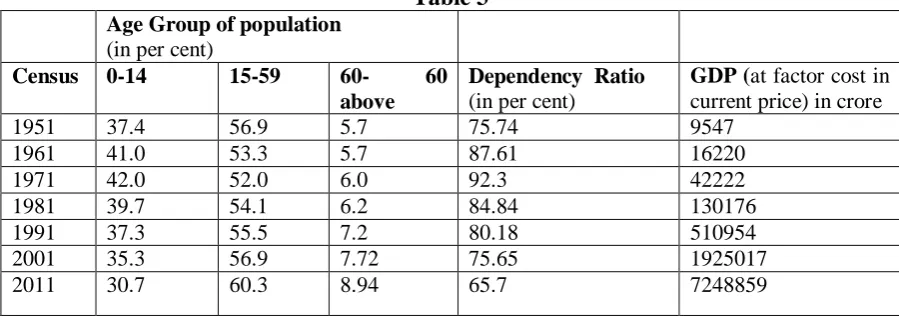
Table 3
Age Group of population
(in per cent)
Census 0-14 15-59 60- 60
above
Dependency Ratio
(in per cent)
GDP (at factor cost in
current price) in crore
1951 37.4 56.9 5.7 75.74 9547
1961 41.0 53.3 5.7 87.61 16220
1971 42.0 52.0 6.0 92.3 42222
1981 39.7 54.1 6.2 84.84 130176
1991 37.3 55.5 7.2 80.18 510954
2001 35.3 56.9 7.72 75.65 1925017
2011 30.7 60.3 8.94 65.7 7248859
According to table 3, dependency ratio is decreasing in India. These days, working population (15-59) is high and young and old age group is low. We can say that dependency ratio is decreasing in India. According to 1971 census, dependency ratio is 92.3 per cent. First of all, it is increase and after that it is decrease in India.
Relationship between employment and dependency ratio General theory tells us that lower the labor productivity lower the economic growth and higher the unemployment and poverty. On the contrary, high dependency ratio in India leads to lower productivity of such labor force As higher rate of economic growth pay the way the sustained and stable increase in productive capacity, employment opportunities with rising productivity are generated. GDP and employment correlation coefficient (r) is 0.08 and to interpret its value, there is weak positive relationship between them in India. In fact, this enables country to absorb more employees in the production and allied activities and thereby decreasing under and unemployment. In this process poor could definitely be able to achieve higher productivity and increase their income in their existing occupations or to obtain new jobs with better remuneration than before. As a matter of fact, employees getting better remuneration than before would make possible to spent more income on nutritional food, education and health care of their children which will enhance the productivity of workforce and also decrease the dependency ratio via education and awareness. Moreover, the effective family planning and re-productive health program can enhance women‘s human capital and productivity and the gains in productivity due to a program-induced decrease in fertility and slowing of population growth appear to have promoted development (Schults, 2009).However, this study obviously highlights the fact that there is association among poverty, economic growth, and employment and dependency ratio.
Table 4 Correlation Coefficient
GDP Employment Dependency Ratio
GDP 1.00 0.08 -0.49*
(Note:- *values are significant at 5% significance level)
There would generally be relationship among the economic growth, poverty, employment and high population or age dependency ratio. It is noted the fact that poverty and unemployment are very high whereas economic growth is very low and unstable in India. According to table 3, GDP and Dependency Ratio are also link to each other and find the correlation coefficient. It is -0.49. To interpret this value, a weak and negative linear relationship between them. What is the important fact is that in addition to economic growth and unemployment, dependency ratio due to high population of India highly affects the poverty
micro, small and medium industrial development.
Reference
Datt and Sundharam. Indian Economy, 64th. ed. New Delhi: GauravDutt and AshwaniMahajan S. Chand andCompany Ltd
Hyung J. 2013. ―An Analysis on Effect of Old Dependency Ratio on Domestic Saving Rate‖ Dept. of Economics, University of California, Berkeley
Klasen, S., and T. Nestmann. 2006. ―Population, Population Density and Technological Change.‖Journal of Population Economics19(3):611-626.
Saxena, N.C. ―Poverty Estimates for 1999-2000‖ Press Information Bureau, Govt. of India.Sundasam K. and Suresh D. Tendulkar, 2002. ― The Working Poor In India: Employment- Poverty Linkages and Employment Policy Options‖
PERIODIC AND FIXED POINT THEOREMS IN d-COMPELTE TOPOLOGICAL SPACES
SAVITA SHARMA
Abstract
The present paper deals with extension and derived briefly theorem existence of periodic points and uniqueness of common fixed point on self maps of d-complete topological spaces which introduced by Hicks. The material of this paper is mainly derived from the paper of Harder and Saliga, which extended and improved the results due to Hicks and Hicks & Rhoades.
Keywords: Periodic and Fixed Point Theorem, d-Complete Topological Space
Introduction
This paper deals with existence of periodic points and uniqueness of common fixed point on self maps of d-complete topological spaces which introduced by Hicks [5], in 1992.
The material of this paper is mainly derived from the paper of Harder and Saliga [3] which extended and improved the results due to Hicks [5] and Hicks and Rhoades [4].
Paper Description
Notation (i) :w.l.s.c. denotes the weak lower semi-continuous. (ii): The set O(x, ) {x, Tx, T x,...} 2 denotes the orbit of x.
Theorem 1: Suppose
T X
:
X n X
, :
N
and
:
X
[0, )
, where (X, ) is a d-complete topological space. If, for some x0X , the sequence S{ }xn n0 defined by( ) 1
n n x
n n
x T x satisfies
d (y, Tn(y) y) (y) - (Tn(y) y) for each y S, then we have (a) lim xn p exists, and
(b) Tn(p)(p)p if and only if G(x)d(x, Tn(x)x) is T-orbitallyw.l.s.c. relative to x0.
Proof : As n(x )n
n 1 n
x T x for n = 0, 1, ……., we obtain
x (x ) ) x T , x ( d ) x , x (d n n 1 n n(xn) n n n 1
.
For m 0,
m m
m n n 1 n n 1
n 0 n 0
d(x , x ) [ (x ) (x )]
0 1 1 2 m m 1
{ (x ) (x )} { (x ) (x )} ... { (x ) (x )}
0 m 1 0
(x ) (x ) (x )
.
The sequence {m}m 0 of partial sums of the infinite series n n 1 n 0
d(x , x )
is a non-decreasing sequence bounded above by (x )0 and thus converges. As X is d-complete, we obtainn
G(p) = d(p, Tn(p) p) = 0
lim
sup d(xn,Tn(xn)xn) = lim sup G (xn).
Assume that G (p) lim sup G (xn).
Now, G(x )n d(x , xn n 1 )0 as n as n n 1
n 0
d(x , x )
.Thus, G(p)d(p, Tn(p)p)0.
Hence p is a periodic point of T and thus (b) holds.
Corollary 1: Let X be a d-complete topological space. Suppose T : XX and
: X
[0, )
. Suppose there exists an x0 such thatd(y,Ty)
(y)
(Ty)
for all yO(x , )0 . Then we have:(1) limTn x = p exists;
(2) Tp = p if and only if G (x) = d (x, Tx) is T-orbitally lower semi-continuous at x0.
Proof : Suppose S = x0, Tx0, T2 x0, ..., and n : XN, defined by n (x) = 1 for every
xX.
Then, by Theorem 1, the results hold.
Corollary 2: Suppose T : XX and n : XN, where (X, ) is a d-complete topological space. If for some x0X, the sequence S{x }n n 0 defined by n(x )n
n 1 n
x T x
satisfies
d(z, w) kd(y, z)
for eachy S
, wherek (0,1)
, zTn ( y)y andw
T
n(z)z
, then(a) limxn = p exists, and
(b) Tn(p) p = p if and only if G(x) = d(x, Tn(x) x) is T-orbitallyw.l.s.c. relative to x0.
Proof : Put d
y,T y
k1 1 ) y
( n(y)
for
y S
.Now,
d(z, w) kd(y, z)
implies
d(y, z) d(z, w) (1 k)d(y, z)
,or 1 [d(y, z) d(z, w)] d(y, z)
1 k .
Now again,
k 1
1
d(y, z) = 1 kd
y,T y
1 n(y) = (y)
and
k 1
1
d(z, w) = 1 kd
T y,T (T y)
(T y). 1 n(y) n(Tn(y)y) n(y) n(y)
Hence, d(y,Tn(y)y)(y)(Tn(y)y)for each
y S
.By Theorem 1, the results hold.
We note that corollary (1) is generalized of corollary (2) of Hicks [5]. Theorems 1 and 2 are extensions of the results due to Ciric [1] of fixed point theorems for quasi-metric spaces to d-complete topological spaces.
Theorem 2: Suppose
T : X
X, n : X
N
and
: X
[0, )
, where (X, ) is a d-complete topological space. If for some x0X, the sequence S{x }n n 0 defined byn n(x )
n 1 n
(i) d(y, Tn( y)y)(y)(Tn( y)y) for each
y S
and for all y Cl[0(x0, )];(ii)
y Ty
implies (T y)m (y) for some positive integer m = m (y), then T has a fixed point.Theorem 3: Suppose
S,T : X
X
and
: X
[0, )
, where (X, ) is a d-complete topological space. If x0Xsuch thatd(y, Ty) + d(Ty, STy) (y) - (STy) for all yO (x , )ST 0 ,
where OST(x0, ) = {x0, Tx0, STx0, T(ST)x0, .... (ST)n x0, T(ST)n x0, ....}.
Then we have
(i) n n
0 0
lim(ST) x lim T(ST) x p exists, and
(ii)
Tp
p
Sp
if and only if G1(x)=d(x, Tx) and G (x)2 d(x,Sx) are (S, T)– orbitallyw.l.s.c. relative to x0.Proof : Let us consider the sequence {z }n n 0 by
z2k = (ST)k x0 and z2k+1 = T(ST)k x0 (k = 0, 1, 2, ...).
For m = 2k+1
2k 1
m n n 1
n 0
d(z , z )
= 2
0 0 0 0 0 0 0 0
[d(x , Tx )d(Tx ,STx )] [d(STx , T(ST)x ) d(T(ST)x , (ST) x )]
+…..+ k k k k 1
0 0 0 0
[d((ST) x , T(ST) x ] d(T(ST) x , (ST) x )]
[(x0) – (STx0)] + [(STx0 – ((ST)2 x0)] + ... + [((ST)k x0) – ((ST)k+1 x0)] k 1
0 0 0
(x ) ((ST) x ) (x )
.
Again, for any m = 2k,
2k
m n n 1
n 0
d(z , z )
2k
n n 1 2k 1 2k 2
n 0
d(z , z ) d(z , z )
= 2k+1 (x )0 .
The sequence {m}m 0 of partial sums of the infinite series n n 1
n 0
d(z , z )
is anon-decreasing sequence which is bounded above by (x0) and thus converges. As X
is d-complete, there exists
p X
such that zn p as n . Thus,lim (ST)n x0 = lim T(ST)n x0 = p.
Assume that G1 is (S,T)–orbitallyw.l.s.c. relative to x0.
1 2k 2k 2k
G (z )d(z , Tz )
= d(z , z2k 2k 1 )0 as k as n n 1 n 0
d(z , z )
.Now, in OST
x0,
, z2k k0 is a sequence such that z2k p as k . Hence, G (p)1 lim sup G (z )1 2k 0.Therefore, d(p, Tp) = G1 (p) = 0 implies p = Tp.
Thus G1 is w.l.s.c. relative to x0.
Similarly, p = Sp implies G2 is w.l.s.c. relative to x0.
Assume that G2 is (S, T)–orbitallyw.l.s.c relative to x0. Now, in O (x , ),{zST 0 2k 1 k 0} is a
sequence such that z2k 1 pas k.
Therefore, G (p)2 lim sup G (z2 2k 1 ). However,
2 2k 1 2k 1 2k 1
G (z )d(z ,Sz )
= d(T(ST)k x0, (ST)k+1 x0)
= d(z2k 1, z2k 2 )0 as
k
,
as n n 1n 0
d(z , z )
. Hence, 2G (p)0 implies d (p, Sp) = G2 (p) = 0
Thus, p = Sp. This completes the proof.
Theorem 4: Let
Tn n1 be a sequence of self mappings of a d-complete topological space (X, ) satisfying d(T x, T y)i j (max{d(x, y), d(x, T x), d(y, T y), d(y, T x)}i j i for allx, y X,
where d is continuous, :[0, ) [0, ), (0) = 0, is non decreasing and upper semi-continuous and (t) < t for all t > 0. Then the sequence
Tn n1 has a uniquecommon fixed point in X if and only if there exists x0Xsuch that
0 n 0 1 0 n x T , xd where 2(t) = ((t)).
Proof : If there exists
p X
, such that pT pn for n = 1, 2, 3, .... , then,
0n n 0
n 1 n 0 0 p T , p d .
Assume there exist x0 X such that
0 n 0 1 0 n x T , x d .Consider the sequence
xn n1, defined by xn = Tnxn-1, n = 1, 2, 3, 4, ... .Now, d(x1, x2) = d(T1x0, T2x1)
(max{d(x0, x1), (x0, T1x0), d(x1, T2x1), (x1, T1x0)})
0 1 0 1 1 2 1 1
(max{d(x , x ), d(x , x ), d(x , x ), d(x , x )})
0 1 1 2
(max{d(x , x ), d(x , x )})
.
If d(x , x )1 2 0, then
1 2 0 1
d(x , x ) 0 (d(x , x )).
If d(x , x )1 2 0 , then we also obtain
1 2 0 1
d(x , x )(d(x , x )). Assume that
0 1 1 2 1 2
max{d(x , x ), d(x , x )} d(x , x ) .
Hence, max{d(x , x ), d(x , x )} d(x , x )0 1 1 2 0 1 and
1 2 0 1
d(x , x )(d(x , x )). Also,
2 3 2 1 3 2
d(x , x )d(T x , T x )
1 2 1 2 1 2 3 2 2 2 1
(max{d(x , x ), d(x , T x ), d(x , T x ), d(x , T x )})
1 2 1 2 2 3 2 2
(max{d(x , x ), d(x , x ), d(x , x ), d(x , x )})
= (max{d(x , x ), d(x , x )})1 2 2 3
= (d(x , x )1 2 2
0 1 0 1
( (d(x , x ))) (d(x , x ))
as is non decreasing.
Continuing in this way, we obtain n
n n 1 0 1
d(x , x ) d(x , x ).
As,
0
n n 0
0 1 0 n 1 0 n x T , x d x , x d ,
then , n n 1 n 0
d(x , x )
.Since X is d-complete, so xn x as n for any x X.
For any fixed n N,
m 1 n m 1 m n
d(x , T x)d(T x , T x)
(max{d(xm, x), d(xm, Tm+1xm), d(x, T x), d(x, Tn m 1x )})m = (max{d(xm, x), d(xm, xm+1), d(x, Tnx), d(x, xm+1)}).
Since is upper semi continuous and d is continuous, letting m which gives
n n
d(x, T x)(max{d(x, x), d(x, T x)}) = (d(x, T x))n .
If d(x, T x)n 0, then (d(x, T x))n d(x, T x)n , which is a contradiction.
Hence, xT xn for n = 1, 2, 3, 4 ... .
Uniqueness, for the uniqueness, let us suppose that x and y are two common fixed point of sequence
Tn n1 with xy.Then, we obtain
d(x, y) = d(Tnx, Tny)
n n n
(max{d(x, y), d(x, T x), d(y, T y), d(y, T x)})
= (max{d(x, y), 0, d(y, x)}) = (d(x, y)).
As d(x, y)0, this implies that (d(x, y)) < d(x, y). Similarly, d(y, x)(d(x, y)).
Hence, d(x, y)(d(y, x))d(y, x)(d(x, y))d(x, y),
which is a contradiction.
Therefore, the common fixed point is unique.
Theorem 5: Let
Tn n1 be a sequence of self mappings of a d-complete topological space (X, ) satisfying d(Tix, Tjy) h max{d(x,y), d(x, Tix), d(y, Tjy), d(y, Tix)} for allx, yX, where 0 h 1and d is continuous. Then the sequence
Tn n1 has a unique common fixed point in X.Proof :Suppose (t)htfor t0. Since (0)0, is continuous and non-decreasing. As 0 h 1, (t)ht t for all t0.
Let x0 X. Then
1n n 1
0 1 0 n 0 1 0 n ) x T , x ( d h x T , x
d as 0 h 1.
By Theorem 4, we have a unique common fixed point for {T }n n 1 and the sequence {x }n n 0
is defined by
n n n 1
x T x for x = 1,2,3, ..., converges to this fixed point.
Theorem 6: Let A, B, S and T be mapping from a d-complete topological space (X, ) into itself satisfying the following conditions :
(a) A(X) T(X) and B(X) S(X),
(b) d(Ax, By) (max{d(Ax, Sx), d(By, Ty), d(Sx, Ty)}) for all x, y X, where
:[0, ) [0, ), (0) = 0, is non decreasing, is upper semi-continuous and (t)t for t0,
(c) One of A, B, S or T is w-continuous, (d) Pairs A, S and B, T are compatible on X, (e) d is a continuous symmetric.
Then A, B, S and T have a unique common fixed point in X if and only if there exist x0,
x1 X such that Ax0 = Tx1 and n 0 1 n 0
(d(Ax , Bx ))
.Proof : If A, B, S and T have a common fixed point qX, then Aq = Tq
and
0
n n 0
n n 0 0 Bq , Aq d .
Assume there exist x , x0 1X such that
0 1
Ax Tx and
0 n 1 0 n Bx , Ax d .
Select x2X such that Sx2 Bx1 and x3X such that Tx3 Ax2.
Continuing in this way, we can obtain a sequence {y }n n 0 in X such that
2n 1 2n 1 2n
y Tx Ax
and y2n Sx2n Bx2n 1 for n = 1, 2, 3,... . Now,
2n 2n 1 2n 1 2n
d(y , y )d(y , y )
= d(Ax , Bx2n 2n 1)
2n 2n 2n 1 2n 1 2n 2n 1
(max{d(Ax ,Sx ), d(Bx , Tx ), d(Sx , Tx )})
= (max{d(y2n 1, y ), d(y , y2n 2n 2n 1)}).
If d(y , y2n 2n 1 )0, then
2n 1 2n 2n 2n 1 2n 2n 1
max{d(y , y ), d(y , y )} d(y , y ), so that
2n 2n 1 2n 2n 1
(y , y ) (d(y , y ))
.
If d(y , y2n 2n 1 )0, then
2n 2n 1 2n 2n 1
(d(y , y )) d(y , y )
.
Assume that
2n 1 2n 2n 2n 1 2n 1, 2n
max{d(y , y ), d(y , y )}d(y y ). Then we obtain
d(y2n+1, y2n) (d(y2n+1, y2n)) < d(y2n+1, y2n),
which is a contradiction.
Hence, max{d(y2n 1 , y ), d(y , y2n 2n 2n 1)} d(y , y 2n 2n 1 ) and d(y , y2n 2n 1 )(d(y , y2n 2n 1)).
Similarly,
2n 1 2n 2 2n 2n 1
d(y , y )d(Ax , Bx )
2n 2n 2n 1 2n 1 2n 2n 1
(max{d(Ax ,Sx ), d(Bx , Tx ), d(Sx , Tx )})
= (d(y2n 1, y ))2n . Then we have
n n 1 n, n 1
d(y , y )(d(y y )) for n = 2, 3, 4, ... .
It follows that
d(yn, yn+1) n-1 d(y2, y1) for n = 1, 2, 3,... , as is non–decreasing.
Hence,
n 1
n n 1 2 1
n 1 n 1
d(y , y ) (d(y , y ))
. =
0 n 0 1 n Ax , Bx d ,implies that there exists p X such that yn p for n .
Since {Tx2n 1 n 1},{Ax }2n n 1 ,{Sx }2n n 1 and {Bx2n 1 n 1} are subsequences of
yn n1, they each converge to p.Assume S is w-continuous, then 2
2n
S x Sp as n . For n , we obtain
ASx2n Spas S and A are compatible. Now,
d(ASx2n, Bx2n-1) (max{d(ASx2n, S2x2n), d(Bx2n-1, Tx2n-1), d(S2x2n, Tx2n-1)}).
Since d is continuous, S is w-continuous and is upper semi continuous, then for n
gives
d(Sp, p)(max{d(Sp,Sp), d(p, p), d(Sp, p)}) = (d(Sp, p)) .
which is a contradiction. Hence, Sp = p as d (Sp, p) = 0.
Also, d(Ap, Bx2n 1 )(max{d(Ap,Sp), d(Bx2n 1, Tx2n 1), d(Sp, Tx2n 1)}). For n , we obtain that
d(Ap, p)(max{d(Ap, p), d(p, p), d(Sp, p)}) = (d(Ap, p)).
If d(Ap, p) > 0, then (d(Ap, p)) < d (Ap, p), which is a contradiction. Hence, Ap = p.
As A(X) T (X), p T(X) and there exits uX such that p = Ap = Tu. Now, d(p, Bu) = d(Ap, Bu)
(max{d(Ap,Sp), d(Bu, Tu), d(Sp, Tu)})
= (d (Bu, p)), which implies that Bu = p.
As B and T are compatible on X and Tu = Bu = p, d (TBu, BTu) = 0 and thus,
Tp = TBu = BTu = Bp. Now, d(p, Tp) = d (Ap, Bp)
(max{d(Ap,Sp), d(Bp, Tp), d(Sp, Tp)})
= (d(p, Tp)), or Tp = p.
The proof for T is w-continuous, is similar. Next, assume that A is w-continuous.
As A and S are compatible on X, SAx2n and A2x2n converge to Ap as n .
Now,
d(A2x2n, Bx2n-1) (max{d(A2x2n, SAx2n), d(Bx2n-1, Tx2n-1), d(SAx2n, Tx2n-1)})
For n , we obtain
d(Ap, p)(max{d(Ap, Ap), d(p, p), d(Ap, p)}) = (d(Ap, p)).
Hence, Ap = p.
Thus, there exists vX such that p = Ap = Tv.
Now, d(A x , Bv)2 2n (max{d(A x ,SAx ), d(Bv, Tv), d(SAx , Tv)})2 2n 2n 2n . For n , we obtain
d(Ap, Bv)(max{d(Ap, Ap), d(Bv, p), d(Ap, p)}) (d(Bv, p)),
implies that Bv = p.
As B and T are compatible on X and Bv = Tv = p, d(TBv, BTv) = 0 and Tp = TBv = BTv = Bp.
Now,
d(Ax2n, Bp) (max{d(Ax2n, Sx2n), d(Bp, Tp), d(Sx2n, Tp)}).
For n , we obtain
d(p, Bp) (max{d(p, p), d(Bp, Tp), d(p, Tp)}) (d(p, Tp))
(d(p, Bp))





![Fig.5 IR spectrum of [Cu(en)2(ppdtt)2]∙2H2O](https://thumb-us.123doks.com/thumbv2/123dok_us/1383121.1648987/59.595.74.535.248.758/fig-ir-spectrum-of-cu-en-ppdtt-h.webp)
![Fig.6ESR spectrum of [Cu(en)2(ppdtt)2]∙2H2O at LNT.](https://thumb-us.123doks.com/thumbv2/123dok_us/1383121.1648987/60.595.236.409.562.726/fig-esr-spectrum-of-cu-en-ppdtt-lnt.webp)

