The Security Method Provocation for User Assigned
Images on Content Sharing Website
1
K.Ramya Krishna,
2Smitha Rani Sahu
1,2Dept of CSE, Sri Vaishnavi College of Engineering, AP, India
Abstract
Present days individuals offer numerous individual images on informal community which requires looking after security. Protection is required to keep the abuse of such images. For keeping these images secure different protection settings are required. In the event that an instrument is given to the client which will make him set protection effectively, this will lessen his undertaking. For tending to this need a few strategies are proposed. In this paper some security proposal methods are talked about. These procedures prescribe protection to client for images. For prescribing such security, client profile data and properties of images are utilized. Labels identified with images and visual properties likewise critical to characterize images. Online networking’s grown to be a standout amongst the most critical piece of our everyday life as it empowers us to speak with many individuals. Making of informal communication locales, for example, MySpace, LinkedIn, and Facebook, people are offered chances to meet new individuals and companions in their own furthermore in the other different groups over the world. Clients of long range interpersonal communication administrations impart a plenitude of individual data to an expansive number of “companions.” This enhanced innovation prompts protection infringement where the clients are sharing the huge volumes of images crosswise over more number of people groups. This security should be taken consideration with a specific end goal to enhance the client fulfillment level. The objective of this study is to give a far reaching audit of different protection strategy ways to deal with enhance the security of data partook in the online networking destinations.
Keywords
Online Information Services, Privacy Policy, Meta Data, Online Social Networking Communities, Privacy Policy, Security
I. Introduction
Online networking is the two route correspondence in Web 2.0 and it intends to convey, share, and collaborate with an individual or with a substantial gathering of people. Informal communication sites are the most well-known sites on the Internet and a great many individuals use them consistently to draw in and interface with other individuals. Twitter, Facebook, LinkedIn and Google Plus is by all accounts the most prominent Social systems administration sites on the Internet. Today, for each and every bit of substance shared on destinations such as Facebook—each divider post, photograph, announcement, and video—the up loader must choose which of his companions, bunch individuals, and other Facebook clients ought to have the capacity to get to the substance. Thus, the issue of protection on destinations such as Facebook has gotten noteworthy consideration in both the examination group [1] and the standard media [2]. We will probably enhance the arrangement of security controls and defaults, yet we are restricted by the way that there has been no indepth investigation of clients’ protection settings on destinations such as Facebook. While noteworthy protection infringement and befuddled client desires are prone to exist, the degree to which such security infringement
happen has yet to be measured. Images are currently one of the key empowering agents of clients’ network. Sharing happens both among beforehand settled gatherings of known individuals or social circles (e.g., Google+, Flickr or Picasa), furthermore progressively with individuals outside the clients social circles, for purposes of social revelation to offer them some assistance with identifying new companions and find out about associates hobbies and social environment. With the expanding volume of images clients offer through social destinations, keeping up protection has turned into a noteworthy issue, as showed by a late flood of advertised episodes where clients accidentally shared individual data. In light of these occurrences, the need of instruments to offer clients control access to their common substance some assistance with being clear. A picture recovery framework is a PC framework for scanning, looking and recovering images from an expansive database of advanced images. Most conventional and basic strategies for picture recovery use some technique for including metadata, for example, inscribing, watchwords or depictions to the picture recovery can be performed over the explanation words. Manual picture comment is tedious, arduous and costly to address this, there has been a lot of examination done on programmed picture explanation. Furthermore, the expansion social web applications and the semantic web have propelled the advancement of a few electronic picture explanation devices. Programmed picture explanation [6] is the procedure by which a PC framework naturally allocates metadata through inscribing or catchphrases to a computerized picture. This utilization of PC vision methods is utilized as a part of picture recovery frameworks to arrange and find images of enthusiasm from a database. This technique can be viewed as a sort of multi-picture grouping with an extensive number of classes expansive as the vocabulary size. Commonly, picture investigation as extricated highlight vectors and preparing comment words are utilized by machine learning procedures to endeavor to consequently apply explanations to new images.
II. Related Work
can be accomplished without an open key base [2]. Tarzan utilizes comparative location revamping methods as a part of a P2P setting [1]. In spite of the fact that we utilize information sending for protection, OneSwarm does not have exit-hubs. Regularly, the malevolent action radiating from way out hubs is credited to their facilitating associations, debilitating clients from facilitating exit hubs. Additionally, OneSwarm is not architected as an administration; to utilize the system, clients must run the customer, advancing adjusted limit and request. A comparative test is natural in BitBlender [7], which endeavors to cover conscious members in BitTorrent swarms by including various arbitrarily chose “blender” hubs in the circulation too. All the more as of late, Baden et al. have connected cryptographic methods to empower information imparting to consents in current social web administrations without presenting substance to administration suppliers [6]. OneSwarm backings consents notwithstanding permitting clients to share information freely without attribution. Comprehensively, OneSwarm contrasts from every one of these frameworks in its backing for a range of information sharing models and associate trust connections, and additionally an assessment grounded in an extensive scale organization and client populace. Trust: Incorporating true trust connections has been a significant configuration component in a few as of late proposed frameworks. SybilGuard [3] utilizes properties of interpersonal organizations to uncover manufactured characters in social frameworks. Friendstore [5] is a P2P reinforcement framework where clients store reinforcement information just on other trusted hubs possessed by companions or associates. In Ostra [6], the shortage of social associations is utilized to battle spam. UIA [6] gives information directing and name determination over a socially built overlay of individual gadgets. Turtle [1] is a record sharing application that points of confinement direct correspondence to just the social diagram trying to bypass listening stealthily. Our experience recommends that utilizing social availability alone is deficient for some clients. Rather, One Swarm enlarges a social topology with an assortment of extra untrusted connections to ease bootstrapping, enhance vigor, and by taking into consideration a blend of companion sources further improve security. Workload: Our estimations and examination of the last.fm workload are to a great extent predictable with existing work that portrays partaking in P2P systems [1, 4, 8] and use of mainstream substance sharing locales [8]. Free estimation endeavors have revealed insight into the properties of well known online informal organizations [2, 4-5]. Our estimations expand on comprehension created in this former work, consolidating estimations of a social diagram with a hint of sharing movement on that chart, and we make this joined information set accessible to the group.
III. Social Content Workloads
OSNs have changed the way content is shared on the Internet. In this section we study the characteristics of OSN content using real traces gathered from popular OSN sites, and focus on the differences between OSN and the traditional web content. 2.1 Datasets We implemented a web crawler for flickr.com and youtube. com, which are popular sites that allow people to share content with their friends. Our crawler gathered detailed information about the uploads and downloads of publicly available content from these sites.
1. Flickr
We randomly chose 11,715 users from the list of 2.5 million users gathered by [4]. We crawled the profile pages of these users
daily for 19 consecutive days. In total, these users had uploaded 1,324,080 publicly accessible photos. For each photo, we recorded the number of daily views received, as well as metadata, like photo size, tags, and favorite markings.
2. YouTube
We randomly chose 77,575 users from the list of YouTube users gathered by [3]. We collected information about the videos uploaded by these users. In total, these users had uploaded 1,251,492 publicly accessible videos. We collected the number of daily views for all of these videos over a period of 166 days using the “StatisticsandData” feature in YouTube. Ideally we would have liked to include data from an OSN site like Facebook, but obtaining data from such sites is hard because most of the shared content is private. In contrast, all the data we gathered from Flickr and YouTube is publicly accessible. Furthermore, these two sites provide mechanisms for searching and featuring popular content. Hence, our analysis of content consumption patterns is likely to overestimate the popularity that content would have reached had it been shared on an OSN site like Facebook. On the other hand, the content production patterns are likely to be similar to the ones in Facebook.
A. Content Production Patterns
In order to understand the storage requirements for sharing OSN content from home, we study the content production patterns of Flickr and YouTube users. We examine the total amount of content shared by each user in our dataset since they joined Flickr and YouTube. The average user in our dataset has been in the system for over 4 years. Figure 1(a) shows the rank of each user against the total number of objects (photos and videos) they shared, in a loglog plot. Flickr shows a plateau at 200 images, as a consequence of the limit imposed on the number of photos visible in a free account. The content production rate is generally low; users uploaded on average 111 photos (median=29) and 16 videos (median=6). Only 10 Flickr users (accounting for 0.08% of all users) uploaded more than 10,000 images. Likewise, only 40 YouTube users (0.05%) uploaded more than 1,000 videos. Figure 1(b) shows the same trend as a function of the total size of uploaded content. Because we are interested in the storage requirements for active users, we only show users who uploaded more than 1MB. While a small fraction of users uploaded more than 100GB of videos, the remaining users’ uploads remain small in size. Users on average uploaded 13.3MB to Flickr and 103MB to YouTube. Even the most prolific user on Flickr uploaded less than 3GB. This amount of data can easily fit into a small storage device, e.g., a USB-stick attached to a home gateway. Our analysis indicates that while the total amount of content that is shared by all users on an OSN is massive, individual users only share a limited amount of content and this content can fit on affordable storage devices.
B. Content Consumption Patterns
such as the different popularity of the two sites— according to alexa.com, 22% of global Internet users visit YouTube, while only 2.5% visit Flickr. With respect to the popularity of OSN content, we make two observations from fig. 2(a). First, not all 1,324,080 Flickr photos and 1,251,492 YouTube videos were requested during a week period. Rather, a substantial fraction of objects did not receive a single request during an entire week. More precisely, 97% of Flickr photos and 44% of YouTube videos were never requested during the one week period. These results suggest that the number of objects that need to be made readily available to web servers and CDNs can, at least potentially, be drastically reduced. The second observation is that even the content that was requested received only a few requests during the one week period. Almost all Flickr photos received less than 1,000 requests. YouTube contained about 1,000 very popular videos, which were viewed over 10,000 times. However, the remaining videos (99% of all videos, or 88% of all videos with at least one request) each received no more than one thousand requests. The fact that many objects are unpopular is promising for the feasibility of a decentralized architecture, because it reduces the resource demand on home networks. Finally, in order to see how popular objects are distributed.
IV. Performance of Home-Based Content Sharing
In order to assess the performance of sharing content from home gateways, we stored 20 JPEG images and 1 MPEG4 video file on the USB storage of each gateway and measured the performance of fetching each file from other gateways. For comparison purposes, we uploaded the same media files to Facebook. The size of the files were between 80KB and 130KB for images and 18MB for the video. Every 10 minutes, each gateway requests the images from a randomly chosen gateway and from the Akamai URL 4 used by Facebook to deliver the files. The same is done for the video file, although only once every hour. For each download, we recorded the completion times and any error and HTTP response codes. On average, each home gateway in our experiments serves more than 4GB per week, which is more than the weekly data served today on behalf of 75% of YouTube users and 100% of Flickr users. Therefore, our results here suggests that most social content can be served using home gateways.
A. Successful Content Downloads
We discuss how often the media file downloads were successfully completed. Table 2 displays the statistics for the content downloads. Overall, the percentages of successful downloads using home servers and Akamai are comparable (93% using home servers and 99.7% using Akamai), although Akamai is clearly preferable if one needs a highly reliable service. Given that content sharing is not a mission-critical service, the slightly lower reliability offered by home servers might be acceptable for many users. Table 2 also reports the major sources of errors that caused content downloads to fail. The major sources of error for Akamai were failed DNS resolutions, where the client could not successfully resolve the Akamai URL. In the case of content served from the testbed, the major sources of errors were internal server errors and empty responses. After inspecting the logs, we found that a lot of these errors were generated by a single gateway with faulty USB storage. Excluding this outlier, the main source of error was failed connections to the server. This accounted for a small 1.8% of the cases, which well matches the 98% availability of the gateways presented above.
B. Performance of Photo Browsing
Next we look at the time taken to complete the photo downloads. Table 3 displays the percentile of download times in the experiments. Even when photos were served from home gateways, 80% of the downloads took less than 3 seconds, a performance likely to be acceptable for many users. Optimized versions of the system could prefetch photos in the same photo album to hide fetch latency from the user. Prefetching seems to be useful since users are likely to spend a few seconds viewing a photo before requesting the next one. Thus, the results suggest that users can obtain acceptable performance when sharing their photos with friends directly from their homes.
V. Privacy Concerns With Social Networking Sites
VI. Proposed System
Some users over CSS influence user’s privacy on their private contents, where some users keep on distribution superfluous comments and messages by attractive advantage of the users’ intrinsic trust in their connection network.
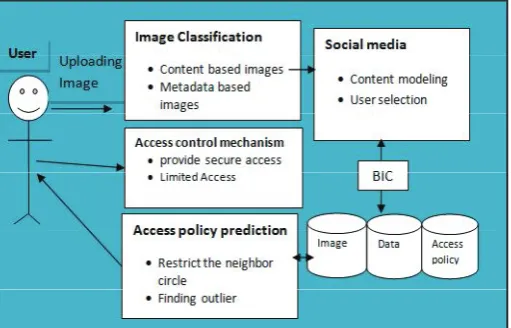
Fig. 1: System Architecture
The overall architecture of the proposed work has given in figure 1.0. This paper switches the most widespread issues and threats objective different CSS freshly. In CSS privacy is frequently a key apprehension by the users. Because millions of people are willing to interrelate with others, it is also a new harass ground for image misuses. They are dispersion the images and contents. This paper will demonstrate and argue the most widespread issues and threats targeting different CSS today. And finally finds the just the thing privacy policy scheme for that privacy. This proposition a privacy policy forecast and access boundaries along with overcrowding scheme for social sites using data mining techniques. This helps to detect and defend distrustful activates, which violates user’s privacy in CSS by making an allowance for the following parameters, i) Text annotation, which emerge in the uploaded contents. ii) Image and policy descriptions iii) Detection of superfluous commends and. To perform this, the system utilizes APP (Access Policy Prediction) and Access control mechanism by applying BIC algorithm (Bayesian Information Criterion).
VII. Security Analysis
One Swarm’s overarching security goal is to improve privacy by allowing users to control information disclosure. When sharing data with permissions, disclosure is limited by familiar mechanisms: strong identities, capabilities, and end-to-end encryption. In this section, we focus on analyzing privacy properties in the more challenging case of data sharing without attribution.Threat model Our goal is to be resistant to the disclosure of user behavior to an attacker with control over a limited number of overlay nodes. Native BitTorrent is susceptible to just this attack, enabling a small number of monitoring agents to infer the behavior of tens of millions of users [29, 33]. Specifically, we assume that an attacker that can join the network with a limited number of nodes, monitor network traffic to/from its nodes, and generate, modify, and delete OneSwarm overlay messages flowing through its nodes. The attacker can record timing information about the messages it sends/receives to infer information about the behavior of the rest of the OneSwarm network, and may spawn any number of OneSwarm instances on its nodes. We do not attempt to guarantee privacy against attackers that can sniff, modify, or inject traffic on arbitrary network links, or attackers that can seize the physical
hardware of OneSwarm users, e.g., law enforcement. OneSwarm assumes that users are conservative when specifying trust in peers, as trusted peers can view files for which they have permissions. If trust is misplaced or a peer compromised, OneSwarm limits the resulting disclosure to only the trusted peers of the compromised nodes. This is in sharp contrast to private Bit Torrent communities [38], wherein a single compromised member can monitor all users of the service. 4.2 Attacks and defenses In this section, we outline several potential attacks and quantify their effectiveness using measurements of OneSwarm users in the wild. In a technical report [20], we explore a wider range of threats: associating search requests to users, identifying trusted links, impact of additional attacker capabilities, and so on. Because of space limitations, we restrict our attention to what we believe to be the most likely attackers conducting the most likely attacks: One or more colluding OneSwarm users bootstrapped via public community servers attempting to infer the source of a data transfer. The discussion highlights the following aspects of the One Swarm protocol that significantly enhance user privacy.
Persistent peering relationships limit monitoring power:
•
In Bit Torrent, peers are dynamically assigned, allowing attackers to become a peer of virtually everyone, given enough time. By contrast, OneSwarm peers are persistent, improving contribution incentives but also limiting the ability of attackers to snoop from arbitrary locations in the overlay.
Heterogeneity of trust relationships foils timing attacks:
•
OneSwarm users define links as either trusted or untrusted and keep this information private. As the protocol behavior varies with link type, the combined use of trusted and untrusted links greatly diminishes an attacker’s ability to infer path properties based on timing information.
Lack of source routing limits correlation attacks:
•
OneSwarm does not provide peers with the ability to construct arbitrary overlay paths. Attackers could use this to correlate performance with ongoing transfers. Such an attack is known to degrade privacy in Tor, for example [39]. Individual clients have a limited view of the overlay and cannot control path setup beyond directly connected neighbors.
Constrained randomness frustrates statistical attacks:
• The
uncertainty arising from random perturbations in the protocol could be reduced through statistical analysis if repeated probes yielded different draws. OneSwarm prevents such analysis by making all random decisions deterministically with respect to a given query and link.
VIII. Conclusion
for a given user. We also effectively tackled the issue of cold-start, leveraging social context information. Our experimental study proves that our A3P is a practical tool that offers significant improvements over current approaches to privacy.
References
[1] A. Acquisti, R. Gross,"Imagined communities: Awareness, information sharing, and privacy on the facebook", In Privacy Enhancing Technologies Workshop, 2006.
[2] R. Agrawal, R. Srikant,"Fast algorithms for mining association rules in large databases", In J. B. Bocca, M. Jarke, and C. Zaniolo, editors, 20th International Conference on Very Large Data Bases, September 12-15, pp. 487–499. Morgan Kaufmann, 1994.
[3] S. Ahern, D. Eckles, N. S. Good, S. King, M. Naaman, R. Nair,"Over-exposed?: Privacy patterns and considerations in online and mobile photo sharing", In Conference on Human factors in computing systems, pp. 357–366. ACM, 2007. [4] M. Ames, M. Naaman,"Why we tag: Motivations for
annotation in mobile and online media", In Conference on Human factors in computing systems, CHI’ 07, pp. 971– 980. ACM, 2007.
[5] A. Besmer, H. Lipford,"Tagged photos: Concerns, perceptions, and protections", In CHI ’09: 27th international conference extended abstracts on Human factors in computing systems, pp. 4585–4590. ACM, 2009.
[6] A. D. Bland JM.,"Multiple significance tests: The bonferroni method", BMJ, 310(6973), 1995.
[7] J. Bonneau, J. Anderson, L. Church.,"Privacy suites: Shared privacy for social networks", In Symposium on Usable Privacy and Security, 2009.
[8] J. Bonneau, J. Anderson, G. Danezis,"Prying data out of a social network", In ASONAM: International Conference on Advances in Social Network Analysis and Mining, pp. 249– 254, 2009.
[9] O. Chapelle, P. Haffner, V. Vapnik,"Support vector machines for histogram-based image classification", Neural Networks, IEEE Transactions on, 10(5), pp. 1055–1064, 1999. [10] H.-M. Chen, M.-H. Chang, P.-C. Chang, M.-C. Tien, W. H.
Hsu, J.-L. Wu.,"Sheepdog: Group and tag recommendation for flickr photos by automatic search-based learning", In 16th ACM international conference on multimedia, pp. 737–740. ACM, 2008.
K.RAMYA KRISHNA Holds a B.Tech certificate in Information Technology Affiliated to the JNTU KAKINADA. She presently Pursuing M.Tech (CSE) department of computer science engineering from Sri Vaishnavi college of engineering at srikakulam Affiliated to JNTU KAKINADA.
SAHU SMITA RANI., M.Tech, Ph.D-BPUT (2015) is HOD, Assistant Professor in CSE department Sri Vaishnavi College of Engineering, Srikakulam, AP, India. A lady of true vision towards modern professional education and deep routed values. She had published her research papers in 2 international journals, 2 proceedings of international conferences and 2 national conferences. She also presented papers in international and national conferences. A few more papers of her are under processing for publication.
She actively participated in professional bodies at various organizations. Her areas of interest are Artificial Intelligence, Computer Graphics, Object Oriented Software Engineering, Operating Systems, System Programming, Machine Learning, Neural Networks.
Her hobbies include listening to old and new melodies, reading books and playing shuttle badminton.
She believes in the wordings of Swami Vivekananda: