* To whom all correspondence should be addressed. Mob.: +989155170294; Fax: +985138807090; E-mail: [email protected]
The Effect of Observing Different Types of
Information on Learning a Novel Motor Skill
Hossein Hajatmand Ghalehroudkhani, Mehdi Sohrabi and Hamidreza Taheri Torbati
Faculty of Sport Sciences, Ferdowsi University of Mashhad, Azadi square, Mashhad, Iran.
http://dx.doi.org/10.13005/bbra/2330
(Received: 11 July 2016; accepted: 17 August 2016)
Relative information is the most important constraint during observation. The present study examined the importance of observing different types of information during observational learning. Participants observed one of the following types of information: whole body (FULL), arm of the throwing hand (ARM), wrist of the throwing hand (WRIST), or the end points of the upper and lower limbs (END- POINTS). During 30 acquisition trials (3 blocks), the participants observed a model five times before the first trial and once before each remaining trial of each block. The retention test (10 trials) was performed the following day. Shoulder-elbow and elbow-wrist intra-limb coordination was assessed in comparison with the model. During acquisition, FULL and ARM groups were more accurate in reproducing the model’s action than the other two groups. These results were repeated during retention tests, which provide partial evidence to the visual perception perspective notion. It was concluded that the end effector is an important source of information, and observing this type of information is enough for learning a novel motor skill.
Keywords: observational learning, relative information, intra-limb coordination, visual perception perspective, novel skill.
Learning is a process that requires practice and experience1, taking place through
various methods including physical and mental practice and action observation. Action observation, sometimes referred to as observational learning, is a process in which observers try to learn and repeat an action through observing a model2. Research on observational
learning has been done in several areas3. Much of
early development has been attributed to the processes of social learning4. One of the main
interests of researchers is the type of information
used when people observe a model. Bandura4, 5
did not discuss this issue in his Social Learning Theory. However, Visual Perception Perspective theory6 states that an observer perceives and uses
the relative information, and this type of information is a prominent constraint during observational learning. Researchers have tested visual perception perspective using Point Light
Displays (PLD)7-9. They believe that important
information is more salient in PLD demonstration and the identification and perception of movement
is easier compared with video presentation10,
that watching dance steps through PLD results in a better learning than watching via video presentation11. However, the priority of PLD model
over video model has not been confirmed in other studies. In a study conducted on throwing darts, no significant difference was observed between PLD and video model7. Similarly, Horn et al.,8, 9
found no significant difference between these two representation models. However, some researchers claim that those studies have not directly manipulated relative information, and without a direct manipulation, its role in observational learning could not be taken into account12-16. Using
PLD techniques, Hodges, et al.16 manipulated the
relative information in a soccer kicking action. The information displayed included relative information (markers attached on all over the leg), restricted relative information (two markers attached on the foot), and absolute information (a marker attached on the ankle). The argument was that if relative information plays the main role in observational learning, those who observed absolute information would learn less than other two groups. The results were contradictory, and those who observed absolute information performed more similar to the model than those in other groups. It was concluded that information related to the movement endpoint has a crucial role in observational learning16, 17. The
results were repeated in another study performed on bowling throwing action15. Nonetheless, in a
study on cricket throwing task12, different results
were reported; relative and absolute information was presented to different participants, showing that those who had watched absolute information related to the endpoint did not act as those who had watched relative information12. Breslin et al.13
used the same task in which participants were provided with relative information about the whole body, the throwing hand, the wrist of both hands, and the wrist of the throwing hand, indicating that all groups did more like the model than the group who observed the wrist of throwing hand. Researchers have concluded that the amount of information plays possibly a more prominent role compared with the type of information. Their study was carried out on a similar task and similar groups of participants, showing that groups given relative information on the whole body and the throwing hand performed better than the other groups. It was concluded that the end effector information
(information about the throwing hand not the endpoint) plays an important role in learning a novel skill via observation14,18.
There are few studies on this research area, which are mostly incongruent. Some studies have emphasized the importance of relative information6,
7; some others highlighted the importance of
absolute information16, and others show the
importance of restricted relative information14.
Thus, the results of studies in this area are not consistent. Tasks used in previous studies are very simple7, 16 and probably available in observer’s
motor repertory15, 19, which somehow explain the
contradictory results. Observational learning may be more effective if learning a new coordination pattern is required20. Thus, designing a study with
a novel task which probably is not in observer’s motor repertory will be illuminating.
METHODS
Participants
Thirty-two male participants were selected from Ferdowsi University of Mashhad, Iran, and assigned randomly into four groups: the whole body information (FULL), the right hand information (ARM), the wrist and feet information (END POINTS), and the wrist only information (WRIST). All participants met the selection requirements of the study, which required no previous throwing experience at an organized club, high school, and college level and were right hand dominant. They had normal and corrected-to-normal vision. Informed consents were obtained from the participants.
Task
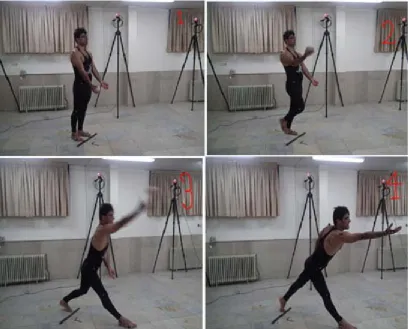
The task involved a backhand throwing adapted from baseball throwing task (Figure 1). However, baseball throwing is done with opposite arm and leg with forehand throwing, but the task was performed as a backhand with the same arm and leg21. The participants had to start the task
from the initial position. In the initial position, hands were stretched out in front of the body (Figure 1, part 1).
Instrumentation
ball’s landing position. In the center of the square, a red circle with a diameter of 10 cm was designed as the target, and the distance between the participants and the target was 5 m. A Simi Motion Analyzer system with six high speed video cameras was used for measuring movement kinematics.
Data collection
In order to provide the model, an adult was asked to perform 200 throwing per day for 5 consecutive days. On the fifth day, reflexive markers were attached to the model’s body to capture the PLD in the following order: distal end of the fifth metatarsal bone (toe), ankle, lateral condylar (knee), trochanteric femoral (hip), acromial process (shoulder), lateral epicondylitis (elbow), radial styloid process (wrist), distal end of the first palmar bone (finger), and forehead (head)13, 15. One of the
trials in which the ball exactly landed on the target was recorded as the model, using a SIMI motion system. Contextual information was removed through SIMI motion software so that markers placed on the anatomical landmarks were observable as point lights in the video. The point light film was divided, with equal duration, into four tracks: full information, all placed markers on the model’s body were observable (FULL); arm information, where four markers placed on the right hand (throwing hand) were visible (ARM); end points information, where markers placed on the right hand wrist and ankles were observable (END-POINTS); wrist only information, where markers placed on the right hand wrist (WRIST) were observable.
In the acquisition phase, the participants had a 5min break to get familiar with the laboratory conditions. Before the experiment, 17 reflective markers were placed on the major joint centers on both sides of the participants’ body. The positioning of the markers were the same as the model. Afterwards, they signed the consent form. Before beginning of the acquisition phase, the participants watched a PLD perceptual training video to ensure that they fully understood the conceptual nature of PLD stimuli. The training video was comprised of a number of daily actions such as walking, jumping, and running displayed both in regular video and point light format. This was actually done to eliminate the possible negative impacts of PLD on the participants15. The training
videos were not similar to the desired throwing
task13-15. After familiarization, the participants
performed 30 acquisition trials (three blocks of 10 trials with 2 min break between the blocks), where a demonstration was shown five times on trial one and then once before each remaining trial. The participants were instructed to equally emphasize replication of the model’s action and hitting the target12-14. After 24 hours, the participants performed
10 trials as retention test. No demonstration was shown to the participants during retention.
Data analysis Kinematics
The start and end points of movement were standardized. The start point was determined as the initiation of right elbow flexion, and the end point was determined as the maximum extension of right elbow. The data were smoothed with a recursive 4th order Butterworth filter applying a
cut-off frequency of 7 Hz. A linear interpolation normalized this period to 100 data points22, enabling
comparison of the trials and the model.
A modified version of normalized root
mean squared error (NORMS)23 was used to
provide an index of similarity of intra-limb coordination of participant to the model. In this approach, the model’s trace is used as criterion, and the disparity of each trial is calculated from model’s criterion trace. Afterwards, this score is normalized for a number of trials and excursion24;
this approach is called as normalized root mean
squared difference (NORM-D)9. A smaller
NORM-D score represents a close approximation to the model’s movement trace. The important aspect of this throwing action occurs in the right side of the body (right arm and leg). Thus, right shoulder-elbow and right shoulder-elbow-wrist coordination were used to compare the intra-limb coordination between the participants and the model. All kinematic data were analyzed based on values computed from the first three (ACQ 1, t1–3), last three of the first block (ACQ 2, t8–10), last three of second block (ACQ 3, t18–20), and last three of third block (ACQ4, t28-30) trials of acquisition. In retention, data from the first three (RET1, t1-3) and the last three (RET2, t8-10) trials were used for analysis.
Action outcome
during acquisition and retention, the radial error was used.
RESULTS
Shoulder-elbow coordination
For acquisition period, data were analyzed in a 4 Group (FULL, ARM, WRIST, END POINTS) × 4 Block (ACQ1, 2, 3, and 4) mixed designed ANOVA with repeated measures on the last factor. Also, in retention, a 4 Group (FULL, ARM, WRIST, END POINTS) × 2 Block (Ret 1, 2) mixed design ANOVA with repeated measures on the last factor was used. For all analyses, when violations to sphericity were observed, a Greenhouse–Geisser correction was applied.
Figure 2 depicts the shoulder-elbow coordination of all groups in acquisition and retention periods. Results did not show a significant difference between groups, F<1.
However, a significant main effect of blocks was observed during acquisition, F (1.58, 44.23) = 5.80, P=0.01, ž2
p= 0.17. Post-hoc analysis for the main
effect of blocks showed a significant difference between ACQ1 and ACQ2, and ACQ1 and ACQ4. As it can be seen in Figure 2, the groups improved their accuracy in reproduction of model’s movement. Also, a non-significant interaction effect concerning group× block was observed, F<1. In retention, a non- significant main effect of Group, F<1, main effect of Block, F (1, 28) = 2.8, p= 0.15, η2
p= 0.09, and interaction effect for Group×
Block, F (3, 28) = 1.26, p= 0.30, η2
p= 0.12 were
observed.
Elbow-wrist coordination
In acquisition, the resulting data were analyzed in a 4 Group (FULL, ARM, WRIST, END POINTS) × 4 Block (ACQ1, 2, 3, and 4) with repeated measures on the last factor. For retention period, data were analyzed in a 4 Group (FULL, ARM,
Fig. 2. Shoulder-elbow coordination of groups for acquisition and retention periods
Fig. 3. Elbow-wrist coordination for all groups in acquisition and retention periods
WRIST, END POINTS) × 2 Block (Ret 1, 2) mixed ANOVA with repeated measures on the last factor. Figure 3 shows the elbow-wrist coordination of groups.
During acquisition, a significant main effect of Group, F (3, 28) = 11.16, P= 0.000, η2
p=
0.54, and Block, F (2.66, 63.45) = 6.95, P= 0.001, η2 p=
0.19 was observed, but, the interaction effect of Group× Block was not significant, F<1.
As Figure 3 shows, all groups improved their elbow-wrist coordination in relation to the model’s action. Post-hoc analysis for the main effect of Group revealed a significant difference between FULL and WRIST, P<0.05, and FULL and END POINTS, P<0.05, groups. Also, significant differences were observed between ARM and WRIST, P<0.05, and ARM and END POINTS, P<0.05 groups. The differences were not significant between FULL and ARM groups, P>0.05, and WRIST and END POINTS groups, P>0.05. Means comparison showed that FULL and ARM groups performed more like the model compared with WRIST and END POINTS groups (FULL= 23.90, ARM= 24.52, WRIST= 39.67, END POINTS= 35.51). In retention, the results showed that the main effect of Group, F (3, 28) =11.77, P=0.000, η2
p= 0.55, and
the main effect of Block, F (1, 28) = 56.02, P=0.000,
η2
p= 0.66, were significant. A non-significant
interaction of Group × Block, F<1, was observed. Based on Figure 3, all groups improved their elbow-wrist coordination in Ret 2 compared with Ret 1. As the acquisition period, significant differences were observed between FULL and WRIST groups, P<0.05, and FULL and END POINTS, P<0.05. Also, the differences between ARM and WRIST groups, p<0.05, and ARM and END POINTS groups, P<0.05, were significant. There was not any significant difference between FULL and ARM groups, P>0.05, and WRIST and END POINTS groups, p>0.05. Generally, FULL and ARM groups performed more like the model action than WRIST and END POINTS groups (means, FULL= 25.56, ARM= 25.83, WRIST= 36.61, END POINTS= 41.51).
Action outcome
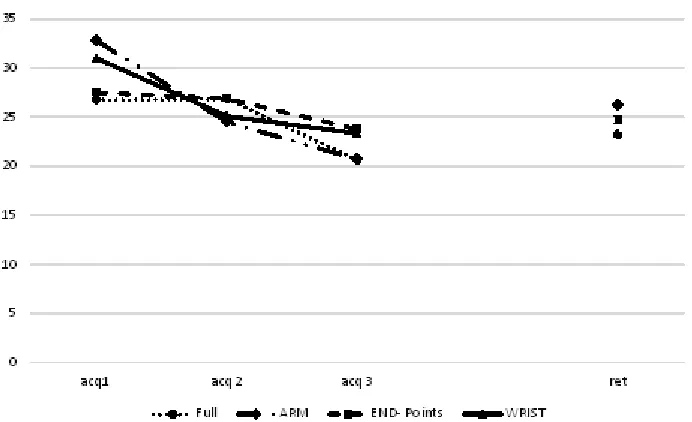
Figure 4 shows the groups’ performances during acquisition and retention. The acquisition’s data were analyzed using a 4 model (FULL, ARM, END- POINTS, WRIST) ×3 block (ACQ 1, 2, 3) mixed design ANOVA with repeated measures on the last factor.
The mixed ANOVA indicated that the main effect of model was not significant, F<1; however, the main effect of blocks was significant ç2p=0.24,
p=0.0001, F (2. 56) =9.23. Also, the results showed a non-significant interaction effect of model with blocks, F<1. The results of post-hoc test for the main effect of blocks indicated a significant difference between the first and second blocks, P<0.05. Also, a significant difference was observed between the first and third blocks, P<0.05 and between the second and third attempt groups, P<0.050. The means comparisons indicated that all groups reduced their error from the first block to the third block(means, block 1= 29.48, block 2= 25.79, block 3= 22.07) (Figure 4). In the retention phase, one-way ANOVA was performed on the radial errors, indicating that the main effect of the model was not significant, F<1.
DISCUSSION
The current study aimed to investigate the effect of observing different types of information on learning a novel motor skill. Shoulder-elbow coordination of all groups improved during acquisition, but no significant difference was observed between the groups in the acquisition and retention tests. Regarding elbow-wrist coordination, FULL and ARM groups performed more like the model compared with the END-POINTS and WRIST groups in the acquisition and retention periods. The findings are consistent
with previous results12, 14. Observing the end
effector may be sufficient to learn a novel skill, which is concluded according to the lack of any significant difference between FULL and ARM groups where both groups performed better than the END-POINTS and WRIST groups in reproducing the elbow-wrist coordination of the model’s action. Although, it had been shown in previous researches that observing the end point of action is sufficient to successfully reproduce the action15, 16, in this study, observing the end
sufficient, but for a whole body novel action like the action described in this study, this type of information is not sufficient, and more information is required to successfully reproduce the action14.
When more information was provided not related to the effector limb (END-POINTS), no improvement was observed in limb coordination relative to the full or restricted relative information. Thus, information pertaining to the action end effector limb is possibly crucial for learning to occur14. The findings partially support the visual
perception perspective’s claims6. According to this
view, during observation, the relative information is the most important constraint at the early stage of acquisition6 Although, it is shown that observing
the relative information is superior than observing the absolute information for learning a novel motor action, it was also reported that viewing the restricted relative information (end effector information) is as effective as whole body relative information. This is probably due to implicitly directing the observers’ attention to important information. It is also possible that participants who observed the whole body information used the information about the end effector to reproduce the action. Previous studies have shown that observers direct their visual gaze to the end effector information during observation14.
For movement outcome data, during acquisition, the results revealed that the participants’ overall performance improved, but not statistically significant. These non-significant group differences also remained in retention period. The findings were not consistent with the results of some studies such as Breslin et al.12-14 and
Hodges et al.16. In previous studies, those
observing a movement end point had a better performance15, 16, and in some other studies, those
observing the end effective information performed superior than others14. Different research results
could be due to the lack of control over the task constraints. In the present study, all participants had to throw the ball toward a specified target. Studies related to observational learning show that in case of the existence of an external target, participants focus primarily on reaching to the target19, 25, 26. Accordingly, the participants might
have focused on reaching to the target; therefore, they performed the task in the same way (in
accuracy measure)26-28. However, in some other
studies, participants had to only imitate the movement, and no external target was provided15, 16, indicating that task constraints can be effective
in observational learnin25, 29.
The present study partially supports the
notion of visual perception perspective6,
indicating that observing the whole body relative information and restricted relative information are superior compared with observing the absolute information or information pertaining to the limbs end points in learning a novel motor skill. In this study, a more implicit method was used to manipulate the relative information. It is possible that manipulating information via a more explicit method would be more influential in learning a
motor skill14, 30, which requires further
investigations.
REFERENCES
1. Schmidt R, Lee T. Motor control: a behavioral emphasis. Champaign IL: Human Kinetics; 2011.
2. Williams A, Davids K, Williams J. Visual Perception and Action in Sport (London: E&FN Spon). 1999.
3. Ashford D, Bennett SJ, Davids K. Observational modeling effects for movement dynamics and movement outcome measures across differing task constraints: a meta-analysis. Journal of motor behavior. 2006;38(3):185-205.
4. Bandura A. Social foundations of thought and action: A social cognitive theory: Prentice-Hall, Inc; 1986.
5. Bandura A, Walters RH. Social learning theory. 1977.
6. Scully D, Newell K. Observational-Learning and the Acquisition of Motor-Skills-toward a Visual-Perception Perspective. Journal of Human Movement Studies. 1985;11(4):169-86. 7. Al-Abood SA, Davids K, Bennett SJ. Specificity
of task constraints and effects of visual demonstrations and verbal instructions in directing learners’ search during skill acquisition.
Journal of Motor Behavior. 2001;33(3):295-305. 8. Horn RR, Williams AM, Scott MA. Learning from demonstrations: the role of visual search during observational learning from video and point-light models. Journal of Sports Sciences.
2002; 20(3): 253-69.
without KR. Journal of Motor Behavior. 2005;
37(4): 265.
10. Johansson G. Visual perception of biological motion and a model for its analysis. Perception & psychophysics. 1973; 14(2): 201-11. 11. Scully D, Carnegie E. Observational learning in
motor skill acquisition: A look at demonstrations.
The Irish Journal of Psychology. 1998; 19(4): 472-85.
12. Breslin G, Hodges NJ, Williams AM, Curran W, Kremer J. Modelling relative motion to facilitate intra-limb coordination. Human Movement Science. 2005; 24(3): 446-63.
13. Breslin G, Hodges NJ, Williams AM, Kremer J, Curran W. A comparison of intra-and inter-limb relative motion information in modelling a novel motor skill. Human movement science. 2006;
25(6): 753-66.
14. Breslin G, Hodges NJ, Williams MA. Effect of information load and time on observational learning. Research quarterly for exercise and sport. 2009; 80(3): 480-90.
15. Hayes SJ, Hodges NJ, Huys R, Williams AM. End-point focus manipulations to determine what information is used during observational learning. Acta psychologica. 2007; 126(2): 120-37.
16. Hodges NJ, Hayes SJ, Breslin G, Williams AM. An evaluation of the minimal constraining information during observation for movement reproduction. Acta Psychologica. 2005; 119(3): 264-82.
17. Hodges NJ, Williams AM, Hayes SJ, Breslin G. What is modelled during observational learning?
Journal of Sports Sciences. 2007; 25(5): 531-45.
18. Ste-Marie DM, Law B, Rymal AM, Jenny O, Hall C, McCullagh P. Observation interventions for motor skill learning and performance: an applied model for the use of observation.
International Review of Sport and Exercise Psychology. 2012; 5(2): 145-76.
19. Hayes SJ, Ashford D, Bennett SJ. Goal-directed imitation: The means to an end. Acta Psychologica. 2008; 127(2): 407-15.
20. Magill RA. Motor learning and control. Concepts and applications. 2004; 7.
21. Hayes SJ, Hodges NJ, Scott MA, Horn RR, Williams AM. Scaling a motor skill through observation and practice. Journal of motor behavior. 2006; 38(5): 357-66.
22. Winter DA. Biomechanics and motor control of human movement: John Wiley & Sons; 2009. 23. Sidaway B, Heise G, SchoenfelderZohdi B.
Quantifying the variability of angle-angle plots. Journal of Human Movement Studies. 1995;
29(4): 181-97.
24. Mullineaux DR, Bartlett RM, Bennett S. Research design and statistics in biomechanics and motor control. Journal of sports sciences.
2001; 19(10): 739-60.
25. Bekkering H, Wohlschlager A, Gattis M. Imitation of gestures in children is goal-directed.
The Quarterly Journal of Experimental Psychology: Section A. 2000; 53(1): 153-64. 26. Chiavarino C, Bugiani S, Grandi E, Colle L. Is
Automatic Imitation Based on Goal Coding or Movement Coding? Experimental psychology.
2013.
27. Wild KS, Poliakoff E, Jerrison A, Gowen E. The influence of goals on movement kinematics during imitation. Experimental brain research.
2010; 204(3): 353-60.
28. Wild KS, Poliakoff E, Jerrison A, Gowen E. Goal-directed and goal-less imitation in autism spectrum disorder. Journal of autism and developmental disorders. 2012; 42(8): 1739-49. 29. Wohlschläger A, Gattis M, Bekkering H. Action generation and action perception in imitation: an instance of the ideomotor principle. Philosophical Transactions of the Royal Society B: Biological Sciences. 2003; 358(1431): 501-15.