Original Research Article
Quantification of poor menstrual hygiene among women of
reproductive age group in a slum of Kolkata
Aparajita Dasgupta, Keya Roy*, Lina Bandyopadhyay, Bobby Paul
INTRODUCTION
Women and girls constitute half of India’s population.1
Menstruation is a unique phenomenon of the females. It is a biological process, the cyclical shedding of the mucosal layer of the uterus, the endometrium, under the control of hormones of the hypothalamopituitary axis.2 The onset of menstruation is one of the most important changes occurring among the girls during the adolescent
years.3 There are over 355 million menstruating women and girls in India.4
Menstrual hygiene management (MHM) or menstrual hygiene is defined as articulation, awareness, information and confidence to manage menstruation with safety and dignity using safe hygienic materials together with adequate water and agents and spaces for washing and bathing with soap and disposal of used menstrual
ABSTRACT
Background: Menstruation, a phenomenon unique to the females, is the cyclical shedding of the inner lining of uterus. It is associated with myths and misconceptions and poor knowledge of the normal physiology. Above all, poor menstrual hygiene is a precursor of various morbidities related to the reproductive tract. This study was conducted among women of reproductive age (WRA) group with the aim to assess their socio demographic characteristics, to elicit the knowledge, attitude and practices regarding menstruation and to find the factors associated with the menstrual hygiene practice.
Methods: This community based cross-sectional study was conducted among 152women aged (15-49 years)during
December 2017 to January 2018 in Lockgate area of Chetla, Kolkata, West Bengal, India. Data on socio-demographic characteristics,knowledge, attitude and practices towards menstruation were obtained from structured questionnaire. Outcome variable was menstrual hygiene practice. Descriptive statistics and logistic regression were performed to analyze the data by using SPSS 16.0 version.
Results: The mean ages of the participants were 27±8 years. Inadequate knowledge, negative attitude and
unsatisfactory practice towards menstruation were 73.7%, 65.1% and 62.5% respectively. Significant correlates were Lower level of education [AOR=1.6 (1.3, 2.1)] and less per capita income [AOR=4.7(1.4, 15.5)] for inadequate knowledge. Less per capita income [AOR=4.7(1.9, 11.1)] for negative attitude. Increasing age [AOR=1.1 (1, 1.2)] and lower level of education [AOR=1.3 (1.2, 1.6)] for unsatisfactory menstrual hygiene practice when adjusted with other variables in the multivariate analysis.
Conclusions: Women need to be educated about the significance of menstruation, importance of high quality
menstrual hygiene management, use of satisfactory absorbent material, proper and hygienic disposal of menstrual absorbent so as to enable them to lead a healthy reproductive life.
Keywords: Menstrual hygiene, Women of reproductive age group, Menstrual hygiene practice
Department ofPSM, All India Institute of Hygiene and Public Health, Kolkata, West Bengal, India
Received: 27 January 2019
Accepted: 02 March 2019
*Correspondence:
Dr. Keya Roy,
E-mail: [email protected]
Copyright: © the author(s), publisher and licensee Medip Academy. This is an open-access article distributed under
the terms of the Creative Commons Attribution Non-Commercial License, which permits unrestricted non-commercial use, distribution, and reproduction in any medium, provided the original work is properly cited.
absorbents with privacy and dignity.5 The importance of this phenomenon is not only physiological; social and religious significance is attached to it as well. The myths and misconceptions regarding menstruation are widespread. According to NFHS-4 women age 15-24 years who use hygienic methods of protection (locally prepared napkins, sanitary napkins and tampons are considered as hygienic methods of protection) during their menstrual period in urban area is 73.0%, in rural area is 47.6% and average is 55.0%.6
Numerous MHM studies have been conducted across the globe, examining prevalence of social, educational and health problems faced by adolescent girls with poor MHM.2,5,7 This study was conducted to assess knowledge, attitude, and practices regarding menstrual hygiene among women of 15-49 years age residing in a urban area, Chetla, Kolkata with the aim to assess the socio demographic characteristics of women of reproductive age group, to elicit the knowledge, attitude and practices regarding menstruation among the women of reproductive age and to find the factors associated with their menstrual hygiene practice.
METHODS
This was a cross-sectional; community based descriptive study on women of reproductive age conducted from December 2017 to January 2018 residing in Lock Gate area, Chetlaunder the jurisdiction of Urban Health Unit and Training Centre, Chetla, the urban field practice area of All India Institute of Hygiene and Public Health, Kolkata.
Sample size
Sample size was calculated by using formula at 95% confidence level,N= (Z1-α/2)2 PQ /L2. Based on a previous
community based study done by Palak et alconsidering the prevalence of satisfactory menstrual hygiene, as 90% and allowable error of 5%, the minimum required sample size was 139.2 During the available time period of two months a total of 152 subjects were interviewed for this study.
Inclusion criteria
Women of reproductive age groups (15-49 years) who were resident of the Lock Gate area of Chetla slum, Kolkata.
Exclusion criteria
Unwilling women and whose door was locked during data collection for three consecutive visits were excluded.
Ethical clearance was obtained from the Institutional Ethics Committee.
Study variables
Dependant variable was menstrual hygiene practice, knowledge and attitude towards menstruation.
Independent variables were Socio-demographic profile.
Operational definition5
Menarche: The occurrence of first menstruation
Menstrual absorbent: A sanitary cloth, napkin, towel or pad is an absorbent item worn by an adolescent girl or woman when she is menstruating, or directly after birth while she is bleeding. The material absorbs the flow of blood from her vagina.
Menstrual waste: Includes a used sanitary cloth, napkin, towel or pad that contains blood.
Tools and techniques: The investigator first explained the nature and purpose of the study and then interviewed the eligible candidates who agreed to participate in this study after getting written informed consent. Study was conducted by house-to-house visit. The candidate was subjected to interview through the structured questionnaire maintaining confidentiality and privacy during data collection. The questionnaire was administered in local language, Bengali for their easy understanding.
SPSS version 16.0 (IBM, USA) was used for statistical analysis. Descriptive statistics, univariate and multivariable logistic regression analysis were performed to identify those factors associated with unsatisfactory menstrual hygiene practice, inadequate knowledge and negative attitude towards menstruation with a confidence interval of 95%, p<0.05.
RESULTS
Among the 152 participants, 95 (62.5%) were found to have unsatisfactory menstrual hygiene practices. 112 (73.7%) participants had inadequate knowledge regarding different facts of menstruation and 99 (65.1%) participants showed negative attitude towards myths and misconceptions related to menstruation.
Mean (±SD) age of the participants in the study was 27.2 (±8) years. 48 (31.6%) participants were illiterate, 90 (59.2%) were living in joint family. 135 (88.8%) were married.86 (56.6%) participants were homemaker. Most of the study participants belonged to middle class 53 (34.9%) and lower middle class 88 (57.9%) according to modified BG Prasad socio economic status assessment scale (January 2017).
(15.5%), sisters 23 (15.5%) and 66 (43.4%) were not aware regarding menstruation before menarche.
42 (27.6%) participants complained of excessive white discharge through genitalia.
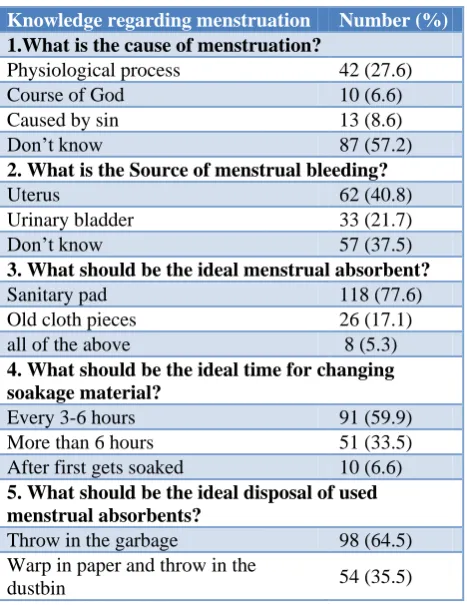
Table 1: Distribution of study participants according to knowledge about menstruation (n=152).
Knowledge regarding menstruation Number (%)
1.What is the cause of menstruation?
Physiological process 42 (27.6) Course of God 10 (6.6) Caused by sin 13 (8.6) Don’t know 87 (57.2)
2. What is the Source of menstrual bleeding?
Uterus 62 (40.8)
Urinary bladder 33 (21.7) Don’t know 57 (37.5)
3. What should be the ideal menstrual absorbent?
Sanitary pad 118 (77.6) Old cloth pieces 26 (17.1) all of the above 8 (5.3)
4. What should be the ideal time for changing soakage material?
Every 3-6 hours 91 (59.9) More than 6 hours 51 (33.5) After first gets soaked 10 (6.6)
5. What should be the ideal disposal of used menstrual absorbents?
Throw in the garbage 98 (64.5) Warp in paper and throw in the
dustbin 54 (35.5)
There were five questions regarding knowledge and each correct response was awarded a score of 1 and the attainable range of score was 0-5, and higher the scores, more was the knowledge. Minimum attained score was 1 and the maximum was 5. Median score was 2; 25th percentile was 2, 75th percentile was 4. Ultimately, score ≥4 (75th
percentile) was regarded as adequate knowledge and <4 as inadequate knowledge, and accordingly 40 (26.3%) were found having adequate knowledge and 112 (73.7%) were found inadequate knowledge regarding different facts of menstruation (Table 1).
To elicit attitude towards menstruation, eight questions were asked and each positive response was awarded a score of 2, neutral response was awarded a score of 1 and negative attitude had a score of 0 and the attainable range of score was 0-16, and higher the scores, more was the positive attitude. Minimum attained score was 4 and the maximum was 10. Median score was 8; 25th percentile was 6, 75th percentile was 10. Ultimately, score >8 (median score) was regarded as – positive attitude and ≤8 –as negative attitude, and accordingly 53 (34.9%) were found having positive attitude and 99 (65.1%) participants showed negative attitude (Table 2).
Table 2: Distribution of study participants according to attitude regarding menstruation (n=152).
Attitude Disagree
No (%)
Neutral No (%)
Agree No (%) 1.Women can enter
temple/can pray during menstruation
152 (100) - -
2.Women can enter kitchen/cook food during menstruation
- - 152 (100)
3.Women can take bath with soap during menstruation
- - 152 (100)
4.Women can wash hair during menstruation
83 (54.6) - 69 (45.4)
5.Women can sleep on same beds as others during menstruation
51 (33.6) 6 (3.9) 95 (62.5)
6.Women can touch pickle during menstruation
152 (100) - -
7.Women need not avoid any foods during menstruation
41 (27) 2 (1.3) 109 (71.7)
8.Women can have sexual intercourse during menstruation
140 (92.1) 12 (7.9) -
Eight questions were asked regarding practice and each correct response was awarded a score of 1 and the attainable range of score was 0-8, and higher the score, more was the satisfactory menstrual practices. Minimum attained score was 3 and the maximum was 6. Median score was 5; 25th percentile was 4, 75th percentile was 6. Ultimately, score ≥6 (75th percentile) was regarded as - satisfactory menstrual hygiene practice and <6 -as unsatisfactory menstrual hygiene practice. And accordingly 95 (62.5%) were found having unsatisfactory menstrual hygiene practices and 57 (37.5%) participants were found having satisfactory menstrual hygiene practices (Table 3).
Table 3: Distribution of study participants according menstrual hygiene practices (n=152).
Practices No (%)
Absorbent used during menstruation
Sanitary pads 96 (63.2)
Unused old cloth pieces 31 (20.4)
Reused old cloth pieces 12 (7.9)
Sanitary pad and old cloth pieces 13 (8.5)
Wash the cloth
With water -
With soap and water 15 (9.9)
Not applicable 137 (90.1)
Dried that material
Dried in sun -
Under other cloth 15 (9.9)
Not applicable 137 (90.1)
Frequency of changing soakage material
3 -6 hourly 68 (44.7)
>6hourly 84 (55.3)
Washing of genitalia
With water only 52 (34.2)
With soap and water 100 (65.8)
Maintain privacy for changing of soakage material
Yes 124 (81.6)
No 28 (18.4)
Bathing with soap during menstruation
Yes 115 (75.7)
No 37 (24.3)
Disposal of soakage material
Reuse cloth pieces 15 (9.9)
Disposed used cloth/sanitary pad with wrapping in open drain 106 (69.7) Dispose used cloth/sanitary pads without wrapping in open drain 31 (20.4)
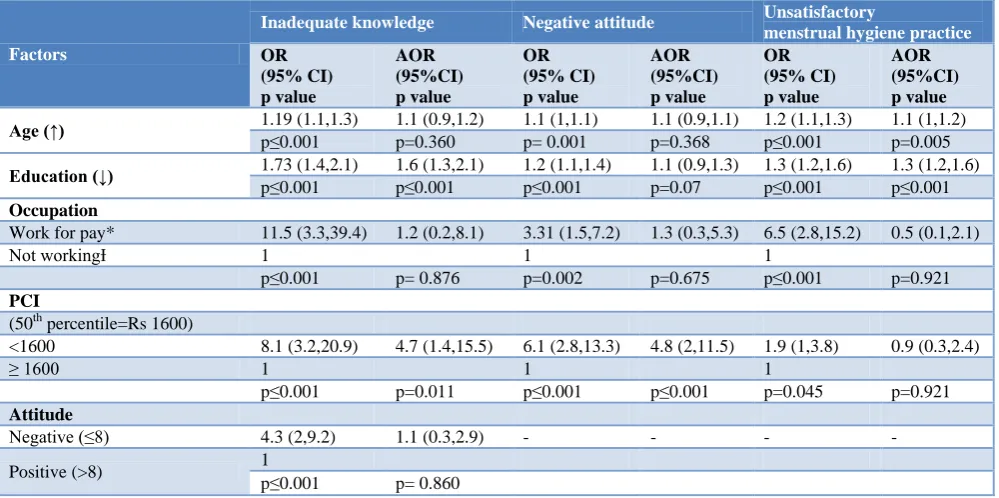
Table 4: Univariate and multivariable logistic regression of factors associated with inadequate knowledge, negative attitude and unsatisfactory menstrual hygiene practice (n=152).
Factors
Inadequate knowledge Negative attitude Unsatisfactory
menstrual hygiene practice
OR (95% CI) p value
AOR (95%CI) p value
OR (95% CI) p value
AOR (95%CI) p value
OR (95% CI) p value
AOR (95%CI) p value
Age (↑) 1.19 (1.1,1.3) 1.1 (0.9,1.2) 1.1 (1,1.1) 1.1 (0.9,1.1) 1.2 (1.1,1.3) 1.1 (1,1.2)
p≤0.001 p=0.360 p= 0.001 p=0.368 p≤0.001 p=0.005
Education (↓) 1.73 (1.4,2.1) 1.6 (1.3,2.1) 1.2 (1.1,1.4) 1.1 (0.9,1.3) 1.3 (1.2,1.6) 1.3 (1.2,1.6)
p≤0.001 p≤0.001 p≤0.001 p=0.07 p≤0.001 p≤0.001
Occupation
Work for pay* 11.5 (3.3,39.4) 1.2 (0.2,8.1) 3.31 (1.5,7.2) 1.3 (0.3,5.3) 6.5 (2.8,15.2) 0.5 (0.1,2.1)
Not workingƗ 1 1 1
p≤0.001 p= 0.876 p=0.002 p=0.675 p≤0.001 p=0.921
PCI
(50th percentile=Rs 1600)
<1600 8.1 (3.2,20.9) 4.7 (1.4,15.5) 6.1 (2.8,13.3) 4.8 (2,11.5) 1.9 (1,3.8) 0.9 (0.3,2.4)
≥ 1600 1 1 1
p≤0.001 p=0.011 p≤0.001 p≤0.001 p=0.045 p=0.921
Attitude
Negative (≤8) 4.3 (2,9.2) 1.1 (0.3,2.9) - - - -
Positive (>8) 1
p≤0.001 p= 0.860
Factors
Inadequate knowledge Negative attitude Unsatisfactory
menstrual hygiene practice
OR (95% CI) p value
AOR (95%CI) p value
OR (95% CI) p value
AOR (95%CI) p value
OR (95% CI) p value
AOR (95%CI) p value Practice
Unsatisfactory (<6) 4.2 (1.9,8.9) 0.6 (0.2,1.8) 1.8 (0.9,3.7) 0.5 (0.2,1.4) - -
Satisfactory (≥6) 1 1
p≤0.001 p=0.304 p=0.073 p=0.229
*Housemaid and unskilled worker, Ɨ Home maker and student; NAGELKERKE R2
=0.431 HOSMER-LEMESHOW=0.682.
DISCUSSION
In this study, mean age of the women was 27.2 (±8) years. Similar findings have been noted by Kansal et al.8 In the current study, only 15.5% of women acquired knowledge regarding menstruation from their mothers, this finding is comparatively less than the findings of the studies conducted by Dasgupta et al, Goel et al and Sarkar.2,3,9 Majority of the women (42.8%) in this study were scared at the time of their first menstruation which signifies that they had no/ little knowledge about menstruation prior to its onset. In our study 40.8% of the women knew that uterus is the source of menstrual bleeding and this knowledge was higher than other studies (Adhikari et al, Pokhrel et al, Roy et al) where approximately 20 percent subjects knew the correct source.10-12 In this study majority of the study subjects had a negative attitude towards entering temple, touching pickle or having sexual intercourse during her menses. These findings are in line with results of several other Indian studies.2,13,14 In this study 62.5% women were found to have unsatisfactory menstrual hygiene practice which is less than in the study conducted by Goel et al.2 Though 77.6% women opined that sanitary pad is the ideal absorbent to be used during menstruation, only 63.2% women used sanitary pad and rest used cloth pieces. Gupta et al. also found that during menstruation 67.7% used sanitary pads while rest used cloth.15 Financial reason was the main reason for avoiding sanitary napkins. Certain positive attitude was observed in our study in the context of menstruation-related taboos and hygiene during menstruation. Most women said that apart from religious activities, other routine activities such as cooking food, washing hair, sleeping in the same bed was not impacted by menstruation, almost similar findings noted by Misra et al.16 In our study majority of the study subjects had a negative attitude towards women entering temple, touching pickle or having sexual intercourse during her menses similar findings observed by Goel et al.2
Statistically significant association was seen between knowledge and age, literacy status, occupation and socio-economic status of the study participants. These findings suggest that literacy level or socio-economic status has a positive impact on knowledge. Statistically significant association was seen between negative attitude and participant’s inadequate knowledge, low literacy level, low socioeconomic condition and increasing age
depicting that women belonging to a higher socioeconomic status and adequate knowledge have a better attitude regarding menstruation compared to those belonging to lower socioeconomic status and had low literacy level. Significant association was also seen between practice and respondent’s socio-economic status and literacy status. In a study done by Kansal et al significant association was observed between menstrual hygiene practices and subject’s marital status, literacy status, religion, socio-economic status and mother’s literacy status.8
Our study had certain strength, i.e. this was a community based study where most of the domains of menstrual hygiene practice, knowledge regarding menstruation and attitude towards menstruation were considered, had the advantage of having multivariable models for menstrual hygiene knowledge, attitude and practice with different factors. The findings of this study can be generalized and applied to all the urban women of West Bengal with similar socioeconomic and cultural background.
Reproductive tract infections, has become a silent epidemic that ruins women’s life is closely inter related with poor menstrual hygiene. Proper menstrual hygiene, correct perceptions and beliefs can protect the womenfolk from this suffering. The women should be educated about the physiology of menstruation, facts and the significance of menstruation, development of secondary sexual characteristics, and above all, about proper hygienic practices with selection of disposable sanitary menstrual absorbent. This can be achieved through educational television programmes, school nurses/health personnel, compulsory sex education in school curriculum and knowledgeable parents, so that her received education would indirectly wipe away the age-old wrong ideas and make her feel free to discuss menstrual matters including cleaner practices without any hesitation. All mothers irrespective of their educational status should be taught to break their inhibitions about discussing with their daughters regarding menstruation much before the age of menarche.
hygienic practices among the women and bring them out of traditional beliefs, misconceptions and various restrictions during menstruation.
ACKNOWLEDGEMENTS
We are thankful to the staff of the Urban Health Training Centre of the Department of Preventive and Social Medicine for their cooperation during the study. We also thank all the families who participated in the study.
Funding: No funding sources Conflict of interest: None declared
Ethical approval: The study was approved by the Institutional Ethics Committee, All India Institute of Hygiene and Public Health, Kolkata
REFERENCES
1. Ministry of Statistics & Programme Implementation, Statistical Year Book India 2015, "Table 2.1 Area and Population by States,” (Census 2011), 2015.
2. Goel P, Kumar R, Meena GS, Singh T, Garg S. A community based cross sectional study on menstrual hygiene among 18-45 years age women. Int J Biomed Res. 2017;8(06):302-8.
3. Dasgupta A, Sarkar M. Menstrual hygiene among adolescent girls. Indian J Community Med. 2008;33(2):77-80.
4. Menstrual Health in India. Landscape Analysis Sponsored by the Bill and Melinda Gates Foundation. Available at: www.fsg.org. Accessed on 2 December 2018.
5. National Guidelines. Menstrual Hygiene Management. Ministry of drinking and sanitation, Govt. of India, 2015.
6. International Institute for Population Sciences. National Family Health Survey -4, India fact sheet, 2015-16. Mumbai, India. IIPS; 2016.
7. Van Eijk AM, Sivakami M, Thakkar MB, Bauman A, Laserson KF, Coates S, et al. Menstrual hygiene management among adolescent girls in India: a systematic review and meta analysis. BMJ Open. 2016;6:e010290.
8. Kansal S, Singh S, Kumar A. Menstrual hygiene practices in context of schooling: A community
study among rural adolescent girls in Varanasi. Indian J Comm Med. 2016;41(1):39.
9. Santra S. Assessment of knowledge regarding menstruation and practices related to maintenance of menstrual hygiene among the women of reproductive age group in a slum of Kolkata, West Bengal. India Int J Community Med Public Health. 2017;4(3):708-712,
10. Adhikari P, Kadel B, Dhungel SI, Mandal A. Knowledge and practice regarding menstrual hygiene in rural adolescent girls of Nepal. Kathmandu University Medical J. 2007;5(19):382-6. 11. Pokhrel S, Mahantashetti N, Angolkar M, Devkota N. Impact of health education on knowledge, attitude and practice regarding menstrual hygiene among preuniversity female students of a college located in urban area of Belgaum. IOSR J Nurs Health Sci. 2014;3:38-44.
12. Ray S, Dasgupta A. Determinants of menstrual hygiene among adolescent girls: a multivariate analysis. Natl J Community Med. 2012;3(2):294-301.
13. Katiyar K, Chopra H, Garg SK, Bajpai SK, Bano T, Jain S, Kumar A. KAP study of menstrual problems in adolescent females in an urban area of Meerut. Indian J of Community Health. 2013;25(3): 217-20. 14. Bodat S, Ghate MM, Majumdar JR. School
absenteeism during menstruation among rural adolescent girls in Pune. Natl J Community Med. 2013;4(2):212-6.
15. Gupta M, Tiwari S, Wavare RR. Awareness and Practices Regarding Menstrual Hygiene among Women of Reproductive Age Group Attending a Tertiary Care Hospital of Indore, India. Ntl J of Community Med. 2015;6(2):141-4.
16. Misra P, Upadhyay RP, Sharma V, Anand k, Gupta V. A community-based study of menstrual hygiene practices and willingness to pay for sanitary napkins among women of a rural community in northern India. Natl Med J India. 2013;26(6):335–7
Cite this article as: Dasgupta A, Roy K,