* To whom all correspondence should be addressed. E-mail: [email protected]
Immunotoxic Effect of Sodium Fluoride and the Mitigating
Effect of Selenium and Curcumin in Male Mice
Mohammad S. AL-Harbi1, Reham Z. Hamza1,2*and Afaf A. Dwary1
1 Department of Biology, Faculty of Science, Taif University, Taif 888, Saudi Arabia. 2Department of Zoology, Faculty of Science, Zagazig University, Zagazig 44519, Egypt.
dx.doi.org/10.13005/bbra/1229
(Received: 06 March 2014; accepted: 04 April 2014)
Sodium fluoride used in the fluoridation of drinking water and it is still commonly used for that purpose to prevent dental caries. It exerts toxic effects on many soft tissues. The present study was aimed to achieving the protective effects of selenium and Curcumin extract against the toxicity and oxidative stress of sodium fluoride (NaF) that adversely affects the immune system capacity. This study evaluated the effects of Sodium fluoride on some immunological parameters and also assessed the ameliorating effects of selenium and Curcumin extract. Mature male mice (weighing 35-45 g and each group of ten animals) were given sodium fluoride (10.3 mg/Kg bw) and/or Selenium (0.5 mg/Kg) + Curcumin extract (60 mg/Kg) daily intraperitoneally (I.P) for 4 weeks. In the present study, Sodium Fluoride exposure resulted in decrease in the IgG, IgM and increasing TNF-± level with respect to the control. As a result, Sodium fluoride induced immunotoxicity which is reduced by Curcumin extract and/or selenium to great extent by restoration of the immunological capacities.
Key words: Sodium fluoride, Selenium, Curcumin extract, renal functions, Oxidative stress.
Fluoride is abundant in the environment and exists only in combination with other elements as fluoride compounds, which are constituents of minerals in rocks and soil (Edmunds and Smedley., 1996). Sources of fluoride include natural fluoride in food stuffs and water (fluoridated water usually at 1.0 mg/L) (Beltran and Szpunar., 1988).
Fluoridated tooth pastes can provide another major source of fluoride intake, particularly to children. Tooth pastes contain 1.0 to 1.5 mg fluoride per gram. Fluoride containing mouth wash could contribute 0.2 to 0.4 mg fluoride per use. Fluoride tablets and topical gels represent
additional sources of fluoride exposure (Hodge and Smith.,1965) The main source of fluoride for humans is the intake of ground water contaminated by geological sources (maximum concentration reaching 30-50mg/L) (Edmunds and Smedley., 1996).
Selenium deficiency is usually associated with increased lipid peroxidation which alters the integrity of cell membranes and consequently, affects cell functions (Stadtman, 1990; Valko et al., 2005).Selenium (Se), a human body essential trace element, displaying an antioxidant effective oxygen free radical scavenging, protects the organs and tissues from oxidative damage and improves the body’s immune system (Liu et al., 2007; Zhou
et al., 2009).
potential by replenishing depleted glutathione by free radicals and ROS scavenging, inhibition of neutrophil activity and TNF production. Selenium is a vital trace element, required essential dietary nutrient for health at low doses and an integral component of ubiquitous antioxidant enzyme glutathione peroxidase (GPx). This enzyme helps in neutralization of reactive oxygen species. However, protective mechanisms of Sevary from organ to organ (Stajn et al., 1997).
Selenium (Se) is an integral component of GSH-Px, an enzyme, which protects cell internal structures against free radicals and acts as an antioxidant for cellular membrane lipids (Alvarez and Storey, 1989; Rotruck et al., 1973).
Curcumin, the active compound in turmeric, because of its antioxidant and anti-inflammatory properties, has been demonstrated in the prevention and treatment of neurodegenerative disorders such as Alzheimer disease and multiple sclerosis (Cole et al., 2007).
Curcumin, an extract of Curcuma longa Linn., is used as a natural drug or a flavoring in Asia and India. Curcumin is an orange-yellow polyphenol present in curry spice and has anti-inflammatory and antioxidant effects. Early studies have also claimed that curcumin down-regulates the transcription factor NFkB and suppresses various inflammatory mediators (Jobin et al., 1999 and Kim
et al., 2005).
Curcumin has been shown in last two decades to be a potent immunomodulatory agent that can modulate the activation of T cells, B cells, macrophages, neutrophils, natural killer cells, and dendritic cells (Jagetia and Aggarwal, 2007).
MATERIAL AND METHODS:
Animals
This study was performed on 70 young male mice, weighing about 35–45 g b.wt. Animals were obtained from the animal house of the King Fahad Center for Medical Research, King Abdul-Aziz University in Jeddah. They were breeding in a well ventilated room with the temperature ranging between 22 and 25 ÚC and maintained under standardized conditions away from any stressful conditions with 12/12 light and dark cycle with free access to humidity and were fed dry balanced meal for experimental animals provided by the
General Organization for Grain Silos and Flour Mills in Jeddah, with a constant source of water. All experimental procedures and animal maintenance were conducted in accordance with the accepted standards of animal care per cage (Council of Europe, European convention for the protection of vertebrate animals 2006). We have followed the European community Directive (86/609/EEC) and national rules on animal care. One group served as control. Animals were weighed and randomly allocated into 6 groups (10 rats each).
Chemicals Sodium Fluoride
Sodium fluoride (NaF) was purchased from Sigma Chemical Co., St. Louis, Mo., USA. The tested dose of NaF (10.3 mg/kg b.wt) was chosen based on the previous studies of Zabulyte
et al. (2007). A stock solution was prepared by dissolving of 100 g of NaF in 1000 ml of distilled water. The dose schedule was so adjusted that the amount of NaF administration per animal was as per their respective weight.
Selenium
Selenium was purchased from BDH Chemicals Ltd., England. The tested dose of selenium (0.5 mg/kg) was chosen based on the previous studies of Ibtissem et al. (2011).
Curcumin extract
Fresh Curcumin was obtained from local market (Cairo, Egypt), then washed and was soaked in water for 24 hours and after that it was dried then homogenized by using electrical mixer and then the dose was prepared (60 mg/Kg) and this dose was chosen according to Abdul-Hamid and Moustafa (2013).
Experimental protocols
The study was performed on 70 mature male mice, divided into 7 main groups; each group was consisted of 10 rats. The 1st Control group:
Animal’s received 1ml of distilled water orally daily for 30 successive days. The 2nd Sodium
Fluoride (NaF) treated group: Animals were daily received NaF (10.3 mg/Kg) for 30 successive days intraperitoneally (I.P).The 3rd Selenium treated
group: Animals were received selenium (0.5 mg/Kg) for 30 successive days intraperitoneally (I.P).The 4th Curcumin extract treated group:
given sodium fluoride (NaF) (10.3 mg/Kg) for 30 successive days and then co-administered by selenium (0.5 mg/Kg) intraperitoneally (I.P). The 6th NaF + Curcumin treated group: Animals
were given sodium fluoride (NaF) (10.3 mg/Kg) for 30 successive days and then co-administered Curcumin extract (60mg/Kg) for 30 successive days intraperitoneally (I.P). The 7th NaF+ Selenium+
Curcumin extract treated group: Animals were given NaF (10.3mg/Kg) and then co-administered with selenium (0.5mg/Kg) and then followed by Curcumin extract (60 mg/Kg) for 30 successive days (I.P).The substances were administered in the morning (between 09.30 and 10.30 h) to non fasted rats. The first day the animals were treated was considered experimental day 0.At the end of the 30 days of treatment, all animals were scarified and dissected.
Blood samples collection
Blood samples were collected after the end of the experiment from the retro-orbital vein, which is a simple, convenient and successful procedure that allows bleeding of the same animal more than one time with minimal stress (Scherners, 1967). After the end of 4th week, individual blood samples were drawn by orbital puncture (from eye plexus) using microhematocrit capillary tubes (Lancer, Athy, County-Kildare, Republic of Ireland), Serum was harvested from blood without EDTA and subsequently used for the determination of them Immunoglobulin G (IgG) and Immunoglobulin M (IgM), Tumour necrosis factor (TNF -α).
Immunoglobulin G (IgG)
The IgG is a quantitative turbidometric test for the measurement of IgG in serum or plasma by using IgG kit (GenWay Biotech, Inc). Anti-human IgG antibodies when mixed with samples containing IgG form insoluble complexes. These complexes cause an absorbance change, dependent upon the IgG concentration of the patient sample that can be quantified by comparison from a calibrator of known IgG concentration (Peace and Kaplan, 1987).
Immunoglobulin M (IgM)
The IMMUNO-TEK Mouse IgM ELISA Kit (EIAab (Wuhan EIAab Science Co.,Ltd) is a rapid, easy to use enzyme-linked immunosorbent assay (ELISA) designed for the measurement of mouse IgM in plasma, serum; the kit is especially useful in monitoring the production and purification
of mouse monoclonal antibodies (Pinherio and Cobber 1997).
Tumor necrosis factor-α (TNF- α)
Tumor necrosis factor (TNF, formerly known as TNF-α) is a potent mediator of immune and inflammatory responses. TNF is produced by many activated cell types including monocytes, macrophages, astrocytes, granulocytes, T and B lymphocytes, NK cells, keratinocytes, fibroblasts, and certain tumor cells. TNF exerts many regulatory influences on the activation, growth, and differentiation of leukocytes and other cells. For example, TNF can co stimulate the proliferation of activated T and B lymphocytes, up regulate the expressed levels of MHC class I and class II molecules by various cell types, as well as induce the expression of adhesion molecules by endothelial cells, TNF is selectively cytotoxic for some transformed cell lines and can exert cytotoxic effects against certain solid tumors. In vivo, TNF serves as a primary mediator in protective immune responses against microbial and viral pathogens. However, TNF has also been implicated as a central mediator in a number of pathologic responses and autoimmune diseases (Ware et al., 1998).
Statistical analysis
Data were collected, arranged and reported as mean ± standard error of mean (S.E.M) of nine groups (Each group was considered as one experimental unit), summarized and then analyzed using the computer program SPSS/ version 15.0) The statistical method was one way analyzes of variance ANOVA test (F-test), and if significant differences between means were found, Duncan’s multiple range test (Whose significant level was defined as (P<0.05) was used according to (Snedecor and Cochran.,1982) to estimate the effect of different treated groups.
RESULTS
Evaluation of immunological capacities Effect of Sodium Fluoride, Selenium, Curcumin extract and their combinations on serum IGg and IGm
Table 1. Effect of Sodium fluoride (10.3 mg/kg), Selenium (0.5 mg/ Kg), Curcumin extract (60 mg/Kg) and their combinations on Immunoglobulin in male mice (mean ± SE). (N = 7)
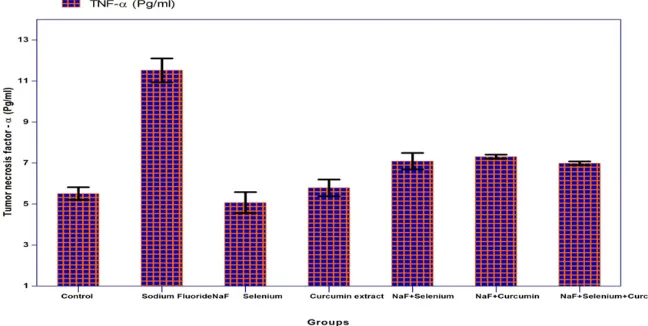
Groups IGg (mg/dL) IGM (mg/dL) TNF-α (Pg/ml)
Control group 635.00±14.83b 246.40±1.80b 5.51±0.31 ef
Sodium fluoride 108.20±0.66g 106.20±0.58g 11.52±0.78 a
Selenium 642.60±0.92ab 251.00±0.70ab 5.07±0.72 f
Curcumin extract 580.00±33.01cd 219.60±0.50c 5.79±0.41 de
Sodium fluoride + Selenium 361.00±29.82e 209.00±1.30d 7.09±0.40 b
Sodium fluoride + Curcumin extract 327.00±17.14f 197.20±0.86f 7.31±0.10 b
Sodium fluoride+ Selenium+ Curcumin 577.00±8.45d 200.80±0.37e 6.99±0.09 c
Means within the same column in each category carrying different litters are significant at (P ≤ 0.05) using Duncan’s multiple range test, where the highest mean value has symbol (a) and decreasing in value were assigned alphabetically.
Fig. 1. Effect of Sodium fluoride (10.3 mg/kg), Selenium (0.5 mg/ Kg), Curcumin extract (60 mg/Kg) and their combinations on Immunoglobulins in male mice
with Selenium when compared with normal control group.
Table (1) and Fig. (1) revealed also that the combinations of Selenium and Curcumin extract with Sodium Fluoride elicited significant decrease (P<0.05) in either IGg and IGm when compared with control group and group treated with Sodium Fluoride, but their effect was much more better than that produced by sodium fluoride alone. However, combination of sodium fluoride with Curcumin extract and selenium afforded slight significant decrease in immunoglobulin’s activities but this effect was much lesser than that produced with the sodium fluoride alone.
Effect of Sodium Fluoride, Selenium, Curcumin
extract and their combinations on serum TNF-α
Table (1) and Fig. (2) showed that the administration of Sodium Fluoride elicited a significant increase in serum Tumor necrosis factor α (TNF-α) whereas, Sodium Fluoride combinations with selenium or curcumin extract elicited a slight significant increase in serum Tumor necrosis factor α (TNF- α) Whereas, Selenium and/or curcumin extract afforded a non significant changes when compared with either control group or group given sodium fluoride alone.
DISCUSSION
The present study was an attempt to evaluate the toxic effect of sodium fluoride and possible ameliorative role of selenium or Curcumin extract as it is well known that selenium and Curcumin extract have been reported to be effective antioxidant, therefore, the present study aimed to elucidate the possible ameliorative role of Selenium and/or Curcumin extract in alleviating the toxicity of sodium fluoride when given to normal rats and we are according to our knowledge the first authors to clarify the immunotoxici effect of Sodium fluoride and the ameliorative effect of Selenium and Curcumin extract in elevating immune capacity which is reduced by sodium fluoride.
Macrophages are the first line of host defense against various infections and cancer (Takeda and Akira, 2004). When exposed to stimulatory agents such as toxic compounds like sodium Fluoride, LPS, zymosan, and various polysaccharides, the macrophages release several inflammatory substances and cytokines, including
IL-1, IL-6, and TNF-α. Although it is well-known that NO and TNF-α are very important inflammatory mediators that can kill microbes and tumor cells, the overproduction of NO and TNF-α
is harmful. In this study, we explored the effect of sodium fluoride (NaF) induced activation of MAP kinases leading to the activation of NF-ºB and production of TNF-α.
Our results are greatly reinforced by (Stajn et al., 1997) who reported that selenium acts by raising the intra-cellular concentration of cysteine/ GSH, and acts by scavenging of oxidant species. Its pharmacological actions include restoration of cellular antioxidant potential by replenishing depleted glutathione by free radicals and ROS scavenging, inhibition of neutrophil activity and TNF production. Selenium is a vital trace element, required essential dietary nutrient for health at low doses and an integral component of ubiquitous antioxidant enzyme glutathione peroxidase (GPx). This enzyme helps in neutralization of reactive oxygen species and thus improving the antioxidant status will lead consequently to ameliorating immune system.
Natural products are a promising source for the discovery of new pharmaceuticals. The low cost of traditional medicinal plants also raise significant interest to prevent morbidity and mortality from chronic diseases in countries where low or middle income populations are important
(Gazioano et al, 2007).
Increased utilization of medicinal plants became a World Health Organization (WHO) policy in 1970. Plants and herbs are chemical factories that directly provide about 25% of currently used drugs and another 25% of drugs comprise chemically altered natural products (Desmet, 1997).
Curcumin, a phenolic compound, exhibits protective effects against oxidative damage and it is considered to be a potent cancer chemopreventive agent (Duvoix et al., 2005).
and this protective effect of curcumin attributed to its free radical scavenging activity, induction of detoxification enzymes and provides protection against degenerative diseases (Manikandana et al., 2004).
In accordance with our results, Curcumin which is an orange-yellow polyphenol present in curry spice and has anti-inflammatory and antioxidant effects. Early studies have also claimed that curcumin down-regulates the transcription factor NFkB and suppresses various inflammatory mediators (Jobin et al., 1999 and Kim et al., 2005).
Curcumin has been shown in last two decades to be a potent immunomodulatory agent that can modulate the activation of T cells, B cells, macrophages, neutrophils, natural killer cells, and dendritic cells (Jagetia and Aggarwal, 2007), and thus Curcumin has greatly alleviated the immunotoxic effect of NaF (Sodium fluoride). In conclusion, the present study shows that Selenium and curcumin extract treatment mitigates sodium fluoride intoxication-induced immunotoxic effect in mice, which could be due to their antioxidant nature that combines free radical scavenging and metal chelating properties and thus enhancing the immune system.
REFERENCES
1. Edmunds, W.M. and Smedley, P.L., Ground water geochemistry and health: an overview, in: Appleton, Fuge, Mc Call (Eds.) Environmental Geochemistry and Health: Geological Society (special publication), 1996; 113: 91-105. 2. Beltran, E.D. and Szpunar ,S.M., Fluoride in
tooth paste for children. Suggestion for change.
Pediatr Dent;1988; 10:185-188.
3. Hodge, H.C. and Smith, F.A., Fatal human poisoning . In: Simons JH, editor. Fluorine Chemistry ,vol.4. NewYork(NY):A cademic press 1965; 2- 37.
4. Stadtman, T.C., Selenium biochemistry. Ann. Rev. Biochem. 1990; 59: 111-127.
5. Valko, M.; Morris, H. and Cronin, M.T., Metals, toxicity and oxidative stress. Curr. Med. Chem. 2005; 12(10): 1161-1208.
6. Zhou, Y.J.; Zhang, S.P. and Cai, Y.Q., The protection of selenium on ROS mediated apoptosis by mitochondria dysfunction in cadmium-induced LLC-PK1 cells.Toxicol. In Vitro 2009; 23: 288-294.
7. Liu, Y.; Zhang, S.P. and Cai, Y.Q., Cytoprotective effects of selenium on cadmium induced
LLC-PK1 cells apoptosis by activating JNK pathway. Toxicol. In Vitro 2007; 21: 677-684.
8. Stajn, A.; Zikic, R.V.; Ognjanovic, B.; Saicic, Z.S.; Pavlovic, S.Z.; Kostic,M.M. and Petrovic, V.M., Effect of cadmium and selenium on the antioxidant defence system in rat kid-neys. Comp Biochem Physiol;1997; 117C: 167-72.
9. Rotruck, J.T.; Pope, A.L.; Ganther, H.E.; Swanson, A.B.; Hofeman, D.G. and Hoekstra, W.G., Selenium: biochemical role as a component of glutathione peroxidase. Science 1973; 179: 588–590.
10. Alvarez, J.G. and Storey, B.T., Role of glutathione peroxidase in protecting mammalian spermatozoa from loss of motility caused by spontaneous lipid peroxidation. Gamete Res 1989; 23:77-90. 11. Cole, G.M.; Teter, B. and Frautschy, S.A.,
Neuroprotective effects of curcumin. Adv. Exp. Med. Biol. 2007; 595: 197-212.
12. Jobin, C.; Bradham, C. A.; Russo, M.P.; Juma, B.; Narula, A. S.; Brenner, D. A. and Sartor, R.B., Curcumin blocks cytokine-mediated NF-kappa B activation and proinflammatory gene expression by inhibiting inhibitory factor I-kappa B kinase activity, J. Immunol., 1999; 163: 3474e3483. 13. Kim, G.Y.; Kim, K.H.; Lee, S.H.; Yoon, M.S.;
Lee, H.J.; Moon, D.O.; Lee,C.M.; Ahn, S.C.; Park, Y.C. and Park, Y.M., Curcumin inhibits immunostimulatory function of dendritic cells: MAPKs and translocation of NF-kappa B as potential targets, J. Immunol., 2005; 174: 8116e8124.
14. Jagetia, G.C. and Aggarwal, B.B.. "Spicing up" of the immune system by curcumin. J. Clin. Immunol. 2007; 27: 19–35 .
15. Ibtissem, B.A.; NejlaSoudani,N.; Afef Troudi,S.; Hanen,B.; Tahia, B. and NajibaZegha, N., Antioxidant effect of vitamin E and selenium on hepatotoxicity induced by dimethoate in female adult rats. Ecotoxicology and Environmental Safety, 2011.
16. Zabulyte, D.; Uleckiene, S.; Kalibatas, J.; Paltanaviciene, A.; Jascaniniene, N. and Stosik, M., Experimental studies on effect of sodium fluoride and nitrate on biochemical parameters in rats. Bull. Vet. Inst. Pulawy. 2007; 51: 79-82. 17. Manal Abdul-Hamid and Nadia Moustafa.,
Protective effect of curcumin on histopathology and ultrastructure of pancreas in the alloxan treated rats for induction of diabetes. The Journal of Basic & Applied Zoology (In press), 2013. 18. Scherners, S., The blood morphology of
laboratory animals. Blackwell Scientific Publication (3rd Ed); 20: 22. Sci., 1967; 72: 363
- 368.
Clinical Chemistry. St. Louis, MO: CV Mosby Co.
20. Pinherio, F.P. and Cobber, S.J., Global situation of dengue and dengue hemorrhagic fever and it’s emergence in the Americans, World Health State Q 1997; 50(3/4): 161 - 169.
21. Ware, C.F.; Santee, S. and Glass, A., Tumor necrosis factor–related ligands and receptors. In: Thompson A, Ed. The cytokine Handbook.3rd ed.
San Diego, CA: Academic Press: 1998; 549-592. 22. Snedecor, G.W. and Cochran, W.G., Statistical
Methods (8thEd), Ames Iowa State University,
1982.
23. Takeda, K. and Akira, S., TLR signaling pathways. Semin. Immunol. 2004; 16: 3-9. 24. Stajn, A.; Zikic, R.V.; Ognjanovic, B.; Saicic,
Z.S.; Pavlovic, S.Z.; Kostic, M.M. and Petrovic, V.M, Effect of cadmium and selenium on the antioxidant defence system in rat kid-neys. Comp Biochem Physiol;1997; 117C:167–72.
25. Gazioano, T.A.; Galea, G. and Reddy, K.S., Scaling up interventions for chronic disease prevention. Lancet., 2007; 370: 1939 - 1946.
26. Desmet, P.A., The role of plant –derived drugs and herbal medicines in health care. Drugs., 1997; 54: 801-840.
27. Duvoix, A.; Blasius, R.; Delhalle, S.; Schnekenburger, M.; Morceau, F.; Henry, E.; Dicato, M. and Diederich, M., Chemopreventive and therapeutic effects of curcumin. Cancer Letter 2005; 223: 181-190.
28. Kalpana, C. and Menon, V.P., Curcumin ameliorates oxidative stress during nicotine-induced lung toxicity in Wistar rats. Italian Journal of Biochemistry 2004; 53: 82-86. 29. Pari, L. and Amali, D.R., Protective role
of tetrahydrocurcumin (THC) an active principle of turmeric on chloroquine induced hepatotoxicity in rats. Journal of Pharmacology and Pharmaceutical Science 2005; 8: 115-123. 30. Manikandana, P.; Sumitra, M.; Aishwarya,