Original Research Article
The art of malaria education: an arts-based malaria education model,
Pepease-Kwahu, Ghana
Stephanie B. Ntim*, Katherine J. Johnson
INTRODUCTION
Ghana is a country in Sub-Saharan Africa, which carries an estimated 90% of global malaria deaths.1 Certain species of mosquitos of the Anopheles genus, which are commonly found around saltwater or lake water marshes, carry the causative malaria parasite. Malaria is caused by the direct effects of the malaria parasite, P. falciparum, in red blood cells.2 The parasite is transmitted through the bite of the female Anopheles mosquito.3 The invasion of the malaria parasite into red blood cells causes significant
changes to the shape and function of red blood cells, which can lead to cell dehydration, and ultimately, the destruction of blood cells.4,5 Affected human populations can develop severe health complications and conditions such as significant blood loss that may lead to death. Malaria is endemic in Ghana.6 According to the 2015 National Malaria Control Programme Annual Report, 38.1% of all outpatient department cases were attributed to malaria, and 7% of all deaths were attributable to malaria (Ghana Health Service, 2016).7 While incidence
ABSTRACT
Background: Malaria is a major health concern in Ghana as well as other countries in West Africa, where it is estimated that more than 300 million people are at risk of malaria infection. While prior research has highlighted promising school-based interventions often facilitated through textbook information or teacher-based lectures to promote awareness about the disease, less is known as to how well such interventions are able to actively involve and engage students in learning about malaria in their schools.
Methods: This research examines the role of the performing arts as a heuristic for student-centered teaching and learning about malaria. Using a convergent parallel mixed-methods study design, an arts-based malaria education model was deployed in a junior high school in Pepease-Kwahu, Ghana.
Results: The proposed product included a peer-peer education model through which students (n=77) demonstrated their learning of malaria through their own creation and participation in poetry, song, dance, and drama performances. Pre- and post- paper-based surveys, coupled with focus groups with student participants (n=10) were used to examine the impact of this program.
Conclusions: Research findings currently show that the arts-based malaria education program can be beneficial to students, by requiring them to use the performing arts to engage with information about malaria transmission, prevention, and treatment. Students correctly identified that the malarial parasite is transmitted by a mosquito bite, and they correctly identified symptoms of malaria, although students were reluctant to say that they will regularly use insecticide-treated bed nets as a preventive measure for malaria.
Keywords: Malaria, Health education, Creative arts
Department of Public Health Studies, Elon University, Elon, North Carolina, USA
Received: 03 October 2019
Accepted: 12 November 2019
*Correspondence:
Stephanie B. Ntim, E-mail: [email protected]
Copyright: © the author(s), publisher and licensee Medip Academy. This is an open-access article distributed under the terms of the Creative Commons Attribution Non-Commercial License, which permits unrestricted non-commercial use, distribution, and reproduction in any medium, provided the original work is properly cited.
varies regionally, cases continue to be reported throughout the country.
Study site
Pepease is a small agricultural town in the Kwahu East District of the Eastern Region of Ghana, which has a population of fewer than 80,000 inhabitants. The Pepease Sub-district recorded a population of 8821, as reported by the Ghana District Health Information System (DHIMS2) in 2019. In 2018, the local health facility, the Pepease Health Centre, reported 3269 suspected cases of uncomplicated malaria, 3265 suspected cases of uncomplicated malaria that were tested, and 1168 cases of uncomplicated malaria that tested positive.9 Complications from malaria are likely due, in part, to poor infrastructure; availability of educational supplies; effective malaria control staples such as insecticide-treated bed nets (ITNs) and antimalarial tablets; and malaria-case management practices in public health facilities.10 Because malaria continues to be a health problem, it is important to consider the appropriateness of the malaria prevention techniques being deployed. In Ghana, malaria prevalence has reduced significantly due to malaria control and elimination efforts including long-lasting insecticide-treated net mass distribution campaigns, government strategic planning, and financial support from public and private donors. Despite significant findings on the effectiveness and availability of vector control approaches such as insecticide-treated nets (ITNs), lost-lasting insecticidal nets (LLIN), insecticides, Rapid Diagnostic Test kits, anti-malaria medicines, and removal of standing water sources, these recommendations do not always translate well to local settings and cultures, where social and behavioral aspects of malaria can restrain appropriate health-seeking, prevention, and treatment behaviors.6,11-18 For example, educative programs about mosquito nets and increased availability of mosquito nets may be insufficient to increase the use of ITNs and knowledge of malaria prevention.19
To promote awareness of preventive measures for malaria such as wide-scale use of ITNs and environmental conditions that can serve as breeding grounds for the parasite-carrying mosquito, greater attention should be placed on how information about malaria is relayed.
The study
Incorporating arts-based traditions and story-telling (i.e., performing arts, drawing, poetry, among others) is an effective approach to increase awareness about health conditions, especially in Ghana, where dance and music are often practiced through traditional ceremonies. There is far less evidence, however, as to how these approaches can more actively involve participants in their own learning, especially in school-based settings where student-driven learning is emphasized. The purpose of
this research was to examine the impact of student-generated artistic performance as a means for teaching and learning about malaria. Drawing on a convergent parallel mixed-method design, this study assessed the use of an arts-based malaria education program at a junior high school in Pepease-Kwahu.20
METHODS
Overview of study
With approval from the Ghanaian Eastern Regional Health Directorate, the Ghana Education Service Kwahu District, and the Pepease Health Centre, a malaria education model was deployed at a junior high school in Pepease-Kwahu, Ghana using a convergent mixed-methods study design. The selection was based on feasibility considerations. Ethical approval was obtained from the Elon University Institutional Review Board and the Ghana Health Service Ethical Review Committee. The quasi-experimental study included three phases: a pre-intervention focus group and survey, an arts-based malaria education program held in May 2018, and a post-intervention focus group and survey. All students enrolled at the study site were invited to participate in the study. The study population consisted of students in grades Junior Secondary School level 1 to Junior Secondary School level 3 and ages 12-18 from one junior high school. The study sample consisted of 90 students in the pre-intervention phase and 77 students in the intervention and post-intervention phases. Focus group participants (n=10) who participated in both pre- and post- intervention focus group were recruited through purposive sampling.
Students were asked to voluntarily participate in all activities outlined in the quasi-experimental study, and they were informed of any potential risks of research to participants. Participants were required to obtain parental consent before engaging with the study. All students at the study site were compensated with a T-shirt inspired by the program, which they wore during the arts-based malaria education program.
Conceptual model
Ghana and how each layer can be strengthened (Figure 1).
Study design components
Survey design
Paper-based pre-intervention surveys (n=90) written in English were disseminated to students at the study site. Paper-based post-intervention surveys (n=77) written in English (identical to the pre-intervention survey, excluding a few modifications to sentence structure and word choice) were distributed immediately after the one-day malaria education program, which was held in the outdoors on the school grounds of the study site. Pre- and post-intervention survey questionnaires were designed with recommendations from a professor of Public Health at the University of Ghana and a healthcare professional at the local health center to gather students‟ knowledge of malaria transmission and prevention, demographics, and preferences for how and where they obtain treatment for health conditions.
Focus group
The pre-intervention focus group included ten students selected through purposive sampling. The group were designed to facilitate student conversations on preferred learning styles, interests in the creative arts, previous knowledge of malaria, and access to malaria education in their communities. The post-intervention focus group, including ten students (who also participated in the pre-intervention focus group), was conducted the day after the malaria education intervention was held at the study site. The post-intervention focus group was designed to generate student feedback on the intervention and assess potential outcomes of the intervention such as greater use of insecticide-treated bed nets.
Intervention
Survey and focus group responses were analyzed and utilized to create an information sheet on malaria, which was reviewed by a professor of Public Health at the University of Ghana and a healthcare professional at the local health center before dissemination to students at the study site. The intervention (n=77) included spontaneous (i.e., students were given one hour to prepare) and rehearsed (i.e., students prepared two weeks before the date of the program) performances by students, which were video-recorded. All students who participated in the intervention engaged with both spontaneous and rehearsed performances. Health professionals at the local health center also gave a demonstration in front of students, teachers, and community members on how to use insecticide-treated bed nets.
RESULTS
The results of the pre-intervention survey and focus group informed how the intervention was structured and
delivered to student participants. Students‟ responses after the intervention were analyzed using the SEM.
The theme of student learning preferences
Pre-intervention focus group
Quantitative and qualitative data were tabulated in Microsoft Excel. Qualitative data from focus group responses were analyzed thematically using qualitative data analysis software, Dedoose. Student responses were coded for themes that emerged from observation and interactions with students. Themes from the pre-intervention focus group and the post-pre-intervention focus group were coded according to the individual, interpersonal, organizational, community, and institutional/public policy levels of the socio-ecological model.
Pre- and post-focus groups were conducted to gain participant perspectives on the arts-based malaria education program. In the pre-intervention focus group (n=10), students were asked about their musical interests, hobbies, and preferred methods for learning information. The students, ranging from age 12 to age 17, said they enjoy listening to Highlife music, a Ghanaian music genre, and Gospel music, a genre of Christian music. For school-related assignments, students said that they learn by reading and repeating information until they understand the material. They also said they learn by discussing the material and collaborating with their peers in groups to retain information:
“It‟s like a challenge in our classroom; we ask questions then we read. Even if it is not correct, we discuss the questions and find the correct answers” (focus group participant).
Students stated that they gain the most information about malaria at school, while two students said they read about the disease in the newspaper. Generally, they said that their parents “don‟t say anything” about malaria (focus group participant). Some students said they believe they can use herbs to cure malarial symptoms, but they also understand some components of the pharmacological pathway to treat malaria. Further, they know they can undergo tests for the disease and go to the clinic, where health professionals can take their temperature. These responses informed what information to highlight in the intervention. The subjects covered in the intervention and the corresponding activities are listed in Tables 1 and 2.
Pre-intervention survey
Table 1: Spontaneous performances.
Subject Activity
What is malaria? Poetry recital
What are the symptoms of malaria? Rap
Where can you find the
parasite-carrying mosquito? Skit How can you prevent malaria? Skit
Who do you talk to if you think you
have malaria? Skit
Who can get malaria? Skit
What are peak times for exposure to the female mosquito of the
Anopheles genus?
Skit
Table 2: Rehearsed performances.
Subject (s) Activity
Bed net, environmental conditions for mosquitos
Dance 1 to contemporary Ghanaian music
Dance 2– bed net, visit at the clinic
Dance 2 to traditional Ghanaian music
Rulers of asante Drama 1
Fetish priest Drama 2
Pastor Drama 3
Themes from the intervention
Post-intervention focus group
In the post-intervention focus group (N=10), students were asked about insecticide-treated bed net usage and their thoughts on the intervention. While students found the instruction on bed net use to be useful, they showed hesitation for using the bed net on a daily basis. Most of the students (9 out of 10) in post-intervention focus group indicated that they do not use the bed net regularly, with students citing laziness and discomfort as reasons for not using the insecticide-treated bed net.
When asked about their experiences with the arts-based malaria education program, students said that they enjoyed the choreography, dramas, and singing. When asked about how malaria was introduced to them in a primary school in comparison with junior high school, a student said, “yesterday we demonstrated it,” which differed from primary school, where they were “taught it” (focus group 2 participant 5). Students felt that the demonstrative component of the intervention was useful for their learning. They also shared that they benefited from working as a collective to create dramas, dances, and songs: “We can share ideas together. “It makes the discussion easier.” Moreover, the students agreed that the arts-based malaria education event was an enriching opportunity to demonstrate their learning about malaria.
Students also shared their thoughts on the structure of the program that affected their ability to create and share performances. Notably, creating a performance within a limited time frame was not an easy task for all of them. One student noted that “the time was hard…without time to study…it‟s difficult” (focus group 2 participant 1). Others acknowledged that rehearsed performances allowed them to improve their English-speaking skills. The results of this intervention show that junior secondary students have the capability to use the creative arts to achieve increased knowledge of malaria. The creative aspect of the intervention effectively engaged their minds and bodies. However, there is not enough evidence from the intervention to suggest that the arts-based malaria model can effectively enforce behaviour change. The relatively shortened time frame to create performances may have restricted creative output or long-term understanding of malaria prevention and treatment. It is, therefore, reasonable that students enjoyed the rehearsed performances more than the spontaneous performances, as they were given more time to prepare and process information for their rehearsed performances.
Survey responses
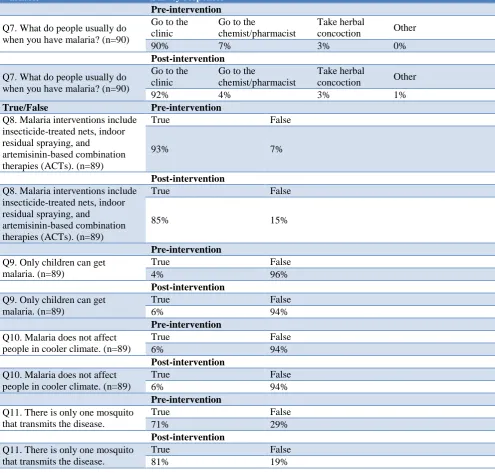
Pre-intervention surveys were completed by 90 students at a junior-high-school in Pepease-Kwahu, Eastern Ghana. The survey consisted of questions about malaria (i.e., what causes the disease, what are symptoms of malaria, who can get malaria, etc.) and where students access treatment for malaria. All figures in the table 3 was rounded to the nearest whole number.
There was a loss to follow-up of participants before the end of the study period. Post-intervention surveys were completed by 77 students at a school in Pepease-Kwahu after participating in the arts-based malaria program. The survey consisted of questions about malaria and where students access treatment for malaria. The post-intervention survey was nearly identical to the pre-intervention survey, except for a few modifications to survey structure, word choice, and rewording of questions. All figures in Table 3 was rounded to the nearest whole number.
From survey responses, 99% of respondents correctly reported that malaria is caused by a mosquito. This was a 6-percentage point increase from pre-intervention survey responses. There was a 10-percentage point increase in correct responses for question 11 (only certain species of mosquitoes carry that parasite that causes malaria), and students showed an overall improvement in understanding the symptoms of malaria.
Table 3: Pre-intervention and post-intervention survey responses.
Variable Survey responses
Demographics Pre-intervention
Sex (n=88) Female (45%)
Age (n=89) 12–15 (72%)
Education (n=89) JSS 1 (43%)
Post-intervention
Sex (n=77) Female (49%)
Age (n=77) 12 – 15 (67%) Education (n=76) JSS 1 (37%)
Prior knowledge Pre-intervention
Q1. Have you ever heard of the disease called malaria? (n=90)
Yes No I don‟t know
100% 0% 0%
Post-intervention
Q1. Have you ever heard of the disease called malaria? (n=90)
Yes No I don‟t know
100% 0% 0%
Pre-intervention
Q2. The disease is caused by (n=90)
Mosquito Contaminated water
Eating unhealthy
foods Water marshes
93% 3% 1% 0%
Post-intervention
Q2. The disease is caused by (n=90)
Mosquito Contaminated water
Eating unhealthy
foods Water marshes
99% 1% 0% 0%
Pre-intervention
Q3. The disease can be prevented by using (n=90)
Mosquito nets Tablet All of the above I don‟t know
87% 7% 7% 0%
Post-intervention
Q3. The disease can be prevented by using (n=90)
Mosquito nets Tablet All of the above I don‟t know
83% 17% 0% 0%
Pre-intervention
Q4. What are the symptoms of malaria? (n=89)
Headache Chills Vomiting All of the above I don‟t know
22% 3% 49% 1% 1%
Post-intervention
Headache Chills Vomiting All of the above I don‟t know Q4. What are the symptoms of
malaria? (n=89) 23% 3% 31% 52% 1%
Individual Preferences Pre-intervention
Q5. There are workers in the community who can help me if I need something (n=88)
Yes No I don‟t know
80% 15% 6%
Post-intervention
Q5. There are workers in the community who can help me if I need something (n=88)
Yes No I don‟t know
92% 5% 3%
Pre-intervention
Q6. What medication do you usually take when you contract malaria? (n=88)
Coartem Artesunate Herbal concoction Other
1% 58% 41% 0%
Post-intervention
Q6. What medication do you usually take when you contract malaria? (n=88)
Coartem Artesunate Herbal concoction Other
5% 62% 29%
4%
Variable Survey responses Pre-intervention
Q7. What do people usually do when you have malaria? (n=90)
Go to the clinic
Go to the
chemist/pharmacist
Take herbal
concoction Other
90% 7% 3% 0%
Post-intervention
Q7. What do people usually do when you have malaria? (n=90)
Go to the clinic
Go to the
chemist/pharmacist
Take herbal
concoction Other
92% 4% 3% 1%
True/False Pre-intervention
Q8. Malaria interventions include insecticide-treated nets, indoor residual spraying, and
artemisinin-based combination therapies (ACTs). (n=89)
True False
93% 7%
Post-intervention
Q8. Malaria interventions include insecticide-treated nets, indoor residual spraying, and
artemisinin-based combination therapies (ACTs). (n=89)
True False
85% 15%
Pre-intervention
Q9. Only children can get malaria. (n=89)
True False
4% 96%
Post-intervention
Q9. Only children can get malaria. (n=89)
True False
6% 94%
Pre-intervention
Q10. Malaria does not affect people in cooler climate. (n=89)
True False
6% 94%
Post-intervention
Q10. Malaria does not affect people in cooler climate. (n=89)
True False
6% 94%
Pre-intervention
Q11. There is only one mosquito that transmits the disease.
True False
71% 29%
Post-intervention
Q11. There is only one mosquito that transmits the disease.
True False
81% 19%
Table 4: Socio-ecological model.
Theme Level(s) of SEM
Protective measures for malaria Interpersonal
Perceived differences between traditional medicine and
biomedical approaches to treating malaria Organizational, Community, and Institutional Improvement in communication skills Individual
Application of the SEM
The arts-based malaria education program was assessed at each level of the SEM (Table 4). The results were analysed based on how well data collected from focus groups and surveys aligned with SEM levels. In the analysis below, there is overlap between levels of the SEM and observed themes (e.g., “communication skills”
may be listed as both a characteristic of the Individual and Interpersonal levels of the SEM).
Theme 1
informal networks, which include family members, school teachers, and friends. Student participants indicated that their parents rarely say anything about malaria, so they may be more inclined to receive information about malaria in school settings. For example, students enjoyed working with their peers who likely share common educational paths, musical interests, and cultural upbringing. Their peers and family members may encourage the use of preventive measures for malaria. Within more formal networks, school teachers helped students select roles for rehearsed dramas and dances, and they aided them if they needed assistance with their performances. In addition, students receive instruction on malaria prevention and treatment from School Health Education Program (SHEP) coordinators who work for the Ghana Health Service.
Theme 2
The theme of „perceived differences between traditional medicine and biomedical approaches to treating malaria‟ explicitly draws on the organizational, community, and institutional levels of the SEM. The characters and dance moves incorporated into student performances emphasize the cultural traditions imparted in the Pepease-Kwahu community. Incorporation of community leaders highlights the ability of these leaders to influence students‟ perceptions of malaria. For example, one student-led drama depicted a traditional leader claiming that he will “shoot malaria,” meaning that he does not recognize malaria as a disease but rather, a foe. While this performance was a dramatization, it suggests that such confusion regarding malaria transmission may be taught to students by traditional, religious, and political leaders, as well.
In pre- and post-intervention focus groups, participants indicated that they were more likely to use traditional medicines in the presence of family members. However, they claimed that they prefer visiting the clinic. This may reflect a generational gap in how healthcare is attained. These findings may imply that there is some disconnect between how information is relayed from private and public health organizations to traditional, political, and religious leaders. Furthermore, government oversight of public knowledge of malaria may be lacking.
Theme 3
The theme of „improvement in communication skills‟ explicitly draws on the individual level of the SEM. Student decision-making in selecting performance types and their ability to participate in performances are influenced by their age, availability of resources, literacy, attitudes, and values. Moreover, these factors influenced how participants crafted their performances. Interestingly, participants valued the opportunity to practice performances in English more than the opportunity to perform in Twi, a Ghanaian dialect. The extended time frame for rehearsals allowed students to become familiar
with the content of their dramas and dances, which may have deepened their individual understanding and behavior toward malaria prevention.
DISCUSSION
Assessing impact of study
Strengthening interpersonal communication
Participants in pre- and post-intervention focus groups alluded to individual interests in achieving creativity within peer networks. They acknowledged that the intervention helped facilitate group work and collaboration to retain information about malaria, which, in turn, improved their understanding of the disease.
Strengthening students’ individual agency
Students enjoyed demonstrating their knowledge of malaria to improve their individual understanding of the disease. They were capable of selecting creative outlets through which information about malaria could be communicated to an audience. We cannot affirm, however, that students‟ performances will translate into individual choices for positive behaviors such as frequent use of ITNs. Moreover, local organizations can provide resources that foster positive behavior changes. Resources in the Pepease-Kwahu community such as the close proximity of the study site to the local health center and students‟ ability to access ITNs from government-sponsored national distribution campaigns may encourage them to adopt personal preventive measures for malaria.
Rehearsed vs non-rehearsed performances
There is a learning curve that affected students‟ comfort with demonstrating newly gained information on malaria. Students confirmed in the post-intervention focus group that they preferred the rehearsed performances, for which they were given two weeks to prepare, over the spontaneous performances, for which they were given approximately one hour to prepare. The rehearsed performances pertaining to the subject of the intervention included two dances and three dramas, for which students were assigned roles and worked with a dance instructor and school teachers to craft original performances. When asked why they preferred the rehearsed drama, one student said, “the time [for the spontaneous performances] was hard…without time to study…it‟s difficult” (focus group participant).
Impact of community on students’ understanding of malaria
This study also reveals that disconnects between organizations at the community level can affect student understanding of malaria transmission and prevention. Interestingly, based on post-intervention survey responses, students indicated that they were generally more likely to seek out palliative care or pharmacologic care over traditional medicines. Given that students‟ performances criticized portrayals of alternative approaches for malaria treatment, it is appropriate to suggest that the arts-based malaria intervention prompted students to select pharmacologic care as their preferred treatment for malaria in their survey responses.
Based on students‟ performances, there was an apparent disconnect between community attitudes toward malaria treatment and national guidelines for malaria treatment. Students‟ portrayals of opinion leaders lacking knowledge of malaria suggest that incorrect local community knowledge can negatively affect behavior changes. Moreover, what is more important than student knowledge is that correct information about malaria is effectively conveyed to entire communities and especially to community members who hold significant social and cultural power. Therefore, the link between organizational and community levels of the Socio-ecological Model should be improved to address community health concerns. More specifically, traditional, religious, and political leaders should be held accountable because they significantly influence the transmission of health knowledge to youth populations in their community.
Application of relevant literature
This quasi-experimental study builds on further evidence that creative approaches to malaria education, especially among school-aged students and children, can increase individual and potentially, community, knowledge about malaria prevention and treatment. This study shows that students enjoyed rehearsing dramas two weeks prior to the intervention. This can increase long-term retention of information, and potentially, result in long-term positive behavior changes for malaria prevention.
Given the appropriate level of involvement and willingness of teachers to engage in the project, there is potential for the arts-based malaria education model to be sustained long-term, in contrast to the dance drama program, which required significant outside support from dance troupes and other community resources.22 Additionally, unlike other similar studies deployed in malaria-endemic areas, this study emphasized student-driven creation and facilitation of all activities to enhance understanding of recommended behaviors for malaria prevention.23,24
These findings expand on the study by Okabayashi et al. that highlights changing teachers‟ and school children‟s behaviors toward malaria prevention with inventive teaching methods, although the study did not examine the wider impacts of a program on local community members.25 Furthermore, the extent to which this arts-based malaria education model can effectively convey correct information about malaria should be examined. The study by Okabayashi et al. also emphasizes the role of school teachers to assist students‟ learning about malaria, which according to the study, may have led students to the same answers when they filled out knowledge part of the questionnaire.25 The present study, however, highlights the capabilities of students to interpret and demonstrate their learning about malaria. Lastly, the sample population in the study by Okabayashi et al included students in grades 3, 4, and 5 who were in younger age groups than the age groups featured in the present quasi-experimental study, and thus students in lower age groups may require more guidance from teachers.25
CONCLUSION
The results of the study support previous interventions that utilize the performing arts and cultural traditions to promote awareness about malaria among school-aged children. This study also suggests that students may benefit from working outside the classroom space in small groups to promote behavior changes. These tactics may be adapted into student-generated plays that are performed annually to community members, and may emphasize incorporating insecticide-treated bed net demonstrations as part of dramas that take several weeks to prepare. As a result, students‟ capabilities to express their knowledge of malaria, and more specifically, demonstrate their use of insecticide-treated bed nets, could lead to positive health outcomes.
ACKNOWLEDGEMENTS
This study was supported by the Elon University Honors Program and the Elon University Lumen Prize program. We would also like to thank our collaborators at the FON R/C JHS, the University of Ghana, and the Pepease Health Centre.
Funding: The Elon University Honors Fellows Program and the Elon University Lumen Prize Program
Conflict of interest: None declared
Ethical approval: Received from the Elon University Institutional Review Board and the Ghana Health Service Ethics Review Committee
REFERENCES
engaging children as health messengers. Malaria J. 2010;9:98.
2. White NJ, Pukrittayakamee S, Hien TT, Faiz MA, Mokuolu OA, Dondorp AM. Malaria. Lancet (London, England). 2014;383(9918):723–35. 3. Arrow KJ, Panosian C, Gelband H (eds). Institute of
Medicine (US) Committee on the Economics of Antimalarial Drugs; The Parasite, the Mosquito, and the Disease. Saving Lives, Buying Time: Economics of Malaria Drugs in an Age of Resistance. Washington D.C. The National Academies Press; 2004: 136-167.
4. Cowman AF, Berry D, Baum J. The cellular and molecular basis for malaria parasite invasion of the human red blood cell. J Cell Biol. 2012;198(6):961–71.
5. Mohandas N, An X. Malaria and human red blood cells. Med Microbiol Immun 2012;201(4):593–8. 6. Awine T, Malm K, Bart-Plange C, Silal SP.
Towards malaria control and elimination in Ghana: challenges and decision making tools to guide planning. Global Health Action. 2017;10(1):138-47. 7. Ghana Health Service. 2016 National Malaria
control Programme Annual Report. National Malaria Control Programme (NMCP), 2016. Available at: https://ghanahealthservice.org/ downloads/NMCP_2015_ANNUAL_REPORT.pdf. Accessed on 28 September 2019.
8. Ghana Health Service. The Ghana Malaria Control Programme Periodic Bulletin. National Malaria Control Programme (NMCP), 9th edition. 2017. Available at: https://ghanahealthservice.org/ downloads/2017-1st_Quarter_Bulletin.pdf.
Accessed on 28 September 2019.
9. Ghana District Health Information System (DHIMS2), April 2019. Retrieved from personal correspondence in April, 2019.
10. Ameme DK, Afari EA, Nyarko KM, Malm KL, Sackey S, Wurapa F. Direct observation of outpatient management of malaria in a rural Ghanaian district. Pan African Med J. 2014;19:367. 11. Smith Paintain L, Awini E, Addei S, Kukula V,
Nikoi C, Sarpong D, et al. Evaluation of a universal long-lasting insecticidal net (LLIN) distribution campaign in Ghana: cost effectiveness of distribution and hang-up activities. Malaria J. 2014;13(1):71.
12. Killeen GF, Smith TA, Ferguson HM, Mshinda H, Abdulla S, Lengeler C. Preventing Childhood Malaria in Africa by Protecting Adults from Mosquitoes with Insecticide-Treated Nets. PLOS Med. 2007;4(7):229.
13. Afoakwah C, Nunoo J, Andoh FK. Effect of insecticide-treated bed net usage on under-five mortality in northern Ghana. Malaria J. 2015;14:309.
14. Afriyie DK, Amponsah SK, Antwi R, Nyoagbe SY, Bugyei KA. Prescribing trend of antimalarial drugs
at the Ghana Police Hospital. Journal of Infection in Developing Countries. 2015;9(4):409–15.
15. De Silva PM, Marshall JM. Factors Contributing to Urban Malaria Transmission in Sub-Saharan Africa: A Systematic Review. Am J Trop Med Hyg. 2012;2012:Article ID 819563.
16. Dinko B, Amakpa E, Kweku M, Amoah P, Tampuori J, Adjuik M, et al. Plasmodium falciparum malaria cases detected for prompt treatment by rapid diagnostic tests in the Ho Teaching Hospital of the Volta Region of Ghana. Parasite Epidemiol Control. 2018;3(3):e00072. 17. De La Cruz N, Crookston B, Dearden K, Gray B,
Ivins N, Alder S, et al. Who sleeps under bednets in Ghana? A doer/non-doer analysis of malaria prevention behaviours. Malaria J. 2006;5(1):61. 18. Nyavor KD, Kweku M, Agbemafle I, Takramah W,
Norman I, Tarkang E, et al. Assessing the ownership, usage and knowledge of Insecticide Treated Nets (ITNs) in Malaria Prevention in the Hohoe Municipality, Ghana. Pan African Medical J. 2017;28:67.
19. Rhee M, Sissoko M, Perry S, McFarland W, Parsonnet J, Doumbo O. Use of insecticide-treated nets (ITNs) following a malaria education intervention in Piron, Mali: a control trial with systematic allocation of households. Malaria J. 2005;4:35.
20. Creswell JW. Research Design: Qualitative, quantitative, and mixed methods approaches. 4th edition. Thousand Oaks, CA: Sage Publications; 2014.
21. McLeroy KR, Bibeau D, Steckler A, Glanz K. An Ecological Perspective on Health Promotion Programs. Health Educ Q. 1988;15(4):351–77. 22. Frishkopf M, Hamze H, Alhassan M, Zukpeni IA,
Abu S, Zakus D. Performing arts as a social technology for community health promotion in northern Ghana. Family Med Community Health. 2016;4(1):22–36.
23. Ghosh SK, Patil RR, Tiwari S, Dash AP. A community-based health education programme for bio-environmental control of malaria through folk theatre (Kalajatha in rural India) Malaria J. 2006;5(1):123.
24. Gotfried EA. Knowledge Transmission by Story Telling Malaria Education of School-Aged Children in the Kwahu- Eastern Region, Ghana “Anansi Tricks Mrs. Mosquito. European Scienti J. 2014;10(10).
25. Okabayashi H, Thongthien P, Singhasvanon P, Waikagul J, Looareesuwan S, Jimba M, et al. Keys to success for a school-based malaria control program in primary schools in Thailand. Parisitol Int. 2006;55(2):121–6.