FORWARD LOOK
European Science Foundation
The European Science Foundation (ESF) is an independ-ent, non-governmental organisation, the members of which are 79 national funding agencies, research per-forming agencies, academies and learned societies from 30 countries.
The strength of ESF lies in the influential membership and in its ability to bring together the different domains of European science in order to meet the challenges of the future.
Since its establishment in 1974, ESF, which has its headquarters in Strasbourg with offices in Brussels and Ostend, has assembled a host of organisations that span all disciplines of science, to create a common platform for cross-border cooperation in Europe.
ESF is dedicated to promoting collaboration in scientific research, funding of research and science policy across Europe. Through its activities and instruments ESF has made major contributions to science in a global context. The ESF covers the following scientific domains: • Humanities
• Life, Earth and Environmental Sciences • Medical Sciences
• Physical and Engineering Sciences • Social Sciences
• Marine Sciences
• Materials Science and Engineering • Nuclear Physics
• Polar Sciences • Radio Astronomy • Space Sciences www.esf.org
Forward Looks
The Forward Looks are the flagship activity of ESF’s strategic arm. Forward Looks enable Europe’s scientific community, in interaction with policy makers, to develop medium to long-term views and analyses of future re-search developments with the aim of defining rere-search agendas at national and European level. Forward Looks are driven by ESF’s Member Organisations and, by ex-tension, the European research community.
www.esf.org/flooks
Cover pictures:
Ronny Ramlau, Industrial Mathematics Institute, Johannes Kepler University, Austria; Jean-Paul Dudon, Research Department – Platform/Satellite – Thermal & Space Environment THALES ALENIA SPACE, France; AG Optimierung & Optimale Steuerung Zentrum für Technomathematik, Universität Bremen, Germany; Jean-Marcel Travere, CEA centre de Cadarache, France; Alfredo Bermudez, Department of Applied Mathematics, Faculty of Mathematics, Santiago de
Contents
Foreword
3
Executive Summary
4
1. Mathematics and its relationship with industry
6
1.1. Mathematics as the language for innovation 6
1.2. Mathematics as an innovation enabler for industry 7
1.3. Means of interaction between mathematics and industry 9
1.4. International context 17
2. Challenges and opportunities
20
2.1. Key challenges for industrial mathematics 21
2.2. Opportunities for Europe 23
3. Mathematics and industry: the missing strategic link
25
3.1. Building a community 26
3.2. Developing the community 27
3.3. Empowering the community 27
4. Recommendations: giving European mathematics and industry the edge
29
4.1. Recommendations to policy makers and funders 29
4.2. Recommendations to both academia and industry 31
4.3. Recommendations to academia 33
Annexes
35
Annex 1. References 36
Annex 2. Example of Model Master in industrial mathematics 37
Foreword
Many areas in academia and industry depend on mathematical sciences to open up new frontiers and advance discovery. Research in mathematics contributes to advances in areas such as medicine, cyber security, weather prediction, digital data compression and mining, aeronautics and computing, to name a few. Today’s challenges faced by academia and industry are so complex that they can only be solved through the help and participation of mathematical scientists.
This ESF Forward Look initiative has involved representatives from all domains of European Mathematics. It has been carried out together with the European Mathematical Society (EMS) and in particular with its Applied Mathematics Committee. Moreover, all national mathematical societies in Europe within academia and industry have been directly involved at different stages. In addition, an online survey has been launched among mathematicians in academia and researchers working in the private sector. The results of the survey and the contributions from more than one thousand researchers, engineers and policy makers are reflected in this report.
The Forward Look springs from the strong belief that European Mathematics has the potential to be an important economic resource for European industry, helping its innovation and hence its capacity of competing on the global market. To fulfill its potential, special attention has to be paid to the reduction of geographical and scientific frag-mentation in the European Research Area. Overcoming this fragfrag-mentation will require the involvement of the entire scientific community and of industry. Europe needs to combine all experiences and synergies at the interface between mathematics and industry and create strong areas of interaction to turn challenges into new opportunities. The need to consider the issue of synergy is the main engine behind this Forward Look exercise. We identified the groups that carry out significant activities in the field of industrial mathematics and invited mathematicians, through mathematical societies and general communication means, to submit short summaries of their experience and suc-cess stories in their cooperation with industry. These “sucsuc-cess stories” will be published separately, representing a snapshot of the impact and value created by European groups active in industrial mathematics.
Professor Marja Makarow Chief Executive
European Science Foundation
Professor Mats Gyllenberg
Where do we want Europe to be in 2020
and beyond?
Three priorities should be at the heart of Europe 2020*: • Smart growth, by developing an economy based on
knowledge and innovation.
• Sustainable growth, by promoting a more resource efficient, greener and competitive economy.
• Inclusive growth, by fostering a high-employment economy delivering economic, social and territorial cohesion.
These three priorities are mutually reinforcing; they offer a vision of Europe’s social market economy for the 21st century. Smart growth means strengthening knowl-edge and innovation as drivers of our future growth. This requires improving the quality of our education, strength-ening our research performance, promoting innovation and knowledge transfer throughout the Union, making full use of information and communication technologies and ensuring that innovative ideas can be turned into new products and services that create growth, quality jobs and help address European and global societal challenges. At national level, Member States will need to ensure a sufficient supply of science, mathematics and engineering graduates and to focus school curricula on creativity, innovation, and entrepreneurship.
Purpose of the Forward Look
Knowledge has become the main wealth of nations, companies and people. Hence, investing in research, innovation and education is now the key-leverage for competitiveness and prosperity in Europe. At the heart and foundation of this challenge, mathematics plays a crucial role as it provides a logically coherent framework to industry and a universal language for the analysis, simulation, optimisation, and control of industrial proc-esses. Mathematics is an essential factor in the industrial creation of value and a driving force for innovations, but often its contributions are invisible in the final industrial products. The use of mathematical techniques gives a competitive advantage to industry by suggesting inno-vative interdisciplinary approaches. In this context, the goal of the present Forward Look was to explore ways of stimulating and intensifying the collaboration between mathematics and industry. European scientific and industrial communities, in close interaction with policy makers, have developed medium to long-term views and analyses of common issues, questions, and “good practices” between mathematics and industry in order to envisage strategies for a stronger interaction of mathematicians with large and medium size companies aimed at technological advancement.
European context
Although there is a clear need in all areas of industry throughout Europe to use knowledge-based technolo-gies in the development and improvement of products and services, it can be clearly seen that the level of cooperation between academia and industry needs to be increased and that is not equally well established throughout Europe. Strong efforts are necessary to cor-rect this and deliver high-value collaborations across Europe.
Strategic objectives
Europe’s competitiveness is to be achieved in a mul-tilateral international environment through a common strategy for European Industrial mathematics by setting up the following key strategic objectives.
Strategic objectives to build the community: • To foster a European Network in applied mathematics
towards a Smart Economy.
• To allow Member States to build up a common strat-egy for European mathematics.
• To establish mathematics as a necessary component of European innovation.
Strategic objectives to develop the community: • To overcome geographical and scientific
fragmenta-tion.
• To broaden and harmonise educational programmes for students and teachers in mathematics at the Euro-pean level.
• To facilitate the mobility between industry and academia.
Strategic objectives to empower the community: • To harmonise the curriculum and educational
pro-grammes in industrial mathematics.
• To encourage the exchange of knowledge and infor-mation between Academia and industry.
• To promote and improve the career path in industrial mathematics.
Recommendations
Recommendation 1: Policy makers and funding organisations should join their efforts to fund mathematics activities through a European Institute of Mathematics for Innovation via the coordination of a virtual research infrastructure. Roadmap implementation:
• EU and National funding agencies should coordi-nate clusters of excellence in industrial mathematics and create a European Institute of Mathematics for Innovation (EIMI) for mathematicians and users of mathematics.
• EU and European governments should set up a Strategy Taskforce for Innovation and Mathematics (STIM) in order to develop a European strategy for mathematics.
• Policy makers should put in place a Small Business Act in Mathematics (SBAM) to encourage spin-off companies explicitly using mathematics.
• EU must identify industrial and applied mathemat-ics as an independent crosscutting priority for the Framework Programme 8.
Recommendation 2: In order to overcome geo-graphical and scientific fragmentation, academic institutions and industry must share and dissemi-nate best practice across Europe and disciplines via networks and digital means.
Roadmap implementation:
• Researchers in academia and industry must adapt their mentalities to the different mathematical and scientific domains they interact with, and dissemi-nate best practice.
• The mathematical community in collaboration with industry should create a journal devoted to indus-trial mathematics and contribute to a European Digital Mathematics Library.
• Academic institutions and industry must facilitate the employment mobility between academia and companies.
• The mathematics community and industry should work together on real opportunities in application-themed competitions.
Recommendation 3: Mathematical Societies and academic institutions should create common curricula and educational programmes in math-ematics at European level taking into account local expertise and specificity.
Roadmap implementation:
• Academia must create a European Curriculum for industrial mathematics and set up a pool of indus-trial mathematics engineers.
• Academia must develop new criteria to assess and recognise careers in industrial mathematics.
Conclusion
It is very hard or even impossible to give a precise defini-tion of mathematics; however there is consensus that mathematics is focused on logical and quantitative relations between fundamental abstract objects. In describing real world objects and processes by means of mathematical tools (mathematical modelling), math-ematics can provide unique approaches to establish quantitative relations and to describe complex systems, to analyse their behaviour, and finally to control and optimise their output.
Development and progress of mathematics have always been driven both by internal forces (to cross the boundary between fields) and by external forces (the need of solving problems arising outside the disci-pline). In the sequel we will often use, for sake of brevity, the term “industrial mathematics” to designate all the research that is oriented at the solution of prob-lems posed by industrial applications: It cannot be considered as a field disjointed from the counterpart of “pure mathematics”, since it uses potentially all fields of mathematics and it is a continuous source of chal-lenges to the fundamental research on structure and methods of mathematics because it has often to deal with completely new mathematical problems. It is our belief that all mathematical fields in the widest sense can of course be important for industry.
Within this report, we use the term “industry” to denote business and commerce (including financial services and healthcare), research and development laboratories, and commercial and not-for-profit research, development, and production facilities, i.e., activities out-side the realm of education and academic research.
1.1. Mathematics as the language
for innovation
Ohne Mathematik tappt man doch immer im Dunkeln.
(Without mathematics it is like walking in the dark)
Werner von Siemens to his brother Wilhelm 1
The role of Mathematical Sciences in Civilisation has been of central importance for centuries. The current trend to a global economy and a knowledge society has placed information and innovation technologies, increasingly dependent on scientific research driven by Mathematics, at the forefront. Mathematics also plays an increasing role in the efficient development of novel products and technologies, which are essential for our ageing societies combined with growing world-wide population and limited resources. Mathematics provides the tools, which enable us to understand and reduce the complexity of the mutual interdependencies in economics, and leads the way in predicting, optimis-ing and controlloptimis-ing the respective systems. The study of these mathematical objects and of their relationships and interconnections is a pillar of modern sciences, guiding the design and interpretation of empirical observations and laboratory experiments.
In almost all industries Mathematics opens the way to virtual experiments, the analysis and simulation of multiple scenarios for a given phenomenon and its
trol and optimisation. Besides its role in science and engineering, the domains of application of mathematics include social, environmental, and economic phenom-ena. This is especially true in areas where innovation is contributing to the well being of society, such as health, security, communications, and environmental stewardship. The search for new life-saving drugs, the development of high-performance materials, the contin-ued miniaturisation in electronics, and the protection of sensitive ecosystems – all of these application-oriented activities, and many others, are strongly dependent on fundamental research, and that research is inextricably linked to mathematics.
The relationship between mathematics, sciences and society has been the subject of study in numerous reports. We have been inspired by these documents which are listed in Annex 1. Here we focus on industrial aspects in the entire European context, aiming at sketch-ing a roadmap for industrial mathematics in Europe. The fragmentation into countries present in the European landscape requires measures which would help combin-ing all experiences and synergies, and creatcombin-ing a strong area of interaction between mathematics, industry and society at large. The need to address this issue is the main driver for this forward look exercise.
1.2. Mathematics as an innovation
enabler for industry
The main challenge is to ensure that there is a good supply of people with mathematical skill sets as they are key to the development of our firm. This expertise is endemic within Google and while the firm can never be sure where the next innovation or product is going to come from, it needs a good supply of university graduates with new ideas and concepts.2
Larry Page, Google co-founder
Google is the apotheosis of how innovation in mathemat-ics and technology can transform a few people into a world-leading services company. Google evolved from a research project by Larry Page, a PhD student in the Computer Science department at Stanford University. Page’s dissertation explored the mathematical proper-ties of the web, treating its link structure as a huge graph and the number and nature of links to a particular page as an indicator of its importance. From this, Page and Sergey Brin (another Stanford PhD student who joined the project later on) evolved a page ranking algorithm
2. http://www.google.com/intl/en/corporate/execs.html (Above) The computational domain for the Electrocardiogram
(Below) “Healthy” ECG obtained by simulation
and a search engine based on the rankings, forming a company based on the technology in 1998, in a garage in Silicon Valley. From these small beginnings, the company has since grown to over 10,000 employees worldwide. This example illustrates that mathematics should be rec-ognised as a true innovation enabler for industry. There is a lack of understanding of this fact in both industry and academia, and it is extremely important for society that this gap is closed. Let us now try to better understand the situation.
1.2.1. Mathematics in the industrial
context
The essential programme of the applied mathemati-cian when collaborating with industry follows essentially the following paradigm: first, identify the problem of concern; then, build a quantitative mathematical model, analyse and solve it, apply the results, and potentially create appropriate mathematical software that can be commercialised. The emphasis is in pointing out which are the important and relevant variables controlling the problem, which are the constraints and what is the goal. This is done through the understanding of the underlying mechanisms involved in combination with the analysis of the respective observations and data. The next steps concern the analysis of the created mathematical model, its numerical simulation in different scenarios, and the validation the model in comparison with experimen-tal data. In addition it is important to investigate the robustness and sensitivity of the model. Note that this is typically an iterative procedure, since if the results do not explain or fit the observations, one has to modify and adapt the model, and repeat the cycle, until the model describes – as accurately as needed – the situation to be studied or simulated. Typically after the iteration of validating and adapting the model then, when the model is finally accepted, it would be used to improve, optimise or control the process that it describes. Model based control and optimisation is a crucial element of automa-tion in all areas of industry, often reducing the cost and time of product, process and service innovation.
The aforementioned process is often not visible in pub-lished research, and requires an active collaboration with the source of the application. Therefore mathematical modellers must have particular skills in communicating with non-mathematical collaborators and the ability to translate in mathematical terms the real world problems, to study them by the use of mathematical techniques and finally to transfer the mathematical results for non-specialists who are typically not interested in the methods of solution. Modellers also have to be able to create models that take into account the main features of the situation or the object to be studied, as well as
the overall efficiency of the model when used in a virtual design environment. The complexity can be very high, and the complete system may be too complicated to be described. So, a mathematical modeller often has to make a trade-off: the best model is not the one that takes into account all factors but the one that incorporates the crucial ones. As Einstein said, “Things are to be made as simple as possible… but not simpler”.
It is evident that, in view of the ever-increasing complexity of real life applications, the ability to effectively use mathematical modelling, simulation, control and optimisation will be the foundation for the technological and economic development of Europe and the world.
1.2.2. Lack of recognition of industrial
mathematics by the mathematical
community
The attitude of the mathematical community with respect to collaboration with industry is far from homogeneous: sometimes one finds a simplistic supercilious attitude that denies industrial mathematics the citizenship in the ethereal world of science, under the unproved postulate that it consists only in the application of standard results and methods without any creativity. The other extreme position would assert that the only justification of math-ematics lies in its “usefulness”. Both application-driven research and research motivated by the development of new concept and theories within mathematical sci-ences are indispensable within the essential framework of scientific research. To quote the OECD report on Mathematics and Industry3: “The distinction [between
pure and applied mathematics] is vague, misleading, and useful at best for classification purposes. Excellent mathematics, however abstract, can lead to the solution of practical problems. In turn, hard problems in nature stimulate the invention of new mathematics”.
It is a common interest of the entire mathematical community to outreach activities to make society and industry aware that mathematics is the com-mon denominator of much that goes on in everyday life, activating the many sectors of society that can benefit from mathematics. Indeed, promoting such awareness will bring resources to all mathemati-cians. As a result of our questionnaire one can see that the culture of mathematicians in academia to work with partners in industry or to do consulting is not widespread.
An additional delicate matter concerns the evaluation of industrial mathematics, as publication and citation
records mostly guide quality criteria in the academic world. The structure of the academic world is not inclined to appreciate interdisciplinary cooperation and the contribution given by mathematicians to the solution of problems is not always fully evident and thus adequately appreciated.
1.2.3. Lack of recognition of mathematics
by industry
An additional contribution to the gap between academia and industry is the lack of recognition of mathematics in industry. This has even culminated in cutting down on mathematics groups in industry, which mainly occurred in the 1990’s. The main reason for this is the invisibility of mathematics; one can rightfully say that mathematics is characterised by “invisible contribution, visible suc-cess”. Designers use virtual design environments that rely heavily on mathematics, and produce new products that are well recognised by management. The major effort concerned with the construction of reliable, robust and efficient virtual design environments is, however, not recognised. As a result, mathematics is not usually considered a key technology in industry. The worka-round for this problem usually consists of leaving the mathematics to specialised small companies that often build on mathematical and software solutions developed in academia. Unfortunately, the level of communication between these commercial vendors and their academic partners with industry is often at a very low level. This, in turn, leads to the observation that yesterday’s prob-lems in industry can be solved, but not the probprob-lems of today and tomorrow. The latter can only be addressed adequately if an effort is made to drastically improve the communication between industrial designers and mathematicians. Industry should realise that this is the only way their problems can be solved in a rigorous manner.
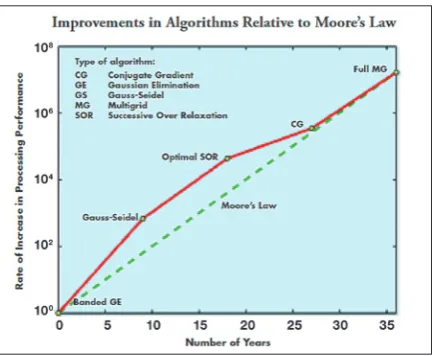
Example: A stunning illustration is given in Figure 1. In the electronics industry and far beyond, it is well known that the performance of chips improves by a factor of 2 every 18 months. Moore’s law describes this trend. What is not known to the general public, and also not to designers and management in the electronics industry, is that numerical mathematics has achieved a similar speed-up in algorithms underlying the virtual design environments used to develop these new generations of chips! Europe must not miss this challenge that is also an opportunity.
The lack of recognition also occurs in more direct interactions between industry and Mathematics. When the Stochastic Operations Research Group at Twente University (Netherlands) proposed a new optimal strat-egy for reducing waiting times in hospitals from 4 weeks
to 1 day, there was much scepticism and virtually no acceptance. Only after quite some investment in pro-ducing an animation, management was convinced and implemented the strategy with great success. This example shows that recognition by industry must be earned, and that it may take additional investment to achieve this. The mathematics community must be prepared to do this investment.
1.3. Means of interaction between
mathematics and industry
Problems in industry which benefit significantly from mathematics, in addition to the standard workflows, typically are seen on different scales:
1. Specific problems where the current methods or commercial codes fail, where a new feature has to be included, where current models do not meet the requirement. In our survey, quite a number of Small and Medium Enterprises are addressing this kind of situation, but have difficulties to survive on this demand alone. Typically these are small-scale projects up to 12 person-months.
2. Medium scale problems where the transfer of a new technology, algorithmic approach or such has to be performed or where a new mathematical software product has to be brought into the market. This is very often done via companies that are spun out of a research lab or an academic institution. These math-ematical spin-offs show a high survival rate in the market or are bought out by global players thus
creating novel high-tech jobs with high salaries. These kind of projects typically require 3-6 person- years.
3. Large-scale multi-physics, multi-scale, multi-mathe-matics are problems where different physical models are coupled, where different areas of mathematics are used and where there are essentially no meth-ods available. An example of this is, for instance, the problem of modelling, simulating and optimising the gas transport in large gas networks, where stochas-tics, partial differential equations, numerics, discrete mathematics and optimisation all have to cooperate and where methods for the simulation are missing and where currently nobody can optimise the whole problem. Typically only a large centre or a consortium can handle such a problem where all the competence is available in-house. Such projects can have an order of 20-30 person years.
1.3.1. Areas of interaction
Probably the central question is the one about the fit or misfit between the competence available in academia and the actual demand in the business sector. The respondents of the ESF questionnaire, both from busi-ness and academia, were asked about the main areas of mathematical expertise as well as fields of applica-tions of mathematics that are relevant for activities in their institutions. What follows is an analysis of a
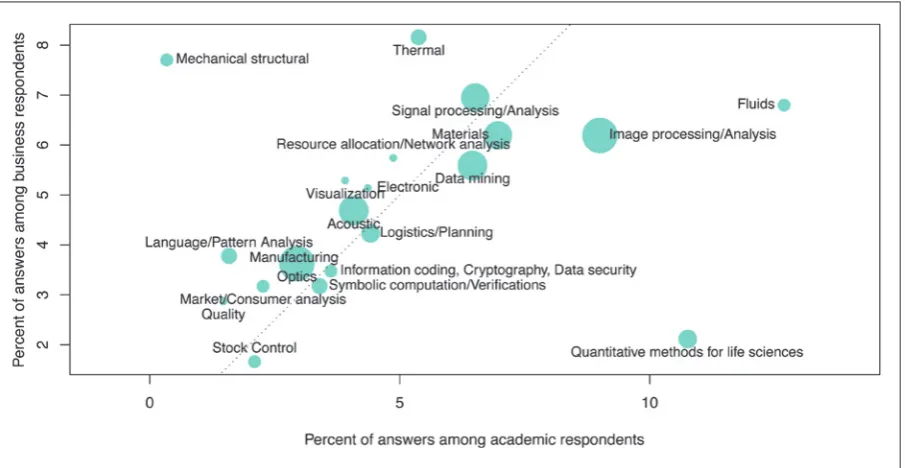
styl-ised supply, understood as a structure of mathematical competence available in academic institutions, versus a stylised demand, understood as the relative impor-tance of particular areas of applied mathematics that are especially of interest to the business sector. In Fig-ure 2, the main areas of competence in academia are plotted versus major business challenges perceived in industry.
The first issue concerns the areas in which available mathematical competence in academia can support the industry, and those which the industry perceive as major business challenges in their companies. The comparison is presented in Figure 2. The location of each area, represented by a bubble, corresponds to relative its importance in academia (horizontal axis) and in industry (vertical axis). Areas above the dotted line are more often pointed out by the business respondents than by respondents from academia. Areas below the dotted line show the other way around: more often by academia than by business.
In general, the perceptions in both groups are very similar. This manifests itself in the fact that the areas align themselves quite closely to the diagonal line. The areas that seem to be most important (chosen most often) are those belonging to the areas of Systems Modelling, Computing/Algorithms, and Simulation. These are slightly more often chosen by academia than
by industry. Areas chosen least often are Design and
Product optimisation. The largest misfit seems to be related to the areas of Risk management and Simulation. Risk management is perceived as the fourth most impor-tant business challenge in industry (12% of answers), however it is chosen by about 8% of respondents from academia (7th most important out of 9 areas).
Based on the declarations of the respondents we conclude that, in general, there exists a fairly good match between the structure of available mathematical com-petence in academia and the structure of the demand for mathematicians in business (Figure 2). However, there are several notable exceptions. These include mathematics for “structural mechanics” and “thermal engineering”, which are perceived as, on the one hand, most needed by the industry, but, on the other hand, not so frequently mentioned by academic respondents. Simultaneously, “quantitative methods for life sciences” and “Fluid mechanics” are popular in academic math-ematics departments, but are not mentioned too often as crucial by the business respondents 4.
The deviations in structural mechanics and fluids may be explained by mutual misconception between mathematics and, more engineering-oriented, simu-lation sciences. However, the result for life sciences has consequences on the entire health care area with a tremendous societal impact. Apparently there exists a significant discrepancy between academics and industry in the perception of the impact of today’s mathematics to life science problems. Of course, until today there are only a few examples, such as in pharmacokinetics or biostatistics, where mathematics provided a significant benefit for health care. Moreover, lots of activities in academic mathematics for biology are far away from the needs in health care. On the other side, it is well accepted that the tremendous amount of genomics, proteomics or epigenetic data which can be measured in parallel using the upcoming experimental technologies makes future mathematical involvement essential for the further progress of biomedical sciences. However, apparently both sides have to move significantly in order to realise the benefits from the tremendous investments in data today and in future. Only by novel, efficient infor-mation retrieval from these data the efficiency of the health care can be increased, as it is urgently needed in order to prevent the health care systems of the European ageing societies from a financial breakdown.
Example: let us consider optimisation problems that are frequently encountered amongst the problems proposed by companies. Optimisation is a transverse domain of mathematics, which involves analysis, numerical analysis, combinatorics, and statistics. The problems of interest
4. Note that the respondents from industry only represent part of the R&D departments of European companies.
for industry have some particular features that make them challenging for mathematicians. A particular and frequent feature of the industrial problems is that they often involve a lot of uncertainty, a large number of constraints, and several output quantities to optimise together. Typical problems are related to scheduling and task assignment, physical or chemical processing or optimal design. It turns out that the first challenge in this kind of problem is in their set-up, that is to say, the definition of the optimisation/cost function, which takes into account the budgetary, implementation and regulation constraints. The choice of the cost function is instrumental in the trade-off between the optimisation of several different outputs with several constraints of different natures. Moreover, industrial researchers often wish to keep flexibility, they do not look for “the” solution, but a class of answers or solutions that achieve different trade-offs between the different constraints. Confidence issues and uncertainty quantification are also critical. Industrial researchers of course prefer a reasonable and stable solution than an optimal and unstable one. Math-ematicians can incorporate this idea in the optimisation routine, but the challenge for them is to form a group that incorporates experts from the different domains of mathematics needed to achieve this task.
Another frequent class of problems reported by the industry is related to data processing. Here, two types of problems may appear. The first type of problem arises when few data are available, and the challenge is to overcome data scarcity. Typically the problem is about interpolation estimations (with the minimal amount of data) and the identification of the key parameters of the process. The second type of problem occurs when industrial researchers or engineers have to process very large amount of data, and the challenge is more about data mining and the extraction of useful information. A typical example is the use of geophysical surveys for oil exploration. But it can be said that practically every field of mathematics has or will have its application in the industrial context. In a parallel document, we have gathered some recent examples of successful coopera-tion between mathematics and industry in European research groups that give an idea of the variety of the applications and of the challenges.
1.3.2. Process of the interaction
First, it is relevant to note that mathematicians can con-tribute in all the different steps necessary to solve an industrial problem as follows.
the identification and characterisation of the problem itself and its origins by formulating the problem in an abstract framework, which can distinguish what is relevant and what is not.
• Modelling of the problem: The mathematical for-mulation helps to clarify the problem, identifying the main obstacles, and proposing the tools to tackle the problem. An additional concept that mathemat-ics can bring is the notion of a hierarchy of problems going from easier to solve problems, where one can get analytical insight at a qualitative level, to highly complex ones where the situation to be modelled is better approached, but at a much higher level of detail and cost (for example, coupled electro-thermal or electro-mechanical models).
• Simulation: Efficient, robust and reliable mathematical techniques must be developed to solve the problem at hand, and provide realistic simulations. However, academic and industrial people may not agree on the same definition of “solution”. Industrial engineers and managers usually look for “a” solution in a given time (say, the best solution given the time allocated to the project, or at least a solution that fulfils the constraints). Academic mathematicians usually work on a different time scale and look for “the” optimal solution. Open discussions are necessary to clarify the different expectations and constraints.
• Uncertainty: Due to variability in the production proc-ess, uncertainties may occur. This needs to be taken into account by employing stochastic and statistical methods, in combination with the scientific computing techniques already employed to solve the problem.
• Validation: This is an extremely important aspect that is, however, often neglected. It is not sufficient to be able to solve the mathematical problem; one always needs to validate the results obtained with measurements. In this sense, there must be strong interactions between modelling and simulation. It is crucial to identify and characterise the range of validity of the model.
• Optimisation: due to the increased computational power and the achievements obtained in speed-up of algorithms (see Figure 1), optimisation of products has become into reach. This is of vital importance to industry. Again, however, this calls for open discus-sions and good communication channels between mathematics and industry.
The question is whether, and to what extent, the above is already taking place in interactions between Mathematics and Industry. In this context, it is interesting to look at the responses given in our questionnaires. Respondents from academia differ in terms of the scientific profile
of their host institutions. The majority of respondents come from Mathematics (36%) and Computational Mathematics (23%) departments. A relatively smaller share of respondents come from departments specialis-ing in Control Theory, Financial Mathematics, Computer Science and Bioinformatics, jointly they constitute about 10% of all respondents from academic institutions. Most of the academic institutions of the respondents do con-sulting for business, on average 71% of respondents answers report that fact. However, consulting for industry varies substantially depending on the scientific profile of the institution. This type of academia-industry collabora-tion happens most often in departments specialising in Computational Mathematics, it is reported by 85% of respondents from these institutions. Other specialisa-tions reporting a high rate of industry consulting include Engineering Mathematics, Control Theory, Computer Science, and Financial Mathematics. Consulting for industry happens least often in Pure Mathematics departments (61%). A vast majority of people from industry, over 90%, report that their company does run a Research and Development department.
Despite of the outlined limits of our survey, an overall message that can be concluded from the answers of the questionnaire is the high demand for mathematical research and mathematical tools in industry. This is demonstrated, in particular, by the following two features evident from our survey: • Industry is more and more challenged to
accom-modate two contradictory requests: the need to optimise all the steps of the industrial process; and the dramatic increase of budgetary and regulatory constraints. Only mathematics can help industry
to optimise more and more complex systems with more and more constraints. The contributions of mathematicians are also helpful as an internal tool for industry to assess the validity of a new project and also as a proof of rigor and robustness that can be used by supervising and regulatory authorities. • When new mathematical or computational techniques
appro-priate. Mathematicians or mathematically trained engineers are aware of this and will analyse results before taking them for granted.
1.3.3. Requirements for a fruitful
interaction
An important remark is that the use of mathematics in the whole design or production process is most of the time invisible in final industrial products or services. In other words, mathematics is typically an “enabling technology… [whose] economic impact is real, and many companies –old, as well as new– have achieved a competitive advantage though the judicious use of mathematics” [OECD report of Annex 1]. This fact that can be phrased as “invisible contribution, visible suc-cess” needs to be acknowledged. Hence the absolutely most important challenge for mathematicians is to further convince industry that they need more mod-ern mathematics and mathematicians to develop new competitive products and technologies.
A means of convincing more people about the pres-ence of mathematics everywhere could be to put stickers “Math Inside” on products where mathematical tech-niques have proved the reliability and robustness. A real challenge is also to convince also policy makers that it is not just engineering, chemistry or physics that are key technologies, but mathematics as well. A difficulty is the missing profile of the “industrial mathematician”. Mathematicians in industry often work in a team and are used as all-rounders or trouble-shooters. It is, therefore, not sufficient to point out that mathematics is every-where if mathematicians are visible noevery-where in their role as mathematicians! Good and relevant mathematics can only be developed and applied by mathematicians, people who know how to model, how to analyse the models and how to make relevant computations, esti-mate errors and to characterise the range of reliable applicability. These tasks are crucial for high quality products and processes and they are not possible for people who just apply commercial or classical methods that have been available for decades and which might not well adapt to new situations.
As a matter of fact the complexity of most of the problems that are currently encountered and the rate at which mathematics is developing are such that a fruitful collaboration is only possible if the industrial mathemati-cian is familiar with the latest advances of contemporary mathematics; especially when new ideas are needed that can induce real innovation. Indeed, some of the most powerful new ideas in mathematics that are finding fruitful application are complex and sometimes difficult to use, which is why professional mathematicians are required.
Let us note that concerning specific needs from indus-try, it is very hard to anticipate them, but that clearly model based simulation, optimisation and control will be key issues in the next 10-20 years. Most of the times, the design of a new product requires taking into account opposite constraints (robustness and cost, reliability and speed of conception…). Therefore, in order to achieve a proper balance between opposite needs, mathematical tools are an alternative to the classical means relying on the expertise and lifelong experience of some engineers or on trial and error evaluation of preliminary prototypes that are extremely expensive. Mathematically based tools are already of current use in some industrial fields (aero-nautics and aerospace, automotive, energy, etc) but they are not so frequent in other fields (such as pharmacology) and absent in most sectors. Doing this requires some effort for the modelling of the process, the definition of the proper simulation algorithms, the wrapping of these high-level scientific concepts into an expert system that can be used in the conception workshop. The goal of these simulation tools is to provide the same output as a true experience. Thanks to the availability of these in-silico experimental benches, the second achievement is to lead to an in-silico expert tool that is “intelligent” and that out of many numerical simulations is able to provide the optimal product capable to achieve different optimal regimes under industrial constraints.
Another example is related to the time consuming assimilation of over representative data in industrial decision time; mathematical models are able to syn-thesise the trends in these data and understand which is currently out of reach while automatic acquisition systems are more and more available. On the opposite, there are situations where the data are very scarce and hard or expensive to acquire. Here again mathematical models may lead to get valuable information from the combination of a priori different representations of the same situation.
It should not be hidden that, if most of the problems encountered in the industrial context will certainly benefit from mathematical input, currently most of them are out of reach for at least two reasons: the first one is that industries are not aware that their problem can be cast into a solvable mathematical frame; the second one is that sometimes the necessary mathematical theory is not available, at least under a form that is directly appli-cable. A one-stop shop where illustration of realisations (success stories) and post list of problems are available would facilitate the meeting of academic research groups and industrial engineers.
many problems of interest are available and are the subject of active research, but for the actual problems of industrial needs, with sizes that are not equivalent to academic problems, further investigation needs to be performed.
Example: In the chemical and pharmaceutical industry, the development of novel products and processes has to tackle an increasing complexity. The systems which have to be optimised, e.g. in functional materials or in bioengineering, are highly complex and are not fully understood in detail. Therefore the established mecha-nistic modelling, which is based on a detailed translation of the underlying mechanisms to mathematics, cannot be applied. Hence hybrid, grey box models have been developed which combine mechanistic modelling with machine learning approaches. Successful applications ranging from process optimisation, materials design up to gene diagnostics show the typical character of high-end mathematics as an enabling technology for a broad range of applications. However, the drawback of the high efficiency is that validation becomes extremely challenging, such that highly skilled mathematicians are the key technology “champions” in industry.
1.3.4. Forms of interaction
The collaborations of industrial and academic research-ers are often the results of presearch-ersonal contacts: typically former students or colleagues working in industries and keeping contact with their former advisors or other members of the academic mathematics departments. A connection can also be established during a workshop or a conference. The early steps of the connections are criti-cal and should benefit from rather simple measures:
• It is not easy for industrial engineers or researchers to know whom to contact in academia when they do not have a priori contacts. There are many mathematics departments throughout Europe but the information about who does what is not easily available. The WebPages of the mathematics departments rarely contain special links to guide the potentially inter-ested people towards a presentation of the recent achievements of the department or specific contacts who could answer the first questions. This could be improved without too much effort, but there would have to be an initiative from the side of European institutions like EMS in this direction.
• Academic researchers usually have slides ready to present their most recent work, but usually do not spend time preparing a presentation that could be more accessible to people potentially interested by submitting industrial problems but without the math-ematical background expected from a mathematician.
It is often much more effective to present practical challenges than ‘perfect’ solutions.
There is a full spectrum of opportunities for groups who are interested in genuine industrial collaboration. These opportunities can range from setting up a fully-fledged mathematics-in-industry group, with a full-time project facilitator and regular symposia and collabora-tive meetings with industrial partners to having a group, which occasionally works on industrially relevant prob-lems. In [OECD report April 2009] the forms in which collaboration can start are described on the basis of concrete experiences of many groups and laborato-ries across the world and the different mechanisms are illustrated. It can be noted that, in cases of complex problems and tasks, typically not all the competence and skills can be found in the same laboratory and research group. For large companies a one-stop-office partner typically is the highest priority, this would require the formation of large clusters where all the industrially relevant mathematical competence is available. But sometimes to get the excellence in different areas even trans-regional or transnational groups may be the best answer. As a consequence a set up of databases and a strong coordination activity would be necessary.
Once a connection is established between industrial and academic partners specific programmes should be available to develop the collaboration. Several types of such cooperation programmes can be identified: • Short-term cooperations (a week up to a few
months) that can be implemented at any time and can be realised very quickly. This would allow to make a proof of concept, or to test ideas with a rather tiny budget. As an example, we mention specific intern-ship programmes that bring a student and his/her advisor together with the industrial partner, or the cooperation that arises from industry workshops (modelling weeks), where industries present specific problems that are addressed by a group of students and researchers.
• Medium term cooperations (approximately one year) where an identified project is carried out jointly by a group of researchers both from industry and academia. Here a clear and very specific project goal needs to be identified and a clear time frame.
• Long-term projects (a few years) that include the temporary transfer of academic researchers to the industrial partner of the project as well as engineers and researchers from the industrial partner to the academic one.
the results (leaving to appendices all technical details that might seem crucial to the mathematician but abso-lutely obscure and not relevant to the company) are essential ingredients for a successful cooperation. It is evident from the results of the questionnaire that there is often little experience in academia in setting up such cooperations, in estimating time-frames and in identifying clear and realistic goals.
Let us end this section by pointing out that, in our opinion, a new type of position is needed in the aca-demic research centres. Indeed, industrial partners usually expect a solution to their problem in a form (a report, an algorithm, a code) that is more finalised than the one that an academic mathematician is prepared to deliver. There are different reasons. First, an academic mathematician may not be an expert in programming. Second, an academic mathematician is evaluated on the number of publications and there is no incentive to spend time and energy on the development of a prac-tical user-guide or a code. The new type of position, which we may call mathematical engineer, would be devoted to the management and development of indus-trial projects. The establishment of such positions should be encouraged.
1.3.5. The particular case of Small
and Medium Enterprises (SMEs)
The case of SMEs is very different from that of large companies. Academic mathematicians often have very few contacts with SMEs although, at the same time, a lot of innovation is created in this kind of companies. In fact, SMEs could bridge the gap between Mathematics and Industry. Therefore, it is extremely important that this kind of collaboration is triggered much more than currently is the case.
For instance, it seems very important to keep contact with former students who have not chosen an academic carrier and have started a carrier in industry. These former students should be privileged interlocutors for establishing contacts between industry and academia. An obvious way for that would be to maintain an alumni directory, but this is not so common, and this should be recommended. Another way should be to invite them during special events like the “Modelling Weeks”. These invitations are interesting in two different ways. They offer mathematical students the opportunity to discuss with non-academic people and to realise that it is possible to think about a career that is wider than the academic world. They also allow former mathematicians working in industry to feel part of the mathematical community. They can share their experiments, provide advice, and
they can present their current problems to the students and researchers, which could initiate collaborations.
The problem of the response time of academic mathematical project partners is at least as critical and probably even more critical for SMEs than for large companies. Here it is important to be able to give at least partial answers very quickly, and it is clear that such answers can only be delivered by a well-organised group with researchers competent in different domains of mathematics and with mathematical engineers capa-ble to deliver answers and products that can be put in a more or less final form. As already noticed, permanent training sessions, internships and modelling weeks pro-posed by mathematical research departments would certainly be a nice way to start collaborations between SMEs and academic departments.
1.3.6. Improving the mathematics-industry
interaction through training
The structure and the content of curricula in mathematics in most European universities are in most cases excel-lent with respect to the basic education and to updated information. But they do not contain all the tools nec-essary to collaboration with other disciplines and even with different branches of mathematics. The current trend to premature overemphasised specialisation is a problem that should deserve a deeper attention within the community. It is important that bachelor programmes focus on a broad and fundamental education and that specialisation is restricted to a minimum.
At a later stage, however, a specific training towards the collaboration with other disciplines should be addressed. One possibility that could be offered is a specific curriculum at master degree and/or at graduate level; this is discussed in Section 3.2 below. But also the invigoration of the key area of mathematical model-ling in all mathematics degrees is needed. Within this framework (but also having in mind students that will not become industrial mathematicians) some opportunities of encountering non-mathematical problems that can be dealt with mathematical means should be offered. For example:
• Graduate students are usually proposed to follow a variety of courses in mathematics during their training. One could suggest that some of these courses could be taught by industrial researchers or engineers, by taking the form of “modelling problems”.
and exchange between participants. The follow-up may take different forms depending on the progress made during the week.
• In some universities special weeks are proposed during which the students (not only in mathematics) are taken out of the university (in order to focus their attention) and receive different lectures about oral and written presentations, career opportunities and the job market. The purpose of this week is to allow them to gain confidence, to learn how to promote them-selves and to realise that they have a huge potential. • It is also common that the students, mostly at grad-uate levels, organise special seminars, where they present their work. It would be a good opportunity to encourage invitation of external people during these seminars so that the students can discover problems presented by industrial researchers. In this non-formal seminar the students would be more will-ing to ask questions and react to the presentation. • Modelling Weeks. These weeks would have the same
form as the Study Groups but would be targeting the students: we note also that this form, as well as the organisation of study groups, can be instruments for promoting more intensive and focused interactions with companies.
• Internships where students work on specific prob-lems brought by a company under the supervision of senior mathematicians can be very interesting for the students and a valuable part of their training. An internship is a research project of short duration (typically 4-6 months) that is undertaken in collabora-tion with an industry partner and places a graduate student or postdoctoral researcher part-time in the company.
• Finally it may be interesting to build courses for start-up companies, with the experience of founders to encourage young students to think in a entrepreneurial manner.
1.3.7. Confidentiality and intellectual
property rights
It is clear that academia and industry have completely different attitudes towards research. For scientists, cir-culation of information is essential and the publication of every interesting results is viewed as the mean of contrib-uting to the advance of knowledge (as well as the means of progressing in the career). In contrast, an industrial company may be reluctant to publish not only the solu-tions to its problems, but even the problems themselves, as they may disclose the directions of research and development of the company. It would be very profitable for both partners to smooth this process by avoiding
the cumbersome task of writing a new agreement for any new collaboration. The idea would be to create an open library that proposes standard agreements 5 that could be the bases of a contract so that everyone can concentrate his time and energy to the problem at hand and not on confidentiality and copyright issues. These agreements would typically describe:
• How the work is carried out (typically the company pays the university for the time spent by the academic researchers or the mathematical engineers on the project).
• Who keeps the intellectual property of the discovery (typically the company keeps the property while the university keeps the free use of the discovery for non-profitable purposes) and how it will be protected under the restrictions of European patent regulations with respect to mathematics and software.
• When the results can be disclosed and published.
1.3.8. Towards a mindset shift
for mathematicians
In the previous sections we have shown how companies can benefit from collaborating with mathematicians. But academia also benefits from its interaction with industry. This interaction stimulates research in new directions and also fosters the development of new analytical and computational methods. New tools have to be designed for new needs. Advances in mathematics can and should arise from this interaction. A recent example is the new algebraic theory for structured matrix polynomials, which arose from an industrial project in analysing vibrations for high-speed rail tracks 6.
Mathematicians have played an essential role in the task of making the computer revolution work to the ben-efit of industry and commerce. Their role and importance in the future is likely to increase not decrease. It follows that there is an urgent need for a new generation of mathematicians to take up the challenges and opportuni-ties presented by industry as Europe seeks to become the leading knowledge-based economy. Despite the wonderful mathematical tradition in Europe in all disci-plines, the numbers of students studying mathematics is not increasing in many countries, in stark contrast to the needs of society.
Research that has traditionally been considered as a part of pure mathematics and motivated by theoretical development has recently found many practical applica-tions in such areas as tomography, internet searching
5. See for example, the UK’s Lambert Agreements at http://www.innovation.gov.uk/lambertagreements
algorithms, cryptology, biology, climate change, insur-ance, the economy, etc. Application-driven Mathematics has usually been associated with problems appearing in industry, science and engineering. These areas are now understood in a broader sense and also include statisti-cal treatment of large data sets, numeristatisti-cal algorithms and computer packages.
Within modern technological development it does not make sense any longer to distinguish between pure and applied mathematical problems. The majority of applications require a deep knowledge of fundamental mathematics as well as the development of new tools and algorithms. For many years companies have successfully worked with the classical techniques that were developed years ago. The high complexity of current industrial problems requires the combina-tion of all areas of theoretical and applied mathematics. Furthermore, recent developments in mathematical sci-ences have reinforced two general tendencies that can be traced back far in the history of mathematics, namely the quest for unity of the discipline and its stimulation through challenges coming from other sciences and engineering. These may appear contradictory but they are not at all. Indeed, when mathematicians speak about unity of their field, they do not have in mind a static architecture of their discipline but rather a very dynamic process that accounts for a permanent rearrangement within the mathematical sciences of its different com-ponents and reflects new impacts of one branch on another. A good example for such an application is the development of new optimisation techniques, which immediately move the frontier of solvable problems far beyond current methods. It is essential for mathemati-cians in academia to be aware of the demand in industry so that they react by developing new techniques and transferring them to industry.
Example: A typical example of the latter is the growing influence of stochastics in many areas of mathemat-ics, from geometry to the analysis of partial differential equations and combinatorics. On the other hand, chal-lenges coming from outside can be typically taken up through combinations of techniques borrowed from different parts of mathematics and/or the emergence of new concepts. Here also typical examples are new security procedures, critical to data transmission, relying on special codes mixing in new ways combinatorics and algebraic geometry, or medical imaging techniques that rely on sophisticated geometric concepts and discreti-sation techniques. This shows that it is more important than ever for mathematicians to be the alert to the new frontiers of their discipline in both pure and applied areas, and to exchange and share their expertise, tools and knowledge.
1.4. International context
As mentioned previously, despite some of the deficien-cies, the mathematical community in Europe has one of the top positions in international research and devel-opment; and in applied and industrial mathematics is clearly in the worldwide leading position. On the other hand keeping this lead position should not be taken for granted, since the number of scientists in some other parts of the world is steadily increasing while stagnat-ing in Europe. The situation can be easily compared to the field of computer science, which started out with many great developments (including the first computer) in Europe and today Europe is lagging behind. In this context, the National Science Foundation (NSF) of the United States (2008) announced Mathematics as an NSF-wide priority area 7 recognising that:
“Today’s discoveries in science, engineering and technology are intertwined with advances across the mathematical sciences. New mathematical tools are needed to understand scores of subjects, from the complex processes that drive the climate system to interactions of magnetic fields and fluid flows in the hot plasmas within stars. Mathematical modelling plays a key role in research on micro-scale, nano-scale and optical devices. Furthermore,
for the United States to remain competitive among
other nations with strong traditions in mathematics education, we must attract more young Americans to careers in the mathematical sciences.”
The focus on training and education in mathemat-ics and science in the US was further enhanced after president Obama’s launch in November 2009 of the “Educate to Innovate” Campaign for Excellence in Science,
Technology, Engineering and Math (STEM) Education. This is a US-wide effort including new investments of over US$ 260M to “move American students to the top of the pack in science and math achievements over the next decade”.8 President Obama furthermore stated that: “Reaffirming and strengthening America’s role as the world’s engine of scientific discovery and technologi-cal innovation is essential to meeting the challenges of this century. That’s why I am committed to making the improvement of STEM education over the next decade a national priority.”
1.4.1. The European context
Counted together, European mathematics is one of the strongest world leading schools. In many European
universities and research centres, mathematicians are frequently organised in communities at national level. In collaboration with industry, they have developed wide expertise at the forefront of research involving most fields of mathematics. Scattered networks of centres exist, exchanging students in common training pro-grammes in industrial mathematics, that have a long tradition and experience, forming a scientific community in the making. The diversity of approaches and cultural differences is a key factor for cross-fertilisation.
Despite the work and efforts of the European math-ematical organisations, the communities are still not sufficiently connected and remain fragmented. Among European countries large differences remain in the tradi-tion of establishing links between research and industry. Companies have in many cases insufficient awareness of and belief in academic research and particularly in mathematics. This is particularly true for small and medium enterprises, for which innovation should be the main concern, in order to face worldwide competi-tion. Regardless of the vital societal and scientific role of industrial mathematics, its recognition is not high in the European and national political agendas. In addition, the scientific community has often underestimated the value of applied and application-driven research. This has led to a difficulty in its evaluation and recognition.
Despite the crisis, the hiring of mathematicians in all business sectors continues, the higher the qualifica-tion the better. Even in the present period of financial crisis, more mathematicians are hired. Mathematicians solve many important industrial maths problems and mathematical software is provided through academic institutions and small spin-off companies, but the demand for good mathematicians is much higher than is currently available.
As is true in many fields but even more in mathemat-ics, if the mathematical schools of the various countries in Europe are considered together, Europe represents the broadest, most vivid and most productive school in the world. There is a strong history which can be built upon all areas of mathematics. The trench between pure and applied mathematics that is still very present in some countries has been bridged in many others. The community of colleagues that are active in developing collaboration with industries is growing and it will cer-tainly benefit from strong promotion of success stories and the success of other people in Europe.
The way pupils, students, engineers, and mathemati-cians are trained still differs widely throughout Europe and also the job market for mathematicians is very dif-ferent in Europe. There are also various economic and sociologic models and what is possible in one country may not be feasible in another. Some critical questions
such as “What falls within the competence of a mathema-tician?” “What falls within the competence of a researcher or an engineer?” “How to use the material developed by pure mathematicians in applications?” all have elements in various countries that should be compared and publi-cised. On this firm ground, the exchange of experience is certainly worthwhile, as some of the approaches for improvement will be possible in some countries.
1.4.2. Strengths and weaknesses
of European Industrial Mathematics
Strengths in Europe:
• Mathematics is the language of innovation, which is vital for society and industry.
• Counted together, European mathematics is by far the world leading school.
• In some European universities and research centres, mathematicians are frequently organised in commu-nities at national level. In collaboration with Industry, they have developed wide expertise at the forefront of research involving most fields of mathematics. • Scattered networks of centres exist, exchanging
stu-dents in common training programmes in industrial mathematics, which have a long tradition and experi-ence, forming a scientific community in the making. The diversity of approaches and cultural differences is a key factor for cross-fertilisation.
• Communication channels between Industry and Academia are already established in many countries. In some cases, mathematicians occupy important positions in industrial R&D, especially within large companies that have in-house research depart-ments.
Weaknesses in Europe:
• Despite the work and efforts of the European math-ematical organisations, the communities are still not sufficiently inter-connected and remain fragmented. • Among the European countries large differences remain
in the tradition of establishing links between research and industry. In many cases companies have insuf-ficient awareness of and belief in academic research and particularly in mathematics. This is particularly true for SMEs, for which innovation should be the main concern, in order to face worldwide competition. • Regardless of the vital societal and scientific role of