Standing Committee for the Social Sciences (SCSS)
Developing a New Understanding
of Enabling Health and Wellbeing
in Europe
European Science Foundation (ESF)
The European Science Foundation (ESF) is an independent, non-governmental organisation, the members of which are 67 national funding agencies, research performing agencies and academies from 29 countries.
The strength of ESF lies in its influential membership and in its ability to bring together the different domains of European science in order to meet the challenges of the future.
Since its establishment in 1974, ESF, which has its headquarters in Strasbourg with offices in Brussels and Ostend, has assembled a host of organisations that span all disciplines of science, to create a common platform for cross-border cooperation in Europe.
ESF is dedicated to promoting collaboration in scientific research and in funding of research and science policy across Europe. Through its activities and instruments, ESF has made major contributions to science in a global context. ESF covers the following scientific domains:
• Humanities
• Life, Earth and Environmental Sciences • Medical Sciences
• Physical and Engineering Sciences • Social Sciences
• Marine Sciences
• Materials Science and Engineering • Nuclear Physics
• Polar Sciences • Radio Astronomy • Space Sciences
www.esf.org
Science Position Paper
The objective of ESF Science Position Papers is to provide evidence-based foresight and advice on science, research infrastructure and science policy issues of European significance to underpin decisions on strategic directions and priorities. Special attention is paid to promoting Europe’s ability to open up new research areas. Published under the responsibility of one or more ESF Standing Committees, they represent a considered opinion of the community represented by the Committee(s) involved.
www.esf.org/social
Authors:
The content of this paper was drafted by Professor Michael Rigby, with support from Professor Sabine Koch, Dr Debbie Keeling and Penny Hill, and contributions from Dr Albert Alonso and Dr Els Maeckelberghe.
This Science Position Paper has been prepared under the responsibility of the Standing Committee for the Social Sciences (SCSS):
Chair: Professor Sir Roderick Floud
Head of Humanities and Social Sciences Unit: Dr Nina Kancewicz-Hoffman
Editorial support:
Mr Étienne Franchineau, Junior Science Officer
Contents
Foreword 3
Executive Summary 5
The Problem 7
Shared Acknowledgement of the Need for Action 9
The Core Societal and Care Provision Issues 11
The Necessary Paradigm Shift – Ensuring the Success of ICT as the Enabler 21
Record Access, Ownership, Custodianship and Responsibility 27
The Necessary Social Science Research Agenda for ICT Application 29
Conclusion 42
References 44 Annexes 47
1. ESF Exploratory Workshop – List of participants 2. ESF Exploratory Workshop – Programme
De
ve
lo
pi
n
g a N
ew U
n
de
rs
ta
n
di
n
g o
f E
n
a
bl
in
g H
ea
lt
h a
n
d W
el
lb
ei
n
g i
n E
u
ro
pe
3
Foreword
l l l
Health is defined by the World Health Organisation as “a state of physical, mental, and social wellbe-ing, and not merely the absence of disease”1. A number of different functions quite separate from clinical health services are indeed essential to maintaining health (e.g. provision of meals, personal hygiene support, mobility assistance); they are often referred to as Social Care. Without these the health of the individual with particular needs would be compromised and eventually fail. However, although social care and informal care are essential to improving health and preventing health problems, especially in an ageing popula-tion, there are still large gaps of knowledge in how best to organise this, and how best to combine it with health care. Specifically, improving health and general wellbeing via social care informatics, optimising the division of labour between different forms of care, is an underdeveloped area in both research and policy.
In 2009, the Standing Committee for the Social Sciences of the European Science Foundation claimed that “improving health and reducing health inequalities” was one of the main challenges that social sciences needs to tackle, especially given the demographic trend of ageing and the pressure this puts on care arrangements. In addition, the role of new technology and its implications for social processes and structures was put forward as an important cross-cutting theme for social sciences to focus on.2
1. Constitution of the World Health Organisation, adopted by the
International Health Conference held in New York from 19 June to 22 July 1946
2. Cf. SCSS Science Position Paper Vital Question, The Contribution of European Social Science, p.23-29
Research on social care informatics is a good example of how the link between social science knowledge production and the application of this knowledge can be strengthened, and how to cru-cially improve the feedback between research and practice. This position paper aims at presenting the vision of a new paradigm of integrated care support for citizens’ health through linked social and health care. In the frame of the current EU flagship pro-grammes such as ‘Healthy and Active Ageing’ and other initiatives in the area of ‘social innovation’, it seeks to set a common ground between relevant consumer, professional and governmental bodies.
Professor Sir Roderick Floud
De
ve
lo
pi
n
g a N
ew U
n
de
rs
ta
n
di
n
g o
f E
n
a
bl
in
g H
ea
lt
h a
n
d W
el
lb
ei
n
g i
n E
u
ro
pe
5 Europe faces significant challenges to its health
and care services due to demographic change, being at the beginning of a large and continuing rise in the number and proportion of older citi-zens, while advances in healthcare mean that an increasing number of these and other adults will have enduring chronic health conditions. But for all citizens with actual or potential health prob-lems, the maintenance of optimal health depends not just on healthcare services, but on support for nutrition, hygiene, mobility and shopping, sociali-sation, warm dry housing and other aspects of daily living, as without these health will be compromised and deteriorate. This demand surge is happening at a time when Information and Communication Technologies (ICT) are increasingly being used in other service sectors to enable consumer customisa-tion and better resource management.
An objective for all health systems, and for patients, is to minimise hospital stays and maxim-ise care at home, but hitherto the practical need to observe the patient’s state of health has extended hospital stays. Similarly there is a drive to mini-mise – for quality of life and economic reasons – admission to long-term institutional care and instead extend support to enable living at home. Traditionally any support needed by an individual
has normally been provided by family members, often assisted by the local community, while social services have been the fall-back provider when the family cannot support, either by direct provision or by mobilising specific services such as delivered hot meals. Housing agencies and other bodies have also had an important role. However, other demographic changes are significantly reducing the capacity of families to provide daily ongoing support.
This means that health services are increasingly providing long-term monitoring and support to those living with chronic disease and frailty, while social services are increasingly needed to provide ongoing support. Many individual citizens are nec-essarily in receipt of both health and social care support, yet in all but a very few European countries these services are provided quite independently one from another, with minimal day to day liaison.
A number of drivers for change are now neces-sitating significant change, and the social sciences have a key role to play in enabling successful progress. At a macro level, across Europe the combination of the economic downturn and the demographic-led increase in demand means that health and social care services are under ever increasing pressures, while constant growth of services is not affordable nor will the labour market support ever continuing expansion.
Executive Summary
l l l
©
T
hi
nk
st
o
De
ve
lo
pi
n
g a N
ew U
n
de
rs
ta
n
di
n
g o
f E
n
a
bl
in
g H
ea
lt
h a
n
d W
el
lb
ei
n
g i
n E
u
ro
pe
6
Meanwhile, at citizen and societal levels two further and partially interlinked drivers are oper-ating, but much less uniformly or equitably in their potential or their effects. The first is a gen-eral increase in consumer awareness of achievable personalised service standards, and availability of information both from service providers and from social and comparison sites and social networks as to reasonable expectations. Strong examples come from the holiday and civil aviation sectors, bank-ing and insurance, and the retail sector includbank-ing home shopping. No longer do consumers in general meekly accept what is offered, but instead seek what they desire from what they themselves can find out is available, related to published professionally set standards and from comparison of providers, and increasingly they are starting to expect a similar approach in the health and social care sectors. The second, and enabling, driver, is the rise in e-services and mobile devices, ranging from personalised monitoring devices, smart phone applications and service provider customer portals, through to the global unorganised but powerful knowledge base of the Internet. There are specific evidence sources on health and care matters, consumer-orientated and disease-specific internet sites, and a variety of blogs and chat rooms – the great majority helpful and well-intentioned, though with the ever-present risk of malevolent presences too.
This paper presents the case for systematic research activity in the social sciences, at European and national levels, to further the interlinked citi-zen-focused objectives of:
• close integration at delivery level of health care and social care support of individual’s health, • personalisation of care delivery including
reason-able accommodation of individual choice, • ensuring effective use of ICT applications based
on user acceptability,
• bringing processes of consent, delegation, rep-resentation, coordination and privacy into the electronic era,
• ensuring respect for and teamwork with formal carers and the informal care team,
• ensuring equity in an electronic era regardless of digital literacy, assets and connectivity,
• examining stable and sustainable models of trusted infrastructure provision,
• establishing governance, authentication, manage-ment, and sustainability principles.
De
ve
lo
pi
n
g a N
ew U
n
de
rs
ta
n
di
n
g o
f E
n
a
bl
in
g H
ea
lt
h a
n
d W
el
lb
ei
n
g i
n E
u
ro
pe
7 Most countries in Europe, as with most
industri-alised nations globally, are facing a significant increase in the number and proportion of elderly citizens, as shown not least by Eurostat (epp.euro-stat.ec.europa.eu) and OECD (Colombo et al, 2011). Developments in health care mean that increasing numbers of people are surviving acute incidents such as cardiovascular disease or stroke to lead near normal lives, but often with a need for monitoring and specific health and wellbeing support, while advancing frailty brings its own needs for practi-cal living support to enable continuing health and wellbeing. Whilst health services themselves are important for health, they are not the only relevant services – essential to good health is good nutrition, domestic and personal hygiene, access to technical aids, safe housing, and socialisation. In cases of frailty or impaired ability, including not just the older persons but those recovering from accident or illness or with a functional limitation, if these support services are not supplied then health will suffer. To compound this, dispersal of the nuclear family, and increasing economic activity of all fam-ily members, frequently reduce the opportunity for family support.
At the same time, in many countries the work-force available to provide health and care services is static or diminishing, due to cost constraints on levels of professional staff and to limited numbers available to undertake lower-paid caring tasks. Meanwhile, demand for improved support for health and wellbeing is being fuelled by increased consumer expectations of good service standards.
Thus both humanitarian arguments favouring effective support for vulnerable citizens in a civi-lised society, and increased consumer expectations and needs, each highlight the requirement for better
The Problem
l l l
coordination and harmonisation of services within and between the health, social care, and other sup-port sectors; and for involving the citizen and their informal carers as partners rather than simply being passive recipients of organisationally determined interventions. Economic pressures for increased efficiency underscore these needs, while making the task more challenging.
A potential and arguably much overdue con-tributory solution is to make better use of modern information and communication technologies (ICTs) to support and coordinate the delivery of services efficiently and effectively. The health sector has long invested in computing systems to main-tain diagnostic results and subsequently in moving to electronic clinical records, and in recent years in specific types of telemedicine and of remote patient monitoring, but has made little advance in mod-ern means of scheduling care delivery. Social care services have made even less use of client-facing electronic systems, while in housing there have been advances in some locations in remote activ-ity monitoring and assisted living. However, each of these services is differently funded, mandated and regulated, and their information systems are quite independent, while furthermore the different sectors of most nations’ health systems still tend to work in mutual isolation.
De
ve
lo
pi
n
g a N
ew U
n
de
rs
ta
n
di
n
g o
f E
n
a
bl
in
g H
ea
lt
h a
n
d W
el
lb
ei
n
g i
n E
u
ro
pe
8
of information and communication technologies to enable citizen-centric integrated service is an over-due step. Some sectors, notably travel and leisure, retail and supply, are more advanced in the provi-sion of such integrational ICT services, and study of their approaches may inform health and care sector developments.
However, although the technologies and the systems knowledge are becoming available, using them in the delivery of health and social care ser-vices is not straightforward given the complexities. Healthcare records are amongst the most complex and most sensitive types of documentation; social care records have similar sensitivities but are very different in nature (Rigby et al, 2008). All services have a strong and commendable commitment to confidentiality, which militates against their inter-coordination. Each of these domains, and their contributory organisations, has its own legacy of paper-based systems and controls, all of which will be challenged by computerisation and will have to be significantly re-engineered to benefit from the opportunities of digitisation and to achieve the goals of coordination and a client focus. Also, citizens themselves will have anxieties about the integrity of digitised systems, with their process-ing power, invisibility and perceived susceptibility to interference or misuse. Further, since each citi-zen’s circumstances are different, the creation of an agreed partnership with informal carers will be different in each case, placing high demands on system design and user interface innovation and intuitiveness.
Consequent on these challenges, the key to pro-gress and success lies primarily with social sciences research. Computing, communications, and sensing technologies can provide opportunities and can be further developed by technical research. However, as is regularly and repeatedly shown in many coun-tries by adverse events (Gell, 2001; Ash et al, 2004; Ammenwerth and Shaw, 2005), effective imple-mentation and use of digital systems in health is only successful if the people factors are researched and understood. Thus social science and techni-cal research need to go hand in hand. Add to this the two further challenges of inter-sectoral coor-dination and a refocusing of service delivery to be citizen-centric and in partnership with clients and their informal carers as co-producers of health and wellbeing, then additional social science research needs become crucial. Thus many aspects need to be investigated in a social science and socio-technical research context as a prelude to considering impli-cations for design and implementation of future information systems and supportive automation.
De
ve
lo
pi
n
g a N
ew U
n
de
rs
ta
n
di
n
g o
f E
n
a
bl
in
g H
ea
lt
h a
n
d W
el
lb
ei
n
g i
n E
u
ro
pe
9 There is increasing realisation of the need
for research-based action rather than single responses. For instance, in July 2010 ESF funded an Exploratory Workshop convened by Professor Michael Rigby at Keele University on The Challenges of Developing Social Care Informatics as an Essential Part of Holistic Health Care, which was attended by 23 participants from 15 countries from health, social care and informatics professions and dis-ciplines, together with legal, ethical, economist, and patient interests (Rigby, 2010). This work-shop identified a range of issues that needed to be addressed, and went further with the produc-tion of a unanimous Declaraproduc-tion which inter alia
“declared the fundamental importance of provid-ing harmonised health and social care services that meet the extended needs of the individual, taking into account diversity in need, preferences, ability and support… utilising modern Information and Communication Technologies as enabling services, as part of a wider health and social care toolkit”, and it further “call[ed]on relevant authoritiesto ini-tiate and facilitate a programme of Research and Development” which the document then outlined (Rigby et al, 2011a). The full Exploratory Workshop report and appended Declaration are available on the ESF website, www.esf.org, under the reports for Exploratory Workshops in 2010.
This theme was then taken up by the Organisa-tion for Economic CooperaOrganisa-tion and Development (OECD) in the context of its Smarter Health and Wellness initiative. Material from the ESF event, together with the Declaration reproduced in full, was included in a joint workshop with the US National Science Foundation in Washington DC in February 2011 on Building a Smarter Health and Wellness Future, and continues as a theme within
that work – see www.oecd.org/sti/smarterhealth. Meanwhile, the European Commission is equally aware of the challenge arising through the increase in the elderly proportion of the popula-tion, and the potential major effects on health and care services. It has established a priority initiative, the European Innovation Partnership on Active and Healthy Ageing, which is receiving high impetus (http://ec.europa.eu/research/innovation-union/ index_en.cfm?section=active-healthy-ageing). It has also set up the Age Platform (www.age-plat-form.eu) to bring together some 150 organisations of and for older people. Several Directorates of the Commission are giving priority to calls for initiatives which address this broad area – par-ticular projects worthy of note in this context are FUTURAGE (futurage.group.shef.ac.uk) to create a roadmap for future research into the issues of age-ing within society, and Bridgage-ing Research in Ageage-ing and ICT Development (BRAID) (www.braidpro-ject.eu), considering the interface between older citizens and ICT. There is also a range of specific projects and research calls on selected themes within the Framework 7 programme of DG Research and the work programme of DG Communications Networks, Content and Technology (CNECT) (formerly part of Information Society). While sev-eral of these have included ICT interfaces or user acceptance of health informatics applications as components, none of these so far has addressed directly as the focal point the specific, sensitive and complex issues of researching in detail the case for, acceptance of, and professional and citi-zen user requirements of systems which facilitate the coordinated delivery of health and wellbeing support. It is this specific research as outlined in the ESF Exploratory Workshop, and underscored
Shared Acknowledgement
of the Need for Action
De
ve
lo
pi
n
g a N
ew U
n
de
rs
ta
n
di
n
g o
f E
n
a
bl
in
g H
ea
lt
h a
n
d W
el
lb
ei
n
g i
n E
u
ro
pe
10
De
ve
lo
pi
n
g a N
ew U
n
de
rs
ta
n
di
n
g o
f E
n
a
bl
in
g H
ea
lt
h a
n
d W
el
lb
ei
n
g i
n E
u
ro
pe
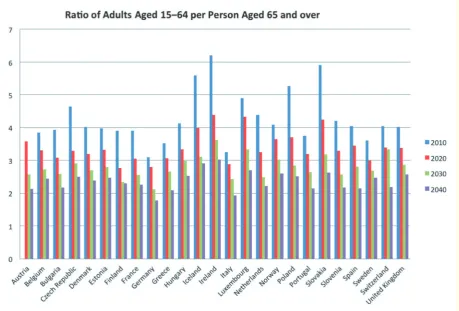
11 of ‘productive’ adults to older citizens is subject to
significant change, shown in Figure 3. However, this is not solely an issue of ageing, and younger persons with chronic conditions or illness must equally be supported sensitively as well.
Thus current patterns of health and social care service are not sustainable in practical terms. Reduction in family size adds to this, not least at the family level, as does increasing parental age at childbirth giving less overlap between successive generations.
At the same time, modern society’s opportuni-ties including greater wealth and improved travel, elimination of rigid political boundaries, and the right of freedom of movement within the European Union and its neighbours, coupled with economic and educational migration, have resulted in the steady decline of the close-knit and co-located satel-lite family as younger generations locate away from the parental home. As a result family support for older family members in terms of shared accom-modation or nearby support is increasingly scarce, and instead the older citizen is often left alone in a large family home from which the grown-up chil-dren have moved to education, employment and marriage long distances away. Isolation adds to frailty, and creates a new demand for support to ensure wellness.
A third demographic change is the reduction of the traditional mother and housewife role, whereby home-making including looking after children and supporting older family members was a full-time activity for a wife, or sometimes an unmarried older daughter. Increasingly, all adult family members choose or are economically drawn into full-time education and employment, and gender-based restrictions are rightly reduced, while more There is an inter-connecting range of societal issues
including demographic factors which is necessitat-ing significant change in how health and wellbenecessitat-ing are supported in a dynamic society. At the same time, while ICTs offer a potent and under-capital-ised range of assistive solutions, their introduction also raises tensions and conflicts. Above all, as the above-mentioned activities have identified, there is a dearth of evidence as to the best ways forward in developing and harnessing informatics support, even using existing known technologies. This next section highlights the societal issues, many need-ing deeper understandneed-ing, consideration of which is an essential precursor to successful application of ICTs, because modernisation through informat-ics must support the new societal dynaminformat-ics, values and means of working so as to ensure relevance and effectiveness. The subsequent sections then identify the issues raised by informatics applications them-selves which need social science based research and action.
Demographic and Societal Change
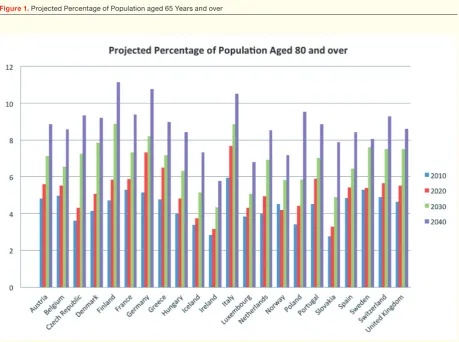
The core issue and one of the triggers of the need for action is the steady growth in both numbers and proportion of persons aged over 65 years, and over 80 years, in Europe, as shown in Figures 1 and 2. Whilst this is a success for society in creating greater longevity for European citizens (achieved through better incomes and nutrition, housing, education, environment, safety and health care), it brings with it the price in the health and care sector of not just a rapid absolute rise in the numbers of older citizens, but a rise also in the proportion of the population who are older or very elderly. As a result the ratio
The Core Societal
and Care Provision Issues
De
ve
lo
pi
n
g a N
ew U
n
de
rs
ta
n
di
n
g o
f E
n
a
bl
in
g H
ea
lt
h a
n
d W
el
lb
ei
n
g i
n E
u
ro
pe
12
Figure 1. Projected Percentage of Population aged 65 Years and over
De
ve
lo
pi
n
g a N
ew U
n
de
rs
ta
n
di
n
g o
f E
n
a
bl
in
g H
ea
lt
h a
n
d W
el
lb
ei
n
g i
n E
u
ro
pe
13
practicality of co-ownership and co-responsibility, much of this should be self-monitoring – raising issues not only of ensuring easy access to service support, but also issues of education, awareness, competence and commitment, and also ethical issues when individuals decline to act and thus let their health deteriorate to the ultimate cost of their health provider organisation and its funders.
As more people survive into their ninth and tenth decade, and indeed many will become cente-narians, so the number of persons with physical and mental impairments caused simply by frailty will increase, exponentially. These people are not ill, yet their health is seriously at risk if they do not get sup-port with daily living; in many cases this supsup-port needs to take account of medical factors.
children are extending their period of education, so even within the household there is much less care-giver time available. This is not necessarily an adverse change, but it does reduce family support for dependent members.
Chronic Diseases, an Older Society,
and Increasing Frailty
Medical science linked with improved living has yielded increased survival of episodes of acute ill-ness, though frequently with some reduced personal functionality or continued elevated disease risks. Acute diseases such as heart attack, stroke or many cancers now have much better survival rates than a decade ago, and even better rates than two decades ago. Similarly chronic conditions such as diabetes are better controlled and their side-effects better managed. The positive outcome of this progress is that many people who in the past would have died, now survive for many years of normal or near-normal life; the negative outcome is that many of these survivors may have some impairment to nor-mal life, and many will need regular monitoring. Some of this monitoring will be professionally led and technically based, but in the philosophy and
Key Demographic Facts
EU27: Population over 80 years will grow from 5% in 2010 to 11.5% in 2050.
USA: 50% of all adults have a chronic disease.
USA: Number of people with Alzheimer’s Disease will grow by 50% in 30 years.
De
ve
lo
pi
n
g a N
ew U
n
de
rs
ta
n
di
n
g o
f E
n
a
bl
in
g H
ea
lt
h a
n
d W
el
lb
ei
n
g i
n E
u
ro
pe
14
normal part of family life, but as families become smaller and disperse, and as spouses themselves may become less able to support fully, the provision of formal services becomes necessary to maintain health. Thus social care, housing and other services become essential contributors to the health of the population, yet in most countries come from a quite separate complex mixed market which is still imma-ture. At the individual level these services can be essential to health, and their staff may be the most frequent observers of the citizen’s state of health and wellbeing, but in nearly all countries they are man-dated, funded and provided quite separately from the health sector, with whom they may have little contact at service level or about the individual client.
Carer Partnerships
Traditionally health systems have viewed the patient as a client in isolation, with the patient indicating the degree to which he or she wanted informa-tion shared with others – including their spouse. That confidentiality is important for a trusting professional–patient relationship. But treating the patient in isolation is inappropriate if done rigidly. Increasingly, informal carers are being taken into partnership in particular ways, such as administer-ing specific injections. Yet too seldom is the question of whether or not a spouse is providing adequate health-related and daily living support, or indeed expressing emotions such as anger or helplessness, being taken into account.
In this respect social care services operate very differently. Their role is to assess the individual in their physical and social context, and to identify housing inadequacies or the need for special equip-ment, but also the context of family, neighbours and friends. These latter are people whose help is important, but who themselves may need help either for their carer roles, or to cope with the impact of the client’s needs on their own lives. Further, there may be a vulnerability in a carer which leads to a ‘care for the carer’ need, which is based on the initial individual’s problem as it impacts on the second per-son – in effect a ‘co-owned’ need, and one creating potential challenges of recording and of resourcing.
What is important in a modern informed society is to welcome and accommodate informal carers as partners with the client patient and with the formal health and social care services. This help may be in active roles, such as cooking or providing assistance with personal hygiene, or it may be as an observer best able to report back mental, physiological, or behavioural changes. For this new carer
partner-Co-ownership of ‘Health’
and Co-responsibility for Health
Concurrent with this the locus of responsibility for personal health is changing. No longer does the citizen passively look to the medical system for advice and cure, based on a significant knowledge differential. Better education, knowledge about the effect of lifestyle and other person-driven health determinants, and widespread availability of that information in many forms of media, mean that the citizen should take on a major responsibility for his or her own health (Russell and Smith, 2003; Jacab, 2012). Even when disease, accident or infirmity mean that the power of modern scientific medicine is necessary, the citizen is now involved not just with compliance with treatment, but increasingly in self-care (Dinesen et al, 2012) as well as discuss-ing treatment options, planned outcomes, and pharmacological options and possible side-effects (Von Korff et al, 1997; Newman et al, 2004) – with the citizen able to get validation and other opinions from the internet and other sources (Andreassen et al, 2007; Kummervold et al, 2008).
This changed pattern of health ownership is particularly pertinent, yet particularly challeng-ing, when it comes to older citizens and others with chronic diseases. Aspects of choice and of informed decision-making increase at a time when issues of confusion, forgetfulness, and frailty may also increase (Smebye et al, 2012). Denying per-sonal autonomy on grounds of age or infirmity is indefensible, but so is expecting frailer individuals to make all choices and initiate communication unaided. Ethically guiding an individual who is feeling personally vulnerable to illness while also confused by modern society, and with no geo-graphically close family, is challenging and needs clear rules and guidelines as well as available sup-port services. This may necessitate the development of new competencies of awareness and reflective-ness in care professionals, to enable perception of the possible difference between the professional’s moral understandings and those of the individual, encompassed also by organisational and societal values and assumptions.
De
ve
lo
pi
n
g a N
ew U
n
de
rs
ta
n
di
n
g o
f E
n
a
bl
in
g H
ea
lt
h a
n
d W
el
lb
ei
n
g i
n E
u
ro
pe
15 of ethics (Von Korff et al, 1997; Caress et al, 2009;
Dinesen et al, 2012). ICTs harnessed appropriately will be essential tools, yet paradoxically the most frail or vulnerable may also be persons naturally least comfortable with digital technologies, provid-ing another research necessity of some importance. This will, In turn, require greater social science study as to how change practice from silo working to shared working (for instance see http://common-well.eu/beyond-silos-integrated-ecare/); and on the other hand to ensure that the public and individual patients trust the methods and the outcome of this collaboration – the negative connotations being those of collusion, reduced patient voice, and of secret messaging of private data.
Personalised Care
and Personalised Medicine
All care within health and social care is considered personal, both by the recipient and by the provider. Confidentiality and trust are manifests of this personalisation. But in fact, hitherto much of that personalised care has consisted of combinations of very standard responses in the light of diagnostic procedures and other rule-based assessments. One example is the comparatively standard doses in which pharmaceuticals are prescribed, even though each individual’s metabolism, absorption and side effect reactions will vary.
Increased recognition of the autonomy of the patient, co-ownership of therapeutic options and informed expression of choice, and the ability of modern record systems to communicate and display virtually to all care partners regardless of location, will enable and indeed create greater expectations of much more personalisation of treatment and of care delivery. Components of care may be stand-ard, though from a much richer and subtler range of options, but also arise from innovative yet justified personal choices, while their packaging into a care plan is personal in every sense, and informatics is a key enabler. This personalisation should be tailored for, and by, the individual across the range of ser-vices to provide trusted holistic support.
The increased incidence of co-morbidity, as long-standing conditions co-exist with newer ones, will deepen this necessity. The autonomous individual treatment by different independent specialties separately for each concurrent condition should no longer apply – there should be understanding and interaction between services. To achieve this there must be information sharing across care teams, yet means must be developed of enabling the citizen to ship informal carers need support, and they also
need the consent of the citizen; but further, they need an information interface with formal systems (McWilliam et al, 2004; Caress, 2009).
Commensurate with this, informal carers them-selves need opportunity for a form of assessment, and for this to be recorded – not only as to their skills, capacities and anxieties, and need for advice or support, but also any risks they may present, since unfortunately not all family members or other car-ers may have the best altruistic motives or caring skills. So carer partnerships are important ethically and practically, but they also raise new challenges that require researched solutions.
Finally, in the new modern idiom, Information and Communications Technologies mean that some of these informal carers can and may be remote – a distance or even a continent away, but still keeping in touch with the older family member they have left behind. They cannot offer physical support, but they can be part of the virtual support team, and may be able to mobilise others especially if they are a close family member. But how to involve distant virtual carers (possibly in another jurisdiction), how to include them in the support team but not be inap-propriately diverted or directed, needs considerable research and debate.
Integration of Care Responsibility
These phenomena make it increasingly important for the health and social care services to work in tandem, as a composite virtual care team, often linked with the informal care team of relatives and others, to support the individual through further contented years. This means significant changes in attitude and in information sharing within the health sector, between health and social care, and with other agencies and with family carers.
De
ve
lo
pi
n
g a N
ew U
n
de
rs
ta
n
di
n
g o
f E
n
a
bl
in
g H
ea
lt
h a
n
d W
el
lb
ei
n
g i
n E
u
ro
pe
16
technology. In all service sectors consumers individ-ually and corporately expect, with justification, an open process of setting and adherence to standards of service delivery based on equity and transpar-ency. Moreover, increased education, and the availability of information from on-line and other sources, means that the consumer is much better able to identify reasonable expectations and assess apparent failures. The health and care sectors are no exception to this expectation of service standards and accountability, but they have the additional challenges of collectively having to provide a service to all, adjusted to each person’s individual needs and characteristics.
Ageing in Place or a Place to Age?
Location of ageing has a significant effect on inte-grated care delivery, and on costs and budgets. There are strong arguments in favour of people growing old in their familiar lifetime home, includ-ing awareness of surroundinclud-ings as frailty advances, and established social and community support. This necessitates delivery of care support to those homes, which at the same time may have disadvantages of being out-dated, and possibly colder, damper, more difficult and expensive to maintain and more risk-bound than more modern housing. It also results in a family-sized house being under-occupied by one to two people. In contrast, clusters of housing designed for less mobile citizens, including ‘smart homes’ equipped to facilitate monitoring, can bring the advantages of ease of living, greater safety and efficiencies of service delivery but at the cost of the elderly individual’s relocation to unfamiliar surroundings, and such developments require sig-nificant capital investment.
A further balance is between domestic living of either type, or a move to residential care or nursing home care. Choice is often strongly influenced by availability – itself linked to investment patterns and regulatory frameworks, and affordability in a complex funding scenario. A major but under-addressed issue, however, is how health and social care delivery are undertaken, and financed, in these different types of residential setting. In principle, specific forms of health and care support can either be given by staff linked to the residential facility, or by the domiciliary care staff of the local health and care providers visiting the citizen as the home is their place of residence. For either option, strong issues of collaboration and coordination, including the home staff as members of the virtual care team, are vital and deepen the inter-operability challenge. have some control – and an awareness of the risks
of any confidentiality barriers erected. Increasingly informed citizens, even if not fluent in the biological and pharmacological sciences, will expect evidence of this interaction.
To this complex scene must now be added so-called Personalised Medicine. This is the somewhat inappropriate title adopted by those seeking, very rightly, to harness the rapidly increased under-standing of the human genome, and the consequent ability to plan care based on analysis of the indi-vidual’s genetic composition. It is anticipated that in future a whole range of personal assessments will be possible, from the propensity to developing a spe-cific cancer (already some women at very high risk are offered prophylactic mastectomy to protect – at a high price – against contracting breast cancer), through to anticipated dose reaction to specific pharmaceuticals; this is becoming known as strati-fication of care. This is truly medicine personalised to the individual, but it must not swamp out other personalisation – to choice, to personal lifestyle and social support circumstances, and other per-sonal factors. It also raises huge ethical and social issues, for instance as individuals discover that their genetic composition is not what would be the case based on their understanding of their blood line-age – a range of difficult issues have to be addressed here from partner unfaithfulness through to egg and sperm donation which may have been ‘forgot-ten’ as parents rightly considered the resultant child as their own. How to handle these situations, and who to protect, needs much deeper study – there will be innocent victims as well as beneficiaries of these processes (Rigby, 2012).
Consumer Expectations
of Patients and Society
Throughout the fabric of European society formal services are increasingly prominent and essential. Retail and financial services, transport, insurance, leisure and vacation and real estate provide some examples of the essential role of services in mod-ern living. With the advent of modmod-ern technology and wealth, new services such as civil aviation have grown rapidly to become effectively available to most citizens, and these set customer expectations for personalised interaction with large technology-based services.
De
ve
lo
pi
n
g a N
ew U
n
de
rs
ta
n
di
n
g o
f E
n
a
bl
in
g H
ea
lt
h a
n
d W
el
lb
ei
n
g i
n E
u
ro
pe
17 public and economic pressures are combining to
cease this employment migration (Colombo et al, 2011).
The net effect is that at the same time as pres-sures for domiciliary support services from social care to maintain health are being increased both by demographic factors and by the drive to reduce length of stay in hospital, so recruitment and retention of competent caring staff is difficult, com-promising service provision. To counterbalance this, the use of informatics systems to increase efficiency and added value, and to enable some routine visiting to be replaced by appropriate remote monitoring, becomes an attractive proposition. But success in this field requires sound social science research, to ensure that client comfort and caring are enhanced not reduced – remote sensors can tell if a kettle has been boiled but not if a hot drink has been made and drunk; electronic records can show of a visit was made as scheduled, but not the quality of the inter-personal interaction.
The Active Elderly
and other Volunteering
However, at the same time that health-related ser-vices are being put under pressure by demographic change, so the same demographic change is produc-ing a cohort of fit and able retired citizens with large amounts of free time, and often a desire to be active and useful. Leisure opportunities will absorb much of this freedom, but many such citizens seek a soci-Too often regulation, accreditation and
inspecto-rial issues, as well as budgetary drivers, dominate these policy decisions ahead of scientific evidence of which solutions provide the most effective and efficient care, and which provide the best health maintenance support to the individual. These ques-tions are additional to the core debate between more intense support to a domestic home or admission to a residential facility, and the citizen’s realistic preference.
Homelessness is a further dimension. Unfortu-nately, in all parts of Europe individuals, often older, can be found sleeping in vacant spaces or shop door-ways. Delivering health and care support to these individuals is a challenge, yet their need is great, and ethically and morally they cannot be ignored. Even when responsible health support agencies are identified, record keeping and delivery planning are challenging. It would seem inappropriate to give the address of the shop in whose doorway a home-less person regularly sleeps as their care delivery location, but to exclude the needy individual from care delivery records is even less appropriate. Until homelessness is eliminated, greater study and solu-tions to delivering health and wellbeing support to these individuals is urgently needed. Care continuity support must also be assured to those in crisis-sup-porting facilities such as refuges and hostels.
Workforce and Related Issues
In many countries the effects of demographic change and of skilled service specialisation have made recruitment of adequate numbers of new entrants to the formal health professions difficult – a situation currently ameliorated to a degree by the economic downturn. Many countries are dependent on maintaining their full health workforce estab-lishment only by recruitment of doctors and nurses from other countries, within and outside Europe, a situation bringing its own quality and ethical issues.
In social care and other support services, includ-ing private recruitment by citizens of help at home, the situation is even more challenged. Though essential, many of these services are low skilled in terms of formal qualifications, do not pay well or have no major career opportunities, and therefore are not attractive forms of employment – a situa-tion exacerbated by the pressures on the budgets of public and insurance providers who have to stretch scarce funds. A partial solution in many countries has been to recruit such low skilled workers from residents of poorer countries, but not only does this raise regulatory and ethical issues, but increasingly
©
T
hi
nk
st
o
De
ve
lo
pi
n
g a N
ew U
n
de
rs
ta
n
di
n
g o
f E
n
a
bl
in
g H
ea
lt
h a
n
d W
el
lb
ei
n
g i
n E
u
ro
pe
18
Health care has witnessed a proliferation of condition-related online communities, providing consumers with the opportunity to share experience and expertise. These communities provide a range of new value propositions offering health care consum-ers opportunities to undertake self-service activities, manage their own experience and, in some cases, be independent of health care professionals. These communities offer a decentralised opportunity with the freedom to explore outside professional boundaries, increasing access and seeking to over-come information asymmetries. They also offer an alternative and community-owned co-created knowledge and experience store. The outcome of involvement in such communities can lead to con-sumers adopting an informed engagement position as a new basis for health relationship management (Laing et al, 2011). These communities are by no means the dominion of the young ‘Millennials’, but are often serviced by consumers in much older age groups, offering their time freely and willingly (including technical expertise). Diverse social media platforms support the proliferation of these peer-to-peer services in new and challenging ways that impact on formal services.
Serious study of the potential to use social media as a planned element of organisation and provision of health and care support is at very early days and needs significant social science study (Lau et al, 2011; Paton et al, 2011). Furthermore, the citizen must be enabled to best use such tools to enable health management, but must be protected against adverse effects, and this too needs research and resultant action (Rigby et al, 2011b).
The Economic Backdrop
Exacerbating these societal issues are the general economic pressures. These can be seen as threefold, though with interlinkages. First the cost of medical treatment, and all care, is increasing. Primarily this is technology led, with new and expensive diagnos-tic methods and treatments, intensive in capital, specialist personnel, and ongoing often life-long costs such as expensive pharmaceuticals. But also, across all care services, basic remuneration must rise from the frequent very low levels if staff are to be recruited and retained, and if the necessary skills are to be acquired and recognised to give the necessary competent workforce (Colombo et al, 2011).
The second economic factor is that the ability of citizens to contribute financially to their own sup-port, which in many cases has been rising, will fall back as longevity eats up savings, as pension sys-etally valuable outlet for some of their time, and
indeed volunteering is a well-established concept, largely uncoordinated but valuable – a potentially rich new social capital.
The act of volunteering by retired people or younger generations contributes to society, but it is primarily a personal decision and activity. Assisting a neighbour or a former work colleague needs lit-tle organisation. But for volunteer support to the health-related needs of citizens to be societally effective, particularly for the most socially isolated and the most dependent, some form of organisa-tion is desirable. Whether for transport assistance for treatment and other appointments, to arrange shopping, or to deliver a hot meal, there needs to be a clear yet simple and reliable system to ensure delivery of promised support, and which can also enable appropriate co-ordination with more for-mal services. In many cases such voluntary activity needs some way to communicate systematically with formal services about services to individuals – for instance to confirm that a support activity has indeed been carried out, or to advise that a person seems to have a new problem – and in these respects interface with the information systems of formal service systems seems necessary, and study is needed to identify optimal solutions.
Research into volunteering and its motivation is a recognised important but young research area (Lauber et al, 2002; Musick and Wilson, 2008). Research into its stimulation, organisation and regulation without dampening the commitment, is even less developed but very important, as is under-standing of how to build partnership with formal services in a monitored and accountable way.
The Social Media Phenomenon
De
ve
lo
pi
n
g a N
ew U
n
de
rs
ta
n
di
n
g o
f E
n
a
bl
in
g H
ea
lt
h a
n
d W
el
lb
ei
n
g i
n E
u
ro
pe
19
providers, and the sub-contracting in any system of some specialist provision to commercial providers. This complex plurality applies in the health sector, and even more so in the social care sector.
Finally, there are different budgeting and accounting systems as to how providers are reim-bursed for care given. For instance, this may be by block allocations or contracts for a given amount of work; be on a nominal cost per service or per case; by costing formula such as diagnostic related group (DRG); or by direct billing. The core issues of this paper are concerned with the human issues of care delivery, the role of technology support, and the social science research needed to ensure this is effective yet acceptable. But the complexity of budg-eting, financing and charging, and the demands of these financial needs for person-level activity data must be highlighted here (Hill et al, 2008). Above all they have an impeding effect both on organi-sational change and on creating new patterns of delivery such as remote monitoring replacing some home visits, or one worker reporting to two differ-ent care-providing organisations. These are societal issues in so far as populations are likely to be con-servative regarding changes to traditional financing systems, and to be suspicious of contributing to financial transaction-related data.
tems come under an increasing variety of pressures, and as extended families are less able to co-support financially. The third factor is the overall global eco-nomic downturn, which has reduced the tax base for public services and the wealth base for insurances.
The immediate pressure therefore is for cuts in budgets, and for increased efficiency which often manifests as rationing. But cuts in support for health and wellbeing to those with needs, as well as being morally difficult, in the longer term is counter-productive if the result is poorer health necessitating deeper and more expensive responses. Instead greater targeting, effectiveness and efficiency are needed, to ensure that good and appropriate services reach each individual to ensure optimum mainte-nance of their health – and this means investment in modern methods of delivery support, particularly innovative use of ICTs.
Financing Philosophies
and Mechanisms
It is important to acknowledge the challenges of health and care systems financing, as they form a backdrop to the issues in this paper, and to the pro-vision of informatics support to integrating the care delivery processes. Financing patterns are a societal issue in that most populations are reluctant to see radical change to the familiarity of the principles of their national health system, yet at the same time recognise the challenges in the detail, and the uncer-tainties caused by change to the status quo including in organisational and patient inter-relationships, not least personal affordability. However, these systems are both complex and specialist, and therefore are not covered in depth here so as not to overshadow the main issues.
There are many different health funding systems in the countries of Europe, including several mod-els of publicly funded system and several modmod-els of insurance-based systems, each with different atti-tudes to supplementary patient-purchased private provision. Social care is differently funded in dif-ferent countries, though with only a few exceptions social care funding is very distinct and differently sourced from that for health care despite the fact that the two services support the same people and have key inter-dependencies. Supported housing provision is funded differently again.
Secondly, in each country there is a different system of organisations providing care, each of which has to have its own financial system. This can include different sets of organisations within the public sector, different private and not-for-profit
©
T
hi
nk
st
o
De
ve
lo
pi
n
g a N
ew U
n
de
rs
ta
n
di
n
g o
f E
n
a
bl
in
g H
ea
lt
h a
n
d W
el
lb
ei
n
g i
n E
u
ro
pe
20
Plurality of Provider Choice
and Porosity of Borders
Finally in the summary of societal issues, increasing numbers of countries are moving towards formal choice in health and social care systems, driven by interpretation of consumer expectations of choice and the avoidance of insensitive monopoly, and by political belief that this will moderate the rising costs assailing besieged budgets. Patients are not consumers in the economic and libertar-ian sense, since they have needs not of their own choosing, and limited sources of supply of highly specialist services, for which they may need guid-ance on choice. However, this does not diminish their rightful expectation of respect, autonomy and choice wherever possible, together with opti-mum achievable quality. At the same time they may need guidance in exercising their treatment and care choices. Whether such choice be through internal market competition within publicly funded systems, or through choice of cover and provider in insurance-based systems, care will perforce have to be personalised also to match provider availability and insurance cover – even for identically presented situations. And there will need to be objective qual-ity standards with related governance and audit processes to protect the vulnerable consumer, and also to ensure equity for providers.
Modern economics and accounting, govern-ance and regulation, and information systems are the enablers of such plurality and choice, assisted by management science. This is a major area needing social science research as to acceptability, personal professional and organisational provider behaviour, standard setting compatible with variety and choice, and how to ensure adherence to principles of equity and quality while enabling needs-targeting of ser-vices to best effect and best satisfaction.
De
ve
lo
pi
n
g a N
ew U
n
de
rs
ta
n
di
n
g o
f E
n
a
bl
in
g H
ea
lt
h a
n
d W
el
lb
ei
n
g i
n E
u
ro
pe
21 Living and smart housing are also making strides.
The European Commission is actively supporting technical research and innovation in all these. But the pressure of combination of demographic, eco-nomic and societal expectation, coupled with the ethical imperative to achieve the right to health by ensuring availability to all options to achieve the universal objective of Health for All, means that health and care services have to undergo a sea change to become truly information rich and infor-matics enabled, as identified by OECD (Rigby and Ronchi, 2011). And while research and innovation in health informatics technologies are important, suc-cess will require tailoring to service delivery need, and acceptance by users of all kinds, and this will need social science research as well as technologi-cal research, and validated effective roll-out beyond high profile pilots (Rigby, 2006).
Evidence-Based Health
and Care Informatics
To achieve the integrated care delivery paradigm shift, the beacon of Evidence-Based Medicine (Sackett et al, 1996) must become Evidence-Based Care (as for example the Scottish Centre for Evidence-Based Care of Older People – http://www. gcu.ac.uk/jbicentre/), delivered by evidence-based practice (Aveyard and Sharp, 2009). The evidence must be not just that of evaluation of treatment options in clinical and care research, but must be the evidence of the most effective use of available resources, in a societal context, delivered optimally to meet the dynamic needs of each individual with This meeting of clients’ and carers’ individualised
needs through delivery of integrated health and personal care across provider boundaries, manag-ing the standards and accountmanag-ing of mixed markets, keeping personal health and care records ethically interfaced so as to yield holistic care, and manag-ing the service organisations based on actual care delivery, will be highly dependent on computer systems, modern communications and system peripherals with their interfaces, automated rules and algorithms, professional, carer and client inter-faces, system functionality design, and education and training. And secondly, ICT solutions through various forms of monitoring of physiology and well-being will bring in a further new vital dimension of informatics to shared care.
Europe progressively has sought to set itself as an ‘Information Society’. Information systems, computer applications, and virtual on-line working are ubiquitous, and are essential underpinning to most modern services and many occupations. The European Commission, particularly though the Directorates for Research and for the Information Society, is actively seeking to widen innovation and application. The most common and generally accepted of these are in domains such as retail ser-vices, travel, insurance, and banking, or are generic for specific functions such as accounting, payroll management or stock control.
In the health domain some informatics appli-cation areas are well developed, such as patient administration systems and digitised diagnostic images; other areas are developing rapidly such as electronic records, prescribing and types of telemed-icine. Some other areas such as Ambient Assisted
The Necessary Paradigm Shift –
Ensuring the Success of ICT
as the Enabler
De
ve
lo
pi
n
g a N
ew U
n
de
rs
ta
n
di
n
g o
f E
n
a
bl
in
g H
ea
lt
h a
n
d W
el
lb
ei
n
g i
n E
u
ro
pe
22
systems of application and delivery harnessing the full potential of ICTs and informatics, but with the balancing provision of new monitoring and control mechanisms.
There is also a need to consider the provision of and access to information and associated ICT tools as a care service in its own right – enabling citizens to become actively engaged in their own care, assist-ing them in makassist-ing informed choices, and helpassist-ing them communicate effectively with service provid-ers and their care team (including remote informal carers.) There are expectations that citizen- and carer-focused knowledge bases – which may include forums for sharing experiences and feedback on ser-vices and service providers – will emerge as online services develop, reflecting those increasingly available for other sectors, such as travel, or enter-tainment. One example is PatientsLikeMe (www. patientslikeme.com) which is unashamedly inde-pendent of health service systems. Citizen eHealth services, interlinked with professional eHealth services, do exist but are limited, and to support both clinical work processes and empower patients to effectively handle self-care a number of issues remain unsolved (Koch and Vimarlund, 2012). Challenges will arise in ensuring that these kinds of services retain validity and safeguard their users, through managing and publishing the provenance of data and addressing concerns for confidentiality and privacy (Rigby et al, 2001).
Finally, digitisation of data on care delivery and outcomes, held in personalised distributed records, should be exploited by a new generation of learn-ing health and care systems, in the way that other service and manufacturing sectors have developed means of learning from the pictures of demand, delivery and outcome to become smart organisa-tions – large increases in knowledge can be made by harnessing the information locked away in health and care systems (Friedman et al, 2010; Grossman
et al, 2011; Friedman and Rigby, 2012). The chal-lenging difference in health and social care is firstly the very confidential nature of the data, necessitat-ing strong access controls and ethical rules; and secondly the general lack of a trusted yet smart over-arching gateway organisation, along with the need to change the current organisation-centred work and delivery routines.
Thus while on the one hand change is necessi-tated in health and care systems by demographic change, consumer expectations of quality and the drive to apply new scientific discoveries, the nature of each of these creates a dependence on a new generation of informatics applications. But the success of these, from the system design, through a need for support for their health (Georgiou, 2002).
Information systems and ICTs are the essential underpinning, but specific systems and applica-tions should only be deployed based on evidence of their safety and effectiveness, as a result of a neces-sary new paradigm of Evidence-Based Informatics (Ammenwerth et al, 2004; Ammenwerth, 2010). And a truly rich research-grounded evidence base in the human and societal context has yet to be developed.
Some long-standing assumptions will have to be changed – the focus needs to be not on records but on interactive information services including both recording and delivery systems. The vision of the cradle to grave (indeed, arguably conception to autopsy) single electronic record is pointless, unwieldy and unachievable; what is needed is the assembly and presentation of the key facts in the right place at the right time for a particular purpose, sometimes on demand and sometimes proactively. This is more effectively achieved by data from different systems, including monitoring data or derived alerts, being kept in defined systems until they need to be integrated, and this then being achieved by fit-for-purpose processes including transmission to key individuals of alerts, and con-trolled environment broker access on an as-needed and as-authorised basis to information currently required for a specific decision or other purpose (Budgen et al, 2007). Automation of paper-driven processes will fail as this will not harness the new science nor produce the new opportunities – paper-based processes were designed to work within their own limitations. What is needed is the design of new
©
T
hi
nk
st
o