Published by Oriental Scientific Publishing Company © 2018
This is an Open Access article licensed under a Creative Commons license: Attribution 4.0 International (CC-BY).
Design of Smart Shopping Enabler For
Visually Challenged People
S. Keerthana, S. Ainul Inaya and S. Abarna
Department of ECE, Mepco Schlenk Engineering College, Sivakasi, India. http://dx.doi.org/10.13005/bpj/1594
(Received: 26 June 2018; accepted: 09 November 2018)
India has changed the four decade old definitionof blindness as “A person who is unable to count the fingers at a distance of 3 meters rather than the earlier count of 6 meters”. This is to reduce the count of blind people in India and to bring in line with the criteria of world health organization (WHO). By this the population count of blind people will be reduced from 1.20 crore to 80 lakh. This great population not only in India but also many countries faces a major challenge i.e shopping independently. They aspire for an independent life. They have to depend on others for buying the products they are in need of. Our project aims at facilitating the visually impaired customers to identify the products in the supermarket, guiding the customers to navigate through all the sections and to automate billing. The user need not stand in long queue for billing the items bought. This eliminates assistance and provides a friendly shopping environment to the customers.
Keywords: RFID tags and readers; RF transceivers; Zigbee; SD card; automatic billing.
Visual impairment is the inability of a person to see the world and to recognize the
things around them. Visual impaired people find it more difficult to identify things around them.
For shopping the things they are in need of, they would either order for products to be delivered at their place or would seek the help of others to buy them. Shopping is one of the interesting things people would love to do. But this cannot be enjoyed by the visually impaired persons as they might
find it difficult to identify the products and move
along the aisles of supermarket. These aisle areas
act as barriers that visually impaired people find difficult to access. There may be many sections in
the supermarket as fruits and vegetables, canned foods, bakery, health and beauty products etc.
The RFID plays a major role in
identification of objects and is used worldwide.
This major technology might help the visually impaired users to realize the world around them. Our system has been designed to make them enjoy their shopping experience and to enable them to purchase their products easily.
The system is proposed by keeping in mind about the simplicity and effectiveness in making an embedded product. The product in the
shelf is identified by the tag attached to the shelf
consequently. This reduces the waiting time of the customer by avoiding long queues and promotes sales since the user friendly environment for visually impaired customer is desired in the supermarket.
RelatedwoRk
Ismahene Hadj Khalifa, Abd-el-Kader Ei Kamel, Bernard Barfety7 created a real time indoor
intelligent system inside supermarkets in which a GPS indoor navigation system is designed which determines the user’s location in the hypermarket and computes shortest distance between two items thus making them to pick up all items in their shopping list.
Ankush Yewatkar, Faiz Inamdar, Raj Singh, Ayushya, Amol Bandal3 have developed a
cart which will be having RFID Reader and ZigBee and every product in mart will have RFID tag attached to it. There will be a centralized system for the billing which receives the details of items purchased. Moreover, there will be RFID reader at the exit door for anti-theft.
Mr. M. Mathan Kumar, N. Sugandhi5 have
proposed a low cost smart shopping facilitator to help the visually impaired people to identify and track the products in the super market using RFID tags. The audio information will assist them.
Mr. S. Manikandan, Mr. C .Arul Murugan6
focussed on a project in which The RFID tag is given to the customer. RFID reader is installed in every rack of the shop. As the customer having the card reaches the object the audio information describing the product would be given. When the customer is in need of the product he has to keep the card on the product.
Abdul Malik Shaari and Nur safwati Mohammed Nor4 have proposed a study to assist
the disabled people by developing an Intelligent storage system that has database to store and inform the position and orientation of the object stored.
M. Mathan Kumar and T. Kavitha1 have
developed a project wherein each shelf is integrated with a passive RFID tag along with unique ID which describes the category of the product and its
specification. The passive tag information is read
by the RFID reader and sent to microcontroller. The
read tag ID is matched with recorded audio file in
the APR9600 IC and played through the speaker which is embedded with the RFID reader.
Methodology and hardware setup
In the proposed system, the experimental setup is designed to identify the product placed
in the shelf using Radio Frequency Identification
(RFID) technology. The hand glove is embedded with RFID reader, RF receiver, microcontroller, Arduino UNO, Earphone, Secure Digital (SD) card adapter and zigbee module. Each shelf is tagged with the RFID tag to denote the product in the shelf. RF transmitters are placed at the beginning of each section which transmits the section name when the receiver comes in the range of the transmitter.
When the customer wants a product on hearing the name of the product, he/she must press the switch interfaced to the arduino and the information about the tag id of the product is sent over Zigbee to the billing system Personal Computer (PC).
The scenario is in such a way that the shelves are provided with the RF transmitter at the ends denoting the name of each section and then at the each shelf there will be a RFID tag and this tag represents the tag id of the product which is kept in that shelf. A switch is also attached to the gloves to select the product.
RFID Tags
RFID uses Electromagnetic field to identify the tags attached to object. There are two types of tags namely Active and Passive tags. An active tag has an inbuilt battery and it sends the signal periodically. Passive tags contain the electronically stored information. It consists of antenna, an Integrated Chip and a means to collect DC power from the reader. In our project, we have used passive tags because that is less costly and is scalable to a larger area in the super market. The passive tags as shown in Fig: 1 also operates at a range of 125 KHz.
RFID Reader
RFID readers as in Fig: 2 read the unique
identification number in the tag and report it to
the arduino interfaced with it. The EM-18 RFID Reader module operates at a frequency of 125 KHz (unlicensed frequency) and it can read upto a range of 10 cm. It interrogates the tag and it powers the
tag to send the 12 bit unique Identification Number.
The antenna in the reader receives the signal.
RF Transceivers
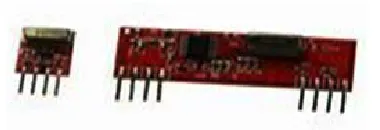
modules as shown in Fig: 3 are very small in size and they have an operating voltage range of 3-12V and a frequency of 433MHZ. A data as a string or an integer can be sent using these transceivers. Both the transmitter and the receiver are interfaced to the arduino. In our project they are meant to send the name of the section.
SD card adapter
A module compatible for micro SD card is the SD card adapter. This module will expand the capability of memory of arduino and is very compatible with it. It has a Serial Peripheral Interface (SPI) and 5V power. The SD card in our
project stores all the audio files like the name of
the product, the name of the section and also the instructions to follow in order to navigate through all the sections.
Arduino UNO
An arduino UNO is a microcontroller board based on ATmega328. It is an open source electronics platform which can be used to read data from sensors, output any data to transmitters to transmit data and to store data that can be read later. It can be used for creating interactive objects. It has 14 digital and 6 analog pins. Arduino UNO shown in Fig: 4 can be programmed with the Arduino Integrated Development Environment. In the proposed system Arduino is used to store the data read by the reader to compare the input
received from reader and retrieve the appropriate
file from the SD card. It reads the switch input
and sends the Tag id of the product selected by the customer to the billing section PC through Zigbee.
Zigbee module
Zigbee (IEEE 802.15.4) as depicted in
Fig: 5 operates on physical radio specification and
operates in unlicensed bands including 2.4 GHz, 900 MHz and 868 MHz. Zigbee is a technology that deals with data transfer in wireless networks. It consumes less energy and it operates at a voltage of 3.3V. Its application includes multi-channel control, lighting control, alarm systems and various home and industrial applications. The security provided by Zigbee is strong and robust. The range of Zigbee is 10-100 meters.
Switch
A pushbutton uses a simple switch mechanism. They are mostly biased switches. A switch in our project is used to know whether the user is in need of the product or not. When the customer pushes the button then it means that he is need of the product heard from earphone and the tag id is transferred using Zigbee to the billing PC and the product will be added in the bill.
System Architecture And Experimental Setup
As the customer enters into the supermarket, the setup gloves embedded with RFID reader, RF receiver, SD card adapter, a switch, Zigbee module is given to the customer.
Fig. 1. Passive RFID Tag-125KHZ Fig. 2. RFID Reader
Fig. 5. Zigbee Module
Fig. 6. Block diagram for Product identification and
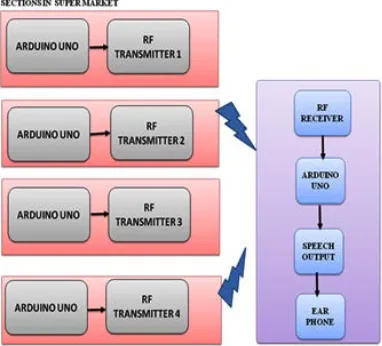
Billing Fig. 7. Block Diagram for Navigation
The customer wears it and he hears the welcome note and the sections available followed by steps to follow to reach each and every section. These are read from the SD card which is stored as audio
files as shown in Fig: 6.
On hearing the steps, the customer walks accordingly and upon reaching the section, RF transmitter sends the name of the section the customer has reached and the receiver in the gloves sends the received signal to the arduino and the
corresponding audio file is read from the SD card.
Now the customer passes through each aisle and the reader reads the tag attached to each shelf on placing the hand near the reader. Fig: 7 depicts the block diagram for Navigation through various sections.
The reader sends the tag id to the arduino
and the arduino calls the audio file from SD card
and then it is played through the speaker. If the
customer is in need of the product he heard, he must press the switch so that the tag id of the product is sent from the arduino to the billing section PC through the Zigbee attached to the gloves.
Now the Zigbee connected to the PC receives the tag id. The tag id is given as input to retrieve the product information that matches this tag id and will be added up for billing.
RESULTS AND DISCUSSION
Product Identification
Model of a shelf is made and the tag ids denoting the product id of each and every product is placed in each shelf. When a visually impaired customer enters the shopping market, a welcome note and also directions to go to every section is read from the SD card by the arduino and played
as an audio file through earphone.
In our prototype we have 5 tag ids denoting the product ids. These identities are unique and hence are placed at each shelf. These shelves have products of same kind. We had 5 RFIDs denoting the products Boost, Ponds talcum Powder, Ariel detergent powder, Good day biscuit, Bru Coffee Powder. The obtained output is shown in Fig: 8.
As the gloves was kept near the RFID tag
kept in the shelf the corresponding audio file was
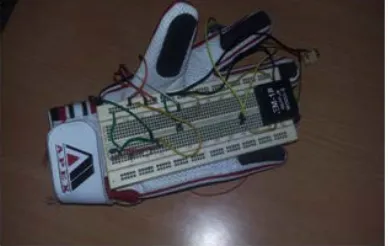
Fig. 9. Front View of designed Gloves
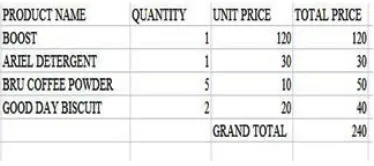
Fig. 10. Rear View of designed Gloves Fig. 11. Cart details table
Fig. 12. Assigning user ID to store product details to the customer’s cart Fig. 8. Output obtained by reading tags attached to
shelves
day biscuit, when the gloves is brought near the tag
then the audio file saying “GOOD DAY BISCUIT”
is played through the speaker.
Navigation
As the customer enters the supermarket, the arrangement of each section and also the steps
to navigate to every section in the supermarket is
played as audio file. After hearing the directions,
In order to confirm the name of the section the RF transmitter is placed at section ends. RF receivers are interfaced with the arduino and the section name is transmitted and the
corresponding audio file is read from the SD card
and is played through the earphone. For example when the customer moves near the Cosmetics section the transmitter transmits it and the string is
received by the RF receiver and the file containing “COSMETICS SECTION” is played through the
speaker. Fig: 9 and Fig: 10 provides the front and rear view of designed hand gloves.
Billing
The customer now gets a clear idea to navigate through the aisles and also to read the tags in the shelves. To purchase the product the customer heard recently, he/she has to press the switch interfaced with the arduino.
On pressing the switch the device id and RFID tag id of the product is sent from the customer side through Zigbee and is received by the receiver Zigbee connected to the billing section PC.
The tables namely cart details, cart product details, product details, customer details are created using My SQL as described in Fig: 11 and the customer details and product details are maintained in the database. Using .NET the queries to insert and update tables was written. As the device id is received, the device id and status
of the device are retrieved from the table “CART DETAILS” and the status is checked. If the status
bit equals zero then the device can be used for the new customer.
Next the cart id is taken from the table
“CART DETAILS” and the cart id, product
id received are inserted into the cart product details. For example, the device with device id
“1777” was used to send the product ids. Now
when scanning the RFID tag having the unique
id “4C006F249D9A”, the data sent over Zigbee is “1777-4C006F249D9A”. The cart id “C1” is
assigned and then the product id and the cart id
are inserted into the table “CART PRODUCT DETAILS”. Now all the details of the product
selected by the customer will be inserted in this table. Finally on clicking SUBMIT button in the form by the cashier, the entire bill is generated as in Fig: 13.
CONCLUSION
The intended objectives were successfully achieved in the prototype model developed. The developed product is easy to use, economical and does not require any special training. This model is very effective and useful for the visually impaired people. By using this fully automated product, they can stand on their own leg and they need not depend on others for shopping. It overcomes the
hesitation and giving confidence for purchasing
their shopping needs.
This system helps the visually impaired people to enjoy their shopping experience and to buy the products they wish to buy. This project highlights the use of wireless personal gadgets in
everyday life. Being specific personal gadget for product identification, navigation was designed.
It makes the better use of RFID and Zigbee technologies for providing the smart environment for the visually impaired.
As a future scope, the size and cost may get reduced further. A robot can be developed to
pick the products from the shelves and finally hand
it over to billing section so that the manual work of packing goods may be avoided. The RFID range can be increased. The system can be made in such a way that the product name spelt by the customer can be converted to text and the way to reach the corresponding shelf can be provided to the user.
REFERENCES
1. M. Mathankumar, T. Kavitha , “Design and Implementation of Smart Supermarket System for Vision Impaired”, International Journal of Engineering and Technology (IJET), Vol.5, No.1, pp.215-219, 2013.
Ayushya, Amol Bandal “Smart cart with automatic billing, product information, product recommendation using rfid and zigbee with anti-theft”, 7th International Conference on Communication, Computing and Virtualization 2016, Procedia Computer Science 79: pp. 793 – 800 (2016).
4] Abdul Malik Shaari and Nur safwati Mohammed Nor, “Position and orientation detection of stored object using rfid tags”, Advances in Material & Processing Technologies Conference, Procedia Engineering, 184: pp. 708 – 715 (2017). 5] Mr. M. Mathan Kumar, N.Sugandhi,” A low cost
smart shopping facilitator for visually impaired”, IEEE International Conferences on Computing Communications and Informatics, (2013). 6] Mr. S. Manikandan, Mr. C .Arul Murugan,
“Smart shopping facilitator for visually impaired using zigbee”, International Journal of Modern Trends in Engineering and Science (IJMTES),3: (2016).
7] Ismahene Hadj Khalifa, Abdelkader Ei Kamel, Bernard Barfety, “real time indoor intelligent navigation system inside hyper markets”, Science Direct journal, (2010).
8] Mounir Bousbia-Salah·Maamar Bettayeb·Allal Larbi, “A Navigation Aid for Blind People”, Springer Science and Business Media B.V, (2011).
9] Abboud M., Abou Jaoude L.M. and Kerbage Z. (2004), “Real Time GPS Navigation System”, proceedings, 2014.
10. Ceipidor U. B, Medaglia C. M., Serbanati A., Azzalin G., Barboni M., Rizzo F., and Sironi M.,Sesamonet,” an rfid-based economically viable navigation system for the visually impaired”, International Journal of RF
Technologies: Research and Applications, 1: (2009).
11. Rong Chen, Li Peng, Yi Qin, “Supermarket Shopping Guide System based on Internet of things,” International Conference on Wireless Sensor Network, IET, pp. 17-20: (2010). 12. Mohamed Manoufali, Ahmed Aladwani, Saif
Alseraidy and Ali Alabdouli, “Smart Guide for Blind People”, International Conference and Workshop on Current Trends in Information Technology (CTIT), IEEE, pp. 61-63, 2011. 13. Kirti Chawla, Gabriel Robins, and Liuyi
Zhang, “Object Localization Using RFID,” 5th International Symposium on Wireless Pervasive Computing (ISWPC), IEEE, pp. 301-306, 2010. 14. Xiaolin Jia1,2, Quanyuan Feng2, Taihua Fan1,
Quanshui Lei1, “RFID Technology and Its Applications in Internet of Things (IOT),”IEEE 2nd International conference on Consumer Electronics , Communications and Networks (CECNet),pp. 1282-1285, 2012.
15. Willis, S. Helal, S . Comput, “RFID information grid for blind navigation and wayfinding,” Proceedings of Ninth IEEE International Symposium on Wearable Computers, 2005. 16. Seung-Ho Baeg, Jae-Han Park, Jaehan Koh,
Kyung-Wook Park, Moon-Hong Baeg, “Building a Smart Home Environment for Service Robots Based on RFID and Sensor Networks,” International Conference on Control, Automation and Systems, pp. 1078-1082, 2007.