ISSN: 2395-3519
www.ijatca.com 26
International Journal of Advanced Trends in
Computer Applications
www.ijatca.com
A REVIEW OF FACE RECOGNITION METHODS
AND TECHNIQUES
Ridhi Gupta1, Dr. Rohit Bajaj2 1
Deptt. of CSE, Chandigarh Engg. College, Mohali, Punjab, India.
1
2
Associate Proffessor
Deptt. of CSE, Chandigarh Engg. College, Mohali, Punjab, India.
2
Abstract:
Face recognition is one of the most important biometrics which seems to be a good compromisebetween actuality and social reception and balances security and privacy well. A lot of face recognition algorithms have been developed during the past decades, their modifications which can be further evaluated with wavelet using neural network. This paper represents an analytical study of the previous implemented algorithms like PCA, or Radial Basis Function Network. This paper also discusses the pros and cons of the recognition methods.
Keywords:
AFR, (Automatic Face recognition, PCA (Principal component analysis), RBFN (radial basisfunction network).
I. INTRODUCTION
A recognition system is a computer application that is automatically used for identifying or verifying a person from a digital image. One of the best ways to do this is by comparing selected facial features from the image to a facial database. Face recognition is a natural and straight forward biometric method that is used by us to identify one another [1, 2]. The current interest in face recognition can be lead to the use of latest techniques insecurity and surveillances. People want more secure methods to protect their valuable information from unauthorized users. A recognition method involves a procedure which includes the feature extraction, training of the network and then testing of the provided data.
Basic Face recognition model is given below. Fig.1.1 Face recognition model.
Face recognition procedure generally consists of main three steps:
ISSN: 2395-3519
www.ijatca.com 27 expected outputs of this step are patches containing
each face in the input image.
Feature Extraction: After the face detection step, human-face features are extracted from images. Directly using these features for face recognition have some disadvantages, as each patch usually contains over 1000 pixels that are too large to build a robust recognition system. Also face features may be taken from different camera alignments, with different face
expressions, illuminations. To overcome these
drawbacks, feature extractions are performed to do information packing, dimension reduction, salience extraction, and noise cleaning. Face features are usually transformed into a vector with fixed dimension.
Face Recognition: Last step is to recognize the identities of these faces. In order to achieve automatic recognition, a face database is required to build. For each person, several images are taken and their features are extracted and stored in the database. Then when an input face image comes in, perform face detection and feature extraction, and compare its feature to each face class stored in the database. There are two general applications of face recognition, one is called identification and another one is called verification.
1. Verification: When a face image is presented for knowing the identity of a person that who, he/she is the person, its identity. Verification is done by one-to-one matching.
2. Identification: From an image of an unknown individual the identity of a person is determined by comparing (possibly after encoding) that image with a database of (possibly encoded) images of known individuals. Identification is done form one-to-many matching. Face verification is a 1:1 match that compares a face images against a template face images, whose identity being claimed .On the contrary, face identification is a 1: N problem that compares a face image against all image templates from a face database in a query [3].
Face recognition Algorithms
Face recognition algorithms can be classified as either geometry based or template based algorithms [4]. The template based methods compare the input image with a set of templates. Many face recognition algorithms include some template matching techniques.
.
Figure1.2.Face recognition patterns [14]
A template matching process uses pixels, samples, models or textures as pattern as shown in figure.1.2 .The recognition function computes the differences between these features and the stored templates. It uses correlation or distance measures. Although the matching of 2D images was the early trend, nowadays 3D templates are more common.
In Appearances method a face is represent in terms of several raw intensity images. An image is considered as a high-dimensional vector. Then statistical techniques are usually used to derive a feature space from the image distribution. The sample image is compared to the training set.
Appearances methods can be classified as linear or non-linear; while model-based methods can be 2D or 3D [5].Linear appearances-based methods perform a linear dimension reduction. The face vectors are projected to the basis vectors, the projection coefficients are used as the feature representation of each face image. Examples of this approach are PCA, LDA or ICA. Non-linear appearances methods are more complicate. In fact, linear subspace analysis is an approximation of a nonlinear manifold. Kernel PCA (KPCA) is a method widely used [6].
In statistical approach, each image is represented in terms of d features. So, it’s viewed as a point (vector) in a d-dimensional space. The dimensionality -number of coordinates needed to specify a data point- of this data is too high. Therefore, the goal is to choose and apply the right statistical tool for extraction and analysis of the underlying manifold. These tools must define the embedded face space in the image space and extract the basis functions from the face space. . Some of them are embedded into bigger systems, or they are just a part of a recognition algorithm. Many of them can be found along classification methods like a DCT embedded in a Bayesian Network or a Gabor Wavelet used with a Fuzzy Multilayer Perceptron [7].
ISSN: 2395-3519
www.ijatca.com 28 linear combinations of statistically independent data
points. Therefore, it provides independent rather that uncorrelated image representation. ICA is an alternative to PCA which provides a more powerful data representation. The ICA algorithm is performed as follows [15].
Let be the covariance matrix of an image sample X.
The ICA of X factorizes the covariance matrix into the following form
= ….1.1
Where is diagonal real positive and F transforms the original data into Z (X = FZ). The components of Z will be the most independent possible. To derive the ICA transformation F,
X = …1.2
where X and Y are derived solving the following eigen problem:
= …1.3
Then, there are rotation operations which derive
independent components minimizing mutual
information. Finally, normalization is carried out.
II. LITERATURE SURVEY
Face recognition is a one of the most both challenging and important recognition technique. In this paper, author has given an introductory survey for the face recognition technology by covering issues such as the generic framework for face recognition, factors that may affect the performance of the recognizer, and several state-of-the-art face recognition algorithms[5].
Neural network based face recognition system is proposed that can recognize even with complex backgrounds, illumination and clutter. To achieve face recognition Robust PCA (Principal component analysis) and Modified RBFN are used. The complexity and dimensionality is reduced by Robust PCA and RBFN (radial basis function network) that gives better speed when compared with native neural methods, so this method gives better result in real time systems [8].
A new framework for face recognition is developed by combining two algorithms: adaptive binning and ada boost. This system is tested with a larger database and the results show better identification of face with better efficiency. The feature i.e. space and execution time of this framework is reduced drastically compared with the other face recognition systems. This new framework is
experimentally verified with FERET and found that the recognition rate of the system is improved [9].A new scheme for automatic face recognition (AFR) is proposed. LDA-based feature extraction for face recognition is proposed and tested. Several results on face recognition are presented, in which highly competitive recognition accuracies are achieved with a small number of features. The feature extraction can be applied to WT representation of images to provide a multiscale discriminant framework [10].
Local Binary Patterns (LBPs) is a popular technique for face recognition. Its non-parametric kernel summarizes the local special structure of an image and it is invariant to monotonic gray-scale transformations. Here, we describe the LBP have some limitations that it is not suitable for shadow images and low contrasted images. To overcome those problems new approach is proposed of 2D principles of component analysis (2D-pca) for extracting the facial features of an image .own data bases is used for extracting the facial features [11].
A number of face databases available in the public domain and several published performance evaluation results are digested. Method is proposed for a face recognition system based on local features. Interesting feature points in the face image are located by Gabor filters, by which feature points are located at positions consisting of Gabor coefficients consisting of Gabor coefficients with high facial features [12].
A novel and efficient facial image representation technique is proposed on the bases on local binary pattern (LBP) texture features. In this method the face image is divided into several regions from which the
LBP feature distributions are extracted and
concatenated into an enhanced feature vector that can be used as a face descriptor [13].
Face recognition has been one of the most interesting and important research fields in the due to its need in automatic recognitions and surveillance systems, and the interest in human visual system on face recognition, and the design of human-computer interface, etc.
ISSN: 2395-3519
www.ijatca.com 29
III. NEURAL NETWORK AS A
CLASSFIER
Neural Network is one of the most advance classifier available now these days. A neural network is consisted of three layers namely Input Layer, Hidden Layer and the Output Layer. Each Layer has its significance and work. The input layer is used to provide the input to the architecture of the neural network and the hidden layer is used to process the input architecture of the data provided. The hidden layer works with Neurons and to proceed data with neurons the data must be changed into a format which a neuron can understand. The neurons get the data in form of weights and they combine the weights with the target set and hence in such a manner the neural network is trained. The trained network is then stored in the net object and then the testing is done. The following diagram explains the architecture of the Neural Network.
Figure no:1.3 Neural Network
The above diagram [16] refers to the explained Neural Network described as above.
The following table briefs some of the advantages and disadvantages of the techniques discussed above
CLASSIFIER Iterative Rando mizatio n
Artificial Intellige nce
Area Impact
PCA 1 1 0 1
ICA 1 1 0 1
NEURAL 1 1 1 0
Table 1.1 representing Classifiers
The above table represents a general classification comparison based on few parameters which are explained as below.
A) Iterative: Iterative means that the classifier does not conclude the result in one shot, it takes
several iterations to compute the best according to the fitness function designed to it.
B) Randomization: Almost every classifier first picks up a random variable to initialize the process of optimization or classification.
C) Artificial Intelligence: It refers to the term of dealing unknown objects or data.
D) Area Impact: Refers to weather the algorithm is bounded to a limited amount of data or not. Or Increase of data puts an impact over the processing or not.
0-FALSE
1-TRUE
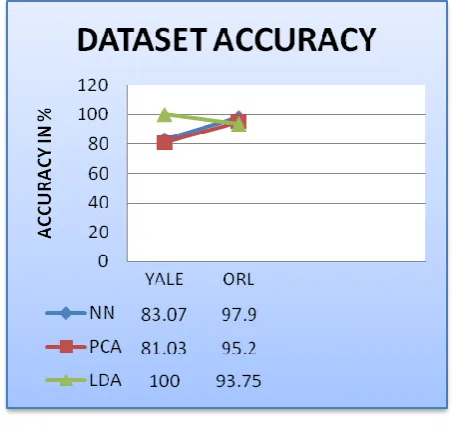
The table provided following describes the accuracy of different classifiers with different data sets[17] in which the author D.T.Meva et.al has tried to sum up all the available good classifiers in the same contrast.
DB NN PCA LDA MRF
YALE 83.07 81.03 100 99.33
ORL 97.90 95.20 93.75 96.75
Table 1.2: Representing accuracies
Figure no. 1.4: Dataset Accuracy
ISSN: 2395-3519
www.ijatca.com 30 accuracy of the classifiers is not consistent, it varies
from one dataset to another.
CONCULSION
In recent years face recognition has received major attention from both research communities and the market, but it is still remained very challenging in real applications. A lot of face recognition algorithms, using different feature extraction, different classifiers along with their modifications, have been developed during the past decades. This paper describes the general terms of few of the optimization or classification algorithm including ICA, PCA and NEURAL NETWORK and list out the advantages and disadvantages of the algorithms. There are a lot of other methods which could be a part of the research like SIFT algorithm, Support Vector Machines.
REFERENCES
1. W. Zhao, R. Chellappa, A. Rosenfeld, P.J. Phillips (2003),”Face Recognition: A Literature Survey”, ACM Computing Surveys, pp. 399-458.
2. LinLin Shen and Li Bai (2005) “A review on
Gabor wavelets for face recognition”, Revision submitted, Pattern Analysis and Application, 2005.
3. X.D. Jiang, B. Mandal, and A. Kot, “Eigenfeature regularization and extraction in face recognition,” Pattern Analysis and Machine Intelligence,IEEE Transactions on, vol. 30, no. 3, pp. 383–394, March 2008.
4. R. Gross, J. Shi, and J. Cohn. Quo vadis face recognition? - the currentstate of the art in face
recognition. Technical report, Robotics
Institute,Carnegie Mellon University, Pittsburgh, PA, USA, June 2001.
5. Xiaoguang Lu, “Image Analysis for Face
Recognition”, pp.1-37.
6. B.Moghaddam, “Principal manifolds and
probabilistic subspaces for visual recognition. IEEE Transactions on Pattern Analysis and Machine Intelligence”, 24(6):780–788, June 2002.
7. D. Bhattacharjee(et.al), “Human face recognition
using fuzzy multilayer perceptron. Soft Computing - AFusion of Foundations, Methodologies and Applications”, 14(6):559–570,April 2009.
8.KesavaRao Seerapu(et.al), “Face Recognition using
Roubst PCA and radial basis function network”, International Journal of Computer Science & Communication Networks,Vol 2(5), 584-589.
9.Srinivasan A, “A frame work for face recognition
using adaptive binning and adaboost techniques”, The International Journal of Multimedia & Its
Applications (IJMA) Vol.3, No.1,pp.76-88,
February 2011.
10. Kamran Etemad, “Discriminant analysis for
recognition of human Face images” , J. Opt. Soc. Am. A/ Vol. 14, No. 8/August 1997.
11. C.Nagaraju , “An efficient Facial Features
extraction Technique for Face Recognition system Using Local Binary Patterns” , International Journal of Innovative Technology and Exploring Engineering (IJITEE) ISSN: 2278-3075, Volume-2, Issue-6, May 2013.
12. LinLin Shen and Li Bai (2005) “A review on Gabor
wavelets for face recognition”, Revision submitted, Pattern Analysis and Application, 2005.
13. TimoAhonen(et.al),“FaceDescription with Local
Binary Patterns: Application to Face Recognition”, IEEE Transaction on Pattern Analysis and Machine Intelligence, Vol. 28, No. 12, December 2006
14. Shang-Hung Lin, “An Introduction to Face
Recognition Technology”, , ,Information Science,
Special Issues on multimedia, Part2,
Vol.3.no1.,2000.
15. P. Comon, “Independent component analysis, a new
concept? Signal Processing” 36:287–314, 1994
16. https://www.google.co.in/search?q=Neural+Networ
k&biw=1366&bih=657&source=lnms&tbm=isch& sa=X&ei=M0_HVJm4I4ru8gWX9ILgCw&ved=0 CAcQ_AUoAg#imgdii=_&imgrc=oZ0L7iwvPEG7 HM%253A%3BNhaOytSjpEHJPM%3Bhttp%253 A%252F%252Fwww.texample.net%252Fmedia%2 52Ftikz%252Fexamples%252FPNG%252Fneural-network.png%3Bhttp%253A%252F%252Fwww.te xample.net%252Ftikz%252Fexamples%252Fneura l-network%252F%3B500%3B309