Original Research Article
Uptake of routine growth monitoring among children under 9 months in
Nyamira County, Kenya
Edna Nyanchama Nyang’echi
1*, Andre Yitambe
1, Kenneth Kibaraa Rucha
1, Justus O. S. Osero
2INTRODUCTION
Growth monitoring is the serial weighing and measuring of the length/height and head circumference (if child is less than 2 years old) of a child and graphing both measurements on a growth chart.1 Routine growth monitoring offers an opportunity for various discussions including breastfeeding, healthy eating and active living with children, prompt detection of problems in children,
preventive and promotive care.2 It is important to routinely monitor the growth of children below two years using all the three WHO recommended measurements including age, length-for-age and weight-for-length as well as head circumference since they enable identification of problems such as underlying chronic diseases, feeding practices and recent and sudden illnesses.3 Growth failure among children aged 0-24 months has critical lifetime consequences.4 Caregivers in
ABSTRACT
Background: The health and nutritional status of children can be assessed through routine growth monitoring (RGM). This provides opportunities for implementation of interventions aimed at reducing under five mortality rates, infectious diseases and malnutrition. The objective of the study was to find out the level of uptake of routine growth monitoring among caregivers of children aged below 9 months in Nyamira County, Kenya.
Methods: This was a cross-sectional study.
Results: Only 21.1% of the caregivers consistently took their children for RGM. About 78.9% of caregivers had skipped RGM visits for their children in the last eight months at least once or more. About 45.8% of caregivers skipped RGM visits twice, 31.7% thrice, 20.4% once and 2.1% skipped four times. Uptake of RGM was not significantly associated with caregivers’ level of education (p=0.052), marital status (p=0.099), occupation (p=0.081), monthly income (p=0.941), distance to nearby health facility (p=0.774) and place of residence (p=0.330). Caregivers who skipped RGM visits gave various reasons including forgetting to come again dates (91.5%), child not sick (77.5%), healthcare providers advising them not to go for RGM since there was no scheduled vaccination (67.6%), among others.
Conclusions: There is need for healthcare providers capacity building on their role in improving RGM since most of them discourage caregivers unless for those with scheduled immunization. Policy makers and implementers in the health sector should formulate relevant policies especially targeted at reminding caregivers on monthly RGM for their children aged below 9 months.
Keywords: Routine, Growth monitoring, Children, Health, Nutrition
1Department of Health Management and Informatics, 2Department of Community Health and Epidemiology, School of
Public Health and Applied Human Sciences, Kenyatta University, Kenya
Received: 13 September 2019
Revised: 12 October 2019
Accepted: 02 December 2019
*Correspondence:
Dr. Edna Nyanchama Nyang’echi, E-mail: [email protected]
Copyright: © the author(s), publisher and licensee Medip Academy. This is an open-access article distributed under the terms of the Creative Commons Attribution Non-Commercial License, which permits unrestricted non-commercial use, distribution, and reproduction in any medium, provided the original work is properly cited.
the rural areas of Ethiopia gave various reasons on why they missed growth monitoring sessions as scheduled in their children’s clinic cards including: workload, child not sick to seek care and health workers not telling them to attend these sessions.5 A study done in Ghana found out that routine growth monitoring among children offered an opportunity for implementation of interventions aimed at reducing under five mortality rates, infectious diseases and malnutrition.6 Majority (98.1%) of mothers in Ghana believed that taking their children monthly to the clinic for weight measurement was important.7 A study by conducted in Kiambu County, Kenya found out that there was low utilization of growth monitoring services among children aged 12-59 months.8 In Nyamira County, only 39% of children aged 6-59 months received Vitamin A supplementation and 13% of them are stunted.9 This is most likely due to low uptake of routine growth monitoring (RGM) in the County. This study therefore aimed at determining the level of uptake of RGM among caregivers of children aged below 9 months in Nyamira County, Kenya.
METHODS
This was a cross-sectional study involving caregivers of children aged below 9 months in Nyamira County, Kenya. Nyamira County was selected using purposive sampling since it has same characteristics just like any other County in Kenya. The study was conducted for two months between December 2018 and February 2019. Questionnaires with both closed and open-ended questions were used to obtain information from the 180 caregivers involved in the study. Approval to conduct the study was obtained from Kenyatta University Graduate School. Ethical clearance was obtained from Kenyatta University Ethics and Review Committee. Research permit was sought from national commission for science, technology and innovation (NACOSTI). Further approval was sought from ethics and review committee in Nyamira County. The study sought informed consent from the respondents before proceeding with the research. Statistical package for social sciences (SPSS) version 23 was used for the analysis of the quantitative data collected
and chi-square test was used to test the relationship between the dependent and independent variables and the relationship was deemed significant when p value was less than 0.05 at 95% confidence level. Content analysis was done for qualitative data and similar categories of data arranged into sub-themes and themes. Results were then presented as narrations or direct quotes which were then triangulated with the quantitative data.
RESULTS
Socio-demographic and economic characteristics of the study participants
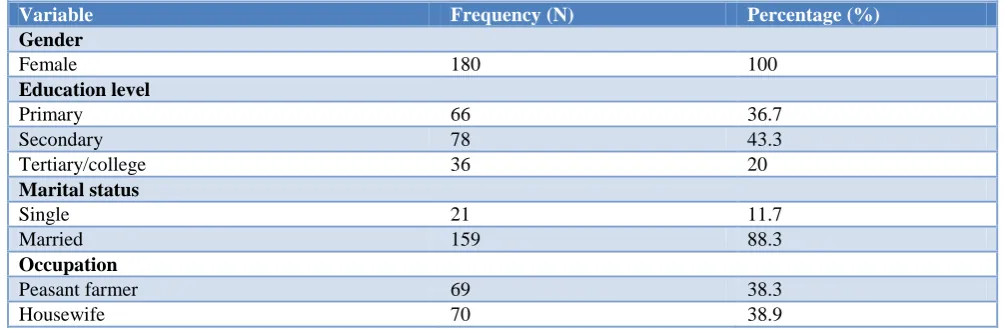
The study results revealed that the general mean age of the caregivers was 26 years, minimum age 15 years while maximum age was 38 years with majority of them aged 26 years (Table 1). Study results showed that 100% of the caregivers were female (Table 2). More than 80% of the caregivers were married (Table 2). The study results showed that 38.9% of the caregivers were housewives, 38.3% peasant farmers, 16.1% business persons and 6.7% employed (Table 2). About 43.3% of the caregivers earned a monthly income of less than KSh. 5 000 and 37.2% of them were dependents (Table 2). About 50.6% of the children were female and 49.4% male (Table 2).
Table 1: Caregivers’ age (n=180)
Variable Count
Age (years)
Mean 26
Mode 26
Minimum 15
Maximum 38
Accessibility to health facility and place of residence of caregivers
Most of the caregivers (62.2%) accessed their health facilities within a radius of between 2-5 km (Table 3). Majority of the study participants (63.3%) resided in their rural areas (Table 3).
Table 2: Socio-demographic and economic characteristics of the study participants (n=180).
Variable Frequency (N) Percentage (%)
Gender
Female 180 100
Education level
Primary 66 36.7
Secondary 78 43.3
Tertiary/college 36 20
Marital status
Single 21 11.7
Married 159 88.3
Occupation
Peasant farmer 69 38.3
Housewife 70 38.9
Variable Frequency (N) Percentage (%)
Business person 29 16.1
Employed 12 6.7
Monthly income (in KSh.)
<5000 78 43.3
5000-10000 21 11.7
>10000 15 8.3
None 67 37.2
Gender of child
Female 91 50.6
Male 89 49.4
Table 3: Place of residence of caregivers and accessibility to health facility (n=180).
Variable Frequency (N) Percentage (%)
Distance from caregivers’ residence to health facility (km)
<2 45 25
2-5 112 62.2
>5 23 12.8
Place of residence of caregivers
Rural 114 63.3
Urban 66 36.7
Level of uptake ofroutine growth monitoring
Since this was a health facility-based study done at the 9th month when children were receiving measles 1 vaccine, all the caregivers (100%) had taken their children for regular growth monitoring at least once.
Proportion of caregivers who consistently took their children for RGM in the last eight months
The study revealed that only 21.11% of the caregivers who consistently took their children for RGM. About 78.9% of the caregivers were not consistent in taking their children for RGM (Figure 1).
Figure 1: Proportion of caregivers who took their children for RGM for the last eight months.
Proportion of caregivers who skipped RGM visits for the last eight months
The study revealed that 78.9% of caregivers skipped RGM visits for their children in the last eight months
(Figure 1). The study established that there was no significant association between; caregivers’ level of education and skipping RGM visits ((χ²=9.132; df=4; p=0.052); caregivers’ occupation and skipping RGM visits (χ²=6.706; df=3; p=0.081); caregivers’ monthly income and skipping RGM visits (χ²=0.492; df=4; p=0.941); distance from caregivers’ place of residence and skipping RGM visits (χ²=0.514; df=2; p=0.774) (Table 4).
Figure 2: Number of times caregivers skipped RGM visits for the last eight months.
Number of times caregivers skipped RGM visits for the last eight months
When the caregivers who had skipped RGM for their children were asked to indicate the number of times they had skipped RGM visits for the last 8 months, 45.8%
Not Skipped
RGM, 21.1%
Skipped RGM ,
78.9% 0.0%
5.0% 10.0% 15.0% 20.0% 25.0% 30.0% 35.0% 40.0% 45.0% 50.0%
Once Twice Thrice Four times
20.4%
45.8%
31.7%
2.1%
Per
ce
n
ta
g
e
(%
)
reported to have skipped twice, 31.7% thrice, 20.4% once and 2.1% four times (Figure 2). The study established that there was no significant association between; caregivers’ level of education and the number of times they skipped RGM visits (p=0.064); caregivers’ marital status and the number of times they skipped RGM visits (χ²=6.041; df=3; p=0.099); caregivers’ occupation and the number of times they skipped RGM visits (p=0.882); caregivers’ monthly income and the number of times they skipped (p=0.063); distance from caregivers’ place of residence and the number of times they skipped RGM visits (p=0.442); caregivers’ place of residence and the number of times they skipped RGM visits (χ²=3.381; df=3;
p=0.330); gender of the child and the number of times they skipped RGM visits (χ²=4.592; df=3; p=0.208) (Table 5).
Caregivers’ reasons for skipping RGM
The study revealed several reasons why caregivers skipped RGM visits. Majority of the caregivers (91.5%) said that they forgot “To Come Again” (TCA) dates. Other reasons given included; children were not sick to be taken for RGM visits (77.5%), Healthcare provider said there was no need since no vaccine was scheduled (67.6%) among other reasons (Table 6).
Table 4: Relationship between socio-demographic, economic characteristics of the study participants and skipping RGM visits.
Socio-demographic/economic characteristics
Skipping RGM visits Significance
Yes No
N (%) N (%)
Education level
χ²=9.132; df=4; p=0.052
Primary 54 (81.8) 12 (18.2)
Secondary 66 (84.6) 12 (15.4)
Tertiary/college 22 (61.1) 14 (38.9)
Occupation
χ²=6.706; df=3; p=0.081 Peasant farmer 55 (79.7) 14 (20.3)
Housewife 58 (82.9) 12 (17.1)
Business person 23 (79.3) 6 (20.7)
Employed 6 (50) 6 (50)
Monthly income (in KSh.)
χ²=0.492; df=4; p=0.941
<5000 61 (79.2) 17 (22.1)
5000-10000 16 (76.2) 5 (23.8)
>10000 11 (73.3) 4 (26.7)
None 54 (80.6) 13 (19.4)
Distance from caregivers’ residence to health facility (km)
χ²=0.514; df=2; p=0.774
<2 34 (75.6) 11 (24.4)
2-5 89 (79.5) 23 (20.5)
>5 19 (82.6) 4 (17.4)
Table 5: Relationship between socio-demographic, economic characteristics of the study participants and the number of times caregivers skipped RGM visits.
Socio-demographic/ economic characteristics
Number of times caregivers skipped RGM visits Significance
Once Twice Thrice Four times
N (%) N (%) N (%) N (%)
Education level
p=0.064* Primary 5 (9.3) 30 (55.6) 17 (31.5) 2 (3.7)
Secondary 18 (27.3) 29 (43.9) 18 (27.3) 18 (28.3) Tertiary/college 6 (27.3) 6 (27.3) 10 (45.5) 0 (0)
Occupation
p=0.882* Peasant farmer 11 (20) 24 (43.6) 19 (34.5) 1 (1.8)
Housewife 11 (19) 28 (48.3) 17 (29.3) 2 (3.4) Business person 5 (2.2) 12 (52.2) 6 (26.1) 0 (0) Employed 2 (33.3) 1 (16.7) 3 (50) 0 (0)
Marital status
Single 0 (0) 10 (58.8) 6 (35.3) 1 (5.9) Married 29 (23.2) 55 (44) 39 (31.2) 2 (1.6)
Socio-demographic/ economic characteristics
Number of times caregivers skipped RGM visits Significance
Once Twice Thrice Four times
N (%) N (%) N (%) N (%)
Monthly income (in KSh.)
p=0.063* <5000 13 (21.3) 30 (49.2) 15(24.6) 3 (4.9)
5000-10000 0 (0) 11(68.8) 5 (31.2) 0 (0) >10000 4 (36.4) 2 (18.2) 5 (45.5) 0 (0) None 12 (22.2) 22 (40.7) 20 (37) 0 (0)
Distance from caregivers’ residence to health facility (km)
p=0.442* <2 6 (17.6) 16 (47.1) 12 (35.3) 0 (0)
2-5 20 (22.7) 40 (45.5) 28 (31.8) 1 (1.1) >5 3 (15.8) 9 (47.4) 5 (26.3) 2 (10.5)
Caregivers’ place of residence
χ²=3.381; df=3; p=0.330 Rural 22 (23.2) 40 (42.1) 30 (31.2) 3 (3.2)
Urban 7 (14.9) 25 (53.2) 15 (31.9) 0 (0)
Gender of child
χ²=4.592; df=3; p=0.208 Male 16 (22.9) 29 (41.4) 25 (35.7) 0 (0)
Female 13 (18.1) 36 (50) 20 (27.8) 3 (4.2)
*Fisher exact test.
Table 6: Caregivers’ reasons for skipping RGM visits for the last eight months (n=142).
Reasons for skipping RGM visits Frequency (N) Percentage (%)
Forgot TCA 130 91.5
My child was not sick 110 77.5
Healthcare provider said there was no need since no vaccine was scheduled 96 67.6
Healthcare provider did not say 90 63.8
I did not find reason for doing it 84 59.2
I had a busy schedule at home/work 80 56.3
Health facility is far 60 42.3
Striking nurses 56 39.4
My partner is not supportive 45 31.7
Healthcare provider sent me back because I went a day prior to TCA 15 10.6
DISCUSSION
Socio-demographic characteristics of the study participants
Overall, a total of 180 caregivers were enrolled into the study. The study results revealed that majority of the caregivers were aged 26 years. This is consistent to a similar study done in Nyamira County, Kenya which found out that majority of the mothers of children 10-59 months who attended RGM were aged between 21-26 years.10 This study found out that all the caregivers (100%) who participated in the study were female. This finding agrees to another study done in Ethiopia which revealed that 92.3% of the caregivers were biological mothers of the children.11 The study revealed that majority (88.3%) of the caregivers was married. This agrees to the findings of previous studies which found out that more than half of the mothers who take their children for RGM visits are married.10-12 These findings could be because partners in marriage tend to encourage one another to take their children for monthly growth monitoring.
Uptake of RGM among caregivers of children aged below 9 months
caregivers gave various reasons on why they missed growth monitoring sessions as scheduled in their children’s clinic cards including: workload, child not sick to seek care and health workers not telling them to attend these sessions.5 A similar study conducted in Zambia also revealed that growth monitoring had performed poorly because of various reasons such as weak monitoring and supervision, lack of motivational package attached to the growth monitoring programme and poor practices among health workers.15
CONCLUSION
The study found out that uptake of RGM was low with only 21.1% of the caregivers taking their children for RGM. One of the major factors contributing to low uptake of RGM was caregivers forgetting TCA dates. Policy makers and implementers in the health sector should formulate relevant policies especially targeted at reminding caregivers on monthly RGM for their children aged below 9 months.
ACKNOWLEDGEMENTS
Our special gratitude goes to all persons who worked with us to ensure success of this work. We are greatly indebted to the Management of Nyamira County, Ministry of Health for allowing us to collect data from the various health facilities in the County and all the caregivers who accepted to be part and parcel of the study giving us sincere information making the study possible. We thank you all.
Funding: No funding sources Conflict of interest: None declared
Ethical approval: The study was approved by the Institutional Ethics Committee
REFERENCES
1. Griffiths M, Dickin E, Favin M. Promoting the Growth of Children: What Works. World Bank Nutrition Toolkit. The Human Development Department, The World Bank; 1996.
2. Dona S. Promoting Optimal Monitoring of Child Growth in Canada Using the New WHO Growth Charts. Dietitians of Canada & Canadian Paediatric Society; 2010.
3. British Columbia. World Health Organization Growth Chart Training. Ministry of Health; 2011. 4. World Health Organization. Essential Nutrition
Actions: Improving Maternal, Newborn, Infant and Young Child Health and Nutrition. WHO Press, Geneva Switzerland; 2013.
5. Feleke FW, Anato AA, Bezabih A. Utilization of Growth Monitoring and Promotion Services and Associated Factors among under two years of age Children in Southern Ethiopia. PLoS. 2017;12:5. 6. Debuo DT, Kubi AP, Kweku M, Asalu AG, Ahiab
SY, Kwami TW, et al. Caregivers’ Knowledge, Attitude and Practices on Child Growth Monitoring and Promotion Activities in Lawra District, Upper West Region of Ghana. Sci J Public Health. 2017;5:1.
7. Gyampoh S, Otoo G, Aryeetey R. Child feeding knowledge and practices among women participating in GMP in Accra, Ghana. BMC Pregnancy Childbirth. 2014;14:180.
8. Mwari KL, Keraka M, Simbauni J. Care Giver Determinants of Utilization of Growth Monitoring Clinic among Children Aged 12-59 Months in Urban Kiambu County, Kenya. Int J Innov Res Adv Studies. 2017;4(6):334-8.
9. Nyamira County Government. First County Integrated Development Plan. Nyamira County, Kenya; 2017.
10. Nyabuti I J. Factors Associated with the Continuation of Growth Monitoring among Children 10-59 months in Nyamira County, Kenya; 2015. 11. Worku A. Prevalence of childhood illness and
mothers’/caregivers’ care seeking behavior in Bahir Dar, Ethiopia: A descriptive community-based cross-sectional study. Open J Prev Med. 2013;3(2):155-9.
12. Kwambai TK, Dellicour S, Desai M, Ameh CA, Person B, Achieng F, et al. Perspectives of men on antenatal and delivery care service utilization in rural western Kenya: a qualitative study. BMC Pregnancy and Childbirth. 2013;13:134.
13. Agbozo F, Esi, C, Jahn A, Timothy G. Understanding why child welfare clinic attendance and growth of children in the nutrition surveillance programme is below target: lessons learnt from a mixed methods study in Ghana. BMC Nursing. 2018;17-25.
14. Scherdel P, Jean FS, Marie N, Laura R, Gabriella P, Elke J, et al. Growth Monitoring: A Survey of Current Practices of Primary Care Paediatricians in Europe. PLoS ONE. 2013;8:8.
15. Charlton KE, Kawana BM, Hendricks MK. An assessment of the effectiveness of growth monitoring and promotion practices in the Lusaka district of Zambia. Nutrition, 2009;25(10):1035–46.
Cite this article as: Nyang’echi EN, Yitambe A,
Rucha KK, Osero JOS.Uptake of routine growth monitoring among children under 9 months in