Towards functional school libraries: supporting library
assistants in under-resourced schools through a
university-community-school partnership
Patti Silbert
1and Constance Bitso
2[email protected] ORCID orcid.org/0000-0001-8970-8715:
[email protected] ORCID: orcid.org/0000-0003-4727-1257
Received 20 July 2015 Accepted: 4 August 2015
This article reports on an ongoing study on building a collaborative support model for library assistants in a group of schools in the Western Cape township of Khayelitsha through a university-community-school partnership. The Cascading Support Model was conceptualised as a community of practice between the University of Cape Town’s Schools Improvement Initiative, UCT’s Library and Information Studies Centre, The Bookery and a group of schools in Khayelitsha. Given the complexity of challenges facing schools in impoverished communities, this collaborative model is presented as a strategy to support library assistants in creating functional school libraries. Using a qualitative, interpretive approach, the study employs an ethnographic research method to describe the collaborative support model offered through the community of practice. The results show that universities are well positioned through their partnership with community organisations and schools to help create models of support through which expertise can be harnessed and disseminated. As a support strategy for library assistants, the Cascading Support Model represents a shift from conventional mentoring models towards a wider community of practice.
Keywords: School libraries, communities of practice, university-community-school partnerships
1 Introduction
Twenty years after apartheid, there remain deep inequalities in educational achievement in South Africa, particularly with regards to literacy and numeracy levels. These disparities are demonstrated in the Annual National Assessments (Department of Basic Education 2012), the Grade 12 national school-leaving results, and the Progress in International Reading Literacy Study (PIRLS). Despite libraries being an essential resource for improved literacy (Wessels 2010; Hoskins 2006; University of Pretoria 2012), there remains a dramatic shortage of school libraries in South Africa. According to PIRLS, only 6% of South African Grade 4 learners attended schools with well-resourced libraries, while more than half of Grade 5 learners were in schools without school libraries (University of Pretoria 2012). Of the forty-nine countries participating in the study, South Africa had one of the lowest levels of library provision. The dearth of school libraries has meant that children and their teachers lack access to a critical resource base, an absence that will inevitably widen the gap of reading and literacy (University of Pretoria 2012).
This article reports on an ongoing study that focuses on building a collaborative mentoring and support model for library assistants in a group of schools in the Western Cape township of Khayelitsha. Building communities of practice through a university-community-school partnership is presented as a strategy for mentoring and supporting library assistants in poor, under-resourced schools. The model, referred to as the Cascading Support Model, was conceptualised by the University of Cape Town’s (UCT) Schools Improvement Initiative (SII), UCT’s Library and Information Studies Centre (LISC) and The Bookery, a Western Cape non-profit organisation. Through exploring interdisciplinary collaborative engagement, we describe how practices can be shaped that help support library assistants in creating functional school libraries, and how, through building communities of practice, library assistants can play a key role in developing their libraries.
The term ‘mentoring’ as used in this study describes “the support given by one (usually more experienced) person for the growth and learning of another, and for their integration into and acceptance by a specific community” (Malderez 2001: 57). The notion of support includes emotional (Rajuan, Beijaard & Verloop 2008) as well as organisational factors that contribute towards the professional development of library assistants. The term ‘library assistant’ is used to describe the role of the school librarian. Although the library assistants are solely responsible for running and managing the school libraries, they do not have formal accredited librarianship qualifications in terms of the Library and Information Association of South Africa (LIASA). In 2014, the South African Qualifications Association registered LIASA as an accredited professional body; an implication is that only library professionals with accredited qualifications may be referred to as ‘librarians’. As noted by Zinn (2006), the Department of Education is currently not budgeting for teacher-librarian post.
1. Patti Silbert is project manager of the Schools Improvement Initiative (SII) in the Schools Development Unit, School of Education, University of Cape Town.
These library assistants are employed, trained and supported through The Bookery to manage existing or new school libraries. Details of the training undertaken by the library assistants are discussed later in this paper.
2 Background
The SII was launched in 2012 as one of UCT’s strategic initiatives3
, linking the university to a number of schools in Khayelitsha4. The overarching aim of the SII is the development of a strong, responsive university-community-school partnership as a vehicle for extending the university’s engagement in schooling in order to contribute positively to long-term change in the classroom and in the broader school community. Through the SII, UCT engages practically and developmentally with the problems of schooling in South Africa. Drawing on university-wide resources and expertise, in particular those of the Schools Development Unit (SDU)5, the SII works in alliance with groupings both within and outside of the university including, significantly, the provincial education authorities. The SII’s goal of strengthening community engagement has resulted in the Initiative partnering with a number of community-based organisations committed to bringing about change in schools. One such example is the partnership with The Bookery, which represents the joint endeavour to create functional and sustainable libraries to promote reading in schools in order to strengthen language and literacy.
From the outset, the SII has acknowledged the need to adopt a holistic approach to working in schools, with a number of organising principles that go beyond simply seeking to impact positively on teaching and learning in the classroom. Through interdisciplinary collaboration and community-based partnerships, programmes have been developed in the partner primary and secondary schools involving management and organisational support; curriculum and classroom support; extra-mural support (including sports and IT development); after-school homework support; and library support.
The need for functional school libraries emerged from the partner primary schools during the preliminary needs assessment conducted by the SII in the initial stages of engagement in the schools. To this end, the SII approached LISC at UCT for expertise and technical support. Given LISC’s strategic objective to “grow partnerships in social and community engagement to advance South African development and social justice” (Library and Information Studies Centre 2012), the Centre entered into a collaboration with the SII, augmented by the involvement of The Bookery and other partners, such as Nal’ibali6
and Rotary7 which share in the long-term objective of strengthening South Africa’s literacy levels.
Established in 2010, as part of Equal Education’s8
campaign to create school libraries in under-resourced communities in the Western Cape, The Bookery became an independent non-profit organisation in 2013. Each library established by The Bookery contains a minimum of three books per learner, and caters to the needs and interests of the school’s readership through a comprehensive selection of fiction, non-fiction and reference works. To date, The Bookery has established forty-one libraries in the Western Cape with necessary resources such as a computer, shelving, tables and chairs. Its objective extends beyond library provision however, and includes capacitating library assistants to establish, manage and sustain functional school libraries.
It is the partnership between The Bookery, UCT and the schools that forms the focus of this study. Within this three-way partnership, the collaborations discussed are presented at four levels, all of which constitute important components of the Cascading Support Model:
The interdisciplinary collaboration within the university, between the SII and LISC;
The partnership between the university (SII and LISC) and The Bookery;
The partnership between the university; The Bookery and the schools;
The collaboration amongst library assistants between and beyond the SII partner schools.
The first two levels represent the staff members, namely the facilitators of the Cascading Support Model, while the fourth level represents the library assistants. The third level represents both the facilitators and the library assistants. It is
3. In addition to the SII, three other strategic initiatives were identified in 2012 by UCT’s Vice Chancellor as strategic goals to deepen UCT’s contribution to addressing South African’s development challenges. These strategic initiatives are the Poverty and Inequality Initiative; African Climate and Development Initiative; and Safety and Violence Initiative.
4. Based on the 2011 population census (Statistics South Africa 2011), the township of Khayelitsha has a population of 430 000 people. There are twenty secondary schools and thirty-five primary schools in the township. These schools fall into the Metro East Education District in the Western Cape Province of South Africa.
5. The SDU is a unit within UCTs School of Education which focuses on in-service professional development of teachers and school managers mainly through university-certified short courses and two-year Advanced Certificates in Education.
6. Nal’ibali is isiXhosa for ‘Here’s the story’ and is a national reading campaign of the Project for the Study of Alternative Education in South Africa (Praesa). One of Nal’ibali’s goals is to initiate and support reading clubs in the schools as a reading promotion strategy. Each of the four library assistants has attended a two-day training course to become Nal’ibali reading club leaders.
7. Rotary’s objective is to develop leadership skills amongst young people through the development of the Rotary EarlyAct clubs. In an attempt to align and cohere the library and reading programmes, Rotary and Nal’ibali formed a partnership in 2014. The Rotary EarlyAct Clubs were therefore amalgamated with the Nal’ibali reading clubs, which are coordinated by the library assistants who receive ongoing monthly support from Rotary and Nal’ibali.
through the community of practice that is the Cascading Support Model that the interests of the facilitators and the library assistants converge and intersect. As such, the study seeks to address the following questions:
1. How can library assistants in disadvantaged communities be supported through a community of practice?
2. To what extent can communities of practice contribute to building functional school libraries in disadvantaged communities?
3. What role can university, school and community partnerships play in the above?
The term ‘partnership’ is used in this study to refer to an established link between two or more parties, formalised through the joint signing of a Memorandum of Agreement. ‘Collaboration’, on the other hand, suggests a close, albeit it less formalised working relationship. These terms overlap in meaning and at times are used interchangeably. Their meanings in this study are discussed in more detail below, along with the notions of the university-community-school partnership and community of practice.
3 University-community-school partnerships and the South African context
Within the post-1994 South African context, numerous studies have explored partnership-based interventions that have sought to redress the inequalities inherent in disadvantaged schools as a consequence of apartheid education (Silbert, Clark & Dornbrack 2015). Sayed, Kanjee and Nkomo (2013) offer an overview of some of the broader initiatives based on different types of partnerships. However, there is far less South African research that has examined the role of university-community-school partnerships in collaborating to achieve a common goal such as library development. Islam (2011) suggests that it remains a challenge for universities and schools to find ways to engage in initiatives that are “relevant, applied and strategic” (2011: 50) and calls upon South African higher education institutions to engage in research and practices that can be utilised to produce new knowledge while improving the conditions of under-resourced communities. While, increasingly, collaborations have been forged between the public and private sectors in South Africa, university-community-school partnerships based intentionally on interdisciplinary engagement within the university for the purpose of achieving a particular objective are relatively new in this country (Silbert, Clark & Dornbrack 2015).
Locating itself within the broader university-school partnership literature (Deppeler 2006; Groundwater-Smith & Dadds 2004; Nehring & O’Brien 2012; and others), the SII has extended the two-way university-school alliance to include its community partners. This addition supports the SII’s view that, through purposeful collaboration between the university, the education district, community organisations and the schools, a deeper, more engaged support strategy could be implemented and sustained. Underpinning this partnership triad is reciprocity, mutuality and collaboration (Nehring & O’Brien 2012) to strengthen benefit and capacity at all three levels. As Corrigan (2000) points out, collaboration extends beyond cooperation and implies that something new is enabled or produced that individuals or organisations could not produce alone.
As interdependent institutions, universities, schools and community organisations enable resource sharing and unite partners to address common problems while bringing “different knowledge, skills, and dispositions” to the partnerships (Parker, Templin & Setiawan 2012). While universities offer theoretical and academic insights, schools bring the reality and expediencies of the classroom and knowledge of the learners within a particular context. Similarly, community organisations offer a contextually relevant set of expertise and strategies needed for effective and sustainable implementation (Thomas-Brow et al. 2011). On the other hand, it must be acknowledged that the divide between the “ivory tower” of the university and the “stockades” of the schools (Rakow & Robinson 1997: 64) has presented challenges that cannot be ignored in the interest of sustainable partnerships. Recognising the “ivory tower” syndrome, Thomas-Brown et al. (2011) show that working towards mutually beneficial outcomes can result in a positive and productive partnership.
Within the South African context especially, mutually beneficial partnerships between schools, universities and community organisations that are relevant to the school context and that work collaboratively towards a shared goal are crucial for sustainable reform. These partnerships are particularly important in challenged social contexts. Khayelitsha, like many other townships in South Africa, is a disadvantaged community established in the 1980s under the principle of racial segregation in an attempt to enforce the Group Areas Act. Twenty-one years after democracy, this informal township continues to suffer gross inequalities and social injustices that permeate all aspects of the community, from services to infrastructure.
As in other disadvantaged communities in South Africa, schools in Khayelitsha face a myriad of complex socio-economic challenges. High levels of crime, domestic violence and alcohol and drug abuse are directly linked to the school dropout rate (Kamper 2008; Myende 2011; Seekings 2013; and others) and feed into perpetuated cycles of poverty and unemployment. In seeking to address the impact of these challenges on schooling, the SII, together with its partners, has sought ways to ensure deeper capacitation, collaboration and sustainability, and to this end has based its partnership model on communities of practice.
3.1 Community of practice
between a group of people who deepen their knowledge, skills or expertise through ongoing interaction (Amin and Roberts 2008; Du Plessis 2008; Wenger, McDermott & Snyder 2002). It is through ongoing interaction and participation that learning occurs as an “integral and inseparable aspect of social practice” (Lave & Wenger 1991: 31). This social practice orientation involves both “self-directed” learning and “collaborative learning” (Kriner et al. 2015: 2) and involves a shift in focus from individual to collective activity. Participation in a community of practice refers therefore not just to “local events of engagement in certain activities with certain people, but to a more encompassing process of being active participants in the practices of social communities and constructing identities in relation to these communities” (Wenger 1998: 4).
Effective communities of practice go beyond active participation and require the formation of new knowledge and the sharing of best practice. Because knowledge and practice are socially constructed, new ideas can be generated through shared meaning and understanding. Participation therefore involves both action and connection, and the ability to negotiate meaning in context (Handley et al. 2006), despite differing “roles, positions and perspectives” of the members
(Foot 2014: 333). A community of practice is regarded as successful when its members “exchange specific knowledge,
practices and/or experiences that contribute to developing a practice (know-how) in a specific field” (Probst & Borzillo 2008: 337 citing McDermott 2004). Using communities of practice as a theoretical framework, we go on to describe the process of supporting library assistants in building functional school libraries.
4. Methodology
Using a qualitative, interpretive approach, the study employs an ethnographic research method providing a first-hand account of the phenomena in their natural setting. The researchers were immersed as active participants (Fetterman 2010; Maier & Thalmann 2012) in that they were both the facilitators of the cascading model and members of the communities of practice. As such, they were involved in the multi-layered partnerships and collaborations. From time to time, the facilitators had to reflect on their own roles, positions and perspectives, thus shifting the study towards auto-ethnography. This process involved critically reflecting on their own experiences “emanating from, and made possible by, being part of the study” (Ellis, Adams & Bocher 2011: 257). In addition to the facilitators’ reflections, data were also drawn from the following sources:
Monthly support meetings of library assistants and minutes from these meetings;
Monthly reports from the library assistants; and
Electronic communication.
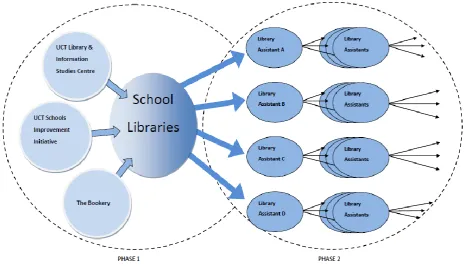
The component of the Cascading Support Model reported on is Phase 1 (Figure 1, below), representing UCT, The Bookery and the school library assistants (three facilitators and four library assistants). The second phase of the model involves the larger cohort of The Bookery library assistants who were organised in separate, smaller clusters. This component is currently being implemented and will constitute further research.
4.1 Ethical considerations
Although the participants were “partners and collaborators” (Angrosino 2007: 88), they were fully informed about the study and of the researchers’ interests in disseminating the findings through symposia, conferences and publications. Participation was voluntary and no library or library assistant is referred to by name. Member checking of the manuscript prior to publication included those involved, as well as those referred to in the study.
5. Discussion
Below, we discuss the Cascading Support Model in more detail.
5.1 Background: Cascading Support Model (Figure 1)
Of the four primary schools involved, three were SII partner schools whose libraries were established through the SII’s partnership with The Bookery. The fourth was not an SII partner school but belonged to The Bookery’s broader group of libraries. The reason for including this library was that it was hoped that the addition of a strong library assistant from a well-established school library in close proximity to the SII partner schools would introduce into the community of practice examples of best practice, especially as the three SII school libraries were newer and therefore less established.
The first of the four libraries, referred to as Library A, was established in 2010; the second (Library B) was established in 2013; and the third and fourth (Libraries C and D) were established in 2014. Prior to their appointment, none of the library assistants had received formal training, and three of them had been unemployed. Following their appointment, each library assistant undertook a compulsory training programme, offered by the Department of Library and Information Science at the University of the Western Cape (UWC). The six-day Foundation Training Course was followed by a three-day Continuing Skills Development workshop and a one-day LibWin training course. The programme was supplemented with site-based support and mentoring offered by UWC and, on completion of the course, library assistants were awarded certificates of attendance.
After each of the SII libraries was established, individual support visits were conducted by the SII Project Manager, together with a volunteer staff member from The Bookery and a senior staff member from LISC. The purpose of these visits was three-fold: firstly, they provided regular, formalised opportunities for mentoring and support with regards to procedural elements covered in the UWC training, such as the formulation of the library policy; the management of the library committee and library monitors; the structuring of the library timetable; the organisation and integration of library-related activities; the management of book cataloguing, loans and returns; and the management of the LibWin software programme. The second purpose of the library support visits was to offer emotional support by creating regular opportunities for the library assistants to reflect on their successes and challenges regarding the above. Thirdly, the monthly meetings provided a platform for discussion regarding the integration of other reading-related interventions linked to the library, such as the Nal’ibali and the Rotary reading clubs as well as the collaboration with the public libraries.
At the end of 2014, a review of the SII library support programme among the facilitators resulted in a proposed restructuring. As agreed, instead of individual monthly visits, a community of practice would be formed, comprising the four library assistants together with the three staff members. The move from individual to group support signalled a shift from traditional mentoring programmes towards a peer-mentoring model (Miller & Benefiel 1998; Level & March 2005). The rationale was based on the understanding of knowledge as a communal creation that “resides in the interactive collectivity” (Cooperrider & Srivastva 1987: 136) and that, as such, it is through the group that knowledge can be mobilised into collective action and social innovation. Through collaboration, it was envisaged that the library assistants would become agents in their own learning, while contributing to the learning of others. As agreed in consultation with the library assistants, from the beginning of 2015 the proposed peer-mentoring model was introduced. In addition to the monthly community of practice meetings, it was expected that, with The Bookery’s support, each of the four library assistants would coordinate separate clusters with a view to extending their skills and new learnings into the development of new communities of practice (Figure 1, Phase B)9.
5.2 Cascading Support Model: Phase 1
What follows is a discussion of the first phase of the community of practice in its initial stage of implementation.
5.2.1 Roles, positions and perspectives
Earlier in this article we referred to communities of practice involving participation through action and connection, and the ability to negotiate meaning in context despite differing roles, positions and perspectives of the members (Foot 2014). The first point of engagement with library assistants was the formalising of their job descriptions and the signing of the Memoranda of Agreement. Over and above these documents providing a platform for discussion of roles and expectations, library assistants were asked to reflect individually on their reasons for becoming library assistants, and on their roles and expectations with respect to their particular school libraries. One of the library assistants reflects as follows:
The reason I applied for the position was because of my love for children and my interest in making a difference in their lives and, of course, because I too love reading and consider myself a reader. I want to have the same effect that my primary school teachers had in my life, in these children's lives. I want to leave a mark in their lives even if it's a drop in the ocean. I know that this won't happen overnight and it won't be easy but I'm willing to try.
In making explicit their motivations and intentions at the outset, library assistants were better placed to understand each other’s perspectives, goals and aspirations which, according to Wenger (2000), is important for the community of practice to move forward. Darwin and Palmer (2009) suggest that gaining different perspectives and learning from one another strengthens collaboration and helps reduce feelings of isolation.
Acknowledging the different roles and perspectives was equally important for the facilitators, who engaged in a similar, albeit separate process during the early stages of collaboration. Emerging from the facilitators’ discussion was an acknowledgement of their shared objective, namely to support the library assistants in building highly functional school libraries. Having clarified roles and expectations for the facilitators and library assistants, it was important for all members of the community of practice to embark on a collaborative process of formulating the objectives.
5.2.2 Setting the objectives for functional school libraries
At the core of the functional school library is success – both in terms of the functionality of the library and of library-related programmes. In identifying appropriate indicators for measuring success, the library assistants were asked as a group to formulate their own success criteria for highly functional school libraries, to which the facilitators added their input. It was agreed that these criteria would constitute the objectives of the Cascading Support Model, against which progress would be tracked and monitored. Once finalised, the objectives would be added to the existing report template which all library assistants were expected to complete and submit to The Bookery and SII on a monthly basis. The eight objectives were:
Building relationships with the principal, heads of department and teachers; Building external links such as with the public community libraries;
Professional development: training and support of the library assistants;
Strong systems and structures such as policies, timetables and library monitors; Integration and involvement of the library and library assistant in the school; Alignment of library activities with the curriculum;
Usage of the library by classes in the school; and
Amount of reading taking place across the grades.
The purpose of shared objective setting was threefold: first, this would enable the library assistants and staff members to make explicit their individual understandings of a successful library; second, by participating collaboratively in the formulation of these objectives, ownership would be generated with regard to individual and collective purpose and direction (Probst & Borzilla 2008); and third, an understanding of the objectives would illuminate the types of competencies required for building functional school libraries.
Formulating shared objectives therefore allowed the library assistants to build collective understanding regarding functional libraries, while developing joint capacity for addressing problems and learning from each other’s experience (Hayes et al. 2006). In building communities of practice, Amin and Roberts (2008) make the point that practice-based knowledge acquired through social interaction creates a shared discourse, or “repertoire of communal resources” (Wenger 2000: 229), and represents an important element of a community of practice. The acquisition of practice-based knowledge took place through the library assistants making explicit their views regarding what was working well within their libraries, and linking these successes with the eight aforementioned objectives. Reflecting on the functionality of his library, Library Assistant B suggests:
What makes my library highly functional is that the library community is active. And at each and every staff meeting there’s always a slot … the principal is talking about the library every time in the staff meeting. He’s mentioning the library every time. Even the (teacher) coordinator when I go to her, she says, ‘You want a meeting?’ and I say ‘Yes’. Then we organise a meeting and talk about anything that we need to do in our library …
However, in the case of Library Assistant B, this was not always the case:
I think at the beginning of 2013 when I started, teachers were reluctant and the principal was not really in support of the library until they saw the work that I did in the school and the improvement I brought for the learners in terms of reading and the activities I did … and then two years later, everyone was in support of the library. They buy in for the work of the library.
I think it’s the fact that I established the importance of the library. Everyone is in support of the library. So from principal to teachers, learners, everyone in the school, they make the library a priority in a way. So I think apart from having all the resources in the library and carrying out the work, I think what makes it more important is that it’s a priority in the school.
Sharing successes and best practice illustrates an outcome of what Wenger (2000: 227) refers to as “modes of belonging”: ‘engagement’ firstly, involves participation in joint activities while ‘imagination’ reflects ways in which group members construct an image of themselves and of their communities in order to reflect on their situation, and to explore possibilities. Wenger’s (2000) third mode of belonging is ‘alignment’, which is the coherence of local activities with other processes so as to be effective beyond the engagement of the group. In this study, ‘alignment’ pertained to the links between library-related activities and the curriculum (Zehetmeier 2010; Mundry 2005). Library Assistant D comments on this link:
I told (the teachers), “I need to know what you’re teaching in class so that I can also like do the same thing in line with whatever they are doing in your classes”. So last week, a teacher came to me. They read a book with rhyming words in isiXhosa. So we wanted a book with G words in it. … They did that in class and then we did it in the library as well …
Library Assistant C similarly shares her alignment of library activities with the curriculum:
Another thing that we do: we try to build the vocabulary of the learners in the Foundation Phase. So what we do, in the story that we were reading last week, I would ask the teachers to select words that they think are important to the story. Then I will print them out and then they will read them in the (library) with the learners.
The effect of the Cascading Support Model extended beyond the acquisition of practice-based knowledge and sharing of best practice within the group, to encompass the distribution and dissemination of knowledge acquired outside of the community of practice to benefit other library assistants. Developing communication channels for the dissemination of good practice (Zehetmeier 2010) involved identifying ways in which library assistants could share and showcase their practice to a wider audience. Photographs of activities were frequently emailed to the facilitators for posting on the SII website10 or for emailing by The Bookery to the wider cohort of library assistants as examples of good practice. The sharing of success, whether communicated through formal reports, verbal report-backs, websites (Stuckey & Smith 2004) or structured reflections comprised examples of anecdotal evidence (Probst & Borzilla 2008) that served to strengthen motivation and engagement.
5.2.3 Leaders and learners
While much of the scholarship on communities of practice emphasises the importance of members assuming leadership roles (Probst & Borzilla 2008; Zehetmeier 2010), for ensuring that objectives are achieved and that roles and responsibilities are maintained, Zehetmeier (2010: 1954) stresses the importance of members developing an “enquiry stance”. The desire to learn and develop was expressed by Library Assistant D soon after being appointed:
I am open to any help that might come along, as I do not have the necessary qualifications for the job, except the passion. I want to make a difference in the lives of children, one child at a time, and what better way to do this than through books?
Functioning as both a “communal” (Rusznyak & Moosa 2014) and “communicative space” (Eady, Drew & Smith 2015), and with the input of the facilitators, the monthly support meetings were intended to provide library assistants with regular opportunities for learning, critical reflection, sharing best practice – and for links to be drawn between practice and expert knowledge (Darling-Hammond et al. 2005).
Creating opportunities for the facilitators to reflect critically on their practice was equally important. To this end, after each monthly meeting the facilitators spent time reflecting with each other on their roles (individually and collectively) within the meetings. During the early stages of the community of practice, the facilitators observed that, instead of offering a reflective space for library assistants, the meetings had taken on more of a procedural focus. They agreed therefore to schedule a separate meeting to clarify the objectives and purpose of the monthly support meetings. It emerged from this discussion that the monthly support meetings needed to shift from discussion of practicalities and procedures to a more critical engagement and reflection by the library assistants. Commenting on this, the LISC academic staff member suggested:
… (The library assistants) should be the centre of the meetings. They are the focus. They should talk more, they should reflect more. Any other thing we need to discuss … should be done outside of these meetings.
In the light of the library assistants submitting monthly written reports, it was agreed that the agendas for the support meetings would be revised to create more space for reflection. It was hoped that through listening to each other, and reflecting more on their own – and each other’s practice – the library assistants would generate new understanding and knowledge. A positive, reflective approach was intended to build confidence and self-awareness relating to existing practices and to motivate and inspire the sharing of new practice (Probst & Borzilla 2008).
The purpose of the revised focus of the meeting was clarified with the library assistants before the start of the subsequent meeting. At the end of the meeting, Library Assistant C reflected:
The meeting for me was very helpful. I’ve been kind of feeling like I’m not achieving what I want to achieve, like I’m drowning …. but listening to Nomvuyo and hearing that she’s going through the same things that I’m going through, it feels a lot better. It’s very helpful.
Reflecting on the Cascading Support Model in general, all four of the library assistants agreed that they had derived tremendous value through learning from others. While Library Assistant B expressed his view that “being part of this group” helped him to “grow stronger”, Library Assistant C stated: “I think what works for me is that I always get solutions to some of the problems that I have whenever I meet with this group….” Echoing these views, Library Assistant D elaborated that, in addition to receiving ideas and information from others, she derived value from knowing that she was also sharing her ideas with others:
I think the cascading model is working for me because, apart from getting all the knowledge that I’m getting from this panel, I’m also getting more ideas and information from other library assistants as well. And also that I get to share my ideas … this is also helpful to me to see like that sometimes my ideas might not work for her or for him but they might work for somebody else, so to know that I’m also helping somebody else and getting help.... it’s of great value to me.
Suggested in the above extract is the value of knowing that, just as she is benefitting from others through sharing ideas and information, so is she contributing to the development of others by sharing her own ideas. Ultimately, as Pemberton, Mavin and Stalker (2007) and Zehetmeier (2010) point out, it is the value members place on participating in and contributing to a community of practice, and the extent to which the experience of participation is aligned with their needs and values, that is critical to the development and growth of the community of practice.
Although further research is needed to examine the effectiveness of extending the support model into the broader network of clusters, at this early stage the data suggests that the establishment of the community of practice between the facilitators and the four library assistants resulted in the positive sharing of ideas and practice and, in library assistants, experiencing greater levels of motivation and support. This success is well illustrated in a comment made by Library Assistant C when asked what was working well in the libraries. She spoke about her creativity in interacting with the learners, their enthusiasm when visiting the library, and their excitement when borrowing books. When asked what else needed to be done to create greater functionality, she responded:
What still needs to be done in the second half of the year is for the school to achieve all of the things that we would like to achieve for my library to be closer to what (Library A) is; for everyone to not see … this as just a library, but to see the library as part of the school. I like what (Library Assistant A) said when he started. He said that everyone knows that the library is important.
Following this comment were suggestions from Library Assistant A of possible strategies that Library Assistant C could initiate to create stronger integration of the library into her school. Creating examples of best practice helped the library assistants strive towards what they believed was possible, and to share ideas with each other on how to achieve this.
6 Conclusion
The establishment of functional school libraries in South Africa is critical in addressing poor literacy levels. However, in order for libraries to be functional, a multi-level support strategy is required for library assistants who are new to the field and who have not undertaken professional librarianship qualifications. The Cascading Support Model was presented as a context-driven initiative that combined elements of university-community-school partnerships and communities of practice. At the core of this interface was the opportunity to build capacity and expertise through collaborations and networks (Mundry 2005; Wenger 2000; Fullan 2006; McLaughlin & Mitra 2001; Owston 2007; Ingvarson, Meiers & Beavis 2005; Maldonado 2002; Mundry 2005).
Support Model represents a shift from conventional mentoring models towards a wider community of practice that involved members at different levels of experience and expertise. This model is both applicable and replicable in a variety of situations, particularly in under-resourced, challenged school contexts. Future research is currently being undertaken to assess the effectiveness of the Cascading Support Model at the cluster level by monitoring the second level of Phase 2 as shown in Figure 1.
References
Amin, A. and Roberts, J. 2008. Knowing in action: beyond communities of practice. Research Policy, 37: 353-369. Angrosino, M. 2007. Doing ethnographic and observational research. London: Sage.
Cooperrider, D.L. and Srivastva, S. 1987. Appreciative inquiry in organizational life. In Research in organizational change and development: Volume 1. R. Woodman and W. Pasmore, Eds. Greenwich, CT: JAI Press. 129-169.
Corrigan, D. 2000. The changing role of schools and Higher Education Institutions with respect to community-based interagency collaboration and interprofessional partnerships. Peabody Journal of Education, 75(3): 176-195. Darling-Hammond, L., Hammerness, K., Grossman, P., Rust, F. and Shulman, L. 2005. The design of teacher education
programs. In Preparing teachers for a changing world: What teachers should learn and be able to do. L. Darling-Hammond and J. Bransford, Eds. San Francisco: Jossey-Bass. 390-441.
Darwin, A. and Palmer, E. 2009. Mentoring circles in higher education. Higher Education Research and Development,
28(2): 125-136.
Department of Basic Education. 2012. Report on the Annual National Assessments 2012: Grades 1 to 6 and 9. Pretoria: Department of Basic Education. [Online].
http://www.education.gov.za/LinkClick.aspx?fileticket=YyzLTOk5IYU%3Dandtabid=298 (16 June 2015). Deppeler, J. 2006. Improving inclusive practices in Australian schools: creating conditions for university/school
collaboration in inquiry. European Journal of Education, 21(3): 347-360.
Du Plessis, M. 2008. The strategic drivers and objectives of communities of practice as vehicles for knowledge management in small and medium enterprises. International Journal of Information Management, 28(1): 61-67. Eady, S., Drew, V. and Smith, A. 2015. Doing action research in organizations: using communicative spaces to facilitate
(transformative) professional learning. Action Research, 13(2): 105-122.
Ellis, C., Adams, T.E. and Bochner, A.P. 2011. Autoethnography: an overview. Historical Social Research, 36(4): 273-290.
Fetterman, D.M. 2010. Ethnography step-by-step. 3rd ed. Sage: Thousand Oaks.
Foot, K.A. 2014. Cultural-historical activity theory: exploring a theory to inform practice and research. Journal of Human Behavior in the Social Environment, 24(3): 329-347.
Fullan, M. 2006. The future of educational change: system thinkers in action. Journal of Educational Change, 7: 113-122. Groundwater-Smith, S. and Dadds, M. 2004. Critical practitioner inquiry: towards responsible professional Communities of
Practice. In International handbook for continuing professional development of teachers. J. Sachs and C. Day, Eds. Maidenhead New York: Iranian Centre for Archaeology Research. 238-263.
Handley, K., Sturdy, A., Fincham, R. and Clark, T. 2006. Within and beyond communities of practice: making sense of learning through participation, identity and practice. Journal of Management Studies, 43(3): 641-653.
Hayes, D., Mills, M., Christie, P. and Lingard, B. 2006. Teachers & schooling making a difference. Sydney, Australia: Allen and Unwin.
Hoskins, R. 2006. Training teacher-librarians in KwaZulu-Natal. Innovation: Journal of Appropriate Librarianship and Information Work in Southern Africa, 33: 59-75.
Ingvarson, L., Meiers, M. and Beavis, A. 2005. Factors affecting the impact of professional development programs on teachers’ knowledge, practice, student outcomes and efficacy. Education Policy Analysis Archives, 13(10): 1-28. Islam, F. 2011. School-university partnerships for educational change in rural South Africa: particular challenges and
practical cases. Oxford: Edwin Mellen Press.
Kriner, B.A., Coffman, K.A., Adkisson, A.C., Putman, P.G. and Monaghan, C.H. 2015. From students to scholars: the transformative power of communities of practice. Adult Learning,26(2): 73-80.
Kamper, G. 2008. A profile of effective leadership is some of South African high poverty schools. South African Journal of Education, 28:1-18.
Lave, J., and Wenger, E. 1991. Situated learning: legitimate peripheral participation. Cambridge University Press: Oxford, UK.
Level, A.V. and March, M. 2005. Peer mentoring: one institution’s approach to mentoring academic librarians. Library Management, 26(6/7): 301-310.
Library and Information Studies Centre. 2012. LISC Strategic Directions 2012-2016. [Online].
http://www.lisc.uct.ac.za/sites/default/files/image_tool/images/40/Final-Strategic-directions-document.pdf (22 June 2015).
Maier, R. and Thalmann, S. 2012. Collaborative ethnography for information systems research studying knowledge work practices and designing supportive information systems. Australasian Journal of Information Systems, 17(2): 137-160.
Malderez, A. 2001. New ELT professionals. English Teaching Professional, 19: 57–58.
Maldonado, L. 2002. Effective professional development: findings from research. [Online].
McDermott, R. 2004. How to avoid a mid-life crisis in your CoPs. Knowledge Management Review, 7(2): 10-13. McLaughlin, M. and Mitra, D. 2001. Theory-based change and change-based theory: going deeper, going broader.
Journal of Educational Change, 2(4): 301-323.
Miller, J.P and Benefiel, C.R. 1998. Academic librarians and the pursuit of tenure: the support group as a strategy for success. College and Research Libraries, 59(3): 1-6.
Mundry, S. 2005. What experience has taught us about professional development: facilitating mathematics and science reform. [Online]. http://www.sedl.org/pubs/ms90/experience_pd.pdf (22 June 2015).
Myende, P.E. 2011. School-community partnerships in education in a South African rural context: possibilities for an asset-based approach. Master’s thesis. University of KwaZulu-Natal.
Nehring, J. and O’Brien, E. 2012. Strong agents and weak systems: university support for school level improvement.
Journal of Education Change, 13(4): 449-485.
Owston, R. 2007. Contextual factors that sustain innovative pedagogical practice using technology: an international study.
Journal of Educational Change, 8(1): 61-77.
Parker, M., Templin, T. and Setiawan, C. 2012. What has been learned from school-university partnerships. Journal of Physical Education, Recreation and Dance, 83(9): 32-35.
Pemberton, J., Mavin, S. and Stalker, B. 2007. Scratching beneath the surface of communities of (mal)practice. The Learning Organization: The International Journal of Knowledge and Organizational Learning Management, 14(1): 62-73.
University of Pretoria. 2012. PIRLS 2011: media release. [Online].
http://www.up.ac.za/media/shared/Legacy/sitefiles/file/43/314/mediastatementpirls2011_101212.pdf (16 June 2015).
Probst, G., and Borzillo, S. 2008. Why communities of practice succeed and why they fail. European Management
Journal,26(5): 335-347.
Rajuan, M., Beijaard, D. and Verloop, N. 2008. Student teachers’ perceptions of their mentors as internal triggers for learning. Teaching Education, 19(4): 279–292.
Rakow, S. and Robinson, L. 1997. Public school/university partnerships. Education Digest, 63(3): 64-68.
Sayed, Y., Kanjee, A., and Nkomo, M. 2013. The search for quality education in post-apartheid South Africa interventions to improve learning and teaching. Pretoria: HSRC Press.
Seekings, J. 2013. Economy, society and municipal services in Khayelitsha. Report for the Commission of Inquiry into Allegations of Police Inefficiency in Khayelitsha and a Breakdown in Relations between the Community and the Police in Khayelitsha.Centre for Social Science Research. Rondebosch: University of Cape Town. [Online].
http://www.khayelitshacommission.org.za/component/phocadownload/category/151-1-commission-of-inquiry-expert-statements.html?download=1823:5.%20Jeremy%20Seekings%20Dec%202013 (16 June 2015).
Silbert, P, Clark, J and Dornbrack, J. 2015. ‘In schools, in community’: implementing a university-school partnership at the University of Cape Town. South African Journal of Higher Education, 29(3B). [In press].
Government Communication and Information System. 2008. South Africa Yearbook 2006/07. Pretoria: Government
Communication and Information System. [Online].
http://www.gcis.gov.za/sites/default/files/docs/resourcecentre/yearbook/2007/chapter8.pdf (15 May 2015). Statistics South Africa. 2011. Census 2011: statistics release P0301.4. [Online].
http://www.statssa.gov.za/publications/P03014/P030142011.pdf (02 July 2015).
Stuckey, B. and Smith, J.D. 2004. Building sustainable communities of practice. In Knowledge networks: innovation through communities of practice. P.M. Hildreth and C. Kimble, Eds. Hershey, PA: Idea Group Publishing. 150-164. Thomas-Brown, K., Brunvand, S., Luera, G., Hentrel, B., Barlow, L. and Wood, L. 2011. Breaking down the ivory tower:
creating a school/university partnership where everyone benefits Scholarlypartnershipsedu, 5(2): 1-12. [Online]. http://opus.ipfw.edu/spe/vol5/iss2/2 (15 May 2015).
Wenger, E. 1998. Communities of practice: learning, meaning and identity. Cambridge, MA: Cambridge University Press. Wenger, E. 2000. Communities of practice and social learning systems. Organization, 7(2): 225-246.
Wenger, E., McDermott, R., and Snyder, W.M. 2002. Cultivating communities of practice: a guide to managing knowledge. Boston, MA: Harvard Business School Press.
Wessels, N. 2010. School libraries as a literacy intervention tool in primary schools: action research in Atteridgeville. Masters thesis. University of South Africa.
Zehetmeier, S. 2010. The sustainability of professional development. Proceedings of the Sixth Congress of the European Society for Research in Mathematics Education (CERME). 28 January – 1 February 2009. Lyon France. [Online].
http://ife.ens-lyon.fr/publications/edition-electronique/cerme6/wg10-27-zehetmeier.pdf (16 June 2015).