ASEAN Countries: Investment Potential,
Economic Challenges
Erdenesuren SODONCHIMEG1
School of Economics, Lanzhou Jiaotong University, Lanzhou 730070, PR China
Wang Jiu Geng2
Professsor,School of Economics,Lanzhou Jiaotong University, ,Lanzhou 730070, PR China
Abstract
Over the last decade the Association of Southeast Asian Nations (ASEAN) has enjoyed a sustained period of rapid economic growth and financial stability. Thus attracting businesses and investors, this has inversely had an impact on the widening of the middle class.The deeper the regional integration among ASEAN nations the more economic benefits accrue as such ease in business practice and emergence of new opportunities. However despite the above mentioned this economic community is not without some shortcomings such as the issues around the state of infrastructure and productivity. This report has covered each of ASEAN countries’ economic situation, which are their investment potential as well as economic challenges.
Key word: ASEAN, investment, economic situation
1.INTRODUCTION
The Association of Southeast Asian Nations (ASEAN) is comprised of the ten countries; Brunei Darussalam, Cambodia, Indonesia, Lao PDR, Malaysia, Myanmar, Philippines, Singapore, Thailand, and Vietnam.
ASEAN is choice destination for ASEAN and international investors.Investors enjoy profitable operations and commit to deeper engagement in the region as shown by strong reinvestment and sustained growth in foreign direct investments (FDI).
Recognizing that direct investment is an important source of finance for sustaining the pace of economic, industrial, infrastructural and technological development; hence, the need to attract higher and sustainable level of direct investment flows in the ASEAN community;
In terms of FDI, the ASEAN's share globally and among developing economies rose to a considerable extend.ASEAN is a fast expanding trade bloc in Asia with a growing economic clout. With a combined population of over 620 million, ASEAN’s aggregate size surpassing US$2.4 trillion, with annual GDP growth of around 5% over the past decade.
Marking a major milestone in the regional economic integration agenda, the ASEAN Economic Community (AEC) was officially launched on 31 December 2015 to create a single market to enable an easier movement of goods, services, investment, capital and people across the region.
Despite the sluggishness of the developed markets over the past few years,ASEAN economies have generally remained buoyant thanks in part to the bloc’s expanding intra-Asia trade .In the past decade alone, intra-Asia trade has tripled by value, rising more rapidly than either extra-Asia trade or global trade, which has doubled in value. Over 60% of ASEAN trade is conducted in Asia, with about one-quarter traded among ASEAN members, some 15% with the Chinese mainland, 11% with Japan, 5% with Korea, and 4% respectively with Taiwan and Hong Kong.
There are opportunities and challenges that surround AEC, including managing labor migration, boosting productivity and wages, and improving job quality. These items in turn will produce effects on job skills development, wages and productivity, and labor migration. However, it is important to emphasize that unless managed properly, the AEC may not be able to capitalize on all of the foreseeable economic opportunities, and instead it could witness an increase in income inequality across the region which would certainly affect the poorest.
2.BACKGROUND
Brunei Darussalam
The Brunei Government encourages more foreign investment. New enterprises that meet certain criteria can receive pioneer status, exempting profits from income tax for up to 5 years, depending on the amount of capital invested. The normal corporate income tax rate is 30%. There is no personal income tax or capital gains tax.
Economic diversification: Low oil prices have highlighted the need for economic diversification in Brunei Darussalam. Foreign investment can be a useful driver of economic growth and diversification, though most FDI in the country has been concentrated in the resource sector. Incentives are being offered by the Brunei Economic Development Board (BEDB) and other parts of the government to attract investment, including recently for the purpose of developing new sectors. Domestic initiatives are also being pursued, with a focus on small and medium sized enterprises, though these have faced challenges in financing and marketing. Competition: Local competition has tended to be weak in
Brunei Darussalam – a situation that has contributed to the lack of economic diversification. The passing of the country’s first national competition law has provided the legislative from development of a more effective competition policy.The Asian financial crisis in 1997 and 1998, coupled with fluctuations in the price of oil have created uncertainty and instability in Brunei's economy. In addition, the 1998 collapse of Amedeo Development Corporation, Brunei's largest construction firm whose projects helped fuel the domestic economy, caused the country to slip into a mild recession.
Cambodia
The government has been taking steps to improve transparency and predictability of customs procedures in order to expedite cross-border flows of goods and integration with regional supply chain networks. Streamlining bureaucratic procedures is also improving the environment for foreign investors.
The major challenges are:
Human-resource development/Education. - Although investors speak positively about the train ability and capacity for hard work of the country’s labor force, they also stress repeatedly that the training it has received is clearly inadequate
Health care – infant mortality, high HIV/AIDS rates, poor rural health care are all major issues Improving infrastructure
Inadequacy of the regulatory and institutional framework – In fairness, it must be noted that the government has made a sustained effort at improvement, in particular, with a view to entering the WTO
Non-transparency in government Better border controls
Despite traditional barriers to investment, including endemic corruption, weak rule of law and the high cost of electricity, Cambodia has a fast-growing economy and liberal investment climate.
The biggest problems the country faces are due in large part to the country's continuing strong economic performance. This rapid growth, which is being sustained even at a time when the rest of the Southeast Asian region is experiencing a significant slowdown in growth, is placing new demands on the country's physical and human infrastructure. These demands are growing faster than the government is building new infrastructure, creating strains that could eventually hurt the country's relative competitiveness. When it comes to physical infrastructure, the high cost of electricity is perhaps the largest single problem, while the main negative issue with labor is the shortage of trained staff capable of independent thinking and implementing modern processes. The government has been taking steps to improve transparency and predictability of customs procedures in order to expedite cross-border flows of goods and integration with regional supply chain networks. Streamlining bureaucratic procedures is also improving the environment for foreign investors.
Indonesia
Indonesia, the world’s biggest archipelago with more than 17,000 islands, is seeking to spu growth in the tourism sector in a bid to lure 20 million tourists a year by 2019.
Opening the health care sector is expected to have a dramatic impact on investment in hospitals, clinics and laboratories, and could start the beginning of far-reaching health care reforms, with foreign medical professions prohibited at present from practicing in Indonesia. Changes to e-commerce and toll road construction restrictions are particularly promising, with Frost and Sullivan reporting in 2016 that the country’s-commerce industry is expected to expand at a compound annual growth rate of 31.1% to reach $3.8billion by 2019. New foreign investment in cold storage will also be an important step towards filling the country’s widening infrastructure deficit, supporting further gro such as fisheries and agricultural processing, which have been hurt by insufficient distribution and logistics networks.
The Chinese economy has a major impact on the Indonesian economy as China, the world's second-largest economy, is the key trading partner of Indonesia. China's economic growth has slowed due to a dramatic decline in trade amid worldwide sluggish growth. Furthermore, the country's overheated property market caused a contraction in its construction output; while the manufacturing sector slumped as demand for Chinese exports fell. The drop in China's heavy industry and construction has been a drag on prices of oil, iron ore and other commodities. Meanwhile, the country is transforming its economy from investment and export-driven to consumption-export-driven, a process that is accompanied by growing pains.
Laos
The accession of Laos to the World Trade Organization last year was the latest in a series of milestones in the country’s global economic integration, stretching back to the launching reforms by the ruling Lao People’s Revolutionary Party in 1986.
Since then, the Lao government has pursued a steady, albeit slow and conservative, path toward opening its economy, resulting in one of the highest rates of gross domestic product (GDP) growth in the world, averaging 7.6 percent over the past five years.
While the Lao economy remains the smallest in Southeast Asia, it has been drawing the attention of foreign investors for a number of reasons, including its abundant natural resources, low-cost labor force, and proximity to China and the fast-growing markets of ASEAN.
Laos’s neighbors China,– Thailand, and Vietnam – continue to dominate the investment landscape, accounting for more than half of all foreign investment. China surpassed Vietnam last year, with licensed projects valued at more than $5 billion. But Laos is broadening its appeal to other investors as well.
Mining and hydro power remain the leading foreign investment sectors, together accounting for about half of licensed projects and more than 60 percent of exports last year. Tourism has grown at an annual rate of 18 percent since 2008, and is one of the nation’s leading sources of foreign generating about half the revenue of mining exports.
While investors are attracted by low labor costs, businesses find it difficult to hire and retain qualified employees. Poorly funded schools have failed to produce enough skilled workers to fill manufacturing and other technology-driven jobs, and those with qualifications frequently pursue higher paying work in Thailand.
The rapid economic growth of the country has been driven by the exploitation of natural resources and development of hydro power, with both sectors largely led by foreign investors. However, the government recognizes that growth opportunities in these industries are finite, and has prioritized the development of high-value agriculture, light manufacturing, and tourism while continuing development of a range of energy resources and improving electrical transmission capacity to neighboring countries.
Some businesses and international investors are beginning to use Laos’s production bases as an opportunity to reach the broader Mekong region, including southern China. Others are placing parts of their global value chains in Laos, often as a way to diversify from existing production bases in Thailand. The Special Economic Zone in Savannakhet has successfully attracted major manufacturers from Europe, North America, and Japan.
Economic progress and trade expansion in Laos remain hampered by a shortage of workers with technical skills, weak educational and health care systems, and poor although improving transportation infrastructure. Institutions, especially in the justice sector, remain highly underdeveloped and regulatory capacity is low. Investor’s report that corruption at all levels is a major concern.
Malaysia
The Malaysian Government encourages FDI by a number of incentive measures particularly geared towards industries exporting "high-tech" products and back office operation services. In 2003, the Government launched a program to boost the economy, which extended the total number of years of tax exemption from 10 to 15 for "pioneer" companies and from 5 to 10 years for priority companies. Firms which benefit from the "Multimedia Super Corridor" (MSC) program have eased terms of taxation and regulation.
liberalization. At the same time, in order to favor the transfer of technology and facilitate the influx into the country of qualified staff, Malaysia is looking forward toliberalize the expatriate employment regime in the manufacturing sector.Industries driving growth are changing. Tourism continues to lead the growth of service industries, but other services like finance and retail trade are also growing in importance. No matter what, whoever holds political power in Cambodia will have to keep nurturing the growth of all these industries in order to maintain popular support. There is little risk that policies will change that discourage tourism or the role of foreign investment
Singapore
Singapore banks, plantations and water treatment plant stocks could all provide upside earnings surprises, and are all attractive investment choices, according to DBS.
Singapore has based its economic development on a proactive strategy to attract FDI using its trade openness. Since 2003, when the World Bank Group began publishing its ranking system, Singapore has been ranked first for ease of doing business. Favorable lending to foreign investors, a simple regulatory system, tax incentives, a high-quality industrial real estate park, political stability and the absence of corruption make Singapore an attractive destination for investment.
Singapore is open to foreign investment and offers tax incentives to companies after they register with the Economic Development Board. However, the country continues to maintain monopolies in certain sectors (financial services, professional services, media and telecommunications). Government-linked corporations play a dominant role in the domestic economy and, to a large extent, on foreign investment.
Urban planning: Managing land use is a critical issue for improving economic growth and well-being in Singapore. In addition to the country’s Concept Plan and Master Plan for land use planning the Ministry of National Development’s Land Use Plan addresses housing, green cities, public economic growth and technology and innovation.
Thailand
Digital economy: Thailand has set a number of goals to support the vision of a transition to a digital economy. The new Ministry of Digital Economy and Society acts as a focal point in the government. Programs have been established to promote ICT use in the country, though barriers to the development of the sector remain to be addressed. These include inadequate ICT use, the lack of a proper regulatory framework for ICT infrastructure and services, using ICT to improve the efficiency of trade administration, private investment in the sector, and ICT literacy and advanced skills.
Thailand’s government has taken measures to enhance regulatory efficiency and the better int economy into the global marketplace. The overall regulatory framework has gradually become more efficient and transparent, with procedures for business formation streamlined and the financial sector opened to competition. The level of trade freedom is relatively high, although non tariff barriers continue to undercut gains from trade.
Despite relatively solid economic fundamentals, serious challenges require deeper institutional reforms. Political instability continues to undermine the investment climate and hold economic activity far below potential levels. The judicial system remains vulnerable to political interference, and government integrity has been undermined by pervasive corruption.
Digital economy: Thailand has set a number of goals to support the vision of a transition to a digital economy. The new Ministry of Digital Economy and Society acts as a focal point in the government. Programs have been established to promote ICT use in the country, though barriers to the development of the sector remain to be addressed. These include inadequate ICT use, the lack of a proper regulatory framework for ICT infrastructure and services, using ICT to improve the efficiency of trade administration, private investment in the sector, and ICT literacy and advanced skills.
Vietnam
Vietnam’s development record over the past 25 years is remarkable Economic. and political reforms under
ĐổiMới, launched in 1986, have spurred rapid economic growth and development transformed Vietnam from one of the world’s poorest to a lower-income middle country.
Over the past several years, Vietnam has shown itself to be a rising powerhouse in ASEAN, and foreign investment into the country has reflected this growth. In the last six years, Vietnam has sustained FDI levels of around US$10-12 billion per year. The latest Business Optimism Index by Dun & Bradstreet seeks to measure this rapid ascension of Vietnam and other ASEAN countries as measured through sales volume, net profit, selling price, new orders, inventory, and employment across sectors and industries. In this article, we highlight key findings for Vietnam in the Index and their implications for foreign investors.
a group of projects were opened to foreign investment in four main areas of infrastructure: transport, power, urban and industrial parks. Inter-ministerial cooperation on soft infrastructure is also critical, and may include the development of consolidated sources of information for technology-intensive industry.
Philippines
The Philippines is currently the fastest-growing country in East Asia, with more than 100 million citizens spread across its 7,000 islands, as well as some eight million or so working and living indefinitely overseas.
In 2017-18 investment activity will moderate significantly. However, real GDP will still grow a healthy 6% on average throughout the forecast period on the back of robust private consumption.
Focus Economics panel sees GDP growth slowing to 6.4%, which is nonetheless up 0.1 percentage points from last month’s forecast. For 2018, panelists expect GDP to grow 6.3%.
FDI: The Philippines has many positive attributes that help in attracting FDI, including abundant natural resources, a growing working-age population with a large number of English speakers and a large domestic market. However, it also has many restrictions in place, particularly in the accounting and audit, architectural, business services, engineering, legal and media sectors. Recent liberalizing reforms have helped to improve the investment environment, though further change may be needed to attract FDI that will bring positive spillovers for domestic firms. Government initiatives such as SETUP, which helps smaller firms with technological adaptation, will also play an important role in improving the capacities of domestic firms to realize the benefits from investment inflows.
Myanmar
In recent years, both China and India have attempted to strengthen ties with the government for economic benefit. Many nations, including the United States and Canada, and the European Union, have imposed investment and trade sanctions on Myanmar. Foreign investment comes primarily from China, Singapore, the Philippines, South Korea, India, and Thailand.
Capital market development: Capital markets are underdeveloped in Myanmar. Recent progress in the country includes the introduction of an interbank foreign exchange market by the Central Bank of Myanmar and the launching of the Yangon Stock Exchange. The benefits of stock markets for financial diversification and corporate governance will be hard to attain without infrastructure, scale and supervision that may not be possible in Myanmar. Regional co-operation, such as through the Asian Bond Markets Initiative (ABMI), will also play a role in promoting capital market development.
Infrastructure: Myanmar’s infrastructure gap is a considerable brake on the country’ development. Diverse sources of financing, including from the private sector, will be needed to finance the needed infrastructure. PPPs have been used in Myanmar for large infrastructure projects, but the country lacks an infrastructure strategy that incorporates PPPs and lacks an institution capable of promoting their use. Higher education: Despite the expansion of higher education in Myanmar, there are concerns about its quality and cost-effectiveness. Problems have been identified with the sect physical infrastructure, access to and use of information, curricula, facility quality, administration and governance, and international engagement. A new education law passed in 2014, following the Comprehensive Education Sector Review (CESR), has been criticized for centralizing the administration of higher education under the National Education Commission.
3. ECONOMIC CHALLENGES
The 1997 Asian financial crisis generated substantial macroeconomic fundamental effects, including a collapse of Asian stock markets, devaluations of domestic currencies, and a reduction in asset prices throughout Asian countries. Many businesses collapsed which in turn condensed per capital income for millions of people in the region.
Some experts argue that the Asian financial crisis exposed many issues such as banks’ structure inefficiencies, weak financial infrastructures, lack of transparency and weak governance and regulation involving the banking sector.
Others argue that moral hazard, asymmetric information, short-sighted government policies, weak institutions, and ineffective regulation also made the region vulnerable to the crisis.
Economic integration could potentially combine to produce opportunities to ASEAN countries; however, it could also generate challenges, namely higher costs related to implementing economic integration across such economically and culturally diverse countries.
ASEAN is an economic region which has diverse patterns of economic development. The majority of ASEAN countries are categorized as low middle income countries, whereas a few are positioned better economically. The existing income inequality gap among some of the ASIAN countries could become even wider post AEC integration.
and unequal purchasing power across ASEAN member countries, giving some countries the ability to purchase more goods of other members. Also, different levels of inflation could result in different levels of investment. This could inadvertently lead to some sectors and industries incurring economic losses and to some workers in the less economically stable countries to consider migrating to more economically prosperous member countries. Many of the SSEAN economies are currently in vastly different stages of development, with large differences between high-saving economies, such as Brunei, Malaysia, and Singapore, and low-saving economies such as Cambodia, Laos and the Phillippines.
There is the possibility of witnessing highly disparate levels of economic development, interest rates, and exchange rates across member countries. As a result, governments could face some challenges in stabilizing macroeconomic and financial conditions under an integrated economic system.
There is also a high degree of political and socio-cultural diversity among ASEAN countries which makes economic integration more challenging. ASEAN member countries have disparate existing levels of capital market development and financial regulations. Some of the ASEAN member countries do not have the appropriate financial sector regulation and infrastructure necessary for a seamless integration process. We can expect that there will be challenges associated with capital market development, financial services liberalization, capital account liberalization, and an eventual ASEAN currency cooperation.
AEC will also incur costs related to institutional strengthening, costs related to monitoring and evaluating the regional systems within the economic framework, and costs related to developing and managing the regional systems necessary for and effective economic integration. One could also expect other costs to rise, such as those related to urbanization as millions of citizens migrate from rural areas to cities in search of economic opportunities. As most of the ASEAN member countries grow and expand their economic activities, there will be additional costs related to climate resiliency and environmental sustainability.
The ASEAN region sits at the intersection of global flows. Intraregional trade in goods is likely to increase with the implementation of AEC as is overall economic growth. To realize the full potential of AEC, better management of structural and institutional change is needed, in addition to ensuring that economic gains lead to shared prosperity among the population. The success of ASEAN economic integration will depend on how it influences the labor market – and consequently on how it improves the quality of life of women and men in the region.
In order to take full advantage of economic growth, the region must develop its human capital and workforce skills, while addressing income inequality and gender inequality. In order for ASEAN to become more globally competitive in a wide range of sectors and industries, it must invest in institutions, infrastructure, education, on the-job-training, and in allowing women to participate more in the regional economy.
4. INVESTMENT POTENTIAL
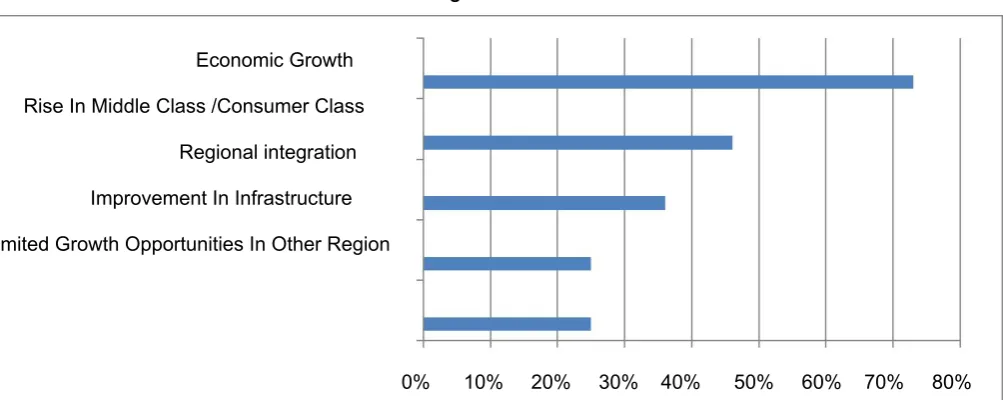
Top Reasons ASEAN market Will be More Important for Worldwide Operations and Revenues over the Next Two Years
Figure 4.1
Economic Growth
Rise In Middle Class /Consumer Class
Regional integration
Improvement In Infrastructure
Limited Growth Opportunities In Other Region
0% 10% 20% 30% 40% 50% 60% 70% 80%
Table 4.1
Source: Asean Business Outlook survey 2017
ASEAN’s market of more than 600 million people is 9% of the world’s total population.
ASEAN's consumer market at present is at US$1.2 trillion which exceeds that of India (US$938 billion) and South Korea (US$590 billion) and compares favorably with Brazil (US$1.8 trillion) and Russia (US$1.3 trillion). ASEAN countries have a growing number of middle income families who beef up demands for wide range of products, such as electronics, mobile phones and gadgets, cars, and services related to education, health, and leisure.ASEAN is one of the most productive agricultural baskets in the world8 corn, 171 million tons of sugarcane, 1.44 million tons of soybean, and 70.34 million tons of cassava. Rice production this year is forecast to increase by 3% to 132.87 million tons.
Tourism has been one of the key growth sectors in ASEAN and has proven resilient amid economic challenges globally.
Natural Resources. Investors significantly gain from the wealth of breath-taking topography, land formations, and water bodies in many ASEAN countries. Viet Nam and the Philippines, for instance, are home to two of the world’s seven new wonders of -nature HaLong Bay and Puerto Princesa River.
Culture, Culture, Culture! ASEAN’s rich culture as reflected in its wealth of ancient temple churches, colonial houses and heritage sites, colorful festivals, and world-famous cuisines are tourists’ fascination and are every investor’s greatest assets.
Access to Talents. ASEAN peoples are known for their charm, hospitality, and, in many countries within the region, English-proficiency – workforce qualities that investors look for when establishing businesses in a service-driven sector such as tourism. Young and well-trained talents for hotels and restaurants, leisure and gaming, culture and the arts abound in ASEAN countries and are ready to fill human resources slots for investments in tourism.
Medical Tourism. Medical tourism is slowly becoming a niche area in ASEAN for travellers who visit the region to receive treatment and undergo medical procedures. Thailand has largely benefited from this market, welcoming 2 million medical tourists a year. In Singapore, 400,000 patients visit every year contributing a profit of some US$700 million. The Philippines also promotes medical tourism as highlighting the quality of Filipino medical practitioners and current efforts of the country’s top hospitals to upgrade their facilities and equipment.
5.TRADE AND INVESTMENT IN ASEAN
Last year, 69% of surveyed executives indicate that their company’s level of trade and in ASEAN has increased, modestly down from 72% in 2016. 8% report a decrease over the same period, up from 5% last year. An overwhelming majority of respondents (87%) anticipate that their companies’ level of trade and investment in ASEAN will increase over the next five years.
While close to half of the total number of respondents (45%) across ASEAN describe the investment environment as improving in their country, there is significant variation by country. Respondents in the Philippines (77%), Vietnam (72%), and Myanmar (70%) are the most optimistic, and say the investment environment is improving, while much smaller numbers of respondents in Malaysia (23%), Thailand (22%), and Brunei (16%) point to an improving investment environment. When examining the investment environment by industry, firms in the software, IT, and telecommunications sectors cite the most improvement, while those in the health care sector see the least.
CONCLUSION;
The ASEAN economic bloc since its initiation has been standing out as a conglomerate of nations striving in diverse fields of economic, financial and political concerns, increase and steady growth over the years has been
Country 2015 2016 2017 2017-21 avg 2011-13 avg
Indonesia 4.8 5.0 5.1 5.4 6.2
Malaysia 5.0 4.2 4.5 4.7 5.2
Philippines 5.9 6.8 6.2 6.1 5.9
Tailand 2.8 3.2 3.3 3.6 3.2
Vietnam 6.7 6.0 6.2 6.2 5.6
Brunei Darussalam -0.6 0.7 2.0 1.8 0.9
Singapore 2.0 1.8 2.0 1.8 4.1
Cambodia 7.0 7.1 7.1 7.3 7.3
Lao PDR 7.4 7.1 7.3 7.5 8.1
a pulling force for investors seeking to grasp the great investment potential still present in these nations. Their success as an economic bloc is a model to mimic by today’s global economies experiencing in diverse capacities some sort of recession or economic sluggishness, challenges however have not been absent but alertness on the part of the diverse stake holders has given to the bloc a sense of stability in its endeavors.
REFERENCES
Hong Kong Trade Development Counsil, “ASEAN Market Profile Latest Development,” Thailand Business News, http://www.thailand-business.com/asean/55498-asean-market- profile-latest-development.html, Dec 13 2016
ASEAN, “ASEAN Investment Report 2016,” ASEAN, http://investasean.asean.org/index.php/page/view/news-and- events/view/669/newsid/1030/asean-investment-report-2016.html, 6september 2016
United Nations (UNICTAD),”World investment Report 2016,” http://unctad.org/en/pages/PublicationWebflyer.aspx?publicationid=1555,2016[4] Invest In Asian,Invest“ in Asian”
http://investasean.asean.org/, 2016
International Policy Digest, “ASEAN Economic Integration: Opportunities and Challenge lie ahead,”International Policy https://intpolicydigestDigest,.org/2016/01/06/asean-economic- integration-opportunities-and-challenges-that-lie-ahead/ Organization for Economic Co-operation and Development, “ASEAN countries returning to pre-crisis growth http://www”.oecd.org/dev/aseancountriesreturningtopre-crisisgrowth.htm. 2015
US Chamber, “ASEAN Business outlook Survey 2017,” The US Chamber of Commerce, https://www.uschamber.com/report/asean-business-outlook-survey-2017, 2017
Focus Economics, “Phillippines Economic outlook,” Focus Economics http://www..focus- economics.com/countries/philippines, Feb 21 2017
The World Bank, “Doing Business in Brunei,”http://www.doingbusiness.org/data/exploreeconomies/brunei,2017
Asian Development bank, “Myanmar: Economy,” https://www.adb.org/countries/myanmar/economy, 2016
Organization for Economic Co-operation and Development, “Economic outlook for south east asia-China and India 2017,” http://www.oecd.org/dev/economic-outlook-for-southeast-asia- china-and-india-23101113.htm