Original Research Article
Medical students’ perception towards introducing Facebook as an
educational tool in respiratory module-faculty of
Medicine-King Abdulaziz University
Ayman Z. Elsamanoudy
1,2*, Sherif A. El Saadany
3,4, Fatma M. Ghoneim
5,
Nelly N. Abulata
6,4, Rasha A. Abu-Kamer
7, Mohammed A. Hassanien
8,9ABSTRACT
Background: A social-network is often a kind of social media that is the dedicated website or application. It can enhance, detract from, or magnify the participant’s professional image. Facebook could be of benefit in learning process This article evaluates the trial of introducing Facebook, as an educational tool for second-year medical students in the College of Medicine [The Respiratory Module], King Abdulaziz University.
Methods: Introducing Facebook is directed to second-year medical students in the College of Medicine [The Respiratory Module]. A 20-point questionnaire was created and distributed online. It was designed to describe students' perception towards introducing Facebook as an educational tool. The collected data were analyzed with descriptive statistics.
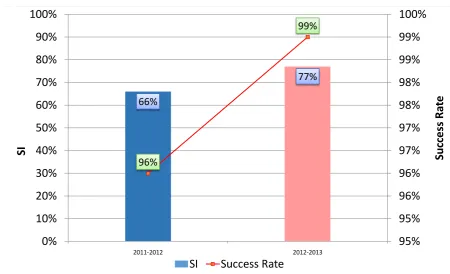
Results: The results reveal an overall good perception score regarding most of the questionnaire items. The lowest scores were found in two items only; the role of Facebook to improve the students' writing skills as well as the proposed use of Facebook and other social networks for teaching by most of the staff members. The overall students' satisfaction index satisfaction (77%). Moreover, matching the overall students' satisfaction index to the overall success rate shows a high success rate (99%) that is matched with 77% satisfaction index.
Conclusions: From the current study, it could be concluded that professional use of Facebook as an educational tool is associated with good student's perception, satisfaction index and better academic performance. So, Facebook can be used and considered as one of the most efficient online learning community tool.
Keywords: Facebook, Educational tool, Respiratory Module, FOM-KAU
1
Department of Clinical Biochemistry, Faculty of Medicine, 7Department of Medical Microbiology and Parasitology, College of Medicine, King Abdulaziz University, Jeddah, Saudi Arabia
2
Department of Medical Biochemistry and Molecular Biology, Faculty of Medicine, Mansoura University, Mansoura, Egypt
3
Department of Tropical Medicine, 9Department of Medical Biochemistry, College of Medicine, Tanta University, Tanta, Egypt
4
Fakeeh College for Medical Sciences (FCMS), Jeddah, Saudi Arabia
5
Faculty Development Unit, Medical Education Department, 8Department of Assessment Centre and Medical Education, Fakeeh College for Medical Sciences (FCMS), Jeddah, Saudi Arabia
6
Department of Clinical and Chemical Pathology, Kasr Al Ainy Faculty of Medicine, Cairo University, Cairo, Egypt
Received: 03 August 2018
Revised: 06 September 2018
Accepted: 07 September 2018
*Correspondence:
Dr. Ayman Z. Elsamanoudy,
E-mail: [email protected]
Copyright: © the author(s), publisher and licensee Medip Academy. This is an open-access article distributed under the terms of the Creative Commons Attribution Non-Commercial License, which permits unrestricted non-commercial use, distribution, and reproduction in any medium, provided the original work is properly cited.
INTRODUCTION
All medical researchers and trainees should know that we have been now living, learning, teaching, and practicing medicine within the digital era. The prevalence of social media continues to increase steadily. In 2011, surveys were done and reported that 50% of adults use social media, as well as over 65% of online adults, do this.1 In 2014, 74% of United States' adult Internet users reported using a social media platform, up from 67% in 2012. The more easy and popular accessibility through mobile technology makes social media use becomes an attainable platform to obtain and generate various types of information.2
Individuals usually use social media to communicate with each other, develop new relationships and share mutual interests. However, health information exchange becomes one of the social media activities. So, obtaining, consuming, sharing and discussion of health information lead to an expansion of the functionality of social media.3,4
Engagement with social networking may be personal, professional, or both. There is ample evidence that digitally-savvy adults and youth use social networking for health-related information.5 Given the character of social network platforms, use is often public. Though you will find risks, many opportunities abound for those engaged in social networking.
A social-network is often a kind of social media that is the dedicated website or application. Social media may be classified into six categories: blogs and micro-blogs (e.g. Twitter), collaborative projects (e.g. Wikipedia), content communities (e.g. YouTube), virtual social worlds (e.g. Second Life), virtual game worlds (e.g. World of Warcraft) and social-networking sites (e.g. Facebook). Facebook, that has been created in February 2004, is among the most popular social-networking site on the planet, with 845 million monthly active users reported right at the end of 2011.6
Some established Virtual Learning Environments (VLEs) incorporate social-media formats into their structure. There are numerous potential advantages of using such social-networking sites in medical education. For instance, internet websites could provide useful tech support team and interfaces for student collaboration, student-generated content, student-student communication as well as the personalization and socialization of student work.7
Social networking activity can enhance, detract from, or magnify the participant’s professional image.8
Credible information could be shared widely. Connections within and beyond medicine can advance education, research, advocacy, and care. Indeed, magnification and rapid information dissemination are recognized as a core characteristic and function of social networking, and
several platforms, for example, Twitter were developed designed for such dissemination. When used well, social networking is usually a kind of engagement enhancing the lives of and learning by health care professionals and trainees, and ultimately for public good.
Social networking adds a different dimension to current teaching strategies. In several educational settings, traditional face-to-face classroom methods including lectures, small conference and one-to-one mentoring have become supported or supplemented by online e-mail communication and controlled-access teaching platforms like Blackboard or Moodle. Using the expansion of widely and freely available social networking platforms, educators are now able to look at the use of blogs, Facebook along with other synchronous and asynchronous communication techniques to teach, get in touch with, and listen to individual learners and/or categories of learners whenever they want of day.
This informative article evaluates the trial of introducing Facebook, which considered as one of the most common social networks, as an educational tool for second-year medical students in the College of Medicine [The Respiratory Module], King Abdulaziz University.
METHODS
The current study was carried out in the Faculty of Medicine -King Abdulaziz University (FOM-KAU), Saudi Arabia -2013. The research protocol and study method were conducted according to the guidelines of Ethical Committee in College of Medicine, King Abdulaziz University.
Introducing Facebook -as an educational tool- is directed to second-year medical students in the College of Medicine [The Respiratory Module]. The respiratory module is really a 3-week long module which is the pre-final module within the second semester in the second year from the new curriculum.420 students (220 female and 200 male) were enrolled in the current study
Implementation
Facebook was used as an educational tool in respiratory module for the following: timetable and assessment announcement, uploading course-related materials including PowerPoint, video, figures…..etc, group discussion and frequently asked question, Students - students and tutors – students interaction, formative assessment, students’ results assessment and private message were used also for solving special course-related problems. Students’ evaluation of this new experience and overall course evaluation by students will be described also in this article.
Evaluation
and 200 male) just after the final exam of the respiratory module. The questionnaire was created to describe
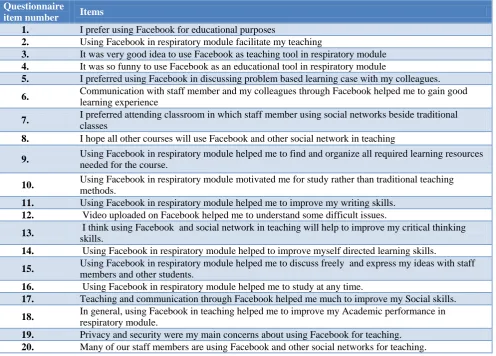
students' perception towards introducing Facebook as an educational tool in the respiratory module (Table 1).
Table 1: Questionnaire of student perception towards using Facebook as an educational tool. Questionnaire
item number Items
1. I prefer using Facebook for educational purposes
2. Using Facebook in respiratory module facilitate my teaching
3. It was very good idea to use Facebook as teaching tool in respiratory module
4. It was so funny to use Facebook as an educational tool in respiratory module
5. I preferred using Facebook in discussing problem based learning case with my colleagues.
6. Communication with staff member and my colleagues through Facebook helped me to gain good
learning experience
7. I preferred attending classroom in which staff member using social networks beside traditional
classes
8. I hope all other courses will use Facebook and other social network in teaching
9. Using Facebook in respiratory module helped me to find and organize all required learning resources
needed for the course.
10. Using Facebook in respiratory module motivated me for study rather than traditional teaching
methods.
11. Using Facebook in respiratory module helped me to improve my writing skills.
12. Video uploaded on Facebook helped me to understand some difficult issues.
13. I think using Facebook and social network in teaching will help to improve my critical thinking
skills.
14. Using Facebook in respiratory module helped to improve myself directed learning skills.
15. Using Facebook in respiratory module helped me to discuss freely and express my ideas with staff
members and other students.
16. Using Facebook in respiratory module helped me to study at any time.
17. Teaching and communication through Facebook helped me much to improve my Social skills.
18. In general, using Facebook in teaching helped me to improve my Academic performance in
respiratory module.
19. Privacy and security were my main concerns about using Facebook for teaching.
20. Many of our staff members are using Facebook and other social networks for teaching.
The questionnaire presented in Table 1 was exposed to a validation procedure that included its perusal by medical students, interns, and experts in the medical education field. The questionnaire was checked for item appropriateness and comprehensiveness (face and content validity). A five-point Likert scale (0=strongly disagree; 4=strongly agree) was adopted within the questionnaires.
Data gathering and statistical analysis
The collected data were analyzed with descriptive statistics using the Statistical Package for the Social Sciences (SPSS, version 16.0 for Microsoft or windows 7). The values were expressed as the mean so as to compare the differences between perceptions of female and male students. The independent samples t-test (t value) was applied to detect the main difference between two means. A value of p<0.05 implied a significant difference.
RESULTS
The results of the current study are illustrated in Table 2 and Figures 1 and 2. The overall students 'perception of
the use of Facebook as an educational tool in the respiratory module and the comparison between males and females are presented in Table 2.
Generally, the presented results reveal overall good perception score (Mean±SD ≥4.0) regarding most of the questionnaire items. The low scores (Mean±SD: from 3.0 to <4.0) were found in the following tested items; its use as a funny method, problem-based learning discussion, its motivating role than the traditional method of teaching, its improvement ability in learning as well as social skills and its privacy and security. The lowest scores(Mean±SD <3.0) were found in two items only; the role of Facebook to improve the students' writing skills as well as the proposed use of Facebook and other social networks for teaching by most of the staff members.
assessment (77%/62%), and finally the learning team (76%/66%). Moreover, matching the overall students' satisfaction index to the overall success rate is presented in Figure 2. The study year 2012-2013 shows a high
success rate (99%) that is matched with 77% satisfaction index. While the year 2011-2012 shows a relatively low success rate (96%) that is matched with 66% satisfaction index.
66% 69% 66%
62% 66%
77% 77% 77% 77% 76%
OVERALL CURRICULUM INSTRUCTION TEAM CONT. ASSESSMENT LEARNING RESOURCES
Respiratory Module
2011 2012 2012 2013
±
Figure 1: Students’ satisfaction index.
66%
77%
96%
99%
95%
95%
96%
96%
97%
97%
98%
98%
99%
99%
100%
0%
10%
20%
30%
40%
50%
60%
70%
80%
90%
100%
2011-2012 2012-2013
Su
cc
e
ss Ra
te
SI
SI
Success Rate
Table 2: Student perception towards using Facebook as an educational tool. No of questionnaire
item
For all students (n=420)
Male students (n=200)
Female students (n=220)
Mean± SD Mean± SD Mean± SD P value
1. 4.4±1.1 4.3±1.1 4.4±1.0 NS
2. 4.2±0.9 4.3±0.9 4.2±0.9 NS
3. 4.6±0.9 4.6±0.9 4.6±0.8 NS
4. 3.6±1.3 3.7±1.4 3.5±1.5 NS
5. 3.6±1.3 3.7±1.3 3.6±1.3 NS
6. 4.4±0.9 4.4±0.9 4.4±0.9 NS
7. 4.2±1.2 4.2±1.3 4.1±1.2 NS
8. 4.5±0.9 4.5±0.9 4.5±0.8 NS
9. 4.0±1.1 4.0±1.1 4.0±1.1 NS
10. 3.9±1.1 3.9±1.1 3.9±1.1 NS
11. 2.8±1.2 2.8±1.2 2.8±1.2 NS
12. 4.4±1.1 4.3±1.0 4.3±1.0 NS
13. 4.0±1.0 3.9±1.1 3.9±1.1 NS
14. 3.8±1.1 3.9±1.1 3.8±1.1 NS
15. 4.1±1.1 4.1±1.0 4.1±1.0 NS
16. 3.7±1.2 3.8±1.1 3.7±1.2 NS
17. 3.6±1.2 3.6±1.2 3.6±1.1 NS
18. 3.8±1.1 3.8±1.1 3.8±1.1 NS
19. 3.0±1.3 2.9±1.3 2.9±1.3 NS
20. 2.7±1.2 2.6±1.2 2.7±1.1 NS
Mean±SD : Mean±Standard deviation; NS: non significance.
DISCUSSION
Nearly all students in our academic institution (FOM-KAU), are categorized as a digital native. They use social networking applications in their daily life activities. This in agreement with Kirschner & Karpinski.9 They reported that the majority of undergraduate students at university or college use Facebook on a daily basis.
Social media use by students is mainly directed towards social connectivity rather than learning purpose. However, the primary skills to use them academically is still not clearly and fully understood and applied. The use of social networking in a purpose to be a tool for interactive learning and communication is still not the main objective for our students.10
So, this paper aimed to apply, mentor and evaluate the use of one of the most widely known social networking tool, Facebook as a learning tool in The Respiratory module –FOM-KAU.
All subjects enrolled in the current study are Saudi medical students. They are second-year medical students in the College of Medicine [The Respiratory Module], 52.3% of them are females and 47.7% are males. All of them gave information that they have used Facebook and other social media tools for at least 5 years for 2- 3 hours per day.
The current study aimed also, to create an online nonofficial learning community in this module. This learning community consists of students, tutors, and staff members as well as the administrative staff of the module. All of those are instructed and gave consent to participate in using Facebook for learning. Each of them has a Facebook account and they are friends with each other.
In overall, all of the participants (100% of students in the Respiratory module) accepted Facebook as part of the learning tool. There are no significant difference in male and female in using and perception of Facebook for learning. The perception of our students' sample towards its use gave good results. These results are in agreement with Bosch, and confirm their data.11 They stated that in spite of it primarily was for social networking activity, Facebook is nowadays could be considered as a respectable e-learning platform.11
Our students show an excellent degree in engagement with Facebook in the course with good learning benefits gain. They respond by good communication among them, better and rapid access to course materials. Our data confirm the results that are reported previously by Madge et al.12
interactivity and collaboration, improved academic relationships non-time limited academic discussions, increased interaction with the peer groups and with tutors and support visibility of most of the commonly evoked problems that students had with course based concepts.
One of the surprising findings of our study is that not all staff member is keen to use Facebook and other social networks for teaching which couldn't be explained. However, it is reported in a previous study that university educators hand in hand beside students may get benefits from merging the traditional learning experiences with Web-based tools such as Facebook. They reported that using technology could enhance the quality of student learning. So, educators should discover available methods to encourage student engagement for activities that help to achieve their learning goals.15,16 Consequently, Facebook is considered as one of the most important accessible widely used platforms that could support educators in promoting student teaching and learning.15-20
In the current study, the students' satisfaction index and the success rate are higher in the study year of implementation (2012-2013 when compared students of its previous years (2011-2012). This result is considered a good evidence of a positive relationship between the use of Facebook as an online learning environment and academic achievement. This confirms a result presented previously by Junco et al; Al-Mukhaini et al; Junco and recently by Siddiqui et al.19-22
CONCLUSION
From the current study, it could be concluded that professional use of Facebook as an educational tool is associated with good students' perception, satisfaction index, and better academic performance. So, Facebook can be used and considered one of the most efficient online learning community tool.
Limitation of the study
There is no data about the use of Facebook as an online learning tool and students point average GPA individually to evaluate its effect on the academic performance in a proper way.
Funding: No funding sources Conflict of interest: None declared
Ethical approval: The study was approved by the Institutional Ethics Committee
REFERENCES
1. Madden M, Zickuhr K. 65% of online adults use social networking sites. Pew Internet & American Life project. 2011;26:2011.
2. Project PI. Social networking fact sheet 2014; http://www.pewinternet.org/fact-sheets/social-networking-fact-sheet/. Accessed 1 March 2015.
3. Thackeray R., Crookston BT, West JH. Correlates of health related social media use among adults. J Med Int Res. 2013;15(1):e21.
4. Jackson DN, Chou WYS, Coa KI., OhA, Hesse B. Implications of social media use on health information technology engagement: Data from HINTS 4 cycle 3. Translational Behavioral Med. 2016;6(4):566–76.
5. Fox S. The Social Life of Health Information, 2011. Pew Internet & American Life Project.
6. Facebook-Newsroom. Official Facebook statistics. Available from http://newsroom.fb.com/content/ default.aspx?NewsAreaId=22. Accessed on 3 November 2012.
7. Gray K, Annabell L, Kennedy G. Medical students’ use of Facebook to support learning: Insights from four case studies. Med Teach. 2010;32:971–6. 8. Greysen SR, Kind T, Chretien KC. Online
professionalism and the mirror of social media. J Gen Intern Med. 2010;25(11):1227–9.
9. Kirschner PA, Karpinski AC. Facebook_ and academic performance. Computers in Human Behavior. 2010;26 (2010):1237–45.
10. Wise L, Skues J, Williams B. Facebook in higher education promotes social but not academic engagement. Available at: http://www.ascilite. org.au/conferences/hobart11/downloads/papers/Wis e-full.pdf.2011. Accessed on 3 June 2018.
11. Bosch TE. Using online social networking for teaching and learning: Facebook use at the University of Cape Town. Communication: South African J Communication Theory Res. 2009;35(2):185-200.
12. Madge C, Meek J, Wellens J, Hooley T. Facebook, social integration and informal learning at university: ‘It is more for socializing and talking to friends about work than for actually doing work’. Learning, Media Tech. 2009;34(2):141-55.
13. Mc Carthy J. International design collaboration and mentoring for tertiary students through Facebook. Australasian J Edu Tech. 2012;28(5):755-75. 14. Rambe P. Critical discourse analysis of
collaborative engagement in Facebook postings. Australasian J Edu Tech. 2012;28(2):295-314. 15. Ferdig RE. Editorial: Examining social software in
teacher education. Journal of Technology and Teacher Education. 2007;15(1):5-10.
16. Irwin C, Ball L, Desbrow B. Students’ perceptions of using Facebook as an interactive learning resource at university. Australasian J Edu Tech. 2012;28(7):1221-32.
17. Heiberger G, Harper R. Have you facebooked Astin lately? Using technology to increase student involvement. New Directions for Student Services. 2008;(124):19-35.
19. Chen MM. Students’ perceptions of the educational usage of a Facebook group. J Teaching in Travel Tourism. 2018.
20. Junco R. Too much face and not enough books: The relationship between multiple indices of Facebook use and academic performance. Computers in Human Behavior. 2011;28(1):187-98.
21. Al-Mukhaini EM, Al-Qayoudhi WS, Al-Badi AH. Adoption of Social Networking in Education: A Study Of The Use Of Social Networks By Higher Education Students In Oman. J Int Edu Res. 2014;10(2):143-54.
22. Junco R. Student class standing, Facebook use, and academic performance. J Applied Developmental Psychol. 2015;36(2015):18–29.