Original Research Article
A comparative and cross-sectional study on the prevalence of risk
factors for mouth ulcer and oral cancers in migrants and native
population of a tourist city of Rajasthan
Rupesh Kumar
1, Maitri R. Hathi
2*
INTRODUCTION
Non communicable diseases like cancer, cardiovascular diseases etc. are on rampant rise all over world including both developed and developing countries due to life style and demographic changes. Over half of the disease burden are from non-communicable disease in low and middle income countries, many parts of India are experiencing an epidemiological transition and this is reflected in a growing burden of non-communicable diseases, which is known as modern epidemics.1 In
developing countries, cancer is among the ten commonest cause of mortality.2 Among cancer, 50-70% of all cancers diagnosed in India were recorded for oral cancer where as in United Kingdom and in United States of America it is only 2 to 3%.3
Research found that the risk factors to cancer or ulcer may be a combination of modifiable (smoking habits, smokeless tobacco chewing, hypertension, physical inactivity) or non-modifiable (age, sex, family history).3 WHO report of 2002 gives the definition of risk as “A
ABSTRACT
Background: Oral cancer is a major non communicable disease which is considered as one of the major public health problems in India. It can easily be prevented through early detection and stopping the associated risk factors like smokeless tobacco. The objective of the study was to assess the prevalence of risk factors for mouth ulcer and oral cancer among migrants of Udaipur city and comparing them to its native population.
Methods: A cross sectional study was conducted to know the prevalence of smokeless tobacco and other associated risk factors and recommend the preventive strategies based on study findings which consisted of 384 migrants and 384 native population of Udaipur, Rajasthan during May 2016 to April 2017.
Results: Majority of migrants 36.46% and native 34.11% were in age group of 28-37 years. Out of 384, 89 (23.18%) and 117 (30.47%) migrants and native were having habit of smokeless tobacco chewing respectively (statistically significant p<0.05). The prevalence of smoking among migrants and native were 34.38% and 24.48% respectively (statistically significant p<0.05). A major risk factor of mouth ulcer was same smokeless tobacco chewing in both migrants (57.14%) and in native (66.66%). Migrants with the habit of smokeless chewing were unable to open mouth was recorded (69.04%) whereas native population was recorded (36.66%) (statistically significant p<0.05)..
Conclusions: Smokeless tobacco chewing habit in both migrants and native population is a significant risk factor for mouth ulcer and oral cancer.
Keywords: Mouth ulcer, Oral cancer, Migrants, Native population, Smokeless tobacco 1
Associate Professor, 2Tutor (Biostatistics), Department of Community Medicine, Pacific Medical College and Hospital, Udaipur, Rajasthan, India
Received: 31 July 2018
Revised: 17 August 2018
Accepted: 18 August 2018
*Correspondence:
Ms. Maitri R. Hathi,
E-mail: [email protected]
Copyright: © the author(s), publisher and licensee Medip Academy. This is an open-access article distributed under the terms of the Creative Commons Attribution Non-Commercial License, which permits unrestricted non-commercial use, distribution, and reproduction in any medium, provided the original work is properly cited.
probability of an adverse outcome, or a factor that raises this probability”.3,4
Major risk factors associated to oral cancer and ulcer are access use of tobacco, smoking, alcohol drinking, smokeless tobacco chewing, low fruit and vegetable nutritional consumption,etc.5
New statistical data of United Kingdom cancer research shows that the rates of the oral cancer disease have increased by 68% in the past 20 years.6 In 1992-95 oral cancer rate was eight cases per 100 000 people, but in 2012-14 it had increased to 13 per 1,00,000 people.7 From many international studies a statement comes in light that migrant population may have more chance to effect by cancer and ulcer problems than native population, because of having some smoking and smokeless tobacco chewing habits to avoid home sickness and mental stress. To emphasis this aim, the present study was selected.
METHODS
Study design
A cross- sectional study was carried out in Udaipur city of Rajasthan.
Sample size
Sample size was calculated with the assumption that 50% of the migrants and 50% of the native population of Udaipur city will have risk factors for oral cancer. Sample size was calculated by using the formula, h= (Z 1-α/δ2)/p (1-p)
Where confidence interval (1-α)= 95%
δ is 10% of p, So estimated sample size was 384 for migrants and 384 for native population
Study group
Both migrants and native population in the age group of 18-65 years were included in the study.
Study area
Study was conducted in Udaipur city. Study duration
Study was conducted from May, 2016 to April,2017. For data collection, pre-designed and pre-tested performa was used and a door to door survey was carried out in city of Rajasthan, Udaipur. Study subject was informed about the survey purpose and verbal consent was taken before collecting information regarding risk factors of
Oral Cancer and Ulcer such as tobacco smoking, smokeless chewing (like tobacco, gutkha, mawa, pan,supari), alcohol and diet history. General demographic information regarding age, gender, religion, marital status, education was collected.
Statistical analysis
A descriptive statistics like mean, standard deviation, percentage and inferential statistics like Z-Test and Chi-Square test were used to test the significance difference between migrants and native populations using Microsoft excel sheet and software Epi Info Version 3.5.1.
RESULTS
Out of 384 migrants and 384 natives, 36.46% of migrants and 34.11% of native population were in age group of 28 – 37 years. From Table 1, no statistically significance difference found in the mean age of migrants (35.98±10.98) and of the native population (36.35±11.04) (Z=0.47, p>0.05). Also more than 90% of migrants as well as native population belonged to Hindu religion. Majority of the Migrants (79.95%) and native (84.12%) were married. Statistically significant result (Z=4.39, p<0.05) was found for the difference between higher education in migrants (36.98%) and in natives (22.66%) (Table 1).
Table 1: Socio demographic profile of migrants and native subjects.
Characteristics Frequency (number & percentage)
Migrants (n=384)
Native (n=384) Age group (in years)
18-27 94 (24.48) 99 (25.79) 28-37 140 (36.46) 131 (34.11) 38-47 86 (22.39) 93 (24.22) 48-57 45 (11.72) 38 (9.89) 58-67 19 (4.95) 23 (5.99) Mean±SD 35.98±10.89 36.35±11.04
Religion
Hindu 372 (96.87) 370 (96.35) Muslim 7 (01.83) 10 (02.61) Christian 1 (0.26) 4 (01.04)
Sikh 4 (1.04) 0 (0.0)
Marital status
Single 76 (19.79) 59 (15.36) Married 307 (79.95) 323 (84.12) Widowed 1 (0.26) 2 (0.52)
Education
Illiterate 20 (5.21) 17 (04.43) Primary 73 (19.01) 99 (25.78) Secondary 70 (18.23) 81 (21.09) Higher secondary 79 (20.57) 100 (26.04) Higher education
Table 2: Distribution of migrants and native subjects on predominant habits.
Risk factors No of migrants (n=384) No of native (n=384) P value
Smoking 132 (34.38%) 94 (24.48%) Z=3.09, p<0.05*
Smokeless tobacco chewing** 89 (23.18%) 117 (30.47%) Z=1.80, p<0.05*
SLT gutkha chweing*** 58.43% 50.46% Z=0.57, p>0.05
*shows significance level
**Smokeless tobacco chewing includes tobacco chewing, gutkha, chewing, mawa chewing, pan and supari chewing. ***SLT stands for smokeless tobacco chewing.
Table 3: Distribution of migrants and native population based on smokeless chewing.
Migrant (n=125) Native (n=129) P value Variables for mawa/gutkha/tobacco/pan/supari chewing
Mean age of initiation(mean±SD) in years 28.26±8.68 27.18±7.94 Z=0.15, p>0.05 Duration (mean±SD) in years 7.76±5.49 10.34±7.26 Z=1.30, p>0.05 Frequency (mean±SD)/day 2.84±0.99 4.12±4.62 Z=1.48, p>0.05 Chewing period (mean±SD) in minute 7.69±3.98 5.28±3.1 Z=1.95, p>0.05
Subject ever tried to stop habit
Yes 96 (76.92%) 77 (59.38%) Χ2
=0.0047, P<0.005
No 29 (23.08%) 52 (40.62%)
Subject awareness on smokeless tobacco causing cancer
Yes 105 (84.62%) 125 (96.88%) X2=0.00043,
P<0.005
No 20 (15.38%) 4 (3.12%)
Table 4: Distribution of migrants and native population based on use of mouthwash
Migrants (n=384) (%) Native (n=384) (%) P value Mouthwash
Yes 21 (5.47%) 5 (1.30%)
X2 =10.19, p<0.05
No 363 (94.53%) 379 (98.70%)
Frequency of mouthwash Migrants (n=21) Native (n=5)
≤1 day 20 (95.24%) 5 (100%)
>1 day 1 (4.76%) 0
Total 21 5
Table 5: Findings of oral examination in migrants and native population based on various warning signs considered for oral cancer.
Oral finding variables Migrant (N=384) (%) Native (N=384) (%) P value
Unable to open mouth properly 17 (4.43) 9 (2.34)
Z=1.49, p>0.05
Ulcer in mouth 17 (4.43) 15 (3.91)
Leukoplakia 8 (2.08) 6 (1.56)
Total 42 (10.94) 30 (7.81)
Out of 384 migrants 34.38% and 23.18% have prevalence of smoking and smokeless tobacco chewing respectively. However in natives 24.48% were smoking while 30.47% chew smokeless tobacco. Moreover the difference was statistically significant for both risk factors (Z=3.09; P<0.05 and Z=1.80, p<0.05) respectively (Table 2). The mean age of initiation smokeless chewing was found to be more among migrant population (28.26±8.68) in comparison to the native (27.18±7.94) which was not significant statistically (Z=0.15, p>0.05).The mean
duration and frequency of smokeless chewing was observed more in native than migrants (Table 3).
The use of mouthwash was more among migrants (5.47%) than the native (1.30%) which was statistically significant (p<0.05) (Table 4).
to open mouth, ulcer and suspected leukoplakia were present in migrants (10.94%) than native population (7.81%). It was insignificant statistically (Z=1.49, p>0.05) (Table 5).
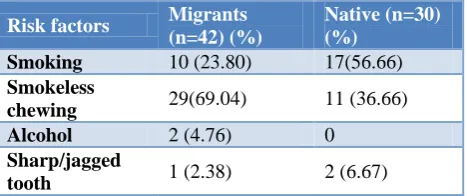
Table 6: Distribution of risk factors among studied population who were unable to open mouth properly
Risk factors Migrants (n=42) (%)
Native (n=30) (%)
Smoking 10 (23.80) 17(56.66)
Smokeless
chewing 29(69.04) 11 (36.66)
Alcohol 2 (4.76) 0
Sharp/jagged
tooth 1 (2.38) 2 (6.67)
More than half of the migrants 29 out 42 (69.04%) with the habit of smokeless chewing were unable to open mouth whereas only 11 (36.66%) of native population were unable to open mouth with the habit of smokeless tobacco chewing (Table 6).
Table 7: Distribution of risk factors among studied population having ulcer in mouth.
Risk factors Migrants (n=42) (%)
Native (n=30) (%)
Smoking 12 (28.57) 7 (23.33)
Smokeless
chewing 24 (57.14) 20 (66.66)
Alcohol 4 (9.52) 0
Sharp/jagged
tooth 0 2 (6.67)
Mouth wash 2 (4.76) 0
Denture 0 1 (3.33)
The risk factors involved for ulcer in migrants were highest for smokeless chewing 57.14%, followed by smoking 28.57% while ulcers seen in native population for smokeless chewing 66.66%, followed by smoking 23.33% etc. (Table 7).
DISCUSSION
Migrants 23.18% and natives 30.47% were using smokeless tobacco in one or other form such as tobacco chewing, gutkha, mawa, pan, sopari etc. (Table 2). Statistical significance difference (Z=1.80, p<0.05) was found in the use of smokeless tobacco between the two groups migrants and native population. Among migrants and native population smoking prevalence were 34.38% and 24.28% respectively.
In the developed countries, tobacco is mostly consumed in the combined form which is mixed with other ingridients.8 For oral cancer, the main responsible risk factors were found tobacco consumption in one and other form. In our study smoking was found to be more prevalent among migrants (34.38%) than native
(24.28%). Same findings were shown by Raniet al in his study for National Family Health Survey– 2 (1998-99). He had found that 15 years older 30% of population either smoked and chewed tobacco.9 In a study “Sixty-four percent of the women surveyed used only one type of SLT; of these, 30% used mishri, 32% used pan with tobacco and the rest used chewed tobacco (11%), gul (17%) or gutkha (10%).”10
No differences were noted between pregnant and non-pregnant women in SLT consumption patterns.10
In migrants 34.38% and 23.18% had prevalence of smoking and smokeless tobacco chewing respectively. However, in natives 24.48% were smoking while 30.47% chew smokeless tobacco. Moreover the difference was statistically significant for both risk factor (Z=3.09, p<0.05 and Z= 1.80, p<0.05) respectively which is nearly same as the study conducted by Gupta et al.11 The mean frequency of tobacco chewing especially khaini per day was 2.84 in migrants whereas 4.12 in native population. Gupta et al observed higher findings nearly 5.5 and 5.1 for migrants and native population respectively.11 The mean age for initiation of smokeless tobacco chewing among migrants was higher (28.26 Years) as compared to native population (27.18 years). Similar findings had been found by Rani et al in his study.12
National Family Health survey-2(1998-99) had found that 30% of population above 15years of age either smoked or chewed smokeless tobacco. The mean duration of tobacco chewing was slightly more in Native population than migrants.13
Among those who consume smokeless tobacco, gutkha chewing was the major form whose prevalence in migrants (58.43% was more than native population (50.46%) (statistically not significant p>0.05). Joshi found tobacco chewingin form of Gutkha to be 57.6%, which is almost similar to this study.14
CONCLUSION
Oral cancer and mouth ulcer are the non-communicable diseases which are amenable to primary prevention. However a warning is written to the packets of tobacco products that it is injurious to health, until these products will be banned with some restrictions, and if the tobacco habits are eliminated from the community, then only a great reduction in the incidence of oral cancer and mouth ulcer be achieved.
Migration in Rajasthan, especially in Udaipur from less developed neighborhood states was very common for better lifestyle, employments due to fast industrializations in various sectors. In this study, results found that migrants and native population of Udaipur city were having habit of smoking and smokeless forms approximately 30-35%. Prevalence of smokeless tobacco chewing is significantly higher in migrants than native population.
The recommendations based on the study results are as follows:
Routine screening health care set up and organization of special screening camps in the community and work place to detect the early warning signs of oral cancer and mouth ulcer.
Special training to health workers to diagnose the precancerous signs in the community for oral cancers like submucous fibrosis (unable to open mouth properly), leukoplakia (white patch on buckle mucosa, tongue etc.), erythroplakia (red patches in mouth) and presence of ulcer in mouth.
Intensive awareness and health education about harmful effects of chewable tobacco among masses are to be done.
Legislation for prohibiting smokeless tobacco in any form should be strictly implemented.
ACKNOWLEDGEMENTS
We are very thankful to our department MSW staff Mr. Ganesh Salvi and Mr. Durga Shanker Dangi for their senior cooperation in data collection, data entry and data compilation in this study.
Funding: No funding sources Conflict of interest: None declared
Ethical approval: The study was approved by the Institutional Ethics Committee
REFERENCES
1. Quigley MA. Commentary: Shifting burden of disease - epidemiological transition in India. International J Epidemiol. 2006;35(6):1530:31. 2. Khandekar SP, Bagdey PS, Tiwari RR. Oral cancer
and some epidemiological factors: A hospital based study. Indian J Comm Med. 2006;31(3):157-9.
3. Park K. Textbook of Preventive and Social Medicine. 20th edition. Jabalpur: Banaridas Bhanot Publishers; 2009: 12-48.
4. World Health Report. Geneva: WHO, 2002.
5. Kumar R, Koria B. The Prevalence Of Risk For Oropharyngeal Cancers In The Migrants Of Ahmedabad City A Comparison With The Native Population. Asian J Med Res. 2013;2(3):65-8. ( 6. Louie KS, Mehanna H, Sasieni P. Trends in head
and neck cancers in England from1995 to 2011 and projections up to 2025. Oral Oncol. 2015;51(4):341-8.
7. Gulland A. Oral cancer rates riseby two thirds. BMJ 2016;355:i6369.
8. Johnson N. Tobacco Use and Oral Cancer: A global Perspective. J Dental Educ. 2001;65(4):328-39. 9. Sharma DC. India’s welcome to foreign tobacco
giants prompts criticism. Lancet. 1998;352:1204. 10. Schensul JJ, Nair S, Bilgi S, Cromley E, Kadam V,
Mello SD. Use of smokeless tobacco by Indian women aged 18-40 years during pregnancy and reproductive years.. PLoS One. 2015;10(3):e0119814..
11. Gupta V, Yadav K, Anand K. Pattern of Tobacco Use Across Rural, Urban, and Urban-slum Populations in a North Indian Community. Indian J Comm Med. 2010;35(2):245-51.
12. Rani M, Bonu S, Jha P, Nguyen SN, Jamjoum L. Tobacco use in India: Prevalence and predictors of smoking and chewing in a national cross-sectional household survey. Tobacco Control. 2003;12(4):4-4. 13. International Institute for Population Sciences (IIPS) and ORC Macro. 2002. National Family Health Survey (NFHS-2), India, 1998–99: Chhattisgarh. Mumbai: IIPS.
14. Urvish J, Modi B, Yadav S. A study on Prevalence of Chewing Tobacco and Existing Quitting Patterns in Urban Population of Jamnagar, Rajasthan. Indian J Comm Med.2010;35(1):105-8.
15. Winn DM, Blot WJ, McLaughlin JK, et al. Mouthwash use and oral conditions in the risk of oral and pharyngeal cancer. Cancer Res. 1991;51:3044-7.
16. Axell T, Henricsson V. The occurrence of recurrent aphthous ulcers in an adult Swedish population. Acta Odontol Scand. 1985;43:121–5.
17. Neha A, Sumit B. Leukoplakia- Potentially Malignant Disorder of Oral Cavity -a Review”. Biomed J Sci &Tech Res. 2018;4(5).
18. Tang JG, Jian XF, Gao ML, Ling TY, Zhang KH. Epidemiological survey of oral submucous fibrosis in Xiangtan City, Hunan Province. China Community Dent Oral Epidemiol. 1997;25(2):177-80.