Original Research Article
A cross sectional study on defective vision among secondary school
going children in Vijayawada city, Andhra Pradesh
Chinta Durga Kumar
1, Venkata Suresh Anga
2*
INTRODUCTION
Eye is one of the most vital organs of human body. Any abnormality in the eye can impair vision and make the person handicapped for life. The school children form a special group because they are most vulnerable to the effects of reduced vision and its impact on learning capability and educational potential. Defective vision in childhood affects academic performance in school and has a negative influence on future of child.1
WHO estimates that 153 million people worldwide live with visual impairment due to uncorrected refractive errors.1 In addition, the management of refractive errors is perhaps the simplest and the most effective eye care that can be provided by involving the community.2 Integration of vision screening and refractive services for school students within screening for other health issues is recommended by the WHO.3-5
Considering these issues the present study was carried out to find out the factors affecting vision of school children
ABSTRACT
Background: Eye is one of the most vital organs of human body. Any abnormality in the eye can impair vision and make the person handicapped for life. The school children form a special group because they are most vulnerable to the effects of reduced vision and its impact on learning capability and educational potential. The objective of the study was to find out the factors affecting vision of secondary school children, to suggest preventive and remedial measures for defective vision.
Methods: It was a cross sectional study. School children of Zilla Parishad secondary high school during November 2016 to December 2016 were studied. A pretested semi structured questionnaire was administered. A total of 320 students were included in the study by using convenient sampling technique. Data was entered in Microsoft excel sheet and analyzed using Statistical Package for Social Sciences (SPSS) version 20. Results were expressed as proportions for different study variables.
Results: Out of the 320 students, majority 181 (56.56%) of study participants were girls. The highest number of students (49.38%) was between 12-13 years of age group. Prevalence of defective vision is 34%. Family history is present in 29% of the study population. 34% of children with defective vision, it was detected by their mother.
Conclusions: Refractive errors are more in girls. Children and parents should be educated regarding ocular hygiene and early correction of refractive errors.
Keywords: School children, Defective vision, Refractive errors
Department of Community Medicine, 1Siddhartha Medical College, Vijayawada, 2NRI Institute of Medical Sciences, Visakhapatnam, Andhra Pradesh, India
Received: 08 June 2018
Revised: 11 July 2018
Accepted: 13 July 2018
*Correspondence:
Dr. Venkata Suresh Anga,
E-mail: [email protected]
Copyright: © the author(s), publisher and licensee Medip Academy. This is an open-access article distributed under the terms of the Creative Commons Attribution Non-Commercial License, which permits unrestricted non-commercial use, distribution, and reproduction in any medium, provided the original work is properly cited.
and to suggest preventive and remedial measures for defective vision.
Objectives
To find out the factors affecting vision of secondary school children.
To suggest preventive and remedial measures for defective vision.
METHODS
Study design: A cross sectional study.
Study area: Ramavarappadu, Vijayawada, A.P.
Study population: School children of Zilla Parishad secondary high school.
Study period: November 2016 to December 2016.
Sample size: A total of 320 students were included in the study by using convenient sampling technique.
Selection criteria
Inclusion criteria were children from 6th to 10th class; children attended school on the day of study.
Exclusion criteria were children those who were absent on the day of study; children who were not available at the time of study.
Study method
Data was collected using pre-tested semi-structured questionnaire method and visual acuity (VA) test was performed using Snellen’s E chart. VA of <6/9 was taken as defective vision.6
Ethical considerations
Prior permission was obtained from institutional ethics committee and informed consent was taken from the parents of all the study participants.
Data analysis
Data was entered in Microsoft excel sheet and analyzed using Statistical Package for Social Sciences (SPSS) version 20. Descriptive statistics like percentages, proportions and bar diagrams were used. Inferential statistics like chi square were used.
RESULTS
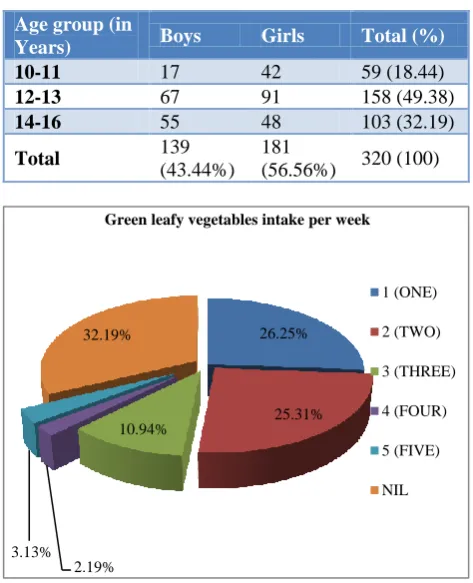
Majority of the study subjects were Girls (56.56%) followed by Boys (43.44%). Among Girls and boys,
majority of the students belong to the age group of 12 to 13 years.
Table 1: Distribution of study subjects according to their age and gender.
Age group (in
Years) Boys Girls Total (%)
10-11 17 42 59 (18.44)
12-13 67 91 158 (49.38)
14-16 55 48 103 (32.19)
Total 139
(43.44%) 181
(56.56%) 320 (100)
Figure 1: Distribution of study subjects based on the intake of vitamin-a rich foods (green leafy vegetables).
Out of total 320 students, majority (26.25%) consumed green leafy vegetables once in the last week followed by 25.31% consumed twice in the last week, 10.94% consumed thrice, 3.13% consumed 5 times and 2.19% consumed 4 times.
In the present study, 70.93% students don’t have any family history. 17.5% students had maternal side family history and 11.56% had paternal side family history.
Table 2: Distribution of study subjects based on the family history of visual defects.
Frequency Percentage (%)
Paternal 37 11.56
Maternal 56 17.5
Absent 227 70.93
Total 320 100
Out of 320 school children, 213 (65.95%) had normal vision. Defective vision is present in 34.05% in which 24.82% had both eyes defective vision, 5.78% had left eye defective vision, 3.45% had right eye defective vision.
26.25%
25.31% 10.94%
2.19% 3.13%
32.19%
Green leafy vegetables intake per week
1 (ONE)
2 (TWO)
3 (THREE)
4 (FOUR)
5 (FIVE)
Table 3: Distribution of study subjects based on the percentage of school children with defective vision.
Frequency Percentage
(%)
Normal vision 213 65.95
Right eye defective vision 11 3.45
Left eye defective vision 18 5.78
Both eyes defective vision 78 24.82
Total 320 100
Table 4: Distribution of study subjects based on the defective vision detected by?
Frequency Percentage (%)
Father 2 1.86
Church 3 2.80
Teacher 6 5.60
Friend 12 11.21
Doctor 15 14.01
Mother 37 34.57
Self 32 29.90
Total 107 100
Defective vision was detected in 107 school children. In 37 (34.57%) school children, defective vision was detected by their mother. 32 (29.90%) detected their defective vision by themselves. In 15 (14.01%) school children, defective vision was detected by the doctor. In 12 (11.21%) school children, defective vision was detected by their friend. In 6 (5.60%) school children, defective vision was detected by the school teacher. In 2 (1.86%) school children, defective vision was detected by their father.
Table 5: Distribution of study subjects based on other eye problems.
Frequency Percentage
(%)
Redness 2 0.47
Watering+redness 3 0.84
Pain+diplopia 3 0.89
Watering+photophobia
+itching 3 1.22
Diplopia 4 1.53
Pain+watering 7 2.40
Pain 7 2.77
Itching 12 3.92
Watering from eyes 72 21.71
No other eye problems 207 64.25
Total 320 100
Out of 320 school children, 64.25% had no other eye problems. Watering from eyes is present in 21.71% school children, followed by itching of eye in 3.92%, pain (2.77%), pain and watering (2.40%), diplopia (1.53%), watering with photophobia and itching (1.22%),
Pain with diplopia (0.89%), watering with redness (0.84%) and redness (0.47%).
Figure 2: Distribution of study subjects based on the health education.
In the present study, majority (38.07%) of the health education is given by parents followed by school teachers (25.87%), doctors (8.24%), both parents and teachers (8.01%) and friends (1.20%).
Table 6: Association between defective vision and gender.
Gender Defective vision Total
Present (%) Absent (%)
Male 60 (43.16) 79 (56.84) 139
Female 47 (25.96) 134 (74.04) 181
Total 107 (100) 213 (100) 320
Chi-square value=10.45, p<0.05, statistically significant.
Table 7: Association between defective vision and family history.
Family history
Defective vision
Total
Present (%) Absent (%) Present 60 (56.07) 33 (15.49) 93 Absent 47 (43.93) 180 (84.51) 227
Total 107 (100) 213 (100) 320
Chi-square value=56.89, p<0.05, statistically significant.
In the present study, out of 139 males, 60 (43.16%) school children had defective vision and out of 181 females, 47 (25.96%) had defective vision. The association between the gender and defective vision was found to be statistically significant.
In the present study, out of 107 school children with defective vision, family history is present in 60 (56.07%) children and out of 213 school children without defective vision, family history is present in only 33 (15.49%) and the association between them was found to be statistically significant.
In the present study, out of 217 school children who ate green leafy vegetables, defective vision is present in 69
friends
both parents and teachers doctor
nil
teachers
parents
1.20% 8.01%
8.24% 18.60% 25.87%
(31.79%) and out of 103 school children who didn’t take green leafy vegetables, defective vision is present in 38(36.9%) and the association between them is found to be statistically not significant.
Table 8: Association between defective vision and intake of green leafy vegetables.
Intake of green leafy vegetables
Defective vision
Total
Present (%) Absent (%)
Present 69 (31.79) 148 (68.21) 217
Absent 38 (36.9) 65 (63.10) 103
Total 107 (100) 213 (100) 320
Chi-square value=0.81, p>0.05, statistically not significant.
DISCUSSION
A total of 320 school children of Zilla Parishad secondary high school were studied.
In the present study, majority of the study subjects were girls (56.56%) followed by boys (43.44%). Among girls and boys, majority of the students belong to the age group of 12 to 13 years. In a study conducted by Singh et al.7 Majority of the study subjects were females (53%) than males (47%). This is similar to study conducted by Shrestha et al in which 1114 (46.2%) males and 1298 (53.8%) females were enrolled in to the study.8 In a study conducted by Shrestha et al, 52.8% were males and 47.2% were females.9
In the present study, out of total 320 students, majority (26.25%) consumed green leafy vegetables once in the last week followed by 25.31% consumed twice in the last week, 10.94% consumed thrice, 3.13% consumed 5 times and 2.19% consumed 4 times. In a study conducted by Niroula et al, children with vegetarian diet (10.52%) had greater number of refractive errors than non-vegetarian diet children (6.17%).10
In the present study, out of 320 school children, 213 (65.95%) had normal vision. Defective vision is present in 34.05% in which 24.82% had both eyes defective vision, 5.78% had left eye defective vision, 3.45% had right eye defective vision. In a study conducted by Singh et al, refractive error (17.36%) was the major cause of ocular morbidity and the overall prevalence of ocular morbidity was 29.35% with 29.33% in males and 29.37% in females.7 In a study conducted by Shrestha et al.8 The most common types of ocular morbidity were refractive error in 241 (10%), In a study conducted by Shrestha et al.9 Refractive error was the commonest problem seen accounting for 21.9%. In a study conducted by Niroula et al, Sixty two schools children (6.43%), out of 964 had refractive errors.10 In a study conducted by Pokharel et al, the overall prevalance of refractive error in school children was 19.8%.11 In a study conducted by Mayro et al, out of 18,974 children screened, 2,492 (13.1%) exhibited uncorrected refractive errors.12 These results
were comparable with Gupta et al, who also found refractive error as the most common disorder, with a prevalence of 22%.13 Das et alin Kolkata and Desai et al in Jodhpur also reported a similar prevalence of 25.11% and 20.8%, respectively.14,15 International studies conducted by Shrestha et al reported a similar prevalence of refractive error in their 2006 study (21.9%).16 Lu et al also found a comparable refractive error prevalence of 11.07% in Maqin county, China.17
In the present study, Out of 139 males, 60(43.16%) school children had defective vision and out of 181 females, 47 (25.96%) had defective vision. The association between the gender and defective vision was found to be statistically significant. In a study conducted by Niroula et al, more boys (7.59%) were found to have suffered from refractive errors than girls (5.31%).10 In a study conducted by Sheeladevi et al, the prevalence of defective vision was higher among girls than boys.18 In a study conducted by Shrestha, the association between ocular morbidity, age and sex.8 P value was considered significant at 0.05 for 95% confidence interval.
CONCLUSION
This study showed that prevalence of defective vision is 34%. One third of the study population had not consumed any green leafy vegetables in past week prior to study. Family history is present in 29% of the study population. 34% of children with defective vision, it was detected by their mother. Majority of the study population had watering of eye as their eye related problems. Health education was given by their parents in around 38% of study population. Significant association was found between defective vision and gender, defective vision and family history.
Recommendations
Screening of the children for vision at the time of school admission.
Periodical eye examination of the children is recommended for early rectification of impaired vision in school children.
School teachers can be trained for screening of defective vision in children.
Children and parents should be educated regarding ocular hygiene and early correction of refractive errors.
Funding: No funding sources Conflict of interest: None declared
Ethical approval: The study was approved by the Institutional Ethics Committee
REFERENCES
uncorrected refractive errors in 2004, Bulletin of WHO. 2008;86:63-70.
2. Ali A, Ayub S, Ahmad I. Prevalence of undetected refractive errors among school children. Biomedica. 2007;23:96-101.
3. Ciner EB, Dobson V, Schmidt PP, Allen D, Cyert L, Magurie M, et al. A survey of vision screening policy of preschool children in the United States. Surv Ophthalmol. 1999;43:445-7.
4. Health dialogue: A forum for the exchange of new and views on primary health care in India. Inveno. 2006;44:1.
5. Seema S, Vashishtht B, Meenakshi K, Manish G. Magnitude of Refractive Errors among school children in a rural block of Haryana. International J Epidemiol. 2009;6(2):1-5..
6. World Health Organization. Elimination of avoidable visual disability due to refractive error Report of an informal planning meeting WHO/PBL/00.79. Geneva: WHO. 2000: 6-10. 7. Singh V, Malik KPS, Malik VK, Jain K. Prevalence
of ocular morbidity in school going children in West Uttar Pradesh. Indian J Ophthalmol. 2017;65(6):500–8.
8. Shrestha RK, Shrestha GS. Ocular Morbidity among Children of Government Schools of Kathmandu Valley: A Follow-up Study. JNMA J Nepal Med Assoc. 2017;56(206):243-7.
9. Shrestha RK, Joshi MR, Ghising R, Pradhan P, Shakya S, Rizyal A. Ocular morbidity among children studying in private schools of Kathmandu valley:A prospective cross sectional study. Nepal Med Coll J. 2006;8(1):43-6.
10. Niroula DR, Saha CG. Study on the refractive errors of school going children of Pokhara city in Nepal. Kathmandu Univ Med J (KUMJ). 2009;7(25):67-72.
11. Pokharel A, Pokharel PK, Das H, Adhikari S. The patterns of refractive errors among the school children of rural and urban settings in Nepal. Nepal J Ophthalmol. 2010;2(2):114-20.
12. Mayro EL, Hark LA, Shiuey E, Pond M, Siam L, Hill-Bennett T, et al, Prevalence of uncorrected refractive errors among school-age children in the School District of Philadelphia. J AAPOS. 2018: 13. 13. Gupta M, Gupta BP, Chauhan A, Bhardwaj A. Ocular morbidity prevalence among school children in Shimla, Himachal, North India. Indian J Ophthalmol. 2009;57:133–8.
14. Das A, Dutta H, Bhaduri G, De Sarkar A, Sarkar K, Bannerjee M. A study on refractive errors among school children in Kolkata. J Indian Med Assoc. 2007;105:169–72.
15. Desai S, Desai R, Desai NC, Lohiya S, Bhargava G, Kumar K. School eye health appraisal. Indian J Ophthalmol. 1989;37:173–5.
16. Shrestha RK, Joshi MR, Ghising R, Rizyal A. Ocular morbidity among children attending government and private schools of Kathmandu valley. JNMA J Nepal Med Assoc. 2011;51:182–8. 17. Lu P, Chen X, Zhang W, Chen S, Shu L. Prevalence
of ocular disease in Tibetan primary school children. Can J Ophthalmol. 2008;43:95–9.
18. Sheeladevi S, Seelam B, Nukella PB, Modi A, Ali R, Keay L. Prevalence of refractive errors in children in India: a systematic review. Clin Exp Optom. 2018.