Original Research Article
The pattern of off-label and unlicensed drug use in adult and
pediatric patients in the Kingdom of Saudi Arabia:
multicenter retrospective study
Nagham Sheblaq
1*, Zainab Albahooth
2, Fatmah Alfawzan
2, Khalid Alanazi
2, Sawsan Alshouli
3,
Amal Alghalbi
3, Sameera Alshnaiber
4, Moyasar Alkurdi
4, Hajer Almudaiheem
4,
Sattam Almutairi
5, Mohammed Alkuzaee
5, Anoud Alanazi
6, Abeer Alshareef
6, Nawaf Alotibi
7,
Samia Almurshadi
7, Mohammed Alotaibi
7, Fatimah Aljohani
8, Lama Almutairi
9,
Marwan ElBagoury
10, Ahmed M. Elagouz
11, Omar M. Hussein
12, Amal Najjar
3ABSTRACT
Background: Screening approved medications to identify therapeutics for drug repurposing is an effective tactic, and
a deep research into off label drug use (OLDU) is required. Unfortunately, OLDU has not been extensively studied in Middle East. Our study aimed to evaluate the extent of OLDU in Saudi Arabia.
Methods: Retrospective study carried out during 12 months period at six tertiary hospitals in Saudi Arabia. Each prescription was evaluated as unlicensed or OLDU based on the product information or based on Food and drug Administration (FDA) approval.
Results: A total of 288 prescriptions were analyzed, where the reasons for off-label prescribing were OLDU by indication (94.42%), OLDU by different age group (2.09%), and other reasons represented (3.48%). Adults/geriatrics (≥18 years) received (89.05%) of the orders, and children (1-11 years) received (7.78%) of the orders. Both adolescents (12-18 years) and neonates (1-29 days) received (1.42%) of the orders per each category, while infants (1 month-1 year) received (0.36%) of the orders. The therapeutic classes most often prescribed were antidepressants (21.88%), antidiabetics (17.71%), and atypical antipsychotics (10.06%).
Conclusions: Off-label prescribing was found in most adults/geriatrics suffering from depression, and diabetes
mellitus. The most common reason for off-label prescription was off-label by indication. The results call for the need to conduct more studies with larger sample size, do more investigations on the OLDU in the whole kingdom, and develop policy for OLDU across hospitals.
Keywords: Off-label medication, Guidelines, Prescriptions
1
Ministry of National Guard Health Affairs, 2Prince Mohammed bin Abdulaziz Hospital, 3Security Force Hospital,
4
Alyamamah Hospital, 6Prince Sultan Cardiac Center, 7Prince Imam Abdulrahman Alfaisal Hospital, 9King Saud University Medical City, Riyadh, Saudi Arabia
5
Maternity and Children Hospital, Makkah, Saudi Arabia
8
Prince Sultan Armed Force Hospital, Madinah, Saudi Arabia
10
Universität Ulm - Medizinische Fakultät, Ulm, Deutschland
11
University of The People, Pasadena, CA, USA
12
Uxbridge Institute, UK
Received: 26 November 2018
Revised: 23 January 2019
Accepted: 28 January 2019
*Correspondence:
Dr. Nagham Sheblaq,
E-mail: [email protected]
Copyright: © the author(s), publisher and licensee Medip Academy. This is an open-access article distributed under
the terms of the Creative Commons Attribution Non-Commercial License, which permits unrestricted non-commercial use, distribution, and reproduction in any medium, provided the original work is properly cited.
INTRODUCTION
Off-label drug use (OLDU) refers to the prescription of a currently available and marketed medication for a use that has never been approved by Food and Drug Administration (FDA).1 Reasons for off-label prescriptions of a medication include that the medication is used for a different indication than the ones registered, administered via a different route, given with a different dose, or given to a patient of a different age range than registered.2
Adverse drug reactions (ADR) of some off label medications were still not been reported and documented, here comes the integral role of expert pharmacists in the medication review process, patient guidance, safety and adverse drug issues.3-7
In most countries, pharmaceutical companies are not allowed to issue prescribing information and promotional materials that contain non-approved indication. However, physicians can prescribe any approved medication for any indication, regardless of the fact that such indication is not approved by regulatory bodies.8 In fact, few countries such as the USA and France have taken an initiative and have come up with the regulations about off-label use of medicine.
Screening approved medications in order to identify therapeutics for drug repurposing is an effective tactic, and a deep research into OLDU is required as well as studies to monitor and evaluate the prevalence rate of OLDU. Unfortunately, OLDU has not been extensively studied in Middle East.9
In a study that was published in 2014, a library of 290 compounds was screened for antiviral activity against Middle East respiratory syndrome coronavirus (MERS-CoV) and acute respiratory syndrome coronavirus (SARS-CoV).10 Interestingly, a total of 27 compounds with activity against both viruses were identified. These compounds belong to 13 different therapeutic classes, including dopamine antagonists used as antipsychotics.
Perceptions and attitudes of pediatricians in Jordan towards off-label pediatric prescribing have been studied.9 Another study was conducted in Jordan to analyze the prevalence and nature of off-label antibiotic prescribing for children in a tertiary setting.11 The rates of prescribing Antipsychotic medications for off-label uses, including treatment of posttraumatic stress disorder (PTSD) in returning Iraq and Afghanistan veterans with PTSD have been analyzed in a study that was published in 2015.12 In a study that was conducted to assess the rational drug use of dabigatran at a tertiary care hospital in United Arab Emirates, it was found that some patients received it for off-label indications. In addition, a study was conducted in Palestine in to determine the extent and nature of unlicensed/off-label prescribing patterns in hospitalized children.13,14
In Saudi Arabia, A retrospective analysis was conducted to study the use of Intravenous immunoglobulin (IVIG) in a tertiary care teaching hospital.15 In this study, the indications of IVIG were categorized into FDA-labeled, off-label recommended as first line, off-label recommended as alternative, and not recommended. The results showed that there was a relatively high amount of IVIG dispensed at the study institution for inappropriate indications, which had a great cost burden on the hospital. The authors concluded that implementing an approval form and obtaining expert permission to use IVIG for off-label indications particularly when science-based evidence is limited or not conclusive may improve this behavior. Another study was conducted in Saudi Arabia to report the indications and safety of biologic agents used in treatment of children with rheumatic diseases at a tertiary hospital.16 The study found that off‐ label use of biologic agents was common.
A study that was conducted in a Saudi tertiary care hospital showed that OLDU in hospitalized neonates seems to be a common practice.17 Nevertheless, there is no information available regarding the extent of use of unlicensed and off-label drugs in Saudi Arabia and Middle East. Therefore, this study was conducted to address this issue, cover this literature gap, and provide data about the prevalence rate and prescribing pattern of off-label use at different hospitals in the Kingdom of Saudi Arabia.
METHODS
Study design
A retrospective study was conducted at six different hospitals in Saudi Arabia including secondary and tertiary hospitals around the kingdom. Data were collected from the medical records of patients who visited or were admitted to the study hospitals between January 2016 and July 2018 and were then transferred into data collection forms. Data included demographic data, diagnosis, the number of medications prescribed, and the complete regimen for each drug prescribed (dose, frequency, indication, route of administration, and formulation).
Objectives
Evaluating the rate of off-label drugs usage.
Identifying the percentage of morbidity and mortality by using off-label medications.
Classifying the most common off-label use medications in Saudi Arabia’s hospitals.
Determining the availability of policy and procedures behind prescribing the off-label medications.
Reasons for OLDU
All drug prescriptions were evaluated as unlicensed or off-label use based on the product information or based on FDA approval. A medicine is classified as an off-label prescription for any of the following reasons:
1. Contraindicated in children of all age ranges. 2. Off-label use by indication.
3. Off-label use by different age group. 4. Off-label use by route of administration. 5. Lower than the approved licensed dose. 6. Higher than the approved licensed dose.
Patients' age classification
Patients' ages were classified into six groups:
1. Neonates (1-29 days). 2. Infants (1-month-1 year). 3. Children (1-11 years). 4. Adolescents (12-18 years).
5. Adults/geriatric (18 years and older).
Sampling technique
A consecutive sampling technique was applied to collect prescriptions from each site, where every subject that met the criteria of inclusion was enrolled till the required sample size was achieved.
The study sites
Data were collected from six tertiary hospitals in Saudi Arabia after getting the institutional review board approval from each one:
Prince Mohammed bin Abdulaziz Hospital-Riyadh (N=100).
Security Force Hospital-Riyadh (N=58).
Alyamamah Hospital-Riyadh (N=45).
Maternity and Children Hospital-Makkah (N=34).
Prince Sultan Cardiac Center-Riyadh (N=30).
Prince Imam Abdulrahman Alfaisal Hospital-Riyadh (N=21).
RESULTS
Demographics and comorbidities
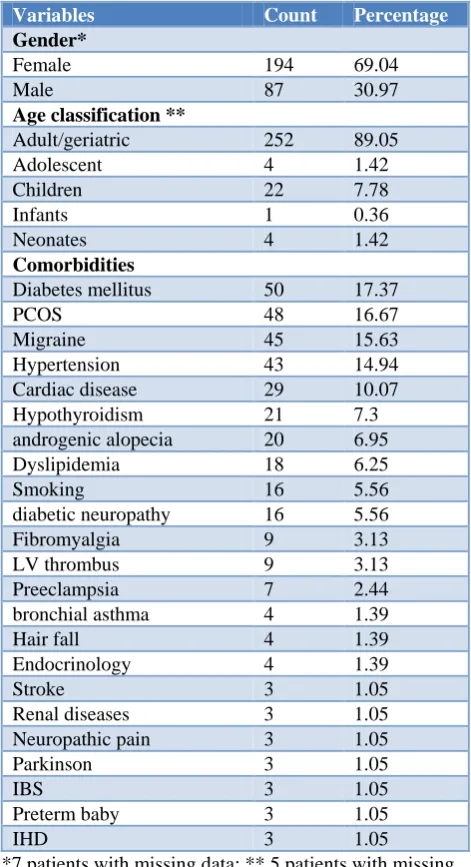
Data of a total of 288 patients were collected. Table 1 shows that females and males represented (69.04%) and (30.97%) respectively. According to age classification, adults/geriatrics represented (89.05%) while children represented (7.78%). Both adolescents and neonates represented (1.42%), whereas infants represented (0.36%). The most comorbid conditions were diabetes mellitus (17.37%), polycystic ovary syndrome (16.67%), migraine (15.63%), and hypertension (14.94%).
Frequency of prescribed medications
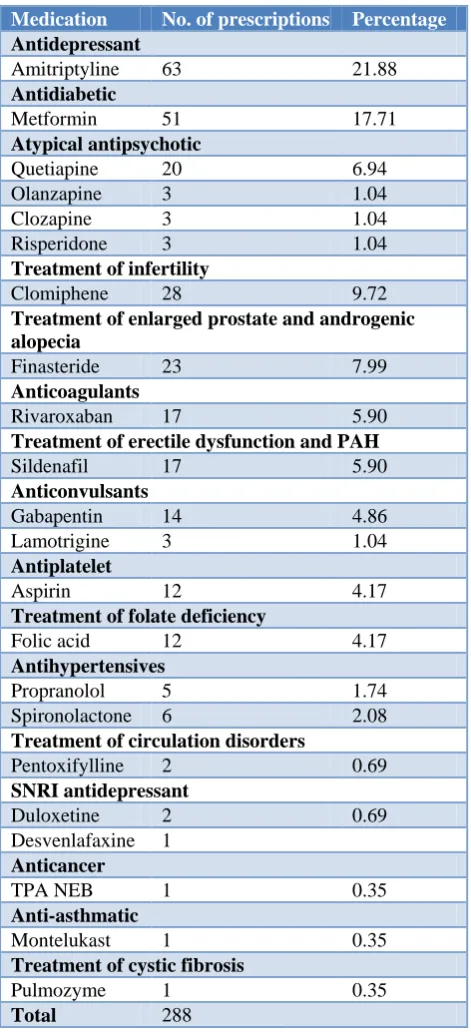
Table 2 shows that antidepressants were the most frequently prescribed (amitriptyline 21.88%), followed by anti-diabetic agents (metformin 17.71%), atypical antipsychotics (AAPs) (10.06%) where quetiapine was the most frequently prescribed medication, drugs for treatment of infertility (clomiphene 9.72%), drugs for Treatment of enlarged prostate and androgenic alopecia (finasteride 7.99%).
Female and adults/geriatric predominance regarding the prescription of the top three OLDU antidepressants, anti-diabetic agents, and AAPs is described in Table 3; while the most common prescribed medication among children was sildenafil (50.09%), followed by spironolactone (22.73%), folic acid (13.64%), and montelukast (4.55%) as shown in Table 4.
Table 1: Demographics and comorbidities.
Variables Count Percentage
Gender*
Female 194 69.04
Male 87 30.97
Age classification **
Adult/geriatric 252 89.05
Adolescent 4 1.42
Children 22 7.78
Infants 1 0.36
Neonates 4 1.42
Comorbidities
Diabetes mellitus 50 17.37
PCOS 48 16.67
Migraine 45 15.63
Hypertension 43 14.94
Cardiac disease 29 10.07
Hypothyroidism 21 7.3
androgenic alopecia 20 6.95
Dyslipidemia 18 6.25
Smoking 16 5.56
diabetic neuropathy 16 5.56
Fibromyalgia 9 3.13
LV thrombus 9 3.13
Preeclampsia 7 2.44
bronchial asthma 4 1.39
Hair fall 4 1.39
Endocrinology 4 1.39
Stroke 3 1.05
Renal diseases 3 1.05
Neuropathic pain 3 1.05
Parkinson 3 1.05
IBS 3 1.05
Preterm baby 3 1.05
IHD 3 1.05
Table 2: Frequency of prescribed medications.
Medication No. of prescriptions Percentage
Antidepressant
Amitriptyline 63 21.88
Antidiabetic
Metformin 51 17.71
Atypical antipsychotic
Quetiapine 20 6.94
Olanzapine 3 1.04
Clozapine 3 1.04
Risperidone 3 1.04
Treatment of infertility
Clomiphene 28 9.72
Treatment of enlarged prostate and androgenic alopecia
Finasteride 23 7.99
Anticoagulants
Rivaroxaban 17 5.90
Treatment of erectile dysfunction and PAH
Sildenafil 17 5.90
Anticonvulsants
Gabapentin 14 4.86
Lamotrigine 3 1.04
Antiplatelet
Aspirin 12 4.17
Treatment of folate deficiency
Folic acid 12 4.17
Antihypertensives
Propranolol 5 1.74
Spironolactone 6 2.08
Treatment of circulation disorders
Pentoxifylline 2 0.69
SNRI antidepressant
Duloxetine 2 0.69
Desvenlafaxine 1
Anticancer
TPA NEB 1 0.35
Anti-asthmatic
Montelukast 1 0.35
Treatment of cystic fibrosis
Pulmozyme 1 0.35
Total 288
Regarding the reasons behind OLDU use, out of 288 off-label prescriptions, 271 (94.42%) were off-off-label by indication, and 6 (2.09%) were off-label by different age group as shown in Table 5.
Table 6 shows that the most frequent outcome indicator was absence of symptoms 165 (57.29%), followed by absence of complications 160 (55.56%), cured/controlled disease 105 (36.46%), and improved laboratory parameters 6 (2.08%).
Table 3: Pattern of prescription according to gender and age.
Therapeutic class
Pattern of prescription according to gender (%)
Pattern of prescription according to age (%)
Antidepressants Females: 79.37
Males: 20.63
Adults/geriatrics: 98.41
Adolescents: 1.5
Anti-diabetic agents
Females: 100 Males: 0
Adults/geriatrics: 100
Atypical antipsychotic
Females: 79.31 Males: 20.69
Adults/geriatrics: 100
Table 4: Off-label medications prescribed for children.
Medication Number of prescriptions %
Sildenafil 13 59.09
Spironolactone 5 22.73
Folic acid 3 13.64
Montelukast 1 4.55
Total 22
Table 5: Reasons for off-label prescriptions.
Reason for
OLDU Number of prescriptions %
OLDU by
indication 271 94.42
OLDU by different age group
6 2.09
OLDU for
other reasons 10 3.48
Total* 287
*1 medication with missing data.
Table 6: Outcome indicators.
Outcome
indicator Number of cases %
Absence of
symptoms 165 57.29
Absence of
complications 160 55.56
Cured/controlled
disease 105 36.46
Improved lab.
parameters 6 2.08
DISCUSSION
since most of the published studies were conducted to analyze the prevalence of OLDU of a certain therapeutic class. Antidepressants are frequently off-label prescribed. In the current study, amitriptyline was prescribed for (21.88%) of the cases for migraine, diabetic neuropathy, fibromyalgia, and IBS. In a study that was conducted to analyze off-label indications for antidepressants, amitriptyline was associated with a high off-label prescribing rate (93%, 89.6% to 95.7%). Metformin was prescribed for (17.71%) of cases in our study. This may be because it is known to induce weight loss in
overweight patients even without glucose
abnormalities.18,19 AAPs were prescribed for (10.06%) of the studied cases. This is justified since AAPs are frequently prescribed as off-label medications.20 Gabapentin was prescribed for (4.86%) of the cases. In another study that was conducted to analyze the prevalence of OLDU of anticonvulsants at a private hospital in Indonesia, it was prescribed for (18.28%) of cases.21
Among studied children, the most common frequent medications were phosphodiesterase (PDE) inhibitors (sildenafil for pulmonary hypertension), and diuretics (spironolactone). These results differ from those published by Luedtke and Buck in a study that was conducted to evaluate the off-label prescribing at the Kluge Children's Rehabilitation Center, Virginia, USA, where the highest percentages of off-label prescribing was for drugs of the cardiovascular system (40.6%), respiratory system (39.4%), genitourinary system/sex hormones (36.8%) and alimentary tract (34.1%).22 Also, it differs from the results reported by Czarniak et al.23 where the highest frequency of off-label prescribing was associated with nervous system drugs in a study that was conducted to estimate the prevalence of off-label prescribing at a major pediatric teaching hospital in Western Australia.
The most common reason for OLDU in our study was OLDU by indication 271 (94.42%), while OLDU by different age group only represented 6 (2.09%). These results differ from those of a study that was conducted in Brazil where the main reason was OLDU by a different dose, followed by OLDU by different age range.24 This is due to the difference of age among the studied populations, where most of our studied patients were adults/geriatrics, while the patients studied in the Brazilian study were children.
Although neither adverse event nor serious side effects have been reported, (20.49%) of the used off label medications were used with no guidelines to govern their use.
Our study has an obvious limitation; a low sample size that hindered a deep analysis of the actual prevalence of OLDU in the Kingdom of Saudi Arabia.
CONCLUSION
Off-label prescribing was found in most adults/geriatrics suffering from depression, and diabetes mellitus. The most common reason for label prescription was off-label use by indication.
Recommendations
1. We recommend a strong collaboration between hospitals and academic institutions in conducting more studies for extensive analysis of the pattern of off-Label and unlicensed drug use in adult and pediatric patients in the Kingdom of Saudi Arabia. 2. These studies would be drug and age specific in
order to deeply understand the efficacy and estimate the risk of the off-label prescribing of each medication with respect to different age groups. 3. Moreover, we recommend that such results be
promptly reported to the Saudi Food and Drug Authority (SFDA) to start planning for regulations regarding off-label use of medicine around the kingdom.
4. Pharmacists can play a major role in the off-label review process based on their medication experience and the high demand toward prescribing OLDU. 5. A well-defined policy across hospitals must be
established to manage the use of OLDU in proper way.
Funding: No funding sources Conflict of interest: None declared
Ethical approval: The study was approved by the Institutional Ethics Committee
REFERENCES
1. Stafford R. Regulating off-label drug use-rethinking the role of the FDA. N Engl J Med. 2008;358(14):1427-9.
2. Walsh T, Caraceni A, Fainsinger R, Foley K, Glare P, Goh C, et al. Palliative Medicine E-Book. Elsevier Health Sciences; 2008.
3. Aagaard. L, Meyer. U, Schaefer. M, Hansen. E. Pharmaceutical production problems detected by adverse drug reactions reports: a documentary study from the German Democratic Republic, 1982–1990. J Clinic Toxicol. 2012;2(2):1000120.
4. Chen X, Liu W, Zhou S. Pharmacogenomics-Guided approaches to avoiding adverse drug
reactions. Clin Pharmacol Biopharm.
2012;1(3):1000104.
5. Prasad A, Datta P, Bhattacharya J, Pattanayak C, Chauhan A, Panda P. Pattern of adverse drug reactions due to cancer chemotherapy in a tertiary care teaching hospital in Eastern India. J Pharmacovigilance. 2013;1(2):1000107.
Reactions from First-Line Antituberculous Drugs. Mycobacterial Diseases. 2012;2(3):1000113. 7. Srba J, Vlcek J. Position and Processing of Adverse
Drug Reactions Directly Submitted by Patients to National Regulatory Authorities in Europe. J Pharmacovigilance. 2014;2(1):1000122.
8. Field R. The FDA's New Guidance for Off-Label Promotion Is Only a Start. Pharmacy & Therapeutics. 2008;33(4):220-49.
9. Mukattash T, Wazaify M, Khuri-Boulos N, Jarab N, Hawwa A, McElnay J. Perceptions and attitudes of Jordanian paediatricians towards off-label paediatric prescribing. Int J Clin Pharma. 2011;33(6):964-73. 10. Dyall J, Coleman C, Hart B, Venkataraman T,
Holbrook M, Kindrachuk J, et al. Repurposing of Clinically Developed Drugs for Treatment of Middle East Respiratory Syndrome Coronavirus Infection. Antimicrobial Agents Chemotherapy. 2014;58(8):4885-93.
11. Mukattash T, Hayajneh W, Ibrahim S, Ayoub A, Ayoub N, Jarab A, et al. Prevalence and nature of off-label antibiotic prescribing for children in a tertiary setting: A descriptive study from Jordan. Pharm Pract (Granada). 2016;14(3):725.
12. Cohen B, Shi Y, Neylan T, Maguen S, Seal K. Antipsychotic prescriptions in Iraq and Afghanistan veterans with posttraumatic stress disorder in Department of Veterans Affairs healthcare, 2007-2012. J Clin Psychiatry. 2015;76(4):406-12.
13. Hussain S, Gebran N, Hussain K, Soliman K. Drug use evaluation of dabigatran in a tertiary care hospital in United Arab Emirates. European J Hospital Pharmacy: Sci Practice. 2013;20(2):106-9. 14. Khdour M, Hallak H, Alayasa K, AlShahed Q,
Hawwa A, McElnay J. Extent and nature of unlicensed and off-label medicine use in hospitalised children in Palestine. Int J Clin Pharma. 2011;33(4):650-5.
15. Alangari A, Abutaleb M, Albarraq A, Al-Dhowailie A. Intravenous immunoglobulin utilization in a tertiary care teaching hospital in Saudi Arabia. Saudi Med J. 2008;29(7):975-9.
16. Al-Mayouf S, Alenazi A, AlJasser H. Biologic agents therapy for Saudi children with rheumatic
diseases: indications and safety. Int J Rheu Dis. 2016;19(6):600-5.
17. Mazhar F, Akram S, Haider N, Hadi M, Sultana J. Off-label and unlicensed drug use in hospitalized newborns in a Saudi tertiary care hospital: a cohort study. Int J Clin Pharm. 2018;40(3):700-3.
18. Igel L, Sinha A, Saunders K, Apovian C, Vojta D, Aronne L. Metformin: an Old Therapy that Deserves a New Indication for the Treatment of Obesity. Curr Atheroscler Rep. 2016;18(4):16. 19. Seifarth C, Schehler B, Schneider H. Effectiveness
of metformin on weight loss in non-diabetic individuals with obesity. Exp Clin Endocrinol Diabetes. 2013;121(1):27-31.
20. McKean A, Monasterio E. Indications of atypical antipsychotics in the elderly. Expert Review of Clinical Pharmacology. 2015;8(1):5-7.
21. Rahajeng B, Ikawati Z, Andayani T, Dwiprahasto IA. Retrospective Study: Theoff-Label Use Of Anticonvulsants At A Private Hospital In Indonesia. Int J Pharm Pharm Sci. 2018;10(5):119-22.
22. Luedtke K, Buck M. Evaluation of Off-label Prescribing at a Children's Rehabilitation Center. J Pediatr Pharmacol Ther. 2014;19(4):296-301. 23. Czarniak P, Bint L, Favie L, Parsons R, Hughes J,
Sunderland B. Clinical setting influences off-label and unlicensed prescribing in a paediatric teaching hospital. PLoS One. 2015;10(3):e0120630.
24. Goncalves M, Heineck I. Frequency of prescriptions of off-label drugs and drugs not approved for pediatric use in primary health care in a southern municipality of Brazil. Rev Paul Pediatr. 2016;34(1):11-7.
Cite this article as: Sheblaq N, Albahooth Z, Alfawzan