http://www.ijcmph.com pISSN 2394-6032 | eISSN 2394-6040
Original Research Article
Assessment of community nutrition program performance through data
validation in the state of Chhattisgarh
Ashish Sinha
1, Srishti Dixit
2*, G. P. Soni
3, Somen Kumar Pradhan
4, Sarwat Naqwi
5INTRODUCTION
Globally, 26% of children are moderately to severely underweight, 10% is moderately to severely wasted, and 31% are moderately to severely stunted.1 In India, 48% of children under 5 years are stunted and 43% are underweight and 20% of children under 5 years in the country are wasted.2 Failing to deal effectively with the
malnutrition problem in India has dire consequences for children‟s development. Through precipitating disease and speeding its progression, malnutrition is a leading contributor of infant and child mortality and morbidity. More than half (54%) of all deaths before the age of 5 years in India are related to malnutrition. Growth assessment is the single most useful tool for defining health and nutritional status in children at both the individual and population levels.4 Recognizing the
ABSTRACT
Background: In India data shows that every 3rd child is underweight. There is a similar situation in Chhattisgarh with 37% children underweight. Women and Child Development Department initiated Nawa Jatan (“new care”), a state specific community based intervention by targeting undernourished children for Six month. Strategy of validation by „External technical support group‟ can be an eye opener for strategic tactical and operational intervention to validate the data of ICDS scheme at field level.
Methods: By systematic random sampling methodology, Out of all targeted 2462 Gram Panchayats (GPs) 246 (i.e. 10%) was included in the survey. One day hands-on demonstration cum training for survey teams mixed with interns, postgraduate and volunteers were organized. Data collection done in pretested proforma.
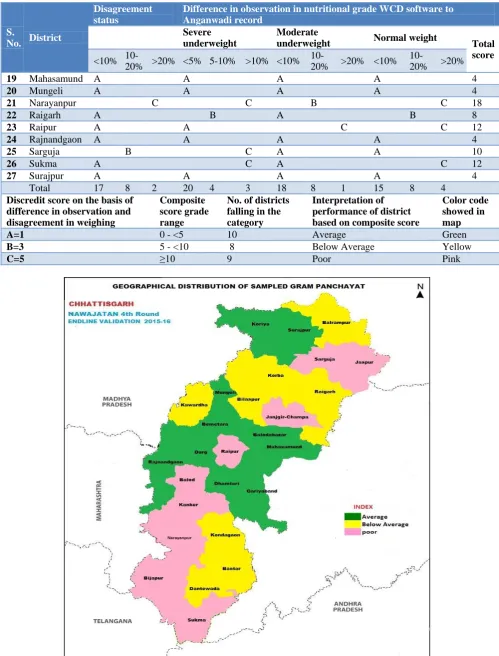
Results: A total of 7155 children distributed in surveyed Gram Panchayats across 27 districts were covered. About 9.1% (651 out of 7155) children showed gap in reporting as they were reported normal grade of nutrition. Out of all children covered for actual field validation. There was 9.84% disagreement in weight recording in the state. Our analysis reveals 9 districts fall in poor performing districts, followed by below average performing 8 districts and average performing 10 districts.
Conclusions: There is wide gap in recorded result as normal children against the observation which was actually in the field level. In addition, there is significant proportion of disagreement of weight records when compared with actual weighing. Above observations might be possibly due to poor monitoring and supervision of weighing activity at the field level.
Keywords: Integrated child development services, Anganwadi worker, Anganwadi centre, Pre-school education,
Nutrition and health education
Department of Community Medicine, 1Pt. J. N. M. Medical College, Raipur, Chhattisgarh, 2Pacific Medical College and Hospital, Udaipur, Rajasthan, 3Government Medical College, Rajnandgaon, Chhattisgarh, India
4
Centre for Healthy Research and Innovation, a PATH affiliate, Chhattisgarh, India
5
Co-ordinator Public Health, Department of Women and Child Development, Chhattisgarh and Maharashtra, India
Received: 18 September 2018 Accepted: 08 October 2018
*Correspondence: Dr. Srishti Dixit,
E-mail: [email protected]
Copyright: © the author(s), publisher and licensee Medip Academy. This is an open-access article distributed under the terms of the Creative Commons Attribution Non-Commercial License, which permits unrestricted non-commercial use, distribution, and reproduction in any medium, provided the original work is properly cited.
extensive prevalence of malnutrition and the consequent drain on the country‟s human resource, the Government of India started the Integrated Child Development Services (ICDS) Scheme; to respond to the child‟s needs in a comprehensive and holistic perspective. The nutritional status of children can be evaluated by their growth. Under nutrition has been measured by anthropometric indicators in terms of stunting, wasting, and underweight. Stunting (low height for age) and wasting (low weight for height) are respectively associated with chronic malnutrition and current nutritional status.
Program description
The Government of India started ICDS Scheme, a centrally sponsored scheme to enhance the health, nutrition, and learning opportunities of children <6 years of age especially targeted for the poor and the deprived. Under the ICDS scheme, Anganwadi Centers (AWCs) are the focal point for the delivery of services and are run by the local community woman, the Anganwadi Worker (AWW) and a helper. Freshly, cooked food supplements are provided at all AWCs to children aged 3-6 years while take-home-rations of food grains are provided every month to children aged 6 months until 3 years (36 months). All children in the eligible age groups can avail of supplementary nutrition provided at the AWCs. The Integrated Child Development Services (ICDS) Scheme is one of the flagship programmes of the Government of India and represents one of the world's largest and unique programmes for early childhood care and development. It is the foremost symbol of country's commitment to its children, pregnant women and nursing mothers, as a response to the challenge of providing pre-school non-formal education on one hand and breaking the vicious cycle of malnutrition, morbidity, reduced learning capacity and mortality on the other. ICDS was launched on 2nd October 1975, on the auspicious occasion of the 106th birth anniversary of Mahatma Gandhi, the Father of the Nation.5
Weighing of each child is carried out by the AWW every month and plotted on the growth chart which is a graphical presentation of weight-for-age. Through the strategy of Nutrition and Health Education, ICDS Scheme aims at bringing about an attitudinal change in health and nutrition habits of the mothers and children and improve their nutritional status. Despite the expansion of the ICDS Scheme to cover most of the children in the country, progress in reducing child malnutrition has been slow.3
Growth monitoring is most important tool for community diagnosis. Cross sectional community nutritional assessment of all children in Chhattisgarh serves as basis to target children. Strategy of validation of any community intervention program by „external technical support group‟ can be an eye opener for strategic tactical and operational intervention designing by WCD, Govt. of C.G. UNICEF requested Department of Community
Medicine to validate the data of end line community nutrition program (i.e. Nawajatan Phase IV) across the state with following objectives:
To validate end line Nwajatan intervention results through record validation at field level
To validate the data of ICDS for March 2016 on the basis of actual weighing.
METHODS
On February all the stakeholders (i.e. DWCD, UNICEF and NGO Representatives) of Nawajatan Phase IV validation met in the Dept. of Community Medicine before initiating survey in the state. There after a one day Hands-on Demonstration cum Training of Survey Teams was organized in Dept. of Community Medicine at Pt. JNM Medical College, Raipur. Out of all 2462 Gram Panchayats (GPs) of Nawajatan Phase IV project, 10% of them were included in the study i.e. 246 GPs across the state. These GPs were identified by applying Systematic Random Sampling methodology. A total of 40 teams two member in each were involved in the survey. Data collection was under-taken during April - May 2016. It was decided that team members will collect data from AWW‟s register and growth chart entry of February and March 2016 for the targeted children and recorded actual weight of targeted children on the day of visit. If child of identified Gram Panchayat/Anganwadi were not available due to any reason then nearby Gram Panchayat / Anganwadi of Nawajatan was visited and additional no. of children were included in the survey. After obtaining sampled Gram Panchayat list (i.e. desired no. of GPs from each district) we obtained the data of targeted children along with unique code of children given to them by DWCD. Supervision of survey teams was carried out by representatives of DWCD and Faculties/PG Scholars of Department of Community Medicine. Each supervisor had to undertake at least six supervisory visits during survey to monitor and supervise the survey team activity.
RESULTS
Table 1: District wise distribution of children covered under Nawajatan phase IV end line validation.
S.
No. District
Total no. Of Nawa Jatan Gram Panchayats
No of Gram Panchayats covered
Aanganwadi centers covered
Target children
Children covered in validation
% children covered
1 Balod 30 3 7 60 47 78.33
2 BalodaBazar 46 5 12 155 140 90.32
3 Balrampur 95 10 63 360 548 152.22
4 Bastar 208 19 69 900 527 58.56
5 Bemetara 14 1 5 60 43 71.67
6 Bijapur 90 7 30 330 283 85.76
7 Bilaspur 62 8 46 306 361 117.97
8 Dantewada 45 4 29 170 140 82.35
9 Dhamtari 416 40 112 635 683 107.56
10 Durg 81 16 46 240 300 125.00
11 Gariyaband 58 7 20 190 134 70.53
12 Janjgir-Champa 83 9 25 60 193 321.67
13 Jashpur 17 2 14 67 69 102.99
14 Kanker 38 4 18 114 118 103.51
15 Kawardha 13 2 4 60 91 151.67
16 Kondagaon 182 22 83 660 659 99.85
17 Korba 13 3 18 60 87 145.00
18 Koriya 57 6 31 120 164 136.67
19 Mahasamund 164 17 55 400 393 98.25
20 Mungeli 70 7 26 240 225 93.75
21 Narayanpur 76 7 37 230 172 74.78
22 Raigarh 211 21 74 480 417 86.88
23 Raipur 9 3 16 60 167 278.33
24 Rajnandgaon 253 26 104 710 701 98.73
25 Sarguja 47 4 16 350 147 42.00
26 Sukma 25 3 11 60 42 70.00
27 Surajpur 59 7 38 240 304 126.67
2462 263 1009 7317 7155 97.79
Table 2: Comparison of Nawa Jatan software data Vs Anganwadi register for February 2016 through grade of under nutrition (i.e. normal, moderate and severe) of Nawa Jatan targeted children covered for validation.
S. No
Grade of children
Children reported in WCD software (February end line data)
Children reported in AWWs register (February end line data)
Deference in observation
No. % No. % No %
1 Normal 3773 52.73 3122 43.63 651 9.10
2 Moderate 2455 34.31 2945 41.16 -490 -6.85
3 Severe 927 12.96 1088 15.21 -161 -2.25
Total 7155 100.00 7155 100.00
Table 3: Comparison of Nawa Jatan Anganwadi register data vs validation weight of March 2016 through grade of under nutrition (i.e. normal, moderate and severe) of Nawa Jatan targeted children covered for validation.
S. No
Grade of children
Children weight in AWW register (March 2016 data)
Children actual validation
weight (April data) Deference in observation
No. % No. % No %
1 Normal 3176 44.39 2557 35.74 619 8.65
2 Moderate 2909 40.66 3112 43.49 -203 -2.83
3 Severe 1070 14.95 1486 20.77 -416 -5.81
Figure 1: Age (at baseline) and sex wise distribution of children covered under Nawa Jatan phase IV end line validation.
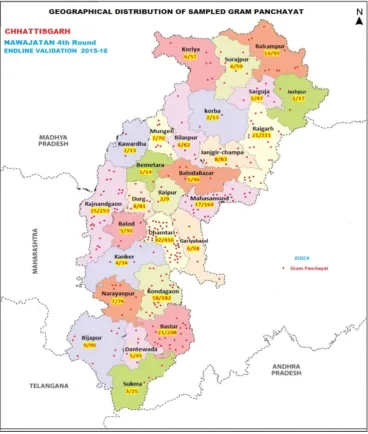
Figure 2: Map of Chhattisgarh showing geographical distribution of surveyed Gram Panchayats for Phase IV end-line validation.
M
a
le %
,
6
-11
m
o
nths,
2
.17
M
a
le %
,
1
2
-23
m
o
nths,
2
5
.96
M
a
le %
,
2
4
-35
m
o
nths,
3
3
.07
M
a
le %
,
3
6
-50
m
o
nths,
3
8
.8
Fem
a
le
%
,
6
-11
m
o
nths,
2
.08
Fem
a
le
%
,
1
2
-23
m
o
nths,
2
4
.44
Fem
a
le
%
,
2
4
-35
m
o
nths,
3
4
.06
Fem
a
le
%
,
3
6
-50
m
o
nths,
3
9
.42
0 5 10 15 20 25 30 35 40 45
6-11 months 12-23 months 24-35 months 36-50 months
Table 4: For study purpose acceptable level of difference between Nawa Jatan weight and validation weight.
Age at the time of Nawa Jatan 4th phase
Interval between Nawa Jatan weight and validation weight-grams
< 2 weeks 2-4 weeks 4-6 weeks 6-8 weeks
Lower Upper Lower Upper Lower Upper Lower Upper
Up to 1 month -200 600 -400 1200 -600 1800 -600 2250
1-2 months -200 600 -400 1200 -600 1650 -600 2100
2-3 months -200 600 -400 900 -600 1200 -600 1500
3-4 months -200 450 -400 750 -600 1050 -600 1350
4-5 months -200 450 -400 600 -600 800 -600 1050
5-6 months -200 300 -400 450 -600 600 -600 900
6 months to 50 months -200 300 -400 450 -600 600 -600 900
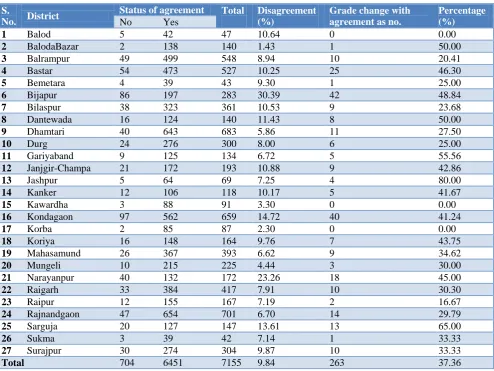
Table 5: District wise distribution of disagreement of weight of children covered for actual field validation March 2016 data.
S.
No. District
Status of agreement Total Disagreement (%)
Grade change with agreement as no.
Percentage (%)
No Yes
1 Balod 5 42 47 10.64 0 0.00
2 BalodaBazar 2 138 140 1.43 1 50.00
3 Balrampur 49 499 548 8.94 10 20.41
4 Bastar 54 473 527 10.25 25 46.30
5 Bemetara 4 39 43 9.30 1 25.00
6 Bijapur 86 197 283 30.39 42 48.84
7 Bilaspur 38 323 361 10.53 9 23.68
8 Dantewada 16 124 140 11.43 8 50.00
9 Dhamtari 40 643 683 5.86 11 27.50
10 Durg 24 276 300 8.00 6 25.00
11 Gariyaband 9 125 134 6.72 5 55.56
12 Janjgir-Champa 21 172 193 10.88 9 42.86
13 Jashpur 5 64 69 7.25 4 80.00
14 Kanker 12 106 118 10.17 5 41.67
15 Kawardha 3 88 91 3.30 0 0.00
16 Kondagaon 97 562 659 14.72 40 41.24
17 Korba 2 85 87 2.30 0 0.00
18 Koriya 16 148 164 9.76 7 43.75
19 Mahasamund 26 367 393 6.62 9 34.62
20 Mungeli 10 215 225 4.44 3 30.00
21 Narayanpur 40 132 172 23.26 18 45.00
22 Raigarh 33 384 417 7.91 10 30.30
23 Raipur 12 155 167 7.19 2 16.67
24 Rajnandgaon 47 654 701 6.70 14 29.79
25 Sarguja 20 127 147 13.61 13 65.00
26 Sukma 3 39 42 7.14 1 33.33
27 Surajpur 30 274 304 9.87 10 33.33
Total 704 6451 7155 9.84 263 37.36
DISCUSSION
Despite rapid economic development along with increase in food production in recent decades and several nutritional intervention programmes in operation since the last three decades, childhood under nutrition remains an important public health problem in India. It is one of the important reasons for ill health and child mortality.6 In present study 97.79% of children were covered out of all sampled children while in a Quick Evaluation Study of Anganwadis under ICDS, done by NITI AAYOG in June
57.7% boys in their study done in urban area of Waynad district.11 In current study 35.74% children were found normal, 43.49% were moderate and 20.77% were severe under-weight. Similarly, it was found in study done by Agrawal et al, in urban slums of Agra city that 32.6% of preschool children were labeled as normal and the rest were underweight; with about 20.5% children were below 3SD weight.12 While in study done by Bhimisetti et al, among tribal population of Andhra Pradesh 12.7% of children were severe undernourished.9 In a quick
evaluation study of Anganwadis under ICDS, done by NITI AAYOG in June 2015 in 19 Districts the health status of 78.8%, 17% and 4.2% of the children recorded during the month of February, 2014 was normal, moderately malnourished and severely malnourished respectively. Further, the on the spot weight measurement carried out during April, 2014 revealed that the health status of 77.4% of the children are in normal grade, 17.6% are in moderate grade and 5% are in Severe grade.7
Figure 3: District wise distribution of disagreement of weight of children covered for actual field validation March 2016 data.
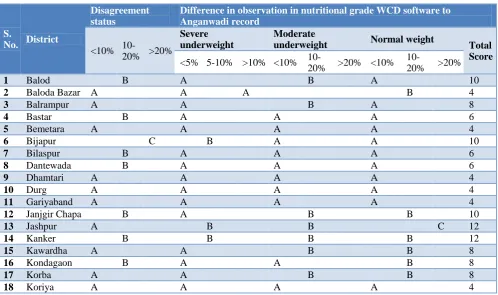
Table 6: Distribution of discredit score on the basis of difference in observation and disagreement in weighing of Nawa Jatan targeted children.
S.
No. District
Disagreement status
Difference in observation in nutritional grade WCD software to Anganwadi record
<10%
10-20% >20%
Severe underweight
Moderate
underweight Normal weight Total
Score <5% 5-10% >10% <10%
10-20% >20% <10%
10-20% >20%
1 Balod B A B A 10
2 Baloda Bazar A A A B 4
3 Balrampur A A B A 8
4 Bastar B A A A 6
5 Bemetara A A A A 4
6 Bijapur C B A A 10
7 Bilaspur B A A A 6
8 Dantewada B A A A 6
9 Dhamtari A A A A 4
10 Durg A A A A 4
11 Gariyaband A A A A 4
12 Janjgir Chapa B A B B 10
13 Jashpur A B B C 12
14 Kanker B B B B 12
15 Kawardha A A B B 8
16 Kondagaon B A A B 8
17 Korba A A B B 8
18 Koriya A A A A 4
1
.43 2.3
3
.3
4
.44
5
.86 6.62 6.7
6
.72 7.14 7.19 7.25
7
.91
8
8
.94 9.3 9.76 9.87
1
0
.17
1
0
.25
1
0
.53
1
0
.64
1
0
.88
1
1
.43
1
3
.61
1
4
.72
2
3
.26
3
0
.39
9
.84
0 5 10 15 20 25 30 35
S.
No. District
Disagreement status
Difference in observation in nutritional grade WCD software to Anganwadi record
Severe underweight
Moderate
underweight Normal weight Total
score <10%
10-20% >20% <5% 5-10% >10% <10%
10-20% >20% <10%
10-20% >20%
19 Mahasamund A A A A 4
20 Mungeli A A A A 4
21 Narayanpur C C B C 18
22 Raigarh A B A B 8
23 Raipur A A C C 12
24 Rajnandgaon A A A A 4
25 Sarguja B C A A 10
26 Sukma A C A C 12
27 Surajpur A A A A 4
Total 17 8 2 20 4 3 18 8 1 15 8 4
Discredit score on the basis of difference in observation and disagreement in weighing
Composite score grade range
No. of districts falling in the category
Interpretation of performance of district based on composite score
Color code showed in map
A=1 0 - <5 10 Average Green
B=3 5 - <10 8 Below Average Yellow
C=5 ≥10 9 Poor Pink
CONCLUSION
All though Survey findings showed that community Nutrition intervention program was operational in all visited Gram Panchayats/Anganwadis. As per survey finding there is wide gap in recorded result as normal children against the observation which was actually in the field level (i.e. Anganwadi register). This may be probably either due to wrong data entry, over reporting and/or incorrect weighing. In addition, there is significant proportion of disagreement of weight records when compared with actual weighing. Out of all disagreement more than one third children showed change in their nutritional grade. Above observations might be possibly due to poor monitoring of weighing activity leading to significant level of gap in observation in grade of malnutrition as well as recording of weight.
Recommendations
Based on these observations, Department of Woman and Child Development undertakes a review of district‟s performance based on the above findings to find out 1) the reasons for the disagreements, 2) to understand whether these observations are limited to the sampled panchayats or across all targeted areas in the respective districts, and 3) suggested measures to guard from such inaccuracies in the future. The Department should consider a stratified approach to further capacity building and monitoring, such that the poor performing (in terms of accuracy) should receive intense capacity building and monitoring of weighing and recording, the below average performing should receive monitoring and average performing should receive routine services.
ACKNOWLEDGEMENTS
Special thanks to Dr Abner Daniel, Nutrition Specialist and UNICEF Chhattisgarh, who provided us financial and logistical support for this study. The authors declare that there is no conflict of interests.
Funding: No funding sources Conflict of interest: None declared
Ethical approval: The study was approved by the Institutional Ethics Committee
REFERENCES
1. UNICEF, The State of the World‟s Children Report. New York: UNICEF; 1998.
2. International Institute for Population Sciences (IIPS) and Macro International. National Family Health Survey (NFHS-3), 2005-06. Vol. I. India: International Institute for Population Sciences; 2007.
3. Salganik MJ. Variance estimation, design effects, and sample size calculations for respondent-driven sampling. J Urban Health Bull New York Acad Med. 2006;83:98-112.
4. Wong's Nutritional assessment - Nursing care of Infants and children. 7th edition. Missouri: Mosby company; 2002: 1692.
5. Mamata T, Sarada D. 2009 Child Right, Discovery Publishing House Private Limited, New Delhi: p.6. 6. Nandy S, Irving M, Gordon D. Poverty, child under
nutrition and morbidity: new evidence from India. Bull World Health Organ. 2005;83:210-6.
7. A Quick Evaluation Study of Anganwadis under ICDS, NITI AAYOG, Programme Evaluation Organisation Government of India New Delhi-110001 June 2015, PEO Report No.227.
8. Silva VG, Silva SG. Nutritional status of Anganwadi Children under the Integrated Child Development Services Scheme in a Rural Area in Goa. Int J Scientific Study. 2015;3(7):217-20. 9. Bhimisetti SC, Pamarthi K, Srinivas PJ. Nutritional
Status of Under 5 Children Belonging to tribal Population Living in Visakhapatnam District, Andhra Pradesh. J Evidence based Med Healthcare. 2015;2(33):4975-80.
10. Philip RR, Vijayakumar K, Indu PS, Shrinivasa BM, Sreelal TP, Balaji J. Prevalence of undernutrition among tribal preschool children in Wayanad district of Kerala. Int J Advanced Med Health Res. 2015;2(1):33.
11. Gope A, Baruah KK, Ojah J. An Assessment of Nutritional Status of 1 to 5 Year Old Children in Slum Area under Urban Health Training Centre Guwahati. Int J Health Sci Res (IJHSR). 2016;6(8):29-33.
12. Agarwal L, Jain A, Pankaj JP, Jain A, Paruthy S. Current status of nutrition among under five children of slum areas of Agra. J Evol Med Dental Sci. 2014;3(58):13120-6.