Journal of Engineering Sciences, Volume 5, Issue 2 (2018), pp. F 7–F 12 F 7 JOURNAL OF ENGINEERING SCIENCES
ЖУРНАЛ ІНЖЕНЕРНИХ НАУК
ЖУРНАЛ ИНЖЕНЕРНЫХ НАУК
Web site: http://jes.sumdu.edu.ua
DOI: 10.21272/jes.2018.5(2).f2 Volume 5, Issue 2 (2018)
UDC 536.24+[678.02:678.5.059]
Numerical Simulation of the Evaporative Air Cooler with a Capillary-Porous Structure
Arseniev V. M., Shulumei A. V.*1
Sumy State University, 2 Rymskogo-Korsakova St., 40007 Sumy, Ukraine
Article info:
Paper received:
The final version of the paper received: Paper accepted online:
June 22, 2018 October 5, 2018 October 10, 2018
*
Corresponding Author’s Address:
[email protected]
Abstract. Application of evaporative air cooling in various technologies allows reducing energy costs for improv-ing environmental performance. Considerimprov-ing the promise of usimprov-ing air coolers with a capillary-porous structure, a mathematical model of the working process for such devices of contact heat of mass transfer was developed. The model takes into account the completeness of the process with temperature efficiency equal to 0.6–0.7 at constant wa-ter temperature at the temperature level of the wet thermomewa-ter. The estimation of energy efficiency of the air cooler on the basis of the exergent method of thermodynamic analysis is proposed. As a result, the thermophysical and de-sign model of evaporative cooling of air in air-cooled contact type with capillary-porous structures was developed. The proposed method of cooling air is characterized by the following advantages the lowest water consumption per unit of heat exchange surface compared with other methods (e. g. spray nozzles), as well as zero discharge of drip liquid, which does not require further separation. Finally, the estimation of energy efficiency of the air vent is pro-posed on the basis of the exergent method of thermodynamic analysis.
Keywords: evaporative cooling, capillary-porous structure, thermophysical modelling, exergy efficiency.
1
Introduction
Evaporative cooling of water and atmospheric air is one of the first ways to implement artificial cold in the history of human development. Modern problems in low-energy low-energy and environment require the search for alternative solutions in the field of climate technology. Evaporative cooling is a non-mechanical way, but its efficiency is significantly limited by climatic conditions. At the same time, interest in the possibilities of evapora-tive coolers has increased in recent years, due to their low energy consumption and environmental cleanliness [1–3]. Among the technical systems for which evaporative cooling can significantly improve the thermoeconomic efficiency are compressor and gas turbine units. As it is known, when working compressor plants with compres-sion of atmospheric air there is a deviation of the regime parameters from the nominal due to changes in the ther-mal parameters of the air at the input: pressure, tempera-ture and relative humidity.
The most negative consequences are associated with an increase in the temperature of atmospheric air. For compressors of the volume principle of operation (com-pressor installations of general purpose, small and medi-um air separation units), the increase in air temperature in the suction is primarily manifested in the reduction of mass productivity and increase in energy consumption in the intermediate and final cooling. For turbochargers (gas
turbine units, compressor stations for mine and chemical production), the power of the drive significantly increas-es.
In the paper [4] the dependence of the relative reduc-tion of the effective power of the gas turbine unit with increasing temperature of the intake of the cyclic air is shown, experimental for GTU of the mark LM 1600 “General Electric”with Nе, iso = 15 MW and calculated for GTU AL-31ST with Nе, iso = 16 MW
According to the graph of the increase in the tempera-ture of air intake from 15 °С (nominal mode ISO) to 40 °C reduces the effective power GTU at 18–20 %, which corresponds to losses of about 3 MW for the con-sidered installations.
To cool the air at the suction, air coolers of the surface or contact type are used depending on the required depth of cooling or cold water capacity.
The required cold-productivity is provided by the op-eration of refrigerating machines, mainly heat-discharging waste streams of heat.
Contact air coolers are suitable for technological air conditioning in premises where it is necessary to maintain high relative humidity (spinning, paper production, etc.). From the position of capital and operating costs, contact air coolers have an advantage over surface type devices for cooling cyclic air gas turbine engines.
F 8 CHEMICAL ENGINEERING: Processes in Machines and Devices requiring its separation or ensuring its evaporation in the
process of compression of air.
In this regard, air coolers with porous ceramics or ca-pillary-porous structures of composite materials are of particular interest. Evaporative cooling using capillary-porous materials allows the film flow to be eliminated on the contact surfaces of the apparatuses and the dropping of moisture from the heat transfer surface.
2
Research Methodology
2.1
Thermophysical description of the
calculation model
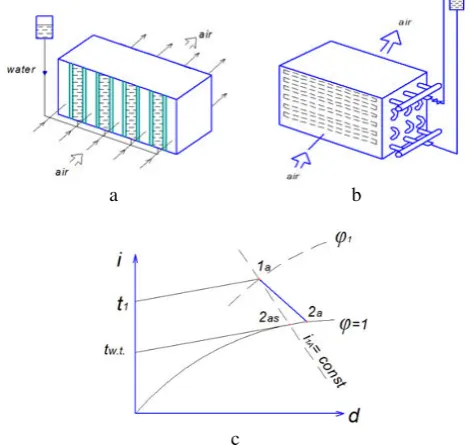
Figure 1 shows simplified schemes for two design var-iants of air coolers using capillary-porous structural ele-ments, the heat of mass exchange between air and water.
a b
c
Figure 1 – Evaporative air coolers: а – multi-channel with walls of capillary-porous materials; b – heat exchange unit with
a bundle of pipes from capillary-porous materials; c – process in “i–d” diagram
According to Figure 1 a, porous walls divide flat paral-lel channels with water and air passage. Water in the channels is replenished as it moves through the capillaries and evaporates into the air at the expense of the reservoir of water in the tank.
A pumping movement of water through the apparatus can also be organized. Filling with water is organized through one row of channels.
According to the scheme in Figure 1 b, the heat ex-change unit has a conventional constructive solution for airflow of a beam of non-circular pipes with a corridor or chess arrangement, in which the pipes are characterized by a fine porosity of 2.0–2.5 μm. Material of pipes: ce-ramics, plastics, composite materials. Water in pipes is supported either by gravity pressure or by pump circula-tion.
Taking into account a number of features inherent in the process of evaporative cooling in the capillary-porous structures, the following assumptions were adopted:
– the temperature of the liquid in the channels is con-stant and is equal to the temperature of the wet thermom-eter;
– the temperature efficiency of the process is limited by the value Eа = 0.6;
– there is no heating of the main mass of the liquid; – the contact surface of the media is completely mois-tened with water by blurring the air flow of the meniscus volume of droplets, which flows from the water of the water;
– there is no attribution of droplet moisture; – gas-dynamic air resistance neglected;
– in the temperature range the dependence of the par-tial pressure of the saturated water vapor on the tempera-ture is taken as a linear function;
– the notion of cold productivity becomes incorrect in view of inequalities i2a > i1a, it is more correct to consider the ability to humidify the air, that is, its increase in mois-ture content.
The conceptual task of the calculation model is to de-termine the required area of the contact surface of the capillary-porous structure, on which the change of the parameters of the air flow along the line of heat - logistic relation is realized, taking into account the accepted value of the temperature efficiency of the evaporative cooling process.
For the temperature efficiency Eа parameters of air flow at the outlet of the air cooler is characterized by the expressions:
2a 1a a(1a 2as)
t t E t t (1)
where φ2.A = 0.98–1.00, which allows to find the mois-ture content, x2а and enthalpy, i2а in the state of 2а and determine the thermal logic ratio:
1 2
1 2
a a
AC
a a
i i
x x
(2)
By breaking the intervals of change in the moisture content in the apparatus, (x1ax2a), on the elementary regions along the line AC we obtain the possibility of determining the thermal, caloric and thermophysical pa-rameters of air from the state 1а to 2а by the equations used in the calculations of air conditioning systems and convective drying of moist materials [7].
The very process of energy interaction between envi-ronments is described by the equation of thermal balance:
,
w Q Q
Q (3)
Journal of Engineering Sciences, Volume 5, Issue 2 (2018), pp. F 7–F 12 F 9 In turn, the component equations are written in the
form:
;·
·F t tw
Q
(4)
;·GBw r pF pw pa r
Q
(5),
t c G
Qw w w (6)
where – coefficient of heat transfer; F – surface area of heat transfer; (tatw) – air temperature in the core of the stream and water on the surface of evapora-tion; r - specific heat of vaporization of water at tw;
ev
G – mass flow rate of evaporated water; p – the coef-ficient of evaporation is determined by the difference of partial pressure of water vapor, pw – at the surface of water and pa - in the core of the stream; Gw- mass flow rate of water when it is circulating through channels or pipes; cw – average heat capacity of water in the interval of temperature changes; t t2wt1w – water heating in the machine.
The heat flux to the liquid Qw is realized under the condition
( )
w w w w w a w
G c t k F t t (7)
where kw – the coefficient of heat transfer from air to water through the distribution surface, the area of Fw.
Assuming equality F F Fw:
( ) ( ) w
a w p w a w w
w
G
t t r p p c t
F
In the absence of water circulation tw 0: (tA tw) r p (pw pA)
To determine the quantities on the interface of the me-dia, we can use the linearized approximation dependence of the partial pressure of the saturated water vapor p ts( ) on the temperature as proposed in [11]:
( )
s
p t a b t
After the appropriate changes: 1 ( )
1
a
w a s a
p p p t
b A
where the complex
( ) p p A r t
– the psychometric
coefficient.
For the calculation of the technical characteristics of the air cooler on the capillary-porous structures, the fol-lowing expressions were obtained:
– consumption of evaporating water per unit of heat exchange surface: 2 1 2 1 ( ) , ; 1 H O a
F p s w
kg
q p t
b m A
– water consumption for evaporation:
2
. . ( 1 2 ), 2 ;
H O
ev d a a a
kg
G m x x
m
– area of heat exchange surface:
2 , ev tot F G F m g
– relative water consumption:
1 2
1 1
a a a
w
a a
G x x
G
m x
;
where the coefficient of mass return is determined from the expression:
p
pa tot
Le c P
(8)
In this formula, the Lewis criterion Le is consid-ered as the ratio of the molecular diffusion coefficient at Ptot and the air temperature in the boundary layer to the air-cooled coefficient under the same conditions.
2.2
Energy efficiency of the evaporative
cooling process
For contact type coolers, energy efficiency is consid-ered as the relative value of air temperature differences, which takes into account the non-adiabativity of the ener-gy conversion process. This value is called the tempera-ture efficiency and is written as:
1 2 1 2 ( ) ( ) a a a a as t t E t t (9)
However, the magnitude of the Eа takes into account only the lack of recuperation for air cooling, due to the non-indifference of the process and does not take into account the internal irreversibility in the form of gas-dynamic resistances along the airway.
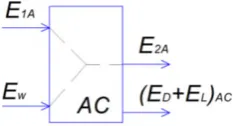
F 10 CHEMICAL ENGINEERING: Processes in Machines and Devices Formalized scheme of exergent transformations is
pre-sented in Figure 2.
Figure 2 – Design scheme of exergent transformations in an air cooler in capillary-porous structures at
1w w t. t t
On this scheme it is indicated:
– E1a, E2a – exergy of the airflow on the input and
output of the apparatus;
– Ew – exergy of water at the entrance to the capillary
canals;
– (EDEL AC) – exergy of destruction and loss in the air cooler.
To determine the exurance of the fuel flow, EF and product flow ER, according to the purpose of the appa-ratus can be written:
2a ( 2a F) ( 2a P)
E E E
where (E2a F) – the exergy of the wet air at t2а, x2а, m1а;
2
(Ea P) – the exergy of water vapor at t2а, x2а with mass flow Gev.
This separation of exergy air at the outlet allows ob-taining:
1 2
2
( )
( )
F a a F
p a F w
E E E
E E E
(10)
and exergic efficiency takes the form of 2
1 2
( )
( )
a F w
P ex
F a a F
E E
E
E E E
(11)
Considering moist air as a mixture of ideal gases, we obtain:
1 2 . 1
1 1
, . 1 2 , . .
2 2
( ) (1 )
( ) ( ln ln
a a F d a a
a a
p w a a a e p w a w a
a a
E E m x
T P
c t t T c R
T P
(12)
where md a. (1 x1a) – mass flow of moist air; cp w a, . – the isobar heat capacity of the wet air in the temperature range t1а, t2а; Rw a. – the gas became wet air; P1а, P2а– air pressure at the entrance and exit of the apparatus.
The calculated equations forcp w a, . , Rw a. , P2a are given in the next section.
For the exergy stream of water vapor and water, use the equation for real gases:
2 2 2
(Ea P) Gev ((ha P) he)Te((S )a PSe) (13)
2
(Ea P) Gev (hwhe)Te(SwSe) (14) where hw,(h2a P) – the enthalpy of water and water vapor at the appropriate temperatures tw, t2а.
When taking environmental parameters Te= 273 K and Pе = 100 kPa, the values of hе, Sе for water are zero and the exergy of the product stream is written as follows:
2 2 . 22 1
( ) ( )
(( ) ) ((S ) )
a P w d a a a
a P w e a P w
E E m x x
h h T S
(15)
After substituting (15) and (12) in (11) it can be ob-tained the following dependence:
2 1
2 2
1 1
1 , . 1 2 , . .
2 2
( ) (( ) ) ((S ) )
(1 ) ( ) ( ln ln
a a a P w e a P w
ex
a a
a p w a a a e p w a w a
a a
x x h h T S
T P
x c t t T c R
T P
(16)
3
Results
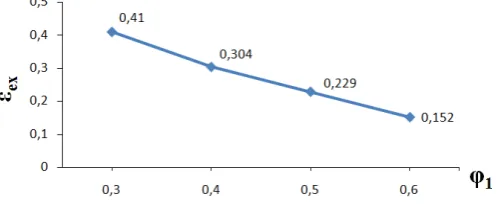
Based on the results of calculations, graphic depend-encies were constructed, Figures 3, 4 for both types of constructive execution.
Based on the calculations in Figure 3 the dependence of the specific wet current on the relative humidity is presented. It can be seen that with an increase in relative humidity, the specific moisture influx decreases.
Journal of Engineering Sciences, Volume 5, Issue 2 (2018), pp. F 7–F 12 F 11
Figure 3 – The dependence of specific wet current on relative humidity
Figure 4 – The dependence of exergic efficiency on relative humidity
4
Conclusions
As a result, the thermophysical and design model of evaporative cooling of air in air-cooled contact type with capillary-porous structures was developed. The following dependencies are calculated:
– water consumption per unit of heat exchange sur-face;
– the effect of relative humidity on exergic efficiency.
This method of cooling air is characterized by the fol-lowing advantages:
– the lowest water consumption per unit of heat ex-change surface compared with other methods (e. g. spray nozzles);
– zero discharge of drip liquid, which does not require further separation.
Finally, the estimation of energy efficiency of the air vent is proposed on the basis of the exergent method of thermodynamic analysis.
References
1. Gorin, A. N., & Doroshenko, A. V. (2007). Alternative Refrigeration Systems and Air Conditioning Systems, Nordpress, Do-netsk, Ukraine.
2. Velasso, E., Rey F. I., Tejero A., & Flores F. E. (2009). Performance of three different evaporative cooling systems. Proceed-ings of the 7th World Conference on Experimental Heat Transfer, Fluid Mechanics and Thermo-dynamics.
3. Cheban, D. N., & Doroshenko A. V. (2013). Use of porous ceramics in the field of evaporative cooling and theoretical analysis of combined systems. Refrigeration Technique and Technology, No 2(142), pp. 4–10.
4. Arseniev, V. M., Miroshnichenko V. V., & Borisov N. A. (2015). Exergy efficiency of technogenic cooling of cyclic air of a gas turbine plant, Refrigeration Technique and Technology, Vol. 51, Issue 6, pp. 6–11.
5. Isachenko, V. P., Osipova, V. A., & Sukomel, A. S. (1969). Heat Transfer. Energy, Moscow, Russia. 6. Bykov, A. V. (1980). Thermophysical Bases for Artificial Cold Production. Food industry, Moscow, Russia. 7. Chumak, I. G., Laryanovsky, S. Yu., et al. (2006). Cooling Installations. Palmyra, Odessa, Ukraine.
8. Tsatsaronis, D. (2002). Interaction of thermodynamics and economics to minimize the cost of the energy-converting system. Ne-gotiant, Odessa.
9. Morozyuk, T. V. (2006). The theory of refrigerating machines and heat pumps. Negociant, Odessa, Ukraine. 10. Arseniev, V. M. (2012). Heat Pump Energy Conservation Technology. Sumy State University, Sumy, Ukraine. 11. Gerasimov, N. A., & Kurilev, E. C. (1970). Cooling Installations. Mechanical Engineering, Saint Petersburg, Russia.
12. Pavlov, K. F., Romankov, P. G., & Noskov, A. A. (1964). Examples and tasks on the course of processes and apparatuses of chemical technology. Chemistry, Moscow, Russia.
F 12 CHEMICAL ENGINEERING: Processes in Machines and Devices
14. Lipa, A. I. (2010). Air conditioning. The basics of the theory. Modern air treatment technology. VMV Publishing House, Odes-sa, Ukraine.
15. Zhuk, K. B., & Doroshenko, A. V. (2012). Prospects of use of capillary - porous structures in evaporative coolers of gases and liquids. Sustainable development and artificial cold. Proceedings of the 8th International Scientific and Technical Conference, pp. 510–513.
16. Cheban, A. N., & Doroshenko, A. V. (2012). Use of porous ceramics in the field of evaporative cooling. Sustainable develop-ment and artificial cold. Sustainable development and artificial cold. Proceedings of the 8th International Scientific and Tech-nical Conference, pp. 174-177.
17. Doroshenko, A. (1992). Compact heat and mass exchange equipment for refrigeration equipment (theory, calculation, engineer-ing practice). Doctoral Thesis, Odessa Institute of Low-Temperature Technology and Energy, Odessa, Ukraine.
Числове моделювання випарного повітроохолоджувача
з капілярно
-
пористою структурою
АрсеньєвВ. М., ШулумейА. В.
Сумський державний університет, вул. Римського-Корсакова, 2, 40007, м. Суми, Україна
Анотація. Застосування випарного охолодження повітря в різних технологіях дозволяє знизити енерговитрати і поліпшити екологічні показники. Зважаючи на перспективність використання повітроохолоджувачів з капілярно-пористою структурою, розроблена математична модель робочого процесу для апаратів контактного тепломасообміну. У результаті розроблена термофізична модель випарного повітряного охолоджування із застосуванням капілярно-пористих структур.Запропонована модель ураховує завершеність процесу з температурною ефективністю 0,6–0,7 при постійній температурі води на рівні
температури мокрого термометра. Запропоновано спосіб оцінювання енергоефективності
повітроохолоджувача на основі ексергетичного методу термодинамічного аналізу. Наведений спосіб
охолодження повітря характеризується такими перевагами якнайнижча витрата води на одиницю поверхні
теплопередачі, а також нульові витоки краплинної рідини, що не потребує подальшого розділення. У результаті запропоновано спосіб оцінювання енергоефективності запропонованої конструкції на основі ексергетичного методу термодинамічного аналізу.