Original Research Article
Medical leadership: interns’ perception on leadership skills:
a qualitative study from Chennai
Sree T. Sucharitha*, E. Suganya, Balaji Arumugam, P. Shirley
INTRODUCTION
Leadership is identified as an essential skill for Indian medical graduates (IMG) and is listed by Medical Council of India (MCI) in the curriculum revisions dating back to 2012.1 "Leadership development" often encompasses efforts to develop individual leaders as well as to build capacity for leadership within an organization.2,3 Formal training in physician leadership has been shown to improve processes and outcomes
4,56,7
in health care. Global studies identified leadership skills among health care providers as a highly valued competency across the spectrum of medicine, nursing and allied streams of medical profession.8-15
Leadership competency framework for health care services is about delivering high quality services to patients by demonstrating personal qualities, working with others, managing services, improving services, and setting direction.16 Though medical leadership is an essential skill for the emerging Indian medical graduates, currently there is minimal focus on formal training in this area for medical undergraduates. Globally, training programs have been attempted by medical professionals to integrate leadership training in First and Second year MBBS curriculum and reported successful learning outcomes.17 Undergraduate medical education (UME) focussing on leadership training has been of interest in developed countries with varied approaches including
ABSTRACT
Background: Medical leadership, an essential skill for the emerging medical graduates has been rarely studied in India.
Methods: A formative research was undertaken among 30 interns selected by purposive sampling method. Triangulation of free listing, pile sorting was done to elicit their perception on leadership attributes. This was followed by a semi-structured focus group discussion to elicit the characteristics and solutions to obtain adequate leadership skills. The data was analysed using Visual Anthropac 4.98.1/X software.
Results: Interns perceived communication skills, impartiality, patience, honesty, self-discipline, receptive to others opinions, knowledge of medicine, self-confidence, and guiding teams as major characteristics of effective medical leadership. The respondents admitted they were deficient in the understanding of leadership traits as it was not required of them as medical undergraduates. Internship period provided multiple platforms to develop leadership skills such as demonstrating personal qualities, working with others, goal setting and delivering services individually thereby overcoming a training gap during undergraduate period. Interns suggested that structured training on leadership skills and personality development coupled with exposure to challenging clinical environments during the undergraduate period will help them emerge as confident leaders.
Conclusions: Medical education reforms should support the inclusion of leadership training in the MBBS curriculum.
Keywords: Medical leadership, Interns, Qualitative study, Free listing, Pile sorting
Department of Community Medicine, Tagore Medical College and Hospital, Chennai, Tamil Nadu, India
Received: 18 September 2018
Revised: 08 October 2018
Accepted: 09 October 2018
*Correspondence:
Dr. Sree T. Sucharitha,
E-mail: [email protected]
Copyright: © the author(s), publisher and licensee Medip Academy. This is an open-access article distributed under the terms of the Creative Commons Attribution Non-Commercial License, which permits unrestricted non-commercial use, distribution, and reproduction in any medium, provided the original work is properly cited.
classroom activities, simulation exercises, and integration into clinical experiences.18 Innovation collaborative study by Public Health Foundation of India (PHFI) in 2015 highlighted the inadequacies in current medical education curriculum for formal training in medical leadership skills.19 In the emerging health care scenario, leadership training for medical graduates equips them with a skill set to effectively address the health system related challenges and improve the health care delivery at all levels including primary care, secondary care and tertiary care. Hence we propose a qualitative study to elicit characteristics associated with effective medical leadership among trainee interns at an academic medical institute for future development of such training for medical students.
METHODS
The present qualitative study was undertaken in department of community medicine, Tagore medical college, Chennai. All the interns posted in either urban or rural health centre were invited to the department and a preview about the study was given. Out of 50 interns posted in the department, 30 were included, based on their willingness to participate in the study. A written consent was obtained from the participants and a triangulation of free listing and pile sorting was planned. The study period is during September 2018-October 2018.
Two days later, the free listing exercise, was conducted. The participants were asked to list individually the perceived attributes of effective medical leadership. This was analysed on the same day by the authors, in Visual Anthropac software, in order to identify the major 20 perceived attributes. Those 20 attributes with high Smith’s S value were noted and listed to the participants. Smith’s S (Smith’s saliency score) refers to the importance, representativeness or prominence of items to individuals or to the group, and is measured in three ways: word frequency across lists, word rank within lists and a combination of these two. In the pile sorting
exercise, the participants were asked to group the 20 attributes into different groups of similar attributes, according to their own individual perception. The pile sort data were analysed by hierarchical cluster analysis and depicted in Figure 1.
The selected interns were then divided into 3 groups, each group comprised of 10 participants. Each group was asked to come to the department on 3 separate day and a semi-structured focus group discussion was conducted separately for each group, to derive solutions to develop effective leadership skills.
RESULTS
In the free list exercise, the various 20 perceived attributes for effective medical leadership based on descending order of Smith’s S value were as follows (1) unbiased (2) communication skills (3) patience (4) receptive (5) knowledgeable (6) honest (7) selflessness (8) self-confident (9) self-discipline (10) bold (11) guide (12) polite (13) punctual (14) friendly (15) motivate (16) helping (17) brave (18) leading (19) decision making (20) courageous (Table 1).
Table 1:Perceptions on effective medical leadership traits among Interns, Chennai.
Item Frequency
(%)
Average
rank Salience
Unbiased 55.0 4.64 0.266
Communication
skills 35.0 2.67 0.213
Patience 25.0 3.60 0.146
Receptive 25.0 4.20 0.117
Knowledgeable 25.0 5.20 0.098
Honest 20.0 2.25 0.143
Selflessness 15.0 3.33 0.084
Self-confident 15.0 1.67 0.117
Self-discipline 15.0 1.67 0.120
Other traits: Bold, guide, polite, punctual, friendly, motivate, helping, brave, leading, decision making, courageous.
Figure 1: Pile sorting of various perceptions on medical leadership (hierarchical cluster analysis).
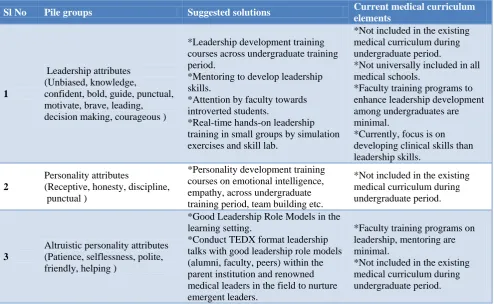
Table 2: Solutions identified by Interns for grouped perceptions during FGD.
Sl No Pile groups Suggested solutions Current medical curriculum
elements
1
Leadership attributes (Unbiased, knowledge,
confident, bold, guide, punctual, motivate, brave, leading, decision making, courageous )
*Leadership development training courses across undergraduate training period.
*Mentoring to develop leadership skills.
*Attention by faculty towards introverted students.
*Real-time hands-on leadership training in small groups by simulation exercises and skill lab.
*Not included in the existing medical curriculum during undergraduate period.
*Not universally included in all medical schools.
*Faculty training programs to enhance leadership development among undergraduates are minimal.
*Currently, focus is on developing clinical skills than leadership skills.
2
Personality attributes
(Receptive, honesty, discipline, punctual )
*Personality development training courses on emotional intelligence, empathy, across undergraduate training period, team building etc.
*Not included in the existing medical curriculum during undergraduate period.
3
Altruistic personality attributes (Patience, selflessness, polite, friendly, helping )
*Good Leadership Role Models in the learning setting.
*Conduct TEDX format leadership talks with good leadership role models (alumni, faculty, peers) within the parent institution and renowned medical leaders in the field to nurture emergent leaders.
*Faculty training programs on leadership, mentoring are minimal.
*Not included in the existing medical curriculum during undergraduate period.
These items were then subjected to pile sorting exercise (Figure 1). Perceived leadership attributes were clustered into three groups, which they thought of as mutually related to each other (Figure 1).
Based on the semi structured focus group discussion, it was found that, most of the participants felt that, regular training on leadership skills has to be there as a part of medical curriculum (Table 2).
DISCUSSION
Medical leadership is a highly-valued essential skill set for Indian medical graduate and this has reflected in medical education reforms undertaken by Medical Council of India (MCI) over the past few decades. Lack of studies from India in this area, suggests this remained a rarely studied topic. Doctors-in-training, whether undergraduates or post graduates lack a formal training in leadership which may be a barrier in effective delivery of health care services amidst ever evolving global health challenges.
We undertook a series of activities such as free listing, pile sorting and focussed group discussions (FGD) with trainee interns posted in the department of Community Medicine to elicit their perceptions on effective medical leadership traits. We found leadership attributes identified by them in congruence with literature available. Leadership attributes such as ‘unbiased, knowledge,
confident, bold, guide, punctual, motivate, brave, leading, decision-making, courageous’ reflect that majority of leadership attributes direct to a positive personality development from early stages of life. Training on development of personality for medical undergraduates can also contribute to develop leadership skills at innate level by enhancing inherent personality traits. Study by
AIIMS-Jodhpur, Rajasthan, identified personality
development as grossly unrecognized in medical curriculum.20
Trainee Interns admitted their deficiency in the
understanding of leadership traits as medical
undergraduates as it was not required of them as a specific learning outcome. As undergraduates they are attuned to focus on developing clinical skills and patient engagement skills with limited scope to develop as leaders. Interns suggested a structured training on leadership skills and personality development along with exposure to challenging clinical skills-focussed learning in undergraduate period will enable them emerge as confident leaders.
Health care delivery is emerging as a collaborative service delivery for which trainee medical undergraduates
need exposure to self-awareness on leadership
as demonstrating personal qualities, working with others, goal setting and delivering services individually thereby overcoming a training gap during undergraduate period. Even during internship, there is no formal training on leadership development but opportunities are availed by default as it is required of the interns to act as leaders in circumstances such as being responsible for patient care independently. Our study had similar findings like Innovation Collaborative study by PHFI in 2015 which highlights the inadequacies in current medical education curriculum for formal training in medical leadership skills.19
Interns suggested that implementing mentoring programs in undergraduate period will also help the faculty to groom leadership skills in them. In Indian medical schools, there is largely no evidence of a formal, uniform mentorship programs entorship has been defined as a dynamic, reciprocal relationship in a work environment between an advanced career incumbent (mentor) and a beginner (prot g ), aimed at the development of both” 21
For this faculty should be provided with training in mentorship, interpersonal communications so as to enable them offer mentoring at a professional capacity and also is similar to recommendations of studies from Indian medical schools.22,23
Role modelling is yet another methodology which can influence the emerging medical graduates with positive influence to model their own behaviours and practices. It is defined as demonstration of skills, provision of feedback, and emulation of specific professional behaviours, as is established as an important component of clinical training.24 In our study, during FGD, interns shared their role models and it is reflected clearly that a
combination of personality characteristics and
professional competencies are contributing for being identified as a role model. We recommend that conducting TED style talks with medical professionals who are renowned for their leadership accolades can act as a powerful trigger for training undergraduates and interns in modelling themselves as leaders infusing their own learnings and aspirations.
Medical education reforms should support the inclusion of leadership and personality development training in the MBBS curriculum.
ACKNOWLEDGEMENTS
We submit our sincere regards to all the interns who participated in this study with enthusiasm and for their valuable insights.
Funding: No funding sources Conflict of interest: None declared Ethical approval: Not required
REFERENCES
1. Vision 2015: Medical Council of India; New Delhi, 2011. Available at: http://www.mciiindia.org/tools/ announcement/MCI_booklet.pdf.
2. Conger JA, Benjamin B. Building leaders: how successful companies develop the next generation. San Francisco, CA: Jossey-Bass; 1999.
3. Kets de Vries M, Korotov K. Introduction. In: Kets de Vries M, Korotov K, eds. Leadership development. Northhampton, MA: Edward Elgar Publishing; 2011: 15-16.
4. Stoller JK, Rose M, Lee R, Dolgan C, Hoogwerf BJ. Teambuilding and leadership training in an internal medicine residency training program. J Gen Intern Med. 2004;19(6):692–7.
5. Morey JC, Simon R, Jay GD, Wears RL, Salisbury
M, Dukes KA, et al. Error reduction and performance improvement in the emergency department through formal teamwork training: evaluation results of the Med Teams project. Health Serv Res. 2002;37(6):1553–81.
6. Shea-Lewis A. Teamwork: crew resource
management in a community hospital. J Healthc Qual. 2009;31(5):14–8.
7. Wells R, Jinnett K, Alexander J, et al. Team leadership and patient outcomes in US psychiatric treatment settings. Soc Sci Med. 2006;62(8):1840– 52.
8. Dickson G, Owen K, Chapman AL, Johnson D,
Kilner K. Leadership styles used by senior medical leaders: patterns, influences and implications for leadership development. Leadersh Health Serv. 2014;27(4):283–98.
9. Frich JC, Brewster AL, Cherlin EJ, Bradley EH. Leadership development programs for physicians: a
systematic review. J Gen Intern Med.
2015;30(5):656–74.
10. Gabel S. Expanding the scope of leadership training in medicine. Acad Med. 2014;89(6):848–82. 11. Mittwede PN. On leadership and service during
medical training. Acad Med. 2015;90(4):399. 12. Schwartz RW, Pogge C. Physician leadership is
essential to the survival of teaching hospitals. Am J Surg. 2000;179(6):462–8.
13. Sonnino RE. Professional development and
leadership training opportunities for healthcare professionals. Am J Surg. 2013;206(5):727–31. 14. Sonnino RE. Health care leadership development
and training: Progress and pitfalls. J Healthc Leadersh. 2016;8:19–29.
15. Stoller JK. Developing physician-leaders:A call to action. J GenIntern Med. 2009;24(7):876–8.
16. Clinical Leadership Competency Framework: Self assessment tool © 2012 NHS Leadership Academy. 17. Webb AM, Tsipis NE, McClellan TR, et al. A first
18. Ginzburg SB, Deutsch S, Bellissimo J, Elkowitz DE, Stern JN, Lucito R. Integration of leadership training into a problem/ case-based learning program for First- and second-year medical students. Adv Med Educ Pract. 2018;9:221–6. 19. Negandhi P, Negandhi H, Tiwari R, Sharma K,
Zodpey SP, Quazi Z, et al. Building
interdisciplinary leadership skills among health practitioners in the twenty-first century: an innovative training model. Front Public Health. 2015;3:221.
20. Nebhinani N, Ghatal S. Effect of personality development program for medical and nursing students: A pilot study Ann Natl Acad Med Sci (India). 2015;51(1&2):13-9.
21. Sambunjak , Straus S , arusi entoring in academic medicine: a systematic review. JAMA. 2006;296(9):1103-15.
22. Bhatia A, Singh N, Dhaliwal U. Mentoring for first
year medical students: Humanising medical
education. Indian J Med Ethics. 2013;10(2):100-3. 23. Awasthi S. Mentoring in medical education: A
neglected essentiality. MJMS. 2017;2(1):5-7. 24. Benbassat J. Role Modeling in Medical Education:
The Importance of a Reflective Imitation Acad Med. 2014;89(4):550–4.