Scientific Production in Innovation and Finance:
synthesis and research agenda under the
international approach for a period of ten years
Lucia Fernanda de CarvalhoDoctoral Program in Administration Nove de Julho University (UNINOVE), Brazil
Antônio Oliveira de Carvalho Accountancy Graduate Program
Jorge Amado Universitary Center (UNIJORGE), Brazil
Leonel Cezar Rodrigues Doctoral Program in Administration Nove de Julho University (UNINOVE), Brazil
Abstract
In this paper we aim to analyze scientific production on the themes of innovation and finance in the main international journals in business and correlate areas. The core purpose is to identify the existence of papers on innovation and finance, during some past years, trends and characteristics of these productions and outline a research agenda for the coming years. The research was performed on the Scopus database, using the key-words innovation and finance, and as filters the following parameters: articles, journals in the English and Portuguese languages, impact factor of over 1.0, published in the period between 2004 and 2014, comprising the last ten years in the areas of Business, Management and Accounting, Economics and Econometrics. Despite the small amount of articles identified (525), results point out both the growth and the diffusion of the publications in journals worldwide and different degrees of impact factor, indicating increased interest on these matters and a promissory research agenda.
Key-words: Innovation. Finance. Academic Research.
INTRODUCTION
One of the most discussed elements of human existence is innovation, considering that the evolutionary process of the species occurred and occurs from discovery, invention and the improvement of things they relate to. In the business environment the behavior of the organizations is similar to the biological process of development, in other words, the constant quest for discovery, creation of things (invention) or improvement of processes. Once the business environment is dynamic, with constant changes, in the last decades innovation has become a fundamental aspect for company objectives for attaining profitability, market share and obtaining a competitive edge.
Innovation is perceived, as of the first decades of the XX century, as one of the determining factors for economic growth. This discussion is even more pronounced as of the book Capitalism, Socialism and Democracy, published by Joseph Schumpeter in 1942, in which the author discussed the figure of the innovator as an economic agent who creates and offers innovative products and services from the invention or the efficiency in processes, pursuing profit as a prize for offering access to new goods and services to the consumer public. Szmrecsányi (2006) stresses that development is only possible through the occurrence of profit, because without this “reward” the entrepreneur would not be stimulated to innovate.
Once profit is the motivating aspect of innovation and innovation is an aspect that demands investment, and investment is a decision made by the entrepreneur or investor only when there is the perspective of profit or a return on the amount invested, then there shall always be a relationship between innovation and financial decisions. In the present scenario of high competitiveness, companies are demanded to generate competitive differentials in order to compete and, on the other hand, governments are faced with the necessity of investing in research and technology in order to promote economic growth from the generation of businesses, employment and currency.
THEORETICAL FRAMEWORK
Innovation
Innovation is defined as the creation of a product, service or process which is new to a given business unit (Nadler & Tushman, 1997, p. 168).The existing understanding on this statement is that innovation is not only in relation to the product or the process, but in the adoption of the idea of what is new and in the behavior of the people involved. Glor (1997) and Rogers (1998) warned that understanding innovation may not be that simple. First, literature dealing with this matter is extensive and requires selective treatment. Second, there is some conceptual ambiguity associated to the term. Third, not all pertinent literature and case study material are identified with innovation.
Thus, one of the challenges in analyzing innovation is the absence of a consensus in relation to the terms of its definitions. Glor (1997, p. 3) assesses the various meanings of the term as (...) “novelty or anything perceived as being new by people” (E. M. Rogers & Kim, 1985), (...) or as “a generation, acceptance, and implementation of new ideas, processes, products or services” (Thompson, 1965). Some see innovation as the “adoption of an idea” (E. M. Rogers & Kim, 1985), or as a synonym for creativity (Jacques & Ryan, 1978). For Glor (1997) innovation is creative generation and application of new ideas that reach an improvement in a product, service, activity, initiative, structure, program or policy.
In general, innovation is more probable among organizations that have the necessary resources and a strong motivation and an organizational environment to innovate (Fichman, 2001). “Highly innovative organizations are highly efficient training systems”, improving work today and strongly preparing for what is coming tomorrow (Nadler & Tushman, 1997, p. 167). Innovation leads to the creation of organization knowledge where the conversion of tacit personal knowledge to explicit organizational knowledge is crucial (Glor, 1997).
Organizational abilities, the identification of opportunities, the development and accumulation of sundry and comprehensive skills are more important than purely technical achievements (Conde & Araújo-Jorge, 2003). In his studies Meyer-Stamer and Schoen (2005), propose three steps for the consolidation of innovation. These being:
• Basic Research – the most basic level of research. Best described as the search for new knowledge or truth. Scientific publications are frequently the primary result of this phase.
• Invention – The creation of new products and processes through the development of new knowledge or of new combinations of existing knowledge. Most inventions are the result of modern applications over existing knowledge. This phase could be compared to applied research. The development of some useful tools to the process is the primary result of this phase.
• Innovation – Represents the initial commercialization of the invention produced and commercialized as a new good, product, service or use of a new method of production. An innovation may be the result of one sole invention or may combine many inventions. Innovation also includes the business model of commercialization of the product. Without a prosperous business model there is no innovation or invention. King et al (1994), on the other hand, proposes that, once innovation is characterized as a process of movement, it must go through three stages: invention, innovation and diffusion, differing, in part, of the idea of Meyer-Stamer and Schoen (2005), previously presented. For King et al (1994) apart from a new product, an invention can by a new idea which may or may not have economic value. In the case of innovation, King et al (1994), as well as Meyer-Stamer and Schoen (2005), agree that this would be the use of innovation. Diffusion is the expansion of the capacity for producing and/or using an innovation, and its use in practice. The work of these authors deals with innovation as a social phenomenon that comprises elements both of invention as well as of diffusion.
What seems to be a consensus among the authors is that innovation must be implemented (diffused). For the OECD (2005) a new or improved product is implemented when it is introduced to the market. New processes, marketing methods and organizational methods are implemented when they are effectively used in the operations of the companies. Companies need to adopt innovation as a corporate lifestyle, without falling into the traps of their own success. The same factors that create a successful innovative company are also those that tend to cast the seeds of complacency and consequent failure in the measure in which competitive conditions change (Nadler & Tushman, 1997).
According to the OECD (2005), important work was developed during the years 1980-1990 with the aim of developing analysis models and structures for studies on innovation. Experiments with pioneer researches and their results, together with the need for a coherent set of concepts and instruments, led to the first edition of the Oslo Manual which was more focused on technological innovation of products and processes of the processing industry. In this manner, the Manual became a reference for various researches examining the nature and impact of innovation in the commercial sector.
(1997) recognizes its limitations with reference to guidelines for collecting and interpreting innovation data, each edition is a step further towards an understanding of the innovation process.
Rogers (1998) defends the idea that the measurement of innovation is probably one of the most difficult tasks due to the wide-ranging nature of the scope of each activity. Nevertheless, once innovation is recognized as a differential which can raise business competitiveness, among other benefits, the study of this theme is always encouraged through governmental and non-governmental agencies, once this subject is considered, according to Rogers (1998) as “volatile” and thus always open to new discoveries. The OECD (1997), for example, reasons that such as the world economy evolves, the same occurs with the innovation process.
The Manual emphasizes that the two core criteria for identifying innovations are the introduction of significant changes and the fact of being new to the company. Thereby, a change may represent an innovation to one company and not to another. Often more detailed descriptions are necessary to determine whether a change may be classified as an innovation and what type of innovation (OCDE, 2005).
Finance in Innovation
In order for an innovation to actually occur, many resources are applied, among which financial resources. Most importantly, innovations demand increased uncertainty in relation to the return on the investment made. Risks and uncertainties analyzed through financial tools often discourage managers and investors (Cândido, 2011). A successful innovation can only be defined as a cost-effective innovation. In order to obtain a profit from new products and services, it is imperative that innovation be considered and managed as a full process, and not a short-term event (Andrew & Sirkin, 2007). On account of the innovation resource being treated as an investment, a conceptual analysis, even when partial, of the present studies in finance is necessary.
Investment decisions are related to the allocation of resources of a company. Investment analysis through techniques, the decision of applying on fixed or operating assets, in other words, where the funds raised shall be applied, independently of the source (Herling, de Lima, & Moritz, 2013). Some concepts that collaborate with investment decisions are the payback and internal rate of return (IRR). Payback is a project evaluation method, which measures the period of time necessary to recover initial investment (Boundless, 2014), calculated from cash receipts (Gitman, 2004). When carefully used it can assist in the comparison of similar investments (Boundless, 2014).
According to Ross, Westerfield and Jaffe (2002) the criterion for defining payback in investment decision making is quite simple. Once the cut-off period is defined, all the projects below this period are accepted and those above the period are rejected. Although popular, it is considered an unsophisticated capital budget analysis technique, since it does not consider time value of money (Gitman, 2004).
The internal rate of return is an annual rate of return that the company shall obtain when investing in a project and receiving cash flows. “When accepting only projects in which the IRR is superior to the capital cost, the company increases its market value and the wealth of its shareholders” (Gitman, 2004, p. 380). Furthermore, when proceeding with the economic evaluation of an investment project according to the internal rate of return, the first providence to be taken by the analysis is to assure the applicability of such criterion (Faro, 1976).
The main concepts of the Modern Finance Theory, such as the Portfolio Theory proposed by Markowitz (1952; 1959), the Efficient Market Hypothesis (EMH) proposed by Famá (1970) and the Capital Asset Pricing Model (CAPM) initially developed by Sharpe (1963, 1964), are based on the rational assumptions that investors are risk averse. Stemming directly from the Markowitz’ portfolio selection theory, the CAPM demonstrates that equilibrium on the return on risk assets are due to covariance with market portfolio (Castro Júnior & Famá, 2002). The model is normally based on historic data. In this manner, the users make adjustments to reflect their expectations as to the future (Gitman, 2004).
Moreover, studies in the areas of behavioral finances are emerging based on the complexity theory and substantive rationality. These seek to answer issues related to the behavior of the manager/investor in financial decision making. This is today one of the most researched fields in corporate finance (Herling et al., 2013).
It is obvious that these few instances are only a sample of all that this area can offer. Also, only the conceptual plan of innovation has been discussed. Nevertheless, this review collaborates towards evoking possible discussions that could arise in order to identify impacts that innovation could bring under the financial focus of organizations.
METHOD
Research classification
With reference to the research level, this one is classified as an exploratory research, considering that it proposes to explore academic production on aspects of innovation and finance, searching for points of integration among them. Gil (2005) emphasizes that the exploratory research has as its main purpose to develop, clarify and modify concepts and ideas, from the formulation of researchable hypotheses or from a more precise issue supporting or guiding other studies. According to the author this level of research is less rigid in relation to its planning and the most adequate for use in studies that involve bibliographical and documental researches, non-standard interviews and case studies.
For the purpose of this research, we considered this as the most adequate level, once, apart from exploring the themes from a bibliographic search (or bibliometric) this study also proposes to serve as support for the proposition of a research agenda on the themes explored herein. For Köche (1997) when adopting bibliographic search as strategy, the objective is to investigate, analyze and get to know the existing levels of theoretical contributions on a given theme or issue within a predetermine timeframe.
Operating Procedures
This research was operationalized using the Scopus database for the targeted data collection for a bibliographic search, once it is considered as an ample and reliable database and operationally practical and, above all, because it offers a structure of the data in an analytical form and grouped in a rational and ordered manner. For the development of the research the terms Innovation and Finance were defined and a set of parameters adopted as delimitating filters of the aspired objectives, these being: a) period – defined for the period between 2004 and 2014 (data range) to research production related to period of 10 years; b) type of publication – restricted to academic articles, because it is the category of academic production most broadly disseminated and accepted due to the blind review which guarantees to this type of production a greater quality in view of the evaluations and opinions of third parties before its publication; c) subject areas (sub-areas) – limited to the fields of Business, Management and Accounting (for the search related to the business area or underlying areas), and Economics, Econometrics and Finance,with the purpose of identifying papers related to the area of economy (economic policies that include financing innovation) and finance related to economic development; and d) impact factor (SJR) selecting only the periods presenting impact factors of over 1.0. For Lakatos and Marconi (2003), to delimit the research is to establish limits for investigation, and once the limits are established it is possible to advance to the operating process.
DATA ANALYSIS
The search on the Scopusdatabase, with the use of the previously described parameters, resulted in the identification of 525 (five hundred and twenty-five) articles published during the period, and the evolution is represented under Figure 1 (graph) and Table 1. Accordingly, it is possible to verify that in the represented period, between 2004 and 2014, there was a 245% increase in research interest. It is also possible to observe in Figure 1, three leaps in interest which comprise the periods of 2006 to 2007 (40%), 2009 to 2010 (19%) and 2011 to 2012 (14%).Table 1 details the values omitted in Figure 1 and permits a more refined analysis. It is possible to perceive that there is no peak in production, demonstrating that these themes were never “in vogue”, but what it seems to indicate is a sustainable development which demonstrates an increase in maturity of the themes and the vision that, as was already defended herein, an innovation that does not generate value (profit) is not an innovation. Thus, to verify the generation of value of an innovation, studies in the area of finance are necessary.
Table 1 details the evolution of the number of published papers per year from 2004 up until 2014.
Table 1: Number of paper published per year
Year of publication Number of published papers
2014 46 2013 76 2012 72 2011 63 2010 62 2009 52 2008 43 2007 38 2006 27 2005 24 2004 22 Total 525
Source: Research data – research on the Scopus database
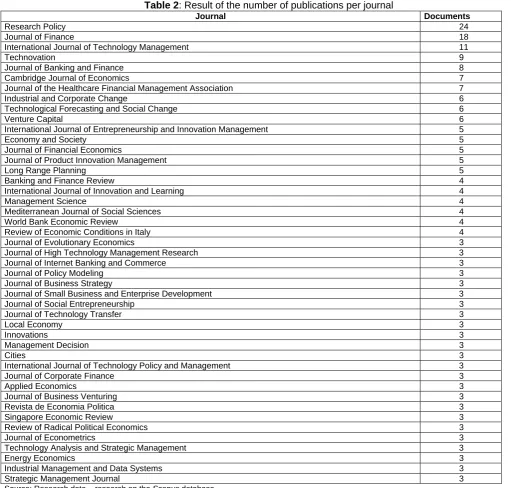
Table 2: Result of the number of publications per journal
Journal Documents
Research Policy 24
Journal of Finance 18
International Journal of Technology Management 11
Technovation 9
Journal of Banking and Finance 8
Cambridge Journal of Economics 7
Journal of the Healthcare Financial Management Association 7
Industrial and Corporate Change 6
Technological Forecasting and Social Change 6
Venture Capital 6
International Journal of Entrepreneurship and Innovation Management 5
Economy and Society 5
Journal of Financial Economics 5
Journal of Product Innovation Management 5
Long Range Planning 5
Banking and Finance Review 4
International Journal of Innovation and Learning 4
Management Science 4
Mediterranean Journal of Social Sciences 4
World Bank Economic Review 4
Review of Economic Conditions in Italy 4
Journal of Evolutionary Economics 3
Journal of High Technology Management Research 3
Journal of Internet Banking and Commerce 3
Journal of Policy Modeling 3
Journal of Business Strategy 3
Journal of Small Business and Enterprise Development 3
Journal of Social Entrepreneurship 3
Journal of Technology Transfer 3
Local Economy 3
Innovations 3
Management Decision 3
Cities 3
International Journal of Technology Policy and Management 3
Journal of Corporate Finance 3
Applied Economics 3
Journal of Business Venturing 3
Revista de Economia Politica 3
Singapore Economic Review 3
Review of Radical Political Economics 3
Journal of Econometrics 3
Technology Analysis and Strategic Management 3
Energy Economics 3
Industrial Management and Data Systems 3
Strategic Management Journal 3
The results of the initial phase of the research demonstrate that in the analyzed period, with the adoption of the established parameters, there are a considerable number of publications. There was a steady increase up until the year 2008, and greater emphasis as of such period. Focus was for the years 2012 and 2013 and indication of maintenance or increase of this level of publication for the year 2014, considering that the year has not yet ended and many papers have not yet been published or in the case of more recent ones still in the phase of being published and not yet included in the database. These results demonstrate the existence of interest and the increased interest on the themes analyzed by the researchers.
Upon analysis of the main periods in which publications on this theme were identified, the results are presented under Table 2 (related only to the journals that presented at least three publications).
From the data of Table 2 it is possible to verify an almost uniform distribution to the journals, with a variation of three to six publications per journal in the period. Nevertheless, there is an emphasis for the journals Research Policy, with 24 articles Journal of Finance (18) and International Journal of Technology Management, with 11 articles in the 10 years under analysis, signaling greater attraction for the themes focused on innovation and finance.
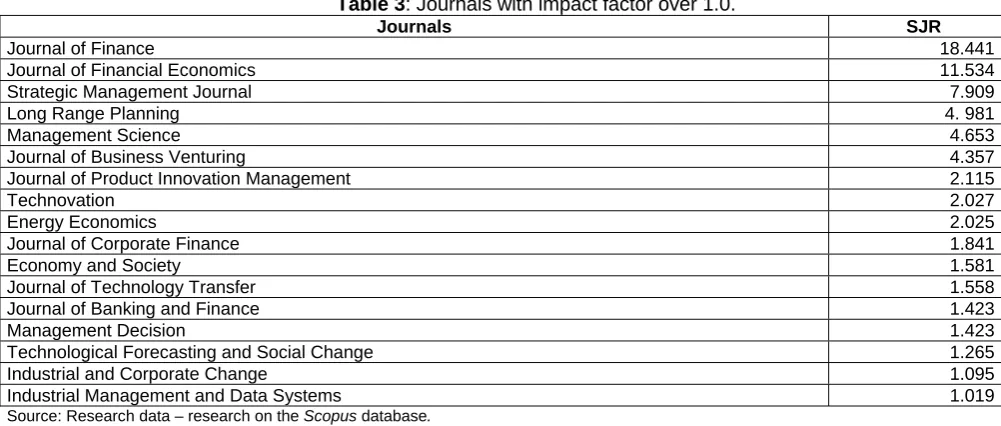
When analyzing the impact factor of the journals presented in the initial research, as of the impact factor criteria of over 1.0 SJR (SCImago Journal Rank), the number of journals that complied with these criteria was reduced to 17, as demonstrated under Table 3.
Table 3: Journals with impact factor over 1.0.
Journals SJR
Journal of Finance 18.441
Journal of Financial Economics 11.534
Strategic Management Journal 7.909
Long Range Planning 4. 981
Management Science 4.653
Journal of Business Venturing 4.357
Journal of Product Innovation Management 2.115
Technovation 2.027
Energy Economics 2.025
Journal of Corporate Finance 1.841
Economy and Society 1.581
Journal of Technology Transfer 1.558
Journal of Banking and Finance 1.423
Management Decision 1.423
Technological Forecasting and Social Change 1.265
Industrial and Corporate Change 1.095
Industrial Management and Data Systems 1.019
Source: Research data – research on the Scopus database.
Analyzing the data related to the 17 journals selected for complying with the impact factor criterion, the findings in relation to each level of analysis are presented in the graphs and tables below.
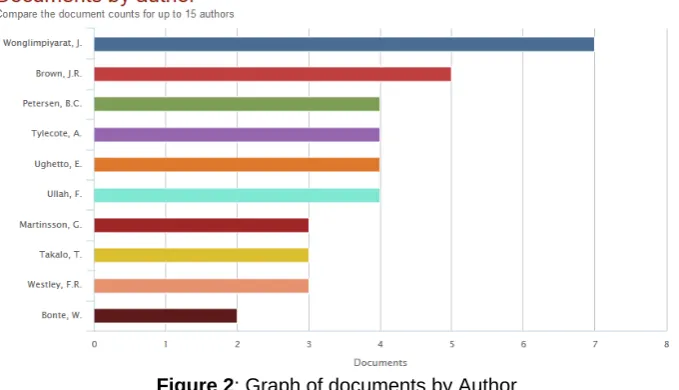
By Author: the authors with greater presence in the papers were:
Table 4: Production by author.
Author Work
Wonglimpiyarat, J. 7
Brown, J.R. 5
Petersen, B.C. 4
Tylecote, A. 4
Ughetto, E. 4
Ullah, F. 4
Martinsson, G. 3
Takalo, T. 3
Westley, F.R. 3
Bonte, W. 2
Source: Research data – research on the Scopus database
Figure 2: Graph of documents by Author
Source: Research data – research on the Scopus database
To understand where the greater production is concentrated involving the themes of innovation and finance, we searched the ranking of the journals with greater impact factor. The results are evidenced under Table 5 5.
By Country: The countries with greatest presence in the ten journals with higher impact factor were:
Table 5: Production per country.
Country Production
United States 157
United Kingdom 102
Italy 37
Germany 33
France 29
Canada 23
Spain 22
China 18
Netherlands 18
Australia 17
Source: Research data – research on the Scopus database
Table 5 and Figure 3 evidence the supremacy of the studies in the United States (157) and in the United Kingdom (102), with impact factor above 1.0. These countries represent 56.8% of the production in a raking of ten countries.
Figure 3: Graph of documents by Country
One of the prerequisites for a journal to have a good impact factor is for it to be well referenced. The volume of citations is one of the determining factors for its classification. Figure 4 demonstrates the performance of the journals used in this paper from 1996 to 2014 – remembering that the results for 2014 have not yet been concluded, being the current year. Nevertheless, an evolution can be observed in all of the journals.
By Citation: Among the selected journals the ones with the most citations are as follows:
Figure 4: Graph of journals by citations
Source: Research data – research on the Scopus database
The graph indicates that the journal Management Science has the most amount of source citations with a certain amount of advantage within the sample, followed by Strategic Management Journal and Journal of Product Innovation Management almost tied in the selected period. Since 1996 Management Science was already ahead of the other journals and this was consolidated throughout time, not losing its leadership to date.
DISCUSSION OF RESULTS
The results obtained from the bibliometric analyses performed in this paper point out to a certain maturity of the researched themes, since, apart from the consistency of the levels of the publications, it presents increasing rates in the researched years. Another positive indication is that the papers published with the themes are distributed in journals of average/high impact, but also in journals of lower impact, which indicates that the themes have aroused the interest of researchers and academics of various levels and in different levels of development of academic research and occupied spaces in publications of various degrees.
In relation to origin, the concentration of paper published in the United States, United Kingdom, Italy Germany, France and Canada is notorious, certainly due to the level of technological development and maturity of the universities and research institutions of these countries. Nevertheless, as well as the impact factor, the presence of papers spread throughout almost all the countries, including Brazil, is perceptible, which indicates that these themes are also present in countries with emerging economies both economically as well as in the development of academic research.
With reference to the authors, it is not possible to identify any exponent or hegemonic group, nevertheless, the authors Wonglimpiyarat, J. of the United States and Brown, J. R. of the United Kingdom, with 7 and 5 publications, respectively, are the most committed with the theme followed by countless authors with less publications. These indications, despite being positive, both by the growth as well as by the diffusion, from the viewpoint of production in absolute numbers is still small, considering the identification of only 525 papers in a ten years interval, which could indicate, on the other hand, the existence of a field with considerable amplitude to be explored by researchers worldwide in the future years.
Final Considerations
innovation and finance, such as financing of innovation, financial management of innovation and return on investments, objects of interest of the authors, the results point to a promissory work agenda taking into account the degree of evolution presented by the production.
Considering the limitations of this paper, among which we highlight: generality of the relationship among the themes, since the existence of more intrinsic relations among the themes of the researched publications were not explored; the consideration only of journals with impact factor above 1.0, which can overshadow the expansion of the research in journals of lower impact and also aspects related to the regionalization of the production in these areas, which we highlight as suggestions for future researches.
It is also necessary to consider the limitation that the search of data in one sole database can entail. In this case if there were the possibility of evaluating all indexed publications in other databases such as Web of Science and Proquest and Ebsco, which are representative of all researches derived from applied social sciences, it would certainly bring more contributions to this theme.
REFERENCES
Andrew, J. P., & Sirkin, H. L. S. (2007). Payback: Reaping the Rewards of Innovation. Boston, Massachusetts: Harvard Business School Publishing.
Boundless. (2014). Defining the Payback Method. Boundless. Retrieved from
https://www.boundless.com/finance/textbooks/boundless-finance-textbook/capital-budgeting-11/payback-method-92/defining-the-payback-method-396-6416/
Cândido, A. C. (2011). Inovação Disruptiva: reflexões sobre as suas características e implicações no mercado (IET Working Paper No. WPS05/2011) (p. 27). Monte de Caparica: IET Centro de Investigação em Inovação Empresarial e do Trabalho. Retrieved from http://run.unl.pt/handle/10362/6912
Castro Júnior, F. H., & Famá, R. (2002). As novas finanças ea teoria comportamental no contexto da tomada de decisão sobre investimentos. Caderno de Pesquisas Em Administração, São Paulo, 9(2), 25–35. Retrieved from http://www.regeusp.com.br/arquivos/v9n2art3.pdf
Conde, M. V. F., & Araújo-Jorge, T. C. de. (2003). Innovation Models and Conceptions: transition of paradigm, the Brazilian S&T reform and conceptions of managers from a public health research institution. Ciência & Saúde Coletiva, 8(3), 727–741. https://doi.org/10.1590/S1413-81232003000300007
Fama, E. F. (1970). Efficient Capital Markets: A Review of Theory and Empirical Work*. The Journal of Finance, 25(2), 383– 417. https://doi.org/10.1111/j.1540-6261.1970.tb00518.x
Faro, C. de. (1976). O critério da taxa interna de retorno e o caso dos projetos do tipo investimento puro. Revista de Administração de Empresas, 16(5), 57–63. https://doi.org/10.1590/S0034-75901976000500006
Fichman, R. G. (2001). The Role of Aggregation in the Measurement of IT-Related Organizational Innovation. MIS Quarterly, 25(4), 427–455. https://doi.org/10.2307/3250990
Gil, A. C. (2005). Como Elaborar Projetos de Pesquisa - 5a Ed. 2010 (5th ed.). São Paulo, SP: ATLAS EDITORA. Retrieved from https://www.saraiva.com.br/como-elaborar-projetos-de-pesquisa-5-ed-2010-2872437.html
Gitman, L. J. (2004). Princípios de administração financeira. Pearson Addison Wesley.
Glor, E. D. (1997). Policy Innovation in the Saskatchewan Public Sector, 1971-82. Universidade de Michigan: Captus Press. Herling, L. H. D., de Lima, M. V. A., & Moritz, G. de O. (2013). Finanças corporativas: sua organização e base
epistemológica. Retrieved from http://www.coloquioepistemologia.com.br/anais2013/ANE113.pdf
Jacques, J., & Ryan, E. J. (1978). Does management by objectives stifle organizational innovation in the public sector? Canadian Public Administration, 21(1), 16–25. https://doi.org/10.1111/j.1754-7121.1978.tb01750.x
King, J. L., Gurbaxani, V., Kraemer, K. L., McFarlan, F. W., Raman, K. S., & Yap, C. S. (1994). Institutional Factors in Information Technology Innovation. Information Systems Research, 5(2), 139–169. https://doi.org/10.1287/isre.5.2.139
Köche, J. C. (1997). Fundamentos de metodologia científica: teoria da ciência e prática da pesquisa (Vol. 7). Petrópolis: Vozes.
Lakatos, E. M., & Marconi, M. A. (2003). Fundamentos de pesquisa metodológica científica. São Paulo, Brasil: Atlas. Leite, F. T. (2008). Metodologia científica: métodos e técnicas de pesquisa: monografias, dissertações. Aparecida-SP:
Ideias & Letras.
Markowitz, H. (1952). Portfolio selection*. The Journal of Finance, 7(1), 77–91. Retrieved from http://onlinelibrary.wiley.com/doi/10.1111/j.1540-6261.1952.tb01525.x/full
Markowitz, H. M. (1959). Portfolio selection: efficient diversification of investments. Yale University Press.
Meyer-Stamer, J., & Schoen, C. (2005). Rapid appraisal of local innovation systems (RALIS): Assessing and Enhancing Innovation Networks (No. 02/2005). Duisburg and Munich: Citeseer.
OCDE, O. para a C. E. e D. (2005). Manual de Oslo: Proposta de diretrizes para coleta e interpretação de dados sobre inovação tecnológica (3rd ed.). Paris: Versão em Português FINEP (Financiadora de Estudos e Projetos). Retrieved from http://marianaassistencia.com.br/pubprocesso/51/manual_de_oslo.pdf
Rogers, E. M., & Kim, J. I. (1985). Diffusion of innovations in public organizations. Innovation in the Public Sector, 85–108. Rogers, M. (1998). The Definition and Measurement of Innovation. Melbourne Institute, 9(98). Retrieved from
https://www.melbourneinstitute.com/downloads/working_paper_series/wp1998n09.pdf
Ross, S. A., Westerfield, R. W., & Jaffe, J. F. (2002). ADMINISTRAÇÃO FINANCEIRA: Corporate Finance (2nd ed.). Ed. Atlas. Retrieved from http://www.editoraatlas.com.br/atlas/webapp/detalhes_produto.aspx?prd_des_ean13=9788522429424
Sharpe, W. F. (1963). A Simplified Model for Portfolio Analysis. Management Science, 9(2), 277–293. https://doi.org/10.1287/mnsc.9.2.277
Sharpe, W. F. (1964). Capital Asset Prices: A Theory of Market Equilibrium Under Conditions of Risk*. The Journal of Finance, 19(3), 425–442. https://doi.org/10.1111/j.1540-6261.1964.tb02865.x
Szmrecsanyi, T. J. K. M. (2006). A herança schumpeteriana. In V. Pelaez & T. Szmrecsanyi (Eds.), ECONOMIA DA INOVAÇAO TECNOLOGICA (pp. 112–134). São Paulo, Brasil: Hucitec- Ordem dos Economistas do Brasil. Retrieved from https://www.travessa.com.br/economia-da-inovacao-tecnologica/artigo/b4c8f457-854c-4263-aa02-57e11eeca80a