
Original Research Article
Knowledge and attitudes of elementary students about reproductive
health (preliminary study on elementary school in Brebes district,
Central Java, Indonesia)
Sri A. Nugraheni
1*, Sri E. Wahyuningsih
1, Ike J. Prihatini
2, Etik Sulistyowati
1INTRODUCTION
Reproductive health in Indonesia still lack. This is shown by a high of maternal mortality rate (MMR) in Indonesia 229 per 100 thousand live births (133-379) in 2008.1-3 Maternal mortality in Brebes highest in Central Java. One of the causes of death among these pregnancies at a young age. Data marriage in Brebes 2015 showing that
40% of weddings between 13 to 18 years, and 70% of them because of teenage pregnancy. Teenage pregnancy caused lack of information about reproductive health in young generation including elementary school age children, many marriages occurred after they finish, even unfinished. There are so many students who did not know how to maintain good reproductive health. The problem is media or tools in reproductive health education very
ABSTRACT
Background: Knowledge of elementary students about reproductive health in Indonesia still lack. There are so many students who did not know how to maintain good reproductive health. Efforts to give lessons reproductive health or sex education to elementary school age children today is still considering taboo, but this problem should be anticipated as soon as possible. To decrease maternal mortality rate and unmet-need needs innovation to educate students. Education about reproductive health is one of strategic ways to increase elementary students’ knowledge and attitudes about reproductive health. This study conducted to evaluate effect of reproductive health education and provision of media on elementary students in Brebes.
Methods: This study utilized quasi experimental pre and post-test one group design. Population of these study 70 elementary students (3 Government ES) in Brebes.
Results: Based on the results of different test with Wilcoxon Match paired Test obtained were significant differences between the respondents' knowledge and attitudes before and after reproductive health education and provision of media (p=0.001).
Conclusions: That means there were significant interventions in the form of education and provision of media to increase knowledge and attitudes of respondent about reproductive health. The results demonstrate that interventions can significantly improve knowledge and attitudes of respondents (p<0.005; Delta: 19.82). Recommendation to improve risk of maternal mortality rate is a reproductive health education with early intervention in young elementary school age children as one of strategic actions to improving knowledge and minimize incidence of teenage pregnancy.
Keywords: Knowledge, Attitudes, Education, Elementary students, Reproductive health
1
Department ofPublic Health, Diponegoro University, Semarang, Indonesia
2
Department ofHealth Sciences, Universitas Pesantren Tinggi Darul Ulum, Jombang, Indonesia
Received: 31 December 2017
Revised: 03 March 2018
Accepted: 07 March 2018
*Correspondence:
Dr. Sri A. Nugraheni,
E-mail: [email protected]
Copyright: © the author(s), publisher and licensee Medip Academy. This is an open-access article distributed under the terms of the Creative Commons Attribution Non-Commercial License, which permits unrestricted non-commercial use, distribution, and reproduction in any medium, provided the original work is properly cited.
limited, students confusing when encountering a variety of issues related to reproductive health, sexuality, maturation process, etc.
Class IV, V and VI elementary school is a transition period between childhood and adolescence, quality of life for the next generation so that puts as a critical period. In developing countries of this transition took place very quickly. Even the age at first sex always turning out to be younger than ideal age to get married. The influence of global information (audio-visual media exposure) are more easily accessible. In the end, cumulatively these habits will accelerate the early age of sexually active and deliver them to sexual behavior risk, because most of students did not have accurate knowledge about reproductive health, sexuality, maturation process, and did not have access to information and reproductive health services, including contraceptives. Needs and types of reproductive health risks nearby young people have different features from children or adults. Types of reproductive health risks, including: pregnancy, abortion, sexually transmitted diseases (STDs), sexual violence, as well as the problem of limit access to information and health services.4,5 This risk cause of a variety of interrelated factors, namely the demand for early marriage and sexual relationships, access to education and employment, gender inequality, sexual violence and the influence of mass media and lifestyle.
Based on that background and literature, a problem of Indonesia which quite a lot contributed to high maternal mortality rate, lack of reproductive health education during children, adolescence or before marriage (the bride), lack of knowledge about early detection of pregnancy risk, as well as delays in referral to mothers with high risk.6,7 Efforts to give lessons reproductive health or sex education to elementary school age children today is still considered taboo, so we must anticipate as soon as possible. To decrease maternal mortality rate and unmet need needs innovation to educate students. Education about reproductive health is one of strategic ways to increase elementary students’ knowledge and attitudes about reproductive health. This study conducted to evaluate an effect of reproductive health education provision of media on elementary students in Brebes.
METHODS
This study utilized the quasi experimental pre and post-test one group design, as a preliminary study to analyze an effect of reproductive health education and provision of media on elementary students in Brebes during January until December 2017.
The population of this study elementary students. Study was conducted in Central Java province with high absolute MMR in Indonesia, especially in the district of Brebes. The study was restricted to only three government elementary school students due to easy
permission from managements. Sample number of 70 students studied.
Inclusion criteria
Inclusion criteria were age group: 10 to 15 years; class level: 4 and 5 elementary school.
Exclusion criteria
The exclusion criterion for this study were nil.
Closed-questionnaire needs to measure reproductive health knowledge and attitudes on elementary students which is filled with their own.
Data analysis
The data was analysed using Wilcoxon match paired test. Before carrying out this study the research protocol was approved by Ethics committee of the Faculty of Public Health, Diponegoro University.
RESULTS
Knowledge of elementary students
Both data group is a group of data pairs. Normality test results obtained are not normally distributed variables both normal (total pre-test p=0.001) and the distribution is not normal (total post-test p=0.001), so it can be different from a non-parametric test. Based on the results of different test with Wilcoxon match paired test obtained were significant differences between the respondents' knowledge before and after reproductive health education and provision of media (p=0.001). That means there was significant interventions in the form of education and provision of media to increase knowledge of respondents about reproductive health. The results demonstrate that interventions can significantly improve knowledge of respondents (p<0.005; Delta: 3.22).
Attitudes of elementary students
Based on the results of different test with Wilcoxon Match paired test obtained were significant differences between the respondents' attitude before and after reproductive health education and provision of media (p=0.001). That means there was significant interventions in the form of education and provision of media to increase attitude of respondents about reproductive health. The results demonstrate that interventions can significantly improve attitude of respondents (p<0.005; Delta: 16.6).
Knowledge and attitudes of elementary students
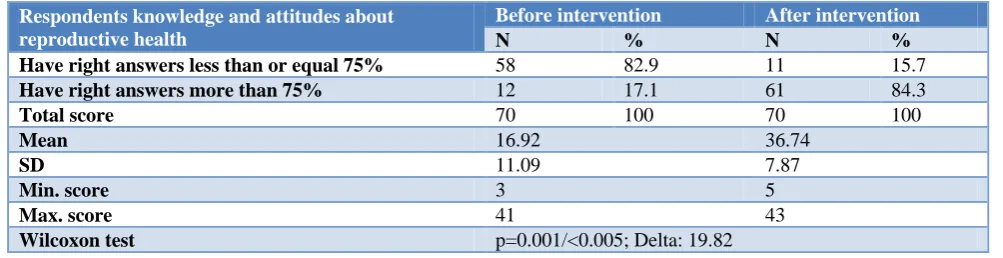
and after reproductive health education and provision of media (p=0.001). That means there were significant interventions in the form of education and provision of media to increase knowledge and attitude of respondents
about reproductive health. The results demonstrate that interventions can significantly improve knowledge and attitude of respondents (p<0.005; Delta: 19.82).
Table 1: Differences score knowledge of elementary students in Brebes district.
Respondents knowledge about reproductive health Before intervention After intervention
N % N %
Have right answers less than or equal 75% 60 85.7 19 27.1
Have right answers more than 75% 10 14.3 51 72.9
Total score 70 100 70 100
Mean 6.52 9.74
SD 2.06 2.02
Min. score 3 2
Max. score 11 12
Wilcoxon test p=0.001/<0.005; Delta : 3.22
Table 2: Differences score attitudes of elementary students in Brebes district.
Respondents attitudes about reproductive health Before intervention After intervention
N % N %
Have right answers less than or equal 75% 55 78.6 9 12.9
Have right answers more than 75% 15 21.4 61 87.1
Total score 70 100 70 100
Mean 10.4 27.00
SD 9.71 6.74
Min. score 0 3
Max. score 30 32
Wilcoxon test p=0.001/<0.005; Delta: 16.6
Table 3: Differences score knowledge and attitudes of elementary students in Brebes district.
Respondents knowledge and attitudes about reproductive health
Before intervention After intervention
N % N %
Have right answers less than or equal 75% 58 82.9 11 15.7
Have right answers more than 75% 12 17.1 61 84.3
Total score 70 100 70 100
Mean 16.92 36.74
SD 11.09 7.87
Min. score 3 5
Max. score 41 43
Wilcoxon test p=0.001/<0.005; Delta: 19.82
DISCUSSION
Basically, when entering a teenage period, adolescents face health risks, one of them is reproductive health. Adolescent reproductive health evident in their early pregnancy, abortion, sexually transmitted diseases including HIV/AIDS and sexual violence. Adolescent reproductive health status is supported also by the problem of nutrition, health, psychological, economic and gender inequalities that make it difficult for young women to avoid sexual intercourse imposed or commercial sex. International Conference on Population and Development (ICPD) in 1994 to encourage the
government and community to develop a program to address an issue of sexual and reproductive students.6-8 ICPD recommends essential services that should be highlighted include reproductive health information and counseling; clinical services for students; advisory services relating to the relationship between gender, violence, responsible sexual behavior and sexually transmitted diseases; as well as the prevention and treatment of sexual abuse.
After counseling and provision of reproductive health media, knowledge has increased but there was lack of knowledge about type of physical changes, especially in males.
Reproductive health education was needed to improve students’ knowledge and attitude about sexuality and decision making related the future plan of the students.
Prior attitude of elementary students in Brebes, mostly good practice but there was attitude that must educate, behaviors that need to educate is how to be a healthy child
After counseling and provision of material, elementary students in Brebes mostly have a good practice, but there was attitude that must educate continually.
Based on study there was a significant difference between knowledge of elementary students executed before and after counseling and provision of material (p=0.001). There was a significant difference between attitudes of elementary students executed before and after counseling and provision of material (p=0.001). There was a significant difference between total knowledge and attitudes of elementary students executed before and after counseling and the provision of material (p=0.001).
These findings are related with this literary, elementary student have special sexual and reproductive health needs, students’ needs to know a definition of reproductive system, reproductive health on male and female, important of reproductive health.9
In 2011, the World Health Organization (WHO) issued guidelines on preventing early pregnancy and poor reproductive outcomes in adolescents from LMICs focusing on four major pregnancy prevention outcomes: (1) increasing access to and use of contraception; (2) preventing marriage before 18 years; (3) increasing knowledge and understanding of the importance of early pregnancy prevention; and (4) preventing coerced sex.10
Also, a study by United Nations Fund for Population Activities, confirmed that knowledge of reproductive health, physically changes of female, physically changes of male, physically protection could remain unmet, mainly due to lack of knowledge, social stigma, laws and policies preventing provision of contraception and abortion to unmarried (or any) adolescents, and judgmental attitudes among service providers.11
In Haldre et al,dressing attitude, media for children, good attitude for children, to be healthy children education, counseling and provision of media could improving knowledge and attitude of elementary students, could minimize causes of death during pregnancy, childbirth and immediately after delivery.12 Besides, with very swift currents of globalization, the rise of impression exposures adults in cyberspace, as well as situations conducive to
support free relationship, increased abortion, drug abuse and incidence of HIV/AIDS, is a threat to youth, especially girls who are generally not yet ready reproductive health to have a risk of death.13 Teenage pregnancy carries high risks, both for a mother, fetus, and baby. Globally, around 50,000 teenage girls die each year during pregnancy and childbirth and latest available estimates suggest around 1 million babies born to adolescent girls die before their first birthday.7,14
Socialization and follow-up of local government instruction regent regional Brebes, if possible will be forwarded to Governor instruction and instruction of
National Education Minister on obligation of
reproductive health education for junior and high school students. Instructions will be forwarded to regional leaders in order to allocate a portion of budget funds, for a provision of teacher training roadshow family planning and reproductive health peer educator. Publication in the Journal of National Scientific and International accredited, Textbook and Workshop on Adolescent reproductive health. The effectiveness of reproductive health education depended on teachers, strategy, and method of teaching used by teachers.
The inclusion of this information is also important given that sexual double standards, harassment, sexual assault, and crime continue as a partial result of a deep gender gap between females and males. Effective sex and relationship education (SRE) and family planning services should be readily accessible and available to all young people. Specialist antenatal services for teenagers should be provided to raise awareness and reduce complications associated with teenage pregnancy, e.g. preterm birth, low birth weight, stillbirth and neonatal death.14
Early marriage and early marital sexual activity present reproductive health risks for young women.15 Early marriage can lead to pregnancies that put young women at risk for obstetric fistulae and can be a risk factor for HIV infection.16 Teenagers have sexual experiences including sexual violence. Both of these phenomena are prevalent among school-going adolescents before they have had appropriate knowledge about reproductive health, thereby putting them at great risk.17 Adolescent sexual activity, within or outside of marriage, can lead to negative reproductive health outcomes.17
To address an unmet need among adolescents, it is necessary to understand which strategies work to increase contraceptive behaviors among this age group and to identify gaps in evidence based for future research.18,19
These findings are consistent with the findings of other school-based studies among junior high school students in Malaysia, that was effective in enhancing sexual health knowledge, creating a positive attitude toward sexuality, and fostering among students in intervention group the intention to refuse to take sexual risks.21 Also, a study by Bleakley confirmed that adolescents obtained sexual information from friends, teachers, parents, and media.22 This finding agreed with a study by Madeni, which showed an increase in adolescents’ knowledge and behavior about sexuality, but there was no significant difference in attitude at pre-test and post-test.8 They suggested that attitudes may be difficult to change. The main reasons oral and anal sex in adolescents based on Cherie negative attitude about oral and anal sex, low college aspirations and low self-esteem were individual level predictors of oral and anal sex.23 Students who perceive their best friends engage in oral and anal sex were highly likely to involve in oral and anal sexual activity.24 Study of Rusmilawaty in Banjarmasin, Indonesia also reported that communication of parents and sexual content intake affected teenage sexual behavior, a good communication of parents and low intake of sexual content may give a protection against risky sexual behavior among teenagers.25 And a study in Yogyakarta, Indonesia found that factors significantly related to risky sexual behavior among teenagers are male sex, negative attitude, and influence of peers.26 Health agency and preliminary health care should improve counseling programs for teenagers and train peer counselors.27
CONCLUSION
The results demonstrate that were a lack of knowledge and attitude on elementary students about reproductive health in Brebes. Reproductive health education needs to improve students’ knowledge and attitude about sexuality and decision making related the future plan of the students. If an elementary students have a better understanding of reproductive health, sexuality, and gender, upcoming younger generations would understand risks involved in unsafe sex and unmet-need. Shared responsibility for reproductive health matters by males (boys) and females (girls) would also be made a greater possibility. Recommendation for the Department of Health and relevant institutions need their continuous efforts in improving knowledge of children, especially elementary school children about reproductive health early to increasing knowledge of elementary school children related to reproductive health provide continuous counseling to elementary students.
ACKNOWLEDGEMENTS
The authors would like to thank all of participants in Brebes district for completing study especially Institution of Research and Community Services Diponegoro University.
Funding: No funding sources Conflict of interest: None declared
Ethical approval: The study was approved by the Institutional Ethics Committee
REFERENCES
1. World Health Organization. World health statistics; 2014: 38-40.
2. Raj A, Saggurti N, Balaiah D, Silverman JG. Prevalence of child marriage and its effect on fertility and fertility-control outcomes of young women in India: a cross-sectional, observational study. Lancet. 2009;373:1883–9.
3. Kementerian Kesehatan RI Direktorat Jenderal Bina Kesehatan Masyarakat Direktorat Bina Kesehatan Ibu. Pedoman Pemantauan Wilayah Setempat Kesehatan Ibu dan Anak (PWS-KIA). Jakarta. 2010. 4. Ferguson S, Davis D, Browne J. Does antenatal education affect labour and birth? A structured review of the literature. J Elsevier Women Birth. Australia. 2013;26(1):e5-8.
5. Slater C, Robinson AJ. FRCP. Sexual health in adolescents. Clin Dermatol. 2014;32(2):189–95. 6. Vázquez-Nava F, Vázquez-Rodriguez CF,
Saldívar-González AH, Vázquez-Rodríguez EM, Córdova-Fernández JA, Felizardo-Ávalos J, Sánchez-Márquez W. Unplanned Pregnancy in Adolescents: Association with Family Structure, Employed Mother, and Female Friends with Health-Risk Habits and Behaviors. J Urban Health: Bulletin of the New York Acad Med. 2014;91(1):176-85. 7. Hindin MH, Fatusi AO. Adolescent Sexual and
Reproductive Health in Developing Countries: An Overview of Trends and Interventions. J Int
Perspect Sexual Reprod Health. USA.
2015;35(2):58-62.
8. Madeni F, Horiuchi S, Iida M. Evaluation of a reproductive health awareness program for
adolescence in urban Tanzania-A
quasi-experimental pre-test post-test research. Biomed Central J Reprod Health. 2011;8:21.
9. Salam RA, Faqqah A, Sajjad N, Lassi ZS, Das JK, Kaufman M, Bhutta ZA. Improving Adolescent Sexual and Reproductive Health: A Systematic Review of Potential Interventions. J Adolescent Health. 2016;59(4):11-28.
10. World Health Organization. WHO guidelines on preventing early pregnancy and poor reproductive
outcomes among adolescents in developing
countries. Geneva. 2011.
11. United Nations Fund for Population Activities. Adding it up: The cost and benefit of investing in sexual and reproductive health. UNFPA. Accessed November 16, 2015.
13. Zheng AX, Anderson FWJ. Obstetric fistula in low-income countries. Int J Gynecol Obstetr. 2009;104(2):85–9.
14. Dixon-Mueller R. How young is “too young”? comparative perspectives on adolescent sexual, marital, and reproductive transitions, Studies in Family Planning. 2008;39(4):247–62.
15. Lalitha B, Nair S, Stone H, Isac S, Hiremath T, Raghavendra T, et al. The barriers and enablers to education among scheduled caste and scheduled tribe adolescent girls in northern Karnataka, South India: A qualitative study. Int J Educational Development. 2013;49:262–70.
16. Banks N. Sexually harmful behaviour in adolescents in a context of gender and intellectual disability:
Implications for child psychologists. Br
Psychological Society Educational Child Psychol. 2014;31:3.
17. Hanson L, VandeVusse L, Roberts J, Forristal A. A Critical Appraisal of Guidelines for Antenatal Care: Components of Care and Priorities in Prenatal Education. J Elsevier Midwifery Women's Health. 2009;54(6):458-68.
18. Villarruel AM, YZ, Gallegos EC, Ronis DL. Examining long-term effects of Cuídate-a sexual risk reduction program in Mexican youth. Rev Panam Salud Publica. 2010;27(5):345–51.
19. Soleimanpour S, Geierstanger SP, Kaller S, McCarter V, Brindis CD. The Role and Value of School-Based Health Care. Am J Public Health. 2010;100:9.
20. Andrade HHSM, de Mello MB, Sousa MH, Makuch
MY, Bertoni NB, Faúndes A. Changes in sexual behavior following a sex education program in Brazilian public schools. Cad Saúde Pública. 2009;25(5):1168–76.
21. Che, Mazlina, Khaidzir Ismail, Moh Suhaimi Mohamad, Fauziah Ibrahim. Knowledge on Sexuality and Reproductive Health of Malaysian Adolescents– A Short Review. Procedia - Social Behavioral Sci Sci Direct. 2015;211:221-5.
22. Bleakley A, Hennessy M, Fishbein M, Jordan A. How sources of sexual information relate to adolescents' beliefs about sex. Am J Health Behav. 2009;33(1):37-48.
23. Cherie A, Berhane Y. Oral and anal sex practices among high school youth in Addis Ababa. Ethiopia BMC Public Health. 2012;12(5):1471-2458. 24. Svensson J, Barclay L, Cooke M.
Randomised-controlled trial of two antenatal education programs. Journal of Elsevier. 2006;25(2):114-25.
25. Rusmilawaty. Communication, of parents, sexual content intake and teenage sexual behavior at senior high school in Banjarmasin City, Jurnal Kesehatan Masyarakat Nasional. 2016;10:3.
26. Rosida, Luluk, Evi Marisha, Besral. Residential density, parents sexual activity and teenage sexual behavior in Yogyakarta. J Kesehatan Masyarakat National. 2016;10(3).
27. Sanders J, Hunter B, Warren L. A wall of information? Exploring the public health component of maternity care in England. Midwifery J. 2016;34:253-26.
![Indigenous young people's participation in health promotion in their community: a participatory action research of the Early Marriage and Early Pregnancy Prevention [EMEP] Project of Nepal](data:image/gif;base64,R0lGODlhAQABAIAAAP///wAAACH5BAEAAAAALAAAAAABAAEAAAICRAEAOw==)