http://www.ijcmph.com pISSN 2394-6032 | eISSN 2394-6040
Original Research Article
Study to assess knowledge, attitude and practice regarding organ
donation among interns of a medical college in Telangana, India
Kishore Y. Jothula*, Sreeharshika D.
INTRODUCTION
Chronic diseases are replacing the infectious diseases as the major cause of morbidity and mortality worldwide. The prevalence of chronic kidney disease in Indian population varies from 0.78% to 1.39%, heart failure ranges from 1.3 to 4.6 million and chronic viral hepatitis is 400- 500 million.1 There is a gradual decrease in health status and daily functioning in patients with end stage organ failure and timing of death remains uncertain. Organ transplantation is the only cure to such patients. Transplantation is the transfer of human cells, tissues or organs from a donor to a recipient with the aim of
restoring function(s) in the body.2 Organ donation is the process of giving an organ or a part of an organ for the purpose of its transplantation into another person. It can be related to a deceased donor or a living donor.3
Though transplantation has been in practice in India for more than 3 decades, it has been grossly inadequate in terms of actual numbers, due to a shortage of resources and organs.1 According to a survey In India every year about 5 lakh people die because of non-availability of organs and 1.5 lakh people await a kidney transplant but only 5,000 get among them.4 Organ replacement remains only a dream for the vast majority of these patients. The
ABSTRACT
Background: There is a gradual decrease in health status and daily functioning in patients with end stage organ failure and timing of death remains uncertain. Organ transplantation is the only cure to such patients. Organ donation rate in India is only 0.26 per million. This is due to lack of awareness about the need of organ donation and the ignorance of common men and medical fraternity about the importance, procedures, benefits and legal issues of organ donation. The objective of this study is to assess the knowledge, attitude and practice regarding organ donation among medical interns.
Methods: A cross-sectional study was conducted among 160 interns with a pre-tested, semi structured questionnaire
in order to assess their knowledge, attitude and practice regarding organ donation. Data collected was analysed using SPSS software.
Results: The mean age of the interns was 23.03±0.73 and majority were females (70%). 79.4% of interns were having
adequate knowledge and majority (77.5%) were willing for organ donation. Only 5.6% had donor card. Willingness for organ donation was significantly associated with knowledge about organ donation. The major barrier for organ donation was fear of organs misuse. Most common source of information was found to be internet.
Conclusions: Though most of the interns had adequate knowledge, still gaps exist in their knowledge, attitude and practices. By giving right knowledge and orientation medicos can be become future organ donors who can then easily motivate their patients to follow the path.
Keywords: Organ donation, Knowledge, Attitude, Practice, Interns, Jeevandan
Department ofCommunity Medicine, Kamineni Institute of Medical Sciences, Narketpally, Telangana, India
Received: 05 February 2018
Accepted: 26 February 2018
*Correspondence:
Dr. Kishore Y. Jothula,
E-mail: [email protected]
Copyright: © the author(s), publisher and licensee Medip Academy. This is an open-access article distributed under
the terms of the Creative Commons Attribution Non-Commercial License, which permits unrestricted non-commercial use, distribution, and reproduction in any medium, provided the original work is properly cited.
bottleneck is the availability of organs. This has led to organ trading and organ trafficking. The problem of organ shortage and organ trafficking can be solved by promoting cadaveric organ transplantation. Unlike most countries where cadaveric transplantation programme is very successful, in India less than 2% of transplantations are based on brain dead heart beating cadaver donors.1There is a poor organ donation rate of 0.26 per million in India, compared to some of the better performing countries such as America‟s 26, Spain‟s 35.3, and Croatia‟s 36.5 per million respectively.5
To streamline organ donation and transplantation activities the legislation called Transplantation of Human Organ Act (THO) was passed in India in 1994.6 Many states in India adopted this act, particularly Tamil Nadu and Andhra Pradesh (undivided) lead the list.7 Andhra Pradesh and Telangana state government developed cadaver transplantation scheme, Jeevandan to streamline various issues of declaration of brain death, infrastructure development, training of transplant coordinators and public awareness.1
In spite of all these efforts, awareness of the organ donation is still in dearth. The reasons for this pathetic scenario may be the ignorance of common men about the importance, procedures, benefits and legal issues of organ donation.8 A study stated that even medical fraternity was lacking clarity with regards to the rules and procedures related to organ transplantation.5 This emphasizes that providing adequate knowledge regarding organ donation in the community is the need of the hour. The best way to start this is to promote the awareness of the college students, especially those in the medical field, towards organ donation because they will be the most suitable persons to carry the message to the community.8 Taimur et alin 2009 stated that doctors can be used as efficient sources of information to generate a favourable attitude towards organ donation in the community.9
As future doctors, medical students can take up the role of promoting organ donation as they are the most critical link in the organ procurement process, by educating and motivating the public to pledge their organs for donation. Therefore, assessing medical student‟s knowledge and attitude regarding organ donation is very important for the future organ supply. With this background this study was undertaken with the objective of assessing the knowledge, attitude and practice of the medical interns towards organ donation in a private medical college of Telangana state.
METHODS
Study setting
A cross sectional study was undertaken after obtaining Institutional Ethical Clearance in Kamineni Institute of Medical Sciences (KIMS), Narketpally, Telangana state.
Study subjects
All interns who were willing to participate in the study.
Sample size
Out of 180 Interns, 20 had participated in the pilot study and 160 interns were included after taking consent, hence sample size was 160.
Study tool
A pretested, semi-structured questionnaire which was standardized by conducting pilot study. The first part of the questionnaire was about demographic data like age, gender and religion. Second part of the questionnaire consists of 15 questions to assess knowledge. Both open and closed end questions were included in this part. Score was allotted to each question based on the response. Subjects who secured 50% or more were considered as having adequate knowledge, and those with less than 50% were considered as having inadequate knowledge towards organ donation. Third, fourth and fifth part of questionnaire was about questions to assess attitude, barriers, practice and source of information regarding organ donation.
Study period
This study was carried out for 2 months from December 2017 to February 2018.
Method of data collection
Questionnaire was administered to the interns after explaining them the importance of study and each question in the questionnaire. Confidentiality regarding the participant response for the questions was ensured.
Statistical analysis
Data was entered in Microsoft excel and analysis was done using SPSS statistical package version 22.
RESULTS
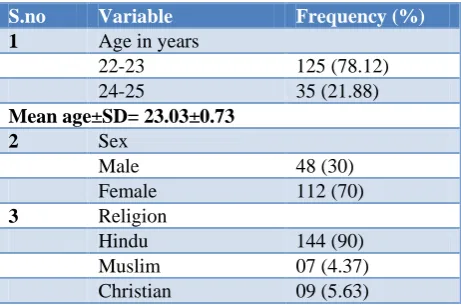
Out of 160 participants, 48 (30%) were boys and 112 (70%) were girls, with a mean age of 23.03±0.73 years. Majority of the participants were Hindus (90%) (Table 1).
donation. Regarding the consent, 56.2% were aware that family‟s consent is required for donating organs even if the deceased had signed for organ donation. Only 98 (58.1%) had heard about donor card. However 42.5% knew that there was an Act regulating the process of organ donation and only 7.5% of the study subjects could name the Act. Only 41.2% of the study subjects had heard about Jeevandan scheme (Telangana state government cadaver transplantation scheme) (Table 2).
127 (79.4%) interns had adequate knowledge about organ donation. The adequacy was significantly higher among males (89.6%) when compared with females (75%) (p=0.05) (Table 3).
77.5% of the study subjects were willing to donate their organs and 88.7% of the participants were positive regarding their family members becoming an organ donor. Only 22.5% subjects support the rule of mandatorily considering dead person as organ donor without the need of family consent. Majority (88.7%) felt that awareness about organ donation should be included in school education (Table 4).
Table 1: Distribution of study subjects according to their age, gender and religion (n=160).
S.no Variable Frequency (%)
1 Age in years
22-23 125 (78.12) 24-25 35 (21.88)
Mean age±SD= 23.03±0.73 2 Sex
Male 48 (30) Female 112 (70)
3 Religion
Hindu 144 (90) Muslim 07 (4.37) Christian 09 (5.63)
84.3% of the subjects with adequate knowledge were willing to donate their organs where as it was only 51.5% among subjects with inadequate knowledge. The association between knowledge acquired and willingness to donate organs was found to be statistically significant (p=0.01) (Table 5).
Table 2: Knowledge of medical students regarding organ donation (n=160).
S.
no Question
Number of students answered correctly (%)
1 Heard about „Organ Donation‟ (Y/N)* 160 (100)
2 Identify the organs that can be donated 56 (35)**
3 Match the given organs with the time within which organs have to be transplanted 17 (10.6)***
4 Who can donate the organs (a. Alive person, b. Dead person, c. Brain dead person, d. All) 132 (82.5)
5 There will be disfigurement of donor body after organ donation (T/F) 142 (88.75)
6 There is no age limit for donating organs (T/F)**** 73 (45.6)
7 All religions support organ donation (T/F) 126 (78.7)
8 Have you heard about donor card (T/F) 93 (58.1)
9 In case of brain death of a person carrying a donor card, the family still needs to approve
the donation of organs (T/F) 90 (56.2)
10 Can the identity of the donor be revealed to the recipient (T/F) 93 (58.1)
11 Is there any Act regulating the process of organ donation (T/F) 68 (42.5)
12 Name of the Act regulating the process of organ donation (T/F) 12 (7.5)
13 Is it an offense to accept money or any other benefits for organ donation? (T/F) 85 (53.1)
14 There is shortage of organs in India for transplantation (T/F) 124 (77.5)
15 Have you heard about Jeevandan scheme (Y/N) 66 (41.2)
* Y=Yes, N=No; **** T=True, F=False; ** Interns who had correctly identified all the given organs that can be donated; *** Interns who had correctly matched all the given organs.
Table 3: Association between sex and knowledge about organ donation (n=160).
Sex Knowledge Total (%)
Adequate (%) Inadequate (%)
Male 43 (89.6) 05 (10.4) 48 (100)
Female 84 (75) 28 (25) 112 (100)
Total 127 (79.4) 33 (20.6) 160 (100)
χ2 =4.365; df=1; p=0.05.
The most common reason for not being an organ donor was found to be fear of organs misuse (55.5%) followed by fear of being declared dead earlier, if signed an organ donor card (27.8%) (Table 6).
Table 4: Attitude of medical students regarding organ donation (n=160).
S.no Question No. of students
replied yes (%)
1 Would you like to donate your organs 124 (77.5)
2 Would you like to motivate others to donate organs 152 (95)
3 Do you support your family members if they wish to become an organ donor 142 (88.7)
4 Do we need a rule in India, which states that every person after death is mandatorily
considered as an organ donor without the need of family consent 36 (22.5)
5 Do you think awareness about organ donation should be made a part of school education 142 (88.7)
Table 5: Association between knowledge about organ donation and willingness to donate organs (n=160).
Knowledge Willing to donate organs Total (%)
Yes (%) No (%)
Adequate 107 (84.3) 20 (15.7) 127 (100)
Inadequate 17 (51.5) 16 (48.5) 33 (100)
Total 124 (77.5) 36 (22.5) 160 (100)
χ2
= 16.099; df = 1; p=0.01
Table 6: Reasons for not donating organs (n=36).
Reason Frequency (%)
Fear of organs misuse 20 (55.5)
Fear of being declared dead earlier, if signed an organ donor card 10 (27.8)
Social and cultural beliefs 6 (16.7)
Total 36 (100)
Table 7: Practice regarding organ donation among medical interns (n=160).
S.no Question No. of students replied
yes (%)
1 Do you have a donor card 9 (5.6)
2 Did any one of your family members donate organs 17 (10.6)
3 Would you like to take money for organ donation 6 (3.7)
Figure 1: Source of information regarding organ donation (n=160).
51.2
16.9
46.2
27.5
10.6
81.2
36.2
21.2
38.1
0 10 20 30 40 50 60 70 80 90
Television Radio News paper Magazines Brouchers Internet and
social network
Faculty doctors
Friends Movies
Perce
nt
ag
e
Most common source of information about organ donation was found to be internet and social network (81.2%) followed by television (51.2%) and newspaper (46.2%) respectively (Figure 1).
DISCUSSION
Knowledge of the study subjects
In the present study, 79.4% of the interns had adequate knowledge about organ donation. In a similar study done on final semester medical students by Karini et al showed that only 56% of them were having adequate knowledge.10 Our study showed that males (89.6%) significantly had more knowledge than females which is in contrast with study done by Alex et al and Adithyan et al.11,12 Majority (77.5%) of the interns knew that there is shortage of organs in India for transplantation which is similar to the findings of Payghan et al (75.29%).13 Main sources of information about organ donation was found to be internet and social network (81.2%) and television (51.2%). Similar findings were observed by Sindhu et al, Bathija et al and Payghan et al.13-15 These findings emphasize the role of media, social network in bringing awareness about organ donation.
All (100%) the interns had heard about organ donation in the present study which is similar to the study done by Sucharitha et al(97.2%),Agarwal (100%)and Vinay et al (98%).16-18 Only 35% of the study participants had identified all the organs that can be donated, whereas it was only 26% according to Karini et al.10 Majority (88.75%) of the participants knew that donor body will not get disfigured after organ donation. Similar findings were observed by Agarwal and Ali et al.17,19 45.6% of interns knew that there is no age limit for organ donation which is similar to the findings of Agarwal (43%),Karini et al (47.2%) and in contrastSucharitha et al reported it as only 19.2%.10,16,17 Though all the religions are not against organ donation there seems to be presence of myths and misconceptions even among medical students as is revealed by only 78.7% mentioning that all religions allows organ donation. The present study found that only 58.1% knows about donor card indicating the need to sensitize the medical students regarding donor card. Regarding the consent, 56.2% were aware that family‟s consent is required for donating organs even if the deceased has signed for organ donation. Our results also go along with the study done by Karini et al (53.7%).10In the studies done by Ali et al in Karachi, Sucharitha et al in Chennai and Vinay et al in Mangalore, only 13.3%, 27% and 13.9% of the medical students knew about existence of act regulating the process of organ donation where as in the present study 42.5% of study subjects knew about existence of act.16,18,19 Our study revealed that only 7.5% of the interns wrote the name of the act regulating organ donation and 53.1% knew that accepting money or any other benefits for organ donation is offence. These figures reflect the poor knowledge
regarding the Transplant of Human Organs Act (THOA) among medicos and there is a need to address this issue. It was shocking to know that only 41.2% of the study subjects had heard about Jeevandan scheme (Telangana state government cadaver transplantation scheme). In contrast 88.7% of final year medicos in Kerala knew about their state governments Mritasanjeevani according to Adithyan et al.12
Attitude of medical students regarding organ donation
It was overwhelming that majority (77.5%) of the interns got positive attitude and are willing to donate organs which is similar to the findings of Bathija et al (71.3%).15 Karini et al and Ali et al studies in different settings found that 48% of final year students were willing for organ donation.10,19 Payghan et al and Vinay et al revealed that almost 90% of medicos were willing to donate their organs.13,18 The present study found that there is a significant association between knowledge acquired regarding organ donation and willingness to donate organs. Similar finding was observed in Pakistan study done by Ali et al and in a study conducted by Dasgupta et al in urban community of West Bengal state.19,20 These findings reflect the importance of bringing awareness about organ donation among medical fraternity and general public as well. Majority (88.7%) felt that awareness about organ donation should be included in school education. Adithyan et al observed that 91.2% of the subjects felt the need for revision of medical curriculum on organ donation.12 Our study found that the most common reason for not being an organ donor was found to be fear of organs misuse (55.5%) followed by fear of being declared dead earlier, if signed an organ donor card (27.85). Similar results were observed by Sucharitha et al and Bathija et al.15,16 Majority (95%) of the study subjects would like to motivate others for organ donation which is similar to the Vinay et al study (98%).18 Regarding their attitude to whether organ donation should be mandatory by law, only 22.5% of the subjects were in favour of the law and this result is similar to the findings of Ali et al (15.2%) study done in Karachi.19
Practice regarding organ donation
CONCLUSION
Our study suggests that most of the interns had adequate knowledge and positive attitude towards organ donation. However Knowledge about Act regulating organ donation, which is considered as essential for doctors was found to be poor. Even though many are willing to donate organs, only few have donor card. The main barrier for organ donation was found to be fear of organs misuse. Willingness for organ donation was significantly associated with knowledge acquired, which implies that by giving right knowledge and orientation medicos can be become future organ donors who can then easily motivate their patients to follow the path.
Limitations
The study population represents only a small fraction of the medical community. So, the results available from this cannot be generalized for the whole community.
ACKNOWLEDGEMENTS
The authors were grateful to all the interns who had participated in the study.
We thank Dr. Navya Krishna and Dr. Pramodh, postgraduates of Department of community medicine, KIMS, Narketpally for their cooperation in data collection.
Funding: No funding sources Conflict of interest: None declared
Ethical approval: The study was approved by the Institutional Ethics Committee
REFERENCES
1. Jeevandan (Cadaver transplantation programme). Govt of Telangana. Awareness material. Available at: http://jeevandan.gov.in/PDF's/JeevandanBook. pdf. Accessed 17 on February 2018.
2. World Health Organisation. Health topics: Transplantation. Available at: http://www.who.int/ topics/transplantation/en/. Accessed on 18 February 2018
3. Ramadurg UY, Gupta A. Impact of an educational intervention on increasing the knowledge and changing the attitude and beliefs towards organ donation among medical students. J Clin Diagnos Res. 2014;8(5):5–7.
4. National Health Portal. “Organ Donation Day”. Available at: http://www.nhp.gov.in/organ-donation-day_pg. Accessed on 18 February 2018. 5. A study of the deceased organ donation
environment in Delhi/NCR. Available at http://organindia.org/wp-content/uploads/2014/11/ ORGAN-Research-Report.pdf Accessed on 18 February 2018.
6. Shroff S. Current trends in kidney transplantation in India. Indian J Urol. 2016;32:173-4.
7. Navin S. Deceased Organ Donation in India. Available at: http://www.mohanfoundation.org/ organ-donation-transplantresources/organ-donation-in-india.asp. Accessed on 17 February 2018. 8. Saraswathi I, Usha MN, Manikandan S, Prema S.
Awareness of organ donation among fresh students in medical field. Int J Med Sci Clin Invent. 2014;1:274-83.
9. Saleem T, Ishaque S, Habib N, et al. Knowledge, attitudes and practices survey on organ donation among a selected adult population of Pakistan. BMC Med Ethics. 2009;10:5.
10. Karini D, Sunitha S, Devi Madhavi B. Perceptions of Medical Students in a Government Medical College towards Organ Donation. J Evidence based Med Healthcare. 2015;2(44):7998-8005.
11. Alex P, Kiran KG, Baisil S, Badiger S. Knowledge and attitude regarding organ donation and transplantation among medical students of a medical college in South India. Int J Community Med Public Health. 2017;4:3449-54.
12. Adithyan GS, Mariappan M, Nayana KB. A study on knowledge and attitude about organ donation among medical students in Kerala. Indian J Transplant. 2017;11:133-7.
13. Payghan BS, Kadam SS, Furmeen S. Organ donation: Awareness and perception among medical students. J Pharm Sci Innov. 2014;3(4):379-81. 14. Sindhu A, Ramakrishnan TS, Khera A, Singh G. A
study to assess the knowledge of medical students regarding organ donation in a selected college of Western Maharashtra. Med J DY Patil Univ 2017;10:349-53.
15. Bathija GV, Ananthesh BG, Bant DD. Study to Assess Knowledge and Attitude towards Organ Donation among Interns and Post Graduates of a Medical College in Karnataka, India. Natl J Community Med. 2017;8(5):236-40.
16. Sucharitha ST, Siriki R, Dugyala RR, Mullai P, Roshini K. Organ Donation: Awareness, attitudes and beliefs among undergraduate medical students in South India. Natl J Res Community Med. 2013;2(2):79-148.
17. Agarwal S. Are Medical Students Having Enough Knowledge about Organ Donation. IOSR J Dental Med Sci. 2015;14(7):29-34.
18. Vinay KV, Beena N, Sachin KS, Praveen S. Changes in Knowledge and attitude among medical students towards organ donation and transplantation. Int J Anat Res. 2016;4(3):2873-7. 19. Ali NF, Qureshi A, Jilani BN, Zehra N. Knowledge
and ethical perception regarding organ donation among medical students. BMC Med Ethics. 2013;14:38.
Community of West Bengal. Sch J App Med Sci. 2014;2(6):2016-21.
21. Chung CKY, Ng CWK, Li JYC, Sum KCY, Man AHY. Attitudes, knowledge, and actions with regard to organ donation among Hong Kong medical students. Hong Kong Med J. 2008;14:278-85.
Cite this article as: Jothula KY, Sreeharshika D.