Original Research Article
Assessment of knowledge and practices of biomedical waste
management and infection control among health assistants in a rural
block of Nadia district, West Bengal
Jayita Pal
1, Mrinal Biswas
1, Swagata Nandi
2*, Asit Kumar Biswas
2INTRODUCTION
Biomedical waste refers to any solid or liquid waste generated during diagnosis, treatment or immunization of human beings and animals or during research that may present a threat of infections to human beings.1 While most of this (80%) is communal waste, a significant percentage (20%) can be deemed infectious and
hazardous. These include infected sharps and wastes with infectious, hazardous, radioactive or genotoxic characteristics, which if inadequately treated and managed can have adverse impact on the environment and on public health through air, land and water pollution.2,3 During providing services to beneficiaries, hospitals or different health care delivery points generate some infectious wastes. Effective waste management
ABSTRACT
Background: Improper biomedical waste management, inadequate precautions to prevent needle stick injuries and air-borne infections among health care workers can lead to several hazards not only to them, but community can also be in danger due to environmental pollutions or risk of transmission of diseases. Sub-centres are the peripheral most points to deliver health services and health assistants posted there are in a unique position to get infected frequently if they are not adhering to standard protocols to manage these problems. The current study aimed to assess the status of infrastructure of sub-centres, knowledge and practices of the health assistants related to biomedical waste management and infection control.
Methods: A cross-sectional study had been conducted in 40 sub-centres of Chakdaha block, Kalyani subdivision, Nadia district, West Bengal, selected purposively. All the health assistants were interviewed after taking informed consent with a pretested predesigned semi-structured questionnaire. An observational checklist had been used to assess infrastructure of the sub-centres and also some practices of the health assistants.
Results: More than half of the study population (61.6% and 63%) secured poor score regarding knowledge and practices related to biomedical waste management and infection control respectively. There was no relationship between knowledge and practices of the same (p=0.187).
Conclusions: Pre-service and also frequent in-service training should be conducted to improve the knowledge and practices of the health assistants. Regular monitoring, supervision of their day to day work by the higher authority, can improve their attitude and practices related to such an important public health issue.
Keywords: Knowledge, Practice, Biomedical waste, Infection control, Heath assistant, Rural block
1
Department of Environmental Health and Occupational Health, 2Department of Epidemiology, Institute of Public Health, Kalyani, Nadia, West Bengal, India
Received: 02 August 2019
Accepted: 07 September 2019
*Correspondence:
Mr. Swagata Nandi,
E-mail: [email protected]
Copyright: © the author(s), publisher and licensee Medip Academy. This is an open-access article distributed under the terms of the Creative Commons Attribution Non-Commercial License, which permits unrestricted non-commercial use, distribution, and reproduction in any medium, provided the original work is properly cited.
system in all health-care facilities is a key prerequisite to improve efficiency and effectiveness of health care.
In order to streamline the waste collection, segregation, processing and disposal practices, the Government of India notified rules known as the Biomedical Waste (Management and Handling) Rules, 1998 which has been further revised on March 28, 2016 for management of biomedical wastes in an environmentally sound manner.4
Healthcare workers are at a greater risk of needle stick injuries that can transmit infectious diseases, especially blood-borne viruses- HIV, Hepatitis B, Hepatitis C and other diseases like tetanus.5,6,7 WHO estimated that globally around 2.6%, 5.9% and 0.5% of health-care workers (HCW) were exposed to blood-borne pathogens like HCV, HBV and HIV respectively.8
Airborne infections like common cold, tuberculosis, influenza, measles, mumps etc. are quite prevalent among health care workers due to their occupational exposures and inadequate compliance to infection prevention guidelines.9Strict adherence to infection prevention protocol is critical to avoid spread of infection among hospitalized patients and fundamental of quality of care.
Sub-centres are the most peripheral and the first contact health care delivery point between health system in India and the community. To provide quality health care services strict compliance to biomedical waste management rule, universal precaution and airborne infection prevention guideline is of utmost importance as a healthy workforce and healthy practices at health care delivery point can curtail several serious environmental and health hazards to community. Adequate knowledge can promote proper practices with availability of appropriate logistics. With this background, the present study had been taken up to assess infrastructure of the sub-centres, knowledge and practices of health assistants related to biomedical waste management and infection control in a rural block of Nadia district of West Bengal.
METHODS
An observational cross-sectional study had been conducted in Chakdaha block of Kalyani subdivision, Nadia district, West Bengal from February 2019-June 2019. The block had been selected purposively considering feasibility of work. All the 40 sub-centres and all the health assistants posted in those sub-centres (1st ANM, 2nd ANM and health assistant male) were included in the study by complete enumeration method after taking informed consent. Health assistants who were absent on the day of survey were excluded from the study. Institutional ethical clearance had been obtained from institutional ethics committee.
The study tool was a predesigned pretested semi-structured questionnaire and an observational checklist to get information on some general characteristics of the
health assistants, infrastructure of the sub-centres, knowledge and practices of the heath assistants related to biomedical waste management, prevention and precaution of needle stick injuries and airborne infection control. The questionnaire was first prepared in English. Then it was translated into Bengali by a linguistic expert keeping semantic equivalence. To check the translation, it was re-translated into English by two independent researchers who were unaware of the first English version. Face validity of each item had been checked from previous researches in the presence of public health experts. They also decided the content validity of each domain. Reliability was checked by test-retest method (r=0.9). Pretesting followed by pilot testing was conducted. Necessary corrections and modifications of the questionnaire were done accordingly. One to one interview had been conducted with the final corrected schedule.
Data thus collected had been entered in MS Excel and analysed subsequently in SPSS 20.0 version. Each item to assess knowledge and practice had been scored. The total attainable knowledge and practice score were 10 and 20 respectively. Then for analytical purpose the scores had been categorized into good score (>median value) and poor score (≤median value). Association between dependent and independent variable was checked through inferential statistics. All analyses were two tailed with p≤0.05 considered statistically significant.
RESULTS
The study population consisted of 1st ANM (49.3%), 2nd ANM (46.6%) and health assistant male (4.1%). Majority of the study population belonged to the age group of 40-50 years (37%) with the mean age of 44.18 (7.691) years. Most of them were Hindu (93.2%) and belonged to general caste (65.8%). Regarding educational qualification, majority (39.7%) were graduate. Most of them (95.9%) had a work experience of >5 years with a mean of 16.9 (10.78) years. Only 12.3% of the health assistants had received training on bio-medical waste management while majority (77.78%) received the last training within last 5 years and only 15.1% of the health assistants were vaccinated with Hepatitis B vaccine (Table 1).
Though in each white bin was available, only 15% of them had red bins and majority (85% and 87.5%) of them had blue and black bin respectively. Only 7.5% cases Gram Panchayat was involved in bio-medical waste management (Table 2).
Table 1: Distribution of health assistants according to general characteristics (n=73).
Characteristics Frequency
(n) %
Designation
1st ANM 36 49.3
2nd ANM 34 46.6
Health assistant (male) 3 4.1
Age (in completed years)
30-40 26 35.6
40-50 27 37
50-60 20 27.4
Mean (SD) 44.18 (7.691)
Minimum 30
Maximum 60
Religion
Hindu 68 93.2
Muslim 5 6.8
Caste
General 48 65.8
24.7
SC 18
ST 1 1.4
OBC 6 8.2
Educational qualification
Secondary 18 24.7
Higher secondary 18 24.7
Graduate 29 39.7
Post graduate 8 11.0
Years of work experience
<5 3 4.1
5-10 30 41.1
10-15 10 13.7
>15 30 41.1
Mean (SD) 16.9 (10.78)
Minimum 3
Maximum 40
Training in BMW management
Yes 9 12.3
No 64 87.7
Last training received (years ago) [n=9]
≤5 7 77.78
6-10 1 11.11
>10 1 11.11
Vaccinated with Hepatitis B vaccine
Yes 11 15.1
No 62 84.9
Table 2: Distribution of sub centres according to infrastructure related to BMW management and
infection control (n=40).
Infrastructure (General) Frequency (n) %
Government building (functional)
Available 26 65.0
Not available 14 35.0
Toilets with running water supply
Available 18 45
Not available 22 55
Cleanliness of toilet
Satisfactory 12 30.0
Unsatisfactory 28 70.0
Electricity supply
Available 38 95.0
Not available 2 5.0
At least two room
Available 27 67.5
Not available 13 32.5
Cross Ventilation of the working room
Available 35 87.5
Not available 5 12.5
Hand-washing basin with running water
Available 22 55.0
Not available 18 45.0
Liquid soap
Available 38 95.0
Not available 2 5.0
Clean towel
Available 3 7.5
Not available 37 92.5
New gloves
Available 40 100.0
Infrastructure (related specifically to BMW management)
Hub cutter with needle destroyer
Available 38 95.0
Not available 2 5.0
Puncture proof container
Available 22 55.0
Not available 18 45.0
Red bin
Available 6 15.0
Not available 34 85.0
White bin
Available 40 100.0
Blue bin
Available 34 85.0
Not available 6 15.0
Black bin
Available 35 87.5
Not available 5 12.5
Biomedical waste managed by
Panchayat 3 7.5
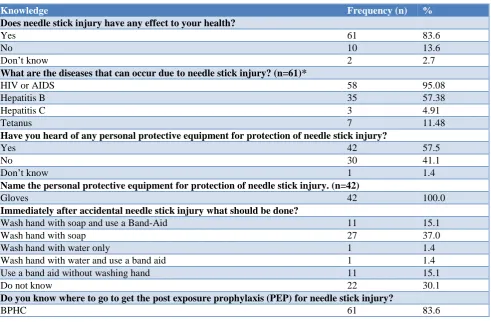
More than half of the study population (57.5%) had knowledge that personal protective equipment can protect against needle stick injury while those who had this knowledge, everyone (100%) knew the name of that personal protective equipment (gloves). Only 15.1% of the health assistants had knowledge that immediately after needle stick injury hands should be washed with soap and a band-aid should be used after that; while 13.7% knew that post exposure prophylaxis after needle stick injury is found in district hospital. Majority (98.6%) knew that diseases can be caused by transmission from person to person through air of which 76.39% and 51.38% said that tuberculosis and common cold respectively can be caused by this way. Most of them (68.5%) heard about personal protective equipment (mask) to protect against air borne diseases. Only 42.5% and 5.5% of them knew that segregation is the first step and there are 4 colour coded bags for bio-medical waste management respectively; whereas only 20.5% and 16.4% of them knew correctly that sharps should be discarded in white bag and the container collecting biomedical wastes should be changed or emptied after it is 2/4th full (Table 3).
Regarding practice related to bio-medical waste management and infection control, none of the health assistants wore apron during their work. Majority (64.4%) of them sometimes used to wear mask when
suffering from respiratory disease but 82.2% did not wear gloves at all during work. Though majority (65.8%) of them never practiced removal of accessories like watches, ring etc. during patient contact, but 75.3% practiced hand washing with soap before and after patient contact. Less than half of the study population (49.3%) always practiced recapping of needle after use, whereas majority (71.2%, 57.5% and 57.5%) never used gloves during handling of medical waste, never segregated bio-medical waste at source and never discarded used up medicine and vaccine vials and ampoules in blue coloured bag respectively. Most of them (91.8%) used to change or empty the container of bio-medical waste after 2 days with mean of 16.1 (9.54) days (Table 4).
Regarding knowledge and practice scores of health assistants, majority (61.6%) scored poor regarding knowledge with a mean of 4.19 (1.43) and 63% scored poor regarding practice with a mean of 6.88 (1.992). The health assistants who had good knowledge score among them 46.4% had good practice score and 53.6% had poor practice score, while among those who had poor knowledge score, 31.1% had good practice score and 68.9% had poor practice score. But this difference was not found to be statistically significant (p>0.05) demonstrating the fact that there was no relationship between knowledge and practices of the health assistants (Table 5).
Table 3: Distribution of study population according to knowledge regarding BMW management and infection control (n=73).
Knowledge Frequency (n) %
Does needle stick injury have any effect to your health?
Yes 61 83.6
No 10 13.6
Don’t know 2 2.7
What are the diseases that can occur due to needle stick injury? (n=61)*
HIV or AIDS 58 95.08
Hepatitis B 35 57.38
Hepatitis C 3 4.91
Tetanus 7 11.48
Have you heard of any personal protective equipment for protection of needle stick injury?
Yes 42 57.5
No 30 41.1
Don’t know 1 1.4
Name the personal protective equipment for protection of needle stick injury. (n=42)
Gloves 42 100.0
Immediately after accidental needle stick injury what should be done?
Wash hand with soap and use a Band-Aid 11 15.1
Wash hand with soap 27 37.0
Wash hand with water only 1 1.4
Wash hand with water and use a band aid 1 1.4
Use a band aid without washing hand 11 15.1
Do not know 22 30.1
Do you know where to go to get the post exposure prophylaxis (PEP) for needle stick injury?
BPHC 61 83.6
Knowledge Frequency (n) %
BPHC and District Hospital 2 2.7
District Hospital 10 13.7
Have you heard about any disease which is transmitted from person to person through air?
Yes 72 98.6
Do not know 1 1.4
Which diseases can be transmitted by this route? (n=72)*
Tuberculosis 55 76.39
Common cold 37 51.38
Pneumonia 2 2.78
Measles 5 6.94
Influenza 20 27.78
Diphtheria 5 6.94
Rubella 4 5.56
Chicken pox 2 2.78
Leprosy 2 2.78
Have you heard any personal protective equipment to prevent transmission of air-borne diseases?
Yes 50 68.5
No 22 30.1
Do not know 1 1.4
Name the equipment to prevent air transmission (n=50)
Mask 50 100.0
Which is the first step of biomedical waste management?
Segregation 31 42.5
How many colour bags are used for this purpose?
1 1 1.4
2 23 31.5
3 45 61.6
4 4 5.5
In which colour bag sharp waste should be discarded?
White 15 20.5
Black 2 2.7
Red 6 8.2
Blue 43 58.9
Yellow 7 9.6
When the container for collecting the sharp waste should be changed or emptied?
1/4 full 20 27.4
2/4 full 12 16.4
3/4 full 39 53.4
Do not know 2 2.7
*: Multiple responses.
Table 4: Distribution of study population according to practice regarding BMW management and infection control (n=73).
Practice Frequency (n) %
Do you wear apron at Sub-centre?
Never 73 100.0
Do you wear mask when you are suffering from respiratory disease while patient contact?
Always 17 23.3
Sometimes 47 64.4
Never 9 12.3
Do you wear gloves during vaccination?
Always 3 4.1
Sometimes 10 13.7
Practice Frequency (n) %
Do you remove accessories like watches, ring and bracelet before patient contact?
Always 7 9.6
Sometimes 18 24.7
Never 48 65.8
Do you practice hand washing with soap before and after each patient contact?
Always 55 75.3
Sometimes 17 23.3
Never 1 1.4
Do you recap the needle after use?
Always 36 49.3
Sometimes 8 11.0
Never 29 39.7
Do you wear gloves during handling of Bio-medical waste?
Always 10 13.7
Sometimes 11 15.1
Never 52 71.2
Do you segregate Bio-medical waste management at source?
Always 30 41.1
Sometimes 1 1.4
Never 42 57.5
Do you put used up medicine vial and ampoule in blue colour bag?
Always 21 28.8
Sometimes 10 13.7
Never 42 57.5
When do you change each container that is used for Bio-medical waste management?
1 day 6 8.2
2 day 0 0.0
>2 day 67 91.8
Mean (SD) 16.1(9.54)
Minimum 1
Maximum 120
Table 5: Relationship of knowledge and practice score of the study population: (n=73)
Knowledge Good Practice Poor practice Test of significance
N (%) N (%)
Good 13 (46.4) 15 (53.6)
Chi-square=1.738, df=1, p=0.187
Poor 14 (31.1) 31 (68.9)
DISCUSSION
The current study revealed that majority of the health assistants had poor knowledge and practice related to biomedical waste management and infection control. There was no relationship of knowledge and practice depicting that despite of having knowledge on a particular matter, they were not practicing it either due to reluctancy, lack of motivation or inadequacy of logistic support. A study by Ranjini et al demonstrated that majority (78%)of health workers had good knowledge on biomedical waste management while another study conducted in Kerala depicted that overall knowledge was found to be satisfactory regarding infection control practices among 29% of the workers of designated microscopy centres.10,11 In consistency with the present
study findings Kumar et al demonstrated that only 25% of the nurses in eight hospitals in Tamil Nadu had good knowledge score regarding biomedical waste management.12
respectively, whereas the present study showed that only 20.5% and 5.5% of health assistants were aware of the above facts. The study in Kerala showed that 87%, 76% and 42% of the workers knew about proper disposal of sharps, personal protective equipment (gloves) to prevent needle stick injury and waste segregation at source while only 57.5% and 42.5% of health assistants of this study knew about importance of gloves for personal protection and about waste segregation respectively.11 Singh et al while reported that 69.48% of dental students knew that tuberculosis can be caused by transmission from person to person through air, while 76.39% health assistants of the current study knew the same.14 Muralidhar et al reported that only 40% of HCWs knew about the availability of PEP services in the hospital and Chacko and Isaacfound it to be 31.6%, but the present study found that only 16.4% of health assistants knew it.15,16
A situational analysis in selected small health care facilities in Bangalore, Indiarevealed that segregation of biomedical waste was present in 62.9% of cases; while in present study only 42.5% of the health assistants practiced segregation at source.17 A study in Gujrat by Pandit et al reported that recapping of needles was practiced by only 17% of health care providers; while in this study 49.3% of the health assistants always practiced it and Muralidhar et al also found the practice of recapping of needles after use was prevalent among HCWs (66.3%).15,18 Lee et al in South Korea found that only (9.52%) of the health assistants had taken the vaccination for Hepatitis B, while in current study it was 15.1%.19 Muralidhar et al also demonstrated that 74% of HCWs were wearing gloves at the time of NSI (needle stick injury), Aslesh et al found the figure to be 61%, Askarian et al in Iran showed it as high as 96.2 %; but all of the above results were not consistent with the present study result which depicted that only 17.8% of the health assistants used to wear gloves during work.11,15,20
Though an observational checklist had been used to assess practices, most of the times the assessment was actually based on stated practice which was fully dependent on verbal responses of the health assistants who might had been wilfully falsified their practices. Due to time and manpower constraints the present study had been conducted in only one block selected purposively. Researches should be conducted to explore the status of health assistants in other blocks with application of proper sampling methods in future.
CONCLUSION
The present study revealed that overall knowledge and practices regarding biomedical waste management and infection control were not satisfactory for more than half of the health assistants. It also demonstrated that there was no relationship between knowledge and practice regarding the same enlightening the fact that even those who had good knowledge did not practice that in day to day work. This unfortunate gap sometimes was due to
inadequate logistics; while lack of proper attitude of the health assistants, infrequent monitoring and supervision from higher authority might be the other possible causes.
With the fact that sub-centres are the most peripheral part of Indian health care delivery system and the first contact point between the patients and health system, the health care assistants are in a unique position to get infected and also to infect others with hazardous wastes, to be exposed to infections from the patients coming to them to get health care; if they do not know or practice the standard guideline for biomedical waste management, needle stick injury prevention and air-born infection control. Therefore, pre-service and refresher courses at regular interval should be undertaken by the respective higher authority regarding the topic; while to curtail the gap between knowledge and practice regular supply of necessary logistics, strict monitoring and supervision are to be done to ensure compliance with hand hygiene, sharps handling, wearing gloves and other related practices.
ACKNOWLEDGEMENTS
The authors acknowledge Department of Health and Family Welfare, Government of West Bengal for permitting and helping in every step to conduct the study.
Funding: No funding sources Conflict of interest: None declared
Ethical approval: The study was approved by the Institutional Ethics Committee
REFERENCES
1. Shukla SR. Manual on “Municipal Solid Waste Management”, Ministry of Urban Development Government of India, New Delhi. Chapter 7, 2000: 117. Available at: netlibrary,http://urbanindia.nic. in/publicinfo/swm/chap7.pdf. Accessed on 11 June 2019.
2. Joseph L, Paul H, Prem Kumar J, Rabindranath, Paul R, Michael JS. Biomedical waste management: Study on the awareness and practice among healthcare workers in a tertiary teaching hospital. Indian J Med Microbiol. 2015;33:129-31.
3. Waste from healthcare activities, Fact Sheet. November 2011. Available at: http://www.who.int/ mediacentre/factsheets/fs253/en/. Accessed on 11 June 2019.
4. Joshi SK. Quality Management in Hospitals. Chapter 43. Bio-medical waste management program. New Delhi: Jaypee Publications; 2009. 5. Gerberding JL. Incidence and prevalence of human
6. Tokars JI, Marcus R, Culver DH, Schable CA, McKibben PS, Bandea CI, et al. Surveillance of HIV infection and zidovudine use among health care workers after occupational exposure to HIV-infected blood. Ann Intern Med. 1993;118:913–9. 7. Sharma R, Rasania S, Verma A, Singh S. Study of
Prevalence and Response to Needle Stick Injuries among Health Care Workers in a Tertiary Care Hospital in Delhi, India. Indian J Community Med. 2010;35(1):74–7.
8. Pruss-Ustun A, Rapiti E, Hutin Y. Sharp’s injuries: Global burden of disease from sharps injuries to health-care workers. Geneva: World Health Organization; 2003.
9. Chandran D, Patni MA. Assessment of airborne infection control practices in the pulmonary medicine ward in a tertiary-care hospital of south Gujarat. Int J Med Sci. and Public Health. 2015;4(9):1265-8.
10. Ranjini MJ. A study to assess the knowledge on Biomedical Waste Disposal among the Group D health workers in Sri Ramakrishna Hospital, Coimbatore. Asian Pac J Health Sci. 2014;1(4):465-70.
11. Aslesh OP, Ubaid NP, Nagaraja SB, Shewade HD, Padmanabhan KV, Naik BR, et al. Compliance with infection control practices in sputum microscopy centres: a study from Kerala, India. Public Health Action. 2015;5(4):255–60.
12. Kumar D. A Study to Access the Knowledge Level on Bio-Medical Waste Management among the Nurses in Tamilnadu. ACTA Scientific Medical Sciences. 2019;3(1):78-87.
13. Eldein HN, Mohamed RA. Effect of education intervention on prevention of blood borne infections for health care workers in family medicine centers, Suez Canal University in Ismailia City, Egypt. Middle East J Fam Med. 2016;14(2):4-13.
14. Singh V, Bhaskar DJ, Agali C, Chaudhary V, Bumb SS, Jain CD. Knowledge and Attitude towards Droplet and Airborne Isolation Precautions and its Correlation among Students of TMDC&RC, Moradabad. Int J Adv Health Sci. 2014;1(3):8-15. 15. Muralidhar S, Singh PK, Jain RK, Malhotra M, Bala
M. Needle stick injuries among health care workers in a tertiary care hospital of India. Indian J Med Res. 2010;131:405-10.
16. Chacko J, Isaac R. Percutaneous injuries among medical interns and their knowledge and practice of post-exposure prophylaxis for HIV. Indian J Public Health. 2007;51:127-9.
17. Chethana T, Thapsey H, Gautham MS, Sreekantaiah P, Suryanarayana SP. Situation analysis and issues in management of biomedical waste in select small health care facilities in a ward under Bruhat Bengaluru Mahanagara Palike, Bangalore, Indian J Community Health. 2014;39(2):310-5.
18. Pandit NB, Choudhary SK. Unsafe injection practices in Gujarat, India. Singapore Med J. 2008;49:936-9.
19. Lee JH, Cho J, Kim YJ, Im SH, Jang ES, Kim JW, et al. Occupational blood exposures in health care workers: incidence, characteristics, and transmission of blood borne pathogens in South Korea. BMC Public Health. 2017;17(1):827.
20. Askarian M, Shaghaghian S, McLaws ML. Needlestick injuries among nurses of Fars Province, Iran. Ann Epidemiol. 2007;17:988-92.