ATTRIBUTE BASED SECURED STORAGE
MIDDLEWARE FOR MOBILE CLOUD COMPUTING
Ms. Akanksha R. Patil
1,
Prof. Sandeep G. Sutar
21
Research Scholar,
2Assistant Professor Department of Computer Science and Engineering,
Annasaheb Dange college of Engineering, Ashta, Maharashtra, (India)
ABSTRACT
Today handheld devices like cell phones and other gadgets are playing more vital roles in the people’s daily
lives with the fast development of wireless technology. All these devices use Internet Protocol for fetching &
accessing services. To save hardware and software investment cost many current applications are being
deployed on Cloud. Now a day’s Mobile cloud has become remarkable cloud service model; in which, mobile
devices are used as the information collecting and processing node for the cloud infrastructure. Cloud has
become the pervasive digital platform for many network applications in their quest to provide a single unified
digital platform.
In this paper, authors present insignificant Cloud-based storage framework. This framework will provide an
easy-to-use file navigation service for attribute-based file querying. Simultaneously, it incorporates an effective
structure for users to verify their data integrity, which can relieve much load from mobile devices. Experimental
simulations show that the proposed framework is effective to provide flexible data sharing in mobile computing
environments.
Index Terms: Decryption Service Provider (DSP), Encryption Service Provider (ESP), Security
Server (SS)
I.INTRODUCTION
Cloud computing security is an evolving sub-domain of computer network technologies and data security. Data security focuses on confidentiality, integrity & authenticity of information. More policies, technologies and controls are been deployed to protect data, applications, and the associated infrastructure for physical and logical security.
Mobile Cloud computing is also emerging advancement, which is transforming the traditional Internet computing paradigm and IT industry into a new devastating era of computing. This new trend demand researchers and practitioners to construct a convincing architecture which includes a large numbers of lightweight, resource constrained mobile devices.
103 | P a g e service architectures are needed to address the security concerns of the users for using cloud computing techniques.
In recent years, many people have realized that Cloud-based storage system is a very cost-effective for commercial applications. Since Mobile devices have limited computational capacity and run on small batteries, data storage and sharing is difficult for these devices. With the spring of Cloud, storage platform can provide reliable and unlimited storage. They fulfill to the requirements of mobile computing environments very well & offer a flexible and low-cost solution to meet the unfolding storage requirements in such environments. This paper deals with the problems identified in regard to mobile devices cloud computing for data security.
The rest of this paper is organized as follows. Section 2 presents the literature survey. In Section 3, we briefly describe system architecture of the proposed system; In Section 4, experimental setup and simulated implementation details are presented. Finally, Section 5 concludes the paper with a brief discussion of future work.
II. LITERATURE REVIEW
A holistic security framework to secure the data storage in public clouds with the special focus on lightweight wireless devices store and retrieving data without exposing the data content to the cloud service providers is been implemented by Zhibin Zhou and Dijiang Huang [1]. To achieve this goal, the solution focuses on the following two research directions: first, it presents a novel privacy preserving cipher policy attribute-based encryption to protect user data. Lightweight devices can securely outsource heavy encryption and decryption operations to cloud service providers, without revealing the data content and used security keys. Second, it proposes an attribute based data storage system as a cryptographic access control mechanism. Furthermore to facilitate key management and cryptographic access control in an expressive and efficient way Bethencourt and
Sahai have associated user with multiple attributes. Multiple users may share common attributes allowing
message encrypted to specify a data access policy by composing multiple attributes through logical operators such as AND, OR, etc [2]. A model for provable data possession is proposed by Antesia & Burns that can be used for remote data checking. The model generates probabilistic proofs of possession by sampling random sets of blocks from the server, which drastically reduces I/O costs [3]. In addition, as mobile cloud computing is a new model [4], it still has an opportunity for future research expansion in the three areas: First, Security issues are still frightening and there should be an appropriate solution for it, Second, architecture for the mobile cloud diverse wireless network should be investigated, Thirdly, A single access platform for mobile cloud computing via various operating systems platforms needs to be established. In another article, research on cross-tenant trust models in Cloud computing is carried out through a systematic analysis of cross-tenant trust relations by Tang &
Ravi Sandhu [5].
A) ABBREVIATIONS
I) Attribute Based Data Storage (ABDS)
III. SYSTEM ARCHITECTURE
Fig1: Architecture of proposed work
The proposed system will provide a lightweight Cloud-based storage framework (middleware), which provides an effective mechanism for users to verify their data integrity, data security and secure network flexibility with PP-CP-ABE, ABDS, data integrity checking modules. Meanwhile it incorporates an effective mechanism for users which can relieve much burden from mobile devices.
In this proposed system mobile devices interact with middleware through a general web service portal. As shown in Figure 1, proposed system consist four major components: Users, Storage Service Provider (SSP), Security Server (SS) and Middleware. The work is divided into following modules,
1. Authentication module with low cost 2. Attribute based Key Generation
3. Data Encryption and Security checking with PDP based Schemes 4. Attribute based file distribution
5. Attribute based retrieval and decryption
3.1. Authentication module with low cost
Whenever user wants to use cloud services, each user needs to register with the security server (SS). While registration to security server user specifies personal credentials with specific attribute which are further used at the time of key generation module. Also, at the time of registration users device is also registered for device authentication with its specific MAC address. If user wants to download owned data file then authentication will be verified with help of SS. User can download owned decrypted data if and only if the verification process is successful with right authentication of that device.
3.2. Attribute based Key Generation
105 | P a g e In this module, the key generation algorithm takes a set of attributes(S) like user occupation, mail_id and MAC address of individual’s device as input and outputs a set of private key and public key components corresponding to each attributes with help of Attribute based key generation algorithm.
3.3. Data Encryption and Security checking with PDP based Schemes
It will perform two operations Viz. encryption on uploaded file & data integrity checking
3.3.1 Encryption on uploaded file
To outsource the computation of encryption and preserve the data privacy, user must encrypt data files with help of ESP from middleware. The ESP then provides encryption service with PP-CP-ABE scheme [1] to the data owner without knowing the actual data encryption key.
3.3.2 Data integrity checking
In Cloud storage system, most users are worried about data security and data integrity at unreliable and un-trusted storage servers. Therefore In this module PDP security protocol [3], [6] is used to provide data security. Data integrity checking process consists following steps:
i. The user uploads input files on cloud with help of SS.
ii. After successful encryption of that file the checksum related with that file is calculated and this checksum value is stored on SS in form of signature value and further this signature is used for verification operation. iii. If user sends data integrity checking request to security server with a target filename, proof message is
produced according the PDP based model and sent to SS.
iv. Security Server is responsible to verify the proof message by comparing original signature value with newly generated value, If verifying operation fails, it return false to users; otherwise, an Integrity Assurance procedure will be invoked by security service of middleware.
3.4 Attribute based file distribution Module
This module uses an Attribute Based Data Storage (ABDS) scheme that is based on PP-CP-ABE [1] to enable efficient, scalable data management and sharing. The ABDS system achieves scalable and fine-grained data access control, using public cloud services. Based on ABDS algorithm [1], user attributes are organized in a carefully constructed hierarchy so that the cost of membership revocation can be minimized. Moreover, ABDS is suitable for mobile computing to balance communication and storage overhead and thus reduces the cost of data management operations for both mobile as well as cloud infrastructure.
3.5 Attribute based retrieval and decryption
IV. EXPERIMENTAL SET-UP & SIMULATED RESULTS
The project is implemented in Net Beans IDE 8.0.1. The experiment is carried out using multiple devices which are connected through same Wi-Fi network using IP. Different configuration mobiles and computers (client) are connected to the server. Server monitors all the tasks.
Table 1. System Setup
Componenets H/W Configuration MAC ID Information
Server Node Intel(R)Core(TM)i3 with 1.70GHz, RAM 4GB, HDD 1TB AC-D1-B8-D3-C4-F7 Client Node mobile Q- core1.2Ghz with Android K 4.4, RAM 2GB, Storage 8
GB
fc:64:ba:cb:3b:11
Client Node Intel(R)Core(TM)i3 with 2.40GHz, RAM 3GB, HD 640GB C0-CB-38-35-BD-EB Client Node mobile Q- core1.2Ghz with Android K 4.4,RAM 1GB, Storage 16
GB
44:91:db:89:9c:0c
Work on first three modules have completed which are related with user, user's device registration, authentication with attribute based key generation module and file uploading with encryption from user to cloud server with data integrity checking for file.
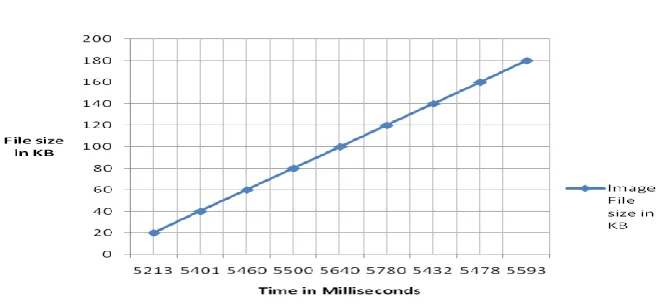
We have simulated the environment for the cloud and following results are generated with respect to time
required for file encryption and uploading on cloud server.
107 | P a g e
Graph 2: Time required for uploading PDF files
Different files (image, word & PDF are inputted for uploading. File sizes are taken from 20 kb to 200 kb. With help of Graphs 1, 2 & 3 we concluded that the time required for uploading the file on cloud storage after encryption increases for every higher file size.
Graph 3: Time required for uploading word-doc files
V. CONCLUSION & FUTURE WORK
REFERENCES
[1] Zhibin Zhou and Dijiang Huang, “EFFICIENT AND SECURE DATA STORAGE OPERATIONS FOR MOBILE
CLOUD COMPUTING”,IEEETRANSACTIONS ON COMPUTERS,OCT.2012, PP.37-45.
[2] J. Bethencourt, A. Sahai, and B. Waters, “Ciphertext-Policy Attribute- Based Encryption”, IEEE Computer Society, IEEE Symposium on Security and Privacy, 321-334, Washington, DC, USA, 2007. [3] G. Ateniese, R. Burns and R. Curtmola, “Provable Data Possession at Untrusted Stores”, Proceedings of
ACM Conf. Computer and Communication and Security, (2007), pp. 598-609.
[4] Ahmed DheyaaBasha, IrfanNaufal Umar, and Merza Abbas, “A Mobile Applications as Cloud Computing: Implementation and Challenge”, International Journal of Information and Electronics Engineering, Vol. 4, No. 1, January 2014.