INTRODUCTION
There are significant development through out the world from the last a few decades and the textile industry is not any exception with this regard. Textile processing, dyeing techniques are taking new advantages day by day as to fulfill the requirements of advance textile market .textile industry is mainly dependent of processing, dyeing, and finishing technologies. Some important emerging techniques are discussed here.
Enzyme catalysed finishing processes
Enzymes are proteins that act as biocatalysts activating and acceleration chemical reactions which would otherwise normally need more energy. Their excellent substrate selectivity allows more gentle process conditions compared to conventional processes. Enzymes are present in bacteria, yeasts and fungi.
At present enzymes are used and under study only for natural fibers, the use of enzymes for man-made fibers is not mentioned in literature.
An overview of the advance emerging techniques in
textile industries
YOGITA YADAV¹ and
RAJENDRA SINGH²
1Department of Chemistry, JIET, Jaipur (India)
²Department of Chemistry, IGBN. PG. College, Jhunjhunu (India). (Received: January 06, 2010; Accepted: February 19, 2010)
ABSTRACT
Textile industry is one of the largest industry world wide .technological development within this industry is still continuous and various new advance technologies are emerging from last a few decades. In this paper an overview is taken with these technologies regarding their advantage and development.
Key words: Enzyme catalised, plasma technology, biotech, electron ray, electrochemical dyeing, fuzzy LOZIC, H2O2,vat dyes.
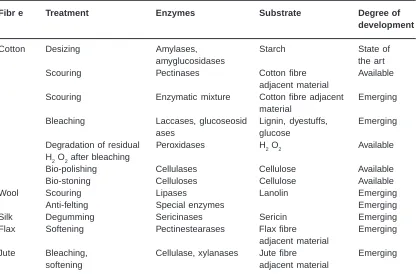
Some enzymes, such as the amylases in the desizing process, have been widely applied for a long time; other enzymes are still the object of investigations. Table 6.1 lists main enzymatic processes already in use or currently emerging in the textile sector.
Energy savings (lower processing temperatures) and lower water consumption (reduced number of rinsing steps) are some of the promising advantages of enzymatic processes, along with the omission, in some cases, of the use of hazardous/harmful substances. Also enzymes can be used in catalytic amounts and as a biocatalyst they can be recycled.
Plasma technology
Plasma treatments have been used to induce both surface modifications and bulk property enhancements of textile materials, resulting in improvements to textile products ranging from conventional fabrics to advanced composites. These treatments have been shown to enhance dyeing rates of polymers, to improve colorfastness and wash resistance of fabrics, to increase adhesion of coatings, and to modify the wet-ability of fibers and fabrics. Research has shown that improvements in toughness, tenacity, and shrink resistance can be achieved by subjecting various thermoplastic fibers to a plasma atmosphere. Recently, plasma treatments have produced increased moisture absorption in fibers, altered degradation rates of biomedical materials (such as sutures), and deposition of low friction coatings.
Unlike wet processes, which penetrate deep into the fibers, plasma produces no more than a surface reaction, the properties it gives the material being limited to a surface layer of around 100 angstroms. These properties are very varied and can be applied to both natural fibers and polymers, as well as to non-woven fabrics, without having any effect on their internal structures. For example, plasma processing makes it possible to impart hydrophilic or hydrophobic properties to the surface of a textile, or reduce its inflammability. And while it is difficult to dye synthetic fabrics, the use of reactive polar functions results in improved pigment fixation. Also, with plasma containing fluorine, which is used mainly to treat textiles for medical use, it is possible to optimize biocompatibility and haemocompatibility - essential for medical implants containing textiles. Four types of plasma are generally used: the corona plasma , Atmospheric pressure plasma technique plasma ,dielectric barrier discharge:
Plasma treatment can be performed on natural fibers as well as on synthetic fibers, to achieve the following effects:
´ wool degreasing ´ desizing
´ change of fiber wet ability (hydrophilic, hydrophobic properties) increase in dyestuff affinity)
´ improved dye leveling properties ´ anti-felt finishing in wool
´ sterilization (bactericidal treatment), etc. Anti-felt finishing effects for wool is one of the most studied applications of plasma technology in the textile sector. Plasma treatment, instead of the conventional anti-felt treatment (see Section 2.9.2.8), is very attractive because this technique causes less degradation of the wool fiber and avoids the presence of AOX in the waste water.
The following table shows var ious applications of plasma in textiles:
Various application of plasma in textile
In general the main advantages of plasma technology are extremely short treatment time and the low application temperature, along with the fact that waiver and solvents can be avoided and no or less chemicals are required.
Electron-ray treatment
Electron-rays start free-radical initiated polymerization reactions that can then be used for coating, lamination and for graft co-polymerization reactions on textiles pre-coated with monomers or pre-polymers.
The advantage over thermal curing is that solvent-free formulations can be used. This reduces the emissions of VOCs during drying operations. The technique is already established in other sectors and therefore its implementation in the textile sector IS foreseeable in the next five years. Use of supercritical CO2 in dyeing processes
Supercritical fluids are capable of dissolving organic molec4les of low to medium polarity.
Carbondioxide has the advantage over other gases of being un flarnable, non-explosive and non-toxic.
CO2 dyeing of PES and PP can be carried out under optimal isothermal and isobaric conditions at 120 and 300 Dc. Dye uptake and fastness proper ties :are very similar to water dyeing. Nevertheless some precautions need to be taken. Excess dye dissolved in the dyeing medium must be extracted with fresh supercritical CO2 at the end of the dyeing cycle.
In conclusion, only special dye formulations can be used because dispersing agents and other auxiliaries typically present in conventional dye formulations strongly influence dye uptake in supercritical CO2.
Hydrophobic preparation agents should be extracted before dyeing because of their solubility in supercritical CO2. They are first extracted from the fiber during the dyeing process, and then precipitate as oily droplets at the end of the process. CO2 dyeing has a number of advantages ´ Almost zero water consumption
´ Zero off-gas emission (CO2 can be recycled) ´ No drying step necessary after dyeing ´ Leveling and dispersing agents are not
needed at all or, in some cases, they are added in very small amounts;
´ The dyestuff residues can be recycled. Nevertheless, the investment cost for the equipment is high and this is a significant drawback, especially when considering that PES textiles are normally low-price products.
Ultrasonic treatments
Ultrasonic treatments improve the dispersion of dyestuffs and auxiliaries and enhance their ability to emulsify and soluble. This allows improved liquor homogenization, which then results in higher bath exhaustion and level dyeing properties. In addition, ultrasounds produce a de-aeration effect in the liquor and on the fabric, which is normally obtained by adding special auxiliaries (de-aerating agents).
Ultrasound technology can be attributed to various mechanisms
The effect of ultrasonic depends on various
mechanisms as follows: ´ Radiation pressure
´ Heat
´ Streaming ´ Cavitations ´ Agitation
´ Interface instability and friction ´ Diffusion and mechanical rupture The mechanisms
1. Increasing swelling in water.
2. Reducing glass transition temperature of the fiber (dilation of amorphous regions). 3. Increasing the fiber/dye bath par tition
coefficient.
4. Enhancing transport of the dye to the fiber surface by reducing the boundary layer 5. Thickness.
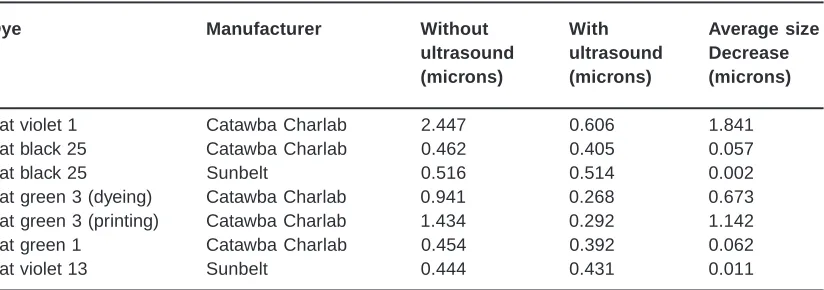
6. Breaking up of micelles and high molecular weight aggregates into uniform dispersions in the dye bath. As Dr G Mock, R McCall, D Klutz carried out experiments. Five different vat dyes of known structure were examined, most of which had previously been used in ultrasound dyeing trials. A 5-gpl solution of each dye was prepared, and then divided in half to give two samples for each dye. One sample of each dye was treated with 20 kHz ultrasound at 25° C for 60 minutes; The other sample was used as a control untreated sample. The dye samples were measured with a Honeywell Microtrac Particle Size Analyzer. The results are shown in table-3.0.
Table 2:
Application Material Treatment
Hydrophilic finish PP, PET, PE Oxygen plasma, Air plasma Hydrophobic finish Cotton, P-C blend Siloxane plasma
Antistatic finish Rayon, PET Plasma consisting of dimethyl silane
Reduced felting Wool Oxygen plasma
Crease resistance Wool, cotton Nitrogen plasma Improved capillarity Wool, cotton Oxygen plasma
Improved dyeing PET SiCl4 plasma
Improved depth of shed Polyamide Air plasma
Bleaching Wool Oxygen plasma
UV protection Cotton/PET HMDSO plasma
Flame retardancy PAN, Cotton, Rayon Plasma containing phosphorus Table 1: Enzymatic processes in textile finishing[77, EURATEX, 2000], [179, UBA, 2001]
Fibr e Treatment Enzymes Substrate Degree of
development
Cotton Desizing Amylases, Starch State of
amyglucosidases the art
Scouring Pectinases Cotton fibre Available
adjacent material
Scouring Enzymatic mixture Cotton fibre adjacent Emerging material
Bleaching Laccases, glucoseosid Lignin, dyestuffs, Emerging
ases glucose
Degradation of residual Peroxidases H2 O2 Available H2 O2 after bleaching
Bio-polishing Cellulases Cellulose Available
Bio-stoning Celluloses Cellulose Available
Wool Scouring Lipases Lanolin Emerging
Anti-felting Special enzymes Emerging
Silk Degumming Sericinases Sericin Emerging
Flax Softening Pectinestearases Flax fibre Emerging
adjacent material
Jute Bleaching, Cellulase, xylanases Jute fibre Emerging
softening adjacent material
The main environmental benefits achievable with ultrasonic treatments in textile finishing are:
´ energy savings (lower process temperatures and shorter cycle times)
´ reduction in auxiliaries consumption.
Nanotechnology
transform industry and create a huge market. In chemicals, cosmetics, pharmaceuticals, technology and textiles, businesses are researching and manufacturing products based on nanotechnology, which uses bits of matter measured in billionths of a metre.
The technology, utilising materials a thousand times smaller than the width of a human hair, is showing up in everything from auto parts to sunscreens and clothingS. However,
nanotechnology has been used to improve products that most of us use everyday. These include laundry detergent, 6-pack rings, and surgical tools. One of the most widespread
applications of nanotechnology is in clothing. Nanotechnology is also called a “bottom up” technology owing to using such small-scale building units, in contrast to bulky mater ial engineering that is considered a “top down” approach . Many textile industries and research organisation has already developed fabrics with distinguishing properties. Scratch-and-sniff clothing is one example. Pleasantly scented, tiny polymer beads are added to clothing, such as within a strawberry applied on a shir t. Then there are menthol pajamas, scented to open the nasal passages of people suffering from colds, ensuring a good night’s sleep.
Table 3.
Dye Manufacturer Without With Average size
ultrasound ultrasound Decrease (microns) (microns) (microns)
Vat violet 1 Catawba Charlab 2.447 0.606 1.841
Vat black 25 Catawba Charlab 0.462 0.405 0.057
Vat black 25 Sunbelt 0.516 0.514 0.002
Vat green 3 (dyeing) Catawba Charlab 0.941 0.268 0.673
Vat green 3 (printing) Catawba Charlab 1.434 0.292 1.142
Vat green 1 Catawba Charlab 0.454 0.392 0.062
Vat violet 13 Sunbelt 0.444 0.431 0.011
Table 4: Nano-particles and potential textile applications
S.No Nano-Particles Properties
1 Silver Nano-Particles Anti-bacterial finishing
2 Fe Nano-Particles Conductive magnetic properties, remote heating. 3 ZnO and TiO2 UV protection, fiber protection, oxidative catalysis 4 TiO2 and MgO Chemical and biological protective performance,
provide self-sterilizing function. 5 SiO2 or Al2O3 Nano-particles with PP Super water repellent finishing.
or PE coating
6 Indium-tin oxide Nano-Particles EM / IR protective clothing. 7 Ceramic Nano-Particles Increasing resistance to abrasion.
8 Carbon black Nano-Particles Increasing resistance to abrasion, chemical resistance and impar t electrical conductivity, colouration of some textiles.
9 Clay nano-particles High electrical, heat and chemical resistance. 10 Cellulose Nano-whiskers Wrinkle resistance, stain resistance, and water
Some other type of clothing niche being explored on many fronts, with perhaps more staying power than scratch-and-sniff shirts, involves the nanoscale improvement of fabrics and fibres. Nanotechnology is adding its labels to popular clothing brands with various products: Resists Spills, Resists Static, Coolest Comfort, and Repels and Releases Stains. Researchers all around the world are looking at all sorts of metal additives and polymer additives, inorganic, organic materials to take them at nanoscale to impart lots of interesting properties to textiles.
Preparation of nano-sized materials
There are several physico-chemical methods for preparation of nano-sized material mentioned as below (4) :
´ Vapour phase reaction. ´ Chemical vapour deposition. ´ Inert gas condensation. ´ Laser ablation.
´ Plasma spraying. ´ Spray conversion. ´ Sputtering.
Some commercially available nano-particles Nano-particles may consist of various elements and compounds. The size of the molecules is the sole criterion for inclusion in the category of nano-particles. Nano-particles have a length of 1 to 100 nm. Conventional materials have grain sizes ranging from microns to several millimeters and contain several billions atoms each, nanometre sized grains contain only about 900 atoms, exhibit new and improved properties compared to the corresponding bulk material (Table1). Some nano-particles currently available are as follows (5-7):
1. Metals: Pd/Pt, Ag, Fe, etc.
2. Compounds: - Organic: Vitamins, DNA, Hydroxylapatite, Colour pigments.
- Inorganic: TiO2, ZnO, Fe2O3, MgO, SiO2 etc.
3. Polymer: - cellulose nano-whiskers - carbon nano-whiskers.
Electrochemical dyeing
Vat and sulphur dyeing involves both a reducing and an oxidising step, which are carried out with chemical oxidants and reducing agents. The environmental concerns associated with the use of
these chemicals are described in Sectiori!2.7.8.1 An attractive alternative technique is to reduce and oxidise the dye by means of electrochemical methods.
With direct electrolysis the dye itself is reduced at the surface of the cathode. In indirect electrolysis the reducing power of the cathode is transferred to the solution by a soluble reversible redox system (e.g. based on anthraquinone chemistry or iron complexes). With this reversible redox system the reducing agent is continuously regenerated at the cathode, which thus allows full recycling of the dye bath and the reducing agent. : Direct cathode reduction in an electrochemical cell is applicable to sulphur dyes. Vat dyes are reduced by indirect electrolysis. Alternative textile auxiliaries
Complexing agents
The use of polyasparginic acid as a substitute for conventional dispersing and complexing agents is under study.
Cross-linking agents
Polycarbonic acids can be used as an alternative to N-methylol-based cross-linking agents, which are responsible for formaldehyde emissions. Biopolymers
Besides cellulose, chitin, the main structural component of ctustacean shells (crabs, lobster, etc.) and insects, is the second main biopolymer. Its deacetylatedderivative, chitosan, which is easier to handle due to its higher solubility, is increasing in importance.
´ After treatment to improve fastness properties when dyeing with direct dyes: cationic modified derivatives of chitosan are reported to be suitable for this application
Fur ther more, chitosan increases the dyestuff uptake and can’ act as a softening agent or binding agent for non-woven fabrics. It can also be used as an additive in printing pastes and in sizing agents. Its application can also be interesting in waste water treatment.
Fuzzy logic
Significant improvements in process reliability are achievable with the use of fuzzy logic (i.e. expert systems based on self-learning software systems, Which auto-enlarge their knowledge by algorithms). The application of fuzzy logic in the textile industry is the object of a number of research projects. Two examples are reported concenring tbe control of the sizing process and the control of the condensation reaction of cross-linking agertts.
The main advantages to be expected are the improved process control, which subsequently can result in increased productivity and enhanced quality of the final product.
Indirect environmental benefits are associated with the’ potential savings in energy and chemicals as a result of the improved process control.
The main limitation in the implementation of these expert systems in the textile industry is often the lack of a reliable database.
On-line Monitoring
Process control by on-line monitoring enhances operation li!1bility in the direction of “right first time production”.
Examples of on-going research in this area are Dyeing
The concentration of the COD (related with the dyestuff concentration) is measured on-line during washing and rinsing operations in discontinuous dyeing processes. When the dyestuff concentration in the rinsing bath is negligible, the rinsing process is automatically stopped. This
technique allows considerable water and energy savings.
dyeing and bleaching
by using a special amperometric sensor, the concentration of reducing or oxidising agents on fabrics can be controlled on-lint;. For example, the completeness of H2O2 removal a,fter bleaching or the concentration of reducing agents in vat dyeing can be monitored and excess use of chemicals avoided.
dyeing with vat dyes
by monitoring the redox potentiaJ, it is possible to detect exactly the point at which the reducing agent is completely rinsed off. When this point is reached the rinsing process can be stopped and the oxidant added to the bath.
Future development of advanced oxidation processes in the textile industry:
Advanced oxidation processes are already applied in the textile industry (see Section 4.10.7) and further research is under way. The BIOFt-UV project is one example. The aim of this research is to develop and test a waste water treatment based on the UV-activated photolysis of hydrogen peroxide (for the decolouration of the spent bath) combined with a bioflotation process (for the destruction of the residual organic load). The combination of these waste water treatment processes is expected to achieve a complete decolourisation of the process waters for every type of wet process (finishing, bleaching; dyeing, etc.). The project will also develop and implement a process-control software based on artificial neural network and systems dynamics. The ultimate goal is the recycling, after filtration of 75 % of the process water and dye destruction [313, BIOFL-UV, 2002].
with all those concerned and those who can help, particularly from water service companies, suppliers of plant and equipment for effluent treatment and also chemical suppliers.
CONCLUSION
Above discussed techniques are no doubt significantly in continuously developing context of
textile industries. These techniques are helpful to improve the quality of textile in all respects, as well as to making the industry eco friendly. Furthermore these technological development also contribute for the economic aspects of textile industry and there is requirement of further continuous research and developments with these advance technologies to make them more feasible.
1. Bhattacharya S D and Shah S R: J Text Inst, 98: 431 (2007).
2. O’shea: Textile Horizon, 9: 41 (1989). 3. Pandey S N: The Indian Text J, 98: 12 (1998). 4. Ansari I A, East G C and Johnson D J: J Text
Inst, 90: 469 (1999).
5. Bhattacharya S D and Shah S R: Colouration Tech 118: 295 (2002).
6. Booth J E: Principles of Textile Testing, 3rd Edn (Butterworth & Co Pub, London) 120 (1970).
7. Wu Jingjia et al: A Study on the Plasma Treated Angora Rabbit Hair in Light of the Scale Field-angle, International Journal of Adhesion & Adhesives, 19 (1999).
8. European Union Plasmatex Programme: Development Plasma Technology Continuous Processing Textile Fabr ics Nonwoven, Sweden (2000).
9. P B Jhala: Monograph on Plasma Textile Technology: Design Applications, National Institute of Design, Ahmedabad, (2005). 10. P B Jhala and S K Nema: Plasma
Enhanced Angora Fibres for Product Improvement and Diversification, Workshop on Angora Wool Development Program in Hill Areas of Uttaranchal, HIFEED, Ranichauri, (2006).
11. N Danish, M K Garg, R S Rane, P B Jhala and S K Nema: Surface Modification of Angora Rabbit Fibres using Dielectric Barrier Discharge, Journal of Applied Surface Science, 253 (2007).
12. Warmoeskerken M M C G, van der Vlist P, Moholkar V S and Nierstrasz V A: Laundry
Process Intensification by Ultrasound, Colloids and Surfaces A: Physicochemical and Engineering Aspects, 210(23): 277-285 (2002).
13. Van der Donck, J C J, So, A, and Frens G: The Influence of Stretching on Salt Release from Porous Yarns, Tenside Surf Det, 35: 119-122 (1998).
14. Moholkar V S: Intensification of Textile Treatments: Sono Process Engineering, PhD Thesis, University of Twente, (The Netherlands) (2002).
15. Moholkar V S and Warmoeskerken M M C G: Mechanistic Aspects and Optimisation of Ultrasonic Washing, AATCC Review, 2(2): 34-37 (2002).
16. Roy S, Sarmah R and Sarkar C R: Indian J of Fib & Text Res, 23: 281 (1998).
17. Basu S N and Ghosh S N: J Text Inst, 42: T1 (1951).
18. Rucker J W and Cates D M: Text Res J, 58: 148 (1998).
19. Cai Y and David S K: Text Res J, 67: 459 (1997).
20. Rucker J W: Textile Chem Color, 21: 19 (1989).
21. Ray P K and Das B K: Text Res J, 47: 437 (1977).
22. Ansari I A, East G C and Johnson D J: J Text Inst, 90: 469 (1999).
23. E Menezes, K Singh: Colourage, LI, 8: 55 (2004).
24. P B Jhala, The Indian Textile Journal, CXIV, 8, 2004,13.
85(9): 698 (2004).
26. L Zhu, and K H Narh: Journal of Polymer Science: B: 42: 2391 (2003).
27. Information from http://www.egr.msu.edu/ cmsc/biomaterials/research.html
28. Y W Wang, C W M Yuen, M Y S Leung, S K A Kuand, H L I Lam: Textile Asia, XXXV, 5: 27 (2004).
29. H J Lee and S H Jeong: Textile Research Journal, 74(5) 442 (2004)
30. L Qian: AATCC Review, 4(5) 14 (2004). 31. Har tley, M Scott, A Holly: The Next
Generation of Chemical and Biological Protective Material Utilising Reactive Nano-particles, Gentex corp, Carbondale, pa. 32. He, Junhui, T Kunitake and A Nakao:
Chemical Materials, 15(23): 13 2003. 33. Dr S Amberg-schwab, D Ulr ikeweber :
International Textile Bulletin, 50: 1 (2004). 34. Information from-
http://www.egr.msu.edu/-tomanek/phy905/w-1-2-6.html
35. J W Gilman, et al: In Chemistr y and Technology of Polymer additives, Edited by A K Malaika, S A Golovoy and C A Wilkie: Blackwell Science Inc, Malden, Mass., 249 (1999).
36. Information from- http;//www.ccmr.cornell. edu/-gianellis/research/silicates.html 37. F Qinguo, et al: AATCC Review, 3(6): 25
(2003).
38. Information from- http;//www.nanophase. com/applications (2002).
39. J Chen, and N Tsubokawa: Polymer Journal, 32(9): 729 (2000).
40. D Li and G Sun: AATCC Review, 3(12): 19 (2003).
41. Information from- http://www.egr.msu.edu/ cmsc/biomaterials/index.html
42. Soane S David: US Patent, No.6, 607,994 (2003).