IOT BASED FIRE EXTERMINATING ROBOT
Ms. R. A. Kalpana B. U. Roobini P. Latha Assistant Professor Department of CSE Department of CSE Department of CSE Sri Sairam Sri Sairam Sri Sairam Engineering College Engineering College Engineering College Chennai Chennai Chennai.
P. Venkata Amrutha Varshini Mr. K. Veera Raghavulu Pokuri Pramod Chowdary Department of CSE Team Lead Technical Services
Sri Sairam Wolters Kluwer ELM Kesoram industries Lmt Engineering College solutions (unit of cement division) Chennai
ABSTRACT
Fire accidents occur often which endanger the environment and the human lives. The life of the fire fighters is always at a risk. The aim of this paper is to design a robot which acts as a fire extinguisher. The robot is sent to the fire prone place and it puts off the fire which replaces the human work of manually extinguishing the fire. Even though the robot is small in size, it performs versatile activities of searching towards the fire using different sensors, capturing the images and sending live updates to the remote user through IoT and exterminating the fire. In addition, the proposed robot also avoids the obstacle when moving forward in search of fire in the automatic mode and sends an alert message to the remote user who then controls the robot through the web page manually based on the live streaming of the place the ip web camera attached to the robot until the fire has been detected.
General Terms
Flame sensor, Ultrasonic sensor, water sprinkler, web camera, Raspberry Pi.
Keywords
Internet of Things (IoT), Fire detection, Obstacle Avoidance, live streaming, email alert.
1. INTRODUCTION
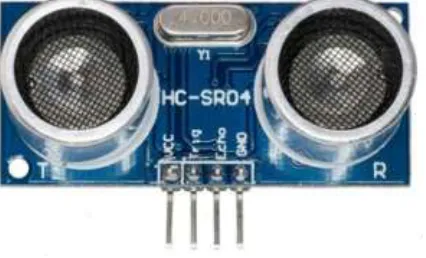
Fig No. 1a Ultrasonic Sensor
It has 4 pins: GND, VCC, Trigger and Echo. Trigger and Echo are connected to the ESP8266 GPIO pins 12 and 13 respectively.
Fig No.1b obstacle detection using ultrasonic sensor
1.1 Problem Statement
To develop the robot which is able to put off the fire and also avoid obstacle which replaces the human effort to a great extent.
Fig No. 1c Flame Sensor
2 LITERATURE SURVEY
In olden days, there is no automatic extinguishing of fire. The fire brigade should be called to the fire prone area which is operated by human whose lives are at greater risk. It takes time to arrive at the fire place and mostly water is used to put off fire. Later with the evolution of technology, fire extinguishers came into existence which is filled with CO2 limitedly. In recent years around 2016, manually controlled fire extinguishing robot came
into existence which is followed by pre trained robot for particular environment like smart homes fire detection and avoidance. It also send alert to the user through Bluetooth which is capable for communication over some metres. The proposed robot uses iot for streaming live pictures of the fire prone area and puts off all types of fire by fitting it with the corresponding fire extinguishing substances depending on the fire prone area.
[1] A fire extinguisher robot was assembled with the intention to extinguish the fire by using a water pump as actuators. The robot movement was controlled using Android smart phones via Wifi networks utilizing Wifi module contained in the robot. User commands were sent to the microcontroller on the robot and then translated into robotic movement. The robot was equipped with cameras and ultrasonic sensors. The camera played role in giving feedback to user and in finding the source of fire. Feedback provided by camera on the robot displayed on a screen of smart phone.
[2] The main requirement of this project is to create a robot that is fully autonomous. This means that once the robot is started by the user, it navigates, searches for, and extinguishes the fire on its own, with no assistance or input from the user. The designed robot indicates the fire through alarm. It is preprogrammed with the environment. The robot can only be used in a pre trained area like home, and not for general purpose
[3] A robot with multiple modes of operation has been developed. The first mode of operation is designed to control the movement wirelessly using a Bluetooth module interfaced with arduino Uno, paired with a smart phone application. The second mode of operation is done by interfacing IR sensors with arduino for obstacle detection and temperature sensing using temperature sensing LM35 IC. A water pump is used as an extinguishing mechanism in both modes of operation. This robot is an effort to facilitate the operation of the fire brigade, by performing the operation of the fire brigade operator. The main disadvantage is using Bluetooth for communication which is restricted to a maximum of 400 metres.
robot is loaded with a water tanker and a pump controlled through wireless communication to sprinkle water. For the desired operation, an PIC microcontroller is used. At the transmitter end, push buttons are used to send commands to the receiver end to control the robotic movement, either in forward, backward, right or left direction. The remote control that has the benefit of adequate range up to 100 meters with apposite antenna, while the decoder decode before feeding it to another microcontroller to drive DC motors via motor driver IC for necessary work.
[5] The obstacle detection is primary requirement of this autonomous robot. The robot gets the
information from surrounding area through
mounted sensors on the robot. Some sensing devices used for obstacle detection like bump sensor, infrared sensor, ultrasonic sensor etc. Ultrasonic sensor is most suitable for obstacle detection and it is of low cost and has high ranging capability. Whenever the robot is going on the desired path the ultrasonic sensor transmits the ultrasonic waves continuously from its sensor head. Whenever an obstacle comes ahead of it the ultrasonic waves are reflected back from an object
and that information is passed to the
microcontroller. The microcontroller controls the motors left, right, back, front, based on ultrasonic signals. In order to control the speed of each motor pulse width modulation is used (PWM)
.
3 SYSTEM ARCHITECTURE
A system’s architecture can provide a plan from which products can be procured, and systems developed, that will work together to implement the overall system.
The robot sends alert message when obstacle or fire is detected to the remote user through email who can then control the robot through the web page.
The overall system design consists of following major modules:
(a) Hardware (b) Web page
(c) Mobile Device/ PC
4 EVALUATION OF SYSTEM
SYSTEM DESCRIPTION
The proposed robot works in two modes, automatic and manual. In automatic mode, the robot search for the presence of possible flames and obstacles in the vicinity. The robot moves around and search for the signs of flame. The robot will search for flames using the three flame sensors placed in front of the robot. The robot has fire sensors interfaced in its control circuitry which senses the presence and intensity of fire and take the responsive action accordingly. One only needs to deploy the robot in a fire prone zone and the robot will automatically initiate action once it detects a fire breakout. The control circuitry of the robot is built on Raspberry pi. When the obstacle is heading, the user will be prompted with an email alert. The user can then
Receiver
IP address
Monitor/ mobile WEB PAGE
Wifi / hotspot
Raspberry Pi Flame sensor
Ultrasonic sensor
camera
Wifi/h otspot
SD card
control the robot movement through the web page based on the live streaming of the fire place through the ip camera fixed in front of the robot which becomes the manual operation. Once the fire is detected, it is put off by using the water sprinkler attached with the robot.
4.1 Advantages
Completely replaces the human effort of putting of the fire. Enables live streaming of the fire place to the remote user. Sends an email alert once the obstacle is detected. Operates well in both manual and automatic mode.
4.2 Disadvantages
The seamless working of the robot largely depends upon the network signal quality when operated manually through web page. Calibration of the ultrasonic sensors can be a deployment time overhead. Also the system is expensive to scale up.
4.3 Applications
The robot can be used in any environment where humans cannot go and put off the fire.
Also the live updates about the fire place is streamed to the user continuously.
5 CONCLUSION
Thus the robot is built to exterminate the fire in the fire prone areas using flame sensor and live streaming of the place is updated to the user through web page by using the web cam attached in front of the robot. The robot also detects the obstacle in the vicinity using ultrasonic sensor and sends alert mail to the user if any obstacle is found. The user can also control the robot through the web page and once the fire is detected, the water sprinkle is activated and the fire is exterminated. The proposed robot is tested for various environment to test the performance of the robot and the user also gets the streaming updates as mentioned above through IoT web page.
6 FUTURE ENHANCEMENTS
7 REFERENCES
[1]J. Casper and R. Murphy, “Human-robot interaction during the robotassisted urban search and rescue effort at the world trade center,” IEEE Transactions on Systems, Man and Cybernetics Part B, vol. 33, no. 3, pp. 367–385, 2003.
[2]M. Micire, “Analysis of robotic platforms used at the world trade center disaster,” Ph.D. dissertation, MS thesis, Department of Computer Science and Engineering, University of South Florida, 2002.
[3]C. Breazeal, Designing Sociable Robots. The MIT Press, Cambridge, MA, 2002.
[4]Wireless communication technologies: new multimedia systems By Norihiko Morinaga.
[5]https://www.researchgate.net/publication/241635 505_Automatic_fire_extinguisher_robot
[6]http://www.arresearchpublication.com/images/sh ortpdf/1484974622_K1067ijeee.pdf
[7]http://www.ijirset.com/upload/2016/january/129 _set_JAN%202016.pdf
[8]https://ieeexplore.ieee.org/document/7905275