2019 volume 36(2)
Review Board 2019 Amanda Alexander University of Texas, Arlington Dan Barney
Brigham Young University Terry Barrett
University of North Texas Cala Coats
Arizona State University Tyler Denmead
University of Illinois, Urbana-Champaign Michelle Bae Dimitriadis
Buffalo State College Laura Hetrick
University of Illinois, Urbana-Champaign Lisa Hochtritt
Chicago Art Institute Ami Kantawala
Teachers College, Columbia University J. Celeste Kee
Boston University Dana Kletchka The Ohio State University Pamela Lawton
Virginia Commonwealth University
Maria Lim
University of North Carolina, Greensboro
Jorge Lucero
University of Ilinois, Urbana-Champaign
Mindi Rhoades The Ohio State University James Sanders III The Ohio State University Stacy Salazar MICA Shari Savage The Ohio State University Manisha Sharma University of Arizona Kryssi Staikidis Northern Illinois University Laura Trafí-Prats
University of Wisconsin, Milwaukee Sarah Travis
University of Illinois, Urbana-Champaign Courtnie Wolfgang
Virginia Commonwealth University Lori Santos (Invited Reviewer) Wichita State University Senior Editors
Joni Acuff, The Ohio State University Associate Editors
Amanda Alexander University of Texas, Arlington Cala Coats
Arizona State University
Editorial Assistant Sharbreon Plummer The Ohio State University USSEA President Fatih Benzer
Missouri State University Past Editors
Karen Hutzel, The Ohio State University Ryan Shin, University of Arizona
Publication:
Once a year by the United States Society for Education through Art (USSEA). Subscriptions:
jCRAE is an open-source online publication of USSEA. While access is free, readers and people interested in supporting the mission and activities of the journal and of USSEA are encouraged to join USSEA (for more information about the organization, please visit www.ussea.netU). Annual membership dues are $25 and include issues of the Newsletter. Check or money orders should be made payable to USSEA and sent to:
Nanyoung Kim Jenkins Fine Art Center East Carolina University Greenville, NC 27858 [email protected] Editorial Office: Joni Acuff, Senior Editor Associate Professor and
Department of Arts Administration, Education and Policy
1813 N High St, 2nd floor Columbus, OH 43210 [email protected]
Copyright:
United States Society for Education through Art, 2011-2014. All rights reserved.
Permission:
Individual must request permission from the editor to reproduce more than 500 words of journal material.
Cover:
Diane Kuthy and Olivia Robinson,Swaddled as seen in their creative submission on page 66 of this issue.
Layout:
jCRAE
2019 Volume 36(2)Journal of
Cultural Research
in Art Education
The Journal of Cultural Research in Art Education is published through generous support from United States Society for Education through Art
(USSEA), The Ohio State Univerisy, and The University of Arizona.
USSEA was founded in 1977 to promote multicultural and cross-cultural research in art education. It is an independent organization affiliated with the International Society for Education through Art (InSEA) and the
National Art Education Association (NAEA).
Past
Editors
jCRAE
Volumes 1-4
Volumes 5-8
Volumes 9-12
Volume 13
Volumes 14-18
Volumes 19-22
Volumes 23-25
Volumes 26, 27
Volumes 28, 29
Volumes 30-32
Volumes 33-35
Larry Kantner 1982-1986
University of Missouri
Rogena Degge 1986-1990
University of Oregon
Volume 6 Guest Editors: Paul Bolin, Doug Blandy, & Kristin Congdon
Ronald W. Neperud 1990-1994
Douglas Marschalek
University of Wisconsin-Madison
Ronald W. Neperud 1994-1995
Don H. Krug
University of Wisconsin-Madison
Don H. Krug 1995-1999
The Ohio State University Volume 18 Guest Editor: Patricia L. Stuhr
Tom Anderson 2000-2004
Florida State University
Enid Zimmerman 2004-2007
Indiana University
Kristin G. Congdon 2008-2009
University of Central Florida
Dipti Desai 2010-2012
New York University
Elizabeth Garber 2012-2015
New York University
Karen Hutzel 2016-2018
The Ohio State University
Ryan Shin
7
10
28
48
66
78
103
108
jCRAE
2019 Volume 36
Contents
Editorial - Whiteness and Art Education
Joni Acuff
Whiteness Is Melanie L. Buffington
Reclaiming the Archives: White Supremacy and Testimonials of Resistance in an Art & Design College
Beth Balliro Lyssa Palu-ay
Becoming a Woman of Color Adriane Pereira
Swaddled Diane Kuthy Olivia Robinson
Rising Above Pain: An Autoethnographic Study on Teaching Social Justice as a Female Teacher of Color
Injeong Yoon
Coloring in the Space Dionne Custer Edwards
Editorial: Whiteness and Art Education
Joni Boyd Acuff, Ph.D.The Ohio State University
Whiteness is a complex, hegemonic, and dynamic set of mainstream socio-economic processes, and ways of thinking, feeling, believing, and acting (cultural scripts) that function to obscure the power, privilege, and practices of the dominant social elite. Whiteness drives oppressive individual, group, and corporate practices that adversely impact schools, the wider society and indeed societies worldwide. Lea & Sims, 2008, p.2
In 2015, White art educator, researcher, scholar, Dr. Sunny Spillane wrote a pointed and candid article, titled “The failure of whiteness in art education: A personal narrative informed by
The jCRAE “Whiteness and Art Education” mini-theme aims to do some of the work that Spillane (2017) refers to, especially the task of identifying whiteness as the lynchpin of systems of racial meaning, and moreover, of racial oppression within art education. Issue 2 of Volume 36, as did Issue 1, brings together conscious voices that ask new questions, make critical considerations and promote anti-racist teaching strategies that decenter and destabilize whiteness within the art education field. From classroom resources to classroom language, arts archives to research strategies, the authors in this issue identify the ways “white hegemony functions to obscure the power and privilege and practices of the dominant social elite and reproduce inequities and inequalities within [art] education and wider society” (Lea & Sims, 2008, back cover). The authors offer strategies for developing the critical consciousness and anti-racist practices that Spillane (2015) vulnerably shares that she failed at, and thus advocates for.
Melanie Buffington opens Volume 36, Issue 2 by taking stock of
the sites where whiteness lives in art education. In her research, Buffington points out that whiteness circulates the art education field through materials like specific pieces of quintessential literature that the field has named significant, and in everyday teaching resources like artist posters used to introduce young children to visual artists. Essentially, Buffington works to unmask the pervasiveness of whiteness so that efforts can be made to disrupt the structural racism that lives within art education. Then, Beth Balliro and Lyssa
Palu-ay use Critical Race Theory to make sense of the wPalu-ays that archived
American art and design education history aid in the perpetuation of white supremacy in contemporary college art classrooms. Using research completed at the Massachusetts College of Art and Design (MassArt), the co-authors identify the counternarratives of students, faculty and staff of color as a methodology of resistance, culture change, and archival reclamation.
In an engaging personal narrative, Adriane Pereira analyzes her lived experiences surrounding “becoming” a woman of color. Describing the shift from self-identifying as a White Hispanic woman to being categorized by a catch-all term, “woman of color,” Pereira examines the complexity and fluidity of the social construct of race. Using Anzaldua’s Borderlands theory and Delueze and Guattari’s theorizing on “becoming,” Pereira ultimately completes a critical examination of the ways her “becoming” a woman of color consequently drives her artist and art education identity. Next, Diane Kuthy and Olivia
Robinson offer a creative work that brings to light the visual culture
Injeong Yoon uses autoethnography to examine the ways whiteness
has impacted her self-actualization as a Korean woman, immigrant, and as an art educator of color in the classroom. Laying out her positionality with frankness and vulnerability, Yoon’s research is pivotal in revealing the ways whiteness can be internalized by people of color, but also the ways it can be destabilized through intentional critical self reflexivity, which consequently impacts her work as an art educator. Yoon takes readers on her journey of resilience and survival as an academic in a predominantly white field. Then, Dionne
Custer presents a creative prose that questions the way children
of color are nurtured to develop, or in this case leave behind, an artist identity. This contribution reveals the significant power of art educators’ words and actions, thus making readers (art educators) question how seriously they take their responsibility to teach and encourage all children inside and outside of the classroom. Issue 2 of “Whiteness and Art Education” wraps with Tyler Denmead’s work, “White Warnings.” In his paper, Denmead identifies the ways reflexivity in research can end up re-centering and reinvesting in whiteness, creating a double bind. Denmead’s work also takes to task the “Creative Cities” discourse, particularly the way whiteness is unmarked in the concept of “the creative.”
Volume 36 of jCRAE forefronts a discussion about what happens to whiteness once it has been made visible to white people. What happens to whiteness when its normality has been interrupted? (Bell, 2017). The authors share personal reflections, paths of
exploration, and even actionable items that may be able to assist the art education field in establishing a new way to talk about race and engage in transformative practices that calls out and challenges the pervasiveness of whiteness in art education.
References
Bell, M. (2017). Whiteness interrupted: Examining the impact of racialized space on White racial identity. (Doctoral Dissertation). Retrieved from https:/surface.syr.edu/etd/769/
Lea, V., & Sims, E. J. (2008). Undoing Whiteness in the Classroom: Critical educultural teaching approaching for social justice activism. New York, NY: Peter Lang.
Spillane, S. (2015). The failure of whiteness in art education: A
personal narrative informed by Critical Race Theory. Journal of Social Theory in Art Education, 35, 57-68.
Whiteness is
Melanie L. Buffington, Ph.D. Virginia Commonwealth University
ABSTRACT
This paper addresses how Whiteness circulates in various forms in the past, present, and future of art education. Through a literature review, document analysis and narrative interpretation, I show myriad ways that Whiteness circulates in art education in an usually unchecked fashion. This unexamined centering of Whiteness harms all of our students, particularly pre-service teachers who will enter diverse settings without a deep and nuanced understanding of race. Through adopting some principles of critical race methodology and augmenting the existing resources in art education, we may be able to start breaking down the specific systems of structural racism within Art Education.
Keywords: Whiteness, anti-racism, teacher education, Critical Race Theory, racism in education
Whiteness1 Is a Force in Art Education
Whiteness is and has been a powerful force in education, especially within art education. In art education, the racial and gender
images of her story quilts including Tar Beach became staples in many art classrooms and countless friends and colleagues, myself included, engaged children in thinking about their dreams. In my experience, I have never seen a lesson plan from a student and have never seen a poster in a classroom featuring one of her works that more overtly addresses race. This contrasts with the frequency that I read lesson plans from students or see posters on walls during classroom observations that feature her works that more subtly attend to race. When we consider Whiteness as a construct throughout the art world and the realm of education, we may see how and why forms of oppression exist and are ignored by many who hold power and privilege (Desai, 2010; Knight, 2006; Kraehe, 2015; Mansfield, 2015) . The United States Department of Education (2016) released a report on teacher diversity finding that during the 2011-2012 school year, 82% of teachers were White, 80% of principals were White, and 75% of college students enrolled in education majors were White. This significant prevalence of Whiteness in these arenas starkly contrasts with the increasing diversity of students in public schools in the US with 43% of high school graduates in 2011-2012 being students of color and predictions that, by 2024, 56% of public school students will be students of color (US Department of Education, 2016). For the purpose of this paper, I rely on the following definition of Whiteness as,
the overt and subliminal socialization processes and practices, power structures, laws, privileges, and life experiences that favor the White racial group over all others….Yet, society socializes everyone to adhere to the Whiteness rules simply because one exists in environments where Whiteness dominates. (Helms, 2017, p. 718)
As a field dominated by White teachers and White faculty members, it is long overdue that the field of art education undergo a significant reflection about how Whiteness operates throughout all aspects of our discipline.
of the artist. When thinking through the future of the field and about how Whiteness may continue to circulate through the actions, values, and beliefs of pre-service teachers, I utilize some narratives from my own teaching and share the ideas and perspectives of students. The paper concludes with some ideas and strategies for art educators to work together to create a more hopeful future for our field, focusing on who needs to do the work of deconstructing Whiteness and how to begin.
Additionally, it is important to situate myself within the landscape of Whiteness in Art Education. I am a White straight cis female art educator who has always attended and taught among majority White student and teacher populations (with a six month exception in my elementary school years). The one common factor among my schooling experiences is that Whiteness and race were taboo topics until I was in graduate school. Through taking classes with students from diverse racial and cultural backgrounds and faculty who acknowledged race, I learned ways to broach these important topics with my own students. Over the last several years, I have made an increasing effort to make my classroom environment, reading list, and pedagogical practices more culturally sustaining. Now that I am in higher education, it is common for me to only see White faces at “important” meetings or to have a small number of people of color present. It is also common at higher level meetings to have majority White men and few women or non-binary people of any race at the table. These meetings serve to remind me that this problem is widespread, though it may be particularly pronounced in art education.
Contemporary Whiteness Literature in Art Education
White & Congdon, 1998), among others. Within the Journal of Social
Theory in Art Education (JSTAE), there were 179 hits with the search term “Whiteness.” As I reviewed the more recent articles from Art Education and JSTAE, two main themes emerged: the need to change art education curriculum practices to acknowledge the power of Whiteness in our field and personal narratives of Whiteness that related to authors acknowledging how their race and racial privilege limited what they could see and understand.
The need for change to address Whiteness
As I reviewed the articles that fit within this category, two stood out because of the depth with which they engaged the topic. These articles, E(Raced) Bodies in and out of Sight/Cite/Site by Wanda Knight (2006) from JSTAE and The Challenge of New Colorblind Racism in Art Education by Dipti Desai (2010) from Art Education
emphasized and clearly articulated the imperative within the field to challenge the dominance and power of Whiteness. Both Knight (2006) and Desai (2010) pointed out that the way that Whiteness has been ignored by predominantly White art educators and pre-service educators throughout the field is one of the reasons that it has maintained its power. Knight (2006) noted “...Whiteness is perhaps the foremost unmarked and thus unexamined category in art education…. Moreover, when Whiteness goes unexamined, racial privilege associated with Whiteness goes unacknowledged” (p. 323). She makes the point that this unexamined approach to Whiteness plays out through the gaze of White teachers on their students and how they may or may not actually see their students, thus reducing the teachers’ abilities to meet the needs of the students. Knight also discusses the prevalent and problematic approach of many teachers who claim to be “colorblind.” In explaining the significant harm that emanates from this position, Knight states, “...a colorblind viewpoint enables White teachers to erase from consciousness the history of racism” (p. 326). As Knight notes, this is particularly harmful when teachers are not aware of or not willing to acknowledge the racist underpinnings of contemporary education practice and policies. Desai (2010) further articulates points about the notion of
elements of visual culture lead some people to believe that racism is an individual issue, not a systemic one.
Both Knight (2006) and Desai (2010) noted how their White students struggle with anti-racist educational practices because they believed that they, personally, are not racist. Further, Desai described a scenario that often occurs between her White students and the students of color in her class in which the White students become annoyed if their positions around colorblindness are challenged, thus indicating the need for more of these types of discussions in pre-service teaching classes.
Personal narratives of Whiteness
While numerous authors addressed how their awareness of their Whiteness brought about an increased understanding of different situations (Kirker, 2017; Slivka, 2015; Spillane, 2015), the article by Sunny Spillane clearly articulated this by using critical race theory as it aligns with art education settings. She notes how, as a White teacher in a predominantly African American school, she assumed that her experience would be analogous to the experiences a Black person might have in a predominantly White space. However, Spillane (2015) goes on to question that assumption and noted that the situations are not analogous because, “whiteness is not just another racial category; it is the axis around which other races are constructed in hierarchical relations of power and both material and psychological privilege” (p. 59). Spillane also acknowledged how the district’s new teacher mentoring program brought her into contact with more experienced teachers who attributed her struggles to deficits in the students of color rather than in her teaching. These White teachers had previously taught in schools with more students of color and transferred to “better” schools with fewer students of color. As Spillane grappled with the implications of these various experiences, she learned about critical race theory (Crenshaw, 1995) and deficit thinking (Bastos, Cosier, & Hutzel, 2012; Valencia, 2010). Her changes in thinking took time and also significantly affected her practice as an art teacher and later as an art teacher educator. Citing the work of Amelia Kraehe (2015), Spillane (2015) noted how the continued centering of Whiteness acknowledges the experiences of the majority of pre-service art teachers, and simultaneously disregards the needs of students of color. This ongoing system of oppression in art teacher education “further entrenches white art teacher identity as normative” (p. 64), rather than constructed.
highlighted nearly as often. The most prominent text on the history of art education, A History of Art Education, by Arthur Efland was
published in 1990. Throughout this text there are chapter titles including “Western Origins of Art Education” (p. v) and headings including “European Origins of Common School Pedagogy” (p. v). Though some female art educators are mentioned throughout the book and there is a three-page section devoted to “Art in the Education of Women in Nineteenth-Century America,” there is not significant attention in this book paid to women or educators of color. Toward the end of the book there is a section on more contemporary developments that includes discussion of Discipline-Based Art Education, Critical Theory, the use of a wider range of media including technological media, the National Art Education Association, and research in art education. Efland addresses each of these topics in more depth than the role of race or gender. In one paragraph, Efland acknowledges the social and political movements that shaped education. He states:
The Civil Rights movements generated a demand for the art forms of ethnic minorities, including the study of living African-American and Native American artists, while the feminist movements generated an interest in the work of women artists. These movements also led to scholarly study that brought to light minority and women artists whose work had previously been neglected. (Efland, 1990, p. 158)
This segment of the book is the most in-depth discussion of these topics. It is interesting to note the contrast between the emphasis placed on the European origins of art education practice and the paucity of detail that relates to any practices or ideas that may have come from other cultural backgrounds. Other than the mention of people of color on page 158, the Efland text does not actively question the idea of Whiteness or the representation of people of color. The Civil Rights Movement is not discussed in detail, the role of segregation and desegregation in informing art education practices or curriculum is not mentioned, the multicultural movement is not mentioned, and issues related to representation of people of color are completely absent from this text.
Narratives of Whiteness
represented there. Over time, there certainly have been efforts by art education scholars to rectify this situation including Paul Bolin, Doug Blandy, and Kristin Congdon’s (2000) Making Invisible Histories
of Art Education Visible, Mary Ann Stankiewicz’s (2001) Roots of Art Education Practice, and a recently published book edited by Paul Bolin and Ami Kantawala (2017) entitled Revitalizing History: Recognizing the Struggles, Lives, and Achievements of African American and Women Art Educators. These books are all well-researched accounts of the
contributions of multiple art educators, highlighting the work of women and art educators of color. Whereas Efland’s (1990) book is a cohesive and comprehensive history of White art education and its European origins, none of these other books present as cohesive a history. Though they are not exhaustive in scope they do present important counter narratives related to individual educators and particular projects.
Solórzano and Yosso (2002) explained the importance of counter narratives from a critical race theory perspective related to
educational research. They noted how counter narratives that center the experiences of people of color tell different stories than the “objective” research of White educators. Thus, the inclusion of these counter narratives in histories of art education might be a means to change the marginalization and sidelining of art educators of color. Further, Solórzano and Yosso proposed a methodology, critical race methodology, that centers race in all aspects of the research process. If art educators utilized this methodology, the historical research they conduct would likely be quite different. For instance, in the case of Efland’s work, researchers might start to ask questions about why documents related to White art educators and students were preserved, but why there is so little archival documentation of teachers and students of color. Further, additional data collection techniques, including oral histories, might be utilized rather than a significant reliance on archival documents. Researchers working from a critical race theory perspective value the experiential knowledge of people of color and recognize how it helps understand and teach about the subordination of people of color. Further, they may regard these types of knowledge as a strength that helps to understand experiences of people of color in more nuanced ways than documents that may be deficit-based or built around an understanding of
Whiteness as a benchmark (Solórzano & Yosso, 2002).
these do not create a comprehensive history in the same way that the Efland text does. Further, as this information is published in separate journals or books, it is easy for a person to come across one of these sources, but not nearly as easy to come across all of these sources. Creating a more inclusive history of the field would be a significant undertaking, but one that is of paramount importance. We cannot simply hope that our students come across counter narratives in a piecemeal fashion. This is one area where the National Art Education Association (NAEA) could take a leadership role and work with experts in the field to curate an inclusive text that could be used alongside Efland’s book to promote a deeper understanding and more inclusive view of the role of people of color throughout the history of art education.
Whiteness is Reified Within the Present of Art Education
Through Commercially Available Classroom Resources To better understand the prevalence of Whiteness in current-day art education practices, I chose to review commercial posters available through one of the larger art education supply sources - Dick Blick. Assessing these posters gave a snapshot of resources likely used throughout the United States, and potentially beyond. For many years, art educators have investigated spaces of learning including textbooks, classroom arrangement, and classroom decoration. For instance, Susi (2002) discussed classroom arrangement in the context of behavior management; Kushins and Brisman (2005) noted how the physical surroundings of classrooms and schools affect learning and learners; Efland (1990), drew from Stankiewicz’s (1984) work related to reproductions of artworks in school classrooms; and Grant and Kee (2013) researched omissions and incorrect information presented in Art History survey textbooks regarding African American artists of the Harlem Renaissance, among many others.
Working with an art education graduate student, Kate Duffy, we conducted a content analysis of the race and gender of the artists represented in all of the commercially available posters through Dick Blick’s website. After we identified all of the posters that featured images of art works and the names of the individual artists, we calculated how many of these posters featured artists of various races and genders. We found that of the 3032 posters that feature a named
None of the sets that we reviewed contained more than one image by a person of color, with the exception of the set from Dick Blick that was specifically about African American artists.
Simultaneously, issues of complete omission are significant here with the complete absence of Native and Asian women artists from these commercially available sets.
After spending some time with the data, we noted multiple ways that diversity was silenced. After separating out the individual artists from the posters, we found that many of the commercially available images represent the same artists multiple times. Among these resources, the artists featured four or more times are: Mary Cassatt (5), Jacob Lawrence (5), Henri Matisse (5), Pablo Picasso (5), Edward Hopper (4), Frida Kahlo (4), Wassily Kandinsky (4), Roy Lichtenstein (4), Rene Magritte (4), Wayne Thiebaud (4), Henri de
11 of the 13 artists are male and the only female artist of color is Frida Kahlo. Thinking about intersectionality and the complete absence of Black and Asian women as well as the exclusion of all Native people presents a troubling scenario that shows how Whiteness continues to be prevalent and significantly reified in the contemporary resources available to art educators.
every day; those lessons reinforce that not all children have equal opportunity in the visual arts.
Another way that NAEA could influence the current situation of Art Education is to develop and distribute poster sets for classrooms that do not replicate these inequities. If there were sets commercially available that promoted artists of color, a wider variety of our students would be able to see themselves represented in the physical environments of their classrooms. Further, district curriculum supervisors might ask art educators to conduct an audit of their classroom to see whose art is featured and how the featured images break down along the lines of race and gender. Art museums often offer a range of educational programs that could similarly be audited by internal staff to better understand the ideas and artists they are promoting through their tours and educational opportunities. Engaging arts educators in various settings in content analysis audits of their resources and curriculum may help well-meaning White educators see inequities that they might not otherwise notice. This relates to the idea from critical race methodology that dominant ideologies should be challenged (Solórzano & Yosso, 2002) because they are embedded with the power and privilege of the dominant group. In this case, the work of certain artists (White ones) as
“masters” and other artists as “not masters” is on display throughout classrooms, museums, and other art settings. Therefore, educators need to challenge their own previous education and think about the dominant ideologies that they learned themselves. This may lead to more art educators pushing back at the “neutral” tropes of art history that omit the work of artists of color while reifying the work of European and White American male artists.
Whiteness is Strong within the Future of Art Education Through my role as a faculty member at a large university in the Southeastern United States, I interact daily with pre-service teachers. Based upon their comments in class, their reactions to readings, and the lessons they create, I know that Whiteness is going to be a factor well into the future in art education. Through the following narratives based on classroom experiences, I highlight several areas that are particularly problematic as they relate to understandings of race, empathy for the plight of White people, and classroom interactions. Understandings of Race
teacher looked White, and thus, would not have ever experienced racial discrimination. The lack of knowledge, both historical and contemporary, on the part of the university student about a variety of issues including the one drop rule, issues of passing, and generational trauma related to race is troubling. Also, the student’s belief that her perception of the teacher’s race was more important than the teacher’s self-identification demonstrates a lack of understanding about how race operates. Further, other students have criticized James Banks (2008) and other authors for openly discussing race with students stating that, “Talking about race is racist.” These issues are compounded by the fact that many of the classes I teach are 100% White or there may be one or two students of color present. It is rare for me to have three or more students of color in an average class of approximately 15-18 preservice students. This is particularly troubling at a large university with a racially diverse student population. For many reasons, students of color are not entering the art education major and this perpetuation of pre-service classes in art education being virtually always White spaces does not do enough to expand students’ understandings of race. It is unlikely that White spaces with White students and White professors can be enough to help pre-service teachers understand the history and harm of racism. Through dialogue and discussions across racial, ethnic, gender, etc., groups White students can come to learn more and develop deeper understandings3.
Empathy for the Plight of White People
In numerous ways, students chose to focus their empathy on the actions of other White people and those who do not intend to do harm. Interestingly, this focus on the intent, rather than the impact continues to direct empathy towards those in power and away from those who are harmed by racism. After visiting an exhibit with a group of students, we noted how some of the images featured stereotypical images of people of color. When I raised this issue with students, they made excuses for the use of this racist, stereotypical imagery, focusing on their perception of the kind intent of the creator rather than the impact these images would have on others. In another instance, a student shared how he had a high school teacher who called out students, in a joking fashion, when they committed a micro-aggression against another student. One of the White students in my class mentioned how it would upset her if she were called out, even in a subtle or playful way. Ignoring the hurt that your words can cause and focusing on one’s own discomfort rather than the pain caused to the other prolongs the effects of Whiteness in classrooms.
The fact that numerous pre-service teachers tend to focus on
themselves and their intentions rather than the impact of words and images on others is a sign that we need to do more to help better prepare our students for their own classrooms. Further, because many White students in my classes perceive racism to be an individual problem, rather than a systemic problem, they do not see the need for significant structural change.
Classroom Interactions
We live in an era when discussions of safe and brave classroom spaces are common. However, the ways that students perform within the classroom consistently reinforce dominant practices that privilege Whiteness and its trappings, even within these teacher-defined safe or brave spaces. For instance, a Latinx student shared with me that a White student did not know how to pronounce her last name. Instead of asking or only using her first name, the White student made a few incorrect attempts and then ended by saying, “Whatever” in front of the whole class. The lack of recognition by the one student about how her classroom interaction and lack of effort to pronounce her classmate’s name correctly is one example of how Whiteness circulates freely in classroom spaces (Kohli & Solórzano, 2012). The Latinx student later shared with me how this was just one of countless microaggressions that made it difficult for her to be as successful in class as her White peers.
I posit that we need to work toward spaces that are more than just brave, but are overtly anti-racist spaces. Instead of having students leave a classroom knowing their classmates do not value or acknowledge their race and/or culture, we need to work toward unpacking Whiteness. The idea of involving student voice in creating parameters for classroom discussions and interactions is one way to begin deconstructing Whiteness as a force in classrooms. Helms (2017) believes that, “Whiteness is so powerful that White people can determine when and under what conditions racism exists, as well as when it is necessary to supersede race and racism with multiculturalism or diversity” (p. 718).
Whiteness is Constructed and Must be Deconstructed to
Create a Different Future for Art Education
teachers (Knight, 2015), but it cannot be the only place and this type of work should be ongoing throughout a career. Helping preservice teachers understand more about the construct of Whiteness and how it infiltrates all aspects of society in the United States may facilitate change in more art classrooms, pre-K through college. The majority of art teachers in schools are White and the majority of faculty members teaching preservice art teachers are White as well. This will require White art teacher educators, White museum educators, White curriculum supervisors, among others to spend time deconstructing their own practices; finding, owning, and changing aspects that reify Whiteness; and will also require rethinking ideas about recruiting and retaining more diverse future teachers. As White teacher educators begin this process, I suggest that White people need to listen. When a person of color shares a story of oppression, White people need to refrain from sharing their own stories of perceived oppressions or problems and not offer suggestions. Instead, they should listen and learn.
Rather than rushing to speak, it is helpful for White teacher educators to wait for the person to finish and then thank the person for
opening up and sharing a story. White educators need to take time to consider this situation and think about it over and over again while considering how Whiteness functions to give privilege and operates in education. It is helpful to examine curricular choices and assignments while searching for instances of deficit-based thinking and assignments that encourage such thinking in students. Teachers can change those assignments, they can acknowledge race in the classroom, and they can intentionally select articles and books by scholars of color and point out that they are people of color. White museum educators can ensure that they have multiple tours that include significant numbers of works by artists of color, they can plan docent trainings to feature pieces by artists of color, and they can invite particular schools to tour the museum. White curriculum supervisors could create in-service sessions that assist art teachers in understanding the role of people of color in the contemporary art world in the US, they could review local and state curriculum to assess the proportion of artists who are people of color, they could overtly address the systemic oppression that has kept and continues to keep many people of color from pursuing careers in the arts, they could intentionally bring in speakers who are artists of color who address racial oppression through their work, among many other options.
to continue to promote Whiteness in education or to deconstruct and decenter Whiteness while working toward a more equitable future. Teaching as you were taught and as you have always taught is a vote for the former. I strive to do the latter.
References
Acuff, J. B., Hirak, B., & Nangah, M. (2012). Dismantling a master narrative: Using culturally responsive pedagogy to teach the history of art education. Art Education, 65(5), 6-10.
Bastos, F. M. C, Cosier, K., & Hutzel, K. (2012). Introduction. In K. Hutzel, F. M. C. Bastos, & K. Cosier (Eds.), Transforming city
schools through art: Approaches to meaningful K-12 learning (pp. 1-9). New York, NY: Teachers College Press.
Bey, S. (2012). Aaron Douglas and Hale Woodruff: African American art education, gallery work, and expanded pedagogy. Studies
in Art Education, 52(2), 112-126.
Bey, S. (2017). Augusta Savage: Sacrifice, social responsibility, and early African American art education. Studies in Art Education, 58(2), 125-140.
Blair, L., & Shalmon, M. (2005). Cosmetic surgery and the cultural construction of beauty. Art Education, 58(3), 14-18.
Bolin, P. E., & Kantawala, A. (Eds.). (2017). Revitalizing history:
Recognizing the struggles, lives, and achievements of African American and women art educators. Vernon Press: Wilmington, DE.
Carpenter, B. S. (2018). In the shadow of change. Studies in Art
Education, 59(3), 181-184.
Crenshaw, K. W. (1995). Mapping the margins: Intersectionality, identity politics, and violence against women of color. In K. Crenshaw, N. Gotanda, G. Peller, and K. Thomas (Eds.), Critical race theory: The key writings that formed the movement, (pp. 357-383). New York, NY: The New Press.
Desai, D. (2010). The challenge of new colorblind racism in art education. Art Education, 63(5), 22-28.
Efland, A. D. (1990). A history of art education: Intellectual and social
currents in teaching the visual arts. Teachers College Press: New York, NY.
Grant, A. W., & Kee, J. B. (2013). Black artists of the Harlem Renaissance in western survey textbooks: Narratives of omission and representation. Visual Inquiry, 2(3), 233-246. Gude, O. (2000). Drawing color lines. Art Education, 53(1), 44-50. Helms, J. E. (2017). The challenge of making Whiteness visible:
Reactions to four Whiteness articles. The Counseling Psychologist, 45(5), 717-726.
Holt, A. (2017). Mary E. Godfrey (1913-2007): Penn State’s first African American full-time faculty member. Studies in Art Education, 58(3), 234-245.
the movement of culture(s): Explanations for the folk/fine art quandary. Art Education, 51(3), 20-24+41-42.
Keifer-Boyd, K., Amburgy, P., & Knight, W. (2007). Unpacking privilege: Memory, culture, gender, race and power in visual culture. Art Education, 60(3), 19-24.
Kirker, J. (2017). Professional friction: Racialized discourse and the practice of teaching art. Journal of Social Theory in Art Education, 37, 80-93.
Knight, W. B. (2015). Culturally responsive teaching in art education.
International Journal of Arts Education, 13(1), 70-89 (English) & 90-105 (Chinese).
Kohli, R. & Solórzano, D. G. (2012). Teachers, please learn our names!: racial microaggressions and the K-12 classroom. Race Ethnicity and Education, 15(4), 441-462.
Kraehe, A.M. (2015). Sounds of silence: Race and emergent counter narratives of art teacher identity. Studies in Art Education, 56(3), 199- 213.
Kushins, J., & Brisman, A. (2005). Learning from our learning spaces: A portrait of 695 Park Avenue. Art Education, 58(1), 33-40. Lee, N. (2012). Culturally responsive teaching for a 21st century art
education: Examining race in a studio art experience. Art
Education, 65(5), 48-53.
Mansfield, K. C. (2015). Giftedness as property: Troubling whiteness, wealth, and gifted education in the U. S. International Journal of Multicultural Education, 17(1), 121-142.
Marantz, K. (1964). A bibliography of children’s literature. Art Education, 17(7), 18-20+29.
O’Neal Parker, L. (2013, June 19). Faith Ringgold exhibit challenges Americans to see their true colors. The Washington Post. Retrieved from: https://www.middletownpress.com/news article/Faith-Ringgold-exhibit-challenges-America-to see-11838180.php#item-85307-tbla-4
Slivka, K. (2015). My failure with an Ojibwe artist: Reflections on initial intercultural relationships. Journal of Social Theory in Art Education, 35, 44-56.
Solórzano, D. G., & Yosso, T. J. (2002). Critical race methodology: Counter-storytelling as an analytical framework for education research. Qualitative Inquiry, 8(1), 23-44.
Spillane, S. (2015). The failure of whiteness in art education: A personal narrative informed by critical race theory. Journal of Social Theory in Art Education, 35, 56-68.
Stankiewicz, M. A. (1984). The eye is a nobler organ? Ruskin and American art education. Journal of Aesthetic Education, 18(2), 51-64.
Stankiewicz, M. A. (2001). Roots of art education practice. Davis Publications: Wooster, MA.
Stumbo, H. (1969). Inductive identification in teaching art. Art
Susi, F. (2002). Behavior management: Principles and guidelines for art educators. Art Education, 55(1), 40-45.
Tomhave, R. D. (1992). Value bases underlying conceptions of multicultural education: An analysis of selected literature in art education. Studies in Art Education,34(1), 48-60.
US Department of Education (2016). The state of racial diversity in the educator workforce. Retrieved from: https://www2.ed.gov rschstat/eval/highered/racial-diversity/state-racial diversity-workforce.pdf
Reclaiming the Archives: White Supremacy and Testimonials of Resistance in an Art & Design College
Beth Balliro, Ph.D.
Massachusetts College of Art & Design Lyssa Palu-ay
Massachusetts College of Art & Design
ABSTRACT
This paper uncovers the white supremacist origins of curriculum and pedagogy in an Art and Design College, while presenting a video testimonial project in which participants speak their truths regarding racialized encounters on campus. Using a Critical Race Theory framework, we trace a lineage from the early Eurocentric formations of American Art and Design higher education to current racial hostility on college campuses. Counternarratives are presented as a methodology of resistance, culture change, and archival reclamation.
Keywords: Art and Design Education; Counternarratives; Critical Race Theory; White Supremacy
In this article, we trace a history of white supremacy in our art and design college by unearthing racist images in our archival library
textbooks and identifying the presence of such history as a defining
legacy. We then describe a video intervention project in which a group of campus activists generated archived testimonials that foreground racialized experience on campus and entered them into the institutional archives. Through a Critical Race Theory (CRT) viewpoint, we interpret these manifestations as evidence of institutionalized white supremacy and hope that their unearthing incites the capacity to support institutional transformation. There is a sense of urgency in art and design education as we are
tasked with preparing the next generation of fine artists and designers
all cultures that fall in the margins. We need other frameworks to refocus on the past and invite counternarratives to subvert an existing educational structure that debilitates all who are in it. To approach the future of art and design education we must unsettle our dominant practices today, uproot and reckon with our past, and insert our counternarratives into the archives.
Critical Race Theory
Unearthing the history of art education within institutes of art and
design can significantly illuminate our current dominant practices.
First, it can bring awareness to past practice, policy and thought
and its “lingering influences…to assess the validity for today’s art
education” (Chalmers, 1996, p. 20). A historical approach allows us to
consider the past and its influences on our current time (Stankiewicz, 2001). Pinder’s (1999) critique on Black representation in Western art
history textbooks pointed out that “it is as if they are writing in this [African American] art history with their left hand and erasing it with their right” (p. 533). Chalmers (1996) suggests that few art educators have linked the history of art education to social, political, and cultural histories or other histories of education in general. CRT will guide this examination of Massachusetts College of Art and Design (MassArt). MassArt began as Massachusetts Normal
Art School as the first free standing art school in the U.S. in 1873, in response to the Massachusetts Drawing Act of 1870 that mandated
drawing as a subject in the public schools. The Massachusetts Normal
Art School graduated the first art teachers, artists and designers
in the U.S. who were trained to answer the needs of the industrial revolution. Massachusetts Normal School took its cues from the European art academies and modeled its curriculum and pedagogy from this tradition. This legacy is essential as we view MassArt from a CRT lens.
One tenant of CRT is that race and racism are endemic and fundamental to the underpinnings of U.S. society (Ladson-Billings and Tate, 1995; Savas, 2014; Yosso, Parker, Solórzano & Lynn, 2004). We can credit Ladson-Billings and Tate (1995) with connecting CRT to the foundation of racism in education. Ladson-Billings (1998)
also demonstrates how racism in education normalizes and fixes
whiteness in particular opposition to other categories of race. A historical study of MassArt will illustrate this tenant and expose how racism is an embedded part of the fabric of curriculum and pedagogy of art education in the U.S. .
to gain a fuller context and understanding of racism in education (Ladson-Billings, 1998). It gives voice to students who have experienced discrimination and encourages an exploration of problematic educational structures (Crichlow, 2015). A CRT
framework also allows the echo of historical structures to be heard in
contemporary voices and wonders what fixes instances of racism in place. The alumni, current students, faculty and staff who shared their stories express some of the same opinions and questions that CRT
scholars ask about the project of white supremacy, marginalization of people of color and the structures that maintain it (Crenshaw, K., Gotanda, N., Peller, G., Thomas, K, 1995).
We will also suggest that the history of art education is linked to other histories of education, in particular, the ideas of recapitulation theory that guided education policy in Europe and the United States in the mid to late 19th and early 20th century. This theory was: “inherently
ethnocentric and racist because it depicted people of color as inferior and inchoate” (Fallace, 2015, p. 3). There were four beliefs that guided recapitulation theory: 1) All global societies existed on a scale of development from savagery, barbarianism and civilization; 2) All global people travel on the same stage of psychological development; 3) Sociological stages of development align with psychological development; 4) Non-White people were stunted in an earlier stage of sociological and psychological development (Fallace, 2015).
Zerffi (1876), a leading English author and teacher, wrote the most influential text on art history training in the 19th century and reveals
ideas consistent with recapitulationsist thinking:
The Negro fixes our attention only as a savage; the
yellow man has a line of his own, and has remained stationary in his artistic development; the white man
has surpassed through the savage stages…the white
man exclusively we owe art in its highest sense. (p.
27-28)
Zerffi illustrated a belief that particular groups of people entered
linear stages of development such as barbarianism, savagery and civilization. White races were assigned to the civilized category, Red or Yellow races were half-civilized and Black or Brown races
were barbaric (Fallace, 2015; Rimmer, 1877; Stimson, 1903). Another
revelation from this citation is the superiority of the “white man” who solely possesses the ability to create art in its best form. This language
reflected a common understanding of the time and reinforced a
hierarchy of a Eurocentric curriculum that would be taught in art schools in England. The European models of art education were the
standard to emulate and Zerffi remained influential as schools of art
of Blacks and Native Americans (Fallace, 2015). Letters from an abolitionist missionary hoping to set up schools for Native Americans in New Mexico illustrate the perpetuation of a hierarchy of the white race:
They look upon us as a superior race. They look up to us for the models of perfection in military prowess, in arts and sciences, in morals, in everything. Hence it
is American influenced sanctified American influence
-that must renovate this land, dissipate its might of
ignorance and degradation, and fill it with the light of
civilization (Gephart, p. 1851).
Education in boarding schools for Native Americans directly
referenced eradicating savage and barbaric ways through curriculum, in the words of Commissioner Morgan to the Bureau of Indian
Affairs: “with an atmosphere of civilization, maturing them in all
that is good, and developing them into men and women, instead of allowing them to grow up as barbarians and savages” (Morgan, 1896, p. 404). The echoes of recapitulation theory are clearly heard from the voices of an English art educator, a missionary and a Bureau of Indian
Affairs commissioner. It is helpful to consider the ideas that framed early history of education in the U.S. and how these influences may
have shaped broader approaches and policies that included art and design curriculum and pedagogy.
Origins of Art Institutes
The CRT tenant that racism is endemic can be seen in the curriculum and pedagogy of the early art institutes where European artistic traditions were seen as the ideal and other cultures were inferior and tokenized (Chalmers, 1996). For example, the description of
a life drawing class in 1879-1880 illustrates this point: “A life class
was started, to meet for three hours on two afternoons a week, and
employed a picturesque old negro for its model” (Bronson, 1932,
as cited in Barrett & Martinez, 2008, p. 52). The “negro” was seen as an object, like a specimen for the art students to study. No other information was provided about the drawing lesson. In fact, the mention of the “old negro” was the only time a description of a
subject in art class was identified. This drawing class illustrates how American society has practiced an ongoing objectification of Black
culture and bodies (Cantanese, 2005).
Two important texts, Art Anatomy (1877) by William Rimmer and The Gate Beautiful (1903) by John Ward Stimson existed at the time of the
founding of MassArt and may have influenced and reinforced the
described by some as the Michaelangelo of North America (Weidman, Harris & Cash, 1985). He postulated ideas about art that directly connected to recapitulation theory. His text Art Anatomy (1877) is filled with visual examples that emphasize the hierarchy and ideal of European culture. This text also may have influenced the movement
to establish mandatory drawing in Northeast U.S. schools since it was
released during the height of the movement (Davis, 2003). Rimmer’s approach to drawing anatomy was influenced by two strategies. One
was comparative anatomy and the other was the pseudo-science of physiognomy that used physical features to analyze personality
types (Davis, 2003). Rimmer borrowed the technique of comparative anatomy from Pieter Camper (1794) who compared the facial angles of animals to different races of man (Davis, 2003). For example,
Rimmer illustrates “negros” in comparison to apes, as seen below in Drawing 1. This comparison suggests that “negros” have features more apelike than human.
Drawing 1. Apelike Man Detail from Rimmer (1877). Art Anatomy. Boston: Little, Brown and Company.
Drawing 2. Massachusetts Indian Detail from Rimmer (1877). Art Anatomy.
Boston: Little, Brown and Company.
Rimmer also uses generalizations and classifications as a way to
rationalize his thinking. Below he writes about form:
The form of the lion stands for the form and qualities
of all lions; that of one horse for all horses; and if
the forms of different animals be so placed, or are
so found, that they may be seen together, they not
only represent the different qualities found in each, but stand, besides, for the difference between them.
(Rimmer, p. 111)
Upon reading this description, it becomes easier to understand how
Rimmer applied this type of thinking to classifications of people. One “negro” represented all “negros.” Rimmer’s text helped to reinforce
the ideas and images of racial stereotyping (Davis, 2002). John Ward Stimson, another notable art educator who taught at Princeton, the Metropolitan Museum and served as superintendent in
New York asserted the importance of art and drawing. His influential
Chart 1. Expression in Race and Architecture Detail from Stimson (1903). The Gate Beautiful. Los Angeles: J.F. Rowny Press.
This is a page from the book The Gate Beautiful by John Ward Stimson
published in 1903. Like Rimmer, Stimson (1903) was influenced
by physiognomy where he assigned physical characteristics to
understand the difference between the barbaric and the civilized:
We may see these same characteristics of evolving Form and triple Style extend over three stages of Barbaric,
Half-Civilized and Civilized man and directly reflected
in his arms and arts. Even among those later and higher race migrations, which whiter and more civilized man pursued under the pressure of a higher ambition and ideality, we can still remark distinct tendencies to broadly classify under Three Main Types of social disposition and temperament, based on similar prime relations in force and form. (p. 396)
Beauty is a very different thing from Art, or even from Individuality and Character in art…Thus a Chinese monster in bronze, a grotesque Japanese dragon, an
Aztec idol, a Polynesian war club may be crowded with
artistic individuality and even significant character
of the age or civilization producing it, without at all producing beauty. (p. 165)
Similarly, Chalmers (1996) recognizes sentiments about beauty in the text The Grammer of Ornament by Owen Jones (1856) in which Jones describes Islamic design as decorative and ornamental work, but ultimately still savage. These examples reinforce the superiority of European art as civilized and ideal while tokenizing and classifying
art from all other cultures as inferior. Rimmer and Stimson influenced
the exercise and training of life drawing in the 19th century (Davis,
2002) and most likely shaped the curriculum and pedagogy of art education in the U.S.
To Challenge Our History
By acknowledging this difficult evidence of racism in art education,
we may begin to subvert policies and practices that made everyone other than white people invisible or marginalized in our classrooms. In most art and design higher education institutions, if Western Art
History is the only art history required of art and design students,
we hear echoes of recapitulation theory and the superiority of the Western European ideal. To this day, there is still a scarcity of Black artists in Western Art History survey texts, and when they are included, it is within a context of being primitive, naïve or othered (Pinder, 1999). We may not have the same images circulating in our drawing classes but in many ways we uphold the same white supremacist sentiments.
There is indeed a sense of urgency in art and design education, as decisions about representation are often made by the art directors, designers and photographers we educate. There are direct linkages
of the historic texts of Rimmer (1877) and Stimson (1903) to Gucci’s
CRT does not allow us to dismiss these connections.
It is important to locate ourselves in the past and in the history of art education in relation to a broader context. Acknowledging the origins of art education in the U.S. is to subvert and tell the story of where we have been and how these racist origins demand a sense of urgency to haunt and teach us where we need to go next.
Racism on College Campuses Today
These past pathologies take new shape on our campuses today. Recently a limelight has been shed on the preponderance of racist
incidents on college campuses across the U.S. Today’s stories of
targeted racialized attacks are tragically abundant, from dramatic
racial profiling by armed campus police (Blow, 2015) to more subtle
assaults in which Black community members are reported as being suspicious (Jaschik, 2018; Victor, 2018). The use of social media has been a key strategy for illuminating these often-alienating encounters, leading to a national conversation regarding the trouble with our
campuses’ racialized climates.
We learn that students of color, in addition to being vastly
underrepresented in higher education (Harper, 2012) are by necessity seeking degrees in institutions that perpetuate white supremacy in practice, design, and legacy (Carnevale & Strohl, 2013). Although there are attempts to address issues of “diversity” on many college
campuses, these efforts often fall short in their lack of aggressive
strategy, their clumsy assumptions that those victimized by racism should be taxed with undoing it, and their pandering to white fragility (Hikido & Murray, 2016; Lam, 2018).
Real Talk: Race on Campus
College campuses have long been sites of activism, and the conditions for catalyzing change have taken many forms across generations. On our campus there have been seasons of student resistance that have been institutionally erased, although not vacant from the minds of those who build upon their legacy. The Real Talk: Race on Campus project grew from a cross-generational spark to foreground the cyclical and shared experiences of students of color across the decades. Current students insisted on the urgency to speak their truths while archiving the narratives of their collective traumas so that their stories would not be silenced and forgotten.
racism on campus, and most worked their anti-racist efforts into
their classrooms. Our dominant culture, however, showed little commitment to acknowledging the troubled climate for community members of color. Although obvious to anyone attuned to issues of race, it was only beginning to emerge in data form that students
of color were significantly less likely to find the climate of their
classrooms supportive and welcoming (Health Resources in Action, Inc., 2015).
Groups of student activists and faculty including Beth Balliro, one of the authors of this article, began to build a momentum for collective action. In 2014, Beth joined forces with student activist Sakina Bramble-Hakim to conceive of Real Talk: Race on Campus and they began to co-direct the undertaking. The methodology, creative design, and project impact are described below.
The project inception involved a confluence of exchanges. Beth and Sakina first met when they joined a Civic Engagement Committee, a formal body created to advance official campus initiatives. Beth was
a new white faculty member with extensive experience in Urban K-12 schools who was experiencing culture shock at the lack of discussion surrounding culturally-responsive teaching. Sakina was an African-American senior completing a socially-engaged art program who felt that her gifts were disregarded and the racial climate was caustic. Having entered the committee work with good faith that they might
affect change, they were both soon disillusioned with the lack of
activism in the group. Their bond through action grew and was fueled by their shared outrage at the festering racial climate and lack of overt response.
Simultaneously, Beth was reporting the inspiration of the younger activist to her alliances outside of campus, many of whom were alumni of color from the institution. She learned that one of these
individuals, a filmmaker, had engaged in similar activism decades
before as the leader of the Black Student Alliance. He recounted
feelings of such deep isolation and racial profiling that he committed
to never set foot on campus again. He would, however, be excited to meet the young activist and support her work. Throughout the project he provided guidance and technical support, while the co-directors brought the project to fruition.
It is important to note that although Beth did submit for an Internal Review Board review, this project was not designed or deemed as research, but rather as an artist-activist work. She was able to secure funding for the project through a serendipitous process which
accelerated the project’s completion. Methodologically, it was enacted
One particularly relevant tenet of CRT as articulated by the eminent legal scholar Derrick Bell (1980) is the concept of “interest convergence”, the belief that “(t)he interest of blacks in achieving
racial equality will be accommodated only when it converges
with the interests of whites” (p. 523). Striving to minimize the
transactional benefits of engaging in such a project, Beth established
some methodological conditions for her practice, which are described
below. These principles of practice were established through Beth’s personal reflection and goal setting.
1. Because funding was secured to bring the project to life, student activists, artists, and
filmmakers were to be compensated for their time but Beth would not receive any financial
compensation.
2. There would be no form of campus compensation for Beth in the form of course releases or diminished committee responsibilities.
3. Because Beth was in the midst of coursework in a doctoral program, none of the project could be “utilized” to advance her degree. 4. The project was to be co-constructed with
a collaborative leadership model. When
difficult judgement calls were to be made,
Beth would default to the student co-director. 5. The project was to be enacted with strategies to mitigate the vulnerabilities of students and the potential for retaliation for their participation.
This project began with an off-campus alumni event which connected
current student activists with those of past generations. In a
celebratory atmosphere, the alumni and students shared their artwork and engaged in facilitated projects and dialogue. A small group of
alumni of color generated the first video testimonials, recounting
memories of being on campus. To initiate the Real Talk project, a series of public viewings of these videos was held for the larger community to build involvement and momentum.
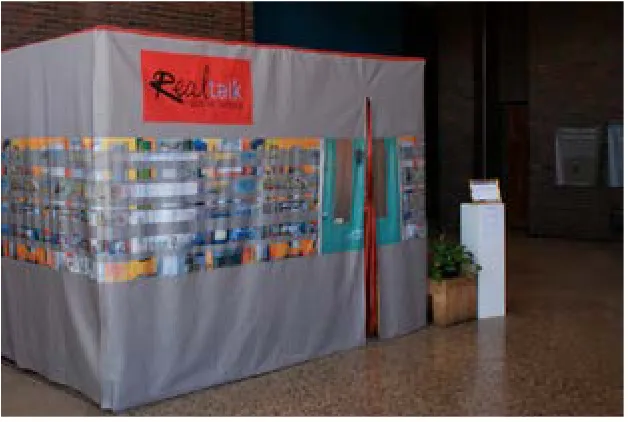
Figure 1. Real Talk: Race on Campus Video Booth, Installed in Campus Lobby. (2015).
The activists then declared a Race on Campus Week in the Spring of 2015. The booth was open for all to enter and tell their stories. Students actively recruited community members whom they knew had poignant stories that they had previously shared, but only in the intimacy of friendship. Student activists generated the three
questions below, which were asked of those sitting in the video booth:
1. List a few adjectives that describe your experience with race at Mass Art?
2. Has there ever been an instance when you were aware of your race at Mass Art?
3. In terms of race relations at Mass Art, is there anything you would like to see continued or changed?
What resulted is a collection of forty-eight recorded testimonials.
Administrators, faculty, staff and students from a variety of
demographics chose to participate and more than half of the testimonials came from students of color. Theirs were the videos
which the activists chose to share during subsequent public forums
and screenings. The content of these testimonials cannot be
essentialized, but there were significant themes that emerged which
Racial Profiling
In the collected testimonials, there were multiple accounts of racial
profiling by a number of Black male students and one Black female
professor. Most of these accounts involved an unnamed community
member alerting our public safety office that a suspicious individual
was on campus. In the case of the professor, who incidentally is the
chair of her department, public safety arrived on the floor of her
department and apologized once they realized the mistake. None of the student narratives included such acknowledgement of fault. We
learn of the definitive impact of racism in the student account below: Right when I first moved into the dorm ... I was with my roommate at the time… this white kid with spiky
hair (pushes hand over center of scalp) ... a punk kid
... apache leather jacket … we were moving in and we
needed to get our student IDs, so we walked to Public
Safety ... and there was a Public Safety officer outside
and it seemed like he looked only at me, and he completely walked by my friend and just stopped me like this (puts out hand) and said, ‘What are you doing
here?’ and I was shocked … because I have never had to explain why I was where I was … and my first
experience here in Boston is someone literally saying ‘I
don’t belong here’. And I said, ‘I am just going to get my ID’ and he steps a little closer and says, ‘Really’ as if he doesn’t believe me. But then my white roommate says, ‘Hey, yeah he’s with me, we’re gonna go get our IDs, we live in the res’... and the public safety officer just nods and says, ‘OK’, and then walks by me and
kind of like nudges me in the shoulder as he does. And that was an experience that pretty much, for the lack
of a better word, ‘colored’ exactly how I would view
my Mass Art experience from then to now. (Balliro &
Bramble-Hakim, 2017)
The effects of racial profiling, particularly for Black men, have been
well documented on college campuses and in the public arena at large (Smith, Yosso & Solórzano, 2007). We can trace the roots of such aggressive and caustic profiling to the racist origins of our institutions
as outlined in the outset of this article. With such extraordinary underrepresentation, Black men appear particularly vulnerable on our
art school campuses (Balliro, 2016). These accounts of racial profiling
by public security are dangerously fraught as many campuses begin
to weaponize such officers with firearms.