The Journal of Media Innovations 1.1 (2014): 86-109 © Lars Nyre 2014
http://www.journals.uio.no/index.php/TJMI
Media Design Method:
Combining Media Studies with Design
Science to Make New Media
Lars Nyre
Department of Information Science and Media Studies University of Bergen
Abstract
Media researchers should construct their own new media. It is in the public’s best interest that academics as well as industry professionals and amateurs experiment directly with the materiality of new media. Due to a medium’s potential for becoming important in people’s lives, its success should be measured not only by its profitability and usability, but also by its communicative ability. The public interest of the many, as fostered by enhanced communicative abilities, counts more than the economic interests of the few. This article proposes that researchers combine media studies with a series of already established design principles from information science to attempt to make new and better media.
Media design, as opposed to media innovation theory, is characterized by placing editorial content at the centre of new developments. Content is king in the simple sense that a new medium must have high quality content in order to function in the marketplace of ideas, and the researchers must therefore experiment with, for example, local news journalism, live music at festivals, or digital storytelling in a big city. All media design projects have to include an ethical platform, a responsible editor at some level of the operation, procedures and norms for content production, and a target audience that represents the public interest. These are severe limitations, but they are productive.
are presented as follows: the research team must formulate a program of action based on the full potential of new media; build a prototype of a particular new medium; try out procedures for editorial content tailored to it; and evaluate it with external test-users in various experimental treatments. Towards the end of the project, the public value of the design project must be evaluated, as this is the ultimate measure of failure or success for a new medium.
Introduction: Distinguishing innovation from design
Innovation is a dominant concept in the university-industrial complex. Government departments, businesses and universities all expect innovation or R & D from their employees, and in academia there are funding schemes such as research-driven innovation centres in the Norwegian Research Council, and EU Innovation Actions on the wider European level. There is a growing institutional market for innovation in the field of ICTs, social media, newspapers and television, and sometimes it seems that everybody is doing innovation.
However, innovation is something quite different from design. Indeed, design should rather be associated with invention than innovation. To invent (or design) is to create a new device, idea or theoretical model, regardless of its performance in the marketplace. Innovation is a much more complex political and economic process than invention. While the latter can take place in the garage, the former takes place in “society”. It negotiates markets, institutions and regulations in attempts to launch an invention successfully in a social setting and make it a household activity. Echoing the idea of “disruptive innovation” Gauntlett (2013: 1) argues that “existing successful operators are liable to become complacent, and then can be surprisingly destroyed and replaced by feisty competitors who come in at the bottom of the market”.
not necessarily useful for the Netherlands’ news readers and the general public. The economic approach to innovation results in new projects often being valued according to their return on investment (ROI), where gains should compare favourably to the cost, and there should be a profit in relation to the capital invested.
The economic approach is quite prominent in relation to media studies of innovation, but it has several blind spots. It carries with it an instrumental knowledge interest, where any given medium is just another product or service, and innovation is fundamentally an improvement of the cost-efficiency of its supporting companies. Innovation research was created in a market economy paradigm that values profit-making interfaces and genres above all other possibilities. But due to its market focus, this type of research doesn’t really produce new products as part of its methodical procedure; at least this is unusual. The creative process and its results are not included in the remit. So this type of research cannot tell us exactly what a medium should consist of, and is unlikely to initiate any attempt at making one. Seen in this light, media innovation research is a quite passive approach: it deals with events post-factum, in a distanced and analytic way typical of “the ivory tower”.
I recommend that media design be used to refer to another, more inventive and riskier approach to what the media should become in the future. Traditionally, design refers to the potential or actual creation of an artefact like a chair or a telephone (Brooks 2010; Norman 1998). The design process fuels the innovation process, in that there must be a material product or rehearsed service for the innovator to promote in the public and capitalize on if it is successful.
The posting for “design” at http://www.merriam-webster.com/dictionary describes a creative process where ideas are made into reality:
- to create, fashion, execute, or construct according to plan
- to conceive and plan out in the mind <he designed the perfect crime>
- to devise for a specific function or end <a book designed primarily as a college textbook>
- to draw the plans for <design a building>
However, beyond analysing texts, academics have increasingly started to synthesize their own products, studying them in the process. From the 1980s onward, there were experiments with hypertext and hypermedia: see, for example, Gunnar Liestøl’s multimedia presentation of the Kon-Tiki museum on CD-ROM (Liestøl 1996). Bolter and Grusin (1999) and Manovich (2001) were influential in giving media students and academics a more practical understanding of media interfaces. McLuhan was reintroduced as a media visionary, especially in the notion of “remediation” and the continued exegesis of the dictum “the medium is the message” (1964: v). The combination of computer programming, graphical design and audio-visual production has spawned new expressive practices such as hypertext, web design, streaming audio and video, blogs, social media, computer-assisted journalism, smartphone apps, etc. Emerging technologies in the 2010s include ubiquitous computing, locative information and augmented reality.
The methods of media design owe a great debt to HCI design or interaction design. These design traditions have flourished in information science departments under various labels since the 1970s (Doorst, 2008). Their user-oriented qualities are a democratic addition to the previously more centralized development process (Sharp, Rogers and Preece 2007). This field is “constructing models, methods and tools that will be valid for every designer, dealing with every possible kind of design problem, in any situation" (Doorst 2008: 5). Despite its increasing relevance for society (Martinec and van Leeuwen 2007; Lunenfeld 2004), the concept of “media design” has caught on neither in traditional media studies nor in interaction design.
During the last five to ten years several interesting media design projects have been conducted, some of them in the Norwegian/Nordic context. For example, Situated Simulations is a prototype that presents an ancient burial mound containing a Viking ship as an audio-visual augmented reality design for iPhones (Liestøl, 2009). Several other projects investigate new media and journalism in similarly experimental ways: LocaNews is a prototype for GPS-driven local journalism (Nyre et.al. 2012, Øie 2013; Nyre 2014). HyperNews is public service-oriented interactive TV-news website (Aam 2010). In the literary genre, Textopia is a locative literature presenter for mobile phones, and you can read excerpts or hear quotes from famous novels being read aloud (Løvlie 2009). The Manhattan Mash-Up was a mass participation photo art project conducted by Aalto University and Nokia, where 184 participants walked around in New York taking photos that were shown on large public signs in Times Square (Scheible, Tuulos and Ojala, 2007).
contribution so far is Krippendorff (2006), who proposes that designers must make artefacts that contribute to a “democratic way of living”:
Design has to shift gears from shaping the appearance of mechanical products that industry is equipped to manufacture to conceptualizing artefacts, material or social, that have a chance of meaning something to their users, that aid larger communities, and that support a society that is in the process of reconstructing itself in unprecedented ways and at record speeds (Krippendorff 2006: iv).
I agree with Krippendorff that any serious media designer must have a public purpose with the design that is being made. This is a more restrictive research policy than that associated with commissioned research that has a pragmatic, market-oriented engagement with whatever an institution needs and is willing to pay for. Bolter (2003: 30) argues that the design of a medium could be motivated by a critical flaw in some aspect of the present reality that could be alleviated by new technologies. “What we need is a hybrid, a fusion of the critical stance of cultural theory with the constructive attitude of the visual designer”, Bolter writes. Media design cannot mean that the researchers just make a complex technological solution, but also that they have a maximally conscious approach to the ethical and cultural implications of the solution they are making. Fagerjord (2012: 199) puts it nicely: "Critical media design could continue the criticism of the media's genres and texts that has been an important part of media studies from the beginning. By designing actual alternatives, functional challenges to commercially developed services, this criticism becomes more solid, and may actually influence the way things develop".
Overview of the method
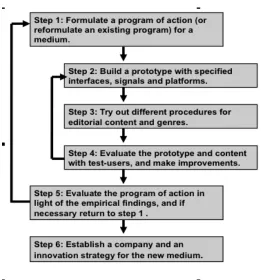
The method presented here is summarized in figure 1. Each box should be considered a task formulation; the box implies an act that can be specified further in recognizable academic language, and should be possible for any research team to conduct in their preferred fashion. This model sums up my recommendation. If it were tested by other researchers it would give us findings that would be quite comparable across interfaces, editorial content and business models.
objective, or at least they employ well-known methods in the limited setting of the media laboratory and the field experiment setting. After such a series of trials and evaluations of the prototype is completed, a second, more intricate evaluation must be made to determine the degree to which the original program of action was accomplished. The falsification process is illustrated with the large return arrow in figure 1.
Figure 1: Relations between six crucial procedures for designing a new medium in a scientifically valid way
This step entails a normative engagement with society that is problematic in relation to the objective ideals of normal science (Nyre 2009). The methodology is meant to reach satisfactory solutions on the practical level before any form of public consultation or recommendation begins. It could take many years for a researcher to complete the empirical round of experiments and evaluations, because it might be disclosed that the proposed medium is unsuitable for public life first in one way, then another, and then a third. The final proposal would presumably be very well adapted to the society in which it has been tried, and its normativity would be as much soaked up from the society as from the value-orientations of the researchers.
making a new medium into a tool for the general improvement of communication in different provinces of reality.
Formulate a program of action
I start from a normative principle: Due to a medium’s potential for becoming important in people’s lives its success should be measured not by its profitability and usability alone, but also by its communicative ability. The public interest of the many counts more than the economic interests of the few. Indeed, the effort of invention could be directed exclusively at the communicative gain the medium might have in the contemporary society. It is safe to say that this approach is currently not dominant in the marketplace of ideas.
It is tricky to define good communication, but we all know it when we see it. It involves a more equal access to the means of communication, better representation of social groups in public arenas, editorial procedures that secure a more ethically sound discourse, etc. There is a whole industry of critical theory about the ideal role of mass media in the public sphere. A strong formulation of the ideal procedure for public communication can be found in Habermas (1962), where Habermas lets the sociologist C. Wright Mills define it on his behalf.
In a public, as we may understand the term, (1) virtually as many people express opinions as receive them. (2) Public communications are so organized that there is a chance immediately and effectively to answer back any opinion expressed in public. Opinion formed by such discussion (3) readily finds an outlet in effective action, even against – if necessary – the prevailing system of authority. And (4) authoritative institutions do not penetrate the public, which is thus more or less autonomous in its operation (C. Wright Mills, quoted in Habermas 1990: 358).
Habermas recommended this definition of the public because he found it particularly suitable for empirical investigations. The approach proposed here takes on Habermas’ empirical challenge in what Liestøl (2013) calls a ”synthetic-analytic” approach: to build media that cultivate better hermeneutical and political relations between the members of the general public, and that are guided by analyses such as those by Habermas, and other critical scholars.
requirements. We engage with a value-orientation that is built into the machinery. Not just Latour stresses this. Winner (1986) reminds us that artifacts have politics. Because a process of human interaction is fundamental to any technology, there are techniques and routines of embodied knowledge among people. A technology becomes a way of life for the humans involved in it, and therefore a conscious value-orientation is required from the researchers when they construct it. In my context the important thing is to remember that media technologies have programs of action. Engineers and researchers can set up an entire way of life for the media consumer, at least as a strategic objective. Cable television has a different program of action from web television, all inviting themselves to be taken up by more people. A researcher can have a long-term plan for the construction of good communication in society, based on a program of action informed by accumulated empirical analyses of historical conditions.
It is clear that a medium is an engine for the production of communication. A medium therefore produces something that a shoe factory (shoes) or a cargo ship (transport) do not. The latter are lasting physical goods, measurable in quantitative terms like cost per weight and distance pr. time. In a medium “factory,” the production process is participatory and hermeneutical, and the receiver can also relate to the product in a participatory and hermeneutical way; improving, challenging, giving his/her own interpretation instead. To formulate a program of action means to formulate who the implied user of the medium is, and what experience of communication they are supposed to engage in. It should be clear that the medium produces communication. There are many attempts to formulate what good communication is. Good communication is a special type of good: the more people who share it, the more valuable it is, and it doesn’t have to be owned by one person at a time. The music of the Beatles is available to all, at the same time as it has exquisite qualities. Furthermore, good communication is a matter of varying trust, accountability and truthfulness in our relationships with each other (Schutz 1967).
Build a prototype
The research team can try to create a new, radical invention, which is really difficult, or try to combine existing components into an incremental invention. Technology is a factor that the experiment staff can manipulate in a very physical way, and which can be systematically conceptualized, built and tested. It is important to explain how the material shaping happens, and to cultivate increased precision and predictability in the relationship between a prototype and the behaviour of people trying it out.
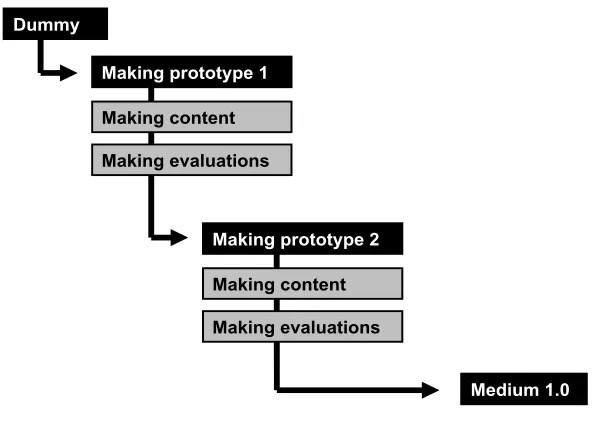
medium. Figure 2 shows the in-design steps of the method, where it is not so important to think about the larger program of action. This is the level of “actually doing things”, and not reflecting on them.
First, a dummy of the prototype should be made. This is a visual simulation of functionalities, for example an interactive video which seems to respond to clicks by the mouse, but which has only been completed for one of the icons, and only gives a realistic impression if you click on that particular icon. The purpose of dummies is to filter out obvious mistakes and misunderstandings without too much effort, and to help the designers to realize which features are simple and which are complex to create.
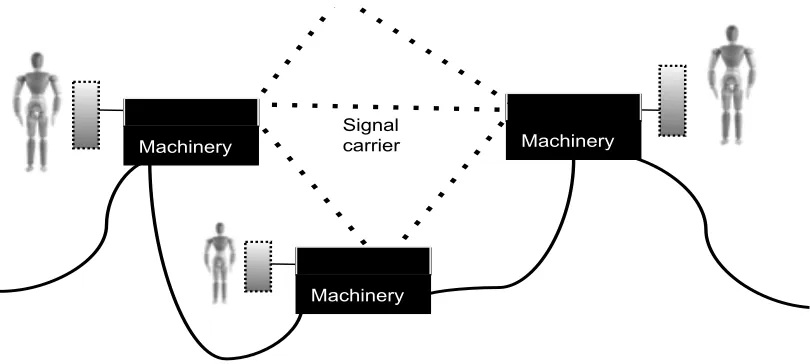
After the initial testing with the use of dummies, a first functional prototype must be built. In the figure it is called prototype 1, and it presumably contains all the necessary features of a medium: that is, interfaces, platforms, machinery and signal carriers at both the producing and receiving end, and also various types of interactivity between the two ends. Research staff should test the prototype in order to safeguard important functions before it is tested on actual user-groups (for example journalists, taxi drivers, school children, representative citizens) by the methods described below. It is likely that the research team discovers imperfections of many kinds through this process. Even if the prototype works efficiently in the technical sense, it might not elicit interesting or valuable communication among the test persons, and if so, it should be redesigned or cancelled.
An influential contribution to the methodical purpose of the design process has been made by Hevner et.al. (2004). They present design science as a method in information systems research, and three of their guidelines are particularly
Making prototype 1
Making content Making evaluations
Medium 1.0 Making prototype 2
Making content Making evaluations
Dummy
relevant to my discussion. First, they stress a problem-oriented development process: “The objective of design-science research is to develop technology-based solutions to important and relevant business problems” (2004: 83). Secondly, “design-science research must produce a viable artefact in the form of a construct, a model, a method, or an instantiation”, and finally “the utility, quality, and efficacy of a design artefact must be rigorously demonstrated via well-executed evaluation methods” (Hevner et.al. 2004: 83). These rules are meant to secure a real, material product that compares favourably with other products in the media and information industry.
From a historical perspective, media design is part of the larger tradition of industry design. For example radio and telephone equipment has been related strongly to design in wood, Bakelite and metals of various kinds. Loudspeakers, TV-screens and computer keyboards are all applicable to the creativity of industry designers, something the minimalist aesthetics of for example the iPhone attests to. I will point out some material components of a medium that the media designer is materially determined to deal with (based on Nyre 2008).
The workings of our senses are well researched and exploited. Interfaces are designed to be handled specifically by humans, typically with the hands, the mouth and ears, and through visual perception. For example, the microphone is crucial in radio, television, film and other audio-visual media because it translates human expression into signals that can thereafter be technically manipulated. Interfaces translate signals into sensory presentations for humans to relate to. The interface is clearly the most communicative component in the media assemblage, since it channels all the expressions into and out of the medium. An interface is a point of simultaneous contact and division, meaning that it doesn’t just create a functional proximity with people (e.g., on the phone we can talk with people in another country), but can also make us aware of how far away from other people we are when we communicate with them.
A platform controls the distribution of the signal, and it is a way of storing and transmitting the signal. The fundamental difference lies between synchronous and asynchronous platforms, or between live and recorded communication. Paper is an asynchronous platform for written words, and it is quite permanent compared to the ephemeral character of the synchronous platform for broadcasting. A platform is dependent on the interfaces for something to distribute, and the signal carriers depend on some way of transporting the signal to the other platforms. At the producing and receiving end there may be different, but compatible platforms, so that a conversion process is necessary. This was the case in the 1960s, when pop music was produced on magnetic tape but distributed and enjoyed on stereo LPs. Notice also that a medium may consist of a whole series of interconnected platforms with different properties.
speed of light. The signal can be carried through space by 1) wireless electromagnetic waves, 2) through landlines, or 3) on a revolving disk, book, or other tangible signal carrier.
There is necessarily a prime-mover that drives the mechanical and/or electronic process, and in modern societies it is typically electricity from mains and batteries. Borgmann (1984) calls this element simply “the machinery”. A semi-automated infrastructure such as the electricity grid is a good example, because the production process is delegated entirely to technology and its engineers, and the user does not need to handle the energy sources in any participatory or hermeneutical way. The entire process of running the device seemingly takes place without human involvement. This is the largest aspect of media technologies, and it is doubtful that many media designers will work with issues at this level.
Figure 3 also tries to show the difference in changeability among the components of a medium. Interfaces can quite easily be redesigned, while platforms are larger and both more expensive and complex to reinvent, while the machinery that drives the whole process is the least easy to change, albeit perhaps the most pressing element to redesign, considering the strain it puts on fossil resources and the environment.
Platform Signal
carrier Machinery
Machinery Machinery Platform
Machinery Platform
Try out genres and content
The weakest link in many design projects is the content. Information system developers seldom relate as thoroughly to the content of the system they do to its functionality and efficiency. Some researchers use pre-produced material from a professional source, for example an archive, or they deal exclusively with the design surface and fill all content fields with “Lorem ipsum dolor sit amet”. (This is a Latin sentence often used in Powerpoint templates and by web designers to show the font sizes and positions of text elements in the layout.) In a media design approach it is impossible to have such a content-agnostic attitude, since the content, and the procedures, genres and norms it is produced with, are the most hermeneutically vital aspects of communication. The communicative ability should be made the main focus in the research process. Researchers must try out of various editorial procedures and types of content in a way that is as
methodically sound as the development process and the user-evaluations.
A genre is a procedure for creating understandable, predictable content for a medium (Liestøl 2013). It can be on the general level of journalism versus fiction film, or on the highly specific level of the Norwegian Easter crime fiction genre. In public service broadcasting three types of content were formulated that still serve as a framework for genres and content in the media: enlightenment; aiming to increase the general knowledge about nature and culture through documentaries, instruction and reportage, news; aiming to support well-informed actions and communication among members of society through updated, critical journalism, and entertainment; aiming to support social enjoyment and personal relaxation through aesthetically pleasing narratives and media events (Gripsrud 2002). Since the 1990s, audience interaction has emerged as another large framework, and it includes phone-ins, commentary fields, reality shows, talent shows and other ways of engaging the general public in media production.
Müller (2013) argues that genre is an important concept in innovation theory. He combines medium theory with genre theory, and argues that sometimes a technological platform is replaced without any striking innovation in the genres and their design patterns. Wikipedia looks very much like a traditional encyclopaedia, but is nevertheless a radical innovation in technological terms. While the medium represents a change from the old practice, the genre remains largely the same, and therefore comes across as a stable continuation of the old practice. Müller helps us to see that genres and technologies are two aspects that can and should be kept analytically separate in the design process.
It is important to stress that a single piece of content is not really interesting. Content is always needed in bulk, either for live experience by the hour, or in writing and photography by word count, paper area or pixel size. What is really interesting is the procedure for making a certain type of content. This procedure
can be practiced in other locations and times, and produce more or less the same type of content. The procedure is the general mechanism for content. Akrich (1992) uses the concept of ”script” to denote the social behaviours that designers bring into the processes of constructing an object. This resembles very much the scripts used by film and television producers, in the sense that it ensures that the produced content corresponds to a relevant genre.
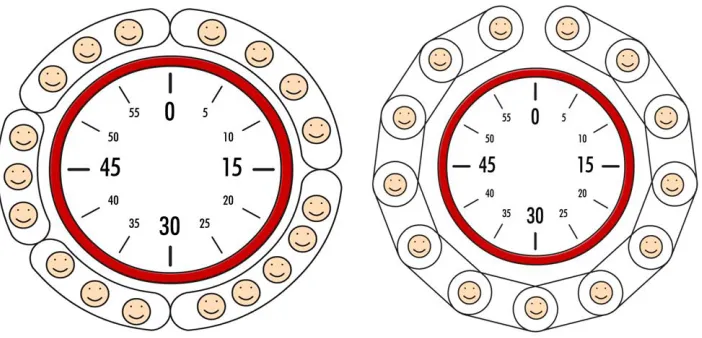
My approach requires the research team to produce editorial content for the new sensory interface in a genre-conscious way. And although the new content will contain text, photos and video – forms that have existed for centuries and decades – it will be sensitive to contexts that were simply not present in previous platforms, such as real-time location tracking. There are so many options to select from, starting with the platforms for spatial distribution and temporal duration. You can choose between distribution on paper or mobile phone or the movie screen; in sound, video, and on Internet pages. Let me show two different spatio-temporal scripts for new media; DemoStation (2005) and LocaNews (2009). The first was an experiment with democratic talk radio for the web, with streaming audio, Skype conference hook-ups, and fair rules of participation.
Figure 4 shows two ways of moderating a large number of phones lines with ordinary people speaking live on the air. DemoStation is an example of how one can test out almost any quality that media scholars have conceptualized. In the form of test-content, any rhetorical, aesthetic and journalistic function can be turned into a practice for a short or long time, and during these experiences the team will develop a sensibility for what combinations are most suitable for the given interfaces and platforms.
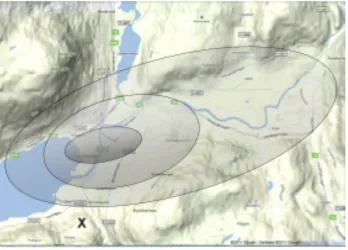
LocaNews was organized to simulate the productive capacity of an average Norwegian local newspaper (Tessem and Nyre, 2012). The only truly new thing was that all news stories were presented for mobile phones in three versions with different texts and photos in each. There is one version for people who are right here, near the spot where the story is geo-located, another for people who are in the neighbourhood, from 250 – 500 meters away, and finally, a version for those who are in the city or town, but unlikely to come very near the location right now. Five journalists worked full time during the weeklong experiment, with an editor and technical support. All photos and journalistic copy were published under the auspices of a responsible editor. LocaNews had a desk editor, journalists worked in teams with a writer and a press photographer, and the news was presented with a catchy headline, lead and journalistic copy.
Evaluate with test users
It is paramount to learn what ordinary citizens from different groups and demographics have to say about the proposed new medium. This has been an ideal in interaction design and participatory design for decades, and most of Apple’s success products are created with very high sensitivity to consumer
preferences. The reason this is so important is that communication is at bottom an individual experience, in that it is contained in a large number of separate human bodies with communication between them, and not in the equipment or genres or content. It only exists as an on-going practice among a number of people for a period of time. When somebody listens to the radio or taps his fingers on the iPad screen, there is a perceptual contact between the humans involved, and an exchange of (more or less) mutually understandable messages or signals in the process.
Most basically, there are producer-humans who make the content and publish it, and there are the audience-humans who hear and see the content. In this process there are always emotions, opinions, attitudes and oppositions relating to the humans’ perceptual experience of the content. If researchers decide to experiment with communication technologies, they automatically experiment with a whole range of sensitive issues relating to the humans that perform the communication. The media studies tradition can help media design researchers to understand the hermeneutical processes involved in testing the media design on real journalists, camera personnel, editors, producers, and audiences.
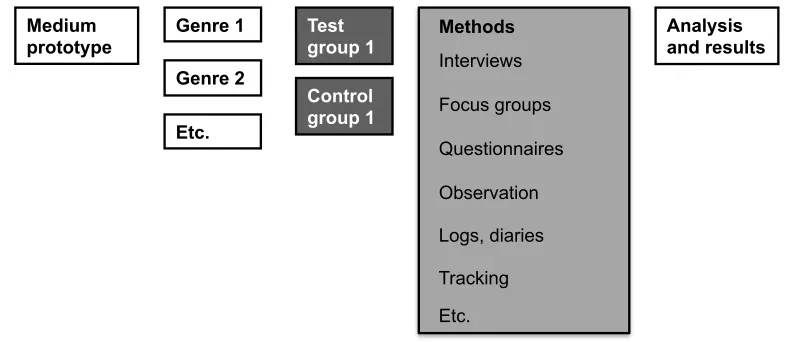
In a large-scale experiment, there might be hundreds of people involved at these two ends, and their communication during the process produces a veritable minefield of interesting experiences. Figure 6 tries to suggest how many permutations can be made in the use of genres and test group demographics. This gives the researchers a host of opportunities for sensitive research. This process should be considered a form of public consultation with citizen stakeholders on the viability of the technology and its content.
Depending on the purpose of the experiment, different user groups can be involved in content production. It can be professionals who have formal skills in a relevant practical field such as journalism, and who also have access to the required technical equipment. Karlsen and Stavelin (2013) show how difficult it is for journalists and computer programmers to collaborate in the newsroom, due to office arrangements, different codes of conduct, etc. In other cases it can be amateurs who have no formal skills, but a special interest in a certain topic, and
Interviews
Focus groups
Questionnaires
Logs, diaries Observation Control
group 1
Medium
prototype Test group 1
Genre 2
Genre 1 Analysis
and results
Tracking
Etc.
Methods
Etc.
are willing to make content about it using the scripts. Finally, it can also be the general public represented by a sample who use the content in the prescribed way.
Traditional methods of observation should be used, mainly qualitative interviews and focus groups, and in addition there are many methods from interaction design that are useful, like talk-aloud procedures, video monitoring, log-file studies, etc. (Sharp, Rogers and Preece (2007). Along with miniaturization of electronic equipment a range of wearable devices have been tried out, recording auditory, visual and locative information about people. See Gjedde and Ingemann (2008) for first-person perspective methods of audience research, and Walker (2010) and Lahlou et.al. (2009) for reflections on tracking and recording users in their everyday life. These methods give access to the participants’ motivation to speak and listen and get involved in the required activities of a new medium; the technology’s functionality during the test phase; and interpersonal encounters that might be of interest for the research team. Often the anomalies contain the deepest insights.
As part of this audience evaluation there can also be projects in the tradition of psychological or social science experiments. The researchers create an artificial situation and expose pre-selected groups of people to it. It is possible to recruit a control group that simply go on with their lives, and are interviewed about the same things as the test-group. This is a way of comparing the experience of the new medium with ‘normal’ experiences of various kinds.
It is possible to evaluate with strictly separated test groups and control groups. To set the new medium experience apart, there should be parallel user studies with a control group – meaning, a demographically matched group that is not exposed to the new medium. In a media design project this tool can be used on many levels, from initial usability testing of buttons and screen size to the photographic aesthetics of a news service to an evaluation of the entire medium. The tests should not be taken to teach us something about media behaviour that exists independently of it; on the contrary, the behaviour is completely based on the new medium.
predetermined time, and has the limited purpose of informing the research team about the technical platform and editorial procedures, before proceeding. In this regard, there is no difference from a statistical survey or other method. The reason for this “cold” approach to experimentation is explained in the next section.
Evaluate the entire program of action
The public purpose of the new communicative practice is at the heart of the media design method. This is the real topic of the research, while the medium is only a material tool for its affordance. How realistic is it to improve communication in the way stipulated by the program of action? Was the program too idealistic, or too simplistic, or just boring? If it worked, why did it work? There are parallels with the concept of “falsification”. The critical, problematic and unpleasant questions must be understood and operationalized as an integral part of the job for the research team. The entire program of action must be critically evaluated towards the end of the research cycle.
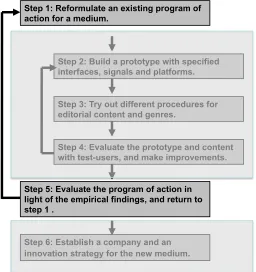
As figure 7 shows, the methodology invites the researchers to return to step 1 for an assessment of what has been achieved in relation to the program of action formulated at the beginning. Based on the collected data, the team should now make a more fundamental evaluation of the medium, and be prepared to reconstruct parts of or the entire set-up if there is good reason for it. This aspect
Step 2: Build a prototype with specified interfaces, signals and platforms.
Step 3: Try out different procedures for editorial content and genres.
Step 4: Evaluate the prototype and content with test-users, and make improvements. Step 1: Reformulate an existing program of action for a medium.
Step 5: Evaluate the program of action in light of the empirical findings, and return to step 1 .
Step 6: Establish a company and an innovation strategy for the new medium.
of the method is meant to improve the medium’s program of action and takes place internally among the researchers. It may be that interviews reveal that crucial aspects of the editorial procedure is rejected by test users, and if this happens, the program cannot proceed unaffected, although it may not be abandoned either. It could happen that the project is success, and this could create a commercial momentum that would lead the development to be driven by other interests than those of the quality of the medium. The medium should only be evaluated at this late stage of the sequence of methods, and should not be evaluated halfway through in an ad hoc fashion. This aspect of the procedure is meant as a safeguard against whimsical changes of purpose. Also, if the researchers are prejudiced against changing their position, this ought to be discovered, and, ideally, overcome during this procedure.
In this regard, my approach differs from that of Løvlie (2010: 44), who introduces a cyclical method of media design, inspired by the hermeneutical circle. "Like the hermeneutical circle it does not have a clear end point. In other words, there are no clear end criteria for when the original problem can be said to have been finally ‘solved’ or ‘answered’”. In my view it is only by having a definite endpoint that the design project can be of use to society. There must be predictability as to when a prototype is successful or a failure. Otherwise, any solution could be seen as beneficial, simply because it was created as such. However, it is the research team that is responsible for setting the criteria for evaluation. As a result of these evaluations, it might be necessary to return to step 1 and reformulate the program of action, and consequently also go through the steps of building a new prototype, making content and evaluating it all over again. No public advice or recommendation can be given without the most rigorous quality control having taken place. Only at the very end of the project can you start recommending that a concrete medium should be established, or alternatively, you had to accept that no, it shouldn’t.
Establish a stakeholder company
If the critical evaluation substantiates that the medium will contribute to improvement in society, the research team should establish a stakeholder company, and develop an innovation strategy for an actual medium with regular content production and a growing number of users. The innovation theory described at the beginning of this article starts to be useful only at the very end of the design process, but will be all the more important as long as the program of action is not disrupted. When working with innovation the researcher must “act as if his hypothesis were in the imperative mood” (Argylis et.al 1985: 65), and plan for a future reality as if it were already reality. Ideally, there should be a public consultation in the national cultural and political sphere about the topical direction of the medium and its program of action. The research results must therefore be aired to the public sphere the pedagogic form of showing how it works, and provoking a response. Stakeholders in civic life, private companies and the state are invited to try out and criticise the new medium. This step presumes a well-researched, well-tested medium that the researchers have good reason to promote.
Beyond its editorial purpose, a real media business must have a business model to make the new medium economically self-sustainable. This requires innovation in advertising, subscription, cooperative funding, etc. It also involves knowledge about how to take market shares, becoming internationally well known, and other aspects of growth. There is also a need for strategy towards regulation and policy, for example in relation to freedom of speech, protection of rights, and lobbying for subsidies or tax relief. Last, but not least, the media company must have a conscious relationship to ethics, and conform to the editorial procedures and privacy regulations that were established for the new medium during the research phase. The organization must be knowledgeable about laws relating to libel, etc.
Conclusion: Suppression of radical potential
The proposed method presumes that things can be changed in an intentional way. Presumably, at the end of the media design project there exists an up-and-running media company, and it produces content that is accessible to the public as one of many market choices (ideally at no cost). The medium communicates in a intelligent and therapeutic way that makes everybody feel better, so that they make good decisions about what should be done in the political and cultural sphere.
But this is bound to be a caricature, since academicians, journalists and other stakeholders will constantly assail the proposal for the new medium. The “law of suppression of radical potential” (Winston 1998) is as strong as it ever was, and it says that when a communications technology is realised, its growth is suppressed through the constraining influence of already prevailing institutions and the protection of professional handicrafts (e.g. journalists). The innovation process is supposed to make a new medium functional in a real community like London or Bergen, and in the process trade-offs will be made that are likely to weaken the communicability of the medium in its original form. The program of action is also under threat from inside. Researchers can become too embedded in the commercial and political world to keep up the needed critical distance. They have to forge alliances with state departments, financers and other powerful interests. All these points of contact with real stakeholders are dangerous for the program of action. Researchers can become stooges in the maintenance of dominant institutions; we can form alliances with groups of citizens who really don’t need help. Not least, researchers can be corrupted like individuals in any other profession.
References
Akrich, M. (1992). The De-Scription of Technical Objects. In W. Bijker and J. Law (Eds.) Shaping Technology, Building Society: Studies in Sociotechnical Change (pp. 205-224). Cambridge, Mass: MIT Press.
Argylis, Chris, Putnam, Robert and Smith, Diana McLain. (1985). Action Science. Concepts, Methods and Skills for Research and Intervention. San Fransciso: Jossey-Bass Publishers.
Arnheim, Rudolf. [1936] (1986). Radio. Salem: Ayer Company. Translated from the German by Margaret Ludwig and Herbert Read.
Bakker, Piet (2013). Measuring Innovation. Successes and Failures in a
Newspaper Market. In T. Storsul and A. Krumsvik (eds.), Media Innovations. A Multidisciplinary Study of Change (pp. 161-174). Gøteborg: NORDICOM. Boehm, Barry W. (1988). A Spiral Model of Software Development and
Enhancement. Computer 21(5), 61-72.
Bolter, J. (2003). Theory and Practice in New Media Studies. In G. Liestøl, A. Morrison, & T. Rasmussen (eds.), Digital Media Revisited: Theoretical and Conceptual Innovation in Digital Domains (pp. 15-34). Cambridge, Mass.: The MIT Press:
Bolter, J. and R. Grusin. (1999). Remediation: Understanding New Media. Cambridge, MA: MIT Press.
Bolter, J., Engberg, M. and MacIntyre, B. (2013). Media studies, mobile augmented reality and and interaction design. Interactions 20 (1), 36-45. Bordwell, David and Thompson, Kristin. (2008). Film Art. An Introduction. New
York: McGraw Hill.
Borgmann, Albert. (1984). Technology and the Character of Contemporary Life. Chicago: Chicago University Press.
Brooks, Frederick P. (2010). The Design of Design: Essays from a Computer Scientist. New York: Addison-Wesley.
Doorst, K. (2008). Design research: a revolution-waiting-to-happen. Design Studies 29, 4-11.
Fagerjord, Anders. (2012) Design som medievitenskapelig metode [Design as a media science method]. Norsk medietidsskrift, 3/3012, 198-215.
Fals Borda, Orlando (2001). Participatory (action) research in social theory. Origins and challenges. Reason, Peter and Bradbury, Hilary (eds.), Handbook of Action Research. Participative Inquiry and Practice. London: Sage.
Gauntlett, David. (2013). Creativity and digital innovation. In Gillian Youngs (ed.), Digital World: Connectivity, Creativity and Rights. London: Routledge. Gjedde, Lisa and Ingemann, Bruno. (2008). Researching Experiences: Exploring
Processual and Experimental Methods in Cultural Analysis. Cambridge: Cambridge Scholars Publishing.
Gripsrud, Jostein. (2002). Understanding Media Culture. London: Hodder Arnold.
Habermas, Jürgen [1962] (1990) Strukturwandel der Öffentlichkeit.
Untersuchungen zu einer Kategorie der bürgerlichen Gesellschaft. Frankfurt a. M.: Suhrkamp. [Published in English as: The Structural Transformation of the Public Sphere. Cambridge: Polity Press, 1989.]
Hevner, A., March, S., Park J., and Ram, S. (2004). Design Science in Information Systems Research, MIS Quarterly 28 (1), 75-105. Karlsen, Joakim & Stavelin, Eirik. (2013). Computational journalism in
Norwegian newsrooms. Journalism Practice, published online: 23 Jul 2013. DOI:10.1080/17512786.2013.813190.
Krippendorf, Klaus. (2006). The Semantic Turn. A New Foundation For Design. Boca Raton, FA: Taylor & Francis Group.
Krumsvik, Arne H., Skogerbø, Eli, and Storsul, Tanja. (2013) Size, Ownership and Innovation in Newspapers. In T. Storsul and A. Krumsvik (eds), Media Innovations: A Multidisciplinary Study of Change (pp. 93-109). Gøteborg: Nordicom.
Küng, Lucy. (2013). Innovation, Technology and Organisational Change. In T. Storsul and A. Krumsvik (eds.), Media Innovations: A Multidisciplinary Study of Change (pp. 9-12). Gøteborg: Nordicom.
Lahlou, S., Nosulenko, V., and Samoylenko , E. (2009). SUBCAM technology as an instrument in psychological science, Experimental Psychology (1), 72-80. Latour, Bruno. (1994). Where are the Missing Masses? The Sociology of a Few
Mundane Artifacts. In W. Bijker and J. Law, (eds.), Shaping
Technology/Building Society. Studies in Sociotechnical Change (pp. ). Cambridge, Mass: MIT Press.
Liestøl, Gunnar. (1996). Kon-Tiki Interactive. New York: Voyager.
Liestøl, Gunnar. (2009). Situated Simulations: A Prototyped Augmented Reality Genre for Learning on the iPhone. International Journal of Interactive Mobile Technologies 3 (2009) Special Issue IMCL2009.
Liestøl, Gunnar. (2013). Topics of innovation. Towards a method of invention and innovation in digital media design. In T. Storsul and A. Krumsvik (eds.), Media Innovations: A Multidisciplinary Study of Change (pp. 61-74).
Gøteborg: Nordicom.
Lunenfeld, P. (2004). Media Design: New and Improved without the New. New Media and Society 6, 65-79.
Løvlie, Anders Sundnes. (2009). Textopia: designing a locative literary reader. The Journal of Location Based Services 3 (4), 249-276.
Løvlie, Anders Sundnes. (2010). Textopia. Experiments with Locative Literature. Doctoral dissertation at the University of Oslo.
Martinec, Radan and Leeuwen, Theo van. (2007). The Language of New Media Design: Theory and Practice. London: Routledge.
Manovich, L. (2001). The Language of New Media. Cambridge, MA: MIT Press. Müller, Kjartan. (2013). Innovation and the Genre-Platform Model, In T. Storsul
and A. Krumsvik (eds.), Media Innovations: A Multidisciplinary Study of Change (pp.255-273). Gøteborg: Nordicom.
Norman, Donald A. (1998). The Design of Everyday Things. London: MIT Press. Nyre, Lars. (2007). Minimum Journalism. Experimental procedures for
democratic participation in sound media, Journalism Studies 8 (3), 397-413. Nyre, Lars. (2008). Sound Media. From live journalism to musical recording.
London: Routledge.
Nyre, Lars. (2009). Normative media research. Moving from the ivory tower to the control room, Nordicom Review 30 (2), 3-17.
Nyre, Lars. (2014). God lokaljournalistikk berre på nett: Hypotetisk redesign av avisa Hordaland på Voss [Good local journalism carried on the Net:
hypothetical redesign of the newspaper Hordaland på Voss]. In L. Morlandstø and A.H. Krumsvik (eds.), Innovasjon og verdiskaping i lokale medier (pp. 281-304). Oslo: Cappelen Akademisk.
Nyre, L., Bjørnestad, S.,;Tessem, B., and Øie, K. V. (2012). Locative journalism: Designing a location-dependent news medium for smartphones, Convergence. The International Journal of Research into New Media Technologies 18 (3), 297-314.
Scheible, J, Tuulos, V. and Ojala, T. (2007). Story Mashup: Design and
Evaluation of Novel Interactive Storytelling Game for Mobile and Web Users. In Proceedings of the 6th International Conference on Mobile and Ubiquitous Multimedia. Oulu, Finland, December 2007.
Schutz, Alfred. (1967). The Phenomenology of the Social World. Chicago: Northwestern University Press.
Sharp, Helen, Rogers, Yvonne and Preece, Jenny. (2007) Interaction Design: Beyond Human-Computer Interaction. Chichester: John Wiley.
Storsul, Tanja and Arne Krumsvik (eds.). (2013). Media Innovations: A Multidisciplinary Study of Change. Gøteborg: Nordicom.
Tessem, B. and Nyre, L. (2012). Lokaljournalistikk for mobile [Local journalism for mobile phones], in M. Eide, L.O. Larsen, and H. Sjøvaag (eds.), Nytt på
nett og brett. Journalistikk i forandring. Oslo: Universitetsforlaget.
Walker, Ian. (2010). In-vivo sampling of naïve drivers: benefits, practicalities and ethical considerations. In B. Fincham, M. McGuinness and L. Murray (eds.), Mobile Methodologies (pp. 43-53). London: Palgrave Macmillan.
Winner, Langdon. (1986). Do Artifacts Have Politics? In The Whale and the Reactor: A Search for Limits in the Age of High Technology. Chicago: University of Chicago Press.
Aam, Pål. (2010). TV-reportasjen 2.0. Ny teknologi - styrking av
samfunnsoppdraget for TV- og videojournalistar [TV reporting 2.0: New technology – strengthening community engagement for TV- and video journalists]. In J. Roppen and S. Allern (eds.), Journalistikkens
samfunnsoppdrag. Kristiansand: IJ-forlaget.