R E S E A R C H
Open Access
Research on the algorithm of
electromagnetic leakage reduction and
sequence of image migration feature
retrieval
Chunwei Miao
1*and Jianlin Hu
2Abstract
When the computer is working, it will transmit the electromagnetic leakage signal containing the video information and receive and process the electromagnetic leakage signal within a certain distance, which can reproduce the screen information and form the electromagnetic leakage restoration sequence image. Due to the noise in the receiving process and the fluctuation of the video line and field signal, the image of the electromagnetic leakage restoration sequence will be blurred and will drift between frames. The multi-frame cumulative averaging method can theoretically improve the signal-to-noise ratio of the reconstructed image, but the offset of the reconstructed image sequence caused by the electromagnetic leakage will bring adverse effects. Firstly, this paper analyzes the noise of electromagnetic leakage emission and restoration sequence images and the method of multi-frame cumulative averaging, as well as the cumulative averaging effect of multi-frame sequence images under the influence of image offset. Secondly, on the basis of theoretical analysis, an algorithm of image migration feature retrieval for electromagnetic leakage restoration sequence is proposed and validated, which achieves more accurate inter-frame matching, automatic offset calculation, and multi-frame sequence image accumulation and enhances the recognition of the electromagnetic leakage restoration image. Lastly, different algorithms are compared, and their effects are evaluated as well.
Keywords:Electromagnetic leakage, Emission image accumulation, Image migration, Feature retrieval, Inter-frame matching
1 Introduction
The changes of current during the process of a work-ing computer will generate electromagnetic leakage emission. If the electromagnetic leakage emission is analyzed, it may be restored to relevant information, resulting in information leakage [1–4]. A large num-ber of scholars have conducted a series of reduction studies on electromagnetic leakage and recovered use-ful video information successuse-fully. As the radiation ef-ficiency of video information of computer becomes relatively higher, electromagnetic radiation signals are easier to receive, and video information becomes the
most easily intercepted and reproduced red informa-tion in a computer system. Video reducinforma-tion is also evolving towards portability in the current days [5–7]. Due to the influence of the electromagnetic environ-ment, equipment noise and other factors during the process of video information receiving and reduction, the introduction noise and fluctuation of video signal line and field signal will inevitably lead to the blur and drift of video information received. Electromag-netic leakage reduction sequence images are accom-panied by a lot of noise. Only after the image is processed can the SNR of the image be improved to the maximum extent and the recognition of the image be enhanced. Once the image details are lost, it is impossible to recover them accurately, but it is possible to eliminate or mitigate the visual effects * Correspondence:[email protected]
1School of Computer and Information Technology, Beijing Jiaotong
University, Beijing, China
Full list of author information is available at the end of the article
caused by a false contour. Specifically, for electromag-netic leakage reduction sequence images, multi-frame
accumulation can effectively improve the image
signal-to-noise ratio, but the premise is that the influ-ence of position migration of each frame image should be eliminated by image feature retrieval and matching, and the migration amount can be found re-spectively. Xiao et al. proposed an improved brain CT image point matching algorithm based on the original SIFT algorithm, which combined SIFT and gray scale features. Using Euclidean distance and cosine similar-ity of gray feature vectors as a similarsimilar-ity measure, the final matching point pairs are obtained [8]. Qu et al. proposed a new image registration algorithm based on SURF feature point extraction and bidirectional matching to solve the problem of low matching ac-curacy caused by different imaging mechanisms of
different source images [9]. Takasu et al. offered an
edge detection algorithm that can be applied to image
matching [10]. Ding et al. brought up an image
matching method based on a gray relational degree and feature point analysis, which has high matching precision and robustness and can eliminate the im-pact of stretching, rotation, and illumination changes
[11]. Konar aims at designing a fuzzy matching
algo-rithm that would automatically recognize an unknown ballet posture [12]. Ma proposes a simple yet surpris-ingly effective approach, termed as guided locality preserving matching, for robust feature matching of remote sensing images. The key idea is merely to pre-serve the neighborhood structures of potential true
matches between two images [13]. The FAST feature
point detection algorithm and the FREAK feature point description algorithm were combined and applied in image matching, to improve the image recognition per-formance of the image recognition algorithm in the
mo-bile phone [14]. Sun propose a Feature Guided Biased
Gaussian Mixture Model (FGBG) for image matching
[15]. Aiming at the problems of slow image processing
speed and poor real-time capability and accuracy of fea-ture point matching in mobile robot vision-based SLAM, Zhu proposes a novel image matching method based on
color feature and improved SURF algorithm [16]. Olson
improve upon these using a probabilistic formulation for image matching in terms of maximum-likelihood estima-tion that can be used for both edge template matching and gray-level image matching [17]. In order to further improve and broaden the accuracy of the image matching algorithm based on spectral features, Bao proposes an image matching algorithm based on the elliptic metric spectral feature [18]. Marc-Michel proposes an innovative approach for registration based on the deterministic pre-diction of the parameters from both images instead of the optimization of an energy criteria [19]. Kim deals with the
problem of boundary image matching which finds similar boundary images regardless of partial noise exploiting
time-series matching techniques [20]. Some of these
image matching algorithms have complex operations, while some can only process binary images, and some have poor adaptability. Firstly, this paper analyzes the noise of electromagnetic leakage emission and restoration sequence images and the method of multi-frame cumula-tive averaging, as well as the cumulacumula-tive averaging effect of multi-frame sequence images under the influence of image offset. Secondly, on the basis of theoretical analysis, an algorithm of image migration feature retrieval for elec-tromagnetic leakage restoration sequence is proposed and validated, which achieves more accurate inter-frame matching, automatic offset calculation, and multi-frame sequence image accumulation and enhances the recogni-tion of electromagnetic leakage restorarecogni-tion image. Lastly, different algorithms are compared, and their effects are evaluated as well.
2 Proposed method
2.1 Multi-frame cumulative average
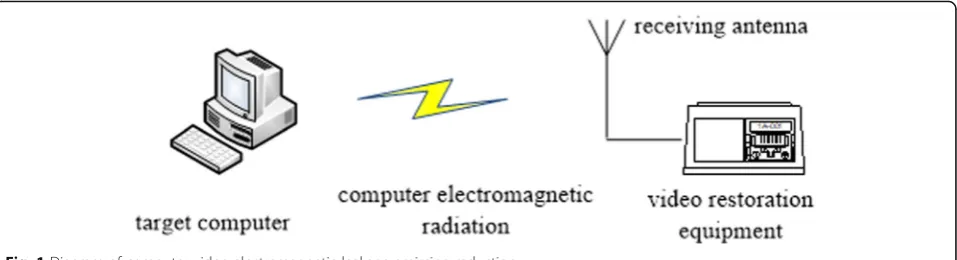
A typical computer video electromagnetic leakage emis-sion reduction is shown in Fig. 1. The video restore de-vice has no physical connection to the target stealing computer. The target computer generates electromag-netic radiation signals while operating and propagates through the air. Within a certain distance, the video res-toration device can receive the computer electromag-netic radiation signal through the receiving antenna, and parse the line and field synchronization signals, thereby reproducing the information on the target computer screen on the video restoration device. Generally, the video restoration device converts the received analog signal into a digital signal, which is displayed on the screen as a video signal consisting of a sequence of digits. Due to the influence of an airborne transmission channel, weak signal, equipment noise, etc., the reduced video signal loses greatly, and Gaussian noise and im-pulse noise are introduced at the same time. Noise and signal may be related or independent.
Gaussian noise is the largest proportion in the general electromagnetic leakage reduction sequence image. In the time domain, Gaussian noise is irrelevant to every coordinate point of the time axis, and its average value is 0. If the Gaussian noise can be effectively eliminated, the image noise can be reduced, and the signal-to-noise ratio of the electromagnetic leakage emission reduction image can be improved.
is more serious in a single frame, the signal distribution is regular in a statistical sense, and the noise of each frame image can be randomly and uniformly distributed. A relatively effective method is the average accumulation method of each frame-related image, which can greatly improve the SNR of the image. The principle is as follows:
To assume thatg(x,y) is a noise image,n(x,y) is noise,
f(x,y) is the original image, which can be represented in the following formula:
g xð ;yÞ ¼ f xð ;yÞ þn xð ;yÞ ð1Þ
Take the images with the same content but different
noises in theMframe and superimpose them, then do the
average calculation, as shown in the following formula:
g xð ;yÞ ¼ 1 M
XM
j¼1
gjðx;yÞ ð2Þ
In an ideal case, it follows that:
Efg xð ;yÞg ¼f xð ;yÞ ð3Þ
σ2
gðx;yÞ ¼
1
Mσ 2
nðx;yÞ ð4Þ
Efgðx;yÞgisgðx;yÞ’s mathematical expectation, and σ2
g
ðx;yÞand σ2
nðx;yÞare the variance of the sum between g
ðx;yÞ and n(x,y) on the (x,y) coordinates. The mean variance of any point in the average image can be ob-tained by the following formula:
σgðx;yÞ ¼ 1
ffiffiffiffiffi
M
p σnðx;yÞ ð5Þ
As can be seen from the above two formulas, the variance of the pixel value decreases with the increase
of M, indicating that the deviation of the pixel gray
value is caused by noise decreases with the average re-sult. It can be seen from formula 6 that when the num-ber of noise images processed as average increases, their statistical average value will be closer to that of the original non-noise image.
According to the calculation formula of SNR:
S N p¼
S σgðx;yÞ
¼ 1 S
ffiffiffiffiffi M p σnðx;yÞ
¼pffiffiffiffiffiM S σnðx;yÞ
¼pffiffiffiffiffiM S N d:
ð6Þ
The above formulaðS
NÞpis the SNR of the multi-image lin-ear accumulation averaging method, andðNSÞdis the SNR of the single-frame image. Therefore, it can be inferred that the
M frame image can improve the signal-to-noise ratio pffiffiffiffim after linear accumulation averaging of multiple images. The-oretically, by increasing the number of images used for aver-age, the deviation of image gray value caused by noise can be reduced, and the signal-to-noise ratio can be improved.
2.2 Multi-frame cumulative average application
This is an ideal analysis, but it is not the case that more im-ages are better. In practical application, the video signal synchronization accuracy problem of the reduction device
can accurately capture to receive images of line
synchronization and frame synchronization, and the average frame accumulation in the actual test is often more than a certain number of frames. In the superimposed effect, the number of image superposition effect can cause the average image to produce larger edge blur, which influences the reso-lution of image detail.
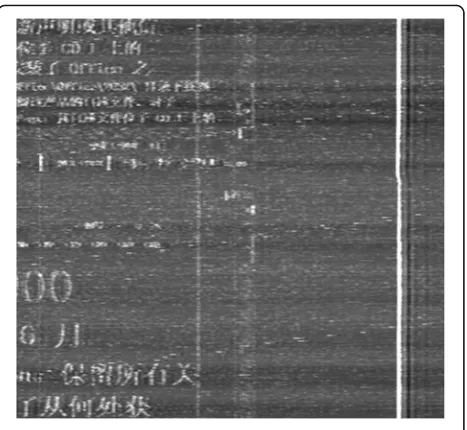
In this paper, a 30-frame image of the electromagnetic leakage reduction sequence is selected as the multi-frame accumulation average sample. Figure2shows the original information of the image with noise in the first frame. Figure3 is the cumulative average result of 10 consecu-tive frames, while Fig. 4is the cumulative average result of 20 consecutive frames.
image quality must be further improved by correcting the deviation between images in the image processing of accu-mulation average. That is to say, the migration feature is re-trieved for the adjacent images through a certain algorithm to find the offset, and the effect of the offset is removed when multiple frames are accumulated.
2.3 Image migration feature retrieval algorithm
The core of image migration feature retrieval is to find the offset in the x direction and y direction. Therefore, it is important to find the offset accurately by a certain match-ing algorithm. Ideally, when all pixels of the two images have the same gray value, it can be assumed that the two images are perfectly matched. It is not exactly the same as
the noise. In addition, the matching difference under dif-ferent SNR images should also be considered.
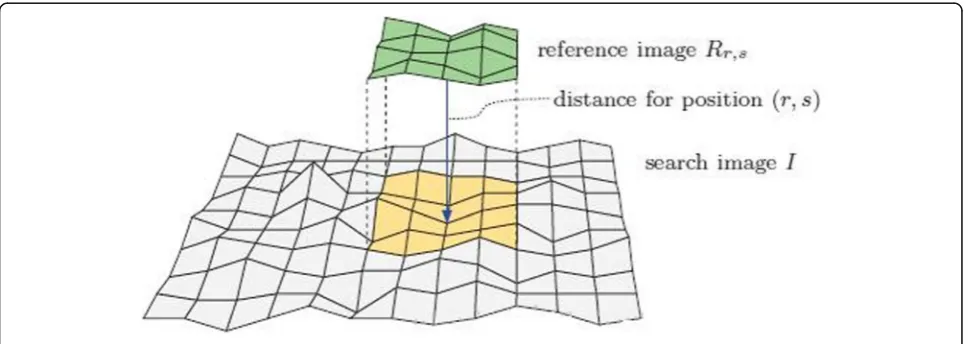
By matching two sequence images, the migration pos-ition of two images can be located. In other words, select the specific image as the reference image in the first image, and then use the reference image to traverse the second image and find the most similar sub-image as the final matching result among all sub-images that can be obtained. The basic principle of image feature retrieval is to find the reference image and the coordinate position of the retrieved image by relevant calculation. The process of image feature retrieval is shown in Fig.5.
WhereRis the reference image,Iis the searched image,
H is the height of the I image, W is the width of the I
image,R0,0is the display schematic of the reference image at the coordinates (0,0) of the I image, and Rr,s is the
Fig. 2First frame of the original image
Fig. 310-frame cumulative average image
Fig. 4Cumulative average of 30 frames
display schematic diagram of the reference imageRshifted to the coordinates (r,s) of theIimage.
The template matching in the gray image is mainly to find the same or most similar position of the template
imageRand the sub-image in the searched imageI. The
following formula shows that the reference image R is
shifted by R and s in the horizontal and vertical direc-tions of the searched imageI.
Rr;sðu;vÞ ¼R uð −r;v−sÞ ð7Þ
The most important thing in template matching is to find a similarity measure function. In order to measure the similarity degree between images, we calculated the
“distance” D(r,s) of the reference image after each shift (r,s) and the corresponding sub-image in the searched image (as shown in the figure below) (Fig.6).
Assuming that the reference image Ris placed on the
searched image I and translated, the block of the search map covered by the translation of the reference image is called theIr, ssubgraph, whererands are the offset dis-tance. As can be seen from figure X, the offset distance valueris equal to the coordinate of the pixel in the upper
left corner of the subgraph on the Igraph.M andNare
the width and height of the reference image. The measure functionD(r,s) that measures R and Ii, jis the degree of similarity which can be divided into the following. The smallerD(r,s) is, the higher the degree of similarity is.
(1)Sum of absolute difference (SAD)
The formula of measure function of SAD algorithm is as follows:
D rð ;sÞ ¼X
M
m¼1
XN
n¼1
Ir;sðm;nÞ−R mð ;nÞ
½ ð8Þ
whereD(r,s) represents the value to measure the similar-ity, that is, the sum of the absolute value difference of
gray value between the search subgraph and the refer-ence image.Ir,s(m,n) denotes the gray value of the coor-dinates at (m,n) after the offsetrand s.R(m,n) denotes the gray value of coordinates at (m, n) in the reference image. Given that the width and height of the search
image I are W and H, the size of the search subgraph
must be consistent with that of the reference image. Therefore, the values ofrand sin the process of traver-sal should be removed. That is to say, the search range is limited to 1≤r≤W −M, 1≤s≤H −N. The smaller
D(r,s) is, the more similar it is, and the matching pos-ition can be determined only by finding the smallest
D(r,s) in the graph. M and N refer to image R and the width and height of the subgraphs covered in search graphI, respectively.
(2)Sum of squared differences (SSD)
The measure function formula of SSD algorithm is as follows:
D rð ;sÞ ¼X
M
m¼1
XN
n¼1
Ir;sðm;nÞ−R mð ;nÞ
½ 2 ð
9Þ
Expand the above formula and get:
Dðr;sÞ ¼X
M
m¼1
XN
n¼1
½Ir;sðm;nÞ2−2X
M
m¼1
XN
n¼1
Ir;sðm;nÞ
Rðm;nÞ þX
M
m¼1
XN
n¼1
½Rðm;nÞ2
ð10Þ
The third term on the right is a constant and is in-dependent of the matching offset distance, which can be ignored when calculating the minimum distance. The first term is that the energy of the subgraph, which is covered by the template, changes slowly
from place to place. The second term is the interrela-tion between the sub-image and the template, which changes with the reference point of the retrieval. When the template and the subgraph match, the value of this term is the maximum. Therefore, the following normalized correlation function can be used for similarity measurement:
Cðr;sÞ ¼
XM
m¼1 XN
n¼1
Ir;sðm;nÞ Rðm;nÞ
ffiffiffiffiffiffiffiffiffiffiffiffiffiffiffiffiffiffiffiffiffiffiffiffiffiffiffiffiffiffiffiffiffiffiffiffiffiffiffiffiffiffiffiffiffiffiffiffiffiffiffiffiffiffiffiffiffiffiffiffiffiffiffiffiffiffiffiffiffiffiffiffiffiffiffiffiffiffiffiffiffiffiffiffiffiffiffiffiffiffiffiffiffiffi XM
m¼1
XN
n¼1
½Ir;sðm;nÞ2
! ffiffiffiffiffiffiffiffiffiffiffiffiffiffiffiffiffiffiffiffiffiffiffiffiffiffiffiffiffiffiffiffiffiffiffiffiffiffiffiffiffiffiffiXM
m¼1
XN
n¼1
½Rðm;nÞ2 ! v u u t v u u u t
ð11Þ
When the gray value of both the reference image and the search image sub-image is positive, the value ofC(r,s) is always within the range [0,1], independent of the gray value of other pixels of the image. WhenC(r,s) is equal to 1, it indicates that at the translation position (r,s), the ref-erence image, and sub-image reach the maximum similar-ity. On the contrary, whenC(r,s) is equal to 0, it indicates that at the translation position (r,s), the reference image, and the sub-image do not match at all. The normalized cross-correlationC(r,s) also changes dramatically when all the gray values in the sub-images change. By calculating the size ofC(r,s), the maximum value can be found, so the corresponding subgraph can be found in the Ir, s(m,n) graph, that is, the matching target.
2.4 The influence of image signal-to-noise ratio on migration feature retrieval
SNR can affect image feature retrieval. For a template image, the factors affecting feature retrieval have their own reasons. For example, the gray distribution of the image searched is relatively consistent, and there are more pixels belonging to a certain gray level. That means that the more details in the image template, the better the registration could become. Ideally, it should be zero. In practical application, feature retrieval is usually not ideal. It is to find the target in a certain frame. The difference of the noise in this frame will affect the feature retrieval of the image. If the signal isf(x,y) and the noise isn(x,y), the image with noise can be represented by formula 1, then formula 9 becomes:
Dðr;sÞ ¼X M
m¼1 XN
n¼1
fr;sðm;nÞ þnr;sðm;nÞ−fRðm;nÞ−nRðm;nÞ
ð12Þ
Formula 10 becomes:
Dðr;sÞ ¼X
M
m¼1
XN
n¼1
fr;sðm;nÞ þnr;sðm;nÞ−fRðm;nÞ−nRðm;nÞ
2
ð13Þ
As shown in the above formula, when the signal noise of the sequential image is relatively low, the influence of the signal is smaller than that of the noise, and even the signal can be neglected. At this point, image feature re-trieval is mainly the feature of noise, and noise is the com-bination of all kinds of noise, so the randomness is relatively strong. Therefore, the minimum value of the found D(r,s) is not necessarily the position of image matching, and the error can easily occur.
2.5 Image migration feature retrieval steps
Image migration feature retrieval is a method to estimate the current target location by using the reference template obtained from the previous image to find the most similar region in the current image. As the received text image is static, the effective information of the two adjacent frames does not change much and the random noise is different. Migration feature retrieval steps are as follows:
1) Read the adjacent images of two frames, which are Image 1 and Image 2 respectively.
2) Select a templateRin Image 1 as the reference image for traversal search.
3) Select Image 2 as the searched imageIand calculate according to the algorithm selected by formula 9 or formula 12 to get the image matching position, and then calculate the offset of the two frames of image according to the templateR. 4) Image 1 and corrected and offset Image 2 are
overlapped to obtain the new image on average. 5) Take the new image after superposition as Image 1
and select templateRto continue matching and superposition with the next image.
6) The process of multiple calibration is the repetition of the above process. Each time, take the image after the average superposition of the previous calibration and calibrate it with the next image, and then average the superposition.
In the actual algorithm implementation process, appro-priate templates, search objects, and algorithms can be se-lected according to the characteristics of sequence images.
3 Experimental results
and high signal noise. For the image processing of this sys-tem, the multi-frame average method has a significant ef-fect on noise removal, while the existing multi-frame cumulative deviation error will affect the image processing effect, resulting in the image edge blurring and poor read-ability. Therefore, the deviation of each frame image must be minimized. For the received sequence images, the image migration feature algorithm is adopted to complete the calculation of the migration frame number, which can reduce the accumulated error. There are many factors in-fluencing the matching process. First of all, the number of frames of the image is relatively large, and it is proved by experiments that the number of frames of the multi-frame accumulation method should be more than 10. We choose 100 frames (theoretically, the more the cumulative number of images to be processed, the better the results could become, because the existing image inter-frame mi-gration and limited registration accuracy lead to the bad effect of excessive cumulative number of frames).
In the experiment, we selected 100 images, and it was im-possible to match each image from the calculation speed. Secondly, the size of the image is very large which is the size of 1024 × 768, and it affects the time of each match. Considering the complexity of the image migration feature algorithm, the following processing methods are adopted:
(1) Select the appropriate templateR
The selection of the template size has a great impact on the speed of image matching. Under the same conditions, the smaller the image template is, the faster the image
matching processing speed could become. The larger the image template is, the worse the dynamic properties get, but the more detail it contains, the more accurate the image registration is. Taking into account the impact of both aspects, the template size can be selected according to different situations. In the actual application, the size of the template can be changed. In the test below, we se-lected the size of 412 × 78.
(2) Select the search object
Electromagnetic leakage emission reduction image has a strong correlation. Since the image that needs to be re-stored is the display text image, generally the image should be kept for a period of time, and the position of the same target in each frame of the image is changed slowly. Sync signal drift is the reason for causing image offset. In a short period of time, every frame image offset is roughly the same size, and the restore image feature is that the offset in a short period of time is comparatively fixed, which can be taken as a constant, so it could reduce the number of matching times and replace it with an aver-age number.
According to the characteristics of the sequence image, the last frame can be searched. Collecting 100 frame accu-mulation, for example, firstly find a template, choose the starting point of the first frame coordinates for the size of the (344,616) of 414 × 78 template, and then map-search the 100th frame, accordingly find the matching point, ac-cording to the location of the matching point to calculate the average deviation value per frame, in this way, the rest
Fig. 8Matching template image of frame 0
of the accumulative calculation can be more frames. If the signal is controlled by software, the deviation of the signal on they-axis will be excluded. In this way, the image mi-gration feature retrieval is only calculated in the x direc-tion, and the template also slides on a line, which will save a lot of time relatively, or the image migration feature re-trieval steps can be followed to match frame by frame, and the result will be more accurate.
According to the above selection results and consider-ing the calculation speed and data volume, there are four methods adopted in practice for image migration feature retrieval:
Method 1: As shown in formula 12, correlation match-ing is adopted.
Method 2: As shown in formula 9, absolute value matching is adopted.
Method 3: Implement method 1, but limit the area to be matched, set the matching rectangle box according to the features of the restored image to improve the oper-ation speed
Method 4: As method 2 is adopted, the matched re-gion should also be restricted. According to the charac-teristics of the restored image, the matching rectangle box is set to improve the operation speed.
The specific settings of methods 3 and 4 are as follows: firstly, the template position and size of the image in frame 0 are determined. Assuming that the template
image starts from (x, y), width is set as TWidth and
height as THeight. The selected starting point coordi-nates of the matching rectangular box is (0, y-yshift), width of the rectangular box is the width of the se-quence image, and height is THeight+2YShift. The par-ameter Yshift represents the maximum value of the offset on the sequence image which can be adjusted in the setting. In the optimal case, the value of Yshift is 0.
In Fig.7, a and b are respectively the images of frame 0 and frame 99 collected in the experiment. The size of the original image is 1024 wide and 768 high:
Select an area in frame 0, starting at (344,616) with a size of 412 × 78. Figure8is the matching template image
of the image at frame 0. In Fig. 9 (zoom out), the area
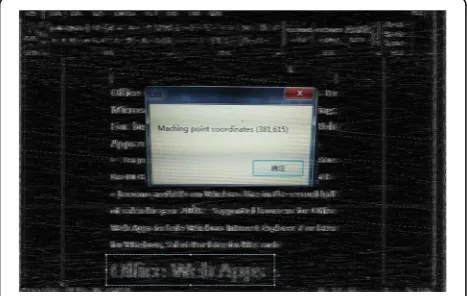
circled by dotted lines is the selection area of frame 0: After selecting the region, Fig.10is the result diagram in the matching process. The matching point is on (381,615), and the region surrounded by white lines is the matching target.
It can be seen from the matching results that the tem-plate image in frame 99 is offset from the original position of frame 0 in both vertical and horizontal coordinates. As can be seen from the experimental results, the image of frame 99 is downwarded by 1 coordinate unit relative to the image of frame 0, and it is shifted to the right by 37 co-ordinate units, which is approximately equivalent to one coordinate unit for every three frames of the image.
According to this migration rule, the sequence image can be corrected. The results show that in the case of high signal noise, all four methods have successfully found the correct offset, which lays a good foundation for the multi-frame ac-cumulation average. The correct offset is also found by ran-domly changing the reference image in frame 0.
In the practical application, by adjusting the receiving dis-tance and direction of the video information of the com-puter, the restored image under different signal-to-noise ratio can be obtained. Figure11shows the images of frame 0 and 99 after the adjustment.
By using the above four methods, accurate offset can be obtained only when certain regions with obvious fea-tures are selected as reference images, while there is a certain error when other non-obvious regions are taken as reference images. The experiments show that the ac-curacy of image matching is reduced when the signal noise is low and the image features are blurred.
4 Discussion
The SSD image migration feature retrieval algorithm has a large amount of matching calculation. If you want to do a full image search, you need to do a relevant calculation at (n−m+ 1) × (n−m+ 1) reference locations, and each
Fig. 9Selected area of the image at frame 0
correlation calculation needs to do 3 ×M×N addition, 3 ×M×Nmultiplication, two times square operation, and one time division. Because the arithmetic speed of multi-plication and division is slower than that of addition and subtraction, the arithmetic speed of SSD image migration feature retrieval is slower. In contrast, the SAD image mi-gration feature retrieval algorithm reduces multiplication; only subtraction and addition operation and the operation speed are greatly improved. However, it is proved by the experiments that the matching accuracy of the SSD image migration feature retrieval algorithm is higher than that of the SAD image migration feature retrieval algorithm.
In this paper, the frame matching of the electromag-netic leakage transmission receiving sequence images is completed by using the full-figure SSD image migration feature retrieval algorithm, the full-figure SAD image migration feature retrieval algorithm, the limited-range SSD image migration feature retrieval algorithm, and the limited-range SAD image migration feature retrieval al-gorithm. The effect evaluation is shown in Table1.
As shown in the Table1, the correlation method takes a long time to operate, but the result is highly accurate. The absolute value method takes a short time to operate, but the accuracy is relatively low. Aiming at the moving range of the image of electromagnetic leakage transmission
receiving sequence, the method of limiting range is se-lected to improve the speed of image matching.
5 Conclusions
In this paper, the principle of video electromagnetic leakage emission reduction is briefly introduced, and the multi-frame accumulation average method is proposed based on the noise characteristics of sequence images. The results show that the image shift is an important cause of the image blur-ring after multi-frame accumulation. In order to correct the image migration, this paper analyzed the characteristics of sequence images, proposed the image migration feature re-trieval algorithm and the implementation steps, and used the correlation between sequence images to verify the effective-ness of the image migration feature retrieval algorithm. Through experiment and comparison, in the case of high signal and noise, the image migration feature retrieval algo-rithm can accurately locate the image migration amount, can solve the inter-frame migration problem of multi-frame accumulation average, and can be applied to automatic mi-gration correction and multi-frame accumulation average. The results show that the image signal-to-noise ratio ob-tained by direct superposition of the image processed by the image migration feature retrieval algorithm is improved, and the recognition degree of video electromagnetic leakage emission reduction image is enhanced effectively. At the same time, in order to evaluate the image migration feature retrieval algorithm, four image migration feature retrieval al-gorithms were selected in this experiment, and image match-ing and speed comparison were conducted respectively. The limited range of the image migration feature retrieval algo-rithm can greatly improve the speed of image matching without reducing the accuracy of image matching.
There are still some limitations in the research work in this paper. For example, the two-frame sequence im-ages are of low signal noise with flat imim-ages, and no ob-vious feature details are available. As it is impossible to accurately select the appropriate reference images, there Fig. 11Image acquisition
Table 1Effect evaluation of four image matching methods
Operation time
Matching degree
SSD image migration feature retrieval algorithm
3.50 min High accuracy
SAD image migration feature retrieval algorithm
1.20 min Comparatively high accuracy
Limited range of SSD image migration feature retrieval algorithm
60.56 s High accuracy
Limited range of SAD image migration feature retrieval algorithm
20.01 s Comparatively
will be some errors in the image matching. In recent years, image matching technology has made great pro-gress and been applied in some fields. However, the elec-tromagnetic information security field is still in its infancy and needs further optimization. The next step in low SNR circumstance is expectedly to analyze the char-acteristics of the reference images and combine with the fuzzy matching, feature point matching, template match-ing, and edge detection of time sequence matching the-ory research results. Future studies are recommended to put forward a new suitable method for electromagnetic leakage reduction sequence image shift characteristics of the image retrieval algorithm in order to promote the application of image processing in the electromagnetic field of information security and innovation.
Acknowledgements
The authors thank the editor and anonymous reviewers for their helpful comments and valuable suggestions.
Funding
Not applicable.
Availability of data and materials
Please contact author for data requests.
Authors’contributions
All authors take part in the discussion of the work described in this paper. All authors read and approved the final manuscript.
Competing interests
The authors declare that they have no competing interests.
Publisher’s Note
Springer Nature remains neutral with regard to jurisdictional claims in published maps and institutional affiliations.
Author details
1
School of Computer and Information Technology, Beijing Jiaotong University, Beijing, China.2Institute of Information Engineering, Chinese
Academy of Sciences, Beijing, China.
Received: 29 October 2018 Accepted: 20 January 2019
References
1. Z. Qian et al., Analysis and reconstruction of conduction leakage signal of computer video cable based on the spatial correlation filtering method. Chinese Journal of Radio Science32(3), 331–337 (2017)
2. C. Ulaş, U. Aşık, C. Karadeniz, Analysis and reconstruction of laser printer information leakages in the media of electromagnetic radiation, power, and signal lines. Computers & Security58(2), 250–267 (2016)
3. Ding, Jian Feng, et al. "New threat analysis of electromagnetic information leakage in electronic equipment based on active detection.
"Communications Technology (2018)
4. Gong, Yanfei, et al. "An analytical model for electromagnetic leakage from double cascaded enclosures based on Bethe’s small aperture coupling theory and mirror procedure." Transactions of China Electrotechnical Society (2018) 5. S. LEE H, G. YOOK J, K. SIM,An Information Recovery Technique from Radiated
Electromagnetic Fields from Display Devices[C]//2016Asia-Pacific International Symposium on Electromagnetic Compatibility.Piscataway IEEE(2016), pp. 473–475 6. S. WANG, Y. QIU, J. TIAN, et al., Countermeasure for electromagnetic
information leakage of digital video cable[C]//2016Asia-Pacific International Symposium on Electromagnetic Compatibility.Piscataway. IEEE, 44–46 (2016) 7. I. Frieslaar, B. Irwin, inInformation security for South Africa IEEE. Investigating
the electromagnetic side channel leakage from a raspberry pi (2018)
8. H.Z. Xiao, L.F. Yu, Z. Qin, H.G. Ren, Z.W. Geng, in2016 IEEE 13th International Conference on Signal Processing ( ICSP). A point matching algorithm for brain CT images based on SIFT andgray feature (2016), pp. 6–10
9. X.J. Qu, Y. Sun, Y. Gu, S. Yu, L.W. Gao, in2016 12th International Conference on Natural Computation, Fuzzy Systems and Knowledge Discovery ( ICNC-FSKD). A high - precision registration algorithm for heterologous image based on effective sub - graph extraction and feature points bidirectional matching (2016), pp. 13–15
10. TAKASU T, KUMAGAI Y, OHASHI G. Object extraction using an edge-based feature for query-by-sketch image retrieval [J]. Ieice Transactions on Information & Systems, 2015, E98 D(1): 214–217
11. Z.S. Ding, S. Qian, Y.L. Li, Z.H. Li, inNAECON 2014- IEEE National Aerospace and Electronics Conference. An image matching method based on the analysis of grey correlation degree and feature points (2014), pp. 24–27 12. A. Konar, S. Saha, "Fuzzy image matching based posture recognition in ballet
dance." IEEE international conference on fuzzy systems. IEEE, 1–8 (2018) 13. J. Ma et al., Guided locality preserving feature matching for remote sensing
image registration. IEEE Transactions on Geoscience & Remote Sensing 56. 8, 4435–4447 (2018)
14. S. Li, R. Shi,"The comparison of two image matching algorithms based on real-time image acquisition." Packaging Engineering(2016)
15. K. Sun et al.,"Feature guided biased Gaussian mixture model for image matching." Information Sciences 295.C(2015), pp. 323–336
16. Q. Zhu et al., Investigation on the image matching algorithm based on global and local feature fusion. Chinese Journal of Scientific Instrument (2016) 17. C.F. Olson, Maximum-likelihood image matching. Pattern Analysis &
Machine Intelligence IEEE Transactions on24(6), 853–857 (2016) 18. W. Bao et al., inJournal of Southeast University. Image matching algorithm
based on elliptic metric spectral feature (2018)
19. M.-M. Rohé et al.,SVF-Net: Learning Deformable Image Registration Using Shape Matching(2017), pp. 266–274