R E S E A R C H
Open Access
A statistical approach for person verification
using human behavioral patterns
Felipe Gomez-Caballero
*, Takahiro Shinozaki, Sadaoki Furui and Koichi Shinoda
Abstract
We propose a person verification method using behavioral patterns of human upper body motion. Behavioral patterns are represented by three-dimensional features obtained from a time-of-flight camera. We take a statistical approach to model the behavioral patterns using Gaussian mixture models (GMM) and support vector machines. We employ the maximum likelihood linear regression adaptation method to estimate GMM parameters with a limited amount of data. Experimental results show that it reduced by 28.6% the relative equal error rates from a system using the maximum likelihood estimation with 25 samples per subject. We also demonstrate that the proposed approach is robust against variations in body motion over time.
Keywords: Person verification; Behavioral biometrics; GMM; SVM; Time-of-flight camera
1 Introduction
Identity verification systems are getting popular in our daily life. They provide a secure means of controlling access to information or equipment. Traditionally, these systems have required something thatone has or some-thing thatone knows(e.g., keys and password). However, these representations of identity can be easily lost, manip-ulated, or stolen. This problem can be solved by a bio-metrics approach, which identifies an individual based on his/her characteristic traits. Biometrics can be divided into two classes [1]: physiological and behavioral.
Physiological biometrics uses physical traits, such as fingerprint or the iris [2]. This type of biometrics is stable and accurate since it relies on unique and perma-nent physical traits. However, they cannot be changed or reissued if the biometric data are exposed or coun-terfeited [3]. They are also perceived as obtrusive [4]. In behavioral biometrics, a person’s identity is verified through action patterns which can be repeated in a unique manner [5]. In comparison to physiological biometrics, behavioral biometrics are less stable since behavior may change due to the environment or the physical state of the individual. On the other hand, they are not obtru-sive and are difficult to disguise or to be imitated by
*Correspondence: [email protected]
Tokyo Institute of Technology, 2-12-1 Ookayama, Meguro-ku, Tokyo, 152-8552, Japan
others [6]. Examples of behavioral biometrics include voice, keystroke dynamics, signature, and gait. Voice can be used for remote identity verification [7]. Keystroke verifies the identity of a user while he/she uses a com-puter [8]. Signature can be used in online transactions [9]. Gait has been proven to be useful for surveil-lance applications where data can be collected from a distance [10].
In this paper, we focus on the individuality of upper body motionas an alternative cue for identity verification applications where the acquisition of other behavioral bio-metrics is not feasible due to visual and space constraints. An example application is an automatic gatekeeper, where a person explicitly requests permission to access a secure area by performing a body gesture in front of a camera. Only a few studies have been done for this kind of appli-cation. Pratheepan et al. used arm waving motion [11] and simple actions such as sitting down, standing up, and walking away [12] for individual identification in surveil-lance applications. These studies used holistic features which represent characteristics from a region of interest of a person as a whole [13]. They used these features to create templates that represent each person’s behavioral patterns.
The holistic features used in the above mentioned works are sensitive to visual variations such as cloth-ing differences and view and scale changes since they
rely on global information about a person’s appearance [14]. To reduce the effects of visual variations, human body models describing the kinematic properties (skele-ton) or the shape of the body have been used for fea-ture extraction in gait recognition [15]. By doing this, it is possible to extract features from joint positions to alleviate the effects introduced by clothing changes or noise. However, this technique requires localization and tracking of specific human body parts, which are often erroneous.
Accurate extraction of features also depends on the cor-rect segmentation of a person from the background scene, which can be affected by texture and illumination changes [16]. Recently, time-of-flight (ToF) cameras have been used to reduce such errors by simplifying background seg-mentation [17,18]. Furthermore, ToF cameras have a low dependency on lighting conditions and invariance to color and texture.
In previous approaches [11,12], extracted features were utilized to create a template characterizing a person’s motion. However, templates are weak against the natural variations of individual behavioral patterns since they only encode an average representation of observed samples [19]. Statistical models such as Gaussian mixture models (GMM) and hidden Markov models (HMM) have success-fully handled variations in individual behavioral patterns [20-23]. For example, Kale et al. [21] showed that HMMs were more robust than templates for gait recognition. Sta-tistical models usually exhibit higher accuracy than tem-plates since they model intraindividual variations well and are also able to handle variations in the sample duration. One drawback is that a relatively larger amount of data is needed to estimate their parameters. The data sparseness problem is significant when the training data are limited, which is often solved by adaptation techniques such as maximuma posteriori(MAP) [24], maximum likelihood linear regression (MLLR) [25], and eigenspace-based techniques [26].
In this paper, we propose a statistical method for person verification based on behavioral patterns of human upper
body motion, extending our prior work published in [27] and later in [28]. We use depth information acquired from a ToF camera to extract characteristic features from spe-cific parts of the body in the three-dimensional (3D) space. GMMs are used to robustly model individuals’ behavioral patterns. To cope with the problem of data sparseness, we use the MLLR adaptation technique. For identity ver-ification tests, we combine GMMs with support vector machines (SVM) [29] and compare its performance with the GMM log-likelihood ratio framework. Lastly, we eval-uate our method using a data set containing samples collected over different sessions to demonstrate that it is able to verify the identity of a person even after a period of time.
The remainder of this paper is organized as follows. Section 2 gives a brief overview of the adopted process for person verification. Section 3 describes the features that are used for person verification in our approach. Section 4 describes the statistical modeling and adap-tation techniques used to model a person’s behavioral patterns. Section 5 describes the classifiers used for person verification systems. In Section 6, experimen-tal conditions are explained and results are presented. Finally, conclusion and future work are described in Section 7.
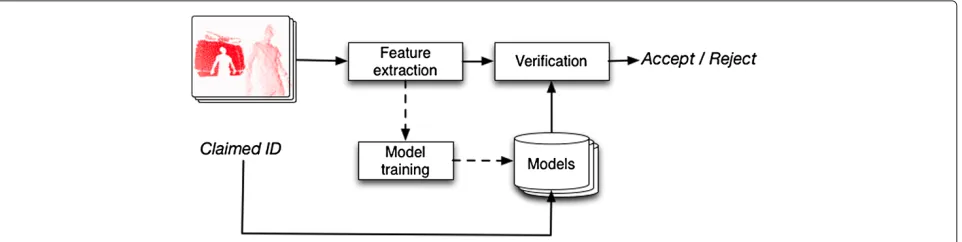
2 Overview of our person verification system Figure 1 shows an overview of our system, consisting of three major phases: feature extraction, model train-ing, and verification. In the feature extraction phase, the video input is processed to extract features from a human upper body motion. In the model training phase, sta-tistical models are created for each person using the extracted features. In the verification phase, a sample input is matched against the claimed person’s model to produce a score. If the score is above a threshold, the iden-tity claim is accepted by the system, otherwise rejected. In our approach, we focus on capturing short image stream samples of two kinds of upper body motion: a vertical motion of either the left or right arm.
3 Feature extraction
We implement an image processing front-end to locate and track eight anatomical landmark points on depth image streams acquired by the ToF camera. The input consists of image streams acquired from a Swissranger SR4000 camera (MESA Imaging, Zurich, Switzerland) [30] at approximately 20 frames per second. Each image frame represents the scene depth map with a resolution of 177×144 pixels and a field of view of 43.6°×34.6°. Each pixel has an accuracy higher than 1 cm within the distance measurement range of 5 m.
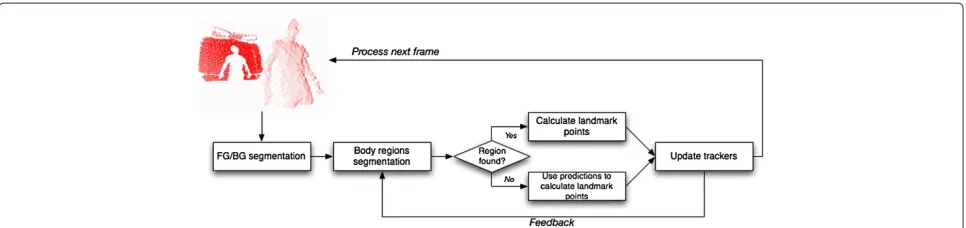
Figure 2 shows an overview of the feature extrac-tion algorithm implemented in the image processing front-end. For each frame, it segments the foreground/ background to find the person in the scene. For the seg-mentation, it employs a simplified region growing strategy [31] which aggregates pixels with similar characteristics to a cluster or region. The growing process starts from a seed pixel that initializes a reference for region building, and it decides if a pixelb is considered a part of the current regionRaccording to the following equations:
∃a∈R, Dist(a,b) < θ → {b∈R} (1)
Dist(a,b)=|Da−Db| (2)
where Dist(a,b)is the distance between pixelaand pixel b,DaandDbare the depth value of pixelsaandb,
respec-tively, and pixelais the seed or a pixel already aggregated toR.
Pixel b is selected from among the four connected neighbor pixels of a, unless it is already a part of the region. The threshold θ in Equation 1 is determined empirically based on preliminary experiments. The region continues growing recursively until no neighbor pixel can satisfy the condition in Equation 1, and then only the regionR, depicting the body of a person, remains.
Next, the algorithm segments the person’s body into four different regions (i.e., chest, head, left, and right arms). First, it finds a chest rectangle around the center of mass of the body. Then it performs few iterations of expanding and shrinking until 15% of its total area does
not contain pixels from the body region. The 15% empty area represents the space between the arms and chest due to the ‘open arms’ position which each subject takes at the beginning of recording or some possible holes in the body region due to noisy data. After setting the chest rectangle, the algorithm segments the head and both arm regions by region growing with a constrained search space. For the head, region growing starts from the middle point at the top edge of the chest rectangle, and the growing is con-strained to the upper sector. For the right/left arm, region growing starts at the corresponding top vertex of the chest rectangle, and growing is constrained to its correspond-ing side. In case a previous landmark point position (i.e., elbows and head) is available, the algorithm uses it as a seed for the growing. Each region is labeled as detected if its area is larger than a threshold, which is empirically set by preliminary tests.
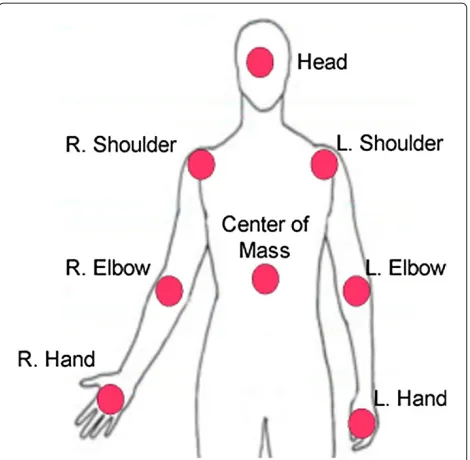
After body segmentation, the algorithm calculates eight landmark points. The algorithm registers the 3D corre-spondence of the rectangle’s top vertex points as the left and right shoulder points. Also, it registers the 3D corre-spondence of the rectangle’s center as the center of mass of the body. The head point is obtained by taking the 3D correspondence of the calculated center of mass of the head region. For the elbow and hand points, skeletoniza-tion operaskeletoniza-tion [32] is applied on each arm region to find the longest single pixel line starting from the shoulder point. We assume that the hand point can be found at the end of the line produced by skeletonization and that the center of mass of this line corresponds to the elbow point. Finally, a Kalman filter [33] for each landmark point is updated to estimate its position in the next frame. If a region is not found, the estimate calculated in the previous frame is used. The Kalman filter is used for visual tracking in order to cope with ambiguities when capturing human movement.
Figure 3 shows the eight landmark points that are used to calculate static and dynamic features from the human upper body. These features are used to create a repre-sentation of the person’s behavioral patterns. The static
Figure 3Body landmark points.This figure shows the eight landmark points that are used to calculate static and dynamic features from the human upper body.
features used in our approach are the relative length and orientation of body parts in the three-dimensional space. For the dynamic features, we focus on analyzing the arm motion. The extracted features were selected based on a preliminary analysis where we compared the performance of different feature sets.
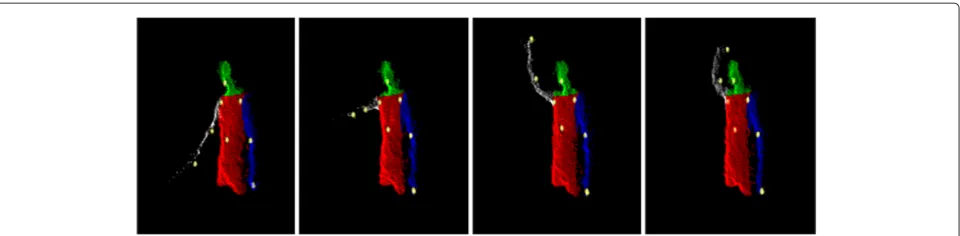
For each landmark point, 3D relative position is cal-culated (8 points × 3 dimensions). Velocity vectors are calculated for both elbows and hands (4 points×3 dimen-sions) since these points exhibit high level of motion on the image streams, and hence, they carry characteristic behavioral information of the subject. In addition, the 3D direction vectors relative to the chest region are calcu-lated only for the shoulders and head points (3 points× 3 dimensions) since subjects tend to show a characteris-tic posture that is visible on these points. The extracted vectors from the posture exhibited high inter-subject dif-ferences. By this setup, we create a 45-dimension feature vector that captures the dynamic and static characteristics of each person. Figure 4 shows four frames of a sam-ple processed by our feature extraction algorithm, where localized landmark points are represented as spheres on the body.
4 Statistical modeling based on Gaussian mixture models
In this section, we review the Gaussian mixture model and describe our motivation to use it to model behavioral pat-terns. A GMM is a parametric probability density function
represented as a weighted sum ofMcomponent Gaussian distributions [34], as given by the equation
p(x|λ)=
M
i=1
wig(x|μii), (3)
wherexis aD-dimensional continuous-valued data vec-tor (i.e., feature vecvec-tor), wi is the mixture weight, and
g(x|μii) is the component Gaussian distribution with mean vectorμi and covariancei. The mixture weights satisfy the constraint that Mi=1wi = 1. A GMM is
represented by its parameter set:
λ= {wi,μi,i} i=1,. . .,M. (4)
The parameters of a GMM are often obtained by max-imum likelihood (ML) estimation. Model parameters are iteratively estimated using the expectation maximization (EM) algorithm [35], where the original parameters (λ) are refined to increase the likelihood of the estimated model (λ) for the observed feature vectors¯ X, such thatp(X|¯λ)≥ p(X|λ). Assuming that feature vectors ofX= {x1,. . .,xT}
are independent, the log-likelihood of a model (λ) forXis computed as follows:
logp(X|λ)=
T
t=1
logp(xt|λ) (5)
A GMM can represent feature vectors by its mean com-ponents as well as represent their average variations by the covariance matrix. For this reason, it is possible to model the variations of individual features that character-ize a person. While other statistical models such as hidden Markov models and conditional random fields have been proven to be effective to model human motion [36], they are better suited for sequential actions characterizing an activity [37].
Figure 4Sample processed by our feature extraction algorithm.This figure shows four frames from a video sample processed by our feature extraction algorithm where localized landmark points are shown as spheres.
In MLLR, an affine transform(A,b) is applied to the Gaussian parameters (μ) of an initial model to create the parameters of a new person-dependent model (μ) byˆ
ˆ
μ=Aμ+b (6)
where A is an n × n transformation matrix (n is the dimensionality of the data), andbis a bias vector which maximizes the likelihood of the adaptation data. The parameters A and b are shared among all the mixture components of a GMM. To further reduce the number of parameters, we use a diagonal transformation. As an ini-tial model, a universal background model (UBM) [43] is often used. A UBM is a GMM trained by EM parame-ter estimation using the training data from all the subjects in the data set. The parameters of the UBM are adapted via MLLR to derive a person-dependent model using a specific person’s training data.
5 Person identity verification
In this task, an unknown person claims an identity and provides a sample to be compared with a model for the person whose identity is claimed. A match score between the claimed identity’s model and the input sample is com-puted, and if the score is above a threshold, the identity claim is accepted, otherwise rejected. We implement a GMM log-likelihood ratio and SVM classifiers for the person identity verification system and compare their performance.
5.1 Log-likelihood ratio
We use a hypothesis-testing framework to decide if the input sample x belongs to the claimed person or not. Under this framework, the hypothesisH0corresponds to the case wherexbelongs to the person whose identity is claimed, and the hypothesisH1 corresponds to the case where x is not from the claimed person. The hypothe-sisH0is represented by a person-dependent model,λpd, that characterizes the claimed person’s identity. For the alternative hypothesisH1, we use a UBM,λUBM, to char-acterize the entire space of possible alternatives to the
claimed person’s identity. The UBM characterizes the person-independent distribution of features of the sub-ject population expected during recognition. For an input sample x, a claimed person’s identity with correspond-ing model λpd, and the model of possible non-claimant personsλUBM, the likelihood ratio is
p(xis from the claimed person) p(xis not from claimed person) =
p(x|λpd) p(x|λUBM)
. (7)
Then we can obtain the log-likelihood ratio (LLR) [44] by
LLR=logp(x|λpd)−logp(x|λUBM), (8)
wherep(x|λpd)is the likelihood that the sample belongs to the claimed person, andp(x|λUBM) is the likelihood that the sample does not belong to the claimed person. If the LLR is above a threshold, the identity claim is accepted, otherwise rejected. The LLR scheme is often used for identity verification using probabilistic models since it measures how much better the claimant’s model scores for a test sample compared with a non-claimant model (i.e., the UBM). The likelihood normalization provided by the UBM in this scheme helps to minimize person-independent variations that would be common between target and non-target subjects. Figure 5 shows a diagram of this verification scheme.
5.2 Support vector machine
A support vector machine is a binary classifier which focuses on modeling of the boundary between two classes [29,45]. This makes it suitable for identity verification since we can model the boundary between the target per-son and impostors. It shows good performance especially when the amount of training data is small. A SVM is constructed as a sum of kernel functionsK(·,·),
f(x)=
L
i=1
αitiK(x,xi)+d, (9)
whereti is an ideal output (either +1 or−1, depending
Figure 5Log-likelihood ratio-based verification.This figure shows the log-likelihood ratio-based verification phase using person-dependent and UBM models.
or negative example of a given class), andαianddare the
SVM parameters set during the training step. The vector xi is a support vector obtained from a training set by an
optimization method. The data points from the training set lying on the boundaries are the support vectors.
We utilize two methods, SVM-S and SVM-T, where different input features are used. SVM-S employs GMM supervectors as input feature vectors [46,47]. A GMM supervector is formed by concatenating the mean vectors (μ) of GMM mixture components into a single vector. One GMM is created by adaptation using one sample as adaptation data. For training, positive feature vectors are made from the GMMs of the target subject, and negative feature vectors are made from the GMMs of non-target subjects.
SVM-T employs MLLR transformation parameters as input feature vectors [48,49]. The elements of the matrix
Aand the vectorbin Equation 6 are concatenated to form a single supervector. By doing this, it is possible to model the difference between the subject GMM and the UBM instead of modeling each subject’s characteristics. One supervector is obtained by performing MLLR adaptation using one sample as adaptation data. For training, positive feature vectors are made from the transformation param-eters of the target subject, and negative feature vectors are made from the transformation parameters of non-target subjects.
6 Experiments
6.1 Conditions
We collected a new data set to evaluate our method since there is no public database containing human upper body movements recorded with a ToF camera over several ses-sions. The data set used in our approach consists of short image streams of 12 subjects (three females and nine males), where each subject performed two different upper body movements separately. The movements are classi-fied as ‘raising left arm’ and ‘raising right arm’. The data were organized in five sessions recorded with an interval of 3 to 5 days between them. The first session (session 0) contains 25 samples per user for each movement and was used only for the model training phase. Each of the four remaining sessions contains eight samples per person for
each movement and was used only as testing samples. The average length per sample is 2.93 s, and the average frame number per sample is 70.5 frames.
Identity verification tests were conducted for each of the four sessions available for testing in the data set. In each session, we conducted eight verification trials per person where each trial used a single sample per sub-ject. System performance was measured by the equal error rate (EER) calculateda posteriorifor the optimal decision threshold. The EER is the value where the false acceptance rate and false rejection rate are equal. The obtained opti-mal threshold was used for all subjects. Detection error trade-off (DET) curves were also plotted to assess system behavior in the full range of operating points.
For the LLR system, we used person-dependent models adapted from a UBM by MLLR using a diagonal trans-formation and compared its performance with models obtained by ML estimation using the EM algorithm. Mod-els used in LLR systems were created with 16 Gaussian mixtures since this setup exhibited the best performance in our preliminary experiments. The Hidden Markov Model Toolkit [50] was used to train GMMs. Each of the SVM-S and SVM-T systems used 2, 4, 8, 16, and 32 Gaussian mixture variants. For the sake of simplicity, only configurations which exhibit the best result are presented in this paper. The SVM-light toolkit [51] was used to train the SVMs. Based on preliminary experiments, we chose linear kernel for SVM training.
6.2 Results
First, we show the accuracy results for a landmark point localization test. Then the results for person verification task are presented.
6.2.1 Body landmark point localization accuracy test
We examined the accuracy of the landmark point localiza-tion implemented on the image processing front-end. The measure was an average accuracy per landmark point for all subjects. We provided hand-labeled ground truth data and compared them to the landmark positions inferred by our method. If a landmark point was found withinD centimeters from the ground truth position, it was consid-ered as correctly localized, otherwise it was considconsid-ered as incorrectly localized. We setD=10 cm. This value is the same as the one used in the previous human pose recog-nition research [53]. The hand-labeled data consisted of image streams depicting left arm movements of five sub-jects (ten samples per person), recorded on a separate session under the same conditions as the rest of the data set.
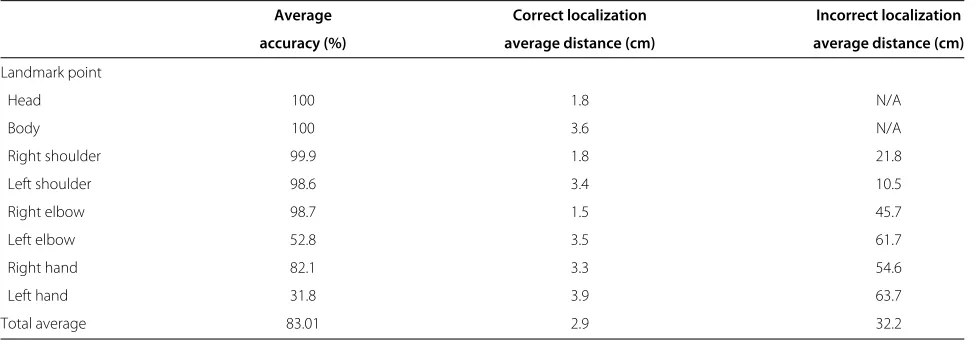
Table 1 shows the average accuracy results of each land-mark point as well as the average distance from the ground truth position for both correct and incorrect localizations. These results show that our method is able to accurately localize the body, head, shoulders, right elbow, and right hand points. However, the localization accuracy decreases for the left side elbow and hand points since the left arm exhibits quick motion.
Despite the low accuracy exhibited for the elbow and hand compared to other landmark points, the tracked points still follow the motion path thanks to the Kalman filter implementation. The measurement errors are smoothed by tuning the parameters of the Kalman filter to achieve a balance between the responsiveness of the tracker and estimate variance. By relying on the
Kalman filter, the tracking results are consistent across samples for each subject, which results in a tracker that exhibits low variance - high bias for the elbow and hand points. For this reason, we assume that the motion pat-tern is preserved to some degree even when the esti-mated position differs with respect to the ground truth position. Furthermore, by combining features from all landmark points, the effects of inaccurate estimations of elbow and hand points are minimized since the remain-ing landmark points are estimated and tracked more accurately.
6.2.2 Person verification results
Table 2 shows the average EER over four testing sessions of ML and MLLR estimation using the LLR classifier. We compare identity verification performance when either a full feature set or an arm feature set is used in both train-ing and testtrain-ing phases. The arm feature set consists of an 18-dimension feature vector including 3D position of the shoulder, elbow, and hand points; velocity vectors of the elbow and hand points; and direction vector of the shoul-der point. This feature vector represents only the traits observed on the moving arm.
By using the full feature set, the systems exhibit over-all higher performance compared to using only features from the arm in motion. The reason for this result is that the whole upper body takes part in the execution of the analyzed gestures. For example, subjects assume a slightly different posture when raising their arms, and a charac-teristic motion is observed on the arm that its not raised. The combination of these perceptible features allows the creation of better representations of individual behavioral patterns.
By using the full feature set, the ML estimation yielded an average EER of 9.1% for the left arm samples. The MLLR adaptation reduced the average EER from 9.1% to
Table 1 Landmark localization accuracy
Average Correct localization Incorrect localization
accuracy (%) average distance (cm) average distance (cm)
Landmark point
Head 100 1.8 N/A
Body 100 3.6 N/A
Right shoulder 99.9 1.8 21.8
Left shoulder 98.6 3.4 10.5
Right elbow 98.7 1.5 45.7
Left elbow 52.8 3.5 61.7
Right hand 82.1 3.3 54.6
Left hand 31.8 3.9 63.7
Total average 83.01 2.9 32.2
Table 2 Average equal error rate for the LLR system
Models EER(%)
Full feature set Arm feature set
ML (16) 9.1 15.9
MLLR (16) 6.5 17.4
The data presented are the average EER over four sessions for the LLR system with models created by ML and MLLR using left arm movement samples. A full feature set and an arm-only feature set were used to compare verification performance. The number within parentheses is the number of Gaussian mixtures in the GMM used for a given system configuration.
6.5%. The relative reduction in EER by 28% confirmed that MLLR adaptation was effective.
Table 3 shows the average EER over four testing ses-sions for our proposed LLR, SVM-S, and SVM-T systems. The accuracies in the left arm motion samples were higher than those in the right arm motion samples. Statisti-cal McNemar’s test [54] showed that differences between using the left arm and the right arm motion samples are statistically significant (Pvalue<0.001). The higher accu-racy in the left hand movement might be because this movement is more difficult to control intentionally. Thus, the difference of individual behavioral patterns is more perceptible. It is worth noting that most of the subjects included in the data set are right handed.
The two SVM systems achieved the same EER of 8.9% by using different numbers of Gaussian components for the GMM models used to construct the supervectors. However, contrary to our expectations, the LLR system with MLLR adaptation achieved 27% relative reduction in EER compared to the SVM system. McNemar’s test con-firmed that performance difference between the systems is statistically significant (Pvalue<0.001).
The reason why the SVM systems did not achieve a bet-ter performance might be the size of the data used to derive GMM models from which the supervectors were created. The number of frames per sample used for GMM model adaptation on the SVM-S and SVM-T systems was relatively small (70.5 frames in average), and thus, adapta-tion was less effective compared to the case of LLR system where person-dependent models were derived using all training samples of the target person.
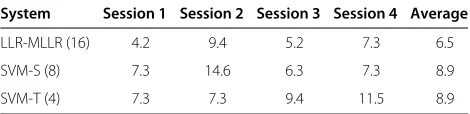
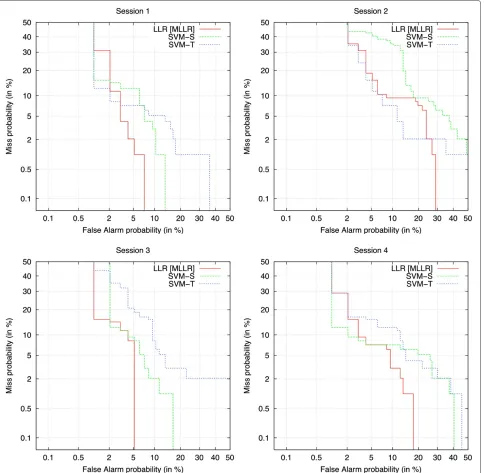
Table 4 shows the EER per session for the LLR and SVM systems, and Figure 6 shows DET curves for each of these
Table 3 Average EER over four sessions for verification task using left and right arm movements
System Left arm EER (%) Right arm EER (%)
LLR-MLLR (16) 6.5 17.7
SVM-S (8) 8.9 12.2
SVM-T (4) 8.9 35.7
The number within parentheses is the number of Gaussian mixtures in the GMM used for a given system configuration.
systems. It can be seen that the EER and the performance of each system vary over the four sessions due to the nat-ural change of behavior patterns of human body motion. However, EER does not increase considerably even though there is a time difference of 3 to 20 days between the training and testing sessions. We consider that the pro-posed method is robust against variations of behavioral patterns over time. Therefore, our approach is promising for general verification tasks.
For comparison purposes, we measured the training and testing time for each system. We used a PC with 8 GB RAM and a double-core Intel(R) Xeon(R) CPU running at 1.86 GHz. For the LLR system, the average training time for the UBM is 34 and 0.33 s for each person-dependent model by MLLR adaptation. For the SVM systems, the average training time is 21.91 s. The average testing time per sample for the LLR and SVM systems is 0.04 and 0.17 s, respectively.
7 Conclusions
We have proposed a statistical approach for person iden-tity verification using behavioral patterns observed on human body motion. In particular, we used behavioral patterns from left arm and right arm movements. By using a ToF camera, we simplified the segmentation of the human body to track specific human body parts in the 3D space. Since we extract static and dynamic fea-tures of human motion directly from identified landmark points, the effects of appearance changes were reduced. By taking a statistical approach, we effectively modeled the natural variation in features observed on behavioral patterns. To deal with the problem of data sparseness, we used the MLLR adaptation method along with a UBM to estimate parameters for person-dependent GMMs. In addition, we used GMM components and MLLR transfor-mation parameters as features to create supervectors in the context of SVMs.
We have shown that by using a model adaptation method in the training phase, the average EER of the LLR system was reduced to 6.5%, a relative reduction of 27% compared with our SVM systems. The reason why the SVM systems did not exhibit better performance might be because the model adaptation used to derive GMM models for creating supervectors was not as effective as
Table 4 EER per session for verification task using left arm
movement(%)
System Session 1 Session 2 Session 3 Session 4 Average
LLR-MLLR (16) 4.2 9.4 5.2 7.3 6.5
SVM-S (8) 7.3 14.6 6.3 7.3 8.9
SVM-T (4) 7.3 7.3 9.4 11.5 8.9
Figure 6Detection error trade-off curves.This figure shows the detection error trade-off curves at each of the four sessions for the LLR, SVM-S, and SVM-T systems.
the LLR system. While the verification performance did not improve by using SVM classifiers, we consider that providing a comparison against the LLR system is useful for future improvement of such an approach. We found that features extracted from the left arm motion sam-ples exhibit an overall higher degree of distinctiveness compared to those from the right arm motion samples. Furthermore, experimental results showed that our sys-tem is able to verify the identity of a person even after a period of time. Hence, our approach is promising for
person verification tasks even when natural variations in behavioral patterns exist. Although we used a vertical arm motion in our experiments, the approach presented in this paper is suitable for any other upper body movements or gestures as well.
cases when each subject performs a personal movement. We also plan on implementing a more robust landmark point localization and tracking method in order to min-imize errors introduced by ambiguities and noisy data. We are interested in implementing a HMM-based frame-work where more complex movements are used as a cue for identity verification, taking advantage of the tempo-ral information of such movements. We would also like to explore the use of the Kinect image sensor since it can acquire depth images with higher resolutions.
Competing interests
The authors declare that they have no competing interests.
Received: 25 September 2012 Accepted: 2 August 2013 Published: 8 August 2013
References
1. A Jain, A Ross, S Prabhakar, An introduction to biometric recognition. Circuits Syst. Video Technol., IEEE Trans.14, 4–20 (2004)
2. JL Lin, HL Hsu, TL Jong, WH Hsu, inPattern Recognition, Machine Intelligence and Biometrics. Biometric authentication (Springer Berlin, 2011), pp. 607–631
3. L O’Gorman, Comparing passwords, tokens and biometrics for user authentication. Proc. IEEE.91(12), 2021–2040 (2003)
4. E Vildjiounaite, SM Makela, M Lindholm, R Riihimaki, V Kyllonen, J Mantyjarvi, H Ailisto, inPervasive Computing.Lecture Notes in Computer Science, vol 3968. Unobtrusive multimodal biometrics for ensuring privacy and information security with personal devices (Springer Berlin, 2006), pp. 187–201
5. RV Yampolskiy, V Govindaraju, Behavioural biometrics: a survey and classification. Int. J. Biometrics.1, 81–113 (2008)
6. R Moskovitch, C Feher, A Messerman, N Kirschnick, T Mustafic, A Camtepe, B Lohlein, U Heister, S Moller, L Rokach, Y Elovici, inIEEE International Conference on Intelligence and Security Informatics, 2009. Identity theft, computers and behavioral biometrics (IEEE Piscataway, 2009), pp. 155–160 7. S Furui, inAdvances in Biometrics.Lecture Notes in Computer Science, vol
5558. 40 years of progress in automatic speaker recognition (Springer Berlin, 2009), pp. 1050–1059
8. K Revett, ST De Magalhães, HMD Santos, inProgress in Artificial Intelligence. 13th Portuguese Conference on Artificial Intelligence, EPIA’07. On the use of rough sets for user authentication via keystroke dynamics (Springer Berlin, 2007), pp. 145–159
9. G Bailador, C Sanchez-Avila, J Guerra-Casanova, A de Santos Sierra, Analysis of pattern recognition techniques for in-air signature biometrics. Pattern Recognit.44, 2468–2478 (2011)
10. S Sarkar, P Phillips, Z Liu, I Vega, P Grother, K Bowyer, The humanID gait challenge problem: data sets, performance, and analysis. Pattern Anal. Mach. Intell., IEEE Trans.27(2), 162–177 (2005)
11. Y Pratheepan, G Prasad, J Condell, inIEEE International Conference on Systems, Man and Cybernetics, 2008. SMC 2008. Style of action based individual recognition in video sequences (IEEE Piscataway, 2008), pp. 1237–1242
12. Y Pratheepan, P Torr, J Condell, G Prasad, inImage and Signal Processing. Lecture Notes in Computer Science, vol 5099. Body language based individual identification in video using gait and actions (Springer Berlin, 2008), pp. 368–377
13. J Davis, inProceedings of the IEEE Workshop on Detection and Recognition of Events in Video, 2001.Hierarchical motion history images for recognizing human motion (IEEE Piscataway, 2001), pp. 39–46
14. N Li, Y Xu, XK Yang, in2010 International Conference on Machine Learning and Cybernetics (ICMLC). Part-based human gait identification under clothing and carrying condition variations (Piscataway, 2010), pp. 268–273 15. DK Wagg, MS Nixon, inSixth IEEE International Conference on Automatic on
Face Gesture Recognition, 2004. On automated model-based extraction and analysis of gait (IEEE Piscataway, 2004), pp. 11–16
16. L Lee, W Grimson, inProceedings of the Fifth IEEE International Conference on Automatic Face and Gesture Recognition, 2002. Gait analysis for recognition and classification (IEEE Piscataway, 2002), pp. 148–155 17. R Jensen, R Paulsen, R Larsen, inDynamic 3D Imaging.Lecture Notes in
Computer Science, vol 5742. Analysis of gait using a treadmill and a time-of-flight camera (Springer Berlin, 2009), pp. 154–166 18. MO Derawi, H Ali, FA Cheikh, inBIOSIG. LNI, vol. 191. Gait recognition
using time-of-flight sensor (GI Bonn, 2011), pp. 187–194
19. N Boulgouris, D Hatzinakos, K Plataniotis, Gait recognition: a challenging signal processing technology for biometric identification. Signal Process. Mag., IEEE.22(6), 78–90 (2005)
20. A Sundaresan, A RoyChowdhury, R Chellappa, inProceedings of the 2003 International Conference on Image Processing, ICIP 2003, vol. 2. A hidden Markov model based framework for recognition of humans from gait sequences (IEEE Piscataway, 2003), p. II–93–6 vol. 3
21. A Kale, A Sundaresan, AN Rajagopalan, NP Cuntoor, AK Roy-chowdhury, V Krüger, Identification of humans using gait. IEEE Trans. Image Process.
13, 1163–1173 (2004)
22. MR Aqmar, K Shinoda, S Furui, Robust gait-based person identification against walking speed variations. IEICE Trans. Inf. Syst.95, 668–676 (2012) 23. D Reynolds, R Rose, Robust text-independent speaker identification using
gaussian mixture speaker models. Speech Audio Process., IEEE Trans.
3, 72–83 (1995)
24. J Luc, C Gauvain, H Lee, Maximum a posteriori estimation for multivariate gaussian mixture observations of Markov chains. IEEE Trans. Speech Audio Process.2, 291–298 (1994)
25. CJ Leggetter, PC Woodland, Maximum likelihood linear regression for speaker adaptation of continuous density hidden Markov models. Comput. Speech Lang.9(2), 171–185 (1995)
26. R Kuhn, P Nguyen, JC Junqua, L Goldwasser, N Niedzielski, S Fincke, K Field, M Contolini, inInternational Conference on Spoken Language Processing. Eigenvoices for speaker adaptation (ASSTA Camberra, 1998), pp. 1771–1774
27. F Gomez-Caballero, T Shinozaki, S Furui, User identification using time-of-flight camera image streams. Inf. Process. Soc. Japan Tech Rep.
2, 615–616 (2010)
28. F Gomez-Caballero, T Shinozaki, S Furui, K Shinoda, inProceedings of the 2011 Joint ACM Workshop on Human Gesture and Behavior Understanding, J-HGBU ’11. Person authentication using 3D human motion (ACM New York, 2011), pp. 35–40
29. N Vapnik,Statistical Learning Theory. (Wiley, New York, 1998)
30. T Oggier, M Lehmann, R Kaufmann, M Schweizer, M Richter, P Metzler, G Lang, F Lustenberger, N Blanc, An all-solid-state optical range camera for 3D real-time imaging with sub-centimeter depth resolution
(SwissRanger). Proc. SPIE Proceedings.5249, 534–545 (2004)
31. L Bianchi, R Gatti, L Lombardi, P Lombardi, inAdvances in Image and Video Technology.3rd Pacific Rim Symposium on Advances in Image and Video Technology. Lecture Notes in Computer Science, vol 5414. Tracking without background model for time-of-flight cameras (Springer Berlin, 2009), pp. 726–737
32. D Eberley,Skeletonization of 2D binary images. (Geometric Tools, Tumwater, 2008). http://www.geometrictools.com/Documentation/ Skeletons.pdf. Accessed 06 Aug 2013
33. RE Kalman, A new approach to linear filtering and prediction problems. J. Basic Eng.82(1), 35–45 (1960). doi:10.1115/1.3662552. http:// fluidsengineering.asmedigitalcollection.asme.org/article.aspx?articleid= 1430402
34. D Reynolds, Automatic speaker recognition using gaussian mixture speaker models. Lincoln Lab. J.8(2), 173–192 (1995). http://www.ll.mit. edu/publications/journal/journalarchives08-2.html#4
35. AP Dempster, NM Laird, DB Rubin, Maximum likelihood from incomplete data via the EM algorithm. J. R. Stat. Soc.39(Series B), 1–38 (1977) 36. M Mendoza, N Pérez De La Blanca, Applying space state models in
human action recognition: a comparative study. Articulated Motion and Deformable Objects.5098, 53–62 (2008)
37. T Starner, J Weaver, A Pentland, Real-time american sign language recognition using desk and wearable computer based video. IEEE Trans. Pattern Anal. Mach. Intell.20, 1371–1375 (1998)
39. O Thyes, R Kuhn, P Nguyen, JC Junqua, inSixth International Conference on Spoken Language Processing. Speaker identification and verification using eigenvoices (ISCA, Baixas, 2000), pp. 1–3
40. CH Lee, CH Lin, BH Juang, in1990 International Conference on Acoustics, Speech, and Signal Processing. A study on speaker adaptation of continuous density HMM parameters (Albuquerque, 3–6 April 1990) 41. CJ Leggetter, PC Woodland, Flexible speaker adaptation using maximum
likelihhod linear regression. Proc. ARPA Spoken Lang. Technol. Workshop.
9, 110–115 (1995)
42. MJF Gales, PC Woodland, Mean and variance adaptation within the MLLR framework. Comput. Speech Lang.10(4), 249–264 (1996)
43. DA Reynolds, TF Quatieri, RB Dunn, Speaker verification using adapted gaussian mixture models. Digit. Signal Process.10(1–3), 19–41 (2000) 44. DA Reynolds, WM Campbell,Text-independent Speaker Recognition.
(Springer, Berlin, 2008), pp. 763–782
45. N Cristianini, J Shawe-Taylor,Support Vector Machines. (Cambridge University Press, Cambridge, 2000)
46. WM Campbell, inIEEE International Conference on Acoustics, Speech, and Signal Processing (ICASSP), vol. 1. Generalized linear discriminant sequence kernels for speaker recognition (IEEE Piscataway, 2002), pp. I-161–I-164 47. W Campbell, D Sturim, D Reynolds, A Solomonoff, inIEEE International
Conference on Acoustics, Speech and Signal Processing, 2006, vol. 1. SVM based speaker verification using a GMM supervector kernel and NAP variability compensation (IEEE Piscataway, 2006), p. 97
48. A Stolcke, L Ferrer, S Kajarekar, E Shriberg, A Venkataraman, inProceedings of the 9th European Conference on Speech Communication and Technology. MLLR transforms as features in speaker recognition (ISCA, Baixas, 2005), pp. 2425–2428
49. M Ferras, CC Leung, C Barras, JL Gauvain, inOdyssey-2008. MLLR techniques for speaker recognition. (2008), paper 023
50. SJ Young, D Kershaw, J Odell, D Ollason, V Valtchev, P Woodland,The HTK Book Version 3.4. (Cambridge University Press, Cambridge, 2006) 51. T Joachims, inMaking Large-scale Support Vector Machine Learning
Practical, ed. by B Schölkopf, CJC Burges, and AJ Smola. Advances in kernel methods (MIT Press Cambridge, 1999), pp. 169–184 52. K Morik, P Brockhausen, T Joachims, inProceedings of the 16th
International Conference on Machine Learning (ICML-99). Combining statistical learning with a knowledge-based approach - a case study in intensive care monitoring (Morgan San Francisco, 1999)
53. J Shotton, A Fitzgibbon, M Cook, T Sharp, M Finocchio, R Moore, A Kipman, A Blake, inIEEE Conference on Computer Vision and Pattern Recognition. Real-time human pose recognition in parts from single depth images (IEEE Washington, D.C., 2011)
54. Q McNemar, Note on the sampling error of the difference between correlated proportions or percentages. Psychometrika.12(2), 153–157 (1947)
doi:10.1186/1687-5281-2013-44
Cite this article as:Gomez-Caballeroet al.:A statistical approach for person verification using human behavioral patterns.EURASIP Journal on Image and
Video Processing20132013:44.
Submit your manuscript to a
journal and benefi t from:
7Convenient online submission 7Rigorous peer review
7Immediate publication on acceptance 7Open access: articles freely available online 7High visibility within the fi eld
7Retaining the copyright to your article