O R I G I N A L A R T I C L E
Wavelength dependence of machining performance in UV-,
VIS- and NIR-laser cutting of wood
Satoshi Fukuta1•Masaki Nomura1• Takeshi Ikeda2• Masaki Yoshizawa2• Mariko Yamasaki3• Yasutoshi Sasaki3
Received: 4 December 2015 / Accepted: 18 March 2016 / Published online: 7 April 2016
ÓThe Japan Wood Research Society 2016
Abstract Cutting of wood using short-wavelength (266-, 355-, 532-, and 1064-nm) lasers was carried out and wave-length dependence in relation to machining performance and post-processing appearance was investigated. We found that a 355-nm-wavelength laser achieves the greatest machining performance. The variation in machining performance between different wavelengths was due to the different light absorptances of the woods: when we measured the spectral reflectance of the woods, we found that the greater the machining performance for a wavelength, the lower its reflection of light (and thus the greater its absorption). Assuming that the absorption of ultraviolet wavelength of 355 nm by wood is due to lignin, a lignin-free cellulose board was prepared for further investigation, and the same machin-ing and measurements were conducted. The results showed that machining progresses well via the absorption of laser light by lignin at the ultraviolet wavelength of 355 nm. On the other hand, when this cellulose board was impregnated with phe-nolic resin, there was high absorption of light between the ultraviolet range and wavelengths near 600 nm, machining progressed well at wavelengths of 355 and 532 nm.
Keywords Laser cuttingShort-wavelength laser Wavelength dependence
Introduction
As organic materials exhibit good absorption of CO2laser light, CO2laser of wavelength 10.6 lm has been applied almost exclusively in the machining of wood [1,2]. As the laser can provide high output power at a relatively low cost, CO2 laser has been used for cutting and welding applications that require high-speed machining with high output power, not only of wood but also other materials. Meanwhile, in the field of precision machining, short-wavelength lasers are being used that have, for example, wavelengths in the vicinity of Nd:YAG lasers (wavelength 1064 nm) and other, even shorter wavelengths. This is because, as the theoretical focal point diameter is propor-tional to wavelength, the use of short-wavelength lasers enables precise machining. In addition, lasers are normally irradiated at a short pulse width, as shortening the pulse width allows heat effects to the surrounding area to be controlled while increasing the peak power. In recent times, shorter and shorter pulse widths are being achieved, reaching nano-, pico-, and even femtoseconds.
Meanwhile, in our previous research [3], we attempted wood machining using a type of short-wavelength laser, ultraviolet (UV) lasers, specifically, third-harmonic-gener-ation Nd:YLF laser and Nd:YVO4laser (wavelengths 349 and 355 nm, respectively), and collected basic perfor-mance data. In practical terms, when we performed cutting, hole-drilling and then incising at the drilling site, we observed the superiority and effectiveness of these lasers: we were able to conduct precise cutting with little heat effect, as well as hole-drilling with an extremely high
Parts of this report were presented at the 9th Meeting of the Tokai Branch, Society of Materials Science, Japan, Nagoya, March 2015.
& Satoshi Fukuta
[email protected]; [email protected]
1 Industrial Research Center, Aichi Center for Industry and
Science Technology, 1-157-1 Onda-cho, Kariya, Aichi 448-0013, Japan
2 Laserx Co., Ltd, 7 Kofukada, Shinbayashi-cho, Chiryu,
Aichi 472-0017, Japan
3 Graduate School of Bioagricultural Science, Nagoya
University, Furo-cho, Chikusa-ku, Nagoya, Aichi 464-8601, Japan
aspect ratio, in a relatively short machining time. While one could use various other wavelengths that are generally classified as ‘‘short-wavelength’’, other than the wave-lengths of 349 and 355 nm used in our previous study, we have not found any reports of testing for a suitable wave-length in relation to wood machining. While there is one case [4] of hole-drilling at a depth of several millimeters by exposing wood to a pulse-irradiation ruby laser with a wavelength of 694 nm, this case was from an emerging era when laser had only just been discovered, and it is likely that the types of lasers that could be irradiated were lim-ited. Hattori et al. [5] compared the critical machining energy of Nd:YAG laser and CO2laser, but their findings were only on Nd:YAG laser, and no detailed quantitative evaluation has since been conducted.
Thus, in this study, we tested for suitable wavelength for wood machining by comparing the wood-machining per-formance of the base wavelength of Nd:YVO4 laser, 1064 nm, and of its second-harmonic generation (wave-length 532 nm), its third-harmonic generation (wave(wave-length 355 nm), and its fourth-harmonic generation (wavelength 266 nm), obtained by wavelength conversion, under uni-form conditions. We also investigated the causes behind the results.
Materials and methods
Wood specimens
The specimens used were heartwood of Japanese cedar (Cryptomeria japonica, hereafter, cedar), heartwood of Japanese larch (Larix kaempferi, hereafter, larch), and beech (Fagus crenata). From these woods, straight grain test specimens of 12 mm (L)96 mm (T) 970 mm (R) were prepared [with the exception of the beech, which was 4 mm (T)]. The partial density variation of cedar and larch is large because of the effect of annual rings. All machining was conducted on early wood: density was measured for each segment of early wood cut out, with the air-dried density of the cedar and larch being 0.31 and 0.35 g/cm3, respectively. The machining area was not limited for the beech, and the air-dried density of the beech was 0.62 g/cm3. All specimens were collected with end matching in the grain direction, and all were air-dried specimens having around 10 % moisture content.
Cellulose board specimens
In addition to the above woods, as a lignin-free material, a cellulose board specimen was prepared with 0.77 g/cm3 density using the following procedure. Briefly, a 6-mm-thick board was prepared by layering a predetermined
number of sheets of cellulose non-woven fabric (BEMCOT M-3II; Asahi Kasei Fibers Co.), while spraying with water, such that its water content was homogenous, compressing the specimen to 6 mm with a 120 °C hot press, and then drying it in this state. This non-woven fabric uses cotton linter (the fuzz hairs attached to cotton seeds) as its raw material, and is a long-fiber non-woven fabric considered to be composed of almost 100 % cellulose.
Furthermore, we prepared a phenolic resin-impregnated cellulose board (hereafter, impregnated board) by impreg-nation treatment with water-soluble, low-molecular phe-nolic resin. Its density was 0.79 g/cm3and its weight ratio of impregnated resin was 40 %. This board was formed by diluting a water-soluble, low-molecular phenolic resin (BRL-120Z; Showa Denko Co.) to a resin density of 33.7 %, impregnating to the non-woven fabric with it, layering and then drying it, and finally thermosetting the resin in a 140°C hot press.
Laser irradiation and machining conditions
The laser irradiation and machining conditions are given in Table1. The power defined in Table1 is actual measure-ment gauged with a power sensor at the output end. The laser used was a LD excitation Q-switched solid-state laser HIPPO 1064-17 by Spectra-Physics, and four wavelengths were set: the base wavelength of a Nd:YVO4 laser, 1064 nm, and its second-harmonic generation (wavelength 532 nm), third-harmonic generation (wavelength 355 nm), and fourth-harmonic generation (wavelength 266 nm), obtained through wavelength conversion. As shown in Fig.1, cutting was conducted at the early wood on straight grain surface (or at an arbitrary site in the case of beech) in the grain direction, and the travel speed of the specimens was varied as per the conditions set out in Table 1. The focal point of the laser was set at the specimen surface for which the most efficient result was obtained in our previous study [3], and assist gas blower was not used.
and wavelengths of 266 and 355 nm, and with an output power of 5.0 W and wavelengths of 355, 532, and 1064 nm. Other output power conditions were employed for finding the machining threshold that would serve as the minimum output power at which machining was possible.
Spectral reflectance measurements
For each of the five types of specimens, an ultraviolet– visible–near-infrared spectrometer (Hitachi High-Tech-nologies Co. U-4000) was used to obtain the total
reflectance of light between wavelengths 240 and 1500 nm. For wood specimens, flat grain test specimens of 20 mm (L)920 mm (T)93 mm (R) were obtained from the same wood pieces used for cutting tests, and its early wood part was measured. The board specimens of 20920 mm were cut randomly from the board prepared by above-mentioned method.
Results and discussion
Wavelength dependence of machining performance
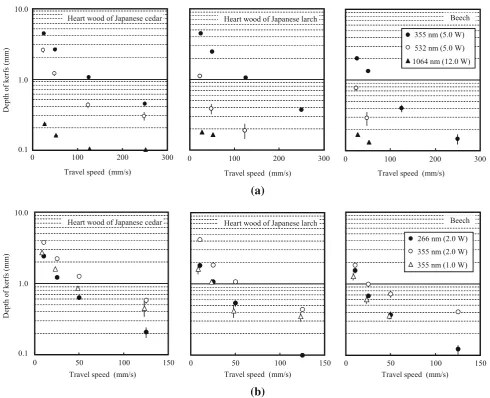
Figure3 shows the relationship between travel speed and kerf depth of the three wood specimens. Figure3a shows the results of a comparison between the wavelengths 355 nm, 532 nm, and 1064 nm for each specimen. At 1064 nm, machining was not possible at an output power of 5.0 W, and, therefore, the output power was set to 12.0 W, but even then, machining was not possible for larch and beech at travel speeds of 125 or 250 mm/s. At 532 nm, machining was not possible for larch at 250 mm/s or for beech at 125 or 250 mm/s. As our previous report [3] stated, the higher the density of the specimen, the greater the energy required for machining; accordingly, kerf depth became slightly shallower from cedar to larch to beech,
Table 1 Laser irradiation and
machining conditions Wavelength (nm) 266 355 532 1064
Pulse width (ns) 11 12 13 15
Pulse frequency (kHz) 50
Focal length (mm) f40
Theoretical focal point diameter (lm) 5.9 11.0 12.3 11.7
Power (W) 2.0 1.0 2.0 5.0 5.0 5.0 12.0
Travel speed (mm/s) 10 10 10 25 25 25 25
25 25 25 50 50 50 50
50 50 50 125 125 125 125
125 125 125 250 250 250 250
Laser beam (Q-switched pulse laser irradiation)
Travel speed : 10 ~ 250 (mm/s)
T R L
(Annual rings)
70 12
6(
4
)
(Straight grain surface)
(Early wood)
(mm)
Fig. 1 Machining method
1 mm
100 µm 1 mm
Machining mark
L T R
L
R T
(a) (b)
(c)
Fig. 2 A larch specimen after machining. Wavelength: 355 nm, Power: 2.0 W, Travel
speed: 25 mm/s.aKerf
observed on the specimen
surface.bSplit
cross-section.cKerf observed on the
clearly showing the machining limits. When we compare the three wavelengths, 355 nm clearly yielded superior machining performance. Figure3b gives the results of a similar comparison between 266 and 355 nm. At the same output power, 355 nm produced deeper kerfs than 266 nm, and its machining performance was superior. The experi-ment was repeated under an additional set of conditions, with an output power of 1.0 W and a wavelength of 355 nm, but this yielded approximately the same results as 266 nm at an output power of 2.0 W for all the specimens. In other words, of the four wavelengths used, 355 nm yielded the greatest machining performance.
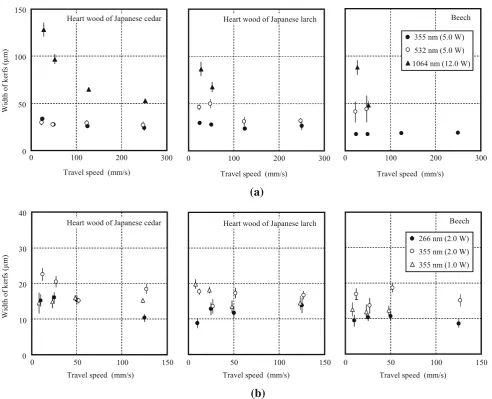
Next, Fig.4shows the relationship between travel speed and kerf width of the wood specimens. Figure4a gives the results of a comparison of wavelengths 355, 532, and 1064 nm for each of the specimens. At 355 nm, the kerf width for each of the specimens was 20–30lm, the same
as the diameter of the drilled holes in our previous report [3]. In contrast, although the theoretical focal point diam-eter differed little from that of a wavelength of 355 nm, at a wavelength of 1064 nm, the kerf width was extremely large, and showed a growing trend with slower travel speed. Even at a wavelength of 532 nm, larch and beech showed a widening trend at slow speeds. At wavelengths of 1064 and 532 nm, the post-processing appearance, partic-ularly under the slow-speed conditions that produced wider kerfs, differed greatly from that at 355 nm. While at these wavelengths, the heat effects, i.e. carbonization around the kerf and on the cut plane were significant enough to be recognizable by visual observation, at 355 nm only a slight change of color was observed, only on the cut plane. Fig-ure4b gives the results of a similar comparison, between 266 and 355 nm. At 355 nm, the width was slightly nar-rower than for the 5.0-W output power cases shown in Travel speed (mm/s)
Heart wood of Japanese larch
0 100 200 300 0 100 200 300
355 nm (5.0 W)
532 nm (5.0 W)
1064 nm (12.0 W) Beech
Travel speed (mm/s)
Depth of kerfs (mm)
0.1 1.0 10.0
0 100 200 300
Travel speed (mm/s) Heart wood of Japanese cedar
(a)
0 50 100 150
Travel speed (mm/s)
0 50 100 150
Travel speed (mm/s) Beech
266 nm (2.0 W)
355 nm (2.0 W)
355 nm (1.0 W)
0 50 100 150
Travel speed (mm/s)
Depth of kerfs (mm)
0.1 1.0 10.0
(b)
Heart wood of Japanese larch Heart wood of Japanese cedar
Fig.4a. The theoretical focal point diameter at 266 nm was smaller than that at 355 nm, and so the kerf width at a wavelength of 266 nm was slightly narrower overall. The post-processing appearance exhibited very slight heat effects for both.
Laser machining is essentially heat processing. When exposed to extremely high-energy–density ultra-short-pulse laser, a material is instantly evaporated and elimi-nated. Because this occurs in an extremely short period, the heat effects to the surrounding area (heat transmission) are minimal, and ablation phenomena are dominant. This is not limited to ultra-short-pulse lasers: it has been theorized that in the machining of polymer materials using ultraviolet lasers, ablation phenomena due to photochemical decom-position are dominant [6]. For the machining using the wavelengths 266 and 355 nm, which are in the UV region, it is likely that, since the heating and evaporation were
instantaneous, heat transmission to surrounding areas was minimal and the machining proceeded as ablation-like phenomena. On the other hand, at wavelengths 1064 and 532 nm, the heating of the material was not as fast as at 266 and 355 nm, and a certain degree of heat was trans-mitted to the surrounding area. As a result, heat processing-like phenomena occurred and were dominant, leading to a difference in the post-processing appearance compared with that at the UV wavelengths 266 and 355 nm. At slow travel speeds, it is predicted that the kerf width was expanded because, heat transmission to the surrounding area increased. Note that, although we are arguing for using hole depth as an indicator of machining performance, similar results were found when calculating eliminated volume, which takes into account hole width, with 355 nm yielding the best machining performance of the four wavelengths used.
0 50 100 150
0 100 200 300
) s / m m ( d e e p s l e v a r T )
s / m m ( d e e p s l e v a r T Travel speed (mm/s)
0 100 200 300
Beech
0 100 200 300
355 nm (5.0 W)
532 nm (5.0 W)
1064 nm (12.0 W)
Width of kerfs (µm)
(a)
(b)
0 50 100 150
Travel speed (mm/s) Beech
266 nm (2.0 W)
355 nm (2.0 W)
355 nm (1.0 W)
0 50 100 150
Travel speed (mm/s) 0
10 20 30 40
0 50 100 150
Width of kerfs (µm)
Travel speed (mm/s)
Heart wood of Japanese larch Heart wood of Japanese cedar
Heart wood of Japanese larch Heart wood of Japanese cedar
The results of wavelength conversion showed that the shorter the wavelength, the smaller the maximum output power that could be obtained. For example, while the max-imum output power at a wavelength of 355 nm was 5.0 W, at a wavelength of 532 nm, an output power of around 13.0 W can be obtained with the same device. However, even if we consider this, there is a concern that a wavelength of 532 nm will create greater heat effects proportional to output power level, and, therefore, a wavelength of 355 nm is considered to be the most suitable for wood machining. As there is also high demand for cutting in the wood industry, there has been much research on laser cutting using CO2laser. Arai and Hayashi [7] have investigated characteristics of wood cutting in terms of their relationship to machining parameters using CO2laser. As an example of a result, the kerf depth was about 5 mm when katsura (Cercidiphyllum japonicum) of density 0.47 g/cm3was cut at a travel speed of 20 mm/s by 50 W of power. This cannot be compared with our results simply, it seems that the UV-laser possesses the performance equiva-lent to CO2laser.
Spectral reflectance
We hypothesized that the variation in machining perfor-mance with wavelength was due to differences in the light absorptance of each of the woods. Thus, Fig.5 shows the results of measurements of the spectral reflectance of each specimen. The three types of wood each showed roughly the same profile. Upon this, the spectral reflectance of late wood part was measured, its profile was almost same as the one of early wood in supplemental experiments. When we define the absorption of light as being inversely related to reflection (including transmission), then wavelengths with less light reflection and greater absorption produce superior machining performance, supporting our hypothesis. In
other words, for wood, light reflection decreases dramati-cally as wavelength shortens from visible light range towards the UV range; of the laser wavelengths used, absorption was largest at a wavelength of 355 nm.
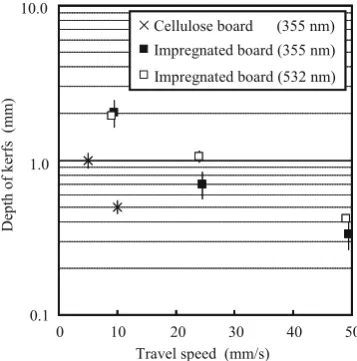
The absorption of ultraviolet light by wood is due to lig-nin, which is a polymeric phenol component that makes up about 30 % of wood. Yasuda et al. [8] exposed UV light to specimens of filter paper that had been impregnated with various components of wood, and used changes in color to investigate the activity of the components in response to UV light. They found that UV light’s contribution to lignin was the greatest, while it contributed almost nothing to cellulose. Therefore, we hypothesized that absorption of the UV-wavelength laser light occurred mainly because of the presence of lignin, which greatly improved the machining performance. Apart from lignin, the components of wood are mainly cellulose and hemicellulose. Thus, by taking mea-surements using a cellulose board, a material composed of cellulose without lignin, we found that the reflectance of light over the range of UV to visible light was greater than that for the woods, and its absorption was smaller. The relationship between travel speed and kerf depth for this board, after performing the same laser machining was shown in Fig.6. For the cellulose board, even at a travel speed of 25 mm/s, kerfs could not be machined on the specimen surface to the extent that carbonization was visible; even when the speed was lowered to 5 mm/s, kerf depth was approximately 1 mm. Next, when we tested the impregnated board, we found that, as shown in Fig.5, spectral reflectance over the range of UV to visible light was much lower than that for the cellulose board, and reflection was particularly low between the UV range and wavelengths near 600 nm. When the same laser machining was conducted on this board, machining
0 20 40 60 80 100
0 500 1000 1500
Wavelength (nm)
S
p
ectr
al r
efl
ect
an
ce (%
)
Japanese cedar Japanese larch Beech Cellulose board Impregnated board
Fig. 5 Spectral reflectance
0.1 1.0 10.0
0 10 20 30 40 50 Travel speed (mm/s)
Depth of k
er
fs (mm)
Cellulose board (355 nm) Impregnated board (355 nm)
Impregnated board (532 nm)
progressed remarkably better than for the cellulose board although carbonization occurred in the area surrounding the kerfs. Furthermore, even a wavelength of 532 nm yielded similar results to those at 355 nm (Fig.6). In short, it appears that the absorption of light drives the machining process. Note that, different from the case of wood, the heat effect was conspicuous and the kerf depth was shallow. Having high density of the board more than a series of wood is considered as the reason. This wavelength dependence has been reported in various fields in which lasers have been applied. For example, Nilaya et al. [9] applied the same wavelengths used in our study to decontamination of radioactive substances loosely deposited on stainless steel, and reported the effec-tiveness of using 1064 nm. In addition, Watanabe et al. [10] reported the effects of wavelength in attempts at surface modification of PET fibers using laser irradiation, and dis-cussed the relationship between it and light absorptance. In this study, as the structure of the polymerized phenolic resin in the impregnated board and the lignin within the wood differ completely, it is difficult to say that we confirmed the effectiveness of the lignin. However, it is highly likely that light absorptance affects machining performance.
One reason for the ablation phenomena caused by the laser can be chemical bond cleavage caused by photon energy. However, if we consider that the photon energy is smaller than the dissociation energy of the bonds of the substances in the impregnated board, it seems more likely that rapid fusion and elimination which occurred after con-version to thermal energy is the cause of the ablation phe-nomenon. It seems that the relationship between the heating speed at the focal point and the rate of diffusion of heat to the surrounding area is the root of the difference between the ablation-like machining, where there was little heat effect on the surrounding area, and the heat-based machining, where heat effects are seen in the surrounding area. We believe this is responsible for following observed effects: the car-bonization of the machined cross section was greater for a wavelength of 532 nm (which had a relatively slow heating speed) than that for a wavelength of 355 nm; the car-bonization of the higher-density beech was greater than that of the cedar; and that of the impregnated board was more conspicuous. Furthermore, we believe that the kerf width at a wavelength of 1064 nm, which exhibited greater reflection of light and an even slower heating speed, was larger because of the greater heat effects to the surrounding area.
Conclusions
Laser machining of wood has traditionally used CO2lasers. In contrast, our previous study investigated wood machining using a type of short-wavelength laser, a UV
laser, and found that microscopic hole drilling and cutting could be performed [3]. However, there exist various other types of lasers with a wavelength range shorter than that of CO2 laser. Thus, in the current study, we used lasers of wavelengths 266, 355, 532, and 1064 nm to perform wood cutting, and investigated wavelength dependence as well as post-processing appearance in relation to machining performance. That is, we tested for the optimal wave-length for the machining of wood. The result was that machining using the 355 nm wavelength laser achieved the greatest machining performance. There were also few heat effects surrounding the machined area. From an industrial perspective, although it is true that the shorter a laser’s wavelength, the smaller the output power that can be obtained, if we consider not only machining perfor-mance but also the advantages that short-wavelength lasers have in terms of machining quality, then a 355 nm wavelength appears to be the most suitable for the machining of wood.
We hypothesized that the variation in machining per-formance for each wavelength was due to differences in light absorptance. When we measured the spectral reflec-tance of the woods, we found that wavelengths that yielded greater machining performance also produced greater absorption, supporting our hypothesis. The optimal wave-length for machining wood, 355 nm, is UV light. Assum-ing that the absorption of UV light by wood is due to lignin, we prepared a lignin-free cellulose board and con-ducted the same kind of machining and measurements to investigate the effects of lignin. We found that the absorption of light in the UV range was low, and machining at these wavelengths was difficult. Therefore, we hypothesized that, for wood machining using a laser with a wavelength of 355 nm, the absorption of light was mainly due to the presence of lignin, and this greatly improved the machining performance. On the other hand, when this cellulose board was impregnated with phenolic resin, there was high absorption of light between the UV range and wavelengths near 600 nm, machining progressed well, and similar machining was achieved at a wavelength of 532 nm to that at a wavelength of 355 nm. In other words, our findings support the idea that light absorptance influences machining performance.
Now that we have determined the optimal laser wave-length for wood machining at short wavewave-lengths, we hope to work towards clarifying the machining conditions and properties for wood at this wavelength, as well as to report on its applications such as cutting, incising and its potential utilization.
References
1. Listyanto T, Ando K, Yamauchi H, Hattori N (2013) Microwave
and steam injection drying of CO2 laser incised Sugi lumber.
J Wood Sci 59:282–289
2. Islam MN, Ando K, Yamauchi H, Kobayashi Y, Hattori N (2007) Passive impregnation of liquid in impermeable lumber incised by laser. J Wood Sci 53:436–441
3. Fukuta S, Nomura M, Ikeda T, Yoshizawa M, Yamasaki M, Sasaki Y (2016) UV laser machining of wood. Eur J Wood Prod 74(2):261–267
4. Bryan EL (1963) Machining wood with light. Forest Prod J 13(1):14
5. Hattori N, Nakamoto Y, Kitayama S (1991) Comparison of
machining performance for wood and paper between CO2laser
and YAG laser (in Japanese). The 41st Annual Meeting of Japan Wood Research Society, Matsue, Japan, p 433
6. Arai T (2013) Chap 4. Interaction of laser and substance. In: Fundamental engineering science for laser materials processing (in Japanese). Maruzen Publishing, Tokyo, p 159
7. Arai T, Hayashi D (1992) Factors affecting the laser processing of wood. I. Effects of mechanical laser parameters on machin-ability. Mokuzai Gakkaishi 38:350–356
8. Yasuda S, Nagaoka M, Hanzawa M (1974) Discoloration of pulps by light (in Japanese). Res Bull Coll Exp For Hokkaido Univ 31(1):1–7
9. Nilaya PJ, Raote P, Kumar A, Biswas DJ (2008) Laser-assisted decontamination. A wavelength dependent study. Appl Surf Sci 254:7377–7380