O R I G I N A L A R T I C L E
Creep behavior of wood under cyclic moisture changes:
interaction between load effect and moisture effect
Yuxiang Huang1
Received: 16 November 2015 / Accepted: 11 May 2016 / Published online: 28 May 2016
ÓThe Japan Wood Research Society 2016
Abstract Load and moisture content (MC) changes are the essential conditions for the mechano-sorptive (MS) creep of wood. An experiment was carried out on poplar to comprehend the mechano-sorptive creep from our point view. To restore the truth of MS creep behavior especially in the first humidifying stage, three well-matched sets of specimens were loaded in third-point bending under dif-ferent humidity cycles. For each set, the applied load varied from 15 to 35 % of the short-term breaking load. It was found that the wood specimens exhibited a partial recovery during all the adsorption phase and deflection increase during all the desorption phase when low load level was applied. This phenomenon was very different from that a considerable creep at first adsorption observed by large amounts of researchers, which can be ascribed to the pseudo-creep due to the difference in the normal longitu-dinal swelling and shrinkage of wood. The results also indicated that an amplified load effect existed within the creep under cyclic moisture changes, which usually resul-ted in a fast increasing rate of viscoelastic creep to veil pseudo-recovery in the first humidifying stage.
Keywords Cycle moisture changesLoad effect Moisture effectCreep of woodThe first adsorption
Introduction
Wood is classified as a viscoelastic material, which would suffer a so-called creep behavior under long-term loading [1]. Creep plays an important role for the design and durability of timber structures. This behavior was often characterized by the power law in which the moisture content (MC) was supposed to be constant.
However, the MC of wood materials in service struc-tures is ceaselessly changing, since it follows the ambient relative humidity of the air due to the hygroscopic nature of wood [2]. Creep deflection in changing moisture conditions between dry and wet is much larger than that under con-stant MC. In other words, the creep of wood can be accelerated by MC changes, which was defined as the mechano-sorptive effect (MSE) resulting from the inter-actions between stress and MC changes [3].
As Armstrong first described the phenomenon of mechano-sorptive (MS) creep [4], the deflection increased rapidly to almost twice the initial deformation during the first adsorption phase, while the loaded wood beam showed partial recovery during subsequent adsorption phase followed by increased deflection during each desorption phase. This unique characteristic of wood attracted numerous attentions to give physical interpretations. Some interpretations were based on the molecular level, such as fracture and recombi-nation of hydrogen bonds [5,6] and deformation kinetics [7]. Some were focused on the cell wall, especially the microfibril structure of S2-wall, such as Body’s lens model [8], model of slip plane in the S2-wall [9] and Mukudai’s MS model [10]. Others even ascribed the mechano-sorptive creep to swelling and shrinkage effect [11,12]. However, no clear consensus has been reached so far.
Great efforts have been also made to establish consti-tutive models to predict the deformation of loaded wood & Yuxiang Huang
1 College of Materials Science and Technology, Beijing
Forestry University, Tsinghua East Road 35, Haidian, Beijing 100083, China
with MC changes. The first attempts for the mathematical modelling of the evolution of MS creep were from the 70s. A typical Maxwell-type model was proposed by Ranta-Maunus based on various plywood creep data [13]. In his original model,
K J Oð Þ¼
afor du\0 aþfor du [0
aþþfor the first change du [0 8
<
: ð1Þ
Kwas constant, and J Oð Þwas creep compliance. The MS parametera depended on the MC changes, includinga?? for the initial adsorption due to the increased creep rate effect of the first adsorption period after loading,a?for the subsequent adsorption and a- for all the desorption. Afterwards, Hunt demonstrated a ‘‘pseudo-creep’’ and ‘‘recovery’’ to account for the increase of creep deflection during drying and the decrease during humidifying, respectively [6]. This phenomenon was ascribed to differ-ences in the normal longitudinal swelling and shrinkage of wood, because Hunt and Shelton found a compression strain resulted a larger shrinkage coefficient compared with a tensile strain [14]. Therefore, pseudo-creep and recovery was approximately a reversible phenomenon, which allowed desorption (-effect) and adsorption (?effect) can be treated equally as contributing to mechano-sorption in the numerical models. Based on this, Hanhija¨rv developed a combined-activation-type non-linear model using the deformation kinetics theory [15]. However, deformation computed by the model decreased during the first adsorp-tion, which was contrary to the actual situation. Thus, the existence of thea?? effect has been controversial. Mon-tero et al. loaded two well-matched sets of Norway spruce in third-point bending at different times (one set was loa-ded dry, while the other was loaloa-ded wet) and obtained the same response after a few humidity cycles, indicating the non-existence of the??effect [16].
Our research, starting from the root of MS creep, load and MC changes, is expected to restore the truth of MS creep by elaborate collocation of different load levels and MC changes. The existence or non-existence of the ??effect was determined by whether there would be occurrence of partial recovery during the first adsorption phase or not.
Materials and method
Specimen preparation
The wood battens were obtained successively in the lon-gitudinal direction from a similar portion of the outer region of heartwood with a straight grain in a log of 15 years old poplar (Populus euramevicana). For bending
creep tests, approximately 197 samples [110 mm longitu-dinal (L)910 mm tangential (T)95 mm radial (R)] were cut from two battens [500 mm (L)950 mm (T)950 mm (R)]. The specimens were then stored in an air-conditioned chamber at 20°C and 42 % relative humidity (RH) for more than 1 week prior to use.
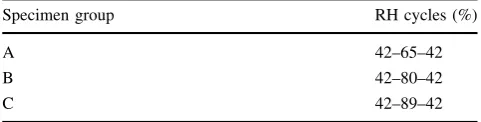
30 specimens with similar density, dimension, and modulus of elasticity (MOE) were selected. Six of them were picked to measure short-term breaking load in four-point bending. Bending tests for MOE under constant RH (42 %) were carried out with a tabletop material tester (EZ Test, Shimadzu, Japan) placed in an air-controlled room under the following conditions: span, 100 mm, crosshead down-speed, 4 mm min-1. Tests for modulus of rupture (MOR) were continued until samples were broken. The average MOR of the six samples was 330 N (coefficient of variation, 5.8 %). The rest was divided into three groups (A–C) according to different cycled relative humidities (Table1). For each group, two of them were prepared for measuring MC during creep tests. The rest six were used for creep tests and their material parameters in detail were presented in Table2.
Creep test
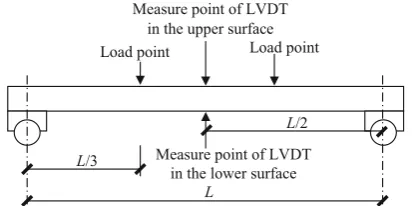
The creep test was performed in a thermostatic-humidistat cultivating chamber (Binder KMF720) at 20 °C and 42 % RH within an air-conditioned room. Creep specimens from group A were placed on a frame with the span of 100 mm inside the chamber; then, three loads, corresponding to 15, 25 and 35 % of short-term breaking load, were applied on the radial section of every two specimens with four-point bending (Fig.1). Two linear variable differential trans-formers (LVDT) were fixed on the upper and lower sur-faces of each specimen to measure the deflection during the creep test. The deflection from lower surfaces was taken as the actual deflection of specimens. The difference between the deflection from upper and lower surfaces was denoted as the shrinkage and swelling deformation. The MC spec-imens were also placed on the frame without loading. At given measured time intervals, the MC specimens were took out of the conditioning chamber, and their mass were determined immediately by a digital balance (accuracy up to 0.001 g), before which the temperature and relative
Table 1 Designed RH cycles for specimens from different groups Specimen group RH cycles (%)
A 42–65–42
B 42–80–42
C 42–89–42
humidity of the room were adjusted to the same condition as those within the chamber. After measuring, the speci-mens were placed back into the chamber. 48 h after load application, the RH inside the chamber was changed from 42 to 65 %, and a moisture adsorption was then performed until adsorption time reached 48 h. The RH was set back to 42 %, and a desorption process was, therefore, conducted subsequently for another 48 h. The above moisture change cycle (adsorption–desorption) was then repeated 1.5 times. Totally, 2.5 moisture change cycles were performed in one creep test.
The creep tests on specimens from group B under RH cycles (42–80–42 %) and group C under RH cycles (42–89–42 %) were carried out by the same procedure.
Calculation
The nominal stress of specimens was determined by
r¼ r0 1þaTðww0Þ
ð2Þ
whereaT is the moisture expansion coefficient measured
on matched specimen without loading (aT =0.18 %/%).w
is the mean MC of the specimen andr0,w0 refers to the initial condition (25°C/42 % RH).
Based on this, the compliance of specimens under four-points loading can be expressed as
D tð Þ ¼ 10810
9bh3y tð Þ
23PL3 1þa
Tðww0Þ
ð Þ ð3Þ
whereD tð Þ is the compliance (GPa-1); y tð Þis the deflec-tion of the wood specimen (m);Pis the applied creep load
(N); b h are the initial width and depth of the specimen, respectively (m); Lis the span (m).
Results and discussion
Creep behavior at different loads within different cyclic moisture changes
Figure2a summarizes the deflection of specimens from group C under cyclic RH change between 42 and 89 %. An initial instantaneous deflection appears immediately after the load was applied at 42 % RH, varying with load levels. During the cyclic moisture sorption process, the creep behavior of specimens is closely related to MC change. Moreover, the deflection increases very gently at the final phase of each sorption when MC almost reaches equilib-rium MC. For each specimen with different load levels, the deflection increases markedly with time during the first adsorption phase. Taking specimen C-35 %, for example, the deflection of this specimen reaches 2.50 mm after the first adsorption process, which is nearly 2.1 times as large as the initial instantaneous deformation. During the sub-sequent adsorption phase, the specimens first present recovery for a while and then their deflection increases again. Apparently, the recovery time depends on the load level. The deflection of specimen C-15 % basically decreases almost all the adsorption time, whereas the defection of C-25 and C-35 % just decreases transitorily and increases most of the adsorption time. Thus, it can be speculated that the load had an effect which prevented the deflection from decreasing. Moreover, the absolute value of deflection recovery of each specimen during the third adsorption phase is greater than that during the second one, which indicates that this impedient effect became weak as time went on.
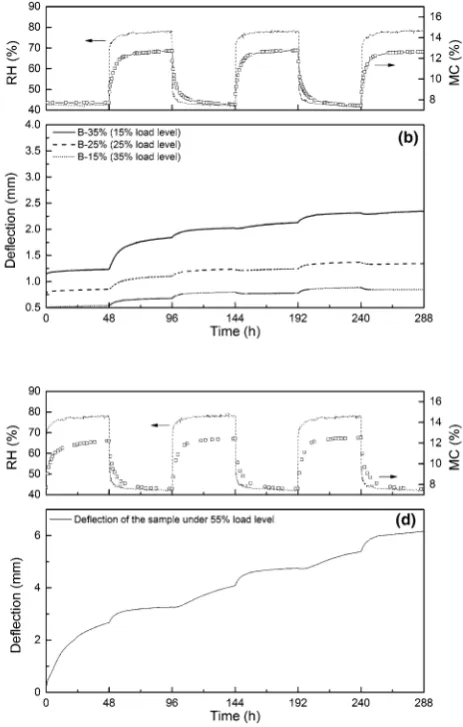
Figure2b displays the creep deflection of specimens from group B under different loads with 2.5 RH cycles from 42 to 80 % RH. The creep behaviors of specimens under these humidity cycles are just the same as those from group C. By further comparison, at the same load level of 35 %, the absolute value of specimen’s recovery deflection (0.026 mm) during the third adsorption phase from group B is much lower than the value (0.080 mm) from group C. Table 2 Material parameters of each group of specimens (eight specimens per group)
Material parameters Group C Group B Group A
Min Max Mean (±SD) Min Max Mean (±SD) Min Max Mean (±SD) MOE 15,130 15,120 15,160 (30) 14,580 15,110 14,820 (240) 14,060 14,370 14,210 (110) Density 0.52 0.57 0.54 (0.02) 0.52 0.56 0.54 (0.01) 0.52 0.57 0.55 (0.02)
Minminimum value,Maxmaximal value,Meanmean value,SDstandard deviation,MOEmodulus of elasticity
Load point Measure point of LVDT
in the upper surface
Measure point of LVDT in the lower surface
L
L/2
L/3
Load point
This means high MC change led to large deflection recovery. Correspondingly, the increment of specimen’s deflection (1.598 mm) during the second desorption phase from 80 to 42 % RH is also obviously lower than that (3.622 mm) from 89 to 42 % RH. Thus, it can be inferred that creep deflection during varying humidity is positively related to MC change. Together with the result that the load level did not seem to have impacts on the recovery deflection under RH cycles 42–80 % as well as 42–89 %, it could be concluded that MC change played a major role in the MSE, while load kept deflection increasing all the time and its effect gradually reduced. MSE, where the moisture effect (ME) is dominant, causes the increase of deflection during desorption time and decrease of deflection during adsorption time and the first adsorption have no exception. When the load effect (LE) was greater than the ME during adsorption, the deflection would increase. If the LE was lower than the ME during adsorption time, the deflection
would decrease. According to this hypothesis, under low load level (15 %) where the LE was weak and RH cycles with great MC change (42–89 % RH) where the ME was strong, wood specimen should reflect recovery deflection in the first adsorption phase. However, specimen C-15 % does not show any recovery deflection during the first adsorption. On the contrary, its deflection increases rapidly. This may be interpreted by the amplified effect on load brought by MC change. When wood is suddenly subjected to abrupt MC increase, its properties would degrade severely [17]. By way of analogy, we might think that a piece of wood with weak properties suffering a load would show an extremely large viscoelastic deformation initially. Thus, LE was amplified by great MC change (refer in particular to MC increase). This effect far outweighs ME, as a result, wood creep accelerated during the first moist-ening phase. Because this effect was also time-dependent, it became weak when wood underwent equivalent MC Fig. 2 Creep deflection of specimens from a group C in varying
humidity from 42 to 89 % RH,bgroup B in varying humidity from 42 to 80 % RH,cgroup A in varying humidity from 42 to 65 % RH (some deviation from the load point when the A-25 % was loaded led
change again, although the viscoelastic deformation was in the same condition as the first adsorption due to the hygro-memory theory [17,18], and the role of the ME gradually dominated so that recovery is increasingly obvious in the subsequent moistening phases.
Based on this, if the goal that wood shows partial recovery during the first adsorption phase is to be achieved, MC change should be reduced to lower its effect on load. Nevertheless, this would result in a decline in ME as well. If they reduce at different rates, it will be possible to make ME greater than LE. As shown for the RH cycles from 42 to 65 % RH (in the inset of Fig.2c), both A-15 and A-25 % exhibit different degrees of recovery during the first adsorption phase. This phenomenon just verifies the above-mentioned conjecture. The total load effect, which is attributed to the stress level and MC change, is lower than ME when the specimen was applied 25 % load level under RH cycles from 42 to 65 %. When the load level reduces to 15 %, the LE became even weaker, thereby recovery caused by ME is more prominent. Furthermore, if the load is large enough, even it is time-dependent, the case may occur that the deflection increases all the time once the LE is much greater than the ME. Seen from Fig.2d, when high load level (55 %) was applied, the creep increased what-ever during the adsorption processes or desorption ones.
Furthermore, an experiment was supplemented for RH cycles from 42 to 65 % at even lower load level to verify that deflection recovery would still appear, where two specimens with similar MOE as those in group A were loaded with 10 and 5 % load level in 42 % RH for 48 h and then subjected to only one adsorption from 42 to 65 % RH. To make a comparison of the creep behaviors during the first adsorption phase among these specimens conve-niently, the starting point of X-axis was set using the time when adsorption process began and all their deflection was converted to the same initial value at the beginning of adsorption (see Fig.3). As expected, the deflection of the specimens loaded with 5 and 10 % load level exhibits recovery to different extents during the first adsorption process. For the specimens loaded with load level from 5 to 20 %, the lower the stress is applied, and more obvious recovery is obtained.
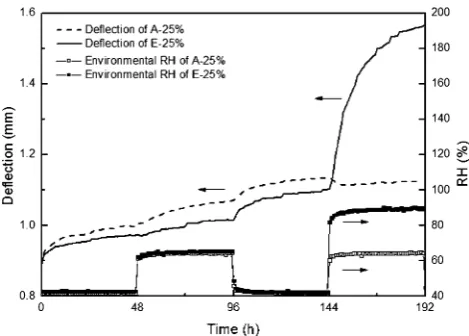
To further confirm the existence of LE amplified by MC change and hygro-memory of wood, another two experi-ments were supplemented. One was very similar to the procedure for the specimen A-25 %. The difference lied in the second adsorption process where RH cycle was chan-ged to the one between 42 and 89 % RH. The specimens used in this experiment were marked as E-25 %, whose density, dimension, and MOE were close to those from A-25 %. As seen from Fig.4, both the deflection curves of the two specimens before the second adsorption show the same changing trend. However, on contrary to specimen
A-25 %, the deflection of specimen E-25 % increases continuously during the second adsorption phase. If there was no interference with other factors, such as LE ampli-fied by MC change, the deflection should decrease more rather than increase during the second adsorption phase when the RH cycle was changed to a wider range based on the fact that high MC change led to large deflection recovery. Because the wood was subjected to a sharp MC change, its properties degraded severely. The amplified LE became greater than the ME, causing the increase of creep deflection during the second adsorption process.
The result of another additional experiment was demonstrated in Fig. 5. At the beginning, a specimen was loaded with 25 % load level at 20°C/65 % RH for 48 h. Then, the RH was changed to 89 % RH, where the first Fig. 3 Creep deflection of the wood specimens under different load levels (5–35 %) during the first adsorption in varying humidity from 42 to 65 % RH
adsorption process started with the duration of only 2.5 h. In spite of this, the creep deflection grows rapidly during the phase, which was similar to the result of C-25 % due to the great amplified LE. After the transient adsorption process, the RH was dropped to 42 % RH until 96 h, where the specimen entered the first desorption phase. During this phase, the deflection continued to increase. Subsequently, the RH was back to 65 %, where the second adsorption began and the specimen showed partial recovery. It was worth noting that the second adsorption was different from the first one owing to the different RH ranges and dura-tions. The second adsorption was followed by the third adsorption between 65 and 89 % RH, which is the repro-duction of the first adsorption. As mentioned above, the LE was time-dependent. The first adsorption only lasted 2.5 h, thus the LE was still greater than the ME, which led to the accelerated creep. When the specimen suffered the same RH change again, because of the hygro-memory, it went on increasing the creep deflection in the first adsorption phase rather than conducted recovery as in the second adsorption phase.
Creep compliance and creep trajectories
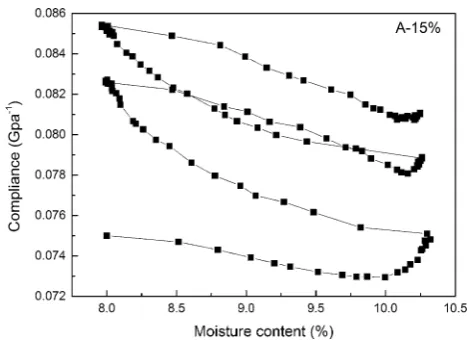
Deflection and load were converted to compliance and stress, respectively, to investigate the MS creep behavior in depth. Figure6presents the nominal stress and compliance of A-15 %. Due to the MC change, there is also an alter-native variation of nominal stress, demonstrating such a test cannot be strictly considered as creep, which theoret-ically requires a constant stress. Nevertheless, the variation is small enough to allow the calculation of compliance by dividing the differential strain by the nominal stress,
confirming that the change of tangential dimension did not alter the basic law of mechano-sorptive creep [19], which just amplified the effect of the pseudo-creep and recovery if it was not taken into account by the correction of nominal stress. The compliance of A-15 % decreased in all the adsorption process, and the first adsorption was no excep-tion, indicating the non-existing of ??effect. Since the ?effect and the – effect can be roughly offsetted after a complete adsorption/desorption cycle, the main contri-bution to the total creep compliance came from the MS creep guided by the LE and the time-dependent viscoelastic creep guided by the amplified LE caused by MC changes. Figure7shows the creep trajectories (the compliance as a function of the MC) of A-15 %. Each wetting period induced a compliance recovery, while each drying period induced a significant increase. As seen in Fig.8, where the change of mechano-sorptive creep compliance was plotted against the MC changes, the recovery during the first adsorption phase is obviously lower than that during the Fig. 5 Creep deflection of wood specimen under 25 % load level in a
complex humidity change condition (the first adsorption: 65–89 % RH; the first desorption: 89–42 % RH; the second adsorption: 42–65 %; the third adsorption: 65–89 % RH; the second desorption: 89–42 % RH)
Fig. 6 Compliance and nominal stress of A-15 % during the creep
second and third adsorption phases. This also illustrates the existence of amplified LE by MC changes. Although it was not very strong due to the low MC changes, it weakened to some extend the decrease of creep compliance in the first wetting period. The time-dependence of viscoelastic creep induced by the LE accounted for the more recovery in the subsequent adsorption process and less increase in the subsequent desorption. It means the compliance increase after a drying-wetting cycle would became less and less within the humidity cycles, which led to a progress towards a creep limit. This was also reflected in Fig.7that the rate of pure creep at the final stage of each MC change became lower.
Figure9presents the compliance of the specimens from group C. The curves of creep compliance of all the three specimens under constant RH 48 % (0–48 h) are almost imposed, sufficiently demonstrating that the specimens were well matched. However, the curves deviate from each
other when the specimens were subjected to humidity cycles. In this case, there are two possibilities. One is that the hydro-mechanical coupling effect was not linear. The other is that the difference among the wood specimens was enlarged by cyclic humidity, although they had similar properties at a constant humidity.
Conclusions
Three groups of matched specimens were loaded within different cyclic humidity, and three load levels were applied for each group. All the specimens within the load level no more than 25 % under cyclic humidity from 42 % RH to 65 % RH exhibited recovery to some extend during the first adsorption, confirming that the ??effect is non-relevant for wood creep in the first humidifying stage. The results also indicated the existence of amplified load effect caused by moisture content change, which would induce a fast increasing rate of viscoelastic creep.
According to these findings, the understanding of creep behavior of wood under cyclic moisture changes can be simplified to three effect. (1) A single process of mechano-sorptive, where the load effect was dominating. (2) ? Ef-fect and – efEf-fect caused by the moisture efEf-fect, both of which can be neutralized after a humidity cycle. (3) Moisture changes-dependent viscoelastic induced by the amplified load effect. Usually, the cyclic humidity within large varying range was used for wood creep testing. Thus, the great amplified load effect covered up the?effect during the first adsorption. This is the reason why a con-siderable creep increase in the first humidifying stage was observed for wood bending creep in most cases.
References
1. Dubois F, Randriambololona H, Petit C (2005) Creep in wood under variable climate conditions: numerical modeling and experimental validation. Mech Time Depend Mat 9:173–202 2. Hanhija¨rvi A (2000) Advances in the knowledge of the influence
of moisture changes on the long-term mechanical performance of timber structures. Mater Struct 33:43–49
3. Zhou Y, Fushitani M, Kubo T, Ozawa M (1999) Bending creep behavior of wood under cyclic moisture changes. J Wood Sci 45:113–119
4. Armstrong LD, Christensen GN (1961) Influence of moisture changes on deformation of wood under stress. Nature 191:869–870
5. Gibson EJ (1965) Role of water and effect of a changing moisture content. Nature 1965:213–215
6. Hunt DG (1984) Creep trajectories for beech during moisture changes under load. J Mater Sci 19:1456–1467
7. Van der Put TACM (1989) Deformation and damage process in wood. Delft University Press, Delft
Fig. 8 Mechano-sorptive compliance vs. moisture content change of A-15 % during the creep
8. Boyd JD (1982) An anatomical explanation for visco-elastic and mechano-sorptive creep in wood, and effects of loading rate on strength. In: Bass P (ed) New perpectives in wood anatomy. Martinus Nijhoff and Dr W Junk Publishers, The Hague, pp 171–222
9. Hoffmeyer P, Davidson RW (1989) Mechano-sorptive creep mechanism of wood in compression and bending. Wood Sci Technol 23:215–227
10. Mukudai J, Yata S (1987) Modeling and simulation of vis-coelastic behavior (bending deflection) of wood under moisture change. Wood Sci Technol 21:49–63
11. Liu T (1993) Creep of wood under a large span of loads in constant and varying environments. Holz als Roh- und Werkstoff 51:400–405
12. Srpcˇicˇ S, Srpcˇicˇ J, Saje M, Turk G (2009) Mechanical analysis of glulam beams exposed to changing humidity. Wood Sci Technol 43:9–22
13. Ranta-Maunus A (1975) The viscoelasticity of wood at varying moisture content. Wood Sci Technol 9:189–205
14. Hunt DG, Shelton CF (1988) Longitudinal moisture-shrinkage coefficients of softwood at the mechano-sorptive creep limit. Wood Sci Technol 22:199–210
15. Hanhija¨rvi A (2000) Computational method for predicting the long-term performance of timber beams in variable climates. Mater Struct 33:127–134
16. Montero C, Gril J, Legeas C, Hunt DG, Clair B (2012) Influence of hygromechanical history on the longitudinal mechanosorptive creep of wood. Holzforschung 66:754–764
17. Armstrong LD, Grossman PUA (1972) The behaviour of particle board and hardboard beams during moisture cycling. Wood Sci Technol 6:128–137
18. Husson JM, Dubois F, Sauvat N (2010) Elastic response in wood under moisture content variations: analytic development. Mech Time Depend Mat 14:203–217