O R I G I N A L P A P E R
Open Access
A numerical boundary integral equation analysis
for standard linear viscoelastic media made of
functionally graded materials
Hossein Ashrafi
1*and Mohammad Shariyat
2Abstract
Background:Although structures made of functionally graded materials have been studied by many researchers, no research may be found in literature on boundary element analysis of the functionally graded viscoelastic structures.
Methods:In the present paper, a 2D boundary element formulation capable of modeling time-dependent functionally graded materials (FGM) is presented. A numerical implementation of the Somigliana identity in terms of the displacements is developed to solve 2D problems of the exponentially graded viscoelasticity. The FGM concept can be applied to various materials, for structural and functional purposes. In this model, only Green functions of the nonhomogeneous elastostatic problems are needed with material properties that vary continuously along a given dimension.
Results and Conclusions:Results reveal that the boundary element approach can successfully be employed for the present complicated problem for arbitrary time histories of the applied loads and arbitrary boundary conditions, without the need to use relaxation functions or mathematical transformations.
Keywords:Boundary integral equation formulation; Viscoelastic; FGMs; Nonhomogeneity; Time-dependent materials
Background
In recent years, the functionally graded materials (FGMs), as a category of the composite materials, have generated a great deal of attention. An FGM is an advanced material whose composition changes gradually and results in corresponding changes in its properties (Suresh and Mortensen 1998). Because of the special features of the FGMs with potential applications to lots of engineering fields, they have attracted attention of numerous scien-tists and engineers in broad areas of research. More-over, a variety of nonhomogeneous engineering media made of polymers, plastics, metals and alloys at ele-vated temperatures, composites, concrete, etc., exhibit significant rate and history dependencies. Appropriate simulation of these types of structures requires using ap-propriate viscoelastic models.
Boundary element method (BEM) has recently found considerable applications in solving lots of engineering problems, such as viscoelasticity, contact mechanics, elas-toplasticity, thermoelasticity, fracture mechanics, elasto-dynamics, etc. (Aliabadi 2002). The viscoelastic media can effectively and accurately be treated by the BEM (Ashrafi and Farid 2009; Ashrafi et al. 2012). The BEM just requires the boundary data as input, and there is no need for discretizing the domain under consideration into elements. Adaptation of the BEM to nonhomoge-neous media is a hard task; because determination of the fundamental solutions corresponding to the concen-trated loads is difficult for such materials. The funda-mental solutions for heat transfer problems in the nonhomogeneous media have been presented using BEM algorithms by some researchers (Shaw and Makris 1992; Clements 1998; Clements and Budhi 1999; Gray et al. 2003; Sutradhar and Paulino 2004; Kuo and Chen 2005). Also, the fundamental solutions of the FGMs for 2D and 3D elasticity problems have been recently developed in some other works (Chan et al. 2004; * Correspondence:[email protected]
1Faculty of Mechanical Engineering, University of Kashan, Kashan, Iran
Full list of author information is available at the end of the article
Criado et al. 2007, 2008). Using a Fourier transform technique, these functions have been derived for exponentially graded media. Although extensive works have been developed to effectively model the consti-tutive behavior of the FG structures, most of these researches have been limited to elastic behavior ana-lysis (Gao et al. 2008; Wang and Qin 2012; Ashrafi et al. 2013a, 2013b).
Methods
In this paper, the boundary element formulation is proposed based on the differential viscoelastic constitu-tive equations of nonhomogeneous SLS model. The resulting algorithm is capable of solving the quasistatic problems for exponentially graded viscoelastic materials with arbitrary boundary conditions and therefore, pro-vides a reasonable model for certain realistic situations. Avoiding internal domain elements is one of the ob-jectives of this paper, which results in numerical discretization of the boundary of the considered non-homogeneous problem, only. Therefore, this work re-duces the number of variables to be computed, which makes numerical treatment of the infinite and semi-infinite time-dependent problems easy.
Constitutive equations
Using two fundamental elements of elastic spring and viscous dashpot to model time-dependent behavior, construction of the viscoelastic models by suitable combinations of this pair of elements becomes easy. A response closer to that of a real structure is obtained by adding a linear spring in series with the Kelvin solid unit (Mase and Mase 1999). This model is believed to represent SLS, which considers both instantaneous and time-dependent behavior of a specific FG structure. In general, the stress components of elastic and Kelvin viscoelastic parts of the model can be expressed as
σij¼σeij2¼σKij ð1Þ
whereσis the total stress andσe2andσKare the elastic and the Kelvin viscoelastic parts of the SLS, respectively. The total strain component can also be divided into two parts as
εij¼εeij2þεKij ð2Þ
where the Cartesian coordinates are represented by sub-scripts i and j. Also, the Kelvin viscoelastic stress com-ponents can be expressed as
σK
ij ¼σelijþσvij ð3Þ
where σv and σel are the viscous and elastic parts of the stresses developed in the Kelvin unit of the SLS model, respectively.
The constitutive equations for the linear elastic part of the SLS model, by assuming infinitesimal strains, can be written according to the generalized Hooke's law as (Mase and Mase 1999):
σe2
ij ¼Cijkmð Þx εekm2 ð4Þ
where Cijkm are the nonhomogeneous isotropic elasti-city tensor, which is a function of the coordinate vector x. The most general form of the fourth-order isotropic tensor Cijkm can be shown to have the fol-lowing form
Cijkmð Þ ¼x λð Þx δijδkmþμð Þx δikδjmþδimδjk
ð5Þ
in whichλandμare Lame’s constants, given by
λ¼ ν E xð Þ
1þν
ð Þð1−2νÞ;μ¼
E xð Þ
2 1ð þνÞ ð6Þ whereE and νare Young's modulus and Poisson's ratio, respectively. The exponential material gradation of Lame's constants in thex-direction is chosen as
μð Þ ¼x μ0 exp 2ð γxÞ
λð Þ ¼x λ0 exp 2ð γxÞ ð7Þ
where γis the gradient parameter. A material with expo-nentially gradation has been widely used in the literature, since such a graded composition represents a justifiable model for certain real situations of the time-dependent nonhomogeneous materials (Jin2006).
Similarly, the elastic part of the Kelvin viscoelastic stress can be written as
σe1
ij ¼Cijkmð Þx εKkm¼E1ð Þx CijkmεKkm ð8Þ
Based on the generalized Newton's law, and using a similar procedure, the viscous stress components of the Kelvin viscoelastic unit can be obtained as (Mase and Mase 1999)
σv
ij¼Kijmnð Þx ε_Kmn ð9Þ
where Kijmn represents the nonhomogeneous, iso-tropic viscosity characteristic tensor of the material that is a function of the spatial variable x and can be defined as
Kijmnð Þ ¼x βλλð Þx δijδmn
þβμμð Þx δimδjnþδinδjm
in which,βμandβλare the hydrostatic and the deviatoric viscosity coefficients of the model, respectively.
Now, based on Eqs. (3) to (10), we derive
σij¼E1ð Þx CkmijεkmþE1ð Þx Kkmijε_km
− E1ð Þx Ckmij σkm
E2Ckmij
þE1ð Þx Kkmij σ_km
E2Ckmij
ð11Þ
In obtaining the boundary integral equations, a simplifi-cation is employed only for the viscosity coefficients, i.e.
βμ=βλ. Thus, the general viscoelastic equation of the SLS
model can be obtained as
σij¼ E1E2
E1þE2
Cijkmεkm
þ βE2E1 E1þE2
Cijkmε_km− βE1
E1þE2
_
σij ð12Þ
Boundary integral equations
The viscoelastic integral equations of the boundary and interior points are obtained by imposing the weighted residual technique on the equilibrium equa-tions. In the BEM, the Kelvin fundamental solution of an elastic infinite body is adopted as a proper function for weighting of the differential equilibrium relations as (Sutradhar et al. 2008):
0¼ Z
D
ψi σij;jþBi
dv ð13Þ
where Bj is a body force acting in the j direction and
ψi is the fundamental solution which represents effect
of a unit concentrated load applied at a point of an infinite domain. After using the fundamental solution in the corresponding Green's function, one can reduce it to the BEM. The direct integral equation requires a displacement fundamental solution. The fundamental solution for 2D elastic problems in exponentially graded structures has been recently derived as (Chan et al.
2004)
ψi¼e−2γx C
0K0ðj jγj jrÞ þC1K1ðj jγj jrÞ þGns
f g ð14Þ
where
C0¼
3−4ν 8π μ0ð1−νÞ
1 0 0 1
C1¼ r2
r
j jj jγ−γ 2
γ
j jj jr
16π μ0ð1−νÞ 1 0 0 −1
ð15Þ
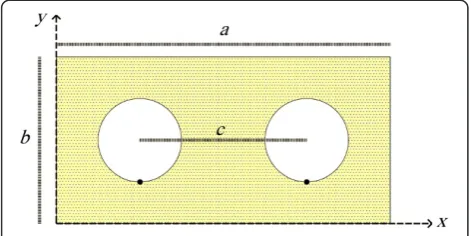
in whichK0andK1are the modified Bessel functions. Figure 1An FG viscoelastic plate with two circular cutouts
under edge tractions atx = a.
0 100 200 300 400 500 600
0 2 4 6 8 10 12 14x 10
- 3
t (sec)
)
m(
t
n
e
m
e
c
al
p
si
D
l
ai
d
a
R
300 305 310
6.5 7 7.5 8 8.5 9
x 10- 4
n = 0.25 n = 1 n = 2 n = 3
By integrating Equation 13 by parts, applying the divergence theorem, and noting that
ψi;j¼
1
2 ψi;jþψj;i
¼εψij ð16Þ
in which ∂D is the boundary of the problem and nj is the outward normal vector; we have
0¼ Z
∂D ψitids−
Z
D
εψijσijdvþ
Z
D
ψiBidv ð17Þ
By substituting the viscoelastic constitutive Equation 12 into the integral Equation 17, we have
0¼ Z
∂D
ψitids− E1E2
E1þE2
Z
D
εψij Cijmnεmn
dv
− E1E2 E1þE2
Z
D
εψij βCijmnε_mn
dv
þ E1 E1þE2
Z
D εψij βσ_ij
dvþ
Z
D ψiBidv
ð18Þ
In addition, by taking the fundamental equilibrium equation into account, we have
Bψið Þ ¼z Δðx;zÞ ei σψij;j¼−B
ψ
i
ð19Þ 0 50 100 150 200 250 300 350
-1 -0.5 0 0.5 1 1.5 2 2.5 3 3.5x 10
- 3
)
m(
t
n
e
m
e
c
al
p
si
D
l
ai
d
a
R
n = 0.25 n = 1 n = 2 n = 3
θ (deg)
Figure 3Effects of the heterogeneity parameter on time history of radial displacement of the viscoelastic plate.
0 50 100 150 200 250 300 350
-2.5 -2 -1.5 -1 -0.5 0 0.5 1 1.5 2 2.5
x 10- 3
θ (deg)
)
m(
t
n
e
m
e
c
al
p
si
D
l
ait
n
e
g
n
a
T
n = 0.25
n = 1
n = 2
n = 3
where the unit vector componenteicorresponds to a unit posi-tive force in theidirection applied atzpoint, andΔ(x, z) is the Dirac delta function, in whereinzandxrepresent the field and the source points, respectively. Equation18, by performing some mathematical manipulations, can be rewritten as
Cjiuið Þ þx βCjiu_ið Þ ¼ þx β
Z
∂Dψji _
tidsþ
Z
Dψji _
Bidv
−
Z
∂Dt
ψ
jiuidsþβ
Z
∂Dt
ψ
jiu_ids
þ E1þE2 E1
Z
∂D
ψjitidsþ E1
þE2 E1
Z
D ψjiBidv
ð20Þ
where free term (Єji) is exactly the well-known one of
the in elastostatic formulations. Equation 20 may be considered as the integral constitutive equation of time-dependent functionally graded structures modeled properly by the SLS model.
The domain integral of the body forces can easily be transformed into an equivalent boundary integral equa-tion, which results in equation in terms of the boundary values only; however, for more simplicity, we neglect it. In a similar manner, the boundary integral equations of the stresses can be derived.
The next step in numerical discretization is dividing the boundary ∂D into Ne elements; so that after choosing identical numbers of the source points and the nodes, and
0 50 100 150 200 250 300 350
-4 -2 0 2 4 6
x 10- 3
θ (deg)
)
m(
t
n
e
m
e
c
al
p
si
D
l
ai
d
a
R
n = 0.25
n = 1
n = 2
n = 3
Figure 5Effects of the heterogeneity on radial displacements of the second hole of the viscoelastic plate.
0 50 100 150 200 250 300 350
-6 -4 -2 0 2 4
6x 10
- 3
θ (deg)
)
m(
t
n
e
m
e
c
al
p
si
D
l
ait
n
e
g
n
a
T
n = 0.25
n = 1
n = 2
n = 3
calculating all integrals, the BEM discretization equations may be derived in a matrix form as follows
Huð Þ þt βHu_ð Þ ¼t E1þE2 E1
Gtð Þ þt ð Þβ Gt_ð Þt
þ E1þE2 E1
DBð Þt
ð21Þ
It should be noted in the, for solving the above time-dependent differential equation, it was necessary to ap-proximate the displacement and the traction rates in the time domain by a time marching treatment. Finally, the presented algorithm has been cast into a unique program and then solved by the MATLAB software.
Results and discussion
For evaluating the accuracy and the efficiency of the pro-posed approach, a numerical viscoelastic problem wherein the material properties are assumed to be exponential functions of the Cartesian coordinatex, is considered.
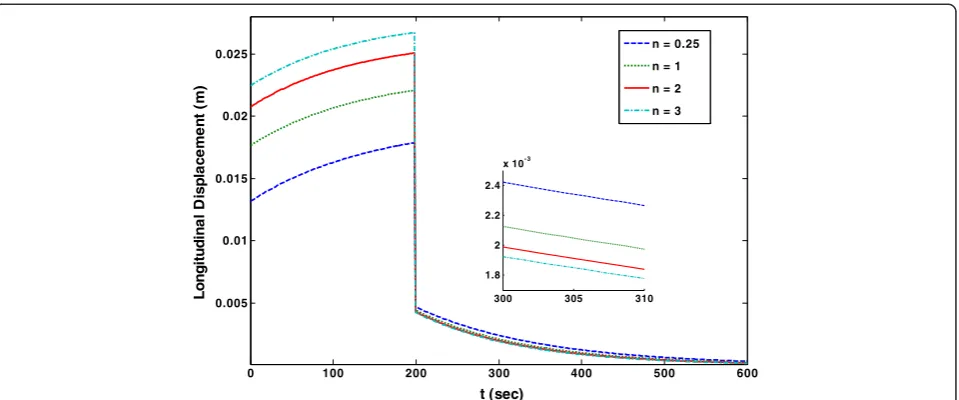
In this regard, a heterogeneous FG viscoelastic plate with exponential material gradation in thex-direction and two circular cutouts as shown in Figure 1 is considered. The considered plate is subjected to a uniform tractionP
in thex-direction at the edgex = a, where
P¼ 20 Mpa0 200t<≤t200<700ð Þs ð Þs
ð22Þ
The opposite end of the considered plate is fixed, while its other boundaries are free of tractions. It is assumed that the plate is sufficiently thin such that a plane stress
condition holds. In this problem, Boltzmann's solid model is employed to formulate the differential constitutive equa-tions of the heterogeneous viscoelastic structures.
This problem is solved using the proposed method, adopting the geometric and material parameters asa =2 m,b =1 m,c =1 m,γ=0.25, 1, 2 and 3,λ0=5 GPa,μ0= 350 MPa,υ=0.4 andβ= 24. The diameter of the circular cutouts is d =0.35 m. Due to using the present-graded boundary integral equation approach, only about 54 boundary elements have been used for the boundary discretization. Using the traditional finite element pro-cedures necessitates using thousands of elements and nodal points.
Time history of the radial displacement component of a node of the heterogeneous plate located at (x = 0.75,y = 0.5) is depicted in Figure 2 for exponential material properties variations and various material gradation exponents.
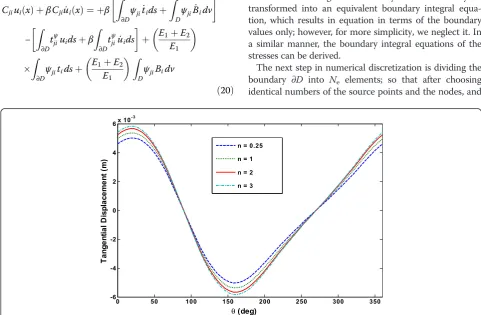
Time histories of the radial and tangential displacement components of the nodes located at the first hole of the FG viscoelastic plate are shown in Figures 3 and 4 for various gradation exponents, respectively. In addition, the radial and tangential displacement components of the nodes located at the second hole of the FG plate are shown respectively in Figures 5 and 6 for various gradation exponents.
Time history of the longitudinal displacement compo-nent of the node (x =2, y= 0) of the heterogeneous viscoelastic plate with exponential material properties variations is shown in Figure 7. These results are given for different material gradation exponents.
Conclusions
In the present paper, a new numerical formulation is pre-sented for accomplishment of the simplified viscoelastic analysis of the functionally graded media by the BEM.
0 100 200 300 400 500 600
0.005 0.01 0.015 0.02 0.025
t (sec)
)
m(
t
n
e
m
e
c
al
p
si
D
l
a
ni
d
uti
g
n
o
L
n = 0.25
n = 1
n = 2
n = 3
300 305 310
1.8 2 2.2 2.4
x 10- 3
This approach avoids using relaxation functions or math-ematical transformations, and it is capable of solving the quasistatic viscoelastic problems with arbitrary load time dependence and arbitrary boundary conditions. A numer-ical example, as an application, was provided to evaluate this boundary element formulation. Only the displacement and traction fundamental solutions of the FG elastostatic structures are needed in the present formulation. This computational system was easily solved by adopting a lin-ear time approximation for the displacement and traction rates. Other advantage of the presented approach is that the mathematical integral representation needs only the boundary data. Numerical discretization was done without any domain approximations, and the integral equations were applied only on the boundaries.
Competing interests
The authors declare that they have no competing interests.
Authors’contributions
HA carried out majority of the activities of the research, including development of the the boundary element solution. MS participated in checking the concepts and preparing the paper. All authors read and approved the final manuscript.
Author details
1Faculty of Mechanical Engineering, University of Kashan, Kashan, Iran. 2
Faculty of Mechanical Engineering, K.N. Toosi University of Technology, Tehran, Iran.
Received: 13 April 2014 Accepted: 7 July 2014
References
Aliabadi, MH. (2002).The boundary element method: applications in solids and structures. New York: Wiley.
Ashrafi, H, Asemi, K, Shariyat, M, & Salehi, M. (2013a). Two–dimensional modeling of heterogeneous structures using graded finite element and boundary element methods.Meccanica, 48, 663–680.
Ashrafi, H, Asemi, K, & Shariyat, M. (2013b). A three-dimensional boundary element stress and bending analysis of transversely/longitudinally graded plates with circular cutouts under biaxial loading.European Journal of Mechanics A/Solids, 42, 344–357.
Ashrafi, H, Bahadori, MR, & Shariyat, M. (2012). Modeling of viscoelastic solid polymers using a boundary element formulation with considering a body load.Advanced Materials Research, 463, 499–504.
Ashrafi, H, & Farid, M. (2009). A mathematical boundary integral equation analysis of standard viscoelastic solid polymers.Computational Mathematics and Modeling, 20, 397–415.
Chan, YS, Gray, LJ, Kaplan, T, & Paulino, GH. (2004). Green’s function for a two–dimensional exponentially graded elastic medium.Proceedings of the Royal Society A, 460, 1689–1706.
Clements, DL. (1998). Fundamental solutions for second order linear elliptic partial differential equations.Computational Mechanics, 22, 26–31. Clements, DL, & Budhi, WS. (1999). A boundary element method of the solution
of a class of steady-state problems for anisotropic media.Journal of Heat Transfer, 121, 462–465.
Criado, R, Gray, LJ, Mantic, V, & Paris, F. (2008). Green’s function evaluation for three–dimensional exponentially graded elasticity.International Journal for Numerical Methods in Engineering, 74, 1560–1591.
Criado, R, Ortiz, JE, & Mantic, V. (2007). Boundary element analysis of three– dimensional exponentially graded isotropic elastic solids.Computer Methods in Applied Mechanics and Engineering, 22, 151–164.
Gao, XW, Zhang, C, Sladek, J, & Sladek, V. (2008). Fracture analysis of functionally graded materials by a BEM.Composites Science and Technology,
68, 1209–1215.
Gray, LJ, Kaplan, T, Richardson, JD, & Paulino, GH. (2003). Green’s function and boundary integral analysis for exponentially graded materials: heat conduction.Journal of Applied Mechanics, 40, 543–549.
Jin, Z-H. (2006). Some notes on the linear viscoelasticity of functionally graded materials.Mathematics and Mechanics of Solids, 11, 216–224.
Kuo, HY, & Chen, T. (2005). Steady and transient Green’s functions for anisotropic conduction in an exponentially graded solid.International Journal of Solids and Structures, 42, 1111–1128.
Mase, GT, & Mase, GE. (1999).Continuum mechanics for engineers. New York: CRC Press.
Shaw, RP, & Makris, N. (1992). Green’s function for Helmholtz and Laplace equations in heterogeneous media.Engineering Analysis with Boundary Elements, 10, 179–183.
Suresh, S, & Mortensen, A. (1998).Functionally graded materials. London: Institute of Materials, IOM Communications.
Sutradhar, A, & Paulino, GH. (2004). The simple boundary element method for transient heat conduction in functionally graded materials.Computer Methods in Applied Mechanics and Engineering, 193, 4511–4539.
Sutradhar, A, Paulino, GH, & Gray, LJ. (2008).Symmetric Galerkin boundary element method. New York: Springer.
Wang, H, & Qin, Q-H. (2012). Boundary integral based graded element for elastic analysis of 2D functionally graded plates.European Journal of Mechanics A/Solids, 33, 12–23.
doi:10.1186/s40712-014-0009-4
Cite this article as:Ashrafi and Shariyat:A numerical boundary integral equation analysis for standard linear viscoelastic media made of functionally graded materials.International Journal of Mechanical and Materials Engineering20141:9.
Submit your manuscript to a
journal and benefi t from:
7 Convenient online submission
7 Rigorous peer review
7 Immediate publication on acceptance
7 Open access: articles freely available online
7 High visibility within the fi eld
7 Retaining the copyright to your article