Article
Modeling, Simulation and Optimization of agricultural greenhouse microclimate by the application of artificial intelligence and / or fuzzy logic
Didi Faouzi 1*, N. Bibi-Triki 2
1* Faculty of Science and Technology, Department of Physics, University of Abou-bakr
Belkaïd, B.P. 119, Tlemcen, Algeria
2 Materials and Renewable Energy Research Unit M.R.E.R.U University of Abou-bakr
Belkaïd, B.P. 119, Tlemcen, Algeria
1*E-mail : [email protected] 2 E-mail : [email protected]
Abstract: Agricultural greenhouse is largely answered in the agricultural sphere, despite the shortcomings it has, including overheating during the day and night cooling
which sometimes results in the thermal inversion mainly due to its low inertia.
The glasshouse dressed chapel is relatively more efficient than the conventional
tunnel greenhouse. Its proliferation on the ground is more or less timid because of its
relatively high cost[14-22].
Agricultural greenhouse aims to create a favorable microclimate to the requirements of
growth and development of culture, from the surrounding weather conditions, produce
according to the cropping calendars fruits, vegetables and flower species out of season
and widely available along the year. It is defined by its structural and functional
architecture, the quality thermal, mechanical and optical of its wall, with its sealing
level and the technical and technological accompanying[12-13].
The greenhouse is a very confined environment, where multiple components are
exchanged between key stakeholders and them factors are light, temperature and
This state of thermal evolution is the level sealing of the cover of its physical
characteristics to be transparent to solar, absorbent and reflective of infrared radiation
emitted by the enclosure where the solar radiation trapping effect otherwise called
"greenhouse effect" and its technical and technological means of air that accompany.
The socio-economic analysis of populations in the world leaves appear especially the
last two decades of rapid and profound transformations
These changes are accompanied by changes in eating habits, mainly characterized by
rising consumption spread along the year[14].
To effectively meet this demand, greenhouse-systems have evolved, particularly
towards greater control of production conditions (climate, irrigation, ventilation
techniques, CO2 supply, etc ...). Technological progress has allowed the development of
greenhouses so that they become increasingly sophisticated and of an industrial nature
(heating, air conditioning, control, computer, regulation, etc ...). New climate driving
techniques have emerged, including the use of control devices from the classic to the
use of artificial intelligence[10-11] such as neural networks and / or fuzzy logic, etc...
As a result, the greenhouse growers prefer these new technologies while optimizing
the investment in the field to effectively meet the supply and demand of these fresh
products cheaply and widely available throughout the year.
Keywords: Greenhouse , microclimate , Modelling , fuzzy controller , Optimization , Solar Energy , Energy saving , Climate Model ,Greenhouse effect , Temperature.
PACS: J0101
1. Introduction
Agricultural greenhouse originally designed as a simple enclosure limited by a
answered chapel in several countries including those of the Mediterranean basin[21].
They amplify certain characteristics of the surrounding environment, thus involving
variations of internal energy and fairly significant heat loss due to the low inertia of the
clamp system[7-10].
To maintain a microclimate suited to the demands of the protected culture, energy
intake and the introduction of new technologies and air conditioning operation becomes
necessary and essential, to do so face the challenge of supply and demand of
agricultural products fresh throughout the year for a strictly increasing population[18].
We are interested in this product conditioning of agricultural greenhouse while
characterizing the dynamic operation of the complex system that is the greenhouse with
its various compartments[8-21], develop models to reproduce the essential properties,
mechanisms and interactions different compartments and to approach the analysis of
thermo-fluid behavior of agricultural greenhouse.
New climate techniques have emerged, including the use of regulation devices
ranging from classical to the use of artificial intelligence, such as neural networks and /
or fuzzy logic, etc
Many facilities have been designed to regulate and monitor climate variables in an
agricultural greenhouse, such as: Temperature, Humidity, CO2 concentration, Irrigation,
the ventilation, etc. The possibilities offered by greenhouse climate computers have
solved the problems relating to the regulation and respect of climate instructions
required by protected cultivation[19-22].
The climate computer greenhouse will have to be integrated as a tool for dynamic
management of production, able to choose the most appropriate climate route, meet
The complexity of managing and optimizing this environment can not be
addressed only through a comprehensive approach to operating greenhouses-systems.
Greenhouse management and the urgent and varied consumer demand make the
problem multivariable, nonlinear and highly complex.
2. Modeling the greenhouse
This article deals with the modeling and simulation of our greenhouse model
which is based on the method of GUESS. [1]
GUESS is a model set in parameter block, meaning that spatial heterogeneity is
ignored and it is assumed that the inner content and the flow through the system
boundary are evenly distributed. .
The conservation equations are used to model the rate of system status change.
For a warm greenhouse these state variables would be the indoor temperature,
relative humidity, air pressure and CO2 concentration.
For the plant state variables are the water content, the body temperature, dry
weight or biomass, and internally sheet CO2.
A complete equation for the transport of some scalar quantity through a control
volume is as following:
= ( − ) + ( − )
C: The heat capacity (J / m3. k)
V: System Volume (m3)
Φ: is a quantity describing the state of the system (W / m2)
dx: Material thickness (m)
A: The flow boundary surface (control surface) (m2)
, : Internal and external flux (W / m2)
2.1 Modeling the climate of the greenhouse systems 2.2.1 Cooling pad Model
In a greenhouse, evaporative cooling devices are used to reduce the
temperature when the fan can not reach appropriate levels for optimal plant growth. In
equipped greenhouses, cooling evaporation is the second part of the unrealized gain.
Most evaporative cooling methods can be modeled as adiabatic cooling process; the
minimum temperature and the achievable maximum vapor pressure is equal to the wet
bulb.
The effectiveness of the typical tablet is about 85%. The heat loss rate depends
on the fan speed.
= ( − ) = ( − )
( − ) : Pad efficiency
, : The difference between the outside temperature and wet bulb (K) : Specific heat (J/kg.k )
: Density (kg /m3)
: fan speed (m/s)
2.2.2 Model of fogging system
The flow of steam and heat are determined through Ohm's Law and is as
following:
= ( ( , ℎ ) − ) =
(2)
(3)
(4)
(5)
: Is the heat transfer between the nebulizer and the air of agricultural greenhouse
(W/m2)
: Global coefficient of heat transmission (W/m2.k)
:Saturation pressure (Pascale)
: Pression de l'air ambiant (pascale)
: Thermal conductivity (W/m2.k)
2.2.3 Evaluation Model of the wall temperature
The T wall temperature evaluation model [8] ,closest to reality is determined based on the average temperatures and
= (7)
The indoor and outdoor temperatures and are:
= , − , , (8)
= , + , , (9)
The temperature evaluation model of wall will be expressed:
= , , +
. .
, , (10)
= , , + , ,
Where : =
. (11)
,, , : Dry Air temperature Inside / Outside (K)
ℎ , ℎ : Coefficient of superficial exchanges at the inter wall, of the outer wall
(W/m2.k)
This report dimensionless is used in evaluating the T wall temperature, it is
now called the quotient of BIBI, it is the ratio of the difference of surface thermal
exchange by conduction, convection and radiation occurring at the level of the
greenhouse coverage.
2.2.4 Heating system
The heat produced per unit of fuel is modeled as eq (12):
ℎ = + ∗ − ( ) − (1 − ) ,
ℎ : Sensible heat load of a condensing water heater (J) , LHV : is
lower heating value (KJ/kg) ,
Φ : is the fuel air , 36/16 : is the weight ratio of the produced steam to supply the
burner , : is the temperature of the exhaust gas (k) and r is the return ratio.
2.3 Energy balance of the greenhouse
The analytical energy balance equation of the greenhouse eq (13):
Stored energy change = Gain from internal sources+ Gain from the sun - Losses due to conduction through the cover - Losses due to long wave radiation -
Unrealized losses (evaporation) - Losses due to the exchange of air .
ρair VGH CP,GH dTdtin STORAGE
= + + , ,
, , , − ( ) −
ℎ, (1 − ) − − 08 ℎ , ( − ) − −
, , , + ( ℓ) ( − ) −
: Indicates the report saturated with the relative humidity in the sub-model of
combustion
(Kg steam / kg air)
: Is the heat provided by the heating system (W)
, , , : Heat transfer coefficient inside and outside by convection
(W/m2.k)
2.4 The mass transfer in the greenhouse
The mass balance for moisture in the greenhouse can be written as following eq (14)
= − ∗ ( − ) − ∗ − +
− − ( ) +
, ℎ − + ( )
: The speed of air infiltration (m/s)
: The total volume of agricultural greenhouse (m3)
, : Is the indoor and outdoor humidity (KJ / kg)
: Ventilation rate (m3 air / s)
And for the humidity balance:
Rates of change in absolute humidity = Infiltration + Ventilation * (humidity difference with the outside) + Misting + Cooling + AND - Condensation
= − ( − )+ − , − ( −
) + (15)
: The amount of heat provided by evapotranspiration (W)
Mass balance for CO2 is :
= − + +
− + (16)
: Ventilation rate (m3 air/s)
: The amount of heat supplied by photosynthesis (W)
CO2 Mass Balance in molar units (ppm or μmol CO2 per mol air). ζ is the
number of moles of carbon per mole of fuel 2.6 Photosynthesis
Photosynthesis is a complex process. CO2 fixation and subsequent conversion
into carbohydrates are not a single reaction, but a series of steps, the Calvin cycle (see
Fig.1Schematic Calvin cycle. The reaction at the apex (CO2 fixation and RuBP) is catalyzed by the enzyme Rubisco. this reaction ordered carbon assimilation rates, and that is modeled by Farquhar. al. equations. Source:
Cellupedia, "Calvin cycle
According to Farquhar model , the CO2 compensation model is:
= 1 − ∗ , (17)
Farquhar model with Γ, CO2 compensation point
: Internal CO2 concentration (ppm)
2.7 Plant state of water balance
In the model of GUESS, we assume that the soil is well watered, so that the
physiological effects of
the state of water should be minimal, except in stomata.
: the potential of water
: Is the capacity of the plant (mole*m2)
E : Is evapotranspiration.
: The root surface ( m2).
: The growth rate.
2.8 Stomatal conductance and balance CO2
The rate of photosynthesis in the Farquhar model depends on the internal
concentration of CO2.
To determine the concentration of CO2, a mass balance is performed on the sheet.
= CO2 - CO2 (19)
According to GUESS the plant stomatal equation of is
= ∗ , (20)
Ball-Berry modified model used in GUESS
: Is stomatal conductance in units of (mole.s-1.m-2.)
2.9 Plants Energy Balances =
( ) , ,
3. Fuzzy controller modeling
Fuzzy logic is widely used in the machine control. The term "fuzzy" refers to the
fact that the logic can deal with concepts that can not be expressed as the "true" or
"false" but rather as "partially true". [15] While alternative approaches such as genetic
algorithms and neural networks can perform just as well as fuzzy logic in many cases,
fuzzy logic has the advantage that the solution can be cast in terms that human operators
can understand, so that their experience can be used in the design of the control device.
This makes it easier to mechanize the tasks have already been performed successfully
by man [3].
3.2 Fuzzy inference method MAMDANI
Fuzzy inference Mamdani type, as defined for Toolbox fuzzy logic, expects the
output membership functions to be fuzzy sets. After the aggregation process, there is a
fuzzy set for each output variable to defuzzification. It is possible, and in some cases
much more efficient to use a single peak as output membership function, rather than a
distributed fuzzy set. This is sometimes known as singleton output membership
function, and we can think like a fuzzy set of pre defuzzification. It improves the
efficiency of defuzzification because it greatly simplifies the calculation required by the
more general method Mamdani which has the center of gravity of a two-dimensional
function. [4-5]
To calculate the output of the SIF in view of inputs, six steps should be followed :
The determination of a set of fuzzy rules.
Fuzzification inputs using the input membership functions.
By combining Fuzzificaion entries according to the fuzzy rules to establish a
Find the consequence of rule by combining the resistance to the rule and the
output membership function.
By combining the consequences to get a distribution outlet.
Defuzzification the output distribution.
3.3 Fuzzy sets
The input variables in a fuzzy control system are generally mapped by sets of
membership functions similar to it, called "fuzzy set". The process of converting a crisp
input value to a fuzzy value is called "fuzzy logic". A control system may also have
different types of switch, or "ON-OFF", inputs and analog inputs and during switching
inputs will always be a truth value of 1 or 0, but the system can handle as simplified
fuzzy functions happen to be one value or another. Given "mappings" of input variables
membership functions and truth values, the microcontroller then makes decisions for
action on the basis of a set of "rules" .
Fig.2 Representation rules of membership 3.3.2 Rules of decisions
If (Ti is TVCOLD) then (FOG1FAN1 is OFF)(FOG2FAN2 is
OFF)(FOG3FAN3 is OFF)(NV is OFF)(Heater1 is ON)(Heater2 is ON)(Heater3
is ON) (1)
If (Ti is TCOLD) then (FOG1FAN1 is OFF)(FOG2FAN2 is OFF)(FOG3FAN3
is OFF)(NV is OFF)(Heater1 is ON)(Heater2 is ON)(Heater3 is OFF) (1)
If (Ti is TCOOL) then (FOG1FAN1 is OFF)(FOG2FAN2 is OFF)(FOG3FAN3
is OFF)(NV is OFF)(Heater1 is ON)(Heater2 is OFF)(Heater3 is OFF) (1)
If (Ti is TSH) then (FOG1FAN1 is OFF)(FOG2FAN2 is OFF)(FOG3FAN3 is
OFF)(NV is ON)(Heater1 is OFF)(Heater2 is OFF)(Heater3 is OFF) (1)
If (Ti is TH) then (FOG1FAN1 is ON)(FOG2FAN2 is OFF)(FOG3FAN3 is
If (Ti is TVH) then (FOG1FAN1 is ON)(FOG2FAN2 is ON)(FOG3FAN3 is
OFF)(NV is OFF)(Heater1 is OFF)(Heater2 is OFF)(Heater3 is OFF) (1)
If (Ti is TEH) then (FOG1FAN1 is ON)(FOG2FAN2 is ON)(FOG3FAN3 is
ON)(NV is OFF)(Heater1 is OFF)(Heater2 is OFF)(Heater3 is OFF) (1)
4. Simulation and model validation
Our model is based on the greenhouse GUESS model that is set for a multi
greenhouse chapel which each module is 8.5 m wide, 34 m deep and ridge height of 4.5
m . Infiltration rate is 1.1 air changes per hour, and a U value of 5.76 W / m2.K was
used. The model of the plant was set for Douglas seedling plants were started at 0.57 g
dry weight, and harvested 1.67 g dry weight; a new growing season was recorded at
harvest.
A set of hourly data for 2015 (1 January to 31 December) weather station of
Biskra Algeria [6], was used to validate our model as a CSV file that consists of four
columns (global solar radiation, temperature, humidity and wind speed).
The model of the greenhouse was coded using the full version of Windows
MATLAB R2012b (8.0.0.783), 64bit (win64) with Simulink. The simulation was
performed on a Toshiba laptop. The laptop is equipped with a hard drive 700 GB and 5
GB of RAM. Simulink model of the parties were made in "Accelerator" mode that has
first generated a compact representation of Code C of the diagram, then compiled and
4.1 Greenhouse Climate Model
4.2 Fuzzy logic controller simulation model of the greenhouse
5 10 1 20 25 30 0 1 2 3 4 5 6 7 8
9 x 10⁴ Indoor Temperature Distribution
Temp. (C)
freq.
0 50 100 150 200 250 300 350 400
-5 0 5 10 15 20 25 30 Day
0 50 100 150 200 250 300 350 400
0 20 40 60 80 100
Relative Humidity % of 100
Day Temperatures outdoor indoor Rel at iv e Hu midi ty % o f 100 Temp. ( C
5. RESULTS
the simulation results clearly visualize the actual thermo-energy behavior of
agricultural greenhouse, applying the model of artificial intelligence, namely the
application of fuzzy logic in arid region (Biskra) [6].
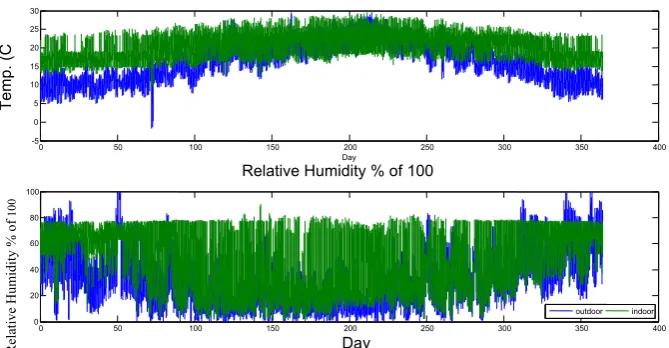
Fig. 5Histogram shows the distribution of indoor temperature
It is found that most of the internal temperature values are in the range 15 ° C
to 25 ° C for the autumn winter period, and in the range 20 ° C to 28 ° C for the spring
summer period in a large variation the temperature during the winter autumn period is
due to heat loss during the night, clearing heating is insufficient and expensive for this
improved thermal insulation of the covering wall is necessary.
The improved thermal insulation of the cover may be carried out in practice by the
addition of an plastic air bubble layer mounted to the inside wall face.
During the period spring summer the temperature is almost within the desired
range except for half of the summer where the temperature is a little increase .The use
of cooling systems and spray is necessary to lower the temperature in the interval
longed for But this solution is insufficient and really expensive, for this purpose we
should improve the characteristics of the coverage of the agricultural greenhouse for
example thermal insulation or blanket double wall which demonstrates improved
efficiency of heating and cooling ... etc
The relative humidity generally stays close to the optimum for all the year except in
summer when the humidity drops below threshold due to significant vaporization used
for temperature compensation, to resolve this problem adding a screen on the roof of the
greenhouse and improving irrigation can compensate the lack of relative humidity in the
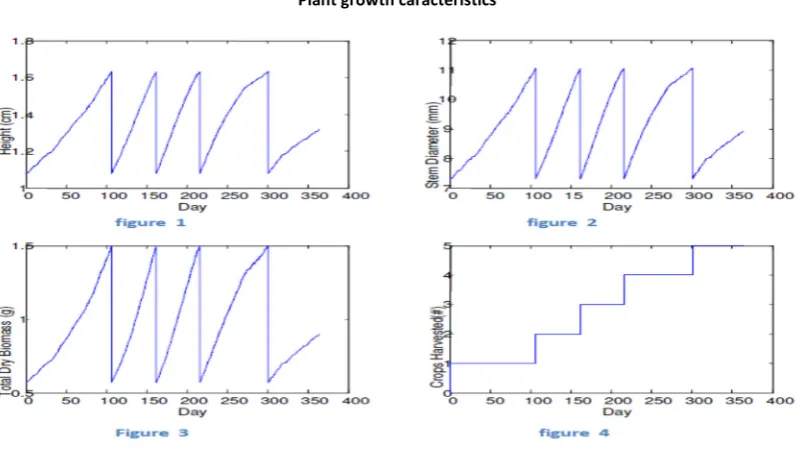
Figure 1 is the height in cm, Figure 4 is the cumulative number of growing season, Figure 3 is the total biomass (dry weight), and Figure 2 is the rod diameter
in mm
The speed of growth of the mass of the plant is normal for most of the year except in
the end of autumn and beginning of winter because of the temperature drops at night
and we discussed this problem and its correction previously.
6. CONCLUSION
However, our objective is achieved to the extent that it has been shown through modeling and control by the use of fuzzy logic, this area is very difficult because it is a
multi control variables which the greenhouse is a biophysical system where parameters
are highly correlated as shown by the results. this technique of fuzzy logic that has been
adapted to the greenhouse to a promising future for the climate control and management
of the greenhouse. for greenhouse growers, it is a preferred approach for structuring and
knowledge aggregation and as a means of identification of gaps in the understanding of
mechanisms and interactions that occur in the system - greenhouse.
Fuzzy logic is a branch of artificial intelligence, which must point out its
advantages and disadvantages. its use has led to quite satisfactory results of the control
and regulation perspective.
We remain optimistic in the near future, as to the operation of artificial
intelligence, including the use of fuzzy logic which indicates:
For the control and regulation of the greenhouse microclimate.
By the conservation of energy.
For the efficiency of energy use in the greenhouses operation.
For improved productivity of crops under greenhouses.
In a significant reduction of human intervention.
7. References
[1] https://ecommons.cornell.edu/handle/1813/3437.
[2] http://library.thinkquest.org/C004535/calvin_cycle.htm.l [3] https://en.wikipedia.org/wiki/Fuzzy_control_system.
[4] S.D. DHAMAKALE and S.B. PATIL , Fuzzy Logic Approach with Microcontroller for Climate Controlling in Green House, International Journal on Emerging Technologies 2(1): 17-19(2011).
[5] https://en.wikipedia.org/wiki/Fuzzy_control_syste.
[6] http://www.wunderground.com/cgibin/findweather/getForecast?qery². [7] N. BIBI-TRIKI , S. BENDIMEMERAD , A.CHERMITTI ,T. MAHDJOUB ,
B. DRAOUI , A. ABENE. Modeling ,characterization and Analysis of the dynamic behavior of heat transfer through polyethylene and glass wall of greenhouses .ELSEVIER -Physics Procedia 21(2011)67-74.
[8] S. BENDIMERAD , T. MAHDJOUB , N. BIBI-TRIKI , M.Z BESSENOUCI , B. DRAOUI , H. BRCHAR Simulation and Interpretation of the BIBI Ratio CB (.), as a Function of Thermal Parameters of the Low Inertia Polyethylene Wall of Greenhouses. Rev ELSEVIER Physics Procedia 55(2014)157-164.
[9] B. DRAOUI , F. BOUNAAMA , T. BOULARD , N. BIBI-TRIKI
In-situ Modelization of a Greenhouse Climate Including Sensible Heat, Water Vapor and CO2 Balances. EPD science ,2013 . EPS Web of conferences 45.01023(2013) DOI : 10105/epjconf/201334501023.
Greenhouse Climate Model Parameters .International Review On Computers and Software (I.RE.CO.S) ,Vol. 3 , N.6 November 2008.
[11] F. BOUAAMA , K. LAMMARI , B. DRAOUI
Greenhouse Air Temperature Control Using Fuzzy PID+I and Neuron Fuzzy Hybrid System Controller International Review of Automatic Control (I.RE.A.CO), Vol. xx, n. x September 2008.
[12] ABDELHAFID HASNI , B.DRAOUI , T.BOULARD , RACHID TAIBI , BRAHIM DENNAI , A Particle Swarm Optimization of Natural Ventilation Parameters in a Greenhouse With Continuous Roof Vents Sensor & Transducers Journal , Vol. 102 , Issue 3 , March 2009 , pp. 84-93.
[13] F. BOUAAMA , B. DRAOUI , Greenhouse Environmental Control Using Optimized MIMO PID Technique Sensors & Transducers Journal, Vol. 133, Issue 10, October 2011, pp. 44-52.
[14] KHELIFA LAMMARI , F. BOUAAMA , B. DRAOUI , BENYOUCEF MRAH, MOHAMED HAIDAS , GA Optimization of the Coupled Climate model of an order two of a Greenhouse . Rev ELSEVIER Energy Procedia 18 ( 2012 ) 416 – 425.
[15] M. GURBAOUI, A. Ed-DAHHAK , Y. ELAFOU , A. LACHHAB , L. BELKOURA and B. BOUCHIKHI , IMPLEMENTATION OF DIRECT FUZZY CONTROLLER IN GREENHOUSE BASED ON LABVIEW ,International Journal of Electrical and Electronics Engineering Studies Vol.1 No.1, pp.1-13, September 2013.
[16] MOHAMED MASSOUR El AOUD and MOSTAFA MAHER , INTELLIGENT CONTROL FOR A GREENHOUSE CLIMATE ,International Journal of Advances in Engineering & Technology, Sept., 2014. ISSN: 22311963.
[16]MOHAMED MASSOUR El AOUD and MOSTAFA MAHER ,
INTELLIGENT CONTROL FOR A GREENHOUSE CLIMATE ,International Journal of Advances in Engineering & Technology, Sept., 2014. ISSN: 22311963.
[17]. Boulard, T. and Draoui, B., Natural ventilation of greenhouse with continuous roof vents: Measurements and data analysis, Journal of Agricultural
Engineering Research, 61, 1995, pp. 27-36.
[18]. Hasni, A., Draoui, B., Bounaama, F., Tamali, M., and Boulard, T., Evolutionary algorithms in the optimization of natural ventilation parameters in a greenhouse with continuous roof vents, In: J. J. Pérez-Parra, J. I. Montero and B. J. Bailey (Eds), International Symposium on Greenhouse Cooling, Almeria (ESP), April 24-27, 2006. ISHS - Acta Horticulturae, 719, 2006, pp. 49-55. [19]. Kennedy J, Eberhart R., Particle swarm optimization, in Proc. of IEEE Int.
Conf. on Neural Networks, Perth, Australia, Vol. IV, 1995, pp. 1942–8.
[20]. Eberhart R. C., Shi Y., Comparison between genetic algorithms and particle swarm optimization, in Proc. IEEE Int. Conf. on Evol. Comput., Anchorage, AK, May 1998, p. 611–6.
[21]. Angeline P. J., Using selection to improve particle swarm optimization, in
Proc. of IEEE Int. Conf. Evol. Comput., Anchorage, AK, May 1998, pp. 84–89.
dynamique). Thèse de doctorat de l’université de Nicesophia antipolis, France, 1994.
[23] Didi Faouzi , Nacereddine Bibi Triki ,Ali Chermitti , OPTIMIZING THE GREENHOUSE MICRO-CLIMATE MANAGEMENT BY THE INTRODUCTION OF ARTIFICIAL INTELLIGENCE USING FUZZY LOGIC , International Journal of Computer Engineering & Technology (IJCET)
,Volume 7, Issue 3, May-June 2016, pp. 78–92, Article ID: IJCET_07_03_007
,Available online at
http://www.iaeme.com/IJCET/issues.asp?JType=IJCET&VType=7&IType=3.
PhD student
Didi Faouzi Graduate: DEUA of University degree in Applied cold in 2008 Yahia Fares University of Médéa
Algeria, State Engineer HVAC in 2011 from the University of khemis Miliana Algeria, academic Master in Energy and Thermal in 2012 University khemis Miliana Algeria in Mechanical Engineering Degree in 2014 of Yahia Fares University of Médéa Algeria, Master in Energy and Industrial Refrigeration in 2013 Yahia Fares University of Médéa Algeria, PhD in Physics specialty Renewable Energies during 201
Professor Doctor N. Bibi-Triki Graduate: State Engineer in mechanical engineering technology and industrial equipment of the University of Annaba Algeria, magister holder in physical energy and Doctorate of Science from the University Es Abu Bakr Belkaïd Tlemcen Algeria.
Professor, scientist, head of the National Research Project (NRP) in the field Agriculture, Food, Forestry, Natural and Rural Areas; head of research team in solar thermal material and thermal systems within the Research Unit of Materials and Renewable Energy (URMER) of the University of Tlemcen Algeria.