Future Network and MobileSummit 2012 Conference Proceedings Paul Cunningham and Miriam Cunningham (Eds)
IIMC International Information Management Corporation, 2012 ISBN: 978-1-905824-29-8
On designing next generation MAC for cellular networks
using the FLAVIA paradigm
Vincenzo MANCUSO1
, Erez BITON2
, Andreas MAEDER3
, Peter ROST3 , Nelly ANDRUSIER4
, Yaniv WEIZMAN4
, and Omer GUREWITZ2 1
Institute IMDEA Networks, Leganes (Madrid), 28918, Spain Email: [email protected]
2
CSE dept., Ben Gurion University of the Negev, Beer Sheva, 84105, Israel Email: [email protected], [email protected]
3
NEC Laboratories Europe, Heidelberg, 69115, Germany Email: [email protected], [email protected]
4
Alvarion Ltd., HaBarzel street, Tel Aviv, 69710, Israel
Email :[email protected], [email protected]
Abstract: Implementing a flexible and modular architecture for scheduled systems will speed-up the deployment of novel and adjustable MACs for cellular systems. Such an architecture will be of great benefit for researchers, vendors and operators by enabling off-the-shelf devices to be used for testing modified MACs, by allowing fast upgrade of existing devices, and by drastically reducing the time-to-market of MAC products, which ultimately turns into enhanced services for the users. In this paper, we show how the architecture proposed in the FLAVIA project can enable the paradigm shift towards open, modular and flexible scheduled MAC architectures, thus allowing cellular operators to use up-to-date research results to augment and promptly update the capabilities of the cellular network by creating and instantiating MAC services.
Keywords: Scheduled systems, modularity, flexibility, wireless services.
1.
Introduction
Innovative MAC solutions require long design, test and validation processes including actual implementations on dedicated platforms. Current solutions imply a rather long time-to-market for innovations, make it very expensive to introduce protocol modifica-tions, and prevent thorough field validation of possible modifications proposed by re-searchers and developers. In particular, scheduled systems are currently developed and implemented on a limited number of proprietary platforms, which completely prevent independent researchers to challenge and validate their models and proposals. Further-more, these proprietary platforms only allow for validation of enhancements which are supported by the platform’s original design.
Recently, a few projects have been initiated which envision the possibility to develop an open platform for wireless systems that would allow for a much closer cooperation of academia and industry. For example, the Femto Application Platform Interface (FAPI) project [1] suggests a common and detailed MAC API definition. The defined APIs enable a high flexibility level and the possibility to interconnect out-of-the-shelf hard-ware and softhard-ware. However, FAPI does not specify an architecture for developing or optimizing new services and functionalities. Optimization support in scheduled systems has been the focus of the OpenAirInterface project [2], in terms of spectral, algorithmic and protocol efficiency based on open-source design tools. The architecture proposed by OpenAirInterface is subdivided into functional sub-layers. Optimization support is also one of the targets of the ACROPOLIS network of excellence [3], focusing on
cooperative and cognitive wireless systems. ACROPOLIS is a holistic and dynamic ap-proach, where cooperation, flexibility and certain learning capabilities (cognition) can yield significant benefits for future wireless systems. However, both OpenAirInterface and ACROPOLIS do not provide modularity at MAC service level.
The FLAVIA project [4] defines a flexible, modular and virtualizable architecture for wireless access networks. In particular, a main focus of the project is to design a novel architecture for scheduled systems. Specifically, in addition to covering requirements of existing standards such as 3GPP LTE and IEEE 802.16, the FLAVIA architecture also applies to generic schedule based systems, i.e., the architecture is technology agnostic. In this paper we follow the paradigm proposed in FLAVIA and show that it simplifies the implementation of wireless MAC for scheduled systems by making it flexible and modular. This paper presents the conceptual design of a scheduled MAC architecture, in which a comprehensive set of MAC functionalities—termed services—are well-defined and can be reused, replaced, reconfigured and updated with none or only minimal modifications to other services. In FLAVIA, we define a function as a stateless MAC
operation, and a service as a stateful composition of functions that can be accessed and
controlled via programmable interfaces. Services can communicate and coordinate with
each other by passing data over well-defined interfaces. Accordingly, we define the following elements: (i) services and functions for scheduled system, (ii) a control system
which orchestrates services and functions, and (iii) interfaces that allow the interaction
of control, services, and functions.
The implementation of such architecture and its elements is out of the scope of this paper. However, we remark that FLAVIA proposes a conceptual architectural frame-work that could be implemented with different levels of complexity, e.g., by modularly re-writing firmwares/drivers of existing hardware, allowing for new code hooks, or by developing novel, hardware-independent wireless processors supported by novel general-purpose hardware interfaces. Similarly, the flexibility of the MAC architecture can be seen as the possibility to change the MAC operation by composing existing building blocks (functions and elementary hardware functions), which does not necessarily re-quire the ability to change the MAC on-the-fly. For instance, a proof-of-concept of FLAVIA-style MAC design has recently appeared in [5, 6], where the 802.11 MAC has been statically modified to schedule conditional data/voice piggybacking within the MAC ACK frame.
FLAVIA services for scheduled systems have been identified in [4, 7]. In this paper we first show the overall MAC service architecture, focusing on scheduling functionali-ties, then we illustrate the modularity and flexibility of the FLAVIA paradigm by means of a few service definition examples. Specifically, we select three services: the very fun-damental Data Transport service (DATR), the Link Adaptation service (LADA), which is a typical service for scheduled MAC, and an innovative service for next generation systems, namely Application Optimization Support (AOPS). For each service, we give a description of functionalities and interfaces. Finally, we delineate how the interaction of modules can be used to optimize the system.
2.
Architecture overview
GenericInterfacesfor
genericservices/function Morespecificfunctions/services
requirespecificinterfaces
SpecificInterfaces
forwireless
processor
GenericInterfacesfor
wirelessprocessor
Servicescommunicatewitheach
other,evenacrossentities
GenericServices
ServicesforLTE
ServicesforWiMAX
FunctionsforLTE
FunctionsforWiMAX
GenericFunctions
WirelessProcessor
Hardware
Thesamehardware
maybeaccessedby
differentprocessors
Servicecontainer
Functioncontainer
Inter/IntraͲentityinformationflow
In te r/ In tr a Ͳ la y e r in fo rm a ti o n fl o w (w it hin o n e e n ti ty )
(a) Scheduled MAC modular architecture and information flow description.
(b) Interface architecture for scheduling systems using the FLAVIA paradigm.
Figure 1: Scheduled MAC modular architecture and interfaces.
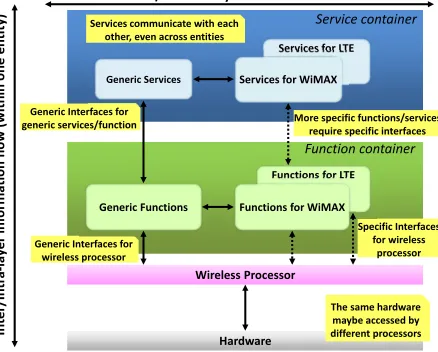
blocks/operations and have limited access to services (e.g., to notify an event to a service) or to the hardware modem (e.g., to the wireless processor, using FLAVIA’s terminology). A function can be reused by multiple services, i.e., services can have common functions. The high-level FLAVIA architecture for scheduled access systems (e.g., 802.16 and LTE) is depicted in Figure 1(a).
As illustrated in Figure 1(a), services can be classified into generic services and technology-specific services. Generic services are common for all scheduled systems, while technology-specific services are only needed in a subset of possible MAC imple-mentations. Nonetheless, generic services have to be tailored to the technology where they are applied, i.e., generic services can behave differently when applied to LTE or 802.16. Accordingly, MAC functions can be classified into generic functions and technology-specific functions [4].
MAC services offer complex operations with rich interfaces towards the control sub-system, other services located on the same machine or on a remote device, applications, and MAC functions. Interfaces are defined byprimitives of four different types: request
(REQ), meant to receive a command; reply (REP), used to reply to a REQ with the output of the invoked command;subscribe(SUB), meant to register a module for event notification on a different module; indication (IND), used to notify an event to the list of subscribers for that event.
Interfaces are grouped inInterface Access Points(IAP), according to the entities they connect (see Figure 1(b)). Furthermore, interfaces can be partitioned into two groups: (i) External interfaces which are used to connect the MAC to the wireless processor,
other MACs, the control subsystem, and higher layers (IAP1, 2, 4 and 6 in Figure 1(b)); (ii) Internal interfaces which are used to connect different MAC components, such as
services to services or services to functions (IAP3 and 5 in Figure 1(b)).
Note that IAP3, between services and functions, is required to contain some standard interfaces. These interfaces allow for the deployment of generic services and technology-specific interfaces. Furthermore, technology-technology-specific interfaces allow for the deployment of technology-specific services through generic and technology-specific functions. In par-ticular, IAP3 is used by MAC services in order to access the MAC functions needed to compose the service. The availability of IAP5, providing a set of inter-service interfaces, allows for the development of modular, programmable, and flexible MAC services.
communicate with services on the same MAC entity (limited access on IAP3), and with the wireless processor running on top of the available hardware (IAP1).
3.
MAC service architecture
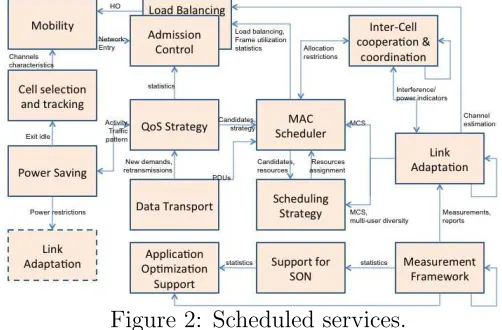
A service oriented architecture is designed of small pluggable software units or services rather than large centralized software [8]. The service design is optimized for modularity by a loose coupling and interoperability of elements. FLAVIA services and their basic interaction are depicted in Figure 2. Each arrow in the figure corresponds to an interface between services.
The scheduler is the main building block of any scheduled system. Here it is com-posed of three services. First,QoS Strategyhandles the support for different QoS classes and can assign different scheduling strategies to subsets of connections. Second,
Schedul-ing Strategy defines different scheduling schemes incorporating link adaptation inputs.
Both QoS Strategy and Scheduling Strategy services can be designed to be technology-agnostic. Third,MAC Schedulermanages the physical frame building process by getting a candidate-list from the QoS Strategy and applying relevant scheduling strategies. This service is technology-specific.
Figure 2: Scheduled services. Another important
ser-vice which is central to the radio resource and interfer-ence management is theLink
Adaptationservice. This
ser-vice aims at optimizing the link performance by adapt-ing transmission parameters in a varying channel environ-ment. Data Transport is a fundamental service for re-ceiving and sending packets.
Among others, it is responsible for packet manipulation such as multiplexing, encryp-tion, header encapsulaencryp-tion, and segmentation. Finally, theApplication Optimization ser-vice aims at optimizing specific application protocols by dedicated MAC operations. In addition, FLAVIA defines services for power saving, load balancing, admission control, inter-cell coordination and cooperation, measurement and other functionalities.
Due to space limitations, we omit here the description of many services’ operation, and use Figure 2 to illustrate the data flow between a number of specific services. In particular, in the following we describe a transmission cycle. When the Data Transport receives new data to transmit, it informs the QoS Strategy service of new demands. The QoS Strategy prepares candidates for scheduling and decides on the specific scheduling strategy to be used. These pieces of information are passed to the MAC Scheduler, that decides about physical resources per group of candidates. The Scheduling Strategy service finally evaluates how to schedule the given candidates on the given resources. Modulation and coding schemes are provided by the Link Adaptation, so that, with the resource assignment at hand, the Data Transport service builds MAC PDUs, which are transmitted on the assigned physical resources.
Adapta-tion, and Application Optimization Support.
3.1 Data transport
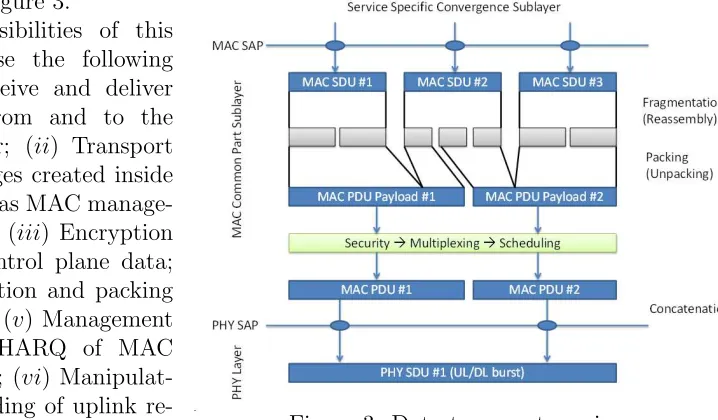
The Data Transport service (DATR) provides forwarding and processing of user or control data before passing data to the physical layer. Data can be transported with protocols to increase transport reliability, e.g., encryption, ARQ or HARQ. DATR provides an interface towards higher layers which expects SDUs from a service flow. Several service flows can be multiplexed. The actual functionality of this service is illustrated in Figure 3.
Figure 3: Data transport service. The responsibilities of this
service comprise the following tasks: (i) Receive and deliver
MAC SDUs from and to the MAC consumer; (ii) Transport
of MAC messages created inside the MAC, such as MAC manage-ment messages; (iii) Encryption
of user and control plane data; (iv) Fragmentation and packing
of MAC SDUs; (v) Management
of ARQ and HARQ of MAC SDUs priorities; (vi)
Manipulat-ing and forwardManipulat-ing of uplink re-ceived packets; and (vii)
Multi-plexing and demultiMulti-plexing of packet flows.
Some service interface primitives of the DATR service are presented in Table 1. Note that due to lack of space, we only show a selected subset of primitives.
Table 1: Examples of service interface primitives of DATR
IAP Primitive name Description
IAP6 DATR IAP6 add sdu REQ/REP Adds SDU (to be sent) to the data buffer of a user’s connection.
IAP5 DATR IAP5 add mac msg REQ/REP Adds MAC message (to be sent) to the data buffer of a user’s connection.
IAP5 DATR IAP5 statistics REQ/REP Returns the current buffer statistics (fill level, delays, etc.) of a user’s connection (downlink specific).
IAP5 DATR IAP5 fill resource assignments REQ/REP Fills the given resource assignments with data from users’ connections. It also invokes inter-nal procedures to fragment SDUs, pack pay-load, apply CRC/ARQ, encrypt, and multiplex PDUs. Returns the final list of PDUs.
IAP5 DATR IAP5 register class REQ Request to update the class-filtering rules (from AOPS).
3.2 Link adaptation
downlink. Specifically, LADA is responsible for the following operations: (i)Collecting
and analyzing the link status statistics—collects statistics on the link quality in terms of
SINR, packet error rate, HARQ retransmissions, transmission failures; (ii) Setting the
transmission parameters—computes and applies the transmission parameters, including:
modulation and coding scheme, transmission diversity scheme, multi-user scheme, and transmission power; (iii) Interference management—collects and distributes power and
interference reports from and to neighboring cells, and limits the transmission power accordingly. Some relevant service interface primitives used for LADA operations are presented in Table 2.
Table 2: Examples of service interface primitives used with LADA
IAP Primitive name Description
IAP2 MEAS IAP2 meas REQ Request link meas. from other MAC entities (e.g., CQI). IAP4 LADA IAP4 configure REQ Allows the FLAVIA control to configure the service.
IAP5 LADA IAP5 PHY profile REQ Output the transmission parameter (i.e., modulation and coding scheme, transmit diversity, transmission power, etc.) based on the link state, allocation size and power budget.
IAP5 DATA IAP5 harq feedback IND Notify about HARQ ack/nack.
IAP5 MEAS IAP2 meas REQ Request link meas. (e.g., Noise Interference, RSSI, SNR)
3.3 Application optimization support
The Application Optimization Support (AOPS) service is a novel modular component meant to enforce automatic optimization of MAC operation as a response to application needs. Moreover, AOPS might be used to provide applications with timely updated MAC and PHY operational parameters.
As an example, AOPS could use MAC and channel statistics computed within the MAC to run optimization algorithms and suggest to update the MAC configuration accordingly. Thereby, AOPS is required to be able to fetch statistics, detect running applications, and propose MAC and PHY parameters that better suit application needs. In particular, AOPS is responsible for the following operations: (i) provide support for
handling traffic classes, e.g., define and apply filters to be used to detect running ap-plications; (ii) suggest how to tune the queuing and scheduling system on a per-class
basis; (iii) configure MAC and PHY parameters by running local algorithms based on
the statistics available for, e.g., bandwidth utilization, channel state information, and currently active applications; (iv) provide an interface to upper layers to present MAC
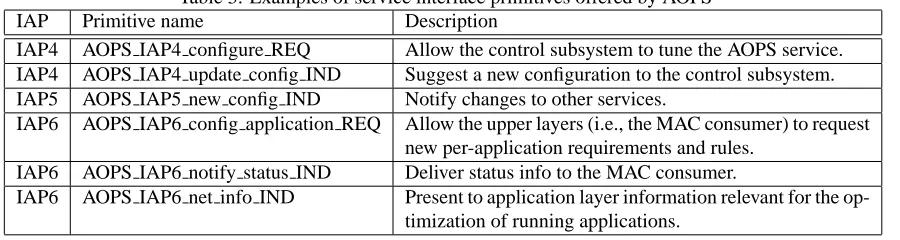
and PHY statistics and configuration settings. A few examples of service interface prim-itives offered by AOPS are presented in Table 3, showing how to manage configuration changes at system control level (over IAP4), MAC consumer level (over IAP5), and inter-service level (over IAP6).
Table 3: Examples of service interface primitives offered by AOPS
IAP Primitive name Description
IAP4 AOPS IAP4 configure REQ Allow the control subsystem to tune the AOPS service. IAP4 AOPS IAP4 update config IND Suggest a new configuration to the control subsystem. IAP5 AOPS IAP5 new config IND Notify changes to other services.
IAP6 AOPS IAP6 config application REQ Allow the upper layers (i.e., the MAC consumer) to request new per-application requirements and rules.
IAP6 AOPS IAP6 notify status IND Deliver status info to the MAC consumer.
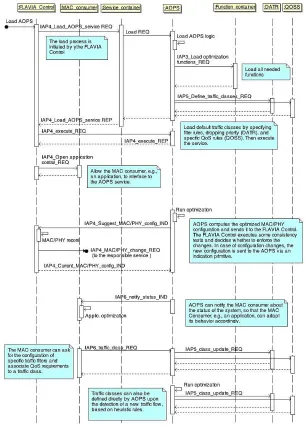
Figure 4: Basic operation of the AOPS service.
4.
Modular and flexible MAC optimization Using FLAVIA
In this section we elucidate how the FLAVIA architecture for scheduled systems can be used to design a modular and flexibly scheduled MAC with support for operator-defined optimization of MAC and applications. In particular, we describe how the AOPS service can be loaded and configured, and how it can interact with other architectural components in order to support MAC and application optimization.
As shown in the topmost part of Figure 4, the AOPS service is loaded and launched by the control-subsystem. In Figure 4, for the sake of readability, we omit naming most of the exchanged REP primitives, which travel in the diagram over dashed ar-rows. The service loading procedure involves the control-subsystem and repositories that contain the code to be executed to run the AOPS service (Service Container) and to load the specific service functions (Function Container). Additionally, other active services might have to be reconfigured upon AOPS activation. Specifically, Data Trans-port (DATR) and QoS scheduling (QOSS) have to be configured through inter-service interfaces (over IAP5) in order to enable traffic differentiation with the parameters suggested by AOPS (e.g., dropping policies, QoS rules, modulation schemes allowed).
MAC consumers that AOPS is running and accepting traffic classification requests. AOPS periodically computes optimal MAC and PHY parameters and detects run-ning applications according to the active rules. Therefore, AOPS periodically request updates of MAC and PHY configurations, while the control subsystem is responsible for actually enforcing the update and notifying the changes to AOPS.
The diagram in Figure 4 also shows the interaction between MAC consumer and AOPS. On the one hand, when AOPS detects, determines, or is notified of configuration changes and system status updates, it can in turn notify the MAC consumer of the new network status. As a consequence, the MAC consumer can adapt its traffic behavior accordingly. On the other hand, if the MAC consumer decides to introduce a new traffic class, it sends a traffic class request over IAP6. Finally, the bottom of the diagram in Figure 4 depicts the case in which the optimization routine detects the presence of traffic flows that can be dealt with by means of a new traffic class. As a consequence, AOPS will automatically determine the parameters to be used for the new traffic class, and the interfaces to DATR and QOSS services in order to deploy the new traffic class (alternatively, AOPS can ask the FLAVIA Control to deploy the traffic class).
5.
Conclusions
We have shown how the paradigm proposed by the FLAVIA project can allow for the design of a flexible, modular and programmable MAC for scheduled systems. The proposed MAC architecture has been exemplified by a number ofservicesandinterfaces. We have provided examples of basic and advanced scheduled MAC services, and we have shown how these services can be orchestrated to implement the desired and operator-defined MAC features. In particular, we have detailed the operation of an advanced service meant to support the optimization of MAC and PHY configuration as well as application behavior through cross-layer interaction of MAC users and MAC services.
In conclusion, we have illustrated how the adoption of the FLAVIA paradigm would pave the way for the deployment of novel and adjustable MACs for cellular systems. Indeed, such a flexible and programmable MAC would be of great benefit to researchers, vendors and operators, because it would allow for fast and easy tests, validation, im-plementation and deployment of innovative MAC features.
References
[1] The Femto Forum, http://femtoforum.org/femto/technical.php
[2] C. Bonnet, D. Camara, R. Ghaddab, A. Hayar, L. Iacobelli, F. Kaltenberger, R. Knopp, B. Mercier, N. Nikaein, D. Nussbaum, E. Yilmaz, and B. Zayen, “Openairinterface and agile spectrum ac-cess,” in New Frontiers in Dynamic Spectrum Access Networks (DySPAN), 2011 IEEE Symposium
on, pp. 662 –663, may 2011.
[3] ICT ACROPOLIS, European Network of Excellence, http://www.ict-acropolis.eu/ [4] ICT FLAVIA project, http://www.ict-flavia.eu/
[5] P. Salvador, F. Gringoli, V. Mancuso, P. Serrano, A. Mannocci, and A. Banchs, “VoIPiggy: Im-plementation and evaluation of a mechanism to boost voice capacity in 802.11 WLANs,” in
Pro-ceedings of INFOCOM mini-conference, (Orlando, Florida, USA), March 2012.
[6] I. Tinnirello, G. Bianchi, P. Gallo, D. Garlisi, F. Giuliano, and F. Gringoli, “Wireless mac pro-cessors: Programming mac protocols on commodity hardware,” in Proceedings of INFOCOM, (Orlando, Florida, USA), March 2012.
[7] A. Maeder, V. Mancuso, Y. Weizman, E. Biton, P. Rost, X. Perez-Costa, and O. Gurewitz, “FLAVIA: Towards a Generic MAC for 4G Mobile Cellular Networks,” in Future Network &
Mobile Summit 2011, (Warsaw, Poland), June 2011.