Electronic Journal of Science Education Vol. 20, No. 3 (2016)
© 2016 Electronic Journal of Science Education (Southwestern University/Texas Christian University) Retrieved from http://ejse.southwestern.edu
Discourse Practices in the New Standards: The Role of Argumentation in Common Core-Era Next Generation Science Standards Classrooms for English Language Learners
Tina Cheuk
Stanford University, United States
Abstract
In this paper, I argue that the practice of argumentation will have implications for students not only in science learning, but also, potential transfer in other disciplines. More importantly, the shift toward a shared discursive language practice of argumentation provides an opportunity for both content-area and language development teachers to build on each other's pedagogical knowledge around argumentation, design tasks that support both content and language development, and create a more coherent learning experience for students. For English language learners, this convergence in the discourse practice of argumentation from evidence is particularly salient because content area teachers will be expected to create a more communicative classroom that supports both content and language development.
Key words: Next Generation Science Standards; argumentation; English language learners; Common Core State Standards
Correspondence concerning this article should be addressed to: Tina Cheuk, 485 Lasuen Mall, Stanford, CA 94305, (415) 370-3239, [email protected]
Introduction
The Common Core State Standards (CCSS) (CCSSI, 2010), the Next Generation Science Standards (NGSS) (NGSS Lead States, 2013), and the English Language Development Framework (CCSSO, 2012) signal major instructional shifts in the United States (U.S.) as to how students will utilize language and literacy practices across the major subject areas of English Language Arts (ELA), mathematics, and science. These new standards and framework documents move away from a paradigm that supports content and language development as contiguous strands of learning, and conceptualizes disciplinary and language learning that is more symbiotic—each interdependent on one another.
Electronic Journal of Science Education ejse.southwestern.edu orient their classrooms toward more intensive discourse practices for their students across the major subject areas.
Science teachers will be expected to change from a predominantly content-driven approach to one the NGSS call "3-Dimensional" science learning. This is a significant shift from viewing science learning as a transmission of knowledge to one that balances the priorities of what knowledge is important with how and why this knowledge came to be. For example, these new science standards provide synergy between the disciplinary core ideas, the crosscutting concepts, and the practices inherent to the complexities of learning science (National Research Council,
2012). The disciplinary core ideas represent important scientific knowledge to be learned in the K-12 years, the practices are what scientists and engineers use to investigate and build models and theories about the world, and the crosscutting concepts are ways to organize the patterns and relationships across the domains of knowledge and practices (NGSS Lead States, 2013).
With the current context of policy based on common academic standards in the U.S., I argue that the discourse practice of argumentation will have implications for student learning and pedagogy across the content areas of science, mathematics, and ELA. This shared practice of argumentation provides an opportunity for disciplinary teachers to build on each other's instructional practices, design communicative tasks that support knowledge building, and create a more coherent learning environment for students. For ELLs, this convergence on argumentation from evidence across the disciplines may provide greater and more explicit opportunities to engage in both content and language development during the school day—thereby extending and deepening their learning experiences beyond courses tailored specifically toward language development.
This article is divided into five sections. First, I discuss how these new standards are driving much of the current conversations around instructional improvement in K-12 classrooms in the U.S. and illustrate how the discourse practice of argumentation could be an important opportunity by which content teachers can consider how language mediates knowledge building and sense-making in the respective content for all students, in particular ELLs. Then, I summarize how educators in science, mathematics, and ELA have defined argumentation and discuss their similarities and differences. What follows is a more in depth discussion on the various mechanisms that support argumentation in science classrooms, and the sociocultural context that undergirds this practice with particular attention to how ELLs could be impacted. I conclude by positing future work that is needed to advance our knowledge to actualize argumentation in diverse science classrooms.
Standards
Tina Cheuk 94
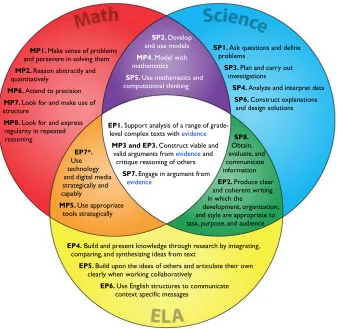
and NGSS as tools for the creation and evaluation of English language proficiency standards" (CCSSO, 2012, p. ii). This document outlines the progressions of language and literacy demands found within the ELA, mathematics, and science standards (i.e. CCSS and NGSS) that ELLs need to be successful in achieving English language proficiencies and disciplinary learning. As illustrated by Figure 1, the student discourse practice of argumentation with evidence is shared across each of the three major disciplines.
Figure 1. Relationships and convergences of student practices and capacities found in the CCSS for Mathematics, CCSS for ELA and Literacy in History/Social Studies, Science, and Technical Subjects, and NGSS science and engineering practices. Notes: MP1-MP8 represents CCSS Mathematical Practices (p. 6-8); SP1-SP8 represents NGSS Science and Engineering Practices; EP1-EP6 represents CCSS for ELA "Practices" as defined by the ELPD Framework (p. 11); EP7* represents CCSS for ELA student "capacity" (p.7).
The NGSS include a total of eight science and engineering practices that include: asking question and defining problems, developing and using models, planning and carrying out investigations, analyzing and interpreting data, using mathematics and computational thinking, constructing explanations and designing solutions, engaging in argument from evidence, and
MP1. Make sense of problems and persevere in solving them MP2. Reason abstractly and quantitatively
MP6. Attend to precision MP7. Look for and make use of structure
MP8. Look for and express regularity in repeated reasoning
SP1. Ask questions and define problems
SP3. Plan and carry out investigations
SP4. Analyze and interpret data SP6. Construct explanations
and design solutions
EP4. Build and present knowledge through research by integrating, comparing, and synthesizing ideas from text
EP5. Build upon the ideas of others and articulate their own clearly when working collaboratively
EP6. Use English structures to communicate context specific messages
EP7*. Use technology and digital media strategically and capably
MP5. Use appropriate tools strategically SP8. Obtain, evaluate, and communicate information EP2. Produce clear and coherent writing in which the
development, organization, and style are appropriate to task, purpose, and audience SP2. Develop
and use models MP4. Model with mathematics
SP5. Use mathematics and computational thinking
EP1. Support analysis of a range of grade-level complex texts with evidence
MP3 and EP3. Construct viable and valid arguments from evidence and
critique reasoning of others SP7. Engage in argument from
Electronic Journal of Science Education ejse.southwestern.edu obtaining, evaluating, and communicating information (NGSS Lead States, 2013). Of these, engaging in argument from evidence is one of the more sophisticated discourse practices in the science domain. For students to make an argument in science, students situate knowledge in a particular context and make claims backed by reasoning and evidence within a classroom setting among peers. This process is content and context-driven, and heavily language-dependent. This type of discourse practice provides a mechanism for students to "produce, evaluate, and therefore, advance scientific knowledge" and helps students "engage with the social construction of scientific ideas as well as learn about the workings of the scientific enterprise" (Bricker & Bell, 2008, p. 474). Together with the core content standards, these practice standards provide an impetus for the science education community to shift the larger goals of science from one situated in a positivist or monologic perspective, to one more open to a dialogic perspective where knowledge is socially constructed. Additionally, this shared practice of interdisciplinary argumentation has implications as to how content area teachers understand this practice and support ELLs.
For example, in ELA, students are expected to comprehend as well as critique and evaluate evidence in constructing and evaluating arguments and claims (CCSSI, 2010). In mathematics, students are expected to "construct viable arguments and critique the reasoning of others" (CCSSI, 2010, p. 6). Likewise in science, students are also expected to carry out the process of argumentation in advancing their content knowledge (NGSS Lead States, 2013). Science teachers can take advantage of this language practice of argumentation and create interdisciplinary learning opportunities that deepen students' learning in not only science content and cross-cutting concepts, but also extend into connecting student knowledge in literacy and mathematics. This increased importance of argumentation across all these new standards signals a major change in how we think students should learn and how teachers should teach (Stage, Asturias, Cheuk, Daro, & Hampton, 2013).
Tina Cheuk 96
and learning (Gee, 1996, p. 131). These science classrooms can provide practice for ELLs to express themselves, their perspectives, and intentions in their native language(s), along with their English. ELLs can leverage these linguistic resources and use them to make sense of the science and construct new meaning for themselves (Ballenger, 1997). In particular, these new content standards with shared language and literacy goals can stem potential collaborations between ELL-educators and content area teachers. Together, these teachers can work to produce content-aligned learning experiences and tasks that "simultaneously develop grade-level conceptual understandings, academic practices, and the language required" to meet the expectations of these new standards (Valdés et al., 2014, p. 25). The shared language goal of argumentation could provide an important departure point for teachers in shaping the types of learning tasks that support these mutual goals of language and content learning for all students, especially ELLs.
It is important to note that even though the standards provide this common language of argumentation from evidence across the disciplines, there are rhetorical differences in how each discipline considers knowledge claims, evidence, and reasoning that may engender barriers in interdisciplinary collaborations. Defined broadly, the practice of argumentation from evidence is composed of a claim or an assertion, backed by a series of evidence and reasoning (Toulmin, 1958).
Science, mathematics, and ELA represent three different bodies of knowledge, and distinguish themselves in how knowledge is organized and formed. Science is different from mathematics in that it builds its reality through plausible reasoning, predominately inductive methods that provide the best temporal explanations about reality (Hofer & Pintrich, 1997; Philosophy of Mathematics, 2015). Argumentation in mathematics is "a technique used to establish a statement . . . [it] is an attempt to transform something open to question into something mutually accepted" (Banegas, 2003, p.3). More generally, it is a "line of reasoning that intends to show or explain why a mathematical result is true" (Sriraman & Umland, 2014, p. 46). Within the scope of these new standards, argumentation in mathematics is not limited to formal proofs, but rather, encompasses a more expansive definition that allows students to "use stated assumptions, definitions, and previously established results in constructing arguments" in grades K-8 (CCSSI, 2010, p. 6) as well as develop capacities to evaluate the strengths and weaknesses of arguments. In primary and middle grades, students can make mathematical conjectures and build their arguments using physical objects, pictorial referents, and symbolic representations as data and evidence (Illustrative Mathematics, 2014). Broadly speaking, argumentation in mathematics serves as a tool for students in organizing their thinking, make connections between mathematical objects and ideas, and communicate with others.
Electronic Journal of Science Education ejse.southwestern.edu thinking, and reason with evidence in efforts to develop understanding, create meaning, and construct knowledge (Cobb, Wood, Yackel, & McNeal, 1992).
A major challenge for ELA educators is that these new standards encompass a larger scope of knowledge from the development of language and literacies skills in literature as well as development of literacy in history/social studies, science, and technical subjects (CCSSI, 2010). Students are expected to evaluate arguments, "introduce precise, knowledgeable claim(s), establish the significance of the claim(s), distinguish the claim(s) from alternate or opposing claims, and create an organization that logically sequences the claim(s), counterclaims, reasons, and evidence" (CCSSI, 2010, p. 64) in a variety of content areas. In an observational study of 31 high school ELA classrooms focused on the practice of argumentation in writing, Newell, VanderHeide, and Olsen (2014) found that there was great variability across how teachers conceptualized argumentation in their high school classrooms. They found three argumentative epistemologies (i.e. structural, ideational, and social) that were socially constructed from interactions and student talk around tasks intended to develop literacy knowledge and student practice on the argumentative process (Newell et al., 2014). Depending on the content of the knowledge and the goals of the task, ELA teachers will need to be versed in the nature and sources of knowledge and use the tools of discourse to shape classroom epistemology (Nystrand & Graff, 2001). Teaching argumentation in ELA classrooms is a complex and challenging endeavor. Students need to be able to discern the various types of evidence found in literary and expository texts, evaluate and assess the author's claims, reasoning and evidence, and in turn, make their own claims and assertions supported by textual evidence and justifications. Nystrand and Graff (2001) found that the "epistemology fostered by classroom talk and other activities was inimical to the complex rhetoric the teacher was trying to develop and encourage students to write arguments" (p. 479). The culture of the classroom, the shift from treating knowledge as a fixed enterprise to one that is generative and co-constructed, and the cognitive demand of this work make the teaching of argumentation challenging for many teachers.
A major step disciplinary teachers can take is to discuss and learn what argumentation from evidence means for their students and classrooms. Even though the standards within each discipline have highlighted argumentation from evidence as an important process facilitating knowledge building, the epistemology of each discipline—what counts as knowledge, justification, evidence, and sound reasoning, may vary—and ultimately, impact the instructional practices and learning goals in science, mathematics, and ELA classrooms.
Tina Cheuk 98
development of communications and literacy skills as well as their critical reasoning skills and perspective-taking within a particular domain. This interplay with others is critical as students exert their claims, engage with each other through a series of bids and offers around a particular idea or assertion, and move closer toward a deeper understanding of a particular knowledge claim or phenomenon. More specific to science, students need to generate their own claims and evaluate the claims made by others. The claims and the supporting evidence can be represented in various forms such as graphs, tables, diagrams, photographs, drawings, symbolic representations, and texts. Lastly, this practice of argumentation moves students toward more authentic practices within the broader science community like peer review and the social construction of science knowledge.
Given the current policy environment, the educational community needs to ask how a program of argumentation supports the goals and outcomes for all students in science classrooms. The language demands of argumentation will be significant for ELLs as the frequency, depth, and quality of language production expectations differ from what has been typically seen in many classrooms serving ELLs—one where limited opportunities are present for ELLs to practice authentic discourse with rigorous content.
Definitions of argumentation
The research on argumentation is expansive as it takes into account how humans reason as well as how argumentation is defined in various contexts and content domains (Mercier & Sperber, 2011). I highlight some salient and recurring themes that are aligned with how the committee from the Framework for K-12 Science Education (NRC, 2012) conceptualized argument from evidence in K-12 science classrooms. A broad definition as proposed by Driver, Newton, and Osborne (2000) and Kuhn (1993) is one where the practice of argumentation supports knowledge building and validates the practice where individuals propose ideas, make claims, provide critiques, and refine ideas toward an understanding of a natural phenomenon. Argumentation is required to convince people that the explanation is justified, whereas construction of explanations requires students to generate causal links between known facts.
Explanations and argumentation are seen as two separate but related processes. Sampson and Clark (2009) further refine the process of argumentation as "the ability to examine and then either accept or reject the relationships or connections between and among the evidence and theoretical ideas invoked in an explanation" (p. 450). Van Eemeren, Grootendorst, and Snoeck (2002) state that explanation is different from argumentation because an argument is one where the standpoint has yet to be accepted. The process of argumentation allows the community to "test contested standpoints" to see if the claims are plausible (van Eemeren & Grootendorst, 2004, p. 188). Two important distinctions are important here. First, the use of evidence is critical in both explanations and arguments. Second, argumentation oftentimes is a dynamic process that engages others or with oneself on a particular claim or set of claims. This type of definition of argumentation in science moves away from the notion that arguments fall within the constraints of formal logic or syllogistic reasoning (Bricker & Bell, 2008).
Electronic Journal of Science Education ejse.southwestern.edu explanations, theories, and models (p. 44). This account of the activities engaged in by scientists and engineers reflects this notion of "science-in-the-making… [and] using of evidences to give support to our complex, articulated understandings of the natural world … [and] to convince other people that such understandings are plausible and fruitful" (Adúriz-Bravo, 2014, p.3). Supporting students in mastering the practice of argumentation allows them to evaluate the knowledge claims, make sense of the supporting evidence, and improve upon these claims in building their epistemic knowledge of science. Argumentation can serve as a form of meaningful and authentic science learning and communications because scientists and engineers are engaged in this practice in their daily work. Osborne (2010) states that "it is debate and discussion with others that are most likely
to enable new meanings to be tested by rebuttals or counter-arguments" and in turn, support student thinking, and generate new understandings (p. 464).
Reiser, Berland, and Kenyon (2012), in their description of the scientific practice of explanation, extend explanations "beyond defining or describing a named process and links [to] a chain of reasoning to the phenomenon" (p. 6). Students can use primary or secondary sources of scientific evidence to support or refute an explanation of a phenomenon and identify gaps or weakness in their own, and others' explanations (National Research Council, 2012). Explanations may include elements of argumentation such as the use of evidence, reasoning, and claims as students are making sense of the science phenomenon. When a claim, or a proposed explanation is in question, students can be motivated to defend or challenge the claims made in the process of scientific argumentation (Osborne & Patterson, 2011).
ELLs may need to be socialized into the discourse practice of argumentation as this way of "behaving, interacting, valuing, thinking, believing, and speaking" may privilege certain type of scientific knowledge, literacies, and groups of individuals who have been shaping and defining the knowledge claims in science (Gee, 1996, p. viii). Consequently, inattention to the needs of ELLs may inadvertently disempower those who are learning the content and English language simultaneously. As educators, it will be important to foster classroom environments and develop instructional tasks that have low-affective filters, and include additional linguistic supports for ELLs to enter into the conversation, hold the 'floor', and account for the diverse perspectives offered by their students (Krashen, 1982).
Mechanisms for argumentation
This section will discuss four interrelated mechanisms that are important to the argumentation in science classrooms. Even though each of the mechanisms is described separately, these mechanisms actually work together in complex and dynamic ways within the classroom context. These mechanisms include the following: range and depth of content area knowledge; facility with the structural components of an argument; relevant and strategic use of scaffolds in building student independence and competencies in both knowledge claims and the argumentation process; and relevant group-worthy tasks that support the growth in students' science expertise. I describe the role of the participants, implications for English language learning, and how the classroom context impacts the process and outcomes of argumentation in science classrooms.
Content Knowledge
Tina Cheuk 100
& Osborne, 2010). That is not to say that children's everyday experiences and the "everyday language" (Brown & Spang, 2008) that are used in moving their claims forward are incorrect. Rather, the children's opinions and conceptions of the scientific phenomenon could serve as motivation in students' development toward evaluating the strength of a claim, and understanding how that claim is supported by evidence. Especially for ELLs, there is potentially a strong role for teachers to leverage students' prior knowledge and experiences and build opportunities for ELLs to make sense of their conceptions and misconceptions of a science phenomenon through argumentation. The linguistic and social practices used in everyday life, especially those found in ELL communities can help in their meaning-making as they build knowledge about a scientific phenomenon. Too often, the classroom discourse found in science classrooms privileges particular communities, and is seen as different from the discourse found in certain language minority groups (Lee & Fradd, 1998). Chin and Osborne (2010) further suggest that students need to draw on their "conceptual resources" that can guide their thinking. The process of argumentation is meant to be generative. In other words, students who are engaged in argumentation in science can be motivated by their lived experiences. These lived experiences, including the use of their native language and everyday language can serve as opportunities for students to strengthen their English language development and deepen their domain knowledge.
A particular challenge students face in building their domain knowledge is the way science knowledge is represented. Not only are students grappling with complex science theories and ideas that are oftentimes unobservable and removed from their lived-experiences, they have to "combine, interconnect, and integrate verbal text with mathematical expressions, quantitative graphs, information tables, abstract diagrams, maps, drawings, [and] photographs” (Lemke, 1998, p. 88). Extending Lemke's claim, Chin and Osborne (2010) suggest that students need "a structure to help them focus, organize, and verbalize their arguments both orally and visually" (p. 902). Examples of this may include the use of writing stems, keywords, or graphic organizers used as learning scaffolds. In essence, students carry a significant cognitive load when they engage in argument from evidence. They have to "translate" the science knowledge that is embodied in various text representations and in turn, use that knowledge and identify appropriate evidence in support of their claim(s). For ELLs in particular, the cognitive load includes the English language development considerations as students practice and gain expertise in argumentation within various science domains and across various disciplines. We want to provide entry points for discourse in a low-anxiety atmosphere for ELLs so that they can practice putting words together and make sense of the science. At the same time, the more ELLs can talk in the context of science, the greater the chances are that other students can respond to the ideas put forth by the classmate. Both the quality and the quantity of the talk increase when ELLs have a more balanced use of expressive and receptive language use in content classroom settings (Krashen, 1982).
Electronic Journal of Science Education ejse.southwestern.edu
development for students. In the practice of argumentation, science teachers will have to consider the range of language proficiencies and assets that students bring into their classrooms and create a supportive environment for this type of discourse so that all students can engage in and be motivated by the richness, complexity and relevance of science phenomena in their lives.
Facility with the Components of an Argument
Students need not only some basis of domain knowledge to engage in argumentation, but they also need to have some facility with the components that contribute toward an argument. That is, the process of argumentation includes component parts that work together in supporting students' reasoning in extending and justifying their claims, and in generating rebuttals or counterclaims. Providing students with the appropriate structure and processes of argumentation together with the opportunities for practice allow students to gain greater competencies with this communicative practice. We should "teach students the structural components of an argument (including the appropriate vocabulary), criteria for a good argument, and the language of argumentation" (Chin & Osborne, 2010, p. 902). Nussbaum, Sinatra, and Poliquin (2008) found that for college undergraduates (n=88) in physics classrooms, the "criteria of scientific arguments,
in combination with constructivist epistemic beliefs, would produce greater learning about physics concepts" (p. 1977). Some of the criteria include depth of claims that are supported by evidence and alternative theories, elaboration of the argument, and the types of interactions among students around the mechanism and variables of the physics concept. This particular physics intervention found that when students were provided a clear rubric, they "used more of those criteria to form their arguments, conducted more thought experiments, and considered more alternatives in
constructing their arguments" (p. 1993). In addition to understanding how the structural
components of argumentation work together, students need to be able to identify and have ways to engage in other students' arguments (Kuhn, 2010).
One of the underlying premises within scientific argumentation is the use of evidence and reasoning skills "in the process of building and evaluating explanations" (Duschl & Osborne, 2002, p. 44). More often than not, student reasoning is weak or lacking in how students select a piece of evidence and use it to justify a claim (Kuhn & Reiser, 2006; McNeill & Krajcik, 2007). Not only do students need to be able to identify, evaluate, and use the evidence to support their reasoning, they need to integrate it into a coherent argument (Kuhn, 2010). Additionally, students need to weed through a plethora of sources and evaluate the claims and purported evidence in promoting their own claims in a discourse environment. Duschl and Osborne (2002) emphasis that these "inter-textual processes affect scientific discourse and argumentation" (p. 65). It is also important to note that how evidence is defined in science may be different across the various disciplines. While some of the components and terminologies that are used to define argumentation may be the same; how these components are defined and used in other disciplines in creating knowledge claims may differ.
Tina Cheuk 102
how to engage in this type of academic discussion (Bathgate, Crowell, Schunn, Cannady & Dorph, 2015). There is some evidence that argumentation skills that are developed in the science domain are "similar in way to the skills in the social domain" (Kuhn, 2010, p. 820). Kuhn (2010) found that there was a transfer of argumentation skills in both directions—social and science. However, she found that students who initially engaged in the science topic and moved to a social topic had greater facilities with argumentation practices than students who were initially trained in argumentation practices grounded in the social sciences. This is particularly important as cross-content teachers may want to consider how they conceptualize argumentation from evidence in their disciplines, and think about ways teachers can organize their instruction so that it can promote potential transfer of student knowledge and processes across classroom settings. This may also be important for English Language Development (ELD) or English as Second Language (ESL) teachers working with ELLs in developing language and literacy skills. This attention toward language practices in the new standards could serve as an additional impetus for collaborations between ELD/ESL and content area instructors.
Scaffolds
Because the process of scientific argumentation has such potentially high cognitive, metacognitive and inter-relationship demands, a number of interventions that are found in the literature focus on using scaffolding that supports students' argumentation processes and move them toward a deeper understanding of the knowledge domain. The use of scaffolds ranges from discourse prompts, group compositions, task-design, to advantaging student misconceptions (Cavagnetto, 2010). Other uses of scaffolding include leveraging the social aspect of science and the use of ELLs' home language and everyday language in building student connections to the science phenomenon.
Other types of scaffolding have focused on supporting students' construction of scientific explanations. McNeill, Lizotte, Krajcik, and Marx (2006) designed a writing intervention with explicit scaffolds tailored to support argumentative writing in instructional materials. These scaffolds provided generic writing prompts under the components of claim, evidence, and reasoning that guided student responses. They found that students who had the scaffolds produced "significant learning gains for all components of scientific explanation (i.e., claim, evidence, and reasoning)" (p. 153). Their work further suggests that scaffolds fade over time as students gain independence and facility of the practice. These types of prompts provide an entry point and
guidance for students to engage in the component processes of argumentation by potentially reducing the cognitive load for students who are starting to grapple with this practice.
Another common type of scaffolding found in the literature was the development and use of questioning prompts for both teachers and students. In Chin and Osborne's (2010) work, they
examined how students' questions supported argumentation and helped them co-construct
Electronic Journal of Science Education ejse.southwestern.edu
four corners, reciprocal teaching, and other structures that support discourse. In a subsequent case study, Christodoulou and Osborne (2014) found that the questioning prompts initiated by an experienced teacher impacted the ways students responded in developing their scientific thinking and contributions to the discourse. Similarly, in McNeill and Pimental's (2010) work where they studied three high school teachers on the topic of climate change, they found that "there was a relationship between more open-ended questions and increased percentages of student talk, the use of evidence and reasoning to support claims, and dialogic interactions between students" (p. 224). While these studies emphasize the role and usage of questioning prompts, this type of scaffolding does not exist in isolation from the nature of the task.
Teachers have significant influence in creating inclusive learning opportunities in their classrooms. The scaffolds that are afforded for ELLs can set the perceptions of acceptable types of discourse in science classrooms. Helping ELLs struggle productively in a science task requires
both a deep knowledge of the science content—that includes misconceptions that students hold—
as well as facility of using various modes of discourse that contribute to a collective understanding of a science phenomenon. These modes of discourse could include explicit opportunities for ELLs to use their home language and forms of everyday language, as well as environments that frees ELLs to engage in translanguaging where ELLs can move fluidly among languages without alienating any members of the group (García & Wei, 2013).
Many of these scaffolds provide not only multiple entry points for students to engage in argumentation, but also various ways students can demonstrate their thinking and knowledge around a particular idea through the use of language. One can think about the language practice of argumentation as the medium by which students wrestle with scientific claims, evaluate strengths of the evidence, and advance one's own or another's thinking on a phenomenon.
Group-worthy Tasks
Tina Cheuk 104
Science teachers can also consider how these argumentative tasks can contribute to English language learning. For ELLs, they are "performing an action … not just saying something" (Austin, 1962, pp. 6-7). The focus of these actions is the message or the core content of the science, not necessarily the grammatical form, or correctness of the ELL output in speech (Krashen, 1982). These learners are developing pragmatic language skills that involve "knowing when and how to take the floor, when to introduce a topic or change the subject, how to invite someone else to speak, how to keep the conversation going, when and how to terminate the conversation and so on" within the context of a science classroom (Nunan, 1989, p. 30). For ELLs, learning goals include both developing language and science knowledge. Learning experiences will need to move away from learning the rule or the vocabulary as the primary driver and shift towards a more the idea, message, or phenomenon in science. Ultimately, the teacher is facilitating how students are negotiating meaning with others and supporting students' repertoire of communicative skills so that they are understood by others. Language can be used to mediate and accomplish science learning objectives and empower students in leading and managing their own learning. ELLs must negotiate both their voice and their ideas about the science as they encounter situations when they are asked to engage in argumentation. The design of these argumentative tasks is critical as it can serve multiple goals for teachers as they create learning experiences for students to meet the expectations found in the NGSS. The next section will discuss the nature of these student interactions and how the mechanisms highlighted within this section are situated within the historical and current sociocultural norms of science classrooms.
Social-Cultural Context
The previous section addressed the general considerations that teachers needed to consider in building out science argumentation in their classrooms. Teachers have to figure out how to shift from the dominant positivist narrative found in science classrooms and create a collaborative and social environment that values discourse and engagement with multiple, including personal accounts of the phenomenon (Ballenger, 1997; Duschl & Osborne, 2002; Matthews, 1994; Scott, Mortimer, & Aguiar, 2006). This tension often plays out in the classroom context where the norms of discourse is more typically "focused on a singular perspective" versus an environment that is "open to different points of view" (Scott et al., 2006, p. 628).
Electronic Journal of Science Education ejse.southwestern.edu p. 472). In addressing the composition of groups, Chin and Osborne (2010) recommended grouping students "who differ in their views which forces them to pose questions, make justified claims, construct explanations, and challenge opposing viewpoints" (p. 902). As teachers and students examine and interpret the discourse that is happening in science classroom, it is important to not only focus primarily on accuracy of the words and the content of the utterances and expressions, but rather, understand and take advantage of the multiple perspectives and viewpoints in building a shared and more sophisticated understanding of the ideas and concepts in science (Bakhtin, 1986).
In Ballenger's (1997) work with Haitian Creole bilingual middle school students, she
examined how students asserted their moral values in science discourse, specifically
argumentation, and how the classroom environment can support this type of discourse—even though at first glance, it may not be generally considered as academic discourse. Ballenger found that the role of the narrative allowed students to make personal and moral claims. For example, one of the students entered the discourse by describing the mold that he found in his home and how that is uncommon because he keeps his home clean. His narrative provided entry points for others to enter the conversation, generate engagement and motivation, and opened up the opportunities for students to ask question about the science phenomenon in a situated context connecting what students experienced at home, to the science phenomenon (Ballenger, 1997). The social nature of argumentation takes into account the history and experiences of the participant. As a result, different rhetorical devices will be used to make claims or situate the evidence and justification depending on the goals and outcomes of the discourse (Bricker & Bell, 2008).
Future Work
An important question for the educational community to ask ourselves is how this program of argumentation supports the goals and outcomes we want for ELLs in science. In order for the community of researchers and practitioners to advance their knowledge and thinking around this program of work, the goals, outcomes, and activities have to be aligned in support of the learning outcomes. Science teaching needs to "address epistemic goals that focus on how we know what we know, and why we believe the beliefs of science to be superior or more fruitful than competing viewpoints" (Duschl & Osborne, 2002, p. 43). If we can agree on these epistemic goals, then the science education community can focus their attention in the following ways:
1. Consider ways to learn from and collaborate with ELA, math, and ELD/ESL teachers and understand the similarities and differences in the pedagogical approaches of argumentation from evidence across disciplines;
2. Provide guidance to teachers in how to create the necessary participatory structures that fosters produce discourse for diverse language learners;
3. Understand the pedagogical content knowledge that teachers need to support this type of learning in our science classrooms; and
4. Build instructional tasks and communicative opportunities that foster generative knowledge among ELLs and mainstream students who engage in argumentation in K-12 science classrooms.
Tina Cheuk 106
improving the program of work in science argumentation (Cohen & Ball, 1999). The first line of work taps into the relationships and convergences identified in figure 1. In these new standards, it is important to note how language is being used to mediate access and sense-making opportunities to knowledge. At the center overlap of argumentation, content teachers, along with ELD/ESL instructors can begin their conversations and learn from each other how each discipline considers this practice, how language can mediate the learning of content, and design content-rich communicative learning experiences for all students.
The second recommendation moves from the task to the participatory structures and context that fosters this type of discourse in science classrooms. This line of work takes into consideration the role of the teacher and the interaction among the students in the classroom. This moves the learner from the role of a "passive recipient of outside stimuli" to one who is an "interactor and negotiator" gaining knowledge through a variety of communicative acts with others (Nunan, 1989, p. 80). Christodoulou and Osborne (2014) worked with an experienced teacher in their case study and recognized the importance of "teacher-initiated discourse in argumentation-based instruction" (p. 1296). What they found in this single case study was that the teacher's epistemic practice has implications and directs the students' discourse in the classroom. Science teachers need to be skilled in managing discussion, in particular the discourse of argumentation in their classrooms (Chin & Osborne, 2010; Christodoulou & Osborne, 2014). Science educators, including researchers, can take advantage of work done across other disciplines that build classroom cultures and dynamics that foster the types of engagement norms necessary for argumentation in science (Au, 1980; Johnson & Johnson, 2009; Yackel & Cobb, 1996).
There exist limited curricular and instructional materials that support this type of practice for students. Duschl & Osborne (2002) argue that these linguistic practices serve as a medium which stimulates the process of reflection through which students may acquire conceptual understanding. When ELLs are asked to engage in argumentation in science classrooms, they are shaping the beliefs and values within their classroom community. This ultimately empower ELLs in advancing their understanding of the scientific ideas at the same time they are developing English language facilities. The attention toward supporting argumentation in science for ELLs is not in addition to what students and teachers need to do in the classroom, but in service of building students’ knowledge of science—enculturating students into the science community. Teachers need these tools to support students' "construction, coordination, and evaluation of scientific knowledge claims" (Duschl & Osborne, 2002, p. 55).
Electronic Journal of Science Education ejse.southwestern.edu
that their workshops were successful in "teachers' development of pedagogical content knowledge for scientific argumentation in relation to the structural components of students' science writing" (p. 936). Furthermore, they found that elementary teachers were able to connect this skill to their other disciplines, whereas high school teachers focused more on the science content. Student voice is critical as it provides an entry point of engagement for all students to engage with the claims and ideas put forth by the science community.
Additionally, the investment in teacher knowledge and skill in deepening their expertise around science argumentation and their "existing understanding of the importance of evidence and argument in science" is promising (Simon, Erduran, & Osborne, 2006, p. 256). However, in both McNeill and Knight's (2013) work with 70 in-service teachers and Simon et al.'s (2006) pre-service work with 12 teachers, both teams found that teachers did not necessarily transfer their knowledge and skill developed via these workshops into classroom practice. Their findings have implications to how professional learning for teachers is designed across the various grade spans, and perhaps even within specific science domains. This includes how we support and create professional learning opportunities for adult learners and the types of classroom environments that generate the range of student discourse that is desired. Much more work is needed in how science educators and researchers are conceptualizing the integration of the language development opportunities
inherent in argumentation and the development of science ideas for ELLs.
The final line of work focuses on task development. Sampson and Clark (2009) describe tasks that allow students to investigate and make sense of complex problems, deal with "intellectual artifacts", and "examine and evaluate theoretical positions and phenomenon" (p. 450). Productive and generative tasks allow students to develop multiple ways of thinking about, explaining, and questioning the phenomenon, and support students to "evaluate and critique methods, explanations, evidence, and reasoning" as well as construct arguments justifying the case for the explanation (Sampson & Clark, 2009, p. 450). For our diverse English learners, the language and literacy demands of the task will be important in how ELLs can leverage their knowledge and facility in navigating in their primary or home language toward productive academic discourse in English in science classrooms.
Conclusion
Tina Cheuk 108
References
Adúriz-Bravo, A. (2014). Revisiting school scientific argumentation from the perspective of the history and philosophy of science. In M.R. Matthews (Ed.). International Handbook of Research in History, Philosophy and Science Teaching (pp. 1443-1472). Dordrecht, The Netherlands: Springer.
Au, K. H. P. (1980). Participation Structures in a Reading Lesson with Hawaiian Children: Analysis of a Culturally Appropriate Instructional Event. Anthropology & Education Quarterly, 11(2), 91-115.
Austin, J. L. (1962). How to do things with words. Oxford, UK: Oxford University Press.
Bakhtin, M. M. (1986). Speech Genres and Other Late Essays. Austin, TX: University of Texas Press.
Ballenger, C. (1997). Social identities, moral narratives, scientific argumentation: Science talk in a bilingual classroom. Language and Education, 11(1), 1-14.
Banegas, J. A. (2003). Argumentation in Mathematics. (M. Gimenez & A. Aberdein, Trans.). In E. Casaban i Moya, (Eds.). XII`e Congr´es Valenci`a de Filosofia (pp. 47-60). Netherlands: Springer. (Original work published 1998)
Bathgate, M., Crowell, A., Schunn, C., Cannady, M., & Dorph, R. (2015). The learning benefits of being willing and able to engage in scientific argumentation. International Journal of Science Education, 37(10), 1590-1612.
Bell, A. W. (1976). A study of pupils' proof-explanations in mathematical situations. Educational Studies in Mathematics, 7(1), 23-40.
Berland, L. K., & Reiser, B. J. (2009). Making sense of argumentation and explanation. Science Education, 93(1), 26-55.
Bricker, L. A., & Bell, P. (2008). Conceptualizations of argumentation from science studies and the learning sciences and their implications for the practices of science education. Science Education, 92(3), 473-498.
Brown, B. A., & Spang, E. (2008). Double talk: Synthesizing everyday and science language in the classroom. Science Education, 92(4), 708-732.
Cavagnetto, A. R. (2010). Argument to foster scientific literacy: A review of argument interventions in K-12 science contexts. Review of Educational Research, 80(3), 336–371. Chin, C., & Osborne, J. (2010). Students' questions and discursive interaction: Their impact on
argumentation during collaborative group discussions in science. Journal of Research in Science Teaching, 47(7), 883-908.
Christodoulou, A., & Osborne, J. (2014). The science classroom as a site of epistemic talk: A case study of a teacher's attempts to teach science based on argument. Journal of Research in Science Teaching, 51(10), 1275-1300.
Cobb, P., Wood, T., Yackel, E., & McNeal, B. (1992). Characteristics of classroom mathematics traditions: An interactional analysis. American Educational Research Journal, 29(3), 573-604.
Cohen, D. K., & Ball, D. L. (1999). Instruction, capacity, and improvement. Philadelphia, PA: Consortium for Policy Research in Education.
Electronic Journal of Science Education ejse.southwestern.edu Common Core State Standards Initiative. (2010). Common Core State Standards For Mathematics. Common Core State Standards (College-and Career-Readiness Standards and K-12 Standards in English Language Arts and Math). Washington, DC: National Governors Association Center for Best Practices and the Council of Chief State School Officers.
Council of Chief State School Officers. (2012). Framework for English Language Proficiency Development Standards corresponding to the Common Core State Standards and the Next Generation Science Standards. Washington, DC: CCSSO.
Driver, R., Newton, P., & Osborne, J. (2000). Establishing the norms of scientific argumentation in classrooms. Science education, 84(3), 287-312.
Duschl, R. A., & Osborne, J. (2002). Supporting and promoting argumentation discourse in science education. Studies in Science Education, 38(1), 39-72.
Erduran, S., Ardac, D., & Yakmaci-Guzel, B. (2006). Learning to teach argumentation: Case studies of pre-service secondary science teachers. Eurasia Journal of Mathematics, Science and Technology Education, 2(2), 1-14.
Ford, M. J. (2012). A dialogic account of sense-making in scientific argumentation and reasoning. Cognition and Instruction, 30(3), 207-245.
García, O., & Wei, L. (2013). Translanguaging: Language, bilingualism and education. London, UK: Palgrave Macmillan.
Gee, J. (1996). Social linguistics and literacies: Ideology in discourses. London, UK: Taylor & Francis.
Hofer, B. K., & Pintrich, P. R. (1997). The development of epistemological theories: Beliefs about knowledge and knowing and their relation to learning. Review of Educational Research, 67(1), 88-140.
Illustrative Mathematics. (2014, May 6). Standards for Mathematical Practice: Commentary and Elaborations for 6-8. Tucson, AZ. Retrieved from http://commoncoretools.me/wp-content/uploads/2014/05/2014-05-06-Elaborations-6-8.pdf
Jiménez-Aleixandre, M. P., & Erduran, S. (2008). Argumentation in science education: An overview. In S. Erduran & M. P. Jiménez-Aleixandre (Eds.), Argumentation in science education: Perspectives from classroom-based research (pp. 3–28). Dordrecht, The Netherlands: Springer.
Johnson, D. W., & Johnson, R. T. (2009). Energizing learning: The instructional power of conflict. Educational Researcher, 38(1), 37-51.
Knuth, E. J. (2002). Teachers' conceptions of proof in the context of secondary school mathematics. Journal of Mathematics Teacher Education, 5(1), 61-88.
Krashen, S. (1982). Principles and practice in second language acquisition (Vol. 2). Oxford, UK: Pergamon.
Kuhn, D. (1993). Science as argument: Implications for teaching and learning scientific thinking. Science education, 77(3), 319-337.
Kuhn, D. (2010). Teaching and learning science as argument. Science Education, 94(5), 810-824. Kuhn, L., & Reiser, B. (2006). Structuring activities to foster argumentative discourse. In annual
meeting of the American Educational Research Association, San Francisco, CA.
Kurth, L. A., Anderson, C. W., & Palincsar, A. S. (2002). The case of Carla: Dilemmas of helping all students to understand science. Science Education, 86(3), 287-313.
Tina Cheuk 110
Lemke, J. (1998). Multiplying meaning: Visual and verbal semiotics in scientific text. In J.R. Martin & R. Veel (Eds.), Reading science: Critical and functional perspectives on discourses of science, (pp. 87-114). London, UK: Routledge.
Matthews, M. R. (1994). Science teaching: The role of history and philosophy of science. New York: NY: Routledge.
McNeill, K. L., & Knight, A. M. (2013). Teachers’ pedagogical content knowledge of scientific argumentation: The impact of professional development on K–12 teachers. Science Education, 97(6), 936-972.
McNeill, K. L., & Krajcik, J. (2007). Middle school students’ use of appropriate and inappropriate evidence in writing scientific explanations. In M.C. Lovett & P. Shah (Eds.), Thinking with Data (pp. 233-265). New York, NY: Lawrence Erlbaum Associates.
McNeill, K. L., Lizotte, D. J., Krajcik, J., & Marx, R. W. (2006). Supporting students' construction of scientific explanations by fading scaffolds in instructional materials. The Journal of the Learning Sciences, 15(2), 153-191.
McNeill, K. L., & Pimentel, D. S. (2010). Scientific discourse in three urban classrooms: The role of the teacher in engaging high school students in argumentation. Science Education, 94(2), 203–229.
Mercier, H., & Sperber, D. (2011). Why do humans reason? Arguments for an argumentative theory. Behavioral and brain sciences, 34(2), 57-74.
National Research Council. (2012). A framework for K-12 science education: Practices, crosscutting concepts, and core ideas. Washington, DC: National Academies Press. Newell, G. E., VanDerHeide, J., & Olsen, A. W. (2014). High school English language arts
teachers' argumentative epistemologies for teaching writing. Research in the Teaching of English, 49(2), 95-119.
Newton, P., Driver, R., & Osborne, J. (1999). The place of argumentation in the pedagogy of school science. International Journal of Science Education, 21(5), 553–576.
NGSS Lead States. (2013). Next Generation Science Standards: For states, by states. Washington, DC: National Academies Press. Retrieved from http://www.nextgenscience.org/
Nunan, D. (1989). Designing tasks for the communicative classroom. Cambridge, UK: Cambridge University Press.
Nussbaum, E. M., Sinatra, G. M., & Poliquin, A. (2008). Role of epistemic beliefs and scientific argumentation in science learning. International Journal of Science Education, 30(15), 1977-1999.
Nystrand, M., & Graff, N. (2001). Report in argument's clothing: An ecological perspective on writing instruction in a seventh-grade classroom. The Elementary School Journal, 101(4), 479-493.
Osborne, J.F. (2010). Arguing to learn in science: The role of collaborative, critical discourse. Science, 328(5977), 463-466.
Osborne, J.F. & Patterson, A. (2011). Scientific argument and explanation: A necessary distinction? Science Education, 95(4), 627-638.
Philosophy of Mathematics. (2015). In The Stanford Encyclopedia of Philosophy online. Retrieved from http://plato.stanford.edu/archives/spr2015/entries/philosophy-mathematics/
Reiser, B. J., Berland, L. K., & Kenyon, L. (2012). Engaging students in the scientific practices
of explanation and argumentation. Science Scope, 35(8), 6-11.
Electronic Journal of Science Education ejse.southwestern.edu Scott, P. H., Mortimer, E. F., & Aguiar, O. G. (2006). The tension between authoritative and dialogic discourse: A fundamental characteristic of meaning making interactions in high school science lessons. Science Education, 90(4), 605–631.
Shulman, L. S. (1986). Those who understand: Knowledge growth in teaching. Educational Researcher, 15(2), 4-14.
Simon, S., Erduran, S., & Osborne, J. (2006). Learning to teach argumentation: Research and development in the science classroom. International Journal of Science Education, 28(2-3), 235-260.
Sriraman, B. & Umland, K. (2014). Argumentation in Mathematics Education. In Encyclopedia of Mathematics Education. (pp. 46-48). Dordrecht, The Netherlands: Springer.
Stage, E. K., Asturias, H., Cheuk, T., Daro, P. A., & Hampton, S. B. (2013). Opportunities and challenges in next generation standards. Science, 340(6130), 276-277.
Toulmin, S. E. (1958). The Uses of Argument. Cambridge: Cambridge University Press.
U.S. Department of Education, National Center for Education Statistics. (2015). The Condition of
Education 2015 (NCES 2015-144). Retrieved from
https://nces.ed.gov/programs/coe/indicator_cgf.asp
Valdés, G., Kibler, A., & Walqui, A. (2014). Changes in the expertise of ESL professionals: Knowledge and action in an era of new standards. Alexandria, VA: TESOL.
van Eemeren, F. H., Grootendorst, R., & Snoeck, A. F. H. (2002). Argumentation: Analysis, evaluation, presentation. Mahwah, NJ: Erlbaum.
van Eemeren, F. H., & Grootendorst, R. (2004). A systematic theory of argumentation: The pragma-dialectic approach. Cambridge, UK: Cambridge University Press.