ISSN: 2149-214X
The Effects of 5E Model Supported by
Life Based Contexts on the Conceptual
Understanding
Levels
Measured
Through Different Techniques
Sema Aydin Ceran1, Salih Ates2 1
Ministry of National Education 2
Gazi University
To cite this article:
Aydin Ceran, S. & Ates, S. (2019). The effects of 5E model supported by life based contexts
on the conceptual understanding levels measured through different techniques.
Journal of
Education
in
Science,
Environment
and
Health
(JESEH),
5
(2),
227-243.
DOI:10.21891/jeseh.557999
This article may be used for research, teaching, and private study purposes.
Any substantial or systematic reproduction, redistribution, reselling, loan, sub-licensing,
systematic supply, or distribution in any form to anyone is expressly forbidden.
Authors alone are responsible for the contents of their articles. The journal owns the
copyright of the articles.
DOI:10.21891/jeseh.557999
The Effects of 5E Model Supported by Life Based Contexts on the
Conceptual Understanding Levels Measured Through Different
Techniques
Sema Aydin Ceran, Salih Ates
Article Info
Abstract
Article History
Received: 18 February 2019
In this study, it was aimed to determine the effects of the learning process based on the 5E Model Supported by Real Life Based Context in the Unit of Force and Energy in the course of Science on the conceptual understanding levels of the students at the seventh grade which are measured various techniques. The research was designed with quasi-experimental design with pre-test post-test control group and the lessons were taught in the experimental groups through lesson plans developed according to 5E Model Supported by Life Based Contexts while, in the control groups, the lessons were conducted through methods based on transmitting or presenting information. The study group of the research consists of 80 students who study at the level of the seventh grade. The conceptual understanding levels of the students were measured through the Life-Based Concept Test and Concept Maps. The data of the research was analyzed via MANOVA statistical method. The students in the experimental group were seen to have higher average statistically significant scores in both Life-Based Concept Test and Force and Energy Concept Maps when compared to the students in the control group. In the research, it was observed through tests in various formats that the teaching process conducted based on real life contexts through integrating the Life Based Approach into 5E Model was effective on the development of conceptual understanding levels of the students in the unit of Force and Energy.
Accepted: 30 June 2019
Keywords
Context based learning approach
5E learning model Conceptual
understanding
Introduction
As a pedagogue, Helen Keller defined a well-educated person as the one who understands the life s/he lives in the best (Gültekin, 2007). From this perspective, it can be stated that education is valuable so long it enables the interpretation of life and plays a functional role after integrating with life. Starting from that window related to the function of education, Science education is one of the fields of education which is integrated with life and holds the process of life. In today’s world where the role and force of science is undeniable fact in the economic development and improvement of the countries in terms of producing societies, the value which individuals attribute to science continuously gains significance. For that reason, there is a need for a perception which regards science as an instrument in interpreting life and solving the problems encountered in life. In order to fill the gap between the Education of Science and real life, various projects and application of teaching programs where “the contexts of real world” were commonly used in the UK in 1980’s and many other countries afterwards were initiated. The Context Based Learning Approach which are called context based approach or contextual approach (Barker and Millar, 1999; Bennett and Lubben, 2006; Gilbert, 2006; Holman and Pilling, 2004; Whitelegg and Parry, 1999) and based on social constructivism and situated cognition (Berns and Erickson, 2001; Crawford, 2001; İlhan, 2010; Nentwing et al., 2007; Taasoobshirazi and Carr, 2008) is a teaching-learning approach which is based on the formation of the learning process where teaching is conducted on the base of need to know (Bulte, Westbroek, De Jong and Pilot, 2006) and includes daily life occasions that are familiar to the students.
Teaching of Science based on Life-based Contexts
scientific courses with daily life and interpret it (Gilbert, 2006; King, 2009; Konur and Ayas, 2010; Stolk, Bulte, de Jong and Pilot, 2009). As a natural result of those problems, the students encounter problems in adapting to the scientific courses and being motivated (King, 2009). Moreover, Gilbert (2006) accepts the isolated status of the concepts in teaching programs of scientific courses from real life as one of the major problems encountered in science education. The employment of real life-based contexts in teaching and measuring scientific subjects was relocated to the central office by the Program for International Student Assessment (PISA) conducted by the Organization for Economic Cooperation and Development (OECD) in order to evaluate the scientific literacy among the students (Fensham, 2009). When science teaching programs of the countries which display high success in PISA exams that aim to measure the scientific literacy in general terms and the skills of the students in applying the information they obtain at school in their daily life, it is striking that the contexts related to daily life were employed in teaching scientific concepts. Real Life Context Based Learning Approach is based on choosing an event, occasion, a living creature or a thing which are familiar to the students as a context and learning process is initiated with this context and formed around this context. Thus, the student is enabled to learn scientific concepts through associating with context.
Gilbert (2006) stated that the education model which materializes the meaning of context should be able to present an effective answer to the related curriculum and social problems. From this point of view, it can be stated that a context chosen from real life is a basic and organizational structure which constitutes the core of life based learning approach and skeleton of life based learning process. The teaching begins with a context where the student is familiar from his/her socio-cultural environment, the concepts are taught within this chosen context, the taught concepts are associated with other contexts and thus the effectiveness of learning process is increased. Within this period, the context and learning shape each other. From this point of view, in this research Life Based Learning Approach was adopted in Energy which is an interdisciplinary issue and Force which constitutes a base for numerous issues in Physics (Weight, Gravitational Force, Pressure etc.). Real-Life Context Based Learning Approach is a new application for the level of secondary school level although it has been applied at the level of high school (King and Henderson, 2018). Within this scope, it is thought that the research is significant for observation of the applicability at secondary school level through the contexts of real life within the scope of teaching scientific concepts and their effects and the application of Life Based Learning Approach at secondary school level.
Conceptual Understanding and Concept Teaching in Science Education
In the book “what do you care what other people think”, Feynman (1988) narrates the effect of his father on his way of perceiving the world and emphasizes that his father narrates everything he reads after he interprets the actual meaning of the things he narrates. For example, he states that his father narrates a dinosaur which is 8 meters tall and the width of its head is 2 meters they read in an encyclopedia saying that “if it were in our front yard, it would be tall enough to enter its head from our window but it would break the window since its head was big”. Through this instructional attitude which Feynman’s father displayed, Feynman translated everything he reads into reality, he re-interpreted them according to his own perception and conceived it. This example emphasizes the importance of making meaningful the effect of learning on conceptual dimension by integrating science with life. Starting from this perspective, the researches in the dimension of conceptual understanding indicate that the students developed beliefs and ideas about some concepts and events without receiving any scientific education and brought along those beliefs into class (Amir and Tamir, 1994, Driver, 1983; Treagust, 1988; Osborne and Wittrock, 1983). Novak called those beliefs and ideas “pre-concepts” while Driver and Easley employed the term of “alternative concepts” (Yağbasan and Gülçiçek, 2003). Yakışan, Selvi and Yürük (2007, p.60-61) defined the alternative concept as the mental model and definitions different from scientifically accepted opinions and in relation with the other elements in mind not incorrect answer which are randomly given in order to explain a situation. As Tregaust and Duit (2008) also state, those incorrect concepts which are structured in minds except its scientific meaning mostly display a strong resistance against changing. For that reason, teaching concepts and, thus, understanding at conceptual level is rather significant in preventing the formation of alternative concepts and sorting out the existing ones in the course of science which also numerous abstract concepts. Because, establishing new information at conceptual level correctly requires the construction of new information on the previous ones. The construction of information begins at very young age and is established on the experiences and comments which a child acquires in daily occasions. Development of a complete understanding takes place in time and occurs as a result of repeated contacts with concepts (Wild, Hilson and Hobson, 2013).
could be used in solving the problems encountered in daily life (Sinan, 2007). Imbuing the culture of science which is needed at every stage of life to the students healthily is directly proportional to the effectiveness of teaching concepts through the courses of science (Yağbasan and Gülçiçek, 2003). When the fact that majority of the students had difficulty in understanding scientific concepts (Gobert and Clement, 1999) is considered and scientific concepts are discretely narrated from daily life in addition to their abstract structure, this occasion may cause the failure of students in associating the scientific concepts with events and phenomenon from daily life and formation of a false mental structure related to that concepts. The main idea of science education based on the contexts of real life more clearly defines both concepts where the concepts are employed and the relationships between those contexts and concepts (Gilbert, Bulte and Pilot, 2011). Starting from her research, King (2009) stated that the relationships between concepts and contexts could be developed through life-based learning. Through the emphasis that the issues and concepts of science could be meaningful on condition that they are functionalized and starting from the importance of establishing connections between concepts and daily life contexts in learning, the Learning Approach Based on Real Life Contexts and 5E Method were preferred in the organization of this approach. The 5E Method provides learning a new concept and trying to understand a concept which is known in every detail (Ergin, Kanlı and Tan, 2007). Bybee (2014) explains the effectiveness of 5E Method in teaching concepts and conceptual understanding as follows;
at the stage of Engage, teacher or curriculum help students engaging a new concept through employing short activities which arise curiosity and reveal preliminary information. The importance of this stage is that it provides opportunities to the teachers informally determine the misconcepts articulated by the students. The Stage of Exploration provides the students a common base of activities where current concepts (misconcepts etc.), processes and skills are defined and conceptual transformation is facilitated. The Stage of Explanation focuses the attention of the students into a definite point of their experiences at the stage of curiosity and exploration and gives them the opportunity of showing their conceptual perception. An explanation coming from the teacher or another resource can direct the students towards a deeper perception and it is a critical characteristic of this stage. During the Elaborate Stage, the students develop a deeper and broader perception through new experiences. The students apply the concepts and their skills which they acquire through additional activities into new occasions. The Evaluation Stage encourages the students to understand their own understanding and evaluate their skills.
According to Bybee (2014), the 5E Method is based on learning psychology and the observation that the students need time and opportunity to formulate and restructure the concepts and skills. On the other hand, it was observed that there is a limited number of researches on the fields of Science about use of contexts in Life/Context Based Learning and how to conduct the teaching process. As a matter of fact, Ültay and Ültay (2014) determined in their study where they conducted content analysis of the studies in the literature related to Context Based Physics Studies that there is need for suggesting a model for context-based approach to the teachers and researchers that teachers can apply for the context-based teaching starting from their determinations it isn’t a pedagogic model to show the steps the teachers apply for context based teaching. Starting from the emphasize of Finkelstein (2001) within this framework that the students structurize the information within a context and the context is an instrument in interpreting the information and context based approach is a supplementary element of context based approach in this study (Tekbıyık, 2010), the 5E Method is thought to integrate the function of context throughout its stages, and it was preferred as a base in conducting life based teaching applications and teaching scientific concepts.
Evaluation of Conceptual Understanding
the students has gained importance in understanding whether an effective learning occurs. Accordingly, the Life Based Concept Test and Conceptual Maps were preferred in this study for using together in the evaluation of the conceptual understanding in the unit of Force and Energy in the education through 5E Model supported by Life Based Contexts.
It was aimed with Life Based Concept Test to determine the levels which students are able to transfer the daily life concepts and combine the contexts they learn within those concepts and contexts. The Concept Maps were used to understand explore the meaning which students attribute and how they establish relationships between the concepts with different importance, the concepts and the examples of concepts (Kaya, 2003).Within the scope of the research, an attention was paid so that the concept test which was developed for the determination of conceptual understanding would be in a life based form. When the tests of science questions in the PISA exams are analyzed, the existence of a life based measuring perception can be observed. In their research which they conducted through two different tests consisting of life based and traditional problems, Tekbıyık and Akdeniz (2008) determined that the students found the life-based problems more understandable, more concretizable and more attracting when compared to the classical or traditional problems. Bulunuz and Bulunuz (2013) regarded the students’ encountering difficulty in solving a problem from real life as the indication of the failure of the operative (algorithmic) problem solving technique and, for that reason, it is necessary to focus on the solution of problems in relation with real life and based on conceptual understanding and reasoning instead of operative problem solving applications in teaching science.
On the other hand, Kaya (2003) states that concept maps present detailed information to the teachers in understanding the employment of concept maps as an instrument of measuring and evaluation, how they establish relationships between the concepts with different importance, and the concepts and the examples of concepts. Since understanding how students structure information in their minds and how they learned concepts is a difficult and complicated process, it is suggested to employ different methods with specific advantages and disadvantages (Tokiz, 2013). Researchers emphasize that concept maps are a meta-cognitive tool, that concept mapping improves higher-order thinking skills and can therefore be used as a powerful assessment tool (Cañas, Novak, González, 2006; Novak, 1990; Novak and Cañas, 2006). From this point of view, it can be stated that the evaluations conducted through concept maps is an effective technique among the students in terms of establishing between the concepts and expressing those relationships and observing their high levels thinking abilities. Cañas, Novak and González (2006) point out that there is a good theoretical infrastructure and empirical reasons which provide motive for the more commonly employment of the concept maps. The researches indicate that concept maps are more effective in revealing the conceptual information structures of the students when compared to the standard test (Markham, Mintzes and Jones, 1994; Ruiz-Primo and Slavelson, 1996; Taber, 2002).As a matter of fact, McClure et al., (1999) states that standard tests largely limit the students about the answers they will give and fail in providing enough information about the structure of conceptual information.
It can be stated that employing the measurement instruments which conform to both nature of the method (Bennett, Lubben and Hogarth, 2007) and the structure required by the information/skills targeted to observe (Sinan, 2007) would be better instead of evaluating the data obtained from a single test in the interpretation of the development of conceptual understanding through a Life/Context Based Learning Perception. In accordance with all the things told about the evaluation of the conceptual understanding levels, two different measuring techniques were used in the research which were thought to be the most convenient in the measurement of conceptual understanding in order to avoid the insufficiency of monotype tests and developing measurement instruments which conform to the nature of teaching method considering the occasions where every sort of information can’t be measured through every sort of measuring technique and measurements techniques provide advantages and disadvantages.
Method
Research Goal
Is there a significant difference between the experimental group which learns through the lesson plans prepared in accordance with the 5E Model Supported by Life Based Contexts in the unit of Force and Energy and the control group which learns through the methods based on transferring and presenting the information in terms of their conceptual understanding levels?
a. Is there a significant difference between experimental and control groups in terms of the scores obtained from Life Based Concept Test?
b. Is there a significant difference between experimental and control groups in terms of the scores obtained from Force and Energy Concept Maps?
Research design
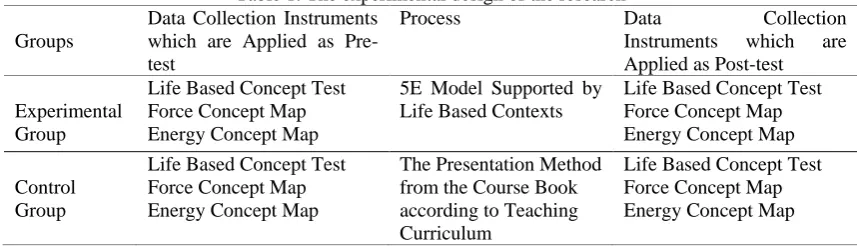
The research was designed in the quasi-experimental design with pre-test, post-test control group. The experimental designs aim to determine the cause and effect relations between the variants (Büyüköztürk, 2001). Two (2) experimental groups and two (2) control groups were randomly selected from five (5) branches in the 7.th grade in a state school in Ankara. In the research which lasted seven weeks, the lessons were conducted according to 5E Model Supported by Life Based Contexts in the unit of “Force and Energy” in experimental groups while the lessons were executed according to the methods based on transferring and presenting information. The experimental design of the research was given in table 1.
Table 1. The experimental design of the research
Groups
Data Collection Instruments which are Applied as Pre-test
Process Data Collection
Instruments which are Applied as Post-test
Experimental Group
Life Based Concept Test Force Concept Map Energy Concept Map
5E Model Supported by Life Based Contexts
Life Based Concept Test Force Concept Map Energy Concept Map
Control Group
Life Based Concept Test Force Concept Map Energy Concept Map
The Presentation Method from the Course Book according to Teaching Curriculum
Life Based Concept Test Force Concept Map Energy Concept Map
Research group
The study group of this research consists of 80 students at the 7.th grade of a state school in Ankara. Four classes were randomly selected from five classes at the 7.th grade so that there are two experimental groups and two control groups and the lessons were conducted by the researcher. In the experimental groups, there are 41 students while control groups consist of 39 students. The information about the experimental and control groups was given in table 2.
Table 2.The students in the study group
Group Branch Number of the Students
Female Male Total
Experimental Group 7E 11 9 20
7B 8 13 21
Control Group 7A 11 9 20
7D 7 12 19
Total 37 43 80
Data collection tools
The measurement tools used to obtain the data of the study are listed below:
Life Based Concept Test
from the literature (Avcı, Kara and Karaca, 2012; Çekiç Toroslu, 2011; Şahin and Çepni, 2011) and prepared by the researchers. The clauses in the test were established within the framework of life based approach which daily life contexts were employed. Following the analysis for validity and reliability and clause analysis conducted after the pilot application the test was finalized. The test consisting of 25 multiple choice questions which their content validity is provided so that there are at least two questions for each acquisition in the unit of Force and Energy for the 7.th grades in the Teaching Programs of Science has four-option questions. The highest score in the test is 25 while the lowest score is zero. The duration for the application of the test is one period of course (40 minutes). The Cronbach Alpha reliability coefficient of the Life Based Concept test was calculated as 0.81. Within this context, it was aimed to employ the test in order to determine the conceptual understanding levels among the students and being able to transfer the contexts employed in the lessons into the other contexts encountered in daily life (the contexts employed in the test).
The Force and Energy Concept Maps
In order to reveal the conceptual understanding levels of the students related to the issues of Force and Energy and determine the difference between the information structures of the students better (Ruiz-Primo, Schultz and Shavelson, 2001),the concept maps were also employed as another instrument of measurement in addition to Life Based Concept Test. The technique of establishing a concept map starting from scratch in the research. In establishing concept map, the students were given concepts related to the issue and they were asked to draw a concept map through using those concepts. This method has lower levels of directing when compared to the methods of Ruiz-Primo (2004) in establishing concept maps.
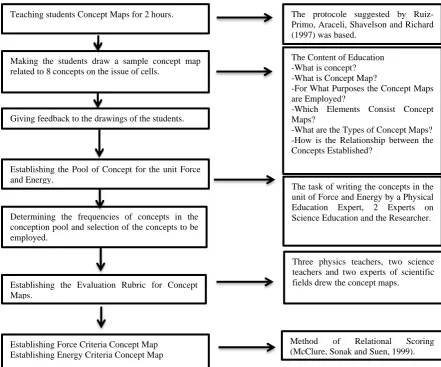
Figure 1. The flow pursued in the development process of concept maps
In addition, two different concept maps called “Force Concept Map” and “Energy Concept Map” within the context of the research since there are numerous basic concepts in the unit of Force and Energy. The reason for following this path is that the application implanted at the level of 7.th grade would be more convenient
Teaching students Concept Maps for 2 hours.
The Content of Education -What is concept? -What is Concept Map?
-For What Purposes the Concept Maps are Employed?
-Which Elements Consist Concept Maps?
-What are the Types of Concept Maps? -How is the Relationship between the Concepts Established?
Making the students draw a sample concept map related to 8 concepts on the issue of cells.
Determining the frequencies of concepts in the conception pool and selection of the concepts to be employed.
Giving feedback to the drawings of the students.
Establishing Force Criteria Concept Map Establishing Energy Criteria Concept Map
.
Establishing the Evaluation Rubric for Concept Maps.
Method of Relational Scoring (McClure, Sonak and Suen, 1999).
The protocole suggested by Ruiz-Primo, Araceli, Shavelson and Richard (1997) was based.
The task of writing the concepts in the unit of Force and Energy by a Physical Education Expert, 2 Experts on Science Education and the Researcher.
Three physics teachers, two science teachers and two experts of scientific fields drew the concept maps.
to the age level of the students. Nevertheless, “a network-type design” was preferred since it contains more than one stages, reflects complicated interactions at various conceptual levels and, thus, displays a high level integrity (Kinchin, Hay and Adams, cited by Taşar et al., 2002). The processes related to the preparation and application of the network-type concept maps within the framework of this research which was preferred as a measurement technique was given in figure 1.
In accordance with the process which was expressed in figure 1, 12 concepts related to “Force” and 13 concepts related to “Energy” were determined. Those concepts are given in the units of “Force” at the 7.th grade and they are “Mass, Weight, Force, Newton, Dynamometer, Pressure, Solid Pressure, Surface Area, Liquid Pressure, Gas Pressure, Gravitational Force, and Force of Gravity”. Related to “Energy”, the concepts of “Energy, Work, Force, Height to Ground, Kinetic Energy, Potential Energy, Gravitational Potential Energy, Flexibility Potential Energy, Weight, Mass, Velocity, Flexible Object, and Frictional Force”. The students were asked to establish a concept map both at the beginning and at the end of the application process. In order to score the obtained concept maps, the criteria-mapped relational mapping method was employed. The relational scoring method was adapted from a technique developed by McClure and Bell (1990) (McClure, Sonak and Suen, 1999). In this technique, each couple of criteria which the student employs in the map are evaluated on condition that they take place in the map. The couples of concepts and propositions which define the relationships between the concepts are scored through the rubric adapted from the study of McClure, Sonak and Suen (1999) between zero and three points. The total of the scores obtained from the relationship between each concept in the map and the total score of the student is obtained. Although there is no an upper limit for the scores to be obtained from the concept maps, maximum 135 points may be obtained according to the criteria concept map. The students were given a period of lesson (40 minutes) for each (Force and Energy) so that they can establish concept maps.
The Reliability and Validity of the Concept Maps
McClure et al., (1999) point out that there may be three sources of mistake which may influence the reliability when concept maps are used as an instrument for measuring. They can be listed as the difference of experiences which students have in establishing concept maps, the differences between the field information of the evaluators and the differences between the scoring of the evaluators. From this point of view, the students were primarily given two hours of lesson about establishing a concept map in order to minimize the error variances in the research which may result from the error sources and the concept maps were established through the concepts on definite issues under the guidance of the teacher, the stages where the students encounter difficulty were observed and activities were conducted to sort out those problems. Another issue in providing reliability is the assessment of evaluators in terms of their field information. The evaluators in this research are Field Experts in the course of Science. Another error source which McClure (1999) points out is the differences between the scoring of the evaluators. In providing reliability which can be defined as the consistency of the scores obtained from the concept maps, generally the consistency between the evaluators is considered (Ruiz-Primo and Shavelson, 1996; Ruiz-Primo et al., 1997). In order to provide the reliability of the evaluators in the assessment of the force and energy concept maps in the research, the scores of the students were scored by two evaluators in relation with the relational scoring protocole according to criteria concept maps and its scoring reliability was tested.
The validity of a measurement can be obtained through providing evidences for content validity, criterion-related validity, and construct validity (Tekin, 2012). Ruiz-Primo and Shavelson (1996) specified that the content validity in concept maps can be obtained through the convenience of the concepts to be employed in establishing the concept maps and containment of the concepts with the structure related to the whole issues. Within this framework, a concept pool was established by the field experts in order to provide the content validity in the concept maps and the concepts were selected from this pool according to their frequencies.
the research and Life Based Concept Test and it was found 0.89. There is a positive, high and significant relationship between the total scores of concept maps and Life Based Concept Tests.
Structuring and Application of Teaching Method
It is of importance to choose the teaching method in which the context to be employed in teaching supported by the life-based contexts being able to realize its function properly. Because, the method to be employed needs to provide a ground that can provide the mobility of the context and coordination of the education process. Infact, the technique that will be employed within this framework should be in the structure which can lead to life based teaching. In the development of lesson plans which real life based contexts will be employed, the emphasizing of “Contextual Structuring” which Finkelstein (2001) stated that the students structured information within a context and the context is an instrument in interpreting the information was based on.
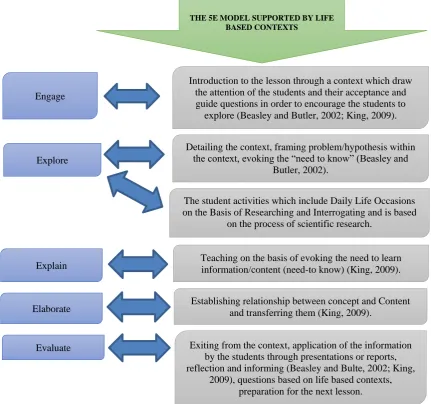
Figure 2.The stages of 5E model supported by life based contexts
Considering that the context based approach is the complementary element of the constructivist learning theory (Tekbıyık, 2010), the 5E Model which is thought to operationally function throughout it stages was preferred. The lesson plans based on Life/Context Based Learning Approach were functionalized within the framework of Contextual Structurism and based on research interrogation perception. While designing the stages of 5E Model, the elements constituting the basis of the Life-Based Teaching Approach were reflected into the stages of 5E Model in organizing the “functions of the context”. Especially, the organization of the context employed in the development of the lesson plans in the stages of 5E Model and the function of the context were paid attention. In order to configure the context in the organization of the stages of the 5E Model and structuring teaching at every stage of the 5E Model, the stages in the model of King (2009) which he adapted from Beasley and Butler’s
Teaching on the basis of evoking the need to learn information/content (need-to know) (King, 2009).
Elaborate
Evaluate Explain Explore
Introduction to the lesson through a context which draw the attention of the students and their acceptance and guide questions in order to encourage the students to
explore (Beasley and Butler, 2002; King, 2009).
Detailing the context, framing problem/hypothesis within the context, evoking the “need to know” (Beasley and
Butler, 2002).
Establishing relationship between concept and Content and transferring them (King, 2009).
Exiting from the context, application of the information by the students through presentations or reports, reflection and informing (Beasley and Bulte, 2002; King,
2009), questions based on life based contexts, preparation for the next lesson. Engage
The student activities which include Daily Life Occasions on the Basis of Researching and Interrogating and is based
on the process of scientific research. THE 5E MODEL SUPPORTED BY LIFE
(2002) context based model were reflected onto the stages of the 5E Model and integrated. The flow diagram where the basic elements regarding the process of designing 5E Model Supported by Life-Based Contexts was illustrated in figure 2. The lesson plans developed in the 5E Model Supported by Life Based Contexts within the framework of the research were applied considering the timing process mentioned in the annual lesson plan in the teaching program of the unit of Force and Energy. In four classes chosen for the application, the researcher (the first author) conducted the research herself. Moreover, the science teacher participated the lessons along with the researcher who conducted the actual application as an observer.
Analyzing of Data
Scoring Concept Maps
The Force and Energy Concept Maps were scored by a Science Education expert together with the researcher. The Force and Energy concept maps developed by the students were scored using the “the criteria-mapped relational mapping method” according to the criterion concept maps created by experts (McClure and Bell, 1990; McClure, Sonak and Suen, 1999).
Table 3. Force and Energy concept maps inter-rater t-test results
Tests Scorers N Mean SD T df p
Energy 1. Scorer 80 26.90 9.05 .453 58 .446
2. Scorer 80 25.87 8.62
Force 1. Scorer 80 9.43 1.92 .276 58 .784
2. Scorer 80 9.30 1.82
According to table 3, no statistically significant difference was found between raters' score assignment status for both tests (t58 = 0.453, p˃0.05; t58 = 0.276, p˃0.05). In other words, the scores assigned by the raters independently for each test are quite similar to each other. The correlation between the scores assigned by the raters is presented in table 4.
Table 4. Correlation coefficients between scores assigned by raters
Correlation p
Force Concept Map 0.971 .000
Energy Concept Map 0.978 .000
*p< .05
According to Table 4 when the correlation between the scores assigned by the raters is examined, it is observed that there is a high level relationship.
The Analysis of the Data Related to the Equivalence of the Experimental and Control Groups
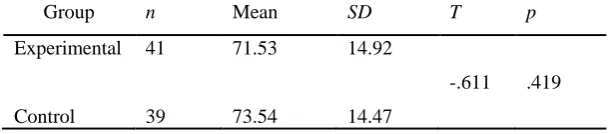
First of all, the general grade point averages of the students at the 6.th grade in the experimental and control groups who participated in the research and the final grade point averages of science course were analyzed in terms of equivalence. In this context, the normality hypothesis was achieved. Then, the average scores of experimental and control groups through independent t-test were analyzed in order to test whether there is a significant difference between the general grade point averages of the students at the 6.th grade in the experimental and control groups and the final grade point averages of science course. The results of independent t-test were given in table 5 and table 6.
Table 5. The results of independent t-test of general grade point averages of the students at the 6.th grade in the experimental and control groups
Group n Mean SD T p
Experimental 41 71.53 14.92
-.611 .419
Control 39 73.54 14.47
Table 6. The results of independent t-test of the final grade point averages of science course of the students of the 6.th grades
Group n Mean SD T p
Experimental 41 66.73 14.42
-.892 .423
Control 39 69.83 16.64
*p>0.05
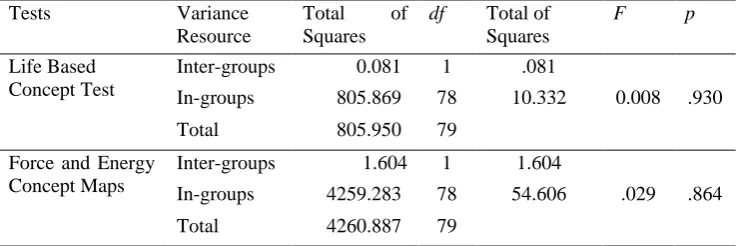
When the table 5and table 6 are analyzed, it can be observed that there is no significant difference between the general grade point averages of the students at the 6.th grade in the experimental and control groups which were included into research according to the results of independent t-test and the final grade point averages of science course. It can be stated that experimental and control groups are equal in terms of the determined characteristics. Nevertheless, the equivalence of the experimental and control groups was analyzed in terms of the implemented pre-tests. In this sense, the results of ANOVA related to the Life Based Concept Test and Force and Energy Concept Maps which are applied as a pre-test in the experimental and control groups were presented in table 7.
Table 7. The Anova results of pre-tests of experimental and control groups
Tests Variance
Resource
Total of Squares
df Total of Squares
F p
Life Based Concept Test
Inter-groups 0.081 1 .081
In-groups 805.869 78 10.332 0.008 .930
Total 805.950 79
Force and Energy Concept Maps
Inter-groups 1.604 1 1.604
In-groups 4259.283 78 54.606 .029 .864
Total 4260.887 79
When table 7 is analyzed, it can be seen that there is no significant difference between pre-test scores of Life Based Concept Test (F(1, 79)= .008 p˃.05), total pre-test scores of Force and Energy Concept Maps (F(1, 79)= .03, p˃.05) in terms of the students’ existence in either experimental groups or control groups . In conclusion, it can be stated that the experimental and control groups are equal in terms of pre-tests.
The Analysis of the Data Obtained from Experimental Application
The issue whether there is a significant difference between the post-test scores of Life Based Concept Test and the post-test scores of Force and Energy Concept Maps according to the variant of group (experimental/control) in order to avoid the increase in the error type 1 was analyzed after integrating and one-way MANOVA analysis was employed. MANOVA is a strong and multivariate statistics which is employed in experimental and scanning researches (Büyüköztürk, 2007; p: 138). Although the number of dependent variants is two or more, the number of variants in one-way MANOVA is only one. The statistical theories required for the One-way MANOVA analysis for one independent (Teaching Method) or two dependent variants were tested. Related to the analysis of covariance matrices, Box’s M test was conducted. The results of the test indicated that the MANOVA analysis could be conducted and variance-covariance matrices of the dependent variants were distributed equally. Thus, the hypothesis of equal distribution of covariance matrices which are among the basic hypothesis of multiple variance analysis are satisfied. Levene’s Test results related to the homogeneity of variances were analyzed and it was found that the significance of the values of Levene’s F test were higher than the boundary value, 0.5. This value indicates that there is no significant difference between the groups in terms of the distribution of error variances of the dependent variants related to the determination of the homogeneity of error variances and the variances are homogenous.
Table 8.The Results of MANOVA for the post-test score averages of life based concept test and force and energy concept maps for experimental and control groups
Test Group n Mean SD df F p
Life Based Concept Test
Experimental 36 22.05 2.22 1-69 100.70 0.000
Control 35 15.74 3.02 Force and Energy
Concept Maps
Experimental 36 65.27 13.53 1-69 68.52 0.000
Control 35 37.94 14.28
In table 8, the results of one way MANOVA which was conducted according to the post-test score averages in the experimental and control groups. When those values are considered, the averages of post-test scores of Life Based Concept Test (F(1, 69)= 100.70 p˂.05) and the averages of post-test scores for Force and Energy Concept Maps (F(1, 69)= 68.52, p˂.05) display significant difference in terms of the students in the experimental groups and those in the control groups. In other words, the students in the experimental group have higher averages of score in the tests where “the Conceptual Understanding Levels” are determined through the Life Based Concept Test and Force and Energy Concept Maps.
Results and Discussion
In this study, the conceptual understanding levels of the students in the 7.th grade who complete the activities in experimental and control groups in the unit of Force and Energy were determined through employing two different measurement techniques such as Life Based Concept Test and Concept Map. According to the obtained data, the students in the experimental groups where the unit of Force and Energy is conducted through lesson plans developed in the 5E Model Supported by Life Based Contexts achieved statistically and significantly higher scores in terms of the scores of both Life Based Concept Test and concept maps when compared to the students in the control groups where teaching process is conducted according to methods of transferring and presenting the information. From this point of view, it can be stated that the teaching process designed in the 5E Model Supported by Life Based Contexts is more effective than the methods implemented in control group in students’ developing conceptual understanding.
When literature is analyzed, it is possible to see some studies which deal with Life/Context Based Learning Approach and 5E Model support and develop conceptual understanding. For example, Kistak (2014) determined the conceptual understanding levels of the students in the unit of Sound through conceptual achievement test in the study conducted with 5E method based on life based learning and found out that the errors of some concepts decreased to some degrees. Considering the gaining of the unit of Energy in the Teaching Program of the course Physics in the 9.th Grade of Secondary Education, Tekbıyık (2010) developed lesson materials for the students and teachers in accordance with 5E teaching model through a context based approach and determined that those materials increased the achievement of conceptual understanding levels of the students. Similarly, the findings of this research overlap with the findings which prove that life based teaching applications(Akpınar, 2012; Bennett and Lubben, 2006; Barker and Millar, 1999; Çekiç Toroslu and Güneş, 2009; Glynn and Koballa, 2005;King, Winner and Ginns 2011; Peşman, 2012; Tekbıyık, 2010) and the activities conducted through 5E Model (Akbulut, 2013; Artun and Coştu, 2013; Demirci and Yavuz 2009; Niaz 2002; Panizzon 2003) all provide conceptual understanding, conceptual achievement or conceptual transformation.
5E Model is effective in students’ developing a deeper perception related to the concept of physics as a method which arranges and coordinates the learning process in terms of providing activity based conceptual transformation and transferring the learned concepts into different environments. The 5E Model is a teaching model which is based on the theory of Piaget and is figured with the constructivist theory and this model encourages the students for experience-based learning through motivating them and drawing their attention. Thus, students actively participate to the high level thinking process. This teaching process which requires teacher to develop in structuring the learning environment enables students develop a critical thinking-based analytical type of relation with the content to be learned (Kanlı, 2007). It can be stated that the 5E Model and the ideational processes the student encounter related to the scientific concepts are effective in developing a strong conceptual structure.
Another dimension of the research which is thought to be effective in developing the conceptual understanding levels of the students is the teaching process conducted based on real life contexts. It was emphasized that the 5E Model Supported by Life Based Contexts was structurized based on Contextual Constructivism and research-interrogation perception and its function in the elements which constitute the principles of Life/Context Based Teaching Approach in organizing the “function of the context” while designing the stages of the 5E model was pointed out. Barker and Millar (1999) asserted that presenting scientific concepts through daily events increased the motivation and learning desire of the students. Related to understanding the context during the stage of arising curiosity, increasing the learning motivation of the student provides the student feel the need of knowing (need to know) the scientific concept in order to understand the context. Thus, the student operates his skills of scientific processes (Schwartz, 2006) such as accessing information, interpreting information, analyzing, and giving decision in order to learn the concept through the context in the stage of exploration. During this process, teacher should introduce and explain the scientific opinions and concepts when necessary (Campbell et al., 2000). One of the key points of the model in establishing a strong perception for scientific concepts is establishing relations and connections between the concepts and real life contexts and transferring those connections from one field into another (King, 2009). The activities to establish the relations between Concept and Context were configured within the stage of expanding. This connection between the concept and real life context continues in the form of transferring the concept into other daily life contexts and contributes to the correctly configuration of the connection of the concept with other concepts. In fact, it is observed that the students in the experimental group are more successful in transferring the concepts into other daily life contexts and establishing correct connections among the concepts according to the results of the research observed from both life based concept test and concept maps. When the real life contexts-based learning approaches is considered from the perspective of the assessment of teaching, the evaluation questions which were prepared in accordance with real life contexts in order to understand whether students understand the concepts or not have importance in establishing a base for the courses in the future (Bennet and Lubben, 2006) has great importance. In fact, the evaluation activities developed based on real life contexts were employed during the Evaluation Process of Life Based 5E Model. Benckert (1997) expressed that classical questions employed in the evaluation of the scientific concepts idealize the science and, for that reason, the science fail in having the students and teachers establish a connection with real life. It is emphasized that the questions which consist of daily life occasions carry the students into various processes of thinking without leading them to memorizing and enable the students concretize the questions within a context and animate them in their minds (Bellocchi, King and Ritchie, 2011; Rennie and Parker, 1996). Burbules and Linn (1991) determine that the reason for the failure in solving the contexts encountered in daily life is the failure of students in transferring the information learned at school into daily life and different occasions. Accordingly, the real life contexts-based questions were employed both during evaluation process of the teaching model implemented in the research and in the concept test which is used for determining the conceptual understanding levels. At this point, it can be stated that developing evaluation activities of the teaching model based on the real life contexts contribute to the students in implementing the concepts they learn during the courses into different contexts and be more successful. In line with this, it can be pointed out that the 5E Model Supported by Life Based Contexts can be regarded as another factor which contributes to the development of conceptual understanding among the students in terms of organization, function and configuration of this model from the stage of Engage to the stage of evaluate.
Conducting the teaching through the contexts which facilitate the transfer of information, The organization of the Contexts at the Stages of 5E,
The issues discussed in integrating Life Based Approach and Constructivist approach,
The activities of stage of Explore and Elaborate related to Establishing Concept-Context Relation.
Different from the other researches, both Life Based Concept Test which consists of daily life contexts and concept maps were employed together in this research in order to determine the effects of life based learning perception within the context of conducting all the teaching and evaluation activities in an integrity on the conceptual understanding levels. Starting from this point, it is thought that discussing the employment of different measuring techniques in the research for the interpretation of conceptual understanding. The experimental groups in the research who learn the unit of Force and Energy through Life Based 5E Model were found more successful than the control groups in terms of the scores where conceptual understanding is evaluated in the dimension of Life Based Concept Test. In the same time, the results obtained from the concept map reveal that the students in the experimental group display a stronger conceptual structure in establishing relations between the concepts. Hence, De Jong (2006) stated that the failure of the context based approach in the students’ understanding the scientific concepts results from the failure in establishment of the relationship between the concepts employed by the students and teachers and the concepts related to the contexts. It can be stated in this research that the findings obtained as a result of measuring the conceptual understanding in the unit Force and Power among the students via life based concept test require the preparation of the evaluation instruments in accordance with the nature of teaching methods which are implemented and the contexts and the organization of the contexts selected for the configuration of the teaching methods and the development of Life Based Concept Test were effective in transferring information.
Another measuring instrument employed in the evaluation of the students’ understanding the science concepts through Life Based Concept Test is the Force and Energy Concept Maps. The experimental groups who learn the unit Force and Energy through 5E Model Supported by Life Based Contexts were found more successful in terms of establishing correct relations between science concepts and setting a hypothesis when compared to the control group. According to Ruiz-Primo et al., (1997), understanding a topic means having a conceptual structure which was strongly associated with that topic. Trowbirdge and Wandersee (1998) employed the concept map in order to observe the different in the understanding of the students related to the topic and found out that the concept map is an extremely delicate for measuring the changes in the structure of information (p.54). In the literature, there are numerous studies where different techniques of establishing concept maps and concept maps are employed as evaluation instruments (İngeç, 2009; İnaltun, 2013; Nakipoğlu and Ertem, 2010; Plummer, 2008; Ruiz-Primo et al., 2001; Ruiz-Primo et al., 1997; Tokiz, 2013; Yin and Shavelson, 2008). In his study related to the revealing the conceptual understanding levels of the students through concept maps, Tokiz (2013) points out that the students were able to insert the concepts related to force successfully into the blanks in the maps but they couldn’t explain these concepts and the relations between those concepts or they couldn’t exemplify their employment in technology and their significance in daily life. In this research, the students were given a list of concepts which were determined according to definite criteria on the topic of Force and Energy and thus it was aimed to reveal the conceptual structures of the students (McClure Sonak and Suen, 1999) and determine their level of defining a concept through its relations with the other concepts (Shavelson, 1974). The study of İnaltun (2013) which he observed the conceptual understanding of the students through the technique of establishing concept map from the zero-point display parallelism with the findings of this study in terms of employing the conceptual maps as an instrument in determining conceptual understanding. Accordingly, a concept test developed based on the contexts in conformity with the nature of the applied teaching method and concept maps were employed together considering the limitedness of interpreting the conceptual understanding of the students through a single test; and it was concluded that 5E Model Supported by Life Based Contexts improve conceptual understanding when the results obtained from the both tests are interpreted together.
Teaching Programs of the Science courses should be reviewed in terms of the applications in the course books and the employed measuring instruments.
Acknowledgements or Notes
This study was formed from a part of first author's doctoral thesis.
References
Akbulut, Ö. (2013). Dokuzuncu sınıf kuvvet ve hareket ünitesine yönelik bilgisayar destekli bağlam temelli öğretim etkinliklerinin incelenmesi. (Doctoral dissertation). Retrieved from https://tez.yok.gov.tr. Akpınar, M. (2012). Bağlam temelli yaklaşımla yapılan fizik eğitiminde kavramsal değişim metinlerinin öğrenci
erişisine etkisi. (Doctoral dissertation). Retrieved from https://tez.yok.gov.tr
Amir, R., & Tamir, P. (1994). In-depth analysis of misconcepts as a basis for developing research-based remedial instruction: The case of photosynthesis. The American Biology Teacher, 56(2), 94-100. Artun, H., & Coştu, B. (2013). Effect of the 5E model on prospective teachers’ conceptual understanding of
diffusion and osmosis: A mixed method approach. Journal of Science Education and Technology, 22(1), 1-10.
Avcı, D. E., Kara, İ., & Karaca, D. (2012). Fen bilgisi öğretmen adaylarının iş konusundaki kavram yanılgıları. Pamukkale Üniversitesi Eğitim Fakültesi Dergisi, 31(1), 27-39.
Barker, V., & Millar, R. (1999). Students' reasoning about chemical reactions: what changes occur during a context-based post-16 chemistry course? International Journal of Science Education, 21(6), 645-665. Bellocchi, A., King, D. T., & Ritchie, S. M. (2011). Assessing students in senior science: an analysis of questions in contextualized chemistry exams. Paper presented at theProceedings of the 1st International Conference of STEM in Education 2010.
Benckert, S. (1997). Context and conversation in physics education. Retrieved from https://tez.yok.gov.tr
https://gupea.ub.gu.se/bitstream/2077/18144/1/gupea_2077_18144_1.pdf.
Bennett, J., Lubben, F., & Hogarth, S. (2007). Bringing science to life: A synthesis of theresearch evidence on the effects of context‐based and STS approaches to science teaching. Science education, 91(3), 347-370.
Bennett, J., & Lubben, F. (2006). Context‐based chemistry: The Salters approach. International Journal of Science Education, 28(9), 999-1015.
Berns, R. G., & Erickson, P. M. (2001). Contextual teaching and learning: preparing students for the new economy. The Highlight Zone: Research@ Work No. 5.
Black, P., & Wiliam, D. (1998). Assessment and classroom learning. Assessment in Education: principles, policy & practice, 5(1), 7-74.
Bulte, A. M., Westbroek, H. B., de Jong, O., & Pilot, A. (2006). A research approach to designing chemistry education using authentic practices as contexts. InternationalJournal of Science Education, 28(9), 1063-1086.
Bulunuz, M., & Bulunuz, N. (2013). Fen öğretiminde biçimlendirici değerlendirme ve etkili uygulama örneklerinin tanıtılması. Türk Fen Eğitimi Dergisi, 10(4), 119-135.
Burbules, N. C., & Linn, M. C. (1991). Science education and philosophy of science: congruence or contradiction? International Journal of Science Education, 13(3), 227-241.
Büyüköztürk, Ş. (2007). Sosyal bilimler için very analizi el kitabı. PegemA.
Bybee, R. W. (2014). The BSCS 5E instructional model: Personal reflections and contemporary implications. Science and Children, 51(8), 10.
Crawford, M. (2001). Contextual teaching and learning: Strategies for creating constructivist classrooms. Connections, 11(6), 1-2.
Cañas, A., Novak, J., & González, F. (2006). Concept maps: theory, methodology, technology. Paper presented at the Proceedings of the second international conference on concept mapping.
Conradty, C., & Bogner, F. (2012). Knowledge presented in concept maps: Correlations with conventional cognitive knowledge tests. Educational Studies, 38(3), 341-354.
Campbell, B., Lazonby, J., Millar, R., Nicolson, P., Ramsden, J., & Waddington, D. (1994). Science: The Salters' approach‐a case study of the process of large scale curriculum development. Science education, 78(5), 415-447.
De Jong, O. (2006). Making chemistry meaningful: conditions for successful context-based teaching. Educaciónquímica, 17(2), 215-221.
Demirci, N., & Yavuz, G. (2009). The effect of constructive teaching approach on students’ science achievement in buoyancy force. e-Journal of New World ScienceAcademy, 4(2), 508-519.
Demircioğlu, H. (2008). Sınıf öğretmeni adaylarına yönelik maddenin halleri konusuyla ilgili bağlam temelli material geliştirilmesi ve etkililiğinin araştırılması. (Doctoral dissertation). Retrieved from https://tez.yok.gov.tr.
Driver, R. (1983). Pupil as scientist: McGraw-Hill Education (UK). Treagust, D. F. (1988). Development and use of diagnostic tests to evaluate students’ misconcepts in science. International Journal of Science Education, 10(2), 159- 169.
Ekinci, M. (2010). Bağlam temelli öğretim yönteminin lise 1. Sınıf öğrencilerine kimyasal bağlar konusunun öğretilmesine etkisi. (Master thesis). Retrieved from https://tez.yok.gov.tr.
Ergin, İ., Kanli, U., & Tan, M. (2007). Fizik eğitiminde 5E modelinin öğrencilerin akademik başarısınaetkisinin incelenmesi. Gazi Üniversitesi Gazi Eğitim Fakültesi Dergisi, 27(2).
Eroğlu, G. M., &Kelecioğlu, H. (2011). Kavram haritası ve yapılandırılmış gridle elde edilen puanların geçerlik ve güvenirliklerinin incelenmesi. Hacettepe Üniversitesi Eğitim Fakültesi Dergisi, 40(40).
Fensham, P. J. (2009). Real world contexts in PISA science: Implications for context‐based science education. Journal of research in science teaching, 46(8), 884-896.
Feynman, R. P., & Leighton, R. (1988). " What do you care what other people think?":further adventures of a curious character: WW Norton & Company.
Finkelstein, N. (2001). Context in the context of physics and learning. Paper presented at the Physics Education Research Conference Proceedings. Rochester, NY: PERC Publishing.
Finkelstein, N. (2005). Learning physics in context: A study of student learning about electricity and magnetism. International Journal of Science Education, 27(10), 1187-1209.
Gilbert, J. K., Bulte, A. M., & Pilot, A. (2011). Concept development and transfer in context‐based science education. International Journal of Science Education,33(6), 817-837.
Gilbert, J. K. (2006). On the nature of “context” in chemical education. International Journal of Science Education, 28(9), 957-976.
Glynn, S., &Koballa, T. (2005). The contextual teaching and learning instructional approach. Exemplary science: Best practices in professional development, 75-84.
Gobert, J. D., & Clement, J. J. (1999). Effects of student-generated diagrams versus student-generated summaries on conceptual understanding of causal and dynamic knowledge in plate tectonics. Journal of research in science teaching, 36(1), 39-53.
Gültekin, S. (2007). Başarılı Sözler. İstanbul: Başlık.
GüneşKoç, R. (2013). 5E modeli ile desteklenen bağlam temelli yaklaşımın yedinci sınıf öğrencilerinin ışık ünitesindeki başarılarına, bilgilerinin kalıcılığına ve fen dersine karşı olan tutumlarına etkisi. (Doctoral dissertation). Retrieved from https://tez.yok.gov.tr.
Hollenbeck, K., Twyman, T., & Tindal, G. (2006). Determining the exchangeability of concept map and problem-solving essay scores. Assessment for EffectiveIntervention, 31(2), 51-68.
Holman, J., & Pilling, G. (2004). Thermodynamics in context: A case study of contextualized teaching for undergraduates. Journal of Chemical Education, 81(3), 373.
İlhan, N. (2010). Kimyasal denge konusunun öğrenilmesinde yaşam temelli (context based) öğretim yaklaşımının etkisi. (Doctoral dissertation). Retrieved from https://tez.yok.gov.tr
İnaltun, H. (2013). Fen bilgisi öğretmen adaylarinin kavramlar arasi ilişki kurma düzeyleri ile fene yönelik motivasyonel inançlari ve öz düzenlemeleri arasindaki ilişkinin incelenmesi. (Master thesis). Retrieved from https://tez.yok.gov.tr
İngeç, Ş. K. (2009). Analysing concept maps as an assessment tool in teaching physics and comparison with the achievement tests. International Journal of Science Education, 31(14), 1897-1915.
İngeç, Ş. K. (2008). Kavram haritalarının değerlendirme aracı olarak fizik eğitiminde kullanılması. Hacettepe Üniversitesi Eğitim Fakültesi Dergisi, 35(35).
Kanlı, U. (2007). 7E modeli merkezli laboratuvar ile doğrulama laboratuvar yaklaşımlarının öğrencilerin bilimsel süreç becerilerinin gelişimine ve kavramsal başarılarına etkisinin karşılaştırılması. (Doctoral dissertation). Retrieved from https://tez.yok.gov.tr.
Kaya, O. N. (2003). Eğitimde alternative bir değerlendirme yolu: Kavram haritaları. Hacettepe Üniversitesi Eğitim Fakültesi Dergisi, 25(25).
Kavanagh, C., & Sneider, C. (2007). Learning about gravity I. Free fall: A guide for teachers and curriculum developers. Astronomy Education Review, 5(2), 21-52.
King, D., Bellocchi, A., & Ritchie, S. M. (2008). Making connections: Learning and teaching chemistry in context. Research in Science Education, 38(3), 365-384.
King, D. (2012). New perspectives on context-based chemistry education: Using a dialectical sociocultural approach to view teaching and learning. Studies in Science Education, 48(1), 51-87.
King, D., & Henderson, S. (2018). Context-based learning in the middle years: achieving resonance between the real-world field and environmental science concepts. International Journal of Science Education,
40(10), 1221-1238.
King, D. T., Winner, E., & Ginns, I. (2011). Outcomes and implications of one teacher's approach to context-based science in the middle years. Teaching Science, 57(2), 26-30.
Kistak, Ö. (2014). Teaching the “sound” unit with conte t-based learning at eight grades in science and technology lesson. (Yükseklisans tezi). https://tez.yok.gov.trsayfasındanerişilmiştir.
Konur, K. B., &Ayas, A. (2010). Sınıf öğretmeni adaylarının gazlarda sıcaklık hacim basınç ilişkisini anlama seviyeleri. Türk Fen Eğitimi Dergisi,7(3), 128-141.
Liu, X., & Hinchey, M. (1996). The internal consistency of a concept mapping scoring scheme and its effect on prediction validity. International Journal of Science Education, 18(8), 921-937.
Markham, K. M., Mintzes, J. J., & Jones, M. G. (1994). The concept map as a research and evaluation tool: Further evidence of validity. Journal of research in science teaching, 31(1), 91-101.
McClure, J. R., Sonak, B., & Suen, H. K. (1999). Concept map assessment of classroom learning: Reliability, validity, and logistical practicality. Journal of research inscience teaching, 36(4), 475-492.
Nakiboğlu, C., &Ertem, H. (2010). Atom ile ilgili kavram haritalarının yapısal, ilişkisel ve öneri doğruluğu puanlaması analiz sonuçlarının kıyaslanması. Türk Fen EğitimiDergisi, 7 (3), 60-77.
Nentwig, P. M., Demuth, R., Parchmann, I., Ralle, B., &Gräsel, C. (2007). Chemieim Kontext: Situating learning in relevant contexts while systematically developing basic chemical concepts. Journal of Chemical Education, 84(9), 1439.
Niaz, M. (2002). Facilitating conceptual change in students' understanding of electrochemistry. International Journal of Science Education, 24(4), 425-439.
Novak, J. D., Bob Gowin, D., & Johansen, G. T. (1983). The use of concept mapping and knowledge vee mapping with junior high school science students. Scienceeducation, 67(5), 625-645.
Novak, J. D. (1990). Concept mapping: A useful tool for science education. Journal of research in science teaching, 27(10), 937-949.
Novak, J. D., &Cañas, A. J. (2006). The origins of the concept mapping tool and the continuing evolution of the tool. Information visualization, 5(3), 175-184.
Osborne, R. J., & Wittrock, M. C. (1983). Learning science: A generative process. Science education, 67(4), 489-508.
Özkan, G. (2013). Kavramsal değişim metinleri ve yaşam temelli öğrenmenin öğrencilerin fizik öğrenme yaklaşımları ve kavramsal anlamaları üzerindeki etkileri. (Doctoral dissertation). Retrieved from https://tez.yok.gov.tr
Panizzon, D. (2003). Using a cognitive structural model to provide new insights into students' understandings of diffusion. Int. J. Sci. Educ., 25(12), 1427-1450.
Peşman, H. (2012). Method-approach interaction: the effects of learning cycle vs traditional and contextual vs non-contextual instruction on 11th grade students„achievement in and attitudes towards physics. (Doctoral dissertation). Retrieved from https://tez.yok.gov.tr.
Pilot, A., &Bulte, A. M. (2006a). The use of “contexts” as a challenge for the chemistry curriculum: Its successes and the need for further development and understanding. International Journal of Science Education, 28(9), 1087-1112.
Plummer, K. J. (2008). Analysis of the psychometric properties of two different concept map assessment tasks: Brigham Young University.
Rennie, L. J., & Parker, L. H. (1996). Placing physics problems in real-life context: Students' reactions and performance. Australian Science Teachers Journal, 42(1), 55-59.
Ruiz-Primo, M. A., & Shavelson, R. J. (1996). Problems and issues in the use of concept maps in science assessment. Journal of research in science teaching, 33(6), 569-600.
Ruiz-Primo, M. A., Schultz, S. E., Li, M., & Shavelson, R. J. (2001). Comparison of the reliability and validity of scores from two concept-mapping techniques. Journal ofresearch in science teaching, 38(2), 260-278.
Ruiz-Primo, M. A. (2004). Examining concept maps as an assessment tool. Paper Presented Concept Maps: Theory, Methodology, Technology Proc. of the First Int.Conference on Concept Mapping A. J. Cañas, J. D. Novak, F. M. González, Eds.Pamplona, Spain.