U si n g f e e d b a c k t o p r o m o t e le a r ni n g : s t u d e n t a n d t u t o r
p e r s p e c tiv e s . P r a c ti tio n e r R e s e a r c h i n H i g h e r E d u c a tio n , 4 ( 1).
p p . 3 0-4 0 .
Do w n l o a d e d fr o m : h t t p ://i n si g h t . c u m b r i a . a c . u k /i d/ e p ri n t/ 1 3 4 2 /
U s a g e o f a n y i t e m s f r o m t h e U n i v e r s i t y o f C u m b r i a’ s i n s t i t u t i o n a l r e p o s i t o r y
‘I n s i g h t ’ m u s t c o n f o r m t o t h e f o l l o w i n g f a i r u s a g e g u i d e l i n e s .
Any it e m a n d it s a s s o ci a t e d m e t a d a t a h el d i n t h e U niv e r si ty of C u m b r i a ’s in s ti t u ti o n al
r e p o si t o r y I n si g h t ( u nl e s s s t a t e d o t h e r wi s e o n t h e m e t a d a t a r e c o r d ) m a y b e c o pi e d ,
di s pl ay e d o r p e rf o r m e d , a n d s t o r e d i n li n e wi t h t h e JIS C f ai r d e a li n g g ui d eli n e s ( av ail a bl e
h e r e
) fo r e d u c a t i o n al a n d n o t-fo r-p r ofi t a c tiviti e s
p r o v i d e d t h a t
• t h e a u t h o r s , ti tl e a n d full bi blio g r a p h i c d e t ail s of t h e it e m a r e ci t e d cl e a rly w h e n a n y
p a r t
of t h e w o r k is r ef e r r e d t o v e r b a lly o r i n t h e w ri t t e n fo r m
• a h y p e rli n k/ U RL t o t h e o ri gi n al I n si g h t r e c o r d of t h a t it e m is i n cl u d e d i n a n y
ci t a ti o n s of t h e w o r k
• t h e c o n t e n t is n o t c h a n g e d i n a n y w a y
• all fil e s r e q ui r e d fo r u s a g e of t h e it e m a r e k e p t t o g e t h e r wi t h t h e m a i n it e m fil e.
Yo u m a y n o t
• s ell a n y p a r t of a n it e m
• r e f e r t o a n y p a r t of a n it e m wi t h o u t ci t a ti o n
• a m e n d a n y it e m o r c o n t e x t u ali s e it i n a w a y t h a t will i m p u g n t h e c r e a t o r ’s
r e p u t a t i o n
• r e m ov e o r a l t e r t h e c o py ri g h t s t a t e m e n t o n a n it e m .
T h e full p oli cy c a n b e fo u n d
h e r e
.
Alt e r n a t iv ely c o n t a c t t h e U niv e r si t y of C u m b ri a R e p o si t o ry E di t o r b y e m a ili n g
Using feedback to promote
learning: student and tutor
perspectives
Dr Jaki Lilly, Uwe Matthias Richter, Dr Berenice Rivera-Macias Anglia Ruskin University
Abstract
This paper summarises a study of students’ and staff perceptions and experiences of
assessment feedback practice across a post-1992 university. Phases 1 and 2 of the project
gathered students’ and academic colleagues’ views on assessment feedback practice.
Focus groups were then carried out with students and one discussion was video recorded
for subsequent use in workshops with faculty colleagues. Students’ and staff’s thoughts
on issues militating against good assessment feedback practice were gathered, commented
on, analysed, and reported back to the faculties.
The student focus groups provided interesting insights as to how students perceive and
receive feedback which were classifi ed as being related to content, clarity and style. It
was established that, with very few exceptions, issues and good practice in assessment
feedback can be generalised across disciplines and, in the main, staff and students share
their perceptions of what constitutes good assessment feedback.
Keywords
Formative feedback; summative feedback; assessment learning process.
Introduction
This paper summarises a study of students’ and staff perceptions and experiences of assessment feedback practice across a post-1992 University. The Assessment Feedback Project (Lilly et al., 2007; Lilly, et al., 2008) is part of the learning and teaching unit’s programme of developing learning, teaching and assessment practice in the university. It addresses the need for an informed, consistent and appropriate approach to giving students good feedback for learning (Rust, 2007:230).
While the focus of this paper is on the limitations of summative assessment feedback, the reach of the project embraces the practice of feedback to both summative and formative forms of assessment. Feedback on summative assessment is defi ned as the marking of scripts and the comments and responses from staff to students’ assignments (Carless, 2006:220). In theory, it is argued that summative feedback should serve a formative function by:
• comparing the students’ performance with established assessment criteria (Black and Wiliam, 1998:53–54); and
• effectively communicating the steps the student may take to reduce his/her knowledge/ performance gap (Black and Wiliam, 1998:53; Hounsell, 2008:5; Sadler, 1998:79–83).
Practitioner Research in Higher Education
Copyright © 2010 University of Cumbria
However, as Boud notes:
‘Most comments on student work, even if students read them, occur at times that are the least propitious in terms of infl uencing subsequent student learning – such as at the end of a unit of study when they are moving on to do something different.’ (Boud, 2007:18)
The results from the 2008 National Student Survey (NSS) report highlight two key issues in assessment feedback. According to the fi ndings by the Higher Education Funding Council for England (HEFCE) and NSS (2008), the timely supply of feedback to students remains to be improved. Secondly, descriptions of where and how students can develop their learning and academic skills need to be enhanced (HEFCE and NSS, 2008). Although these two concerns might characterise all modes of assessment and feedback used across the sector, they may refer to a great extent to the most common practice: feedback to summative assessment. Students need much clearer and specifi c feedback on the things they need to improve, since feedback on summative assessment aims at assisting students on their learning from the assessment (Irons, 2008:23; our emphasis).
Written feedback to summative assessment does not always make enough of a contribution to students’ learning. Research shows that reasons for this include:
• students’ lack of understanding about the role good feedback plays in their learning;
• contradictions arising if students do not fi nd that feedback is valuable to their current and subsequent learning; and
• the subsequent lack of interest in collecting their marked assignments and the feedback provided by their tutors (Carless, 2006:220; Chanock, 2000:95–98; Hounsell, 2007:102–103; Irons, 2008:23–24).
In Phase 1 of the project, students’ experiences and expectations of written assessment feedback and staff opinions as to how they could improve their written assessment feedback practice were gathered. During Phase 2, these fi ndings were presented to academic colleagues and their responses to the students’ views were collated. Their thoughts on issues raised in these fi ndings were discussed, and good practice in addressing the issues was shared and recorded. Phase 2 widened the perspective from written assessment feedback to all formative and summative feedback.
Phase 1: Methodology
Participants and procedures
During Phase 1, it was decided to review examples of good written feedback from the samples of assignments normally kept for Quality Assurance Agency for Higher Education (QAA) purposes, academic year 2005/06. Through a letter to faculties, heads of departments and programme/pathway leaders were asked to provide:
• samples of good feedback practice;
• copies of two samples of the associated student submitted assessment per department;
• assessment information (e.g. from module guides);
• assessment tasks; and
• marking schemes.
The samples were reviewed to establish commonalities and differences in approach and form. The Students’ Union (SU) worked closely with us and invited student representatives from all faculties to focus groups. The focus groups were designed to capture the participants’ perceptions of criteria constituting good (written) feedback and then to review the anonymised samples against the identifi ed criteria.
A total of 65 samples were received from the university’s fi ve faculties. The distribution was as follows:
• Faculty A 21
• Faculty B 19
• Faculty C 4
• Faculty D 8
• Faculty E 13
While every attempt had been made to ensure that only samples of ‘good’ feedback were submitted for review, in some cases, samples of assessments were provided which had been confi rmed as good by external examiners, rather than those for which examiners had commented on the quality of the tutor’s feedback. In some cases the samples appeared to have been randomly selected.
The initial review of the samples was focused entirely on the form and style used and did not attempt to establish the quality of the feedback. The review identifi ed that the form and style of feedback across the University varies considerably.
Nominal Group Technique and focus groups
The Nominal Group Technique (NGT) (Stewart and Shamdasani 1990:22–23) was adapted and combined with focus groups. The main objective for using NGT before focus groups was because it allows a balanced participation from each member of the group. Problems normally associated with individual contributions in focus groups were avoided (Stewart and Shamdasani, 1990:96–100); and the combination of methods proved particularly useful for getting students’ feedback (Hagyard and Keenan, 2007:1).
Activity 1
Using the fi ve steps of the NGT:
1. The students independently produced written ideas – in this case their own perception of the characteristics of ‘good’ feedback - written on individual Post-it notes
2. Students then prioritised their ideas using A, B, C, D etc.
3. Each student read out their fi rst priority idea in turn, and then placed the Post-It on the fl ipchart. Each idea was discussed only to ensure there was a mutual understanding of its meaning. This was repeated until all the ideas were collected on the fl ipchart.
4. Students were given 5 points each to allocate amongst the collected ideas as they wished – 5 points to one idea, or distributed amongst a number of ideas
5. The ideas were prioritised according to the number of points they had been allocated.
Activity 2
Students were each asked to review two randomly selected, anonymised samples of assignment feedback provided by the faculties. They were not given copies of the assignments themselves. They were asked to use their list of characteristics of good feedback from Activity 1 as a guideline for their review, and to note any further characteristics.
Phase 1: Findings
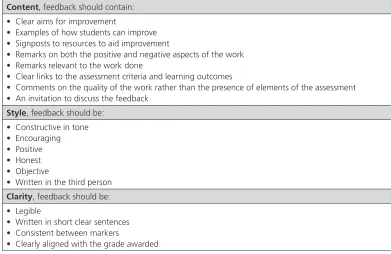
Following the students’ discussions, the responses to Activity 1 were categorised as relating to the content, style or clarity of written feedback (see Table 1). The discussions demonstrated that these students place great trust in their tutors – they see them as the experts and are keen for their advice. Students mentioned that they are encouraged by enthusiastic tutors and wanted their feedback to demonstrate this. They stated that they want to feel that their work has been appreciated – even if it hasn’t passed – and they want to know that their tutor has put some work into marking it. Moreover, students want lecturers to be sensitive to the effort students make in constructing their assignments.
Table 1. Students’ expectations from feedback.
Content, feedback should contain:
• Clear aims for improvement
• Examples of how students can improve • Signposts to resources to aid improvement
• Remarks on both the positive and negative aspects of the work • Remarks relevant to the work done
• Clear links to the assessment criteria and learning outcomes
• Comments on the quality of the work rather than the presence of elements of the assessment • An invitation to discuss the feedback
Style, feedback should be:
• Constructive in tone • Encouraging • Positive • Honest • Objective
• Written in the third person
Clarity, feedback should be:
• Legible
• Written in short clear sentences • Consistent between markers
• Clearly aligned with the grade awarded
Rae and Cochrane (2008) report on a similar research project to this one. They report on issues concerning clarity/lack of clarity as one of their arising themes, where ‘clarity’ contained the items that were defi ned here as ‘content’ (Rae and Cochrane, 2008:224–225). It is, therefore, possible to say that this parallel in fi ndings refl ects that across the sector. Students remain confused as to the potential that assessment feedback could have on their learning process (Chanock, 2000).
They additionally discussed the use of language – namely the tutor’s use of the fi rst or third person in written feedback. In fact, students identifi ed that since they are expected to use the third person in their assignments, they expected the tutors to use the third person in their feedback. They considered feedback written in the third person to be more objective, and to help ensure that comments were taken as relevant to the work, rather than as personal observations. This fi nding raised the most controversy when discussed with academic staff. It was concluded that the focus should be on feedback being neutral and fair rather than impersonal.
Students suggested that opportunities to meet with tutors and discuss feedback are valued, particularly formative feedback on early drafts of the work with an opportunity to incorporate it into the fi nal
submission. It was stated that feedback should be ‘substantial in totality’ i.e., the mix of feedback methods – on cover sheets, against criteria mark sheets, in discussion with the tutor – should address all the necessary points.
Students did not feel that the length of feedback was important – too much was no better than too little. In their opinion, feedback should be concise and to the point.
Finally, students indicated that they had found it diffi cult to accept constructive criticism when they fi rst started their studies, but had come to recognise its signifi cance for their learning as they progressed. They also identifi ed a need for students to be made aware of how to use and respond to constructive feedback. For instance, students who had participated in peer feedback had felt uncomfortable with it at fi rst, but ultimately found it very useful.
Phase 2: Methodology
Participants and procedures
During the spring of 2008 workshops were held with colleagues from four faculties. To ensure a wide representation of disciplines from each faculty, sessions were arranged for up to 30 participants, with a minimum of seven. Seven sessions were held and a total of 57 members of staff attended.
The sessions were planned to last three hours, with activities designed to address three primary goals:
• for colleagues to have an opportunity to share good practice and learn from each other;
• to collect contextualised examples of good practice, which could be returned to the faculties for the construction of localised guidelines; and
• to secure examples that might inform the development of generic university-wide guidelines.
The sessions included:
• a brief presentation of the previous phase of the project;
• collecting participants’ expectations of the workshops;
• a video of a Phase 1 student focus group;
• presentation of the Guidance and Feedback Loop (Hounsell, et al., 2006) a model selected as it identifi es different stages in the assessment feedback process, which can promote discussion.
The model depicts an illustration of the processes and infl uences upon students’ expectations of assessment feedback, including:
(1) Students’ prior experiences of assessments;
(2) Preliminary guidance;
(3) Ongoing clarifi cation;
(4) Feedback on performance/achievement;
(5) Supplementary support; and
(6) Feedforward.
The Loop highlights the concerns of students about the guidance they have received before writing up an assignment, while they are writing it, and after submission (Hounsell, 2008). Furthermore, the Loop is understood as a reminder that the feedback received by students is closely linked to the guidance they are given before they start, while they are working on their assignments and after assignment submission (Hounsell, 2008:4).
The structure
The categories identifi ed by the students’ expectations from feedback (Table 1) were used to structure the staff workshops. The participants were organised into teams and were given the task of discussing one category and noting any examples of good practice arising during the discussions. These examples could be taken from their own teaching experience or from their knowledge of the practice of colleagues. Additionally, teams wrote down issues that they felt militated against good assessment and feedback practice. The staff discussed the gathered information at a plenary session. All plenary sessions were audio-recorded with the consent of the participants.
Phase 2: Findings
The activities provided data on issues that staff encounter during the stages of assessment feedback and beyond, and the plenary focused on sharing ways in which such issues can be addressed. Furthermore, it was demonstrated that academic staff have a wide range of experience and advice to share.
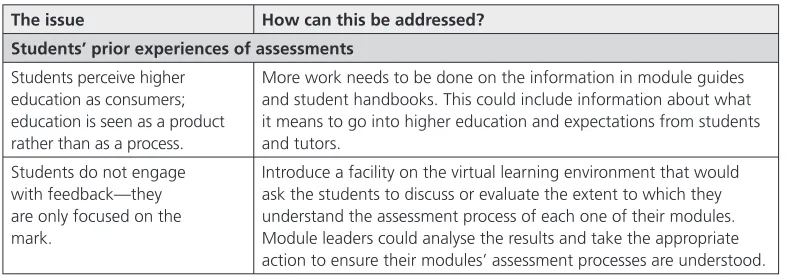
A signifi cant fi nding was that, with very few exceptions, issues regarding assessment feedback are to a great extent common across faculties. Table 2 summarises the most signifi cant issues and suggestions for how common problems in assessment feedback practice could be addressed. This list represents the experiences of colleagues who attended the assessment feedback workshops. The data are presented according to the stages of the Loop (Hounsell et al., 2006).
Table 2. Addressing issues in student feedback.
The issue How can this be addressed?
Students’ prior experiences of assessments
Students perceive higher education as consumers; education is seen as a product rather than as a process.
More work needs to be done on the information in module guides and student handbooks. This could include information about what it means to go into higher education and expectations from students and tutors.
Students do not engage with feedback—they are only focused on the mark.
The issue How can this be addressed?
Preliminary guidance
Teaching is assessment focused. Academic staff have little time to teach beyond what is required for the assessment.
Develop features of the module guide such as learning objectives and outcomes, assessment criteria, learning agreements, with students during the fi rst sessions to generate a shared understanding of the purpose of the module between the tutor and the students.
Ongoing clarifi cation
There is a separation between assessment and feedback, and learning and teaching.
Introduce continuous forms of assessment which constructively align assessment with learning and teaching. Examples include presentations, project work and patchwork text, including peer assessment.
Students have no input into the development of assessment criteria…
Clarify – and where possible negotiate – the meaning of assessment criteria and provide formative feedback during the module before students are writing up their assignments.
…so it is diffi cult for them to understand the meaning of assessment criteria.
Use online activities involving peer feedback and refl ection, where small groups work together to prepare their assignments. This could be particularly helpful for part-time students.
Group tutorials could be used to further clarify assessment criteria.
The dialogue between tutors and students is a one-way monologue – tutor to student.
Students can self-assess their own work and hand in their comments with their work for marking. Accordingly, tutors comment on and/ or mark the work, based on the students’ self-assessment. This starts a dialogue and decreases the sense of marking in isolation. Students begin to learn the ropes of self-assessment, and accept constructive comments in the form of feedback.
Students need to develop insight into the quality of their own work, to enable a meaningful dialogue between tutor and student.
Students present their work plans/drafts in the classroom. Peers (and perhaps the tutor) review the draft before it is written up. This has been found to enable experience of working as a team and promote students’ success.
No face-to-face interaction with the students.
In an online-delivered module, students are asked to submit a self-assessment with their fi nal self-assessment. This has proved useful with non-traditional students, e.g. people who have been away from institutional education for a long time. In this case, self-assessment has been built into the module.
There is no training in marking and assessment.
The induction course could be expanded to include advice on assessment and feedback. Also, subject, department-based staff development or team work can address specifi c marking and assessment issues for more established staff by sharing good practice.
Lack of consistency between academic tutors as to how much of a draft assignment they will see and comment on prior to submission.
The issue How can this be addressed?
Feedback on performance/achievement
Tutors do not have enough time.
Allocation of realistic time allowances for marking and moderation built into the yearly calendar and academic timetable.
Tutors have to teach big groups, and they don’t have time to feedback adequately.
After assignments have been marked, offer feedback to the entire group. Students are able to relate the generic feedback to their own work, and therefore are better able to understand how their mark was arrived at, and how they could have done better.
Feedback lacks clarity due to unclear handwriting.
Feedback is provided very late or not at all.
Arrangements should be made to allow feedback and marks to be given electronically/online. In some cases (e.g. online deliveries), formative feedback is already provided using email. Word-processed feedback can address this issue, and ensure that staff have a permanent copy of the feedback given to their students.
Supplementary support
Modules are not designed to allow time for tutors to support students after the assessment.
Electronic feedback could include a fi eld in which students may sign their agreement to allow subsequent tutors to follow up their progress. Moreover, where possible, tutors can provide feedback on a previous module in a follow-up module. In some cases, personal development planning (PDP) has been used as a refl ective mechanism to feedforward.
Feedforward
The modular structure does not permit the communication of feedback across the levels, preventing feedforward.
Feedback could form part of PDP. Students should have a personal repository for their feedback, especially in the fi rst year. Students and tutors could refl ect on the feedback they receive and identify generic issues and development needs. The Students’ Union has suggested that this would be more useful than discussing careers at that stage. At a later stage, the feedback would help tutors in giving career development advice.
In addition to the issues listed in Table 2, the feasibility of anonymity in certain subject areas was widely debated by the workshop participants, in spite of the fact that anonymous marking is the current policy of the university. It is possible to locate the source of this debate within the double role played by the tutors who, at some point, ‘have to switch role from that of supporter of learning to assessor of achievement’ (Yorke, 2003:496). Since many teachers hold a great deal of knowledge about their students, the likelihood of anonymity being at risk is high when they have to evaluate their students’ progress, especially in subjects within the humanities, e.g. arts and design. The participants argued that sometimes it is impossible to be completely objective when marking and writing up their feedback because they could recognise the student they were assessing.
Staff were aware of the benefi ts of giving feedback which could feedforward to subsequent assignments within the same module, and feedforward to future modules. Participants identifi ed a lack of
Discussion
The fi ndings from both phases have strong resonance with the wider literature and research on assessment feedback. For instance, Handley et al. (2007:12–15) found that students required certain levels of psychological safety when receiving feedback on drafts. They also found that students admitted that they may take some time to develop the necessary academic skills to formulate questions to their tutors. Further, by using a scheme where feedback is given on drafts, there is no signifi cant impact on the workload of staff, and students fi nd the feedback more effective for feedforward to future activity (Handley et al., 2007:15).
Academic staff identifi ed a range of issues they considered constrained their own feedback practice. These related broadly to:
• time;
• assessment and feedback practice;
• organisation;
• communication;
• clarity; and
• personality (Lilly et al., 2007).
Within these categories, tutors identifi ed the need for guidance in designing assessment criteria and managing students’ expectations which, if addressed, would promote the development of the good feedback practice described by the students and staff in the study. There were also some ideas to support feeding-forward. For example, since the fi rst lecture of the year and the fi rst meeting with the students sets the scene for a module, it was suggested that it would be useful to talk about the students’ strengths and weaknesses during the fi rst week. This would help them to connect their past assessment feedback with the learning outcomes of the current module.
Tutors and students should be encouraged to view the modules as part of a whole programme of study, instead of separate unconnected parts. Thus, both staff and students would be able to see the links across modules and elaborate on their feedback for the benefi t of students’ academic and professional development.
As this project has shown, academic staff showed awareness of reasons why their feedback to students is not effective and how they could improve it (Race, 2008:4). However, this does not mean that tutors are solely responsible for the provision and effectiveness of assessment feedback. Nicol and Macfarlane-Dick (2004:1) emphasise that feedback is not exclusively produced by teachers. As this project has also identifi ed, feedback comes in various forms and may be produced by peers, tutors and from self-assessment (Race, 2008:8).
Conclusion
The student focus groups provided interesting insights as to how students perceive and receive feedback, which was classifi ed as being related to content, clarity and style. It was established that, with very few exceptions, issues and good practice in assessment feedback can be generalised across disciplines and, in the main, staff and students share their perceptions of what constitutes good assessment feedback.
Therefore, in order to improve feedback it is not only assessment patterns that need to be reviewed, but also the culture of learning and teaching (Handley, 2009). A focus on increasing formative feedback (for example by the breakdown of a summative assignment into several continuous but smaller assessment tasks) challenges teachers to think creatively about how to maintain an appropriate assessment load for students, and a manageable marking load for themselves. Activities such as the use of peer feedback (Handley et al. 2007:12–15) blur the relationship between student and teacher and can be mistrusted by both.
Findings like those reported here should inform and assist in the development and provision of support from wider institutional structures. For assessment feedback to be successful, it is not only research and theorisation which is required in this area (Rust, 2007; Sadler, 1989; Yorke, 2003). There should be an adequate infrastructure (that is accurate module descriptor forms, generic and, perhaps, specifi c assessment guidelines) to support the development of consistent assessment practice across disciplines. However, it is important too that tutors, as assessors, in accepting that it is as much their responsibility to clarify the assessment criteria and ensure this is understood by the students as it is the teaching of the subject (Yorke, 2003:487–488), also prioritise the improvement of their own assessment practice.
References
All websites accessed 3 January 2010
Black, P. and Wiliam, D. (1998) Assessment and classroom learning. Assessment in Education 5 (1): 7–74.
Boud, D. (2007) Reframing assessment as if learning were important. In D. Boud, and N. Falchikov (eds.) Rethinking Assessment in Higher Education: Learning for the longer term: London: Routledge, 14–25.
Carless, D. (2006) Differing perceptions in the feedback process. Studies in Higher Education 31(2): 219–233.
Chanock, K. (2000) Comments on essays: Do students understand what tutors write? Teaching in Higher Education 5(1): 95–105.
Hagyard, A. and Keenan, C. (2007) Nominal group technique: A brief guide. Learn Higher. www.learnhigher.ac.uk/View-document-details/737-Introduction-to-Nominal-Group-Technique.htm
Handley, K. et al. (2007) When less is more: Students experience of assessment feedback, in the HEA (Higher Education Academy), 3rd Annual Conference. Harrogate. UK 3–5 July 2007.
www.heacademy.ac.uk/resources/detail/when_less_is_more
Handley, K. (2009) Engaging students with assessment feedback: ‘satisfying’ students or facilitating their learning? Keynote at Assessment in Higher Education Conference. Carlisle. 8th July 2009. C-SHEN, University of Cumbria: Carlisle. www.cumbria.ac.uk/Services/CDLT+/C-SHEN/C-SHEN docs/Conference8thJuly/ Handley-Carlisle8July09(2).pdf
HEFCE and NSS (2008) Higher Education in Further Education Colleges in England: Outcomes of the 2008 National Student Survey. The Quality Assurance Agency for Higher Education. www.qaa.ac.uk/publications/ infobulletins/NSS08/default.asp
Hounsell, D. (2007) Towards more sustainable feedback to students. In D. Boud, and N. Falchikov (eds.) Rethinking Assessment in Higher Education. Learning for the longer term. London: Routledge: 101–113.
Hounsell, D. (2008) The trouble with feedback: New challenges, emerging strategies, TLA Interchange, (2): 1–9. www.tla.ed.ac.uk/documents/feedback2.pdf
Hounsell, D., McCune, V., Hounsell, J. and Litjens, J. (2006) Investigating and enhancing the quality of guidance and feedback to undergraduate students, in ETL Project (Enhancing Teaching-Learning Environments in Undergraduate Courses), 3rd Biennial Northumbria/EARLI SIG Assessment Conference. Northumbria, UK, 30 August–1 September. www.etl.tla.ed.ac.uk//docs/earlinth06.pdf
Irons, A. (2008) Enhancing Learning through Formative Assessment and Feedback. London: Routledge.
Lilly, J., Richter, U. M. and Rivera Macias, B. (2008) Assessment Feedback Project: Report for phase 2. www.inspire.anglia.ac.uk/download.php?view.91
Nicol, D.J. and Macfarlane-Dick, D. (2004) Rethinking formative assessment in HE: A theoretical model and seven principles of good feedback practice, in C. Juwah et al., Enhancing Student Learning through Effective Formative Feedback. SENLEF (Student Enhanced Learning through Effective Feedback), the HEA Generic Centre. www.heacademy.ac.uk/assets/York/documents/resources/resourcedatabase/id353_senlef_ guide.pdf
Race, P. (2008) Compendium on feedback. http://phil-race.co.uk/?page_id=13
Rae, A. M. and Cochrane, D. K. (2008) Listening to students: How to make written assessment feedback useful. Active Learning in Higher Education 9 (3): 217–230.
Rust, C. (2007) Towards a scholarship of assessment. Assessment and Evaluation in Higher Education 32 (2): 229–237.
Sadler, D.R. (1989) Formative assessment and the design of instructional systems. Instructional Science 18: 119–144.
Sadler, D.R. (1998) Formative assessment: Revisiting the territory. Assessment in Education 5(1): 77–84.
Stewart, D.W. and Shamdasani, P.N. (1990) Focus Groups: Theory and practice. Applied social research methods series: Volume 20. London: Sage.