Survey On Different Method For Improving The Performance
Of End To End Data Transmission (Qos) Using Routing
Protocol In Vanet
Vijay Khata1, Ashil Patel21Research Scholar, IT Department, L.D. College of Enginnering, Gujarat, India
2Assistant Professor, IT Department, L.D. College of Enginnering, Gujarat, India
ABSTRACT
Vehicular Ad Hoc Network (VANET) is sub group of mobile ad hoc network (MANET).This network are becoming the main stream of network research have been carried out from many aspects. It is an emerging new technology to exchange the information between vehicles to vehicles. This technology considered as one of most noticeable technologies for improving the efficiency and safety of transportation system. For the development of the intelligent transport system (ITS) having the ability for both management and also self-organization, making them reliable as a highly mobile network system.In this paper I will survey different method which involves evaluation of performance in vehicular ad hoc network with various parameters, for this various protocols from two classes (unicast and multicast) of routing in VANET are implemented.
Keywords: Routing, Routing protocol, Mobility, ITS (intelligent transport system), IDM (intelligent driver model).
I.
INTRODUCTIONVehicular Ad Hoc Networks (VANET) have been proved for its great potential in various application prospects including the enhancement of traffic safety, the optimization of traffic flow and the infotainment services like finding nearest hotel ,email services ,audio or video sharing. It uses wireless technology to create an ad hoc network and communicate among moving vehicles. In vanet every vehicle is considered as wireless router or forwarder, allowing vehicle around 250 meters to 1000 meters coverage range to do communication with other vehicle and construct a network with wide range. The wireless communication in VANETS between vehicle –to –vehicle (V2V) and vehicle –to –infrastructure (V2I).For the car - to -car or any other vehicle communication there is ON BOARD UNIT (OBU) and for the vehicle to infrastructure ROAD SIDE UNIT (RSU) like sensor, wifi network is available.
Vehicle do communication either one hop or multihop communication. In one hop communication vehicle directly communicating to the target node, whereas in multihop communication source node does not communicate directly, it will use relay node. In the nature of VANETS multihop communication gets the need for robust routing protocols, where more than one route is exists between the source and target vehicle [6].
II.
METHODSA. TOPOLGOGY BASED ROUTING:-These routing protocols use links information that exists in the network to perform packet forwarding like Reactive based routing and Proactive routing protocols.
B. POSITION BASED ROUTING:-Position based routing consists of class of routing algorithm. They share the property of using geographic positioning information in order to select the next forwarding hops like position based greedy v2v protocols, greedy perimeter coordinator routing, and connectivity aware routing protocols.
C. CLUSTER BASED ROUTING: - cluster based routing is preferred in clusters. A group of node identifies themselves to be a part of cluster and node is designated as cluster head will broadcast the packet to cluster.
D. BROADCAST ROUTING: - Broadcast routing is frequently used in VANET for sharing, traffic, weather and emergency, road conditions among vehicles and delivering advertisements and announcements.
E. GEO ROUTING: - Geo cast routing is basically location based multicast routing. Its objectives is to deliver packet from source node to all other node within specified geographical region.
III.
LITERATURE REVIEW OF DIFFERENT METHOD FOR IMPROVING PERFORMANCE OFEND TO END DATA TRANSMISSION BASED ON ROUTING ALGORITHM IN VANET
A. A Stable Routing Protocol for Vehicular Ad hoc networks
[a] methodology
A stable Routing Protocol (SRP) FOR VANETS has been proposed for efficient routing of packets that can find reliable route from source to destination nodes.the proposed protocol has two phases, namely the route formation phase and route maintenance phase.the route formation phase use the
ROUTE_REQ and ROUTE_REPLY control messages for forming the routes and select the best stable route using the STABLE_ROUTE function. The route maintenance phase uses the next best route when link failure happens in transmitting route.
There is three phase in the proposed protocol like ROUTE REQUEST, REPLY TO ROUTE REQUEST, ROUTE RECOVERY.
Following are the steps for ROUTE REQUEST in which NS is the source node and NT is target node and Ɵ is the threshold value.
1. Send the route request.
2. If no route is found within the Ɵ time 3. Store and forward(NS,NT)
Required steps for REPLY to SOURCE REQUEST. 1. Vehicle already available in route record of
route request. 2. Discard the packet.
3. Target vehicle NT is equal to available vehicle NI.
4. Send route reply. 5. Else.
6. Add vehicles in route table. 7. Send route request(NS,NT) 8. End if.
Figure 1
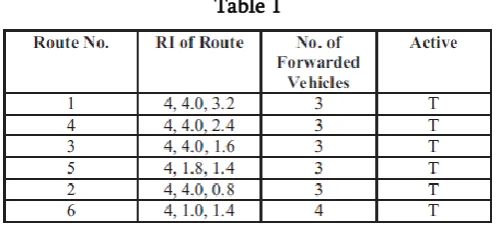
Table 1
In the above figure SORTED ROUTE TABLE based on RELIABILITY index is shown.
Sorted route table has been created using STABLE_ROUTE (NS, NT) function based on Reliability Index and number of forwarded nodes. The stable route between source and destination has been selected in the first record of the Sorted Route Table. Using this Stable Route Table, the messages are transmitted from source vehicle VS to the target vehicle VT through Route 1. When the transmitting link failed due to change of direction of the forwarded vehicle, then the active field of the route is marked as inactive in the Sorted Route Table and the next route is selected to transmit the messages from source to destination vehicles. It will reduce the number of overhead packets while link failure occurs in the active route while transmitting the messages from source to destination vehicles and hence improve the throughput of ad hoc networks.
B. COMPARATIVE STUDY BETWEEN UNICAST AND MULTICAST ROUTING PROTOCOLS IN DIFFERENT DATA RATES USING VANET [b] Methodology and scenario
In this paper VANET simulation is implemented in 50 x 50 meters grid of city environment which is based on Manhattan Grid model of mobility also known as the City section mobility model. There is a some assumption in this model like in the vertical direction mobile node can move either north or south, whereas for horizontal direction , it is either east or west.also assumed that mobile node can only move in the horizontal as well as vertical lines on the streets. The simulation uses two unicast routing protocols as AODV and DSR, two multicasting routing protocols
ODMRP and ADMR.these protocols are compared in terms of their performance using the following metrics:
Average end-to-end delay: - measure an average delay time from sender to a destination in second.
Packet delivery ratio: - measure the percentage of the transmitted data packets that are successfully received.
Normalized routing load: - measures the number of routing packets transmitted per data packet delivered at the destination.
MOBILITY MODEL: - In the below image configuration of mobility model is shown as well as SUMO tool which is used for graphical user interface in network simulator for mobility tracing.
Table 2
Network model: - This network model is simulated using NS2 using the mobility trace that is generated by the SUMO engine. Unicast and Multicast routing protocols are used to transmit multicast packets to group of receivers.
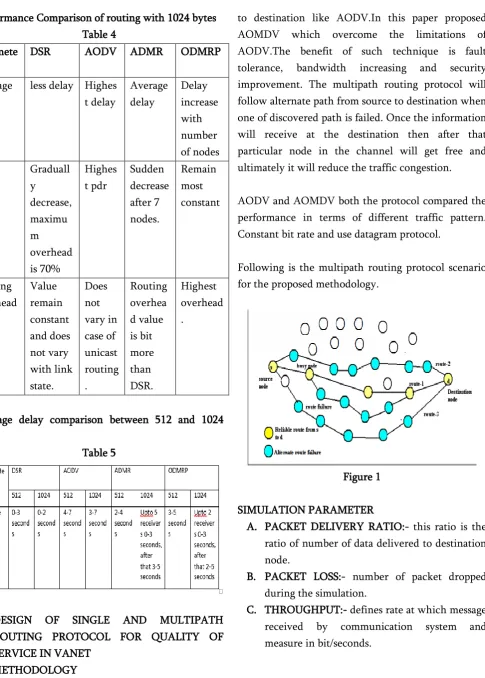
Performance Comparison of routing with 1024 bytes Table 4
Paramete r
DSR AODV ADMR ODMRP
Average delay
less delay Highes t delay Average delay Delay increase with number of nodes
PDR Graduall
y decrease, maximu m overhead is 70% Highes t pdr Sudden decrease after 7 nodes. Remain most constant Routing overhead Value remain constant and does not vary with link state. Does not vary in case of unicast routing . Routing overhea d value is bit more than DSR. Highest overhead .
Average delay comparison between 512 and 1024 bytes
Table 5
C. DESIGN OF SINGLE AND MULTIPATH
ROUTING PROTOCOL FOR QUALITY OF SERVICE IN VANET
[C] METHODOLOGY
There is lots of reactive, proactive and hybrid routing protocols are available in vehicular ad hoc netwroks.Maximum protocol support only single path
to destination like AODV.In this paper proposed AOMDV which overcome the limitations of AODV.The benefit of such technique is fault tolerance, bandwidth increasing and security improvement. The multipath routing protocol will follow alternate path from source to destination when one of discovered path is failed. Once the information will receive at the destination then after that particular node in the channel will get free and ultimately it will reduce the traffic congestion.
AODV and AOMDV both the protocol compared the performance in terms of different traffic pattern. Constant bit rate and use datagram protocol.
Following is the multipath routing protocol scenario for the proposed methodology.
Figure 1
SIMULATION PARAMETER
A. PACKET DELIVERY RATIO:- this ratio is the ratio of number of data delivered to destination node.
B. PACKET LOSS:- number of packet dropped during the simulation.
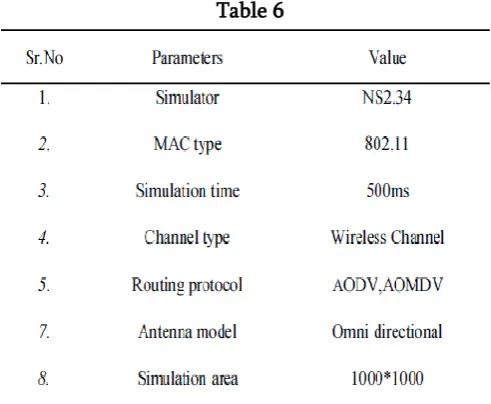
NETWORK AND SIMULATION PARAMETER Table 6
D. SIMULATED ANAYSIS OF LOCATION AND DISTANCE BASED ROUTING IN VANAET WITH IEEE802.11P
[D] METHODOLOGY
In this paper performance analysis of DREAM and LAR in city as well as in highway environments with different metrics are presemted.in order to provide realistic vehicular traffic movements an extended version of IDM (intelligent driver model) is used.
Distance effect routing algorithm for mobility (DREAM) routes the packet in the network by geographical location of the node.Location table store all the location of network node and or also location packet is flooded to update the location by neighboring node.
Location aided routing (LAR) main objective of this protocol is to lower overhead caused by routing process.
Figure 2
In above figure whole procedure is shown in which simulation of routing protocol for vehicular ad hoc network.
NETWORK SIMULATION PARAMETERS Table 8
E. PERFORMANCE EVALUATION OF DREAM
PROTOCOL FOR INTER VEHICLE
COMMUNICATION [E]METHODODLOGY
In this paper a performance evaluation of geographical protocol DREAM (distance routing effect algorithm for mobility), in VANETS using vehicle mobility based on real road map is presented.
In this protocol when source wants to send message to destination node, it stats by looking for its location table and receives information about its geographical position. If direction is valid source node send the message to all one hop neighbors in the forwarding zone determined by the direction. If no information about the location is available for destination, then recovery procedure must be executed by flooding partially or entirely the network in order to reach the destination. When node receive message first it checks if it is the destination node or not. If this is the case it send the acknowledgement to the source node
otherwise repeat the same procedure until it is reached to destination.
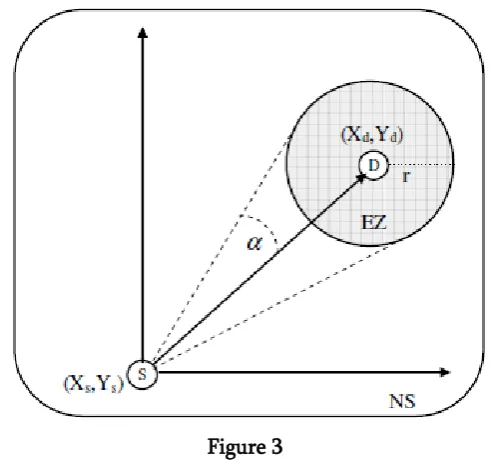
To determine the forwarding zone in the direction of destination node the source node calculates the expected zone which contains the destination node D.
Figure 3
In the above figure we can see the expected zone with the network space.
MOILITY SCENARIOS AND TRAFFIC PARAMETERS
In this paper network simulator 2 is used. For the mobility model in which moving direction for that MOVE (mobility model generator for vehicular networks) and TRANS (traffic and network simulation) which is built on to SUMO.number of vehicles is fixed like 50 and dimension area is 200m x 200m.
Figure 4
Above figure is for mobility scenario. Figure 5
This figure is for the structure of each intersection.
IV.
COMPARISIONTable 9
PAPER PROTOCOL PARAMETER PERFROMANCE
ANALYSIS
RESEARCH GAP
A Stable routing
protocol
Range, direction, speed
Reduce overhead, increase throughput
delay constraint
B unicast
protocol-AODV DSR multicast protocol-ODMRP, ADMR
CBR as a traffic model, speed, transmission range, packet size
Average end-to-end delay, PDR, normalized routing load
in DSR protocol- high mobility pattern
AODV-bandwidth
C AODV AOMDV Constant bit rate,
user datagram protocol
PDR, throughput, packet loss
Varying traffic type, topology, number of nodes
D DREAM, LAR IEEE802.11p, IDM
model, transmission range, wireless channel, data rate
PDR, delay, throughput, lost packet ratio, routing overhead
Evaluate location based geocasting protocol
E DREAM Vehicle mobility
scenario
Control load, average latency
V.
CONCLUSIONIn above all the paper I reviewed different routing protocol for routing the information from source to destination. In case of unicast routing protocol when packet routes from source node to destination node DSR (dynamic source routing) protocol is best in terms of performance like it has minimum delay and overhead as compared to other routing protocol. In case of multicast routing protocol ADMR (adaptive demand driven multicast routing) routing protocol is better as compared to other protocol. It utilizes the data sending application to avoid pattern control periodic message and also adapt the change of mobility.
VI.
REFERENCES[1].T Sivakumar, R Manoharan, K S Kuppusamy" A Stable Routing protocol for Vehicular Ad hoc network" 2014 IEEE
[2].Dr Parminder singh"Comparative study between Unicast and Multicast Routing protocols In Different Data rates Using Vanet" 2014 IEEE [3].Farhana Anjum, V.D.Bondre, AusafUmar
khan"Design of Single and Multipath Routing Protocol for Quality of Service (Qos)" 2015 IEEE ICCSP conference.
[4].Akhtar Husain and S.C.Sharma"Simulated Analysis of Location and Distance Based Routing in VANET with IEEE802.11p, Perr-review under responsibility of organizing committee of the 3rd international Conference on Recent Trends in Computing 2015 (ICRTC-2015) 1877-0509 © 2015 Published by Elsevier B.V.
[5].M.Bakhouya, J.Gaber, M.Wack"Performace Evaluation of DREAM Protocol for Inter-vehicle communication" IEEE 2009
[6].Yogesh, Parminder Singh"Meliorate ACO Routing Using Wi-MAX In VANETS"2016 International Conference on Computing for Sustainable Global Development (INDIACom), 978-9-3805-4421-2/16/$31.00_c 2016 IEEE.
[7].Haojun Yang, Ming Yu and Xuming Zeng" Link available time prediction based GPSR for vehicular ad hoc networks", 978-1-5090-4429-0/17/$31.00 c 2017 IEEE