Available online on 15.08.2019 at http://jddtonline.info
Journal of Drug Delivery and Therapeutics
Open Access to Pharmaceutical and Medical Research© 2011-18, publisher and licensee JDDT, This is an Open Access article which permits unrestricted non-commercial use, provided the original work is properly cited
Open Access
Research Article
Formulation Development and Evaluation of Floating Microsphere of
Famotidine for the Treatment of Peptic Ulcer
Dharmendra Rai*, Durga Pandey, Nishi Prakash Jain, Surendra Kumar Jain
Sagar Institute of Research and Technology-Pharmacy, Bhopal (M.P.)
ABSTRACT
The purpose of this research was to prepare a floating drug delivery system of famotidine. The floating microspheres can be prepared for the improvement of absorption and bioavailability of famotidine by retaining the system in the stomach for prolonged period of time. Floating microspheres of famotidine were prepared using different polymers like ethyl cellulose, hydroxy propyl methyl cellulose by solvent diffusion-evaporation method. The microspheres had smooth surfaces with free-flowing and good-packing properties. The yield of the microspheres was up to 73.32±0.14% and ethyl cellulose microspheres entrapped the maximum amount of the drug. Scanning electron microscopy confirmed their hollow structures with sizes in 331.6 nm. The prepared microspheres exhibited prolonged drug release and Percentage buoyancy was found to 73.25±0.23. The formulated batches were evaluated for percentage yield, particle size measurement, flow properties, percent entrapment efficiency, swelling studies. The formulations were subjected to stability studies and In-vitro release and release kinetics data was subjected to different dissolution models. It was concluded that developed floating microspheres of famotidine offers a suitable and practical approach for prolonged release of drug over an extended period of time and thus oral bioavailability, efficacy and patient compliance is improved.
Keywords: Famotidine, Solvent diffusion evaporation method, Ethyl cellulose, Hydroxyl propyl methyl cellulose
Article Info:Received 18 June 2019; Review Completed 27 July 2019; Accepted 04 Aug 2019; Available online 15 August 2019
Cite this article as:
Rai D, Pandey D, Jain NP, Jain SK, Formulation Development and Evaluation of Floating Microsphere of Famotidine for the Treatment of Peptic Ulcer, Journal of Drug Delivery and Therapeutics. 2019; 9(4-s):426-431
http://dx.doi.org/10.22270/jddt.v9i4-s.3350
*Address for Correspondence:
Dharmendra Rai, Sagar Institute of Research and Technology-Pharmacy, Bhopal (M.P.)
INTRODUCTION
Oral rout of administration is the most convenient and widely used method of drug administration and the development of stomach specific oral controlled-release drug delivery systems is a challenging job due to the variation of pH in different segments of the gastrointestinal tract, the fluctuation in gastric emptying time and the difficulty of localizing an oral delivery system in a selected region of the gastrointestinal tract. Rapid gastrointestinal transit can prevent the absorption of complete drug in the absorption zone and reduce the efficacy of the administered dose since the majority of drugs are absorbed in stomach or the upper
part of small intestine1, 2. To overcome the above discussed
issues, many types of oral controlled drug delivery systems having prolonged gastric residence times have been reported
such as: floating drug dosage systems (FDDS)3-7, swelling or
expanding system8, mucoadhesive systems 9,10
modified-shape systems 11, high-density systems and other delayed
gastric emptying devices 12. FDDS have lower density than
gastric fluids and thus remain buoyant in the stomach fluid without affecting the gastric emptying for a prolonged period
of time. While the system is floating in the gastric fluid, the drug is released slowly from the system at a desired rate. Materials used for FDDS include carbon dioxide gas-forming
agents (carbonate or bicarbonate compounds) 8,13, highly
swellable hydrocolloids and light mineral oils14,15. Multiple
unit systems and floating systems prepared by solvent
evaporation methods have also been developed12, 16-20.
However, it has been shown that products based on a multiple unit system comprising many small units have advantages over single -unit preparations such as matrix
tablets21. The gastric emptying of multiple unit dosage forms
occur gradually, in a more consistent manner, with less
individual variation2,22. Multiple unit dosage forms also have
the potential to distribute widely over a large area in the stomach and small intestine, thus yielding a more predictable drug release by suppressing the effect of many variables in the gastrointestinal environment. As multiple unit dosage forms consist of many small units, less risk of dosage
dumping is expected23.Famotidine, a competitive histamine
H2-receptor antagonist is used to treat gastrointestinal
disorders such as gastric or duodenal ulcer,
hypersecretory conditions. Famotidine inhibits many of the isoenzymes of the hepatic CYP450 enzyme system. Other actions of famotidine include an increase in gastric bacterial
flora such as nitrate-reducing organisms24. Famotidine is
widely used as the treatment of peptic ulcer disease and gastroesophageal reflux disease. Famotidine binds competitively to H2- receptors located on the basolateral membrane of the parietal cell, blocking histamine affects. This competitive inhibition results in reduced basal and nocturnal gastric acid secretion and a reduction in gastric volume, acidity, and amount of gastric acid released in response to stimuli including food, caffeine, insulin, betazole
and pentagastrin 25. Floating microspheres are one of the
multiparticulate delivery system and are prepared to obtain prolonged or controlled drug delivery to improve bioavailability and to target drug to specific sites. Microspheres can also offer advantages like limiting fluctuation within therapeutic range, reducing site effects, decreasing dosing frequency and improving patient
compliance26.
MATERIAL AND METHODS
MaterialFamotidine was a gift sample from Pharmaceuticals Company. Dichloromethane, ethanol and isopropyl alcohol were purchased from E. Merck (India) Ltd., Mumbai. Ethyl cellulose, hydroxyl propyl methyl cellulose was purchased from Loba Chem. Pvt. Ltd, Mumbai. Double distilled water was prepared freshly and used whenever required. All the chemicals used in this work were of analytical grade.
Methods
Determination of absorption maxima
A solution of containing the concentration 10μg/ml was prepared in 0.1N HCl. UV spectrum was taken using Double beam UV/VIS spectrophotometer (Labindia-3000+). The solution was scanned in the range of 200-400nm.
Preparation calibration curve
Accurately weighed 10 mg of drug was dissolved in 10 ml of 0.1N HCl solution in 10 ml of volumetric flask. The resulted solution 1000µg/ml and from this solution 1 ml pipette out and transfer into 10 ml volumetric flask and volume make up with 0.1N HCl solution. Prepare suitable dilution to make it to a concentration range of 5-25μg/ml. The spectrum of this solution was run in 200-400 nm range in U.V. spectrophotometer (Labindia-3000+). Linearity of standard curve was assessed from the square of correlation coefficient (r2) which determined by least-square linear regression analysis.
Preparation of floating microsphere of Famotidine
Floating microspheres loaded with famotidine were prepared using solvent diffusion-evaporation method using HPMC and EC in different ratio like 1:0.5, 1:0.75, 1:1, 1:1.5, 1:1.75, 1:2 w/w. Drug and polymer in proportion of drug and polymers were dissolved in 1:2 mixture of solvent system of ethanol and dichloromethane. This clear solution was poured slowly in a thin stream into the aqueous solution of 1% polyvinyl alcohol. The emulsion was continuously stirred for 3 hrs at a speed of 500 rpm at 27±2°C. The floating microspheres were collected by decantation, while the non-floating microspheres were discarded. The microspheres were dried overnight at 40±2°C and stored in desicator. The compositions of the formulations were shown in Table 1.
Table 1 Formulations of the floating microspheres prepared
Sr. No Formulation Code Famotidine (mg) HPMC (mg) (mg) EC
1. F1 40 100 50
2. F2 40 100 75
3. F3 40 100 100
4. F4 40 100 125
5. F5 40 100 150
6. F6 40 100 175
7. F7 40 100 150
8. F8 40 100 200
Evaluation of microspheres
Microscopic observation of prepared microsphere
An optical microscope (cippon, Japan) with a camera attachment (Minolta) was used to observe the shape of the prepared microsphere formulation.
Percentage yield
The prepared microspheres with a size range of 1μm to 1000μm were collected and weighed from different formulations. The measured weight was divided by the total amount of all non-volatile components which were used for the preparation of the microspheres.
Drug entrapment
The various formulations of the floating microspheres were subjected for drug content. 10 mg of floating microspheres from all batches were accurately weighed and crushed. The powder of microspheres were dissolved in 10 ml 0.1 N HCl and centrifuge at 1000 rpm. This supernatant solution is than filtered through whatmann filter paper No. 44. After filtration, from this solution 0.1 ml was taken out and diluted up to 10 ml with 0.1 N HCl. The percentage drug entrapment was calculated using calibration curve method
Floating behavior
Particles in the sinking particulate layer were separated by filtration. Particles of both types were dried in desiccators until a constant weight was obtained. Both the fractions of microspheres were weighed and buoyancy was determined by the weight ratio of floating particles to the sum of floating and sinking particles.
Measurement of mean particle size
The mean size of the microspheres was determined by Photo Correlation Spectroscopy (PCS) on a submicron particle size analyzer (Malvern Instruments) at a scattering angle of 90°. A sample (0.5mg) of the microspheres suspended in 5 ml of distilled water was used for the measurement
Determination of zeta potential
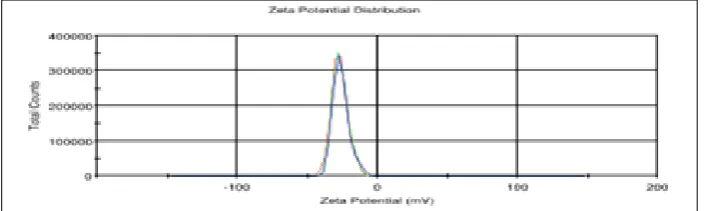
The zeta potential of the drug-loaded microspheres was measured on a zeta sizer (Malvern Instruments) by determining the electrophoretic mobility in a micro electrophoresis flow cell. All the samples were measured in water at 25°C in triplicate.
In-vitro release studies
The drug release rate from floating microspheres was carried out using the USP type II (Electro Lab.) dissolution paddle assembly. A weighed amount of floating microspheres equivalent to 100 mg drug were dispersed in 900 ml of 0.1 N HCI (pH=1.2) maintained at 37 ± 0.5°C and stirred at 55rpm. One ml sample was withdrawn at predetermined intervals and filtered and equal volume of dissolution medium was replaced in the vessel after each withdrawal to maintain sink condition. The collected samples analyzed spectrophotometrically at 266 nm to determine the concentration of drug present in the
dissolution medium27, 28.
Drug release kinetic data analysis
Several kinetic models have been proposed to describe the release characteristics of a drug from matrix. The following three equations are commonly used, because of their simplicity and applicability. Equation 1, the zero-order model equation (Plotted as cumulative percentage of drug released vs time); Equation 2, Higuchi’s square-root equation (Plotted as cumulative percentage of drug released vs square root of time); and Equation 3, the Korsemeyer-Peppas equation (Plotted as Log cumulative percentage of drug released vs Log time).
To study the release kinetics of Famotidinefrom the Floating microspheres the release data was fitted to these three equations
Zero order equation
When a graph of the cumulative percentage of the drug released from the matrix against time is plotted, zero order release is linear in such a plot, indicating that the release rate is independent of concentration.
Qt = k0.t ……… (1)
Where Qt is the percentage of drug released at time t and k0 is
the release rate constant;
First order equation
In (100-Qt) = In 100- kI.t ……….. (2)
Where kI is the release rate constant;
Higuchi’s equation (Wagner, 1969):-
Qt = kH.t1/2 ……….. (3)
Where KH is the Higuchi release rate constant
Korsemeyer-Peppas
The curves plotted may have different slopes, and hence it becomes difficult to exactly pin-point which curve follows perfect zero order release kinetics. Therefore, to confirm the kinetics of drug release, data were also analyzed using Korsemeyer’s equation.
Qt/Q∞ = kKP.tn
Where Qt/ Q∞ is the fraction of drug released at time t, kKPa
constant compromising the structural and geometric characteristics of the device and n is the release exponent. The slope of the linear curve gives the ‘n’ value. Peppas stated that the above equation could adequately describe the release of solutes from slabs, spheres, cylinders and discs, regardless of the release mechanism. The value of ‘n’ gives an indication of the release mechanism. When n = 1, the release rate is independent of time (typical zero order release / case II transport); n = 0.5 for Fickian release (diffusion/ case I transport); and when 0.5 < n < 1, anomalous (non-Fickian or coupled diffusion/ relaxation) are implicated. Lastly, when n > 1.0 super case II transport is apparent. ‘n’ is the slope
value of log Mt/M∞ versus log time curve29-31.
Stability studies for optimized formulation
The purpose of stability testing is to provide evidence on how the quality of a drug substance or drug product varies with time under the influence of a variety of environmental factors such as temperature, humidity and light and to establish a re-test period for the drug substance or a shelf life for drug product and recommended storage conditions. In general, a drug substance should be evaluated under storage condition (with appropriate tolerances) that test its thermal stability and if applicable, its sensitivity to moisture. Three types of storage conditions are used i.e. long term, Accelerated and where appropriate, Intermediate.
RESULTS AND DISCUSSION
The λ max of famotidine was found to be 266 nm by using U.V.
scattering angle of 90°.The results of measurement of mean particle size of optimized formulation F5 of floating microsphere was found to be 331.6 nm Fig. 3. Results of zeta potential of optimized formulation F4 of floating
microsphere was found -32.8 mV Fig. 4.
Figure 1 U.V. Spectra of Pure Drug (Famotidine)
Figure 2 Calibration Curve of Famotidine in 0.1 N HCl at 266 nm
Table 2 Percentage Yield for Different Formulation
Formulation Percentage Yield*
F1 65.58±0.45
F2 68.89±0.65
F3 63.23±0.25
F4 68.89±0.32
F5 73.32±0.14
F6 69.98±0.18
F7 68.78±0.74
F8 65.65±0.65
Table 3 Drug Entrapment for Different Formulations
Formulation Drug entrapment (% w/w) of prepared microsphere
F1 65.76±0.45
F2 69.98±0.23
F3 71.12±0.36
F4 65.56±0.56
F5 76.65±0.58
F6 69.98±0.74
F7 65.41±0.65
F8 62.23±0.41
*Average of three determination (n=3) Table 4 Percentage Buoyancy and Floating Lag Time of
Floating Microsphere
Formulation Floating Lag Time (Sec.) Percentage Buoyancy
F1 69±3 62.23±0.45
F2 78±4 60.25±0.65
F3 65±5 61.25±0.58
F4 98±6 65.58±0.41
F5 32±4 73.25±0.23
F6 49±2 62.23±0.25
F7 88±5 55.56±0.41
F8 98±6 65.45±0.32
Figure 3 Particle Size Data of Optimized Microsphere Formulation F5
The drug release from floating microspheres was found to be
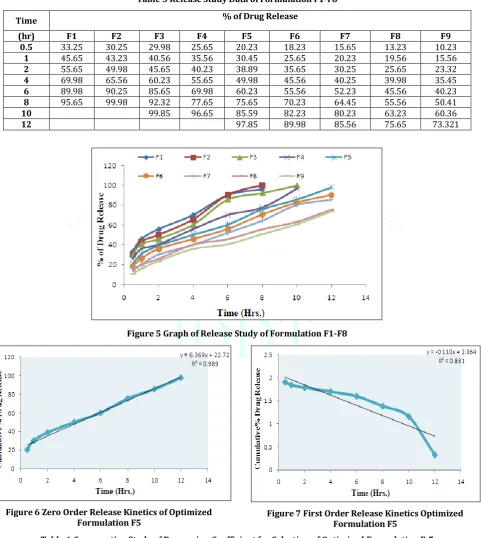
99.89% at the end of 12 h for F2 Table 5 & Fig. 5. The In vitro
drug release data of the optimized formulation was subjected to goodness of fit test by linear regression analysis according to zero order and first order kinetic equation, in order to determine the mechanism of drug release. When the regression coefficient values were compared, it was observed that an ‘r’ value of microsphere was maximum zero order i.e 0.989 hence indicating drug releases from
formulations was found to follow zero order for floating
microsphere. Table 6 and Fig.6 & 7. According to ICH guidelines, 3 months accelerated stability study at 40±2°C and 75±5% RH optimized formulations (F5) was carried out. It showed negligible change over time for parameters like appearance, drug content, dissolution and assay etc., No significant difference observed in the drug content between initial and formulations stored at 40±2°c & 75±5% RH for 3 months.
Table 5 Release Study Data of Formulation F1-F8
Time % of Drug Release
(hr) F1 F2 F3 F4 F5 F6 F7 F8 F9
0.5 33.25 30.25 29.98 25.65 20.23 18.23 15.65 13.23 10.23
1 45.65 43.23 40.56 35.56 30.45 25.65 20.23 19.56 15.56
2 55.65 49.98 45.65 40.23 38.89 35.65 30.25 25.65 23.32
4 69.98 65.56 60.23 55.65 49.98 45.56 40.25 39.98 35.45
6 89.98 90.25 85.65 69.98 60.23 55.56 52.23 45.56 40.23
8 95.65 99.98 92.32 77.65 75.65 70.23 64.45 55.56 50.41
10 99.85 96.65 85.59 82.23 80.23 63.23 60.36
12 97.85 89.98 85.56 75.65 73.321
Figure 5 Graph of Release Study of Formulation F1-F8
Figure 6 Zero Order Release Kinetics of Optimized
Formulation F5 Figure 7 First Order Release Kinetics Optimized Formulation F5
Table 6 Comparative Study of Regression Coefficient for Selection of Optimized Formulation F-5 Release
Kinetics Zero order First order
CONCLUSION
Floating microspheres of famotidine can be successfully prepared from sodium alginate by ionic gelation in combination with HPMC and EC for the purpose of gastroretentive drug delivery. On the basis of drug release, percentage yield, drug entrapment, percentage buoyancy and floating lag time F5 could be considered as promising formulations. Thus, the prepared floating microspheres may prove to be potential candidates for multiple-unit delivery devices adaptable to any intragastric condition.
ACKNOWLEDGMENTS
The authors would like to thank the Mr. Prabhat Kumar Jain, Geeta Parkhe and All supporting staff of Scan Research Laboratories, Bhopal (M.P.) who helped in the experiments during research work.
REFERENCES
1. Kaushik K, Chaurasia D, Chaurasia H, Mishra SK, Bhardwaj P. Development and characterization of floating alginate beads for gastroretentive drug delivery system. Acta Pharma Sci 2011; 53(4): 551-562.
2. Tadros MI. Controlled-release effervescent floating matrix tablets of ciprofloxacin hydrochloride: development, optimization and in vitro-in vivo evaluation in healthy human volunteers. Eur J Pharm Biopharm 2010; 74(2): 332-339. 3. Baumgartner S, Kristl J, Vrecer F, Vodopivec P, Zorko B.
Optimisation of floating matrix tablets and evaluation of their gastric residence time. Int J Pharm 2000; 195(1-2): 125-135. 4. Bulgarelli E, Forni F, Bernabei MT. Effect of matrix
composition and process conditions on casein-gelatin beads floating properties. Int J Pharm 2000; 198(2): 157-165. 5. Davoudi ET, Noordin MI, Kadivar A, Kamalidehghan B, Farjam
AS, Javar HA. Preparation and characterization of a gastric floating dosage form of capecitabine. Biomed Res Int 2013; doi: 10.1155/2013/495319.
6. Singh BN, Kim KH. Floating drug delivery systems: an approach to oral controlled drug delivery via gastric retention. J Control Release 2000; 63(3): 235-259.
7. Garg R, Gupta G. Progress in controlled gastroretentive delivery systems. Trop J Pharm Res 2008; 7(3): 1055-1066. 8. Chen J, Park K. Synthesis of fast-swelling, superporous sucrose
hydrogels. Carbohyd Polym 2000; 41(3): 259-268.
9. Shaikh R, Singh TRR, Garland MJ, Woolfson AD, Donnelly RF. Mucoadhesive drug delivery systems. J Pharm Bioallied Sci 2011; 3(1): 89-100.
10. Boddupalli BM, Mohammed ZNK, Nath RA, Banji D. Mucoadhesive drug delivery system: an overview. J Adv Pharm Technol Res 2010; 1(4): 381-387.
11. Kedzierewicz F, Thouvenot P, Lemut J, Etienne A, H offman M, Maincent P. Evaluation of peroral silicone dosage forms in hymans by gamma-scintigraphy. J Control Release 1999; 58(2): 195-205.
12. Rouge N, Allémann E, Gex-Fabry M, Balant L, Cole ET, Buri P, et al. Comparative pharmacokinetic study of a floating multiple-unit capsule, a high density multiple-multiple-unit capsule and an immediate-release tablet containing 25 mg atenolol. Pharm Acta Helv 1998; 73(2): 81-87.
13. Prajapati PH, Nakum VV, Patel CN. Formulation and evaluation of floating matrix tablet of stavudine. Int J Pharm Investig 2012; 2(2): 83-89.
14. Chaturvedi K, Umadevi S, Vaghani S. Floating matrix dosage form for propranolol hydrochloride based on gas formation technique: development and in vitro evaluation. Sci Pharm 2010; 78(4): 927-939.
15. Murata Y, Sasaki N, Miyamoto E, Kawashima S. U se of floating alginate gel beads for stomach-specific drug delivery. Eur J Pharm Biopharm 2000; 50(2): 221-226.
16. Jagtap YM, Bhujbal RK, Ranade AN, Ranpise NS. Effect of various polymers concentrations on physicochemical properties of floating microspheres. Indian J Pharm Sci 2012; 74(6): 512-520.
17. Jain AK, Jain CP, Tanwar YS, Naruka PS. Formulation, characterization and in vitro evaluation of floating microspheres of famotidine as a gastro retentive dosage form. Asian J Pharm 2009; 3(3): 222-226.
18. El-Kamel AH, Sokar MS, Al Gamal SS, Naggar VF. Preparation and evaluation of ketoprofen floating oral delivery system. Int J Pharm 2001; 220(1-2): 13-21.
19. El-Kamel AH, Sokar MS, Al Gamal SS, Naggar VF. Development of floating microspheres to improve oral bioavailability of cefpodoxime proxetil. Int J Pharma 2001; 220: 13-21. 20. Wakde PH, K asliwal RH, Mane SB. Design and fabrication of
gastroretentive bilayer floating tablet of propronolol HCl using natural polymer. Int J Pharm Sci Res 2013; 4(12): 4715-4728. 21. Pandya N, P andya M, Bhaskar VH. Preparation and in vitro
characterization of porous carrier-based glipizide floating microspheres for gastric delivery. J Young Pharm 2011; 3(2): 97-104.
22. Jagdale SC, Agavekar AJ, Pandya SV, Kuchekar BS, Chabukswar AR. Formulation and evaluation of gastroretentive drug delivery system of propranolol hydrochloride. AAPS PharmSciTech 2009; 10(3): 1071-1079.
23. Hussain MN, M asum MAA, Akhter S, Sharmin F, Reza MS. Formulation and evaluation of gastro retentive floating tablets of simvastatin using hydrophilic rate retardant. Bangladesh Pharm J 2012; 15(2): 119-126.
24. Al-Omar MA, Al-Mohizea AM. Famotidine, analytical profile. In: Brittain HG, editor. Profiles of drug substances, excipients and related methodology. Burlington: Academic Press; 2009, p. 115-151.
25. Muzib YI, Ch Rekha. Development and evaluation of mineral oil entrapped emulsion gel beads of famotidine. Int J Pharmacol Technol 2011; 3(2): 83-90.
26. Haznedar S, Dortunc B. Preparation and in vitro evaluation of eudragit microspheres containing acetazolamide. Int J Pharm 2004; 269(1): 131-140.
27. Tanwar Y S, Naruka P S, Ojha G R. Development and evaluation of floating microspheres of verapamil hydrochloride. Brazilian J Pharm Sci 2007; 43(4): 529-534. 28. Deepa MK, Karthikeyan M. Cefpodoxime Proxetil Floating
Microsphere: Formulation and In vitro Evaluation. Iran J Pharm Sci 2009; 5(2):69-72.
29. Brahamankar DM, Jaiswal SB. Biopharmaceutics and pharmacokinetics e a treatise, pharmacokinetics: basic consideration. 2nd ed. Vallabh Prakashan; 2009. pp. 240-3. 30. Higuchi T. Mechanism of sustained action medication,
theoretical analysis of rate of release of solid drugs dispersed in solid matrices. J Pharm Sci 1963; 52:1145-9.