California State University, San Bernardino California State University, San Bernardino
CSUSB ScholarWorks
CSUSB ScholarWorks
Theses Digitization Project John M. Pfau Library
1992
Sound and mathematics
Sound and mathematics
Nancy Jean Parham
Follow this and additional works at: https://scholarworks.lib.csusb.edu/etd-project Part of the Mathematics Commons
Recommended Citation Recommended Citation
Parham, Nancy Jean, "Sound and mathematics" (1992). Theses Digitization Project. 621. https://scholarworks.lib.csusb.edu/etd-project/621
SOUND AND MATHEMATICS
A Project
Presented to the
Faculty of
California State University,
San Bernardino
In Partial Fulfillment
of the Requirements for the Degree
Master of Arts
in
Mathematics
by
Nancy Jean Parham
SOUND AND MATHEMATICS
A Project
Presented to the
Faculty of
California State University,
San Bernardino
by
Nancy Jean Parham
June 1992
Approved by:
Susan Addington, Chair, Mathematics
Gar^ Gtiffrng",' llkthfematics
Lkll-L
Date
Ya^iha Karant, Information and Decision Science
ABSTRACT
This paper investigates the connection between sound and
mathematics. In particular, we study the vibrations of a plucked string, such as a guitar string, and of a hollow
cylinder fixed at both ends set in motion by striking its
surface. The investigation found the connection between sound
and mathematics to be the eigenvalue of the Laplacian
differential
operator
of
the
vibrating
object
which
corresponds to a particular solution to the wave equation.
The wave equation is a second order linear differential
equation 8^$ = cAf.
8t2
Using the eigenvalue A, the frequency is calculated by
f = -Tk 1211. The frequencies produced determine the notes on
a musical scale.
This project is dedicated to
my children Devon and Dustin,
and my loving husband Rick who took
a week off from work to do the laundry.
TABLE OF CONTENTS
Title page
i
Signature page
ii
Abstract iii
Dedication iv
Chapter 1
Introduction 1
§1.1 Derive the wave equation for the string 3
§1.2 Solutions to the wave equation 11
§1.3 Solution of the form § = X(x)T(t) 14
Chapter 2
§2.1 Solve the wave equation for the string fixed 16
at both ends
§2.2 Solve the wave equation for the string fixed 23
at one end
Chapter 3
§3.1 The wave equation in r' in cylindrical coordinates....26
§3.2 Solve the wave equation for the cylinder 30
INTRODUCTION
Tfti& will investigate the connection between musical sound and mathematics. I. first became interested in
the connection between sound and mathematics last summer while
making a set of wind chimes. The chimes #ete made of brass tubing, and the different lengths produced different sounds as
the tubes were struck. My investigation first led to the case
of the vibrating string. From properties of physics I Was
able to derive the wave equation. The wave equation is an equation in which many models of physical phenomena follow.
Any natural occurring property that involves periodic motion,
vibration and oscillation are properties that follow the wave
equation. Some example of waves are; the guitar string fixed at both ends and then plucked, the hollow cylinder's surface
struck with an object, seismic waves propagating beneath the
surface of the earth during an earthquake, or shock waves from a sonic boom produced from the space shuttle entering the earth•s atmosphere. This paper will cchsider models of the
first two situations, the fixed string and the cylinder. In
the case of the fixed string I wili ®xamin two cases, that
case of both ends fixed and then with only one end fixed. In
the case of the cylinder, I will consider both ends fixed.
Solutions of these three cases require the use of partial differential equations. From the solution to the partial differential equations, we can determine the frequencies of
musical scale that are produced.
Note; "model" means the mathematical approximation to
§1/1 DERIVE THE WAVE EQT^ FOR THE STRING
When a string is plucke<i/ the string and
produces sound we perceive as a musical tone v
physical phenomena in which waves are produced involves the
wave equation.
The wave equation is a second partial
differential equation 8?$ = c^8^$
♦ [7]
More generally,
02$ = c2 A$ where A is the Laplacian. In r', A =
,
and in R" A =E The following is a derivation of
'V'/Vv'" 5x.2 ■ ; ■
the wave equation from physical properties of the string.
Y-AXIS T.
X-AXIS
X (X +
The diagram depicts a string as it is set in motion. The
tension in the string is represented by T^ and T2f where Ty i
the force in the negative x direction, and
is the force in
the positive X direction. The mass M is the mass of the piece
of string between x and x+Ax.
We assume that Ax ie very
small.
where the acceleration is the second partial derivative of y
with respect to t, a = d£y. So F = ma is the net force.
3t2
Forces in the x direction cancel each other out since they are the same force in opposite .directions. This leaves the
remaining forces of T. and T,. If F = ma, then F = m d\
V .
at2
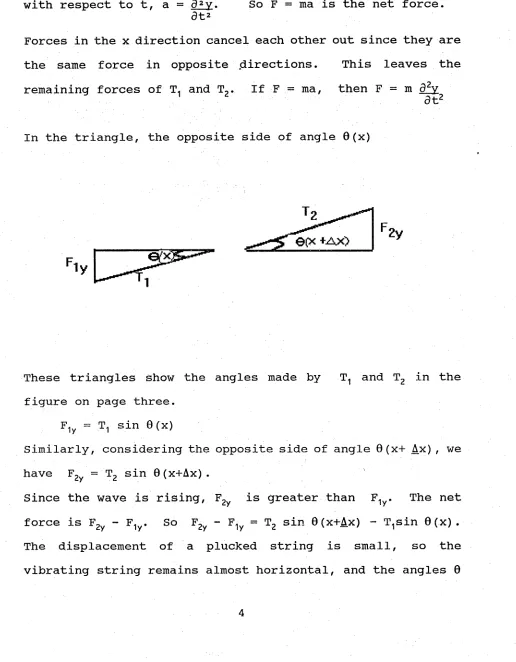
In the triangle, the opposite side of angle 0(x)
T
2y
e(x +Ax>
X
These triangles show the angles made by
T^ and Tg in the
figure on page three.
Fly =
sin 6(x)
Similarly, considering the opposite side of angle 0(x+ Ax), we
have Fjy = Tj sin 0(x+Ax).
since the wave is rising, Fgy is greater than F^y. The net
force is Fjy - F^y. So F^y - F^y = Tj sin 0(x+Ax) - T^sin 0(x).
The displacement of a plucked string is small, so the
are quite small. When the 0 is very small, the tangent of 0
is approximately equal to the sine of 0. (Estimate from the
Maclaurin series)
So Fjy - F^y = '^2
+Ax) -
sin 0(x)
« Tj tan 0(x+Ax) -
tan 0(x)
But
= Tj, since the tension in the string is the same at
as it is for Tj. Therefore;
Fjy - F^y = T(tan 0(x+Ax) - tan0(x)).
Recall that tan 0(x) is the slope of the tangent lines at x
and x+Ax, or the partial derivative dv ■ 3x
So the net force is
- F^^ = Tf dv
-
dv )[ dx dx)
at x+ Ax at X
But the net force is also F=ma, which is m d^v :
■ ■ . at2 ■ , therefore
- F^ ^ m d^,
2y
which implies
m d^v « Tf dv
-
dv )
3t2 I 3x 5x J
at x+Ax at x
Define u to equal the linear mass density, u = m . where m 1
is the mass of the whole string, and 1 is the length of the
string. So mass of a small piece of string is equal to u(Ax), where (Ax) is the length of a small piece of the string.
Therefore
u(Ax)d£y_ » Tf dv
-
dv 1
8t2 I dx dx J
at x+Ax at x
So d^v «Tf dv - dv 1
3t2 ul 5x dx )
at x+Ax at x
(4x)
Observe that in the limit we have the x derivative of dy.
dx
since Lim ffx+Ax) - ffx) is the derivative of the function
A-»o Ax
f=dv. which is the second partial of y with respect to x.
dx
We therefore have the wave equation where T/u is a positive
constant
d^v = T V. 8t2 u 5x2
We have just derived the wave equation using physical
properties. The wave equation has a constant T/u, which we
constant T/u becomes c^, where c is the speed of the wave. To
prove T/u = c^, we need some definitions .
Definition: The frequency f, is equal to the number of
vibrations per second, f = vib , where the units of the
sec
frequency are measured in hertz, Hz. The period P, is the
number of seconds per vibration, or P = 1 . The wave
f
length X is the length of one complete cycle of the wave.
I
A = wavelength
The speed of the wave is the distance the wave travels divided
by the time traveled.
Therefore, the wave speed c, is distance = X = X
time P 1
Suppose we have a traveling wave moving along the x-axis,
and at t = 0, the peak of the wave, f(x) is at x = 0. We
can describe the pulse at this mCment in time as the
displacement y as a function of position x.
y-axis
n
II
x-axfs
V,
;;:x=
We need a function that gives the same shape as but
moved to the right. At a later arbitrary time t, the of
the wave can be pictured as the following;
y-axis
"VM
x-axis
x=0
The pulse is moving at speed c. Therefore it has moved a
distance of ct. A function that represents this displacement with time t is f(x - ct). So whatever the shape of the wave f(x) describes, f(x - ct) describes the same shape but at a later time t. The peak of the wave of f(x) is at x = 0,
whereas the peak of the wave of f(x - ct) is at x = ct. An
example of such a wave at t = 0 is given by the equation
y = y^cos(27rx/A) where y is the vertical displacement
from the point of equilibrium, the maximum displacement or
amplitude is y^, and X is the wavelength.
x-axis
= wavelength
We need to describe the wave's position at time t. Replace x
by X - ct.
y = y^cos27r(x - ct)
Xy = y^jCos(27rx/A - 2nctlX)
c = fX implies = f
y = y^jCos(27rx/A - 27rft)
Let k = {2tt/X), where k equals the wave number. The
wave number describes the number of radians of a wave
Let (i) = 27rf.
Therefore we have y = y^jCosCkx - et) as a solution to our
equation, = T d^v
5t2 u 3x2
liote;
Y = yQCOs(kx + wt) is also a sblution; it is a wave
moving to the left along the x-axis. To relate the constant
T/u in the wave equation to the constants in a periodic
solution we substitute the cosine solution into the wave
equation: d^v = -yj,w2cos(kx - wt), d^v = -y k^cosCkx -ot)
3t2 3x2
then
32 V
T = 3t2
= -v_.e2cosfkx - <atV
u
32V
-yQk2cos(kx - (ot)
3x2■ ■■
T = 0)2 , But a - 2nf and k = 2n . so
u k2 X
XZjitXL = 47r2f2 __Ad_ = f2A,2 = c2.
u (2it/A.)2 4772
So the equation for the string that vibrates near the
point of equilibrium is 32y - c^d^v . where c =
3t2 3x2 sj u
If y = $(x,t) is a periodic solution then we have shown that
c is the wave speed. Recall that T is the tension in the
string and u is the linear mass density. Observe that as the
string becomes longer the wave speed slows, and as T grows the
string is tightened and the speed of the wave is faster.
§1.2 SOLUTIONS Tb THE
We now want to look at what types of functions satisfy
the wave equation. We will show equations of the form
y = f(x ± ct) are solutions to the wave equation/ where f is
any function of one variable. [12]
Since f is a function of
one variable it's derivitives can be defined as f and f'.
Let f, and fg be arbitrary functions.
Show that
y = f^(x - ct) is a solution to the wave
equation,
= c^d^v .
5t2 8x2
Find the first and second partials of y with respect to t and
">■* 8y = -cf. • (x - ct) .
82V = c2 f ' ' (x - ct)
and
8y = f/ (X
8x ■
82 V = f ' • 8x2
So ■ ■ 82 V = c2
, 3t2 8x2,/' ■
Therefore, y = f^ (x - ct) is a solution to the wave equation.
Show that
y = fgCx + ct) is a solution to the wave
8v = cfp' (X + ct)
8td^v =c2f-''(x + ct)
at2
and
8v = fp*(x + ct)
5xd^v = fp"(X + ct).
3x2
Again, d^v - c^ 32y .
3t2 3x2
Therefore, y = fjCx + ct) is a solution to the wave eguationv
Because the wave equation is a linear equation, any linear
combination y = A f^(x - ct) + B fgCx + ct) is also a solution
to the wave equation. Sine and cosine functions satisfy the
wave equation, but functions such as exponentials will also
satisfy the equation [2].
Show the wave equation has an exponential solution.
Let y = e"*e®*.
Then
3v = 3t
32V = (22 e^^e®^
3t2
3v = Be"^e®*
3x
32V = 62e«*e®*. 3x2
Substitute the second partials into the wave equation.
= c262
6 = ±a , So y = "■Vc-
= gat+ax/c
and
72=
Therefore y:, and yj are also solutions to the wave equation
but not physically realistic. There are other solutions to
the equation.
To find them all we need Fourier Analysis,
which is beyond the scope of this paper.
§1.3 SOLUTIONS OF THE FORM $ = X(x)T(t)
If we have a linear second order ordinary differential
equation with constant coefficients, we can easily find the
general solution.
If the solution a partial differential
equation can be represented as a product of independent
functions X(x)T(t), we can separate the functions and solve by
using general solutions from O.D.E. Assume that t(x,t) is a
solution of the form $ = X(x)T(t), where X is a function of
X, and T is a function of t.
= X'(x)T(t)
3$ = X(x)T'(t)
,;dx
■ ■ ■
dt
_ai§_ = X''(x)T(t)
_dli_ = X(x)T''(t)
ax2 at2
Plug the second partials into the wave equation.
XV'(x)T(t)= 1 X(X)T'•(t)
■ yVV C2
Divide both sides by § = X(x)T(t).
X''rx^Tft) = 1 Xfx^T''(t)
X^(^^
c2 X(x)T(t)
X"fx) = 1 T''ftV X(x) c2 T(t)
The left hand side is a function of x only, and the right hand
side is a function of t only. The on^^^^^
can happen is
if both sides are equal to a constants
This constant is
called the separation constant. Let the separation constant
be a negative number.
We use -^m— instead of m^ to insure
periodic solutions, and so that later boundary conditions will
be satisfied.
X''fx^ = 1 T''ft) = -in2 X(x) c2 T(t)
So X«'Cx^ = -m^ and 1 '(t) =
X(x) c2 T(t)
X''(X) = -in2X(x) and T''(t) = -m^c^TCt)
Both equations are second order ordinary differential
equations. Two independent solutions to X''(x) + in2X(x) = 0
are
=
sin(mx) and
^ cos(mx). Two independent solutions
to T''(t) + m2e2T(t) = 0 are §3 = sin(met) and
= cos(mct).
([2], page 114). Hence, setting X(x) = A sin(mx) + B cos(mx)
and T(t) = G sin(mct) + D cos(mct) a solution for the partial
differential equation is
§(x,t)=[A sin(mx) + B cos(mX)][C sin(mct) + D cos(mct)]
In chapter one we saw the derivation of the wave equation
using physical properties. Solutions that satisfy the wave
equation were calculated, and it was shown that arbitrary
functions f^, f2 of the form
y - f^ fx - ct) + f2(x + ct)
satisfy the wave equation.
In section three, it was
demonstrated that $(x,t) has solutions of the form
$ = X(x)T(t),
§2.1 SOLVE THE WAVE EQUATION FOR THE STRING FIXED AT BOTH ENDS
In chapter two, two cases for the vibrating string will
be solved. The first case is where the string is fixed at
both ends like that of a guitar or violin string. The second
case is that of a string fixed at one end and the other end is
allowed to travel up or down the line x = x^.
We need to
formulate boundary conditions that describe the physical
properties of the string.
These boundary conditions will
enable us to determine the constants A,B,C,D in the solution
§(x,t)=[A sin(mx) + B cos(mx)][C sin(mct) + D cos(mct)].
5-axis i(x.l)
x-axis x=o
This graph shows the position of the vibrating string at time
t, with the ends fixed at x=0 and x=L, with vertical axis
y - § arid horizontal axis x.
J -axis
Itx.t)
t2
13
x-axis x=o
This illustration shows the string fixed at both ends with
different values of f at x^ for different times t..
t-axis
I M I'U I I 1.^
11
This illustration shows the string's position at x^^ for
various times t..
Having the string fixed at both ends imposes boundary
conditions on the wave equation.
The boundary conditions are as follows;
B.C #1 §(0,t)=0 (This implies X(0)=0 V t e T)
B.C.#2 $(L,t)=0 (This implies X(L)=0 V t e T)
B.C.#3 $(x,0)=0 (This implies T(0)=0 V x e X)
B.C.#4
3$(x^.0)=v (For some Xjj e X, x^ =v, when t-0, where
dt V eR is the initial velocity of thepoint x^)
A node is a place in which the function is always zero.
Boundary conditions number one'states the function has a node,
at X =0, which implies the string is at rest. Boundary
condition number two states the length of the string is L,
and at thisi point is there is another node. Boundary condition number three states that at time zero the string is
at rest, and boundary condition number four states the
velocity of the string at a fixed point on the string at time
zero is a constant v.
Assume that §(x,t) is a solution of the form
# = X(x)T(t).
In section 1.3 we found a periodic solution
#(x,t) = [A sin(mx) + B cos(mx)][D sin(cmt) + E cos(cmt)].
Test the boundary conditions.
B.C. #1 §(0,t)=0 implies
[A sin(O) + B cos(0)][D sin(cmt) + E cos(cmt)] =0
B [D sin(cmt) + E cos(cmt)] = 0
Either B = 0 or [D sin(cmt) + E cos(cmt)] = 0 V t.
If [D sin(cmt) + E cos(cmt)] = 0 then D sin(cmt) = E cos(cmt),
which is a contradiction since the sine and the cosine cannot
be proportional, so D = E - 0. But this is the trivial wave,
therefore in a nonzero solution, B - 0.
So §(x,t) = A sin(mx) [D sin(cmt) + E cos(cmt)],
B.C. #2 §(L,t) =0 implies
A sin(mL) [D sin(cmt) + E cos(cmt)] = 0
Either A sin(mL) = 0 or D sin(cmt) + E cos(Gmt) = 0 V t.
If D sin(cmt) + E cos(cmt) =0 then, we have the trivial
wave again, therefore A sin(mL) =0.
A sin(mL) = 0 implies mL = kTT, k e Z
Hence m = k7r. L
So $(x,t) = A sin(k7rx/L) D sin(ck7rt/L) + E cos(ck7rt/L).
B.C. #3 f(x,0) = 0 implies,
A sin(k7rx/L) D sin(O) + E cos(O) =0
A sin(k7rx/L) E =0, therefore E = 0.
So §(x,t) = A sin(k7rx/L) D sin(ck7rt/L)
Let AD = G,
$(x,t) = G sin(k7rx/L) sin(ck7rt/L)
B.C. #4
_aj&(x ,0) = V
at
Find the derivative of $(x,t) at (x^, 0):
a§ = (GkTTc/L) sin(7rkx^/L) cos(O) = v
at(GkTTc/L) sin(7rkXQ/L) = v
G = vL
kTTC sinCTrkx^)
Therefore our solution under these boundary conditions is
$(x,t) = vL sinfTTkx/L) sinf7rkct/L)
kTTC sin(7rkx^)
Where V is velocity of the string at x^, L is the length of
the string, c is the wave speed, and k is an arbitrary
integer. We can rewrite the equation as
( vL sinf7rkx/L) sin(7rkct/L) V
dt21
kTTC sin(7rkx^),
J
=- fTTkcV^ VL sinfTrkx/LV sinf7rkct/Ll .
I L j
kTTc sin(7rkx^)
This has the form of an operator times a function, which
equals a constant times the same function. The solution $ is
an eigenfunction of the Laplacian L = d± with eigenvalue
5X2 ■-(7rk/L)2. The solution 4 is also an eigenfunction of the
operator 5i. with eigenvalue -(7rkc/L)2. The
3t2
eigenvalue is the negative of the square of the angular
frequency w, which is in radians per second. So w = Trkc/L. The regular frequency f, is in cycles per second, and there
are 27r radians per cycle. Therefore if we divide w by 2n we
get f = kc/2L. Hence the frequency that produces the sound
that is emitted from a vibrating string fixed at both ends is
kc/2L, where
k = 1,2,... As k runs through the integers an infinite number
of frequencies are produced. What we hear is combinations of
these frequencies.
Certain combinations are perceived as
noise, whereas other combinations are pleasant sounding and as music. So different frequencies produce different sounds, and
the higher the frequency the higher the pitch. This implies
by our kc/2L, that the higher the pitch the faster the wave
speed. Notice as L (the length of the string) gets larger,
the pitch will be lower.
Sound that we perceive as musical notes have their
frequencies in the following ratio form [13],
C D E F G A B G'
3 5 15 2
8 4 3 2 3 8
9 5 4
For example the note E, has a frequency 5/4 times that of the
note C, and F has a frequency 4/3 times that of C. The note
C' has twice the frequency of C.
Consider one octave on a piano.
D G A B
fl
9fi 5f^
4f, 3f^ 5f^
15f, 2f,
. 8 .;/■ /4..., 3 ■ : ■ 2 ■ ■ 3 V ' 8
There is no absolute standard of pitch.
The definition of
middle C, for example, has changed over the decades [13], but
the ratios defining a scale are determined by the wave
equation, as we shall see. Currently it is agreed that A has
a frequency of 440 hz. If the frequency of middle C = is
taken to be 264 hertz, then G is 396 hz, and C'=2f^ = 528 hz.
Also, as we go up an octave each of these ratios are in
the following form
Up one octave from f,,
D'=2(9f,)
E'=2(5f,)
F'=2(4f,)
8 . 4 ■ '•;- 3 ■ ,
D'•=22(9f,)
E''=22(5f,)
F''=22(4f,)
8 V-::/. '''
:
4
^
■ ■
3
-
'
D"•=2'(9f;)
E'"=2^(5fi)
F'"=22(4f,)
■ •\. /',A8-v .4 3.'Consider the frequencies that appear in the solution of
the wave equation. The corresponding notes are
=
Ifi - (the fundamental frequency)
Cj = 2f^ = (the first harmonic or overtone)
Gj
— 2(3/2)f^ = 3f^ (the second harmonic or overtone)
• C3 = 22f^ = 4f,
■
;
E3 = 22(5/4)f^ = 5fi
G3 = 22(3/2)f, = 6f,
. B3'' = 22(7/4)f, = 7f,
= 8f,
Recall f = kc/2L where k = 1,2,3.... This is what just came
out of our calculations. When a guitar string is plucked,
the sound is a combination of these notes. The fundamental
tone is the most prominent.
§2.2 SOLVE THE WAVE EQUATION FOR A STRING FIXED AT ONE END
We will now solve the wave equation for the string fixed
at one end, and allowed to move up and down the line $(x) =x^j.
()- axis
x-axis
x=o
X = L
Boundary Conditions,
B.C. #1 $(0,t) =0 (This implies X(0)=0 V t e T)
B.C. #2 ^(L,t)=0 (This implies that V t e T the slope dx of the string is zero at x = L)
B.C. #3 f(x,0)=0 (This implies that function is zero
at t=0)
B.C. #4
(x^.0)=v (This implies that the piece of the
3t string at x has velocity v at t=0)
Assume the solution to be of the form §(x,t)=X(x)T(t).
From previous work in section 1.3, a solution is
$(x,t)=[A sin(mx) + B cos(mx)][C sin(mct) + D cos(mct)].
Test the boundary conditions.
B.C. #1 $(0,t) = 0 implies
[A sin(O) + B cos(O)][C sin(mct) + D cos(met)] = 0
so either [A sin(O) + B cos(O)] = 0 or
[C sin(mct) + D cos(mct)] = 0, contradiction unless
C = D = 0 which implies the trivial solution. The trivial
solution is a flat wave which is not very interesting,
therefore B - 0. Our solution is
§(x,t)= A sin(mx) [C sin(met) + D cos(met)] B.C. #2 _dl_(L,t)=0 implies
dx
= Am sin(mL) (C sin(met) + D cos(met)) = 0,
5x
So either Am sin(mL) = 0 or C sin(met) + D cos(met) = 0, as
before contradiction unless C = D = 0, which is the trivial
wave, so Am sin(mL) = 0. Therefore m = 7rk/L where k e Z.
f(x,t) = ATTk/L sin(7rkx/L) (C sin(7rkct/L) + D cos(wkct/L))
B.C. #3 §(x,0)=0 implies
Avrk/L sin(7rkx/L) (C sin(O) + D cos(O)) =0. So D = p, and our
solution is
$(x,t) = ATTk/L sin(7rkx/L) C sin(7rkct/L). Let ACTrk/L = F;
then $(x,t) = F sin(7rkx/L) sin(7rkct/L)
B.C. #4
^ (x„,0) = V implies
at^(x ,0) = F sin(7rkx /L) 7rkc/L cos(O) - v
at
F sin(7rkx^/L) vrkc/L = v
which implies
F = vL/(7rkc sin(7rkx^/L))
So our solution for a string fixed at one end is
$(x,t)= vL sin(7rkx/L) sinfTrkct/P
TTkc sin(7rkx^/L)
As before our eigenvalue is -(Trkc/L)^, and our frequency is
kc/2L.
In chapter two we have seen the solutions for the string
fixed at both ends, and for the string fixed at one end. From
the particular solution an eigenvalue was found which was the
negative of the square of the angular frequency. From the
angular frequency the regular frequency was calculated by
dividing by 27r. The frequency could then be correlated to
notes on a musical scale which we perceive as pleasant sound.
§3.1 THE WAVE EQUATION IN IN CYLINDRICAL COORDINATES
In the previous sections we have worked with the wave
equation involving just x and t. To solve the wave equation
on the cylinder, we need the wave equation in three
dimensions,
3^$ + 3^$ + 3^$ = 1 3^$» Since we will be
3X2 3y2 3Z2 C23t2
solving the wave equation for the cylinder, it will be easier
to use cylindrical coordinates. We will now change the three dimensional wave equation from rectangular coordinates into
cylindrical coordinates. We will then solve the equation for
the cylinder. Change (x,y,z) to (r,0,z), where r^ = x^ + y2
and 6 - tan'^y/x) [4]. From the above information we can
derive the following partials.
3r = COS0 30 = -lsin0
3x 3x r
We will assume that $ is C^; that is all second partial exist
and are continuous. Therefore mixed partials are equal.
3$ — 3$ 3r + 3j^ 3j9 3x 3r 3x 30 3x
3j& = d§ 3r + 3^ 3^
3y
3r 3y
30 3y
3$ = 3$ 3z 3z
We want the second partial of §:
32$ = 3 f3^ 3r1 + d_{
30)
3x2 3xl0r 3xJ 3xl0r dxj
=d (d§]dr + d f dr]d§ + d 13$)36 + d f38V 3$
3xl3rJ dx
dxlSxj dr
dxldQl^x
dx^^
36
3fi cos6 + 3 (cos6)
+ 3f,^"1 sin6l + 3 f- 1 sin6l
dx
dx
dr
dx I r
1
3x1 r
J
where f, =^ and
f, = 3#.
■ ■ V ■■ 36r ■
=
3f, cos6 + 3fp f- 1 sin 61
(equation 1)
dx dx [ r
3 fI = 3 f3$1 3r + 3 f3$1 36
dx drldr) dx 36l3rJ dx
d fI = d^§ cos6 - 1 sin6 3^$
dx dr^ r 363r
3_fp = 3 f3$1 3r + 3 f3$1 36
dx 3rl36J dx 36136j 3x;
3_fp = 3^$ cos6 - 1 sin6 31$
dx 3r36 r 36^
Using equation 1, substitute
3 f, ahd 3 f,
V dx ' ■3x
3^$ = cos6(cos6 3^$ - lsin6 3l$ 1
3x2 I 3r2 r 363rJ
- 1 sin6 f3^$ cos6 - 1 sin6 3$ll
r
I3r36
r
362j
cos6 3_fcos6 3$ - 1 sin6 3$1
3rI
3r
r:
36j
1 sin6 i3fcos6 3^ - 1 sin6 3$1
t
36^^^^^^^
3r
r
36j
= COS0 fd£$ cos6 + 1 sin0 3§ - 1 sin0 di \
Id?
, rf;
30 r
0r00j
1 sin0 fd^l_ c6s0 - sin0 3$
1 cos0 3$ - 1 sin0 3$T
r l303r 3r r 30 r 30j
cos^0 3^$ + 1 sin0cos0 ^ - 1 sin0cos0 3i#_
3r^ 30 r 3r30
1 sln0cos0 3^$ + 1. sin^0 3$ -f 1 sin0cos0 3$
r
303r
r
3r
?
30
+ 1 sin^0 3f.
30
Therefore
3^$ = COS20 3^$ +2 sin0cos0 3$ - 2 sin0cos0
3x2 3r2 r^ 30 r 3r30
+ 1 sin20 ^ + 1 sin^0 d^§.
^ .
3r
r2
30^
A similar derivation shows that
32$ = sin20 32$ t 2 sin0cos0 32$
'■2 ' ...v ■ ,3r2 dddr ■
- 2 sin0cos0 3j|, + 1 COS20 3$ + i cos20 32$, ■' , ,/r2:'V ' - dd ■ . ;'r;,'-'> dr r^ 36^
Plug the partial derivatives into the wave equation
1 324 = 32# 4- 32# + 32$ ■„
C2 3t2 3x2 ^ 0y2 022
1 32$ = COS2 0 32$ + 2 sin0cos0 3$
c2 3t2 3r2 r^ 30
2 sin0cos0 3i$_ + 1 sin2 0 3ji + 1
r 3r30 r 3r r2 30^
+ sin20 02$ +2 sin0cos0 02$ - 2 sin0cos0 0$
0r2 r 000r r2 00
+ i COS20 0$^ + i COS20 02$ + 02$
r 0r r2 002 0z2
1, 02$ = cbs20 02$ + sin20 02$
C20t2 0r2 0r2
+ 02$
+ 1 sin^0 0^$ + 1 COS20 02$
r2 00^ 00^ 0z2
1 9^$
= 02$ (cos^0 + sin^0) + 1 ^$ (cos^0 + sin^0)
302
G20t2 0r
+ 1 ^ (cos^0 + sin^0) + 0^$
r 0r 0z2
1 02$ = 02$ + 1 ^$
+ 1 M + 0^$
C20t2 0r2 00^ r 0r 0z2
02$ + 1
Note: 1 0 (r 0$1
0$ + r 0^$
r 0rl 0rj 0r 0^r 0r2 r 0r
Therefore the wave equation in cylindrical coordinates is
1 0_(r 0$1 + 1 ^$
+ 0^$ = 1 0^$
r 0rl 0rj
r^ 00^
02^
c20t2
§3v2 S0l^E THE WAVE EQUATION
The case of the cylinder can be generalized from the case
of the vibratihg string. The string gscillates up an
in
a plane until eventually coming to rest at the point of
equilibrium. The restoring forces pull the string toward the
point of equilibrium.
Likewise, the cylinder vibrates
radially, as the restoring forces pull the wave back toward
the point of equilibrium which is the surface of the cylinder. The direction of vibration can be thought of as a normal
vector to the surface of the cylinder. We will assume that
both ends of the cylinder are clamped, which is analogous to
the string fixed at both ends.
Z-UIS
Z-H
T-illS
I-illS
In cylindrical coordinates the wave equation is
1 d_(r5§J + 1 $ + 8^$ = 3. 8^$
r 8rl 8rJ dz^ c^ dt^
The radius of the cylinder is a constant R and so all
derivatives with respect to r are zero; therefore, the first
term is zero. So our wave equation becomes.
802
1 3>* +di§ = 1 _d±i, where $ = §(0,z,t) a function
R2 302 3z2 c2 3t2
of three variables.
Boundary conditions;
1) f(0,z,O)=O (Implies the cylinder is initially at rest
V 0,z)
2) §(0,O,t)=O (Implies a node at the bottom of the cylinder
V 0,t)
3) $(0,H,t)=O (Implies a node at the top of the cylinder
V 0,t)
4) M = (eo,z„,0) = V
3tBoundary condition number one implies at time equal zero, the system is at rest. Conditions number two and three state that
there is a node at every point along the bottom of the
cylinder, and at every point along the top of the cylinder.
Recall the nodes are places on the wave where the function is
identically zero. Condition number four implies that at time
zero, the velbcity at a specific point on the cylinder 0^, z^,
is V.
Assume $ - $(0,z,t)=0(0)Z(z)T(t)
82$ = 0«'(0)Z(z)T(t)
82$ = 0(0)Z'•(z)T(t) ,
8z2
82$ = 0(0)Z(z)T''(t)
8t2
Substitute the partial derivatives into wave equation
1 0'•(0)Z(z)T(t)+0(0)Z"(z)T(t) = 1 0(0)Z(z)T'•(t)
R2 c2
1 0"(0)Z(z)T(t)+0(0)Z"(z) = 1 0(e)Z(z)TLLltl
R2 C2 T(t)
1 0''(0) + Z''fz^ =1 T''rt)
R2 0(0) Z(z) c2 T(t)
The left hand side is a function of 0 and Z, and the right
hand side is a function of T. Both sides are independent, so
they must equal a constant. Let the constant equal -m^.
1 T''ft) = -m2 implies T*'(t) + m^c^TCt) =0
c2 T(t)
T(t) = A sin(met) + B cos(mct)
Test boundary conditions #1.
Notice this is work from the one dimensional case.
B.C. #1 §(0,z,O) =0
T(O)0(0)Z(z) =0
T(0) = A sin(O) +B cos(O) which implies B=0.
so T(t) == A sin(mct)
Separate the left hand side.
1 0''f0) + Z''f z) = -m2 R2 0(0) Z(z)
1 0''f0) = -m2 - Z''(z)
R2 0(0) Z(z)
Again, both sides must be constant. Let the constant be -n2. 1 0"f0) = -n2 implies 0"(0) + n2R20(0) = o
R2 0(0)
So 0(0) = C sin(nR0) + D cos(nR0)
Z''fz) + m2 = -n2 implies
Z(z)
Z' * (z) + (m2 - n2)Z(z) =0 has a solution of the form
Z(z) = E sin(Vm2 - n2 z) + F cos(Vm2 ^ n2 z)
B.C. #2 §(6,0,t) =0
Z(0) = E sin(O) + F cos(O) = 0 implies F = 0
Z(z) = E sin(Vm2 - z)
B.C. # 3 $(0,H,t) = 0
Z(H) = E sin(Vm2 - n2 H) = 0
Let (Vm2 -n2)H = p7r 3peZ
Vm2 - n2 = gTT
H
ra = (p27r2 - /H
So Z(z) = E sin(p7rz/H)
Now T(t) = A sin(ct[p27r2
0(0) = C sin(nR0) + D cos(nR0)
Z(z) = E sin(p7rz/H)
§ = (C sin(nR0) + D cos(nR0))
• E sin(p7rz/H)' A sin(ct[p27r2
For solutions to be defined on the cylinder, nR
where j e Z. So n = j/R
Let G = EA.
$ = G(C sin(j0) + D c6s(j0))
• sin(p7rz/H) sin(ct[p27r2 - j /R2]
B.C. #4
dA (0^,z^,O) = V
at
a$ = G(C sin(j0 ) + D cos(j0 ))
at
•sin(p7rz^/H)• cos(O)' c(p^iT^ -
=v
V = Gc/H (C sin(j0jj) + D cos(j0jj))
• sin(p7rZjj/H)• (p^yr^
G = V
abed
a = (p27r2 - j2H2/R2)''''2/H
b= sin(pttz^j/H)
d= C sin(j0jj) + D cos(j0g).
Therefore the solution, subject to these boundary conditions
is
$ = V rc sinfi0) + D cosM0)1 sinfP7rz/H) sinfact)
abed
Using a trig identity, let
C sin(j0) + D cos(j0) = VC2 + D2 sin(j0 - $) where tan$ = D/C,
and
C sin(j0Q) + D cos(j0^j) = VC2 + D2 sin(j0Q - i)
oTherefore
4 = V fVC2 + D2)sin(i0/ - g) sin(P7rz/H^ sinfact)
a c b (VC2 + D)sin(j0^ - $)
§ — V sinM0 - E) sinfPTTz/H) sinfact^ .
cb sin(j0^ - $)
Therefore replacing a and b our solution becomes
$ = vH sinM0 -
sinfPTTz/H) sin(ct(02712- i2^2/Rz)Y^/h)
♦
c sin(p7rz^/H) sin(j0|j - i) (p27r2-j2H2/R2)
Where R and H are the radius and the height of the cylinder
respectively, c is the wave speed, v is the initial velocity
of a point on the cylinder of the wave, and p and j are
integers. The solution f is an eigenfunction of the Laplacian
and also an eigenfunction of with eigenvalue
■ -■ ■ ■ dt^
-c2 ^ /R^)• The frequency can be calculated as before.
■ ■H2
It can be seen from the particular solution, that the radius
and height of the cylinder have an effect on the sound. If
the cylinder is shortened the pitch will become higher, and if
the radius is widened the pitch will become lower.
In conclusion, a connection between sound and mathematics
is the eigenvalue of a particular solution for a second order
partial differential equation. Once the eigenvalue is khown,
the angular frequency and then the regular frequency can be
calculated for the wave. The frequency then corresponds to a
note from the musical scale, and we perceive these frequencies
as music. If we were to observe the frequency on an
oscilloscope, which breaks down the frequency by components,
we would see the different waves which makes up the harmonics.
REFERENCES
[1]
■
Bleistein, nV, Mathematical Methods for Wave Phenomena,
Academic Press, 1984
[2] Boyce, W., & DiPrima, R., Elementary Differential
Equations, Wiley, 1986
[3] Braun, M., Differential Equations and Their
Applications, Springer-Verlang, 1975
[4] Chisholm, J.SrMathematical Methods in Phi^sics, W.B.
Saunders Co. 1966
[5] Coulson; C.A'7' Waves,j ^
[6] Crhndall, I., Theory of vibrating systems and sound. Van
Nostrand Co., 1926[7] Feynman, R., The Feyriman Lectures on Physics, Addison-^
"V'-'
■; ■ ■ wesley,. \i963 ^/'y' : :■ ■
[8] Friedlander, F.G., The Wave Equation on a curved
space-time, Cambridge University Press, 1975[9]
Kane, J., Physics., Wiley, 1978
[10] Kibble, T.W.B.: Classical Mechanics, McGraw Hill, 1973
[11] Lindsay, R., Physical Mechanics, Van nostrand Co., 1933
[12] Pain, H.J.: Physics of Vibrations and Waves, Wiley &
Sons, 1968[13] Rayleigh, J.W.S., The Theory of Sound, Macmillan Co.,
1878[14] Strang, G^, intirciductidn to Applied Mathematics,
Wellesley-Cambridge Press, 1986[15] Weinberger, H.F., Partial Differential Equations,
Blaisdell, 1965
[16] Wolfson, Richard: Physics, Little Brown & Co., 1987