Routing Optimization for Server-Centric Data Center
Networks
Huanzhao Wang1,2, Kun Qian1, ChengChen Hu1, Che Zhang1, and Yadong Zhou1
1 Department of Computer Science and Technology, Xian Jiaotong University
710049 Xian, China
{hzhwang, chengchenhu, ydzhou}@mail.xjtu.edu.cn [email protected]
2
Science and Technology on Information Transmission and Dissemination in Communication Networks Laboratory
Shijiazhuang 050081, China [email protected]
Abstract. Server-centric data center architecture has been proposed to provide high throughput, scalable construction and error tolerance with commodity servers and switches for cloud data centers. To fully utilize those advantages of server-centric data center, an effective routing algorithm to find high quality multiple paths in Server-centric network is needed. However, current routing algorithms cannot achieve this completely: 1) the state-of-art routing algorithms in server-centric data center just consider hop count when selecting paths; 2) traditional multi-constraint QoS routing algorithms only find one feasible path and are usually switch-oriented; 3) present multi-path algorithms cannot guarantee the performance of the founded paths. In this paper, we propose a multi-constrained routing algorithm for server-centric data centers, named Server-Centric Multi-Constrained Routing Algorithm (SCRAT). This algorithm exploits the topology features of the Server-Centric data center to decrease the algorithm complexity and returns optimal and feasible paths simultaneously. In simulations, SCRAT has a very high probability (more than 96%) to find the exact optimal path, and the cost of the optimal path found in SCRAT is about 10% less compared with path found in previous TS MCOP. Compared with previous MPTCP, SCRAT reduces the path delay by 18% less and increase the band-width by 20%.
Keywords:server-centric, data center, routing optimization.
1.
Introduction
routing inside a data center becomes one of the essential and challenging parts of DCN due to the following two reasons. First, the traffic exchanges among the servers in a data center dominates the traffic of a data center. A recent measurement reported the ratio of traffic volume between servers inside a data center to the traffic entering/leaving the data center to be 4:1 [11]. Second, the scale of the data center grows really fast and it is expected to hold hundreds of thousands of servers in a single data center. In order to interconnect such a large number of servers with commodity switches and servers, Server-Centric Data Center (SCDC) is proposed [13, 15]. In SCDC servers are equipped with multiple network interfaces and act not only as end hosts but also as relay switches for multi-hop communications. Although SCDC achieves architectural advantages, its routing algorithms contain limitations. First, state-of-art routing algorithms for SCDC are topology dependent. A specific routing algorithm is only designed for the specific topology (called original routing algorithm).Data center operators have adopted many different network topologies [22] (e.g., folded Clos, FatTrees, VL2, DCell, BCube and so on) [1, 12, 14, 16, 24]. For example, the original routing algorithm for DCell cannot work on other SCDC topologies like BCube. Second, all the original routing algorithms use hop count as routing metric. Without taking path quality into consideration, routing algorithms cannot guarantee satisfied performance for diverse applications in DCNs.
To effectively utilize high performance routing path, general multi-constrained QoS routing algorithms are widely investigated in the context of traditional network, which control traffic of the whole network by adjusting the number of flows through routers and switches, e.g., Multi-Constrained Path problem (MCP) [22], Multi-Constrained Shortest Path (MCSP) [28], Multi-Constrained Optimal Path problem (MCOP) [7], etc. However, all these solutions only calculate one path for an original destination pair and only focus on routings for routers. In addition, these algorithms originally designed for arbitrary topology and no optimizations are considered leveraging the topology characteristics of SCDC. In fact, the performance of the network routing can be significantly improved by exploiting the unique features of SCDC.
In order to overcome the aforementioned limitations and fully utilize multiple paths in SCDC, this paper aims to solve the so-called Multi-Constrained Multi-Path Problem (MCMP), which finds out an optimal path and other sub-optimal paths for routing under multi-constraints. To the best of our knowledge, it is the first time to introduce this prob-lem in the context of SCDC to find optimal routing paths, which is different from finding only multiple paths in DCNs done by previous work. In this paper, we propose Server-Centric Multi-Constrained Routing AlgoriThm (SCRAT) to solve the MCMP problem, which finds feasible paths from source to destination under multi-constraints simultane-ously. We utilize the characteristics of SCDC to decrease the complexity of algorithm and propose a specific Multi-Constrained QoS Routing method to weight the cost of links in searching optional paths. Simulations have demonstrated that SCRAT performs much better than original routing algorithm in SCDC.
Specifically, the proposed SCRAT has the following technical merits.
Second, we take topology characteristics of SCDC into consideration when we de-sign SCRAT. As a result, SCRAT makes the relaxation progress more efficiently and decreases the complexity of algorithm and increases the algorithm’s accuracy. Compared with present MCOP algorithms that ignore the characteristics of SCDC, SCRAT has a better performance to find the global optimal paths.
Third, SCRAT is a general method for SCDC and can be employed for all the SCDCs topologies, which is an advance over the original SCDC routing algorithms only working for a specific topology.
The rest of this paper is organized as follows. Section 2 overviews existing routing algorithms in Server-Centric network and Multi-Constrained algorithms. Section 3 works out the way to calculate weight vector and cost, and lists some definitions that will be used in this paper. Section 4 describes our SCRAT. Section 5 gives two sets of simulations to evaluate the performance of algorithm. Finally, Section 6 concludes the paper.
2.
Related Work
Server-Centric Data Center Network is widely researched around the world. In [2], au-thors mentioned 5 main disadvantages in traditional data center network, such as no per-formance isolation, limited management flexibility etc. And the solutions to all of those issues are crucial to the future development of data center. In order to overcome them, many new network architectures had been proposed along with high efficient routing algo-rithms. For example: BCube original routing algorithm assigns server addresses according to their position characteristics. This algorithm systematically finds intermediate servers by ‘correcting’ one digit of previous server address [15]. However, as mentioned before, original server-centric algorithm only works well in unique architecture and almost all of those initial algorithms choose the path according to hop count. Some researches have been done on routing in all kinds of DCs to provide multi-paths [23, 27]. However, in [27] the first way is spreading load by choosing path randomly. It is obviously not an effective solution. The article also mentioned another way to find multi-paths using multi-static VLANs. The minimal number of VLANs of this solution exponentially depends on the number of equipment in data center. Setting too much VLANs in data center is very ex-pensive. In [23], the multi-path selecting algorithm in SPAIN is running the shortest path algorithm for k times. However, computing shortest paths just consider the hop-count constraint, which cannot ensure good performance of chosen paths. And in the process of repeating shortest algorithm for several times, a large amount of computations are unnec-essary. Multi-path routing algorithm can be designed in a much more efficient way.
problem appealed many people’s attention. There are several algorithms improving the performance of H MCOP, such as TS MCOP [8], and EH MCOP [30]. The TS MCOP was proposed [8], which improved H MCOP best. Those algorithms work well in finding optimal path. But they do not provide multi-paths. So they cannot be used directly in the context of Server-Centric Network.
In all, present multi-path algorithms in data center are not efficient. And all general multi-constrained routing algorithms do not consider topology characteristics in SCDC and can only provide one feasible path. Neither of them can solve the MCMP problem, which is fairly significant for the performance of SCDC. So we propose a new routing algorithm to solve it.
3.
Foundation And Definitions
3.1. Weight and Cost
According to the different characteristics and properties of constraints, they can be divided into the following three categories [10]: additive constraint (e.g. delay, jitter, cost and hop count) multiplicative constraint, (e.g. link reliability and packet loss probability) and concave constraint (e.g. bandwidth). Assume pathP hasjhops andwi(e)means theith weight of edgee. According to the constraints, we proposed the following functions to compute weights of a path:
Additive constraint The weight of additive constraint is represented by summing every link’s weight together, shown in (1).
wi(P) = j X
l=1
wi(el) (1)
whereiis the serial number of all additive constraints.
Multiplicative constraint By converting logarithm form of multiplicative constraints to additive constraints , the weight can be calculated with (2)
wi(P) = j Y
l=1
wi(el) =e (
n P
l=1
ln[wi(el)])
(2)
whereiis the serial number of all multiplicative constraints.
Concave constraint concave constraints mark the limit of path, and can be directly used as boundaries for selecting paths. So, (3) is used to calculate those concave weights.
wi(P) =min{wi(e1), wi(e2), ..., wi(ej)} (3)
In order to calculate various constraints in one function, Jaffe [19] used the linear cost function to represent the cost of path, shown in (4)
COST(P) =
k X
i=1
diwi(P) (4)
whereCOST(P)indicates the cost of pathP anddiis the coefficient ofwi.
This representing method can be used to calculate the cost of path for Dijkstra Al-gorithm, which are utilized by many former routing algorithms. However, linear function cannot reflect the real constraints very well. In order to fit actual constraints better, non-linear function (5) was proposed to calculate the cost of path [6].
COST(P) = [
k X
i=1
[wi
ci
]
q
]
1
q
(5)
whenq→ ∞
COST∞(P) = max
1≤i≤k[ wi(P)
Ci
] (6)
By (6), we can precisely find out all feasible paths that meet the multi-constrained re-quirements. If we use (6) to calculate the cost of paths, Dijkstra algorithm is not suitable any more. So we need to work out an algorithm that can calculate cost with nonlinear function.
3.2. Definitions
Definition 1 Server-Centric Data Center: in server-centric data center, servers act not only as end hosts but also as relay nodes for multi-hop communications. [4] In SCDC, there are links that connect servers directly and there is no traditional hierarchic switch structure, which may cause bottleneck in whole network. In SCDC each server links to several, not one, servers or switches, which balances the load of overall network greatly.
Definition 2 Feasible Path: given a weighted network graphG(V, E), whereV represents the set of nodes andE represents the set of edges,n = |V|andm = |E|. Each edge e(vi, vj) has a link weight vectorW with components of K link weightwk ≥ 0 for all1 ≤ k ≤ K. And the corresponding constraint vector C withK constraintsck. A path is a sequence with non-repeated nodesP = (v1, v2, ..., vi). Since there are different types of constraints, simply adding weights together is unreasonable. A feasible pathP = (v1, v2, ..., vi)so thatwk(P)≤ckfor all1≤k≤K.
Definition 3 Optimal path: in all feasible paths fromvi tovj noting asP1, P2, ..., Pl, we use (5) to calculate the cost of paths. Then the optimal path is the pathP0 satisfied: COST(P0)≤COST(Pi)for all1≤i≤l.
ss
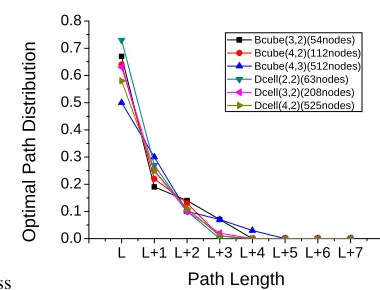
L L + 1 L + 2 L + 3 L + 4 L + 5 L + 6 L + 7 0 . 0
0 . 1 0 . 2 0 . 3 0 . 4 0 . 5 0 . 6 0 . 7 0 . 8
O p ti m a l P a th D is tr ib u ti o n
P a t h L e n g t h
B c u b e ( 3 , 2 ) ( 5 4 n o d e s ) B c u b e ( 4 , 2 ) ( 1 1 2 n o d e s ) B c u b e ( 4 , 3 ) ( 5 1 2 n o d e s ) D c e l l ( 2 , 2 ) ( 6 3 n o d e s ) D c e l l ( 3 , 2 ) ( 2 0 8 n o d e s ) D c e l l ( 4 , 2 ) ( 5 2 5 n o d e s )
Fig. 1.The distribution of optimal path’s path-length in SCDC.
Definition 5 Neighbor node matrix: in a Server-Centric network withN servers, the neighbor node matrix is aN2matrixM1. Each elementv
i,jinM1contains hop count, weight vector and cost of the neighbor node path that linksvi andvj together. Ifviand vj are neighbor node pair, we note down hop count, weight vector and cost invi,j. If vi andvj are not neighbor node pair, we note 0 invi,j. Ifvi andvj connect directly, hop count= 1. Ifviandvjare connected by a switch, thenhop count= 2.
Definition 6 Path-length: in this paper, ifviandvjare neighbor node pair, we define the path-length of path(vi, vj)to be 1. Ifviandvjare neighbor node pair andvjandvkare neighbor node pair, then there is a path(vi, vj, vk)between(vi, vk), and the path-length of this path is 2. Paths with path-length 3, 4 and so on can be defined similarly.
4.
Algorithm Design
In SCDC, all switches are connected to servers directly. If two servers are neighbor node pair but do not connect directly, it is easy to figure out the intermediate switch’s ID through the IDs of those two servers. This kind of topology characteristic offers us great favor to simplify our searching strategy. So when designing routing algorithm in Server-Centric network, we should pay more attention on servers instead of switches and find an efficient way to route by servers. If we fully employ the topology characteristic in SCDC, the routing algorithm can be simplified and more efficient.
ss
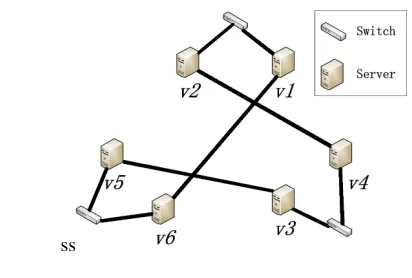
Fig. 2.DCell(2,1)
the path-length of shortest path, it owns fairly low prolixity to become optimal path. This feature guides us to work out a routing algorithm based on the increase of path-length, which is more efficient for SCDC network.
4.1. Algorithm Description
The basic idea of SCRAT is using paths of path-length 1 and paths of path-lengthNto find paths of path-lengthN+ 1. SCRAT takes advantage of the fundamental idea of Warshall algorithm to search alternative paths in network. Warshall algorithm is a high-efficiency algorithm to work out the transitive closure of binary relation. However, this algorithm itself can only judge the connectivity of any two nodes in a network, and the complexity of this algorithm is high. In our design, all feasible paths are stored while searching in the graph and the time complexity is decreased successfully by applying the topology characteristics of SCDC.
In order to make the algorithm easily to understand, firstly we use a small network as an example to depict it. In Figure 2, we build a small DCell model (n=2,k=1) as an exam-ple. There are six severs and three switches in this network. And we use four constraints
[c1, c2, c3, c4], in whichc1, c2are additive constraints (e.g. hop count; delay);c3is multi-plicative constraint(e.g. link reliability) andc4is concave constraint (e.g. bandwidth). So there are four corresponding weights for any pathP. We note the weight vector ofPas
WP = [w1(P), w2(P), w3(P), w4(P)] T
(7)
Considering any two serversvi, vj(1≤i≤6,1 ≤j ≤6), if(vi, vj)is neighbor node pair, then we can calculate the cost of this path with (5). Then we store hop count and other related information (RI): weight vector and cost value invi,j ofM1. The result is shown in TABLE I (a).
Table 1.
(a) Neighbor Node Matrix M1 v1 v2 v3 v4 v5 v6
v1 0 RI2 0 0 0 RI1
v2 RI2 0 0 RI1 0 0
v3 0 0 0 RI2 RI1 0
v4 0 RI1 2
RI 0 0 0
v5 0 0 RI1 0 0 RI2
v6 RI1 0 0 0 RI2 0
(b) Path-Length 2 Matrix
M2 v1 v2 v3 v4 v5 v6 v1 0 0 0 3RIv2 3RIv6 0 v2 0 0 3RIv4 0 0 3RIv1 v3 0 3RIv4 0 0 0 3RIv5 v4 3RIv2 0 0 0
3v3
RI 0
v5 3RIv6 0 0 3RIv3 0 0 v6 0 3RIv1 3RIv5 0 0 0 whereRI(related information) contains weight vector and cost value.
the two paths using (1) (2) (3), then calculate cost by (5). Here we use path(v1, v2, v4) as an example. First two constraintsc1, c2are additive constraints, so we choose (1) to compute the weights of first two constraints. So
w1(v1, v2, v4) =w1(v1, v2) +w1(v2, v4) (8)
w2(v1, v2, v4) =w2(v1, v2) +w2(v2, v4) (9) The third constraintc3is multiplicative constraint, so corresponding weightw3(P) should use (2) to compute:
w3(v1, v2, v4) =eln(w3(v1,v2))+ln(w3(w2,w4)) (10)
Forth constraint is concave constraint, use (3) to calculate the corresponding weight:
w4(v1, v2, v4) =min{w4(v1, v2), w4(v2, v4)} (11)
The weight vector of path(v1, v2, v4)can be present in the following form:
W(v1,v2,v4)= [w1(v1v2v4), w2(v1v2v4), w3(v1v2v4), w4(v1v2v4)]
T
(12) Comparing this weight vector with constraints, if all weights meet multi-constrained requirements, we compute the cost of this path:
COST(v1,v2,v4)={
4 X
i=1
[wi(v1, v2, v4)
ci
]
q }
1
q
(13)
If any weight of this path excesses the required limitation, we drop this path off. Because all weights are increasing with the increase of hop count, so if a pathPicannot meet multi-constrained requirement, any other path with a sub-pathPialso cannot meet requirement, too.
In a similar fashion, with the information fromM1andM2, we can buildM3. Then M4, M5,...,Mxcan be built. Wherexindicates the maximum number of path-length that is limited by the QoS requirements. Since the topology of SCDC is very efficient,xis always a small number. For example, in BCube,xcan be set asl+ 1(lis the port number
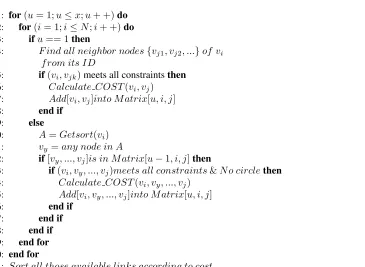
SCRAT
1: for(u= 1;u≤x;u+ +)do
2: for(i= 1;i≤N;i+ +)do
3: ifu== 1then
4: F ind all neighbor nodes{vj1, vj2, ...}of vi f rom its ID
5: if(vi, vjk)meets all constraintsthen 6: Calculate COST(vi, vj) 7: Add[vi, vj]into M atrix[u, i, j] 8: end if
9: else
10: A=Getsort(vi) 11: vy=any node in A
12: if[vy, ..., vj]is in M atrix[u−1, i, j]then
13: if(vi, vy, ..., vj)meets all constraints&N o circlethen 14: Calculate COST(vi, vy, ..., vj)
15: Add[vi, vy, ..., vj]into M atrix[u, i, j] 16: end if
17: end if
18: end if
19: end for
20: end for
21: Sort all those available links according to cost
Fig. 3.Server-Centric Multi-Constrained Routing Algorithm pseudo-code.
of a server). All feasible paths between any two servers are available from those tables. We sort them according to their cost, then we can find the optimal path and other alternative paths as well.
The general algorithm is shown in Figure 3. In the algorithm,M atrix[u, i, j]records all paths and their weigh vectors and costs fromvitovjwith path-length u. The loop in first line is to search all paths with path-length less than x. The10thline is to pick up all neighbor nodes ofvi.6thand14thlines are calculating the cost of paths using (5).21th
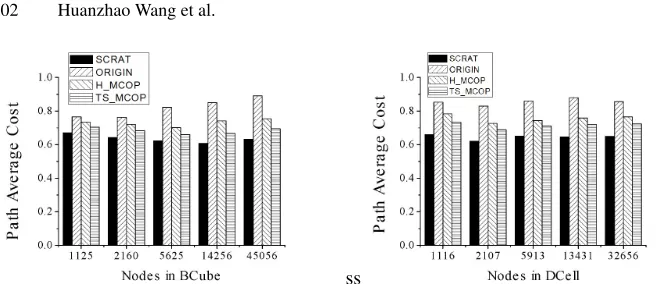
(a) BCube scale increases from 1125nodes (BCube(5,3)) to 45056 nodes (BCube(4,6))
ss
(b) DCell scale increases from 1116nodes (DCell(5,2)) to 32656 nodes (DCell(3,3))
Fig. 4.The average cost of optimal path selected by different algorithms in different scale of BCube and DCell.
4.2. Complexity of Algorithm
SCRAT is an all-to-all routing algorithm. Time complexity of SCRAT isO((k−1)xN), whereN represents the number of servers;krepresents the number of ports on a server andxindicates the given max limitation of path-length. Bothkandxare small constants compared withN. The searching cost of prior one matrix isN2. AllM2,M3,...,M
xmatrix needed to be calculated, so we need to repeatx−1times. And for each possible path, we need to check all its neighbors, the cost isk−1. In any matrixMi, for any two nodes, the average number of possible paths is less than(k−1)i−1/N. So the total complexity is Px
i=2k(k−1)
i−1N≤k[(k−1)x−(k−1)]/(k−2)∗N=O((k−1)xN). Meanwhile we need a matrix when we store all paths in each path-length. So the spatial complexity of SCRAT isO(x∗N2).
4.3. Proof of Optimality
In this part, we will prove that if there exists an optimal path satisfying the multi-constrained requirements, SCRAT can guarantee to find it.
Assume that the source server isvi, and the destination server isvj. And there is an op-timal path meeting multi-constrained requirements, noting it as(vi, vm1, vm2, ..., vmn, vj). So this optimal path’s sub-paths(vm1, vm2, ..., vmn, vj),(vm2, ..., vmn, vj),(vm3, ..., vmn, vj),...,(vmn, vj)all meet the multi-constrained requirements. Then node pairs(vi, vm1),
(vm1, vm2),...,(vmn, vj)are all in neighbor node matrixM1. For the reason that(vm,n−1, vmn)and(vmn, vj)are inM1,(vm,n−1, vmn, vj)is inM2. Due to(vm,n−2, vm,n−1)is in M1,(vm,n−2, vm,n−1, vmn, vj) is in M3. And so on in a similar fashion, the path
Table 2.
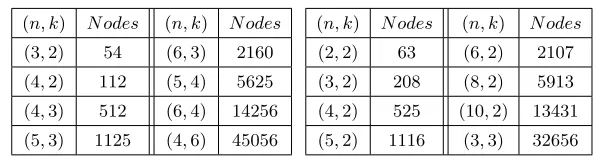
(a) BCube(n,k) Nodes Number (n, k) N odes (n, k) N odes
(3,2) 54 (6,3) 2160
(4,2) 112 (5,4) 5625
(4,3) 512 (6,4) 14256
(5,3) 1125 (4,6) 45056
(b) DCell(n,k) Nodes Number (n, k) N odes (n, k) N odes
(2,2) 63 (6,2) 2107
(3,2) 208 (8,2) 5913
(4,2) 525 (10,2) 13431
(5,2) 1116 (3,3) 32656
5.
Simulation
5.1. Simulation Settings
In simulations, we take most widely researched and used SCDC topologies: BCube [13] and DCell [15] as our architectures. The algorithms’ performances in other SCDCs are similar. The scale of those two types of topologies is shown in TABLE II. Four metrics are selected as multi-constraints: hop count, delay, package loss probability and bandwidth. The hop count between any two servers is fixed due to the structure of network. The bandwidth of all links in topologies are 1Gb. The initial values of other three metrics are assigned randomly. Specifically the original values of delay, containing waiting time in node and transforming time on link, obey uniform distribution in the interval(0,200)us. Values of package loss probability obey uniform distribution in the interval(0%,5%). The initial values of used bandwidth obey uniform distribution in the interval(0,0.6)Gb. The constrains generate by1.5wk(p), wherepis the shortest path from source to destination [21]. In each simulation, source and destination are selected randomly and each simulation is repeated for 500 times.
We build two sets of simulations to evaluate the performance of SCRAT. The first set of simulations are to evaluate the quality of the optimal path in SMCMRA. Although SCRAT is a multi-path algorithm, it is also quite important to guarantee the selected optimal path has a high quality. And the second set of simulations are to evaluate the performance of selected multi-paths in SCRAT.
5.2. Simulation Results
– Optimal Path Simulations
Average Path Cost The first simulation compares the optimal path found in SCRAT with the original algorithm, TS MCOP and H MCOP. We run each algorithm on different scales of BCube and DCell respectively. And we calculate the cost of path selected in original algorithms, so we can compare them directly. Figure 4 shows the average cost of optimal path found in different algorithms. In those two figures, SCRAT can decrease path cost about 10% compared with TS MCOP.
ss
Fig. 5.Optimality is the probability that one algorithm find the exact optimal path under multi-constraint. Because finding the exact optimal path under multi-constraint is an NP problem, we just calculate the exact optimal path in small scale of BCube and DCell.
(a) BCube(6,4) 14256 nodes (b) DCell(10,2) 13431 nodes
Fig. 6. The delay in DCell and BCube using multi-paths computed by SCRAT and MPTCP respectively.
NP problem and it is almost impossible to work out exact optimal path in large scale of topology, we use small scale of BCube and DCell in simulation. Figure 5 shows the results, where optimality reflects the possibility that the chosen path is the exact optimal path. We can find that SCRAT has the largest possibility to find out the exact optimal path than other algorithms. And with the increase of topology, optimality decreases in a very low rate. So it is convincing that in large scale of topology, SCRAT performs well in finding the exact optimal path.
Optimality The second set of simulations compare the performance of multi-paths in SCRAT with MPTCP.
– Multi-Path Simulations
decreases significantly. Figure 6 compares the overall delay of different number of paths selected by SCRAT and MPTCP respectively in BCube and DCell. From the figure, we can find that multiple paths can efficiently decrease the delay to transfer flow. When the number of paths is small, increasing one more path can decrease delay apparently. Com-pared with paths found in MPTCP, multiple paths found in SCRAT can decrease delay at least 18%.
(a) BCube(6,4) 14256 nodes (b) DCell(10,2) 13431 nodes
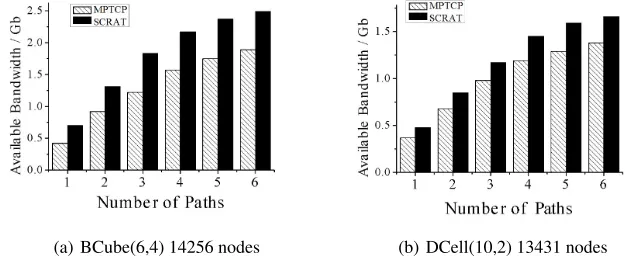
Fig. 7. The available bandwidth in BCube and DCell using multi-paths computed by SCRAT and MPTCP respectively.
Available Bandwidth of Multi-Path Figure 7 compares the available bandwidth of dif-ferent number of paths selected by SCRAT and MPTCP respectively. From the figure, we can find that multi-paths found in SCRAT achieve 20% more available bandwidth than MPTCP. And with the increase of selected paths, available bandwidth in SCRAT grows faster than MPTCP.
6.
Conclusion
MCMP is a very important problem for efficient traffic spreading in SCDC, which has not been solved previously. This paper propose SCRAT to solve the MCMP problem, which leverages the topology characteristics of Server-Centric data center. The algorithm decreases the complexity of the algorithm and simplifies the routing process. Given the path-length, SCRAT can find the optimal path and other sub-optimal paths under multi-constraint. Simulations demonstrate that SCRAT has a very large possibility to find out the exact optimal path and path cost is also lower than the optimal path cost in other multi-constraint algorithm. Additionally, multiple paths found in SCRAT can decrease delay and increase available bandwidth compared with MPTCP.
References
1. Al-Fares, M., Loukissas, A., Vahdat, A.: A scalable, commodity data center network architec-ture. ACM SIGCOMM Computer Communication Review 38(4), 63–74 (2008)
2. Bari, M.F., Boutaba, R., Esteves, R., Granville, L.Z., Podlesny, M., Rabbani, M.G., Zhang, Q., Zhani, M.F.: Data center network virtualization: A survey. Communications Surveys & Tutorials, IEEE 15(2), 909–928 (2013)
3. Benson, T., Anand, A., Akella, A., Zhang, M.: Understanding data center traffic characteristics. ACM SIGCOMM Computer Communication Review 40(1), 92–99 (2010)
4. Chen, K., Hu, C., Zhang, X., Zheng, K., Chen, Y., Vasilakos, A.V.: Survey on routing in data centers: insights and future directions. Network, IEEE 25(4), 6–10 (2011)
5. Chen, K., Singla, A., Singh, A., Ramachandran, K., Xu, L., Zhang, Y., Wen, X., Chen, Y.: Osa: an optical switching architecture for data center networks with unprecedented flexibility. Networking, IEEE/ACM Transactions on 22(2), 498–511 (2014)
6. Dai, F.S., Liu, A.J.: A multi-constrained quality of service routing algorithm based on vec-tor converting. In: Wireless Communications, Networking and Mobile Computing, 2009. WiCom’09. 5th International Conference on. pp. 1–4. IEEE (2009)
7. De Neve, H., Van Mieghem, P.: Tamcra: a tunable accuracy multiple constraints routing algo-rithm. Computer Communications 23(7), 667–679 (2000)
8. Fang, Q., Han, J., Mao, L., Li, Z.: Exact and heuristic algorithm for multi-constrained optimal path problem. In: Dependable, Autonomic and Secure Computing (DASC), 2011 IEEE Ninth International Conference on. pp. 45–51. IEEE (2011)
9. Farrington, N., Porter, G., Radhakrishnan, S., Bazzaz, H.H., Subramanya, V., Fainman, Y., Papen, G., Vahdat, A.: Helios: a hybrid electrical/optical switch architecture for modular data centers. ACM SIGCOMM Computer Communication Review 41(4), 339–350 (2011) 10. Fu, Y., Cheng, X., Tang, Y.: Optimization theory and method. Press of UESTC (1996) 11. Greenberg, A., Hamilton, J.R., Jain, N., Kandula, S., Kim, C., Lahiri, P., Maltz, D.A., Patel, P.,
Sengupta, S.: Vl2: a scalable and flexible data center network. In: ACM SIGCOMM computer communication review. vol. 39, pp. 51–62. ACM (2009)
12. Greenberg, A., Hamilton, J.R., Jain, N., Kandula, S., Kim, C., Lahiri, P., Maltz, D.A., Patel, P., Sengupta, S.: Vl2: a scalable and flexible data center network. In: ACM SIGCOMM computer communication review. vol. 39, pp. 51–62. ACM (2009)
13. Guo, C., Lu, G., Li, D., Wu, H., Zhang, X., Shi, Y., Tian, C., Zhang, Y., Lu, S.: Bcube: a high performance, server-centric network architecture for modular data centers. ACM SIGCOMM Computer Communication Review 39(4), 63–74 (2009)
14. Guo, C., Lu, G., Li, D., Wu, H., Zhang, X., Shi, Y., Tian, C., Zhang, Y., Lu, S.: Bcube: a high performance, server-centric network architecture for modular data centers. ACM SIGCOMM Computer Communication Review 39(4), 63–74 (2009)
15. Guo, C., Wu, H., Tan, K., Shi, L., Zhang, Y., Lu, S.: Dcell: a scalable and fault-tolerant network structure for data centers. ACM SIGCOMM Computer Communication Review 38(4), 75–86 (2008)
16. Guo, C., Wu, H., Tan, K., Shi, L., Zhang, Y., Lu, S.: Dcell: a scalable and fault-tolerant network structure for data centers. ACM SIGCOMM Computer Communication Review 38(4), 75–86 (2008)
17. Heller, B., Seetharaman, S., Mahadevan, P., Yiakoumis, Y., Sharma, P., Banerjee, S., McKeown, N.: Elastictree: Saving energy in data center networks. In: NSDI. vol. 10, pp. 249–264 (2010) 18. Hong, C.Y., Kandula, S., Mahajan, R., Zhang, M., Gill, V., Nanduri, M., Wattenhofer, R.:
Achieving high utilization with software-driven wan. In: ACM SIGCOMM Computer Com-munication Review. vol. 43, pp. 15–26. ACM (2013)
20. Jain, S., Kumar, A., Mandal, S., Ong, J., Poutievski, L., Singh, A., Venkata, S., Wanderer, J., Zhou, J., Zhu, M., et al.: B4: Experience with a globally-deployed software defined wan. In: ACM SIGCOMM Computer Communication Review. vol. 43, pp. 3–14. ACM (2013) 21. Korkmaz, T., Krunz, M.: Multi-constrained optimal path selection. In: INFOCOM 2001.
Twen-tieth Annual Joint Conference of the IEEE Computer and Communications Societies. Proceed-ings. IEEE. vol. 2, pp. 834–843. IEEE (2001)
22. Kuipers, F., Van Mieghem, P., Korkmaz, T., Krunz, M.: An overview of constraint-based path selection algorithms for qos routing. IEEE Communications Magazine, 40 (12) (2002) 23. Mudigonda, J., Yalagandula, P., Al-Fares, M., Mogul, J.C.: Spain: Cots data-center ethernet for
multipathing over arbitrary topologies. In: NSDI. pp. 265–280 (2010)
24. Niranjan Mysore, R., Pamboris, A., Farrington, N., Huang, N., Miri, P., Radhakrishnan, S., Subramanya, V., Vahdat, A.: Portland: a scalable fault-tolerant layer 2 data center network fabric. In: ACM SIGCOMM Computer Communication Review. vol. 39, pp. 39–50. ACM (2009)
25. Porter, G., Strong, R., Farrington, N., Forencich, A., Chen-Sun, P., Rosing, T., Fainman, Y., Papen, G., Vahdat, A.: Integrating microsecond circuit switching into the data center, vol. 43. ACM (2013)
26. Puri, A., Tripakis, S.: Algorithms for the multi-constrained routing problem. In: Algorithm TheorySWAT 2002, pp. 338–347. Springer (2002)
27. Raiciu, C., Barre, S., Pluntke, C., Greenhalgh, A., Wischik, D., Handley, M.: Improving data-center performance and robustness with multipath tcp. ACM SIGCOMM Computer Commu-nication Review 41(4), 266–277 (2011)
28. Reinhardt, L.B., Pisinger, D.: Multi-objective and multi-constrained non-additive shortest path problems. Computers & Operations Research 38(3), 605–616 (2011)
29. Van Mieghem, P., Kuipers, F., et al.: Concepts of exact qos routing algorithms. Networking, IEEE/ACM Transactions on 12(5), 851–864 (2004)
30. Wang, S., Wang, H., Li, L.: An enhanced algorithm for multiple constraints optimal path cal-culation. In: Communications, Circuits and Systems, 2004. ICCCAS 2004. 2004 International Conference on. vol. 1, pp. 703–713. IEEE (2004)
Huanzhao Wangreceived her B.S., M.S., and Ph.D. degrees in Computer Science and Technology from Xi’an Jiaotong University, China. She is currently an Associate Pro-fessor of Department of Computer Science and Technology at Xi’an Jiaotong University. Her research interests include wireless sensor networks and Software Defined Networks.
Kun Qian received his B.S. degree in Computer Science and Technology from Xi’an Jiaotong University, China, in 2015. He is currently working toward the Ph.D. degree at the Department of Computer Science and Technology at Tsinghua University, Beijing, China. His research interests include network measurement and monitoring.
Che Zhangreceived her B.S. and M.S. degrees in computer science and automation re-spectively from Xi’an Jiaotong University, China. She is a PhD candidate in computer science of City University of Hong Kong. Her research interests include SDN, cloud com-puting, cloud robot, network, algorithm, lego and MIT App Inventor.
Yadong Zhoureceived his B.S., M.S., and Ph.D. degrees in control science and tech-nology from Xi’an Jiaotong University, China. He is currently an assistant professor of department of automation at Xi’an Jiaotong University. His research interests include software defined networks, online social networks.