Agent Reasoning on the Web using Web Services
Costin B˘adic˘a1, Nick Bassiliades2, Sorin Ilie1, and Kalliopi Kravari2
1 University of Craiova
Bvd. Decebal, 107, RO-200440, Craiova, Romania {cbadica,silie}@software.ucv.ro 2
Aristotle University of Thessaloniki, GR-54124, Thessaloniki, Greece {nbassili,kkravari}@csd.auth.gr
Abstract. In this paper we present an approach for reusing agent-based reasoning capabilities by making them available for invocation as Web services. In this way, we provide the missing link between the highly interoperable Web services and the autonomicity and intelligence of agent-based systems, so that the latter can be seam-lessly integrated into the knowledge-rich Semantic Web environment without being compromised by isolated communication platforms and languages or restricted to only one or just few reasoning formalisms. We have achieved this by extending the EMERALD framework for agent based reasoning with a Web service interface. Our approach is exemplified by the development of an online system for intelligent brokering of apartment rentals. The broker intelligence is captured as a defeasible knowledge base, while its problem solving process involves the invocation of third party defeasible reasoning Web services included into the EMERALD framework.
Keywords:Web service, reasoning, software agent, UML.
1.
Introduction
The Web was originally envisioned as a platform for information dissemination to human consumers. The next generation of Web systems shifted its interest to make that informa-tion available for machine consumpinforma-tion by realizing that Web data can be reused for var-ious problem solving purposes. This idea was put into practice through the development of the Semantic Web [2] that promotes the enrichment of Web content with meaningful semantic metadata.
In parallel with the progress of the Semantic Web, the field of distributed systems has seen a progress by the proposal of a new approach known as service oriented architec-ture. By promoting the new ideas of interoperability and integration, the adoption of this approach enabled the development of significantly more complex distributed applications by integration of various existing or new heterogeneous components.
Software agents are defined as computer systems situated in an environment that are able to achieve their objectives by: (i) acting autonomously, i.e. by deciding themselves what to do, and (ii) being sociable, i.e. by interacting with other software or human agents [33]. If we place software agents into the Web environment then we can easily regard them as a potential incarnation of the Semantic Web vision. According to this view, the Semantic Web is regarded as a Web of semantic services that are provided and consumed by software agents over the Web protocols.
We already have service provisioning agents that act similarly with Web services be-ing able to provide reasonbe-ing services [18] or negotiation services [9]. However, we have noticed that there are both conceptual and technological “missing links” between soft-ware agents and Web services in the context of the Semantic Web. From the conceptual point of view, services lack autonomy and they are rather passive components that be-have reactively by waiting to be invoked by client software. They also lack social abili-ties, as well as the ability to adapt and evolve. On the other hand agents have interesting features regarding autonomy, sociability and adaptivity. From the technological point of view, multi-agent systems are developed using specialized packages and deployed on dis-tributed multi-agent platforms. Those platforms are providing appropriate middleware services required for running distributed multi-agent systems [7]. Moreover, while avail-able for invocation within the agent platform, agent services are not immediately availavail-able for invocation over the Web. In this paper we propose a system that integrates and updates existing software tools to enable the invocation of agent reasoning services over the Web. In particular we highlight the problems, as well as our solution details of the integration process of a defeasible reasoning service into a coherent system for supporting a realistic e-commerce scenario in the domain of brokering apartment rental.
Our work contributes to bridging gap between software agents and Web services in the context of the Semantic Web. Using our approach, a Web application can reuse a set of declarative rules that capture valuable knowledge about the various constraints, re-quirements and particularities of the problem domain. The knowledge can be represented using one of the available rule-based knowledge representation formalisms. Using our extension, Web applications can exploit this knowledge by invoking appropriate reason-ing services over the Web protocols on specific sets of facts that capture the particular instance of the problem in hand.
The main contributions reported in this paper can be summarized as follows:
(i) The extension of EMERALD multi-agent knowledge-based framework [17] to enable the exposure of agent-based reasoning services as Web services.
(ii) The development of a prototype system supporting a realistic scenario for intelligent brokering of apartment rentals. The broker intelligence is captured as a defeasible knowledge base, while its problem solving process involves the invocation of third party defeasible reasoning Web services included into the EMERALD framework. The prototype provides a Web-based user interface, incorporates a rule-based knowl-edge base about user preferences and invokes external Web services for reasoning. This prototype is intended as a proof-of-concept for checking the viability of our proposed approach.
Note that, although in our experimental system we used the particularDR Reasoner
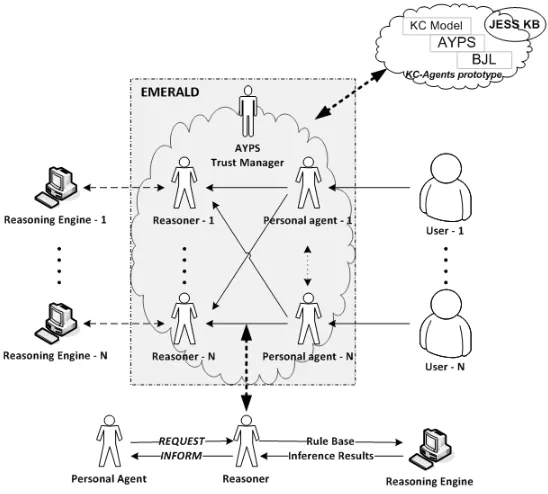
Fig. 1.EMERALD abstract architecture.
brokering activity for apartments rental, the presented approach is general and customiz-able so it can be also applied (i) to other types of reasoners, as well as (ii) to other appli-cation domains.
The paper is structured as follows. In section 2 we give an overview of background results and software tools that we have utilized to develop our prototype system and we also provide a review of related works. Section 3 introduces our method for exposing agent-based reasoners incorporated into EMERALD as Web services. The method was used for the development of theDR Web Servicefor defeasible reasoning. In section 4 we present our use case and we outline the design and implementation of an intelligent broker for the domain of apartment rental. Section 5 presents the details of our experiment carried out with the prototype system. The last section presents our conclusions and identifies a number of paths for continuing this research.
2.
Background and Related Works
2.1. Background
EMERALD ([17], see Fig. 1) is a multi-agent knowledge-based framework, based on the Semantic Web and FIPA standards [10], that enables reusability and interoperability of behavior between agents. It is built on Jade [4], a reliable and widely used framework. EMERALD supported so far the implementation of various applications, like brokering and agent negotiations. It provides a generic, reusable agent prototype for knowledge-customizable agents (KC-Agents), consisted of an agent model (KC Model), a directory service (AYPS - Advanced Yellow Pages Service) and external Java methods (Basic Java Library). Hence, EMERALD supports service provisioning by allowing agent service de-scriptions to be published onto the “yellow pages” service - known as Directory Facilitator (DF) in FIPA and Jade. Whenever a consumer agent decides to outsource a certain func-tion, it can search the AYPS for an appropriate service that meets its specific requirements. AYPS actually provides a service retrieval ability, which groups and sorts the registered (advertised) services according, among others, to their domain and their synonyms, allow-ing (requestallow-ing) agents to make complex queries and receive the best available service. Yet since trust has been recognized as a key issue in Semantic Web Multi-agent Systems, EMERALD adopts a variety of reputation mechanisms, both decentralized and central-ized [26].
Another important issue in this framework is reasoning interoperability. Agents do not necessarily share a common rule or logic formalism, thus, it is vital for them to find a way to exchange their position arguments seamlessly. To this end, EMERALD proposes the use of Reasoners [18], which are actually agents that offer reasoning services to the rest of the agent community. This approach does not rely on translation between rule formalisms, but on exchanging the results of the reasoning process of the rule base over the input data. The receiving agent uses an external reasoning service to grasp the semantics of the rule base, namely the set of entailments of the knowledge base. Thus, although Reasoners are built as agents, actually they act more like Web services.
Currently, EMERALD implements a number of Reasoners that offer reasoning ser-vices in two major reasoning paradigms: deductive rules and defeasible logic. Deduc-tive reasoning is based on classical logic arguments, where conclusions are proved to be valid, when the premises of the argument (i.e. rule conditions) are true. Defeasible reason-ing [23], on the other hand, constitutes a non-monotonic rule-based approach for efficient reasoning with incomplete and inconsistent information, which is useful in many applica-tions, such as security policies, business rules, e-contracting, personalization, brokering and agent negotiations.
Among these Reasoners available in EMERALD, DR-Reasoner based on DR-DE-VICE [3] has an exceptional interest. It is based on defeasible logic (DL), a nonmono-tonic logic which is capable of modeling the way intelligent agents, like humans, draw reasonable conclusions from inconclusive information. Knowledge in DL is represented in the form of facts and rules. Facts are indisputable statements, represented either in form of states of affairs or actions that have been performed. On the other hand, rules describe the relationship between premises and conclusion. Three types of rules are available strict rules, defeasible rules and defeaters. Strict rules (A1, . . . , An→B) are rules in the
clas-sical sense: whenever the premises are indisputable then so is the conclusion. Thus, they can be used for definitional clauses. Defeasible rules (A1, . . . , An ⇒ B) are rules that
conclusions, not to support them which is actually the main concept in DL. This logic does not support contradictory conclusions, instead seeks to resolve conflicts.
Hence, in cases where there is some support for concludingAbut there is also support for concluding¬A, namely where there are conflicting (mutually exclusive) literals, no conclusion can be derived unless one of them has priority over the other. This priority is expressed through a superiority relation among rules which defines priorities among them; namely where one rule may override the conclusion of another rule. For example, suppose that there is a conflict set{(c(x), c(d)|x 6= d}; it is consisted of two compet-ing rulesr1 (r1 : a(X) ⇒ c(X))andr2 (r2 : b(X) ⇒ c(X)), wherer2 could be superior(r2 > r1). To this end,DR Reasonerin order to exploit the DL’s capabilities uses, as already mentioned, the DR-DEVICE inference system. DR-DEVICE is capable of reasoning about RDF metadata over multiple Web sources using defeasible logic rules. More specifically, DR-DEVICE accepts as input the address of a defeasible logic rule base, written in DR-RuleML language, an extension of the OORuleML syntax. The rule base contains the rules and one or more RDF documents that contain the facts for the rule program, while the final conclusions are exported as an RDF document. Furthermore, DR-DEVICE supports all defeasible logic features, like rule types, rule superiorities etc., applies two types of negation (strong, negation-as-failure) and conflicting (mutually ex-clusive) literals. DR-DEVICE is based on a CLIPS-based implementation of deductive rules. The core of the system consists of a translation of defeasible knowledge into a set of deductive rules, including derived and aggregate attributes. The implementation is declarative as it interprets the not operator using Well-Founded Semantics [11].
An important aspect of our approach was the integration of multi-agent technolo-gies with Web services. Authors of [25] provide a good overview of such possibilities with a special focus on interoperability between FIPA (Foundation for Intelligent Phys-ical agents) and Web services. Among them, a useful tool for our own work is the Jade Web service Integration Gateway – WSIG (see [4], chapter 10). It allows the provision of Jade agent services as Web services. In particular, services provided by Reasoner agents available in EMERALD framework can be exposed as Web services. This allows the con-venient incorporation of reasoning functions into complex Semantic Web applications.
2.2. Related Works
files. To this end, whenever a Reasoner receives a new valid request, it launches a new in-stance of the associated reasoning engine that performs inference. Reasoners actually act like proxies, allowing other agents to contact with the appropriate rule engines with low computational and time cost. Otherwise, each single agent should have had hard-coded rule engines for every rule or logic formalism, which is infeasible. Moreover, EMERALD provides trust mechanisms that ensure the reliability of each agent or Reasoner, in par-ticular, acting in the environment. Hence, it is ensured that Reasoners in EMERALD are trusted parties that have no access or interference in agents’ internal information.
A similar to EMERALD architecture for intelligent agents is presented in [32], where reasoning engines are employed as plug-in components, while agents intercommunicate via FIPA-based communication protocols. The framework is build on top of the OPAL agent platform [24] and, similarly to EMERALD, features distinct types of reasoning services that are implemented as reasoner agents. The featured reasoning engines are 3APL [8], JPRS (Java Procedural Reasoning System) and ROC (Rule-driven Object-oriented Knowledge-based System). 3APL agents incorporate BDI logic elements and first-order logic features, providing constructs for implementing agent beliefs, declarative goals, basic capabilities and reasoning rules. JPRS agents perform goal-driven procedu-ral reasoning and each JPRS agent is composed of a world model (agent beliefs), a plan library, a plan executor (reasoning module) and a set of goals. Finally, ROC agents are composed of a working memory, a rule-base (consisting of first-order, forward-chaining production rules) and a conflict set. The primary difference between the two frameworks lies in the variety of reasoning services offered by EMERALD. While the three reasoners featured in [8] are all based on declarative rule languages, EMERALD proposes a variety of reasoning services, including deductive, defeasible and modal defeasible reasoning, thus, comprising a more integrated solution. Furthermore, EMERALD not only features trust and reputation mechanisms but also it is based on the Semantic Web standards, like, for rule and data interchange.
The One Ring project [22] on the other hand is a promising scripting rules engine ser-vice. It aims to be used as a Web service (SOA) for multiple applications to gain access to scripted processing of arbitrary parameters. It centralizes processing of common or busi-ness rules for multiple applications that need access to the same rules. Rules are defined using a simple language understood by domain experts. The primary difference between One Ring and EMERALD lies in the variety of reasoning services offered by EMERALD. While One Ring supports only a simple but not widely understood language, EMERALD proposes a variety of reasoning services, including deductive, defeasible and modal de-feasible reasoning. Yet EMERALD, featuring additionally trust mechanisms, comprises a more integrated solution complying with the Semantic Web standards. However, both approached share a similar view of rule importance and usage.
Our literature review revealed also a number of systems and approaches that combine distributed multi-agent systems, reasoning services and the Semantic Web technologies for the development of application in several areas including: medical rehabilitation, agent auctions, supply-chain management, and service personalization.
Web 2.0-enabled discussion forum. To ensure a certain level of correctness of information, the users experience in the forum is filtered by evidence-based medicine, thus only cer-tified information will be integrated into OntoRis. The OntoRis component incorporates an ontology and a reasoning engine. Nevertheless, while OntoRis agents are useful for information searching and knowledge enhancement, they have no role in the automation of reasoning processes, requiring either the manual intervention of the OntoRis adminis-trator, as well as knowledge certification via methods of evidence-based medicine.
Knowledge-based declarative approaches are also useful for the specification of in-teraction mechanisms between software agents. Reference [21] proposes a declarative framework for auctions mechanisms in multi-agent systems. The key point of the pro-posal is the factoring of the model into two architectural components, the auction host and the auction participants. Their interaction is governed by a protocol with a declarative specification decomposed into: generic negotiation protocol (GNP), declarative negoti-ation mechanism (DNM) and custom negotinegoti-ation mechanism (CNS). The GNP makes possible the interaction between auction host and auction participants. The specific rules of a particular auction are described using the DNM, while the CNS captures the strategic behavior which is private to each auction participant. A prototype implementation of this model is proposed using the Jason agent programming language [6]. This implementa-tion benefitted from several features of Jason including: Belief-Desire-Intenimplementa-tion model, Prolog-style rule-based reasoning, meta-programming and extensibility. Nevertheless, a cleaner separation between the CNS and DNM is desirable, especially taking into account that negotiation strategies could require more specialized types of reasonings, for example to account for priorities or conflicts between strategy rules.
Authors of reference [31] propose an ontology-based approach for capturing nego-tiation knowledge in supply chain management multi-agent systems. Similarly to [21], negotiation knowledge is partitioned into shared negotiation ontology and private nego-tiation ontology to ensure agent communicative interoperability and privacy of strategic knowledge. The agents’ negotiation ability is further enhanced with private inference rules defined on top of private negotiation ontology. Nevertheless, although conceptually quite similar to [21], the implementation approach is different. It is based on Jade multi-agent platform and Jess expert system shell [12], as well as on the Semantic Web technologies OWL and SWRL [30].
Personalization is an important concern in context-aware applications. Authors of [27] propose a method that combines ontological modeling of user profiles, rule-based person-alization mechanisms and service-oriented architecture for providing personalized Help-on-Demand services to mobile users in pervasive environments. The flexibility of the method is achieved by using an intelligent personalization service that incorporates a rule-based knowledge and a reasoning engine. While interesting, one limitation of this approach is that it is restricted to a single type of reasoning based on standard forward chaining for determining cause-effect relationships.
exchange, and (ii) collaboration level, by letting partner agents develop strategic relation-ships through intense communication thus allowing to achieve global goals for the entire supply chain.
3.
Agent-Based Reasoning Web Services
The aim of this section is to introduce the design and implementation of a Reasoning Web Service. An external Web-based application will be able to invoke this Web service by providing a rulebase and an initial set of facts. The Web service returns the output of the reasoning process to the invoker application as a set of resulted facts.
3.1. Architecture and Design
Our design presents a method for wrapping an EMERALD reasoning service as a Web service using the Jade WSIG. For that purpose we exploit:
– The architecture and interoperability protocols of Reasoner agents inside EMERALD framework.
– The architecture of Jade WSIG.
The Reasoning Web Service takes as input a rule base represented in RuleML and outputs a result file using a simple request-reply interaction protocol. The meaning of the rulesbase, as well as of the initial set of facts is application dependent. It must be appro-priately defined and interpreted by the client application in the context of the application domain of the system that is using the reasoning process.
The rulebase will specify a link to an RDF file containing an initial set of facts using the rdf importattribute of RuleML. The output of the reasoning process is determined as an RDF file and saved by the Reasoning Web Service in a temporary location on the service side, while its URL is returned to the client. Consequently, the client will be able to download the result file and further process it according to the application requirements.
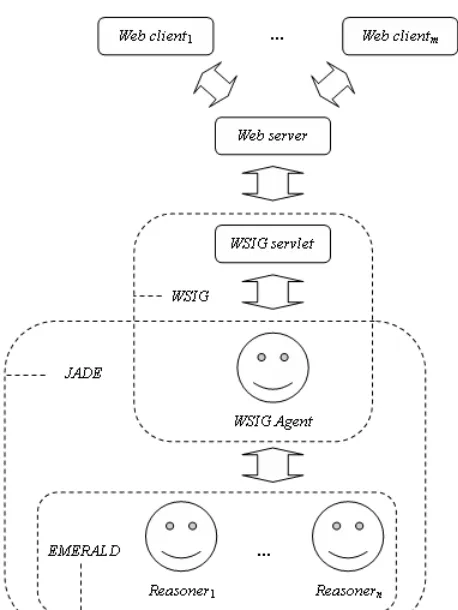
The architecture of the Reasoning Web Service is shown in Fig. 2. In particular, this diagram shows the relation between EMERALD, Jade, WSIG and the “outside world”. The Reasoning Web Service is hosted by a Web server and implemented with the help of a WSIG servlet that handles reasoning requests. The servlet is interfaced with Jade via a special agent – the WSIG agent using a special component known as the Jade Gateway. The WSIG agent is able to pass reasoning requests to the appropriate Reasoner agent of the EMERALD framework, as well as to return reasoning results to the WSIG servlet.
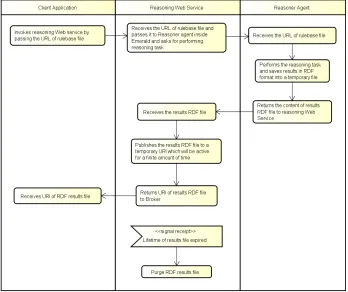
For the design of the Reasoning Web Service we have produced an UML activity dia-gram that shows the activities of the client application and the reasoning platform, shown in Fig. 3, as well as an UML sequence diagram detailing the interactions between them, shown in Fig.4. For the reasoning platform we show two actors, namely theReasoning Web Servicewhich was developed by us, as well as theReasonerwhich is part of EMER-ALD. The system functioning can be better understood if we follow both diagrams.
Fig. 3.Roles and activities in the Reasoning Web Service.
<wsdl:definitions ... declarations of namespaces> <wsdl:types>
<xsd:schema xmlns:impl="urn:Defeasible_Reasoning_Service" ... declarations of namespaces>
<xsd:annotation/> <xsd:element name="DRReasoning"> <xsd:complexType> <xsd:sequence><xsd:element name="inputRulemlPath" type="xsd:string"/></xsd:sequence> </xsd:complexType> </xsd:element> <xsd:element name="DRReasoningResponse"> <xsd:complexType> <xsd:sequence><xsd:element name="DRReasoningReturn" type="xsd:string"/></xsd:sequence> </xsd:complexType> </xsd:element> </xsd:schema> </wsdl:types> <wsdl:message name="DRReasoningRequest">
<wsdl:part name="parameters" element="impl:DRReasoning"></wsdl:part> </wsdl:message>
<wsdl:message name="DRReasoningResponse">
<wsdl:part name="parameters" element="impl:DRReasoningResponse"></wsdl:part> </wsdl:message> <wsdl:portType name="Defeasible_Reasoning_ServicePort"> <wsdl:operation name="DRReasoning"> <wsdl:input message="impl:DRReasoningRequest"></wsdl:input> <wsdl:output message="impl:DRReasoningResponse"></wsdl:output> </wsdl:operation> </wsdl:portType> <wsdl:binding name="Defeasible_Reasoning_ServiceBinding" type="impl:Defeasible_Reasoning_ServicePort"> <wsdlsoap:binding style="document" transport="http://schemas.xmlsoap.org/soap/http"/> <wsdl:operation name="DRReasoning"> <wsdlsoap:operation soapAction="urn:Defeasible_Reasoning_ServiceAction"/> <wsdl:input><wsdlsoap:body use="literal"/></wsdl:input> <wsdl:output><wsdlsoap:body use="literal"/></wsdl:output> </wsdl:operation> </wsdl:binding> <wsdl:service name="Defeasible_Reasoning_ServiceService"> <wsdl:port name="Defeasible_Reasoning_ServicePort" binding="impl:Defeasible_Reasoning_ServiceBinding"> <wsdlsoap:address location= "http://ids.software.ucv.ro:8080/KSWAN/ws/Defeasible_Reasoning_Service"/> </wsdl:port> </wsdl:service> </wsdl:definitions>
Fig. 5.WSDL of the DR Web service.
of the reasoning process expressed in RDF (resultsRDF) is returned to the Reasoning Web Service(interaction 3 in Fig.4). TheReasoning Web Servicepublishes the RDF file to a temporary URL and then returns this URL (resultsURL) to theClient Application
3.2. Implementation
For demonstration purposes we have only addressed the integration of theDR Reasoner
agent available in EMERALD into our prototype system. Nevertheless, the principles behind this integration process are the same for any other Reasoner that is part of the EMERALD platform. As a general procedure, a Reasoner (including theDR Reasoner): (i) receives a rulebase that contains the knowledge base as a set of rules expressed for interoperability purposes using RuleML, as well as possibly one or more RDF files con-taining initial facts that are required for the reasoning process, (ii) performs the reasoning and (iii) returns the reasoning result as an RDF file.
For the implementation we have used the Jade WSIG add-on [13] that gives the pos-sibility of invoking agent services exposed as Web services from Web service clients. WSIG provides the standard Web services stack including: WSDL service descriptions, SOAP message transport and UDDI “yellow pages” repository. WSIG runs as part of a Web application powered by a Web server and a servlet container. WSIG incorporates the WSIG servlet and the WSIG agent and acts as a gateway between the Web application and the Jade multi-agent system. The WSIG servlet handles SOAP over HTTP requests, ex-tracts the SOAP content, maps it to an agent action and passes it to the WSIG agent. After the action execution, WSIG servlet converts the result received from the WSIG agent to SOAP, prepares a SOAP over HTTP reply and sends it back to the Web client (see Fig. 2). The implementation follows the architecture diagram shown in Fig. 2.
The WSIG add-on provides a method for exposing Jade agent services whose de-scriptions are published in theDirectory Facilitator(DF) agent as Web services. For this purpose, the DF description of an agent service is automatically mapped by WSIG onto an WSDL description. For example, the WSDL for the reasoning service provided byDR Reasoner is shown in Fig. 5. Analyzing this example we observe that this WSDL file defines a Web service named Defeasible Reasoning Servicethat was derived from the description of theDefeasible Reasoning Serviceservice provided byDR Reasoneragent.
The WSDL is structured in an abstract part, containing data types, messages and operations specification, followed by a concrete part, containing bindings and services specification [1]. The abstract part contains: (i) type definitions specified using XML Schema – thewsdl:typesection; (ii) message types, specified aswsdl:messagesections; and (iii) port types that represent service interfaces (expressed usingwsdl:portype ele-ment) made up of sets of operations, represented aswsdl:operationelements. For exam-ple ourDefeasible Reasoning ServiceWeb service has an interface with a single opera-tion that takes two parameters: an input parameter representing aDRReasoningRequest
message and an output parameter representing a DRReasoningResponse message. Go-ing deeper, for example theDRReasoningRequest message transports an object of type
DRReasoning that encapsulates a value namedinputRulemlPath representing the URL of the rulebase that is passed to the service. The concrete part contains bindings for op-erations and messages (element wsdl:binding) and service endpoints specification (el-ement wsdl:port). For example, Defeasible Reasoning Service Web service exchanges messages that are specified in “document” style and are formatted using SOAP and trans-ported over HTTP. This binding is combined with the URL where this service is available:
4.
Web-Enabled Intelligent Broker
This section contains the details of the use case, as well as the design and implementa-tion of our prototype Web-enabled Intelligent Broker that is using third party reasoning services provided by our Reasoning Web Service.
4.1. Use Case
We consider the intelligent broker use case introduced in [3] and we adapt it for the Web environment. The actors of this use case are:
(i) TheUserthat represents a buyer interested to purchase or rent an apartment. (ii) TheBrokerthat matches buyer requested features with seller capabilities and
recom-mends one or more possible transactions that meet the requirements of both trading parties.
(iii) The EMERALD framework that provides on-demand third party reasoning services for supporting the “intelligence” of theBroker.
Placing the actors in the Web environment, the situation presents as follows. TheUser
is using a Web browser to connect to theBrokerWeb site and to search for apartment offers. The business of theBrokeris powered by a Web application that provides at least the following two functionalities: (i) to assist the human users looking for renting apart-ments to search for suitable offers according to their requireapart-ments; (ii) to allow landlords to describe and publish their offers. Apartment offers will be registered and saved in a database that is available to the Web application of theBroker. In this work we assume the existence of this database and we shall only focus on theUserside that is looking for renting or buying a suitable apartment.
The intelligence of theBrokeris driven by a knowledge base. However, taking into account the large variety of knowledge representation formalisms, in particular based on rules, theBrokerdecided to outsource its reasoning functions to a third party reasoning platform (EMERALD in this case) that provides trusted reasoning capabilities that can be invoked over the Web as Web services. Separating the representation of the Broker
intelligence from the reasoning services has the advantage that theBrokercan update the knowledge-base according to the interests of theUser. This update can either involve the update of the rules, as well as the adoption of a new rule representation formalism that better fits theUserneeds.
Briefly, the brokering use case proceeds as follows. In the first step theUserconnects to theBrokerWeb site and receives a form where he or she can fill-in his or her request. When the input process is finished, theBrokergenerates a parameterized rulebase rep-resented using RuleML and an RDF file that contains parameter values specified by the
User. Parameters can specify for example: minimum number of bedrooms, maximum floor, minim size of the garden (in m2), if pets are allowed or not, maximum price for
a central or suburb location, extra price perm2(above the minimum preferred size), the
minimum preferred size, the available budget.
or preferences that cannot be easily parameterized, like for example: “if the flat is on the 3rdfloor or above the presence of an elevator is necessary”. Therefore we have simplified
the scenario by restricting our attention to a “prototypical user” for whom we defined a rulebase characterized by a given fixed set of parameters. The rulebase captures the “intelligence” of theBrokerin understanding the preferences of a typicalUser, while the specific values of the parameters are input by theUserat run-time using the form provided by theBroker. Eventually, an “experienced user” can still be provided with the possibility to visualize and update the rulebase. Moreover, if the user does not provide values for some of the preference parameters, then the corresponding rules will not be added to the generated rulebase.
In the second step theBroker will consult its internal database to retrieve a set of apartments which are relevant for theUserrequest. In the third step, theUserpreferences (captured as the rulebase accompanied by a set of parameter-value pairs), together with the set of relevant apartments are submitted by theBrokerto the reasoning service. Finally, the reasoning service returns to theBrokera set of available options. TheBrokerconverts them into a meaningful presentation (eg. HTML) and sends it to theUserfor visualization in the browser.
4.2. Design
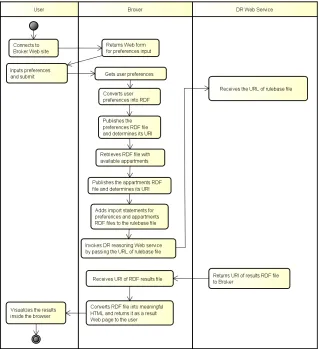
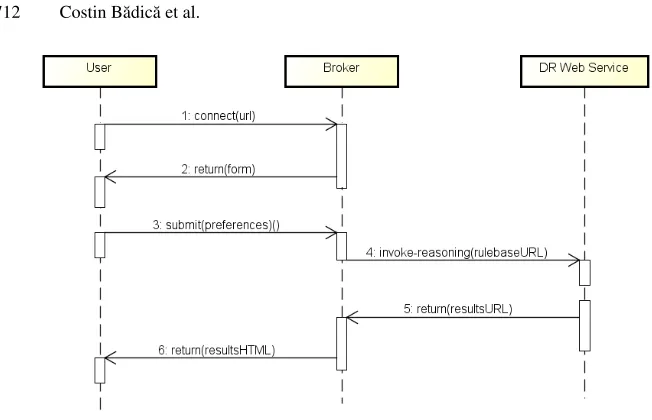
For the system design we have produced an UML activity diagram that shows the activ-ities of theUser,Brokerand the reasoning service, shown in Fig. 6, as well as an UML sequence diagram detailing the interactions between them, shown in Fig.7. The reasoning service is namedDR Web serviceand it is based on theDR Reasoner which is part of EMERALD reasoning platform. The system functioning can be better understood if we follow both diagrams.
TheUserconnects to the Web site of theBrokerby submitting the URL. The Bro-ker delivers back to theUser a Web page containing a form for preference input as a set of parameter-value pairs describing his options concerning the rental of an apartment. TheUser fills-in this form and submits it to theBrokerWeb site. Behind this form the
Brokerpreprocesses the preferences and produces a rulebase represented in RuleML no-tation, following the example from [3]. The rulebase contains a set of defeasible rules that are used by theBrokerto capture the generic preferences of a typicalUser. Differently from [3], the rulebase is kept separate from the set of parameter-value pairs (called pref-erencesin Fig.7, interaction 3). This approach simplifies the operation of instantiating a particular scenario with the specific values input by theUser. Intuitively, the rulebase rep-resents the “intelligence” of theBrokerin understanding and formalizing the requirements and preference of a prototypical user regarding the rental of apartments.
Fig. 7.Roles interaction in the brokering scenario.
Then theBroker invokes theDR Web service (interaction 4 in Fig.7) by passing it therulebase. TheDR Web serviceperforms the reasoning task by using the EMERALD reasoning infrastructure, determines the output RDF file and returns its URL (resultsURL) to theBroker(interaction 5 in Fig.7). TheBrokerreceives the URL, downloads the RDF file, converts it to meaningful HTML and returns the HTML (resultsHTML) to theUser
for visualization in the browser (interaction 6 in Fig.7).
4.3. Implementation
Following the above described design principles, a user-friendly Web site that hosts the
Brokerfunctionality was developed. Here, it is calledBroker Web sitesince it is currently focused on this specific domain, however it can host any kind and any number of domains. The key issue behind this possibility is the fact that the site is hosted in an independent server. Having two separated servers, one for hosting the services such as theDR Web Serviceand one for hosting the registered parties such as theBroker, enables flexibility in the setting. In other words, it is important to preserve intact and unaffected the core framework which provides the services and at the same time provide an easy and efficient way for agent parties to communicate with human users. Adding new domains is in prin-ciple easily achievable, since it requires parsing the ontology of the input data and then using this ontology to author the appropriate rulebase for the end-user preferences. There exist graphical tools to achieve these, such as [14] and [15]; however, in this paper we do not cover this aspect.
Fig. 8.Choosing domain in the GUI.
menu the domain in which he/she is interested in; here it is Broker domain called Carlo in the implementation (Fig.8).
After the domain is chosen, the GUI is dynamically updated providing a list with all the available attributes for this domain (Fig.9). Hence, the user will be able to indicate his/her personal preferences, e.g. the number of bedrooms. For user convenience we pro-vide some default values in the interface. When the user finishes, “Submit all” button is clicked, the data are collected and stored in the RDF data file that will be used in theDR Web Service. This file is stored in the server and each time users provide their preferred values appropriate PHP functions update the stored attribute values. More specifically, we have stored an RDF template data file, hence each time a new attribute values is set, the template is parsed and the value is stored under the appropriate instance.
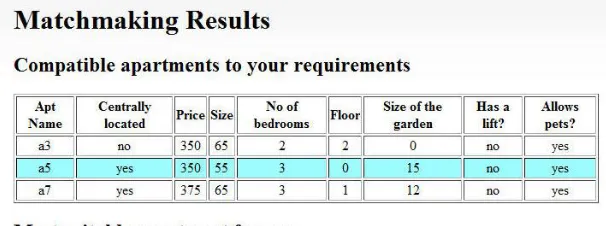
Fig. 10.GUI output.
Next, the updated RDF file, filled with the user’s requirements and preferences, is used by the Broker in its request to the DR Web Service. As soon as theDR Reasoner
processes the request, it sends back a reply containing the results in RDF syntax, here the compatible apartments to user’s requirements, as well as the most suitable for him/her. The Broker on its side parses the RDF results and transforms then into HTML, in order to represent them in a user-friendly and easily understandable output to the user (Fig.10).
5.
Proof-of-concept Scenario
In this section we present a proof-of-concept scenario of using theDefeasible Reason-ing ServiceWeb service for implementing the intelligent broker introduced in section 4. This scenario was adapted following [3], while it actually originates from [2].
We assume that a generic user with name Carlo has the following requirements for an apartment rental:
a) Apartment requirements
• Minimum number of bedrooms:2.
• Maximum floor:2.
• Minimum garden size:12.
• Pets allowed:yes. b) Price Requirements
• Maximum budget:400.
• Maximum price for a central apartment:300.
• Maximum price for a suburb apartment:250.
• Extra price per additional apartmentm2:5. • Extra price per additional gardenm2:2.
c) Preferences
• The cheapest apartment is mostly preferred.
• The second option is the garden availability.
• The third option is availability of additional space.
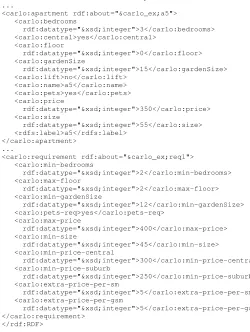
Now, differently from [3], in order to fit this scenario into our prototype system, we extracted from this set of requirements the generic rulebase representing the requirements of a typical user. Moreover, we captured the specific values of the requirements’ parame-ters for Carlo as a separate RDF file shown in Fig. 12.
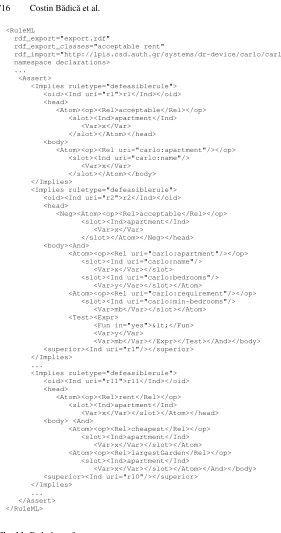
The rulebase that captures the Broker’s intelligence as a set of defeasible rules is expressed in RuleML3. A snapshot of the rulebase is exemplified in Fig .11. The set of apartments available for rent that are registered with the theBrokeris captured as an RDF file4. An example is shown in , shown in Fig. 12. This file, as well as the RDF file with parameter values from Fig. 12 are included into the rulebase using therdf importattribute of theRuleMLroot element of the rulebase file expressed in RuleML [3].
TheBrokerinvokes the reasoning task by sending a request message to the Defeasi-ble Reasoning ServiceWeb service. This message is packaged using SOAP as shown in Fig. 13. The request specifies the URL of the rulebase file that is located on theBroker’s Web server, using theinputRulemlPathelement.
TheDefeasible Reasoning ServiceWeb service replies with a response packaged as a SOAP file that contains a link to the RDF file with the results, published on the De-feasible Reasoning ServiceWeb server. A part of the results file in this case is shown in Fig. 14. It contains the list of “acceptable” apartments –carlo:acceptableelement with thetruthStatusset todefeasibly proven positive, as well as the apartment which is chosen by Carlo –carlo:rentelement. You can easily note that among the acceptable apartments, Carlo chose to rent apartmenta5.
3The file is available athttp://lpis.csd.auth.gr/systems/dr-device/carlo/
carlo-rbase-flex-0.91.ruleml.
4The file is available athttp://lpis.csd.auth.gr/systems/dr-device/carlo/
<RuleML rdf_export="export.rdf" rdf_export_classes="acceptable rent" rdf_import="http://lpis.csd.auth.gr/systems/dr-device/carlo/carlo_ex.rdf" namespace declarations> ... <Assert> <Implies ruletype="defeasiblerule"> <oid><Ind uri="r1">r1</Ind></oid> <head> <Atom><op><Rel>acceptable</Rel></op> <slot><Ind>apartment</Ind> <Var>x</Var> </slot></Atom></head> <body> <Atom><op><Rel uri="carlo:apartment"/></op> <slot><Ind uri="carlo:name"/> <Var>x</Var> </slot></Atom></body> </Implies> <Implies ruletype="defeasiblerule"> <oid><Ind uri="r2">r2</Ind></oid> <head> <Neg><Atom><op><Rel>acceptable</Rel></op> <slot><Ind>apartment</Ind> <Var>x</Var> </slot></Atom></Neg></head> <body><And> <Atom><op><Rel uri="carlo:apartment"/></op> <slot><Ind uri="carlo:name"/> <Var>x</Var></slot> <slot><Ind uri="carlo:bedrooms"/> <Var>y</Var></slot></Atom> <Atom><op><Rel uri="carlo:requirement"/></op> <slot><Ind uri="carlo:min-bedrooms"/> <Var>mb</Var></slot></Atom> <Test><Expr> <Fun in="yes"><</Fun> <Var>y</Var> <Var>mb</Var></Expr></Test></And></body> <superior><Ind uri="r1"/></superior> </Implies> ... <Implies ruletype="defeasiblerule"> <oid><Ind uri="r11">r11</Ind></oid> <head> <Atom><op><Rel>rent</Rel></op> <slot><Ind>apartment</Ind> <Var>x</Var></slot></Atom></head> <body> <And> <Atom><op><Rel>cheapest</Rel></op> <slot><Ind>apartment</Ind> <Var>x</Var></slot></Atom> <Atom><op><Rel>largestGarden</Rel></op> <slot><Ind>apartment</Ind> <Var>x</Var></slot></Atom></And></body> <superior><Ind uri="r10"/></superior> </Implies> ... </Assert> </RuleML>
<rdf:RDF ... declarations of namespaces> ... <carlo:apartment rdf:about="&carlo_ex;a5"> <carlo:bedrooms rdf:datatype="&xsd;integer">3</carlo:bedrooms> <carlo:central>yes</carlo:central> <carlo:floor rdf:datatype="&xsd;integer">0</carlo:floor> <carlo:gardenSize rdf:datatype="&xsd;integer">15</carlo:gardenSize> <carlo:lift>no</carlo:lift> <carlo:name>a5</carlo:name> <carlo:pets>yes</carlo:pets> <carlo:price rdf:datatype="&xsd;integer">350</carlo:price> <carlo:size rdf:datatype="&xsd;integer">55</carlo:size> <rdfs:label>a5</rdfs:label> </carlo:apartment> ... <carlo:requirement rdf:about="&carlo_ex;req1"> <carlo:min-bedrooms rdf:datatype="&xsd;integer">2</carlo:min-bedrooms> <carlo:max-floor rdf:datatype="&xsd;integer">2</carlo:max-floor> <carlo:min-gardenSize rdf:datatype="&xsd;integer">12</carlo:min-gardenSize> <carlo:pets-req>yes</carlo:pets-req> <carlo:max-price rdf:datatype="&xsd;integer">400</carlo:max-price> <carlo:min-size rdf:datatype="&xsd;integer">45</carlo:min-size> <carlo:min-price-central rdf:datatype="&xsd;integer">300</carlo:min-price-central> <carlo:min-price-suburb rdf:datatype="&xsd;integer">250</carlo:min-price-suburb> <carlo:extra-price-per-sm rdf:datatype="&xsd;integer">5</carlo:extra-price-per-sm> <carlo:extra-price-per-gsm rdf:datatype="&xsd;integer">5</carlo:extra-price-per-gsm> </carlo:requirement> </rdf:RDF>
Fig. 12.RDF document for available apartments and parameter values.
<soapenv:Envelope ... declarations of namespaces> <soapenv:Header/> <soapenv:Body> <urn:DRReasoning soapenv:encodingStyle="http://schemas.xmlsoap.org/soap/encoding/"> <inputRulemlPath xsi:type="xsd:string"> http://lpis.csd.auth.gr/systems/dr-device/carlo/carlo-rbase-flex-0.91.ruleml </inputRulemlPath> </urn:DRReasoning> </soapenv:Body> </soapenv:Envelope>
<rdf:RDF ... declarations of namespaces> ...
<export:acceptable rdf:about="&export;acceptable4"> <export:apartment>a4</export:apartment>
<defeasible:truthStatus>defeasibly_proven_negative</defeasible:truthStatus> </export:acceptable>
<export:acceptable rdf:about="&export;acceptable2"> <export:apartment>a5</export:apartment>
<defeasible:truthStatus>defeasibly_proven_positive</defeasible:truthStatus> </export:acceptable>
...
<export:rent rdf:about="&export;rent1"> <export:apartment>a5</export:apartment>
<defeasible:truthStatus>defeasibly_proven_positive</defeasible:truthStatus> </export:rent>
</rdf:RDF>
Fig. 14.RDF file with the reasoning results.
6.
Conclusions
In this paper we proposed an approach for reusing agent-based reasoning capabilities by making them available for invocation as Web services. Our approach is supported by a prototype system that provides an online brokering function in the domain of apartments rental. Firstly, we proposed an extension of the EMERALD framework for agent based reasoning services with a Web service interface. Then we considered an intelligent bro-kering proof-of-concept scenario that involves the defeasible reasoner available in the EMERALD framework.
Our approach is general enough so it can be applied to other types of reasoners, as well as to other problem domains. As future work we plan to (i) extend the system by providing other types of reasoning services over the Web such as the deductive reasoner of EMERALD [17]; (ii) experiment with more complex scenarios that require multiple and possibly different reasoning tasks; and (iii) extend the Web services to serve multiple operations regarding the reasoning tasks, such as proof explanation ([19]); (iv) enhance the description of reasoning Web services with metadata (including for example attributes like trust, performance, quality, reasoning type, and representation formalism) for allow-ing clients to search and select the most appropriate reasoner for their task in hand.
Finally, a longer term goal is to provide an open, flexible and customizable Web-agent platform for hosting various Web-agent communities and activities over the Web, such as negotiation and auction platforms for e-business applications. They can benefit from the reasoning services provided by our Web-agent-based extension of EMERALD, for example by declarative representation of private agent strategies, as well as of public negotiation mechanisms for agent-based negotiation activities [28,9,21].
References
1. Alonso, G., Casati, F., Kuno, H., Machiraju, V.: Web Services: Concepts, Architectures and Applications. Springer (2004)
2. Antoniou, G., van Harmelen, F.: A Semantic Web Primer – Second Edition. MIT Press (2008) 3. Bassiliades, N., Antoniou, G., Vlahavas, I.P.: A defeasible logic reasoner for the semantic web.
International Journal on Semantic Web and Information Systems 3(1), 1–41 (2006)
4. Bellifemine, F.L., Caire, G., Greenwood, D.: Developing Multi-Agent Systems with JADE. John Wiley & Sons Ltd (2007)
5. Boley, H., Paschke, A.: Rule responder agents framework and instantiations. In: Elc¸i, A., Kon´e, M.T., Orgun, M.A. (eds.) Semantic Agent Systems, Studies in Computational Intelligence, vol. 344, pp. 3–23. Springer (2011)
6. Bordini, R.H., H¨ubner, J.F., Wooldridge, M.: Programming Multi-Agent Systems in AgentS-peak using Jason. John Wiley & Sons Ltd, The Atrium, Southern Gate, Chichester, West Sussex PO19 8SQ, England (2007)
7. B˘adic˘a, C., Budimac, Z., Burkhard, H.D., Ivanovi´c, M.: Software agents: Languages, tools, platforms. Computer Science and Information Systems 8(2), 255–298 (2011)
8. Dastani, M., Birna Riemsdijk, M., Meyer, J.J.C.: Programming multi-agent systems in 3apl. In: Bordini, R., Dastani, M., Dix, J., Fallah Seghrouchni, A. (eds.) Multi-agent programming: Languages platforms and applications, Multiagent Systems, Artificial Societies, and Simulated Organizations, vol. 15, pp. 39–67. Springer, US (2005)
9. Dobriceanu, A., Biscu, L., B˘adic˘a, A., B˘adic˘a, C.: The design and implementation of an agent-based auction service. International Journal of Agent-Oriented Software Engineering 3(2/3), 116–134 (2009)
10. FIPA: The foundation for intelligent physical agents (fipa): Fipa communicative act li-brary specification (2002), retrieved November 29, 2012 fromhttp://www.fipa.org/ specs/fipa00037/
11. Gelder, A.V., Ross, K.A., Schlipf, J.S.: The well-founded semantics for general logic programs. J. ACM 38(3), 620–650 (1991)
12. Giarratano, J.C., Riley, G.D.: Expert Systems: Principles and Programming, Fourth Edition. Course Technology (2004)
13. JADE: Jade web services integration gateway (wsig) guide (2012), retrieved March 23, 2013
fromhttp://jade.tilab.com/doc/tutorials/WSIG_Guide.pdf
14. Kontopoulos, E., Bassiliades, N., Antoniou, G., Seridou, A.: Visual modeling of defeasible logic rules with dr-vismo. International Journal of Artificial Intelligence Tools (IJAIT) 17(5), 903–924 (2008)
15. Kontopoulos, E., Zetta, T., Bassiliades, N.: Semantically-enhanced authoring of defeasible logic rule bases in the semantic web. In: Proc. 2nd International Conference on Web Intelli-gence, Mining and Semantics (WIMS’12). Craiova, Romania, June 13-15, 2012. pp. 489–492, Article 56. ACM (2012)
16. Kravari, K., Kontopoulos, E., Bassiliades, N.: A trusted defeasible reasoning service for broker-ing agents in the semantic web. In: Papadopoulos, G.A., B˘adic˘a, C. (eds.) Intelligent Distributed Computing III, Proc. 3rd International Symposium on Intelligent Distributed Computing, IDC 2009. Studies in Computational Intelligence, vol. 237, pp. 243–248. Springer (2009)
17. Kravari, K., Kontopoulos, E., Bassiliades, N.: Emerald: A multi-agent system for knowledge-based reasoning interoperability in the semantic web. In: Konstantopoulos, S., Perantonis, S.J., Karkaletsis, V., Spyropoulos, C.D., Vouros, G.A. (eds.) Artificial Intelligence: Theories, Mod-els and Applications, Proc. 6th Hellenic Conference on AI, SETN 2010. Lecture Notes in Com-puter Science, vol. 6040, pp. 173–182. Springer (2010)
19. Kravari, K., Papatheodorou, K., Antoniou, G., Bassiliades, N.: Extending a multi-agent rea-soning interoperability framework with services for the semantic web logic and proof layers. In: Bassiliades, N., Governatori, G., Paschke, A. (eds.) Rule-Based Reasoning, Programming, and Applications, Lecture Notes in Computer Science, vol. 6826, pp. 29–43. Springer Berlin Heidelberg (2011)
20. Kwon, O., Im, G., Lee, K.: An agent-based web service approach for supply chain collabora-tion. Scientia Iranica 18(6), 1545–1552 (2011)
21. Muscar, A., B˘adic˘a, C.: Towards a declarative framework for the specification of agent-driven auctions. Engineering Intelligent Systems 21(2-3), 642–651 (2013)
22. nerdErg: The one ring project, nerderg pty ltd 2012 (2013), retrieved June 10, 2013 from
http://nerderg.com/One+Ring
23. Nute, D.: Defeasible reasoning. In: Proc. 20th International Conference on Systems Science. pp. 470–477. IEEE Press (1987)
24. Purvis, M., Cranefield, S., Nowostawski, M., Carter, D.: Opal: A multi-level infrastructure for agent-oriented software development. In: Information Science Discussion Paper Series No. 2002/01. University of Otago, New Zealand (2002)
25. Ryzko, D., Radziszewska, W.: Integration between web services and multi-agent systems with applications for multi-commodity markets. In: Kaleta, M., Traczyk, T. (eds.) Modeling Multi-commodity Trade: Information Exchange Methods, Advances in Intelligent and Soft Comput-ing, vol. 121, pp. 65–77. Springer Berlin Heidelberg (2012)
26. Sabater, J., Sierra, C.: Review on computational trust and reputation models. Artificial Intelli-gence Review 24(1), 33–60 (2005)
27. Skillen, K.L., Chen, L., Nugent, C.D., Donnelly, M.P., Burns, W., Solheim, I.: Ontological user modelling and semantic rule-based reasoning for personalisation of help-on-demand services in pervasive environments. Future Generation Computer Systems 34, 97–109 (2014)
28. Skylogiannis, T., Antoniou, G., Bassiliades, N., Governatori, G., Bikakis, A.: Dr-negotiate - a system for automated agent negotiation with defeasible logic-based strategies. Data & Knowl-edge Engineering 63(2), 362–380 (2007)
29. Su, C.J., Peng, C.W.: Multi-agent ontology-based web 2.0 platform for medical rehabilitation. Expert Systems with Applications 39(12), 10311–10323 (2012)
30. Walton, C.D.: Agency and the Semantic Web. Oxford University Press (2007)
31. Wang, G., Wong, T., Wang, X.: An ontology based approach to organize multi-agent assisted supply chain negotiations. Computers & Industrial Engineering 65(1), 2–15 (2013)
32. Wang, M., Purvis, M., Nowostawski, M.: An internal agent architecture incorporating standard reasoning components and standards-based agent communication. In: IEEE/WIC/ACM inter-national Conference on intelligent Agent Technology (IAT’05), Washington, DC. pp. 58–64 (2005)
33. Wooldridge, M.: An Introduction to MultiAgent Systems – Second Edition. John Wiley & Sons (2009)
book chapters; editorials of journal special issues; books. His published research has re-ceived over 500 citations (h-index 13). Costin B˘adic˘a is member of the editorial board of several international journals and served as member of the program or organizing com-mittee of many international conferences. He has co-initiated the Intelligent Distributed Computing – IDC series of international conferences that is being held annually. He has been Program co-Chair of IDC-2007 and WIMS-2012. He has been Conference co-Chair of ICCCI-2013.
Nick Bassiliades(http://tinyurl.com/nbassili) received his MSc in Applied Artificial Intelligence from the Computing Science Department of Aberdeen University, in 1992, and his PhD degree in parallel knowledge base systems from the Department of Informatics at the Aristotle University of Thessaloniki, Greece, in 1998, where he is cur-rently an Associate Professor. He curcur-rently also serves as an academic coordinator at the School of Science & Technology of the International Hellenic University. His research in-terests include knowledge-based and rule systems, multiagent systems, ontologies, linked data and the Semantic Web. He has published more than 150 papers in journals, confer-ences, and books, and has coauthored two books. His published research has received over 1000 citations (h-index 17). He was on the Program Committee of more than 70 and on the Organizational Committee of 6 conferences / workshops. He has been the Program co-Chair of RuleML-2008, RuleML-2011@IJCAI and recently of WIMS-2014. He has been involved in 30 R&D projects leading 9 of them. He has been the general secretary of the Board of the Greek Artificial Intelligence Society; he is a director of RuleML, Inc., and also a member of the Greek Computer Society, the IEEE, and the ACM.
Sorin Ilieis research assistant at the Department of Computers and Information Technol-ogy, University of Craiova from 2009. He defended his PhD thesis in December 2012 in the area of Distributed Ant Colony Optimization. His research interests are Multi-Agent Systems, Distributed Systems and Software Engineering. Sorin Ilie was involved in four national and international research projects. He is a member of the Intelligent Distributed
Systems research group (http://ids.software.ucv.ro). Sorin Ilie co-authored
more than 30 research publications as: journal papers, conference proceedings papers and book chapters. Sorin Ilie served as member of the program or organizing committee of two international conferences.
Kalliopi Kravariis currently a PhD student at the Department of Informatics of Aristotle University of Thessaloniki (AUTH), Greece, and she is member of Intelligent Systems and Knowledge Processing (ISKP) Group. She holds a BSc in Informatics and an MSc in Information Systems from AUTH. Her research interests are mainly focused on Semantic Web and Intelligent Agents, including among others Trust Management, Knowledge Rep-resentation and Reasoning, Logic and Rule-based Programming, Ontologies and Rules. She has already published 3 journal papers, 1 book chapter and 12 conference papers at the above issues. She has received a best paper award at RuleML-2010 and one of her papers was selected among the best 2 papers of RuleML-2011@IJCAI to be presented at IJCAI-2011.