Geschke Center
Doctoral Dissertations Theses, Dissertations, Capstones and Projects
Spring 5-17-2018
A Program Evaluation of a Drug and Alcohol
Family Treatment Program
Katrina Ramirez
Follow this and additional works at:https://repository.usfca.edu/diss
Part of theBiological Psychology Commons,Clinical Psychology Commons,Cognitive Behavioral Therapy Commons,Community Health Commons,Health Psychology Commons, Psychiatric and Mental Health Commons,Social Psychology Commons, and theSubstance Abuse and Addiction Commons
This Dissertation is brought to you for free and open access by the Theses, Dissertations, Capstones and Projects at USF Scholarship: a digital repository @ Gleeson Library | Geschke Center. It has been accepted for inclusion in Doctoral Dissertations by an authorized administrator of USF Scholarship: a digital repository @ Gleeson Library | Geschke Center. For more information, please [email protected].
Recommended Citation
Ramirez, Katrina, "A Program Evaluation of a Drug and Alcohol Family Treatment Program" (2018).Doctoral Dissertations. 438.
A PROGRAM EVALUATION OF A DRUG AND ALCOHOL
FAMILY TREATMENT PROGRAM
A Clinical Dissertation Presented to
The University of San Francisco
School of Nursing and Health Professions
Department of Integrated Healthcare
PsyD Program in Clinical Psychology
In Partial Fulfillment of the Requirements for the Degree
Doctor of Psychology
By
Katrina Diana Ramirez, M.S.
ABSTRACT
The current study is a program evaluation at John Muir Behavioral Health, Center for Recovery.
The research determined the effectiveness of the program at Center for Recovery that is offered
to patients that struggle with substance use disorder and their families.The purpose of this study
is to assess patients’behavioral, cognitive and social/environmental factors as it relates to their
commitment to sobriety and examine how the involvement of family members influences the
patient’s recovery process. I utilized a mixed methodology of quantitative and qualitative
interviews of patients and family members. The findings suggest depressive symptoms were
negatively correlated with commitment to sobriety.The correlation between higher rates of
treatment helpfulness predicted lower levels of depression scores. As hypothesized, individuals
with increased levels of social support reported lower levels of depression on the pre-test and
post-test. Lastly, the correlation between higher rates of treatment helpfulness predicted lower
The faculty listed below, appointed by the Dean of Nursing and Health Professions have
examined a dissertation titled “A Program Evaluation of a Drug and Alcohol Family Treatment
Program,”presented by Katrina Diana Ramirez, candidate for the Doctor of Psychology degree,
and certify that in their opinion it is worthy of acceptance.
Supervisory Committee
Brent “Rick” Ferm, Ph.D., Committee Chair School of Nursing and Health Professions
William Bosl, Ph.D.
School of Nursing and Health Professions
ACKNOWLEDGMENTS
I would like to thank my wonderful parents, Diane and Cesar, for their unwavering amount of
love and support over the years. Their constant words of encouragement and discussions about
the future have been the catalyst to my growth and success. You are the reason I am here today. I
would like to thank my two younger sisters, Tiana and Sabrina, for inspiring me to achieve all
that I am capable of and always being there for me through life hardships. Thank you to all of my
friends for always believing in me, even when I didn’t believe in myself. I would also like to
acknowledge the staff at the Center for Recovery (CFR) for sharing your passion in recovery
with me and inspiring me to continue to obtain more skills in working with this amazing
community. Further, thank you for allowing me to conduct the study at the CFR.
“You are asking yourself, as all of us must: 'Who am I?' . . . 'Where am I?' . . . 'Whence do I go?' The process of enlightenment is usually slow. But, in the end, our seeking always brings a finding. These great mysteries are, after all, enshrined in complete simplicity.”
Table of Contents
Abstract ii
List of Illustrations iii
Acknowledgements iv
Chapter I
Introduction 1
Chapter II
Background 2
Factors that contribute to relapse 4
Interventions for Substance Use Disorder 8
Purpose of Study/Hypothesis 12
Chapter III
Method 13
Setting 13
Quantitative Assessment
Procedure 15
Participants 15
Measures 16
Data Analysis 19
Qualitative Assessment
Procedure 20
Measures 21
Data Analysis 21
Chapter IV
Results - Quantitative Phase 22
Correlations 25
Changes from T1 to T2 25
Table 1 27
Table 2 28
Predicting Change in Outcome of Interest 29
Content Analysis 30
Results - Qualitative Phase 37
Thematic Analysis 38
Chapter V
Discussion 52
Limitations 58
Future Research 59
Appendix A 63
Appendix B 65
Appendix C 67
Appendix D 68
Appendix G 72
CHAPTER I
INTRODUCTION
In the United States, 8 to 10% of people 12 years of age or older are addicted to alcohol
or other drugs. The abuse of tobacco, alcohol, and illicit drugs in the United States is estimated
more than $700 billion annually in costs related to crime, lost work productivity, and health care
(Longo, Volkow, Koob, & Mclellan, 2016). The financial costs do not include the amount of
suffering and pain addiction produces for individuals and their loved ones. Addiction does not
discriminate and impacts individuals of all socioeconomic statuses, races, ages and cultures. The
following proposal is a program evaluation for a pre-existing drug and alcohol treatment
program for patients and their family members. The study will be conducted at John Muir
Behavioral Health, Center for Recovery in Concord, California.
I will be utilizing a mixed methodology of quantitative and qualitative interviews of
patients and their family members. The research will seek to determine the effectiveness of the
program at Center for Recovery that is offered for patients at different levels of recovery and
their families. This study will explore the association of treatment satisfaction, mood, perceived
social support, and motivation to remain sober. The purpose of this study is two-fold: (1) to
assess patients’behavioral, cognitive and social/environmental factors as they relate to
motivation to maintain sobriety as indicators of the effectiveness of the family treatment program
at John Muir and (2) to assess how the involvement of family members impacts the recovery
CHAPTER II
BACKGROUND
In order to orient the reader to the validity of this proposal, various aspects of the national
and local statistics of Substance Use Disorder (SUD), factors that contribute to relapse, types of
SUD treatment and the proposing study of a program evaluation of a drug and alcohol family
treatment program at John Muir Behavioral Health, Center for Recovery will be reviewed.
Substance misuse and dependency is a serious health issue in the United States that
impacts millions of individuals and their families. From 2012-2013, an estimated 21.4% of
Americans between 18-25 years of age reported using illicit drugs in the past month (Substance
Abuse and Mental Health Services Administration [SAMHSA], 2013). Illicit drugs include:
marijuana, cocaine, inhalants, hallucinogens, lysergic acid diethyl amide (LSD), Ecstasy
(MDMA), heroine, and prescription drugs. Marijuana use has also increased dramatically amount
young adults between the ages of 18-25, with reports of 31.78% using from 2012-2013
(SAMHSA). Further, it was reported that between 2012-2013, nearly 60% of Americans 18-25
reported using alcohol in the past month.
Not only are substance use disorders rampant among individuals between the ages of
18-25, but it is also an issue for individuals ages 26 years or older. From 2012-2013, it is
estimated that 7.19% individuals reported using illicit drugs in the past month (SAMHSA, 2013).
Further, 8.89% of individuals reported using marijuana in the past year. Between the years of
Binge drinking rates are dramatically higher among people who are 18-25 years of age
(38.70%) compared to those 26 years old or older (22.21%) (SAMHSA, 2013). SAMHSA (2013)
states that 13.67% of individuals between the ages of 18-25 reported alcohol abuse or
dependence in the past year, which is more than double in comparison to the age group of 26 and
older at 5.95%. In 2014, the national survey on drug use and health indicated that 20,230
individuals over the age of 18 have had illicit drugs or alcohol dependence/abuse in the past year
(SAMHSA, 2013). It is evident that individuals between the ages of 18-25 years have the highest
rates of drug and/or alcohol abuse, which categorizes them as an at-risk group for drug and
alcohol dependence.
In the state of California, 11.32% of individuals 18 years and older reported using illicit
drugs in the past month and 24.12% of the overall population were between the aged 18-25 years
old. Marijuana usage in the past year is the highest among those aged 18-25 year olds (33.69%)
compared to those aged 12-17 years (15.03%) and 26+ years (10.91%). The California National
Survey of Substance Abuse Treatment Services (N-SSATS) reported that 123,000 individuals
were receiving treatment for substance abuse in the state of California (Substance Abuse and
Mental Health Services Administration, 2010, 2010). Given the national and statewide statistics,
it is also important to consider the prevalence of substance use locally in order to deliver
effective treatment interventions.
Within Contra Costa County, it is estimated that 71,314 individuals 12 years and older
have reported using illicit drugs in the 2007 data collection. Of this total amount, the largest
methamphetamine abuse being the primary drug. In 2007, 28.8% of adults 18 years or older in
Contra Costa County reported binge drinking the past year. Young adults aged 18-24 had a
higher prevalence of binge drinking than adults aged 25-39. Adults aged 18–24 years (45.5%)
and 25–39 years (39.1%) had a greater prevalence of binge drinking than the greater Bay Area
overall (29.5%)(Contra Costa Health Services, n.d.).
Considering the high prevalence of substance use disorder (SUD), it is important to
understand factors that contribute to relapse. Due to the nature of the disease with its
pervasiveness and complexity, it remains to be a difficult disorder to treat. Unfortunately, SUD is
associated with poorer treatment engagement and greater impairment if the person has
psychiatric comorbidity in addition to SUD (Weinstock, Farney, Elrod, Henderson, & Weiss,
2016). Of the small percentage of the population that seek SUD treatment, relapse appears to be
an ongoing issue that remains common and difficult to avoid. It is estimated that 60% of
individuals relapse within one year of SUD treatment (Weinstock et al., 2016). These high rates
of relapse leave researchers and clinicians questioning how to enhance SUD treatment to prevent
against relapses.
Factors that contribute to relapse
Relapse is the overarching barrier in treatment for substance use disorders that often
interferes with the outcome of effective treatment. Minimizing the risk of relapse can facilitate
long-term treatment benefits. Hendershot, Witkiewitz, George and Marlatt (2011) define a
relapse as “a setback that occurs during the behavior change process, such that progress toward
behavior”(p.2). A drug relapse is also conceptualized as an ongoing process that occurs rather
than one isolated event (Daley, 1987).
Most substance use treatment programs adhere to the bio-psycho-social-spiritual factors
of treatment and can be conceptualized as factors that can contribute to relapse (Cheung & Lee,
2003; Daley, 1987). The biological factors consist of cravings, urges, and physiological
withdrawal symptoms of the desired drug and/or alcohol resulting in the individual being at high
risk for relapse (Daley, 1987).
Daley (1987) further explained that psychological factors contribute to relapse as well.
Unresolved psychological conflicts that include intense mood swings, phobias, or psychological
disorder are examples of psychological factors that may precipitate a relapse. Psychological
factors include conscious and unconscious motivations and psychological patterns that one
experiences (Daley, 1987; Giordano, Clarke, & Furter, 2014).
Affective factors include mood and emotions of the individual that can be either positive
or negative. Researchers Hammerbacher and Lyvers (2006) found that 12.5% of their sample
reported to relapse for a desire of a positive mood state, like ‘wanting to party’and ‘wanting to
get high.’These internal factors include negative emotions as well, such as depression, anger,
sadness, stress or guilt, adverse life events, and marital conflict (Giordano, Clarke, & Furter,
2014). Negative moods are more commonly associated with relapse than positive moods. The
authors delineated that 61.5% of their sample reported to have relapsed due to negative mood
states (e.g. depression and anxiety) (Daley, 1987; Hammerbacher & Lyvers,2006).
treatment programs in order to aid patients in developing refusal skills, hobbies, and prosocial
interaction skills (Daley, 1987; Giordano, Clarke, & Furter, 2014). Individuals who do not
develop the appropriate skills are at a higher risk of relapsing in comparison to those who have
the proper skill set. Patients who do not develop activities that occupy their time nor develop
refusal skills are also at an increased risk for relapse (Daley).
Cognitive factors including an individual’s expectations, beliefs, and attributions have
been shown to impact a person’s ability to maintain sobriety (Daley, 1987; Cheung & Lee, 2003).
A common finding is that a person who is early in their sobriety believes they have the ability to
engage in social situations where drugs and/or alcohol are present without relapsing, thus,
putting themselves in risky situations for a potential relapse. Many treatment programs
implement drinking refusal skills training in order to cognitively restructure how patients
respond when exposed to alcohol/drugs in social situations (Witkiewitz, Villarroel, Hartzler, &
Donovan, 2011).
Social and environmental factors that contribute to relapses include social and cultural
influences, such as a person’s peer group, specific locations of socializing (i.e. bars, restaurants
that serve alcohol; Daley, 1987; Giordano, Clarke, & Furter, 2014). External factors such as
interpersonal conflict, lifestyle, social pressures, and environmental stimuli also increase the
likelihood of relapse. It is estimated that 17.3% reported to relapse from external pressures like
peer pressure and dealing drugs (Hammerbacher & Lyvers, 2006). Family dysfunction and
limited social support have also been implicated as a factor for relapse through several studies
(Hser, Grella, Hsieh, Anglin, & Brown, 1999; Mankowski, Humphreys, & Moos, 2001;
which was characterized as having ‘little or no support’or ‘social isolation’(Hammerbacher &
Lyvers, 2006).
Spiritual factors contribute to relapse in that those with substance use disorder experience
shame and guilt as a result of their substance use. This may be due to their perception that their
use of substance is in conflict with spiritual and/or religious values (Daley, 1987). Deng, Li,
Sringernyuang and Zhang (2007) suggest pre-existing religious values contribute to the
stigmatization of drug users in the Dai community, similar to other communities. Societal
perceptions of drug users and addicts lead to punitive attitudes and increase in the exposure to
risks and limits access to protective factors (Deng, Li, Sringernyuang & Zhang). In other words,
the stigma of addiction can prevent and discourage individuals of accessing the treatment they
need, which can lead to further drug use and relapse.
Giordano and Cashwell (2014) conducted a study examining internal and external
characteristics to provide more of a holistic perspective of what makes individuals at risk for
developing substance use disorder (SUD). The researchers found a correlation between low
levels of social interest (e.g. sense of welfare of others and belonging to a community) and low
levels of substance use. The researchers suggest that addressing family issues during treatment is
extremely important for individuals diagnosed with SUD (Giordano & Cashwell, 2014; Knight
& Simpson, 1996; Spjeldnes, Jung, Maguire & Yamatani, 2012). Giordano and Cashwell further
describe that strengthening family bonds are essential during the treatment of clients with SUD.
This can be done with family members attending Al-anon, Nar-anon, Ala-teen and Family
each patient with SUD in order to address the individual and the specific contextual factors that
increase the likelihood of them relapsing.
Interventions for SUD
Treatment centers across the country vary on how they implement various treatment
components when targeting addiction, a complex and multi-faceted disorder. Monti, Abrams,
Binkoff, Zwick, Liepan, Nirenberg, and Rohsenow (1990) suggested that treatment strategies
should instill a variety of skills-training components, for instance: developing social skills to
cope with social stressors and mood management skills to cope with negative mood states (e.g.
anger, frustration, depression). Research suggests that skills training decreases the length and
severity of drinking episodes, which enhance treatment programs’ effectiveness for patients (Litt,
Kadden, & Stephens, 2005; Weinstock, Farney, Elrod, Henderson, & Weiss, 2016; Witkiewitz,
Villarroel, Hartzler, & Donovan, 2011).
Monti and colleagues (1990) conducted a study to evaluate three intervention groups:
communication skills treatment (CST), skills training package with close family members or
friend participating in the training (CSTF), or a cognitive behavioral mood management training
(CBMMT). The researchers found that participants in a standard inpatient treatment program that
received CST consumed significantly less alcohol during the six months following treatment
than individuals that received CBMMT. The researchers hypothesized that this could be
attributed to CST being more effective with training the participants in developing skills that are
means for coping with high-risk interpersonal and intrapersonal situations. Thus, teaching
participants how to seek support when they encounter emotional distress, how to resolve conflict
reduce amounts of alcohol consumed if a relapse were to occur (Monti et al., 1990). Coping is
recognized as a skill that includes cognitive and behavioral strategies designed to reduce or
achieve fulfillment in a given situation (Marlatt & Gordon, 1985). Studies suggest that the most
critical predictor of relapse is an individual’s ability to utilize effective coping skills while
dealing with high-risk situations. Coping strategies are often implemented in SUD treatment and
have displayed efficacy across a wide range of clinical programs and settings (Bröning et al.,
2012; Daley, 1987; Marlatt & Gordon, 1985).
In 1998, The Institute on Medicine issued a landmark report titled Bridging the Gap
Between Research and Practice: Forging Partnership with Community Based Drug and Alcohol
Treatment, which has significantly impacted substance use treatment (Garner, 2009). In order to
reduce the disparity between research and practice, the field of substance use treatment has
adopted evidence-based practice to improve the treatment and disseminate research findings at a
community-based program. Researchers collected data from 1998-2008 to review the literature
on the diffusion of evidence-based treatment (EBTs) within the United States at
community-based substance use treatment centers. The study classified EBT in two categories:
pharmacological (e.g. naltrexone, buprenorphine) and psychosocial interventions (e.g.
community reinforcement approach, contingency management) for the treatment of alcohol
abuse or dependence. The literature indicates that the public generally has more positive attitudes
and support for psychosocial EBTs relative to psychopharmacological EBTs. One study found
that clinicians were more likely to adopt twelve-step facilitation, cognitive behavioral therapy,
Hendershot, Witkiewitz, George and Marlatt (2011) believe the Relapse Prevention
Model (RPM) to be a highly influential model that is included in the cognitive-behavioral
treatment approaches. Relapse prevention is an intervention strategy aimed at reducing the
likelihood and severity of relapse following reduction of problematic substance use behaviors.
Contrary to most theoretical models that assume linear relationships amongst constructs and
outcomes, the RPM is non-linear and complex. RPM is a dynamic model focused on high-risk
situations and how they play a role in relapse, which is dependent on timing and severity. The
relapse prevention approach is the second most commonly offered in treatment facilities used in
California (96.4%), and substance abuse counseling being the most common (98.5%; California
National Survey of Substance Abuse Treatment Services, 2010).
Matheson and Lukic (2011) reviewed the literature and described the importance of fully
integrating family members in the treatment of SUD for adolescents and young adults. Studies
have suggested that implementing family therapy while addressing substance use issues
significantly reduces episodes of harmful drug abuse and improves the likelihood of long-term
sobriety. The materials that are utilized for families and patients are based on findings that
provide information on the impact drugs and alcohol have on one’sbehavior, development, and
overall health. Additionally, introducing statistics and trends can be advantageous to represent
the prevalence of SUD and to reduce the shame that the disorder can be associated with
(Matheson & Lukic, 2011).
Further, experts have identified psychoeducation as an important component of substance
use treatment (Matheson and Lukic, 2011). Psychoeducation regarding parent-child
the patient’s treatment. Psychoeducation is utilized in diverse treatment programs to provide
proper knowledge about addiction to patients and family members. The rationale is that many
patients and their families have limited knowledge of substance use disorders due to deeply
ingrained values about self-determination and personal responsibility that frame drug use as a
voluntary, hedonistic act (Longo, Volkow, Koob, & Mclellan, 2016). One form of
psychoeducation includes information about the medical model, which is also known as brain
disease model (BDM) of addiction.
As previously mentioned, our society holds values about drug use as being voluntary and
based on self-determination (Longo, Volkow, Koob, & Mclellan, 2016). Consistent with this
social-control theory has been used as a framework to investigate factors that contribute to
addiction. Gottfredson and Hirschi suggest that a person with low self-control can exhibit poor
impulse control and high risk-taking behavior (Gottfredson & Hirschi,1990; Longo, Volkow,
Koob, & Mclellan, 2016; Schaefer, Vito, Marcum, Higgins, & Ricketts, 2015). From the review
of the literature, the social-control theory supports the belief that lower self-control impacts
binge drinking behaviors, drug use, cigarette smoking and imprudent behaviors (Arneklev,
Grasmick, Tittle, and Bursik Jr., 1993; Gibson, Schreck, and Miller, 2004; Schaefer, Vito,
Marcum, Higgins, & Ricketts).
Included in the substance use treatment curriculum is the biopsychosocial framework of
addiction, which emphasizes biological component with categorizing substance use disorder
(SUD) as a disease of the brain. Longo, Volkow, Koob, and Mclellan (2016) suggests that
based on one’s self-determination and personal responsibility. Longo and colleagues (2016)
argue that the underlying concept of addiction as a disease is rooted in Pavlovian learning or
conditioning. Although there are countless studies that support this view, the belief that addiction
is a brain disease remains controversial (Hall, Carter, & Forlini, 2015; Longo et al., 2016;
Volkow & Koob, 2015).
There are many substance use disorder (SUD) treatment programs that exist nationally.
Yet, little is known about how empirical findings are being translated into practice and whether
the treatment programs are effective at preventing relapse. Evaluating existing SUD treatment
programs is critical to understanding how research informs practice and enhances existing
programs.
Present Study/Hypothesis
This study employs a mixed-methods approach to a program evaluation of the family
treatment program that is offered at John Muir Hospital, Center for Recovery (CFR). The
philosophy at CFR is based on the medical model for treatment, conceptualizing substance use
disorder as a chronic and progressive disease. The program serves adults 18 and older that are
suffering from chemical dependence. CFR assists patient’s that have an addiction to alcohol,
prescription medications, street drugs (e.g. methamphetamines, heroin, cocaine, and crack), and
designer drugs (e.g. Ecstasy and GHB). The purpose of this study is two-fold: (1) this study will
assess patients’treatment satisfaction, psychological, and social/environmental factors as they
relate to motivation to maintain sobriety as indicators of the effectiveness of the family treatment
intervention at John Muir Hospital, Center for Recovery and (2) assess how the involvement of
involvement and who perceive they have adequate social support will report increased mood and
a higher level commitment to sobriety in comparison to their counterpart. Additionally, patients
reporting higher levels of treatment helpfulness will have a greater commitment to their sobriety.
CHAPTER III
METHOD
Overview
This study will employ a mixed-method approach using quantitative and qualitative data
to conduct an evaluation of a family substance abuse treatment program. This will be completed
in partnership with a community partner to evaluate the program that is designed for patients and
family members at Center for Recovery. Family members are defined as anyone who the patient
perceives as their support system and participates in the family treatment program. Assessments
and interviews will be conducted in a private room to ensure patient confidentiality and privacy.
Institutional Review Board approval was obtained in order to interview family members and
interact with current and former patients at Center for Recovery. Additionally, approval was
obtained from John Muir Hospital’s Institutional Review Board.
Setting
The philosophy at Center for Recovery is based on the medical model for treatment,
conceptualizing substance use disorder as a chronic and progressive disease. The program serves
adults 18 and older that are suffering from chemical dependence. CFR aids in assisting patients
that have an addiction to alcohol, prescription medications, street drugs (e.g. methamphetamines,
inpatient and detoxification services, outpatient programs as well as after care programs for
young adults (ages 18-30), adults (ages 30+), parents and families.
The inpatient and outpatient program consists of a half-day or full-day (depending on the
patient’s level of need) of substance use interventions in a group setting. The program includes
two different forms of groups: process (men/women’s group, morning process group) and
skills-based groups (relapse prevention group, negative consequences group, yoga, and expressive
arts). In addition, the individual receives individual therapy once a week, family therapy, and
daily homework assignments. The group facilitators utilize cognitive behavioral therapy (CBT)
as the treatment approach with focus in development of healthy coping skills. Additionally, CFR
uses the 12-step model in the program through patients acquiring a sponsor, receiving AA/NA
books, assignments related to the 12-step model, and aftercare that is based on the 12-step model.
Center for Recovery (CFR) is unique in that it incorporates a family program, which
fosters growth and recovery within the family system. The program’s philosophy is rooted in the
belief that chemical dependency is a family disease and the effects of dependency are
far-reaching in the family support system. That being said, family members receive much of the
same education as the patients receive. CFR incorporates members of the patient’s life that are
significant to them and they do not have to be biological family members in the patient’s
recovery process. The CFR counselors strive for family involvement throughout each stage of
the patient’s recovery, whether it is through conference calls or family therapy. Additionally, each
Saturday is dedicated to family treatment day where family members are highly encouraged to
participate in a process group, educational lecture, experiential activity, and family therapy
members, and former patients of CFR. There are five key lectures that are related to Substance
Use Disorder (SUD) for patients and family members that are presented each Saturday. Areas of
common concern that are addressed in the lectures include: effective communication, relapse
prevention, withdrawal symptoms, anger, and shame and guilt. Saturday attendance is optional
for family members, but are highly encouraged for them, in order to gain a better understanding
of the severity of SUD and how they could enhance their relationship with their family member.
Quantitative Assessment
Procedure
The quantitative aspect of the study assesses changes on the factors that have been shown
to contribute to relapse. The variables examined in the current study are: treatment satisfaction,
perceived social support, moodandmotivation to maintain sobriety. I evaluated these variables
of the participants to determine the effectiveness of the family program at Center for Recovery
(CFR). In addition to the measures aforementioned, the survey included demographic and
program satisfaction questions. These variables were evaluated through questionnaires that the
participants completed individually. I conducted an initial assessment and follow-up assessment
that occurred 3 months later that utilized the same measures.
Participants
I selected participants on a voluntary basis in order to participate in this study. The
demographic information of individuals that receive services at Center for Recovery (CFR) are
middle-to upper-class individuals that live in various counties in California. Patients attending
includes patients that are 25+ with a mental health diagnosis, chronic illness or co-morbid
illnesses. Of this population, 15% of the individuals identify as racial minorities; 10% Latino and
5% African-American. The participants will be existing patients at CFR, which will include
current patients and family members of the patient. The patients range in level of treatment,
whether they are in the outpatient program or in aftercare and have already completed the 30-day
inpatient/outpatient program.
Participants were recruited for the present study by attending aftercare, outpatient and
more care groups at Center for Recovery (CFR). She provided the patients a brief introduction of
herself and description of the dissertation topic and asked patients if they were interested in
being involved in the study. The patients were informed that participating in the current study is
completely voluntary and they have the choice to discontinue their involvement in the study at
any time. I reviewed the patient rights, confidentiality and received written consent from each
participant. I recruited participants by attending CFR aftercare and treatment groups and received
a total of 88 participants that volunteered to complete the initial assessment.
Participants that were included in this study were over the age of 18 years; proficient in
English; have a history of substance use; participate in the family treatment program; and have
the ability to provide informed consent. Participants who were under the age of 18 years, do not
speak English, and/or are not able to provide informed consent were excluded from this program
evaluation.
Measures
The questionnaire contained demographic questions and measures of treatment
perceived social support (Evaluation of Social Systems Scale; Aguilar-Raab, Grevenstein, &
Schweitzer, 2015), mood (Patient Health Questionnaire-9; Kroenke, Spitzer, & Williams, 1999),
andmotivation to maintain sobriety (Commitment to Sobriety Scale; Klein, Slaymaker, & Kelly,
2011). Additionally, the questionnaire consisted of questions related to the duration of attending
Center for Recovery (CFR), questions that identify family members that are involved in the
treatment, commitment to treatment, questions about their support system outside of CFR, and
intentions to maintain sobriety.
Demographic – This measure includes questions of age, gender, race/ethnicity, sexual
orientation, educational attainment, monthly income, marital status, number of children,
insurance status, employment status, and substance use history (previous programs attended/
number of relapses to date; refer to appendix A).
Treatment Helpfulness Questionnaire. This measure consists of 10-items that ask
participants to rate the helpfulness of their current treatment. Participants rate the degree of
helpfulness of each type of treatment that ranges from extremely harmful to extremely helpful
with neutral (not helpful or harmful) falling in the middle. Responses are scored along a 10-point
scale ranging from “–5”for extremely harmful, to “+5”for extremely helpful. Neutral yields a
score of “0,”Scores are calculated to the nearest tenth of a point. Inter-scorer reliability for 163
pairs of data points yielded a Pearson correlation of 0.98 and the Pearson test-retest reliability
was even higher (r= 0.92) for the 75 pairs of data points when items were listed in reverse order
on the second test. The Cronbach alpha for this measure in the study is .927 (Chapman,
Evaluation of Social Systems Scale. Participants rate level of social support and identify
whether it is through partnership, family members, or work team. It includes questions that range
from decision making to adapting to change. Questionnaire is a 9-item measure and utilizes a
four-point rating scale format ranging from very poor “0”to very good“3”. This measure
showed the expected high and positive correlations with scales of life satisfaction, especially
with the subscale of marriage/partnership. For the evaluation of the family context, similar
moderate to very strong results indicated high construct validity. In the working team context
slightly lower correlations were found. Still, all correlations pointed in the expected direction.
The Cronbach alpha for this measure in the study is .922 (Aguilar-Raab, Grevenstein, &
Schweitzer, 2015; refer to appendix C).
Patient Health Questionnaire-9 (PHQ-9). This 9-item measure briefly assesses the
presence of depressive disorder diagnoses as well as grade depressive symptom severity. Each
question is based from the DSM-IV depression criteria and is scored on a 4-point scale ranging
from "0" not at all to "3" nearly every day. To determine the severity of depression, the PHQ-9
score can range from 0 to 27. Participants that score between 5-9 equates to minimal symptoms,
10-14 represents mild depression, 15-19 equates moderately severe depression, and scores above
20 are considered severe depression. The Cronbach's alpha value is .89. Construct validity was
established by the strong association between PHQ-9 scores and functional status, disability
days, and symptom-related difficulty and findings were generalizable to outpatients in a variety
of clinical settings. The Cronbach alpha for this measure in the study is .863 (Kroenke, Spitzer,
Commitment to Sobriety Scale. This measure is a 9-item questionnaire used to assess the
construct of motivation to remain abstinent from drugs and/or alcohol. Questions such as
“Staying sober is the most important thing in my life”are rated on a 6-point likert scale from
strongly disagree“1”to strongly agree“6”. The final question is rate 10-point scale from not at
all confident“1”to very confident“10.” Responses to all items are summed together to create a
total score; higher scores represent a higher level of commitment to sobriety. Reliability and
validity for this measure are not indicated; however, the measure has been utilized in several
studies. The Cronbach alpha for this measure in the study is .962 (Kelly & Greene, 2014; Klein,
Slaymaker, & Kelly, 2011; Schuman-Olivier, Greene, Bergman, & Kelly, 2014; refer to appendix
E).
Additional questions. The survey also includes items related to if the participant is a new
patient, the duration of attending Center for Recovery (CFR) and level of treatment (residential,
inpatient, or outpatient). The patients provided two qualitative responses to questions that asses
how the patient would feel if family members were involved in their treatment at CFR (refer to
appendix F).
Data Analysis
In the current study, I used a sample of participants (n = 88) involved in a substance
abuse treatment, as well as a subsample of these participants who completed a follow up
assessment (n = 38) to assess participant’s responses to substance abuse treatment. I examined
the relevant associations among the variables of interest, social support levels, self-reported
(time 1; T1), and follow-up assessment that occurred 3 months later (time 2; T2). Next, paired
sample t-tests to determine if there was significant change in overall level for each of these
variables from T1 to T2. Finally, I used multiple regression to examine what variables might
predict changes in the participant’s assessment of their commitment to sobriety and depressive
symptoms from T1 to T2 as the main outcomes. All analyses were run in SPSS Version 24 using
pairwise deletion for all models. Estimates included standardized regression weights to allow for
comparison between differently scaled predictors.
Qualitative Assessment
Procedure
The qualitative assessment consisted of conducting semi-structured interviews with
family members currently involved in the family treatment program at Center for Recovery.
Individuals were selected to participate in the study through convenience sampling. Participants
were informed of the current study by a staff member, and those that volunteered provided their
name and contact information. The interview assessed the level of motivation to supporting the
patient in their recovery, commitment to treatment and development of any additional support. I
conducted four interviews that were approximately 30-45 minutes. Interviews were conducted in
private rooms to ensure privacy, and saturation was met after 4 interviews were completed.
Participants
Only those described as family members participated in the qualitative portion of the
study and patients were excluded from this phase. For the purposes of this project, a family
member is defined as anyone who the patient perceives as their support system and participates
years of age, proficient in English, and able to provide informed consent. Participants under the
age of 18 years, did not speak English, and/or not able to provide informed consent were
excluded from this program evaluation.
Measures
Demographics. Family members completed the same demographic questionnaire as the
patients.This measure included questions of age, gender, race/ethnicity, sexual orientation,
educational attainment, monthly income, number living in household, marital status, number of
children, insurance status, employment status, and substance use history (previous programs
attended/number of relapses to date) (refer to appendix A).
Interviews. Semi-structured interviews were conducted to determine the family member’s
association to the patient, level of motivation to supporting the patient in their recovery,
commitment to treatment and development of any additional support (refer to appendix G).
Data Analysis
Thematic analysis was used to disseminate the findings of the qualitative interviews with
family members. I used the guide to thematic analysis by Braun and Clark (2006) as a foundation
to their work (Braun & Clarke, 2006; Glaser & Strauss, 1967). The interviews were transcribed
individually without traceable identification. I developed a transcription of the audio taped
interviews and analyzed the four interviews separately until thematic saturation was
accomplished. Of the transcription, I first utilized open coding to develop codes and general
themes related to family member’s involvement in the patient’s treatment. Next, axial coding was
shift in identity, belongingness). Finally, selective coding was used to determine what factors can
impact the recovery process from a family member’s perspective.
CHAPTER IV
RESULTS – QUANTITATIVE PHASE
Participants were recruited for the present study by attending aftercare, outpatient and
more care groups at Center for Recovery (CFR). I provided the patients a brief introduction of
myself and description of the dissertation topic and asked patients if they were interested in
being involved in the study. The patients were informed that participating in the current study is
completely voluntary and they have the choice to discontinue their involvement in the study at
any time. I reviewed the patient rights, confidentiality and received written consent from each
participant. I recruited participants by attending CFR aftercare and treatment groups and received
a total of 88 participants that volunteered to complete the initial assessment.
Of the 88 participants (n = 88), there were a total of 52 males (59%) and 36 females
(41%) involved in the present study. The marital status of the sample included: 31 participants
(35.2%) who identified as single, 29 participants (33%) identified as married, 20 participants
(22.7%) identified as divorced, 4 participants (4.5%) identified as widows and 4 participants
(4.5%) identified as separated. Of this sample, 66 participants (75%) were involved in outpatient
aftercare at Center for Recovery (CFR), 21 participants (23.9%) were involved in outpatient day
treatment and 1 participant (1.1%) was in inpatient. Thirty-five participants (39.8%) reported to
be a new patients to CFR and 53 participants (60.2%) were existing patients of CFR.
The majority of the sample fell between the ages of 41-64 with a total of 42 participants
and 9 participants (10.2%) falling between the ages of 18 through 25. The sample included 79
participants (89.8%) who identified as heterosexual, 4 participants (4.5%) who identified as
bisexual, 3 participants (3.4%) who identified as homosexual and 2 participants (2.3%) who
identified as other. The majority of the sample (n=68, 77.3%) racially identified as white, with
African American and biracial participants each at 5 participants (5.7%); 4 participants (4.5%)
were Latino; 3 participants (3.4%) identified as Asian, and the other 3 participants (3.4%) listed
their ethnicity as “other.”
The participants that answered that they are not a new patient at Center for Recovery
(CFR) provided the length of time they have been affiliated to the program. Of the sample,
participants reported being affiliated with CFR for 60+ months for 4 participants, 60 months for
1 participant. 48 months for 3 participants, 36 months for 6 participants, 30 months for 2
participants, 24 months for 4 participants, 18 months for 2 participants, 12 months for 5
participants, between 6-12 months for 11 participants, less than 6 months with 14 participants, 1
month for 3 participants and less than one more for 7 participants.
The sample involved 52 participants (59.1%) earning a college degree or higher, 23
participants (26.1%) who complete some college, 7 participants (8%) with post-high school
technical training, 5 participants (5.7%) with a high school degree/GED,and 1 participant (1.1%)
with high school or lower. The monthly income of the sample are as follows: 45 participants
(51.5%) earn more than $3,001, 17 participants (19.3%) rather not say, 14 participants (15.9%)
earn less than $2,000 per month and 12 participants (13.6%) earn between $2,001-$3,000 per
13 participants (14.8%) with 3 children, 9 participants (10.2%) with 1 child and 6 participants
(6.8%) with 4+ kids.
The sample had diverse responses related to the sample desired drug of choice (DOC)
and it is important to consider the participants selected one or more drug(s) if necessary for their
responses. Sixty-four participants identified alcohol as being their DOC, 13 participants reported
their DOC is weed, 11 participants identified opiates as their DOC, 8 participants reported their
DOC is cocaine, 5 participants selected meth, 5 participants indicated heroin as their DOC and 3
participants identified benzodiazepines as being their DOC. Xanax, stimulants and “everything”
was selected by 2 participants each. Lastly, 1 participant identified hypnotics as their DOC.
Participants in this study were asked specific questions related to their history of
substance abuse, such as how many times they have relapsed throughout their lifetime, how
many times they have completed substance abuse treatment and family participation in their
substance use treatment. Of the sample, 37 participants (42%) reported they have never relapsed,
22 participants (25%) reported to have 5+ relapses, 10 participants (11.4%) reported they have
had one relapse, 8 participants (9.1%) reported to have three relapses and 7 participants (8%)
reported to have two relapses. Forty participants (45.5%) reported that Center for Recovery
(CFR) was their first attempt at receiving substance use treatment, 20 participants (22.7%)
reported that that they have been involved in two treatment programs, 12 participants (13.6%)
reported to be involved in three treatment programs, 10 participants (11.4%) reported they have
been involved in 5+ programs and 3 participants (3.4%) have been involved in four different
treatment programs. Of this sample, 31 participants (35.2%) reported their family attends
participants in the Saturday family program. Twenty-six participants (29.5%) reported that their
family participates in other programs that support their recovery that excludes CFR. Of the
sample, 61 participants (69.3%) reported that their family does not participate in other programs
that support their recovery.
Correlations
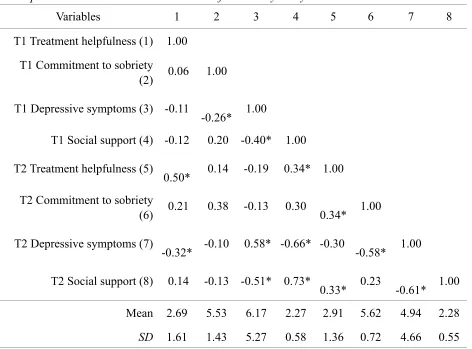
I first examined the simple correlations among the T1 and T2 variables of interest. As
expected, all the T1 variables were significantly and moderately to very strongly correlated with
their corresponding scores at T2, .38 < rs< .73. In addition, social support and depressive
symptoms were moderately to strongly negatively correlated at both T1 and T2, (r = -.40, p < .
001; r = -.61, p < .001). Similarly, depressive symptoms were moderately negatively correlated
with commitment to sobriety at both T1 and T2, (r = -.26, p = .014), and strongly at T2, (r = -.58,
p < .001). In addition, participants’ assessment of treatment helpfulness at T1 did not correlate
with any other variables of interest at T1, but moderately correlated at T2 with commitment to
sobriety, (r = .34, p = .035), social support, (r = .33, p = .039). The full correlations among the
variables of interest are presented in Table 1.
Change from T1 to T2
Next, the paired sample T-tests were conducted to examine changes from T1 to T2 for
specific variables of interest. When accounting for the autocorrelation between the assessment at
T1 and T2, there were no significant changes in participants’ scores across any of the four
variables of interest—commitment to sobriety, (t = -0.03, df = 36, p = .978); depressive
a significant decline. These results suggest that the participants’ depressive symptoms,
commitment to sobriety, social support, and perception of treatment effectiveness did not change
significantly from T1 to T2. Table 1 outlines the descriptive statistics for the variables of interest
Table 1.
Descriptive Statistics and Correlation Matrix for Primary Study Variables.
Variables 1 2 3 4 5 6 7 8
T1 Treatment helpfulness (1) 1.00
T1 Commitment to sobriety
(2) 0.06 1.00
T1 Depressive symptoms (3) -0.11
-0.26* 1.00
T1 Social support (4) -0.12 0.20 -0.40* 1.00
T2 Treatment helpfulness (5)
0.50* 0.14 -0.19 0.34* 1.00
T2 Commitment to sobriety
(6) 0.21 0.38 -0.13 0.30 0.34* 1.00
T2 Depressive symptoms (7)
-0.32* -0.10 0.58* -0.66* -0.30 -0.58* 1.00
T2 Social support (8) 0.14 -0.13 -0.51* 0.73*
0.33* 0.23 -0.61* 1.00
Mean 2.69 5.53 6.17 2.27 2.91 5.62 4.94 2.28
SD 1.61 1.43 5.27 0.58 1.36 0.72 4.66 0.55
All variables are means with the exception of depressive symptoms, which is a sum score. T1 = Time 1, T2 = time 2.
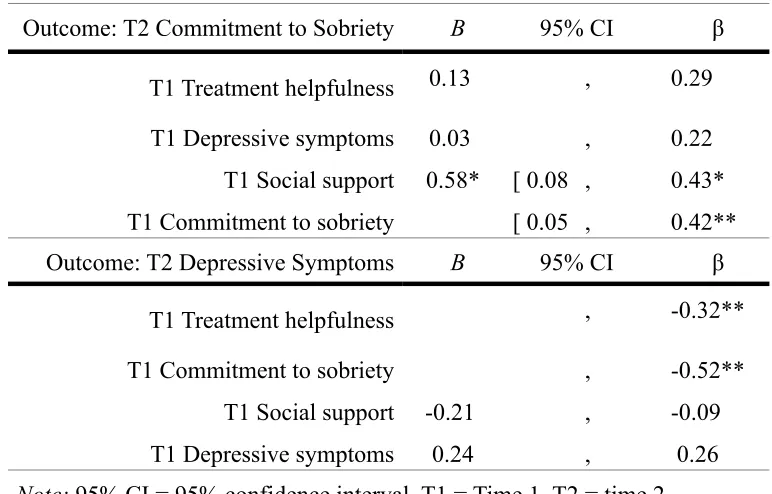
Table 2.
Model Results for the Regression Models
Outcome: T2 Commitment to Sobriety B 95% CI β
T1 Treatment helpfulness 0.13 , 0.29
T1 Depressive symptoms 0.03 , 0.22 T1 Social support 0.58* [ 0.08 , 0.43* T1 Commitment to sobriety [ 0.05 , 0.42**
Outcome: T2 Depressive Symptoms B 95% CI β
T1 Treatment helpfulness , -0.32**
T1 Commitment to sobriety , -0.52**
T1 Social support -0.21 , -0.09 T1 Depressive symptoms 0.24 , 0.26
Predicting Change in Outcomes of Interest
Finally, I used multiple regression to assess what variables might predict who
responded more or less positively to the treatment over time in terms of their commitment
to sobriety and depressive symptoms from T1 to T2. The full results for the two
regression models are presented in Table 2. In terms of commitment to sobriety,
depressive symptoms did not predict T2 commitment, (B = 0.03, β = 0.22, p = .260).
Higher perceptions of treatment helpfulness approached significance in predicting greater
commitment, (B = 0.13, β = 0.29, p = .071), whereas more social support significantly
predicted greater commitment to sobriety, (B = 0.58, β = 0.43, p = .024). All these effects
were independent of participants’ T1 commitment to sobriety, which was included as a
covariate in the model. These results suggest that people who have higher social support
also were more committed to their sobriety.
Next, I examined the model with depressive symptoms at T2 as the main outcome
of interest. Commitment to sobriety did not predict later depressive symptoms, (B =
-0.21, β = -0.09, p = .417). In contrast, greater social support levels significantly
predicted lower depressive symptoms, (B = -4.37, β = -0.52, p < .001). Similarly, higher
ratings of treatment helpfulness predicted lower levels of depressive symptoms, (B =
-0.90, β = -0.32, p = .006). All these effects were independent of participants’ T1
depressive symptoms, which was included as a covariate in the model. These results
suggest that people who have more social support and have a higher assessment of
Content Analysis
A content analysis was used to analyze the qualitative portion of the answers that
were provided by the patient. The two questions were included in the questionnaire
packet given to the patients in the initial assessment and 3-month follow up assessment.
Patients were asked the following two questions: “How does it feel to have your family
involved in your substance use treatment?” and “If they are not currently involved in your
treatment, would you like them to be involved? Why or why not?”
The patients’ responses for the question: “How does it feel to have your family
involved in your substance use treatment?” had two overarching themes. The majority of
patients identified positive qualities as to why they enjoy or would enjoy having family
involved in their substance abuse treatment.
That majority of patients identified that they would like their family members
involved in their treatment in order for them to have a greater level of understanding of
addiction and the recovery process. Understanding addiction and the recovery process
was an overarching theme, specifically family members understanding the disease model
of addiction.
“It is important to have the support from my family. They make adjustments to
allow time for recovery - meetings, sponsor contact, etc.”
“I would like my daughters to go to a few Ala-non meetings, help them
Sub-themes that were identified were: removal of blame on the patient, increasing
honesty and family member’s acceptance of the patient for their identity as an individual
suffering from addiction.
“It really helped when we are all educated about the physical process of addiction.
Took a lot the ‘hurt’ out of the situation.”
“Very helpful to know I have people who love me and my decisions and my
journey.”
Another theme that was developed was the patient having an increase in positive
feelings if their family member was involved in their treatment. Concepts, such as feeling
loved by their family, making their family members proud of them and the patient feeling
proud of themselves were all sub-items identified.
“When my family support me I feel that they accept me the way I am and
acknowledge my disease. I feel encouraged and proud to be sober.”
“My son came to one session and is very proud of me. That makes me happy.”
“[Family participation is] extremely important knowing I have the support of my
family. It has brought us closer together.”
The final theme that was developed was more openness within the patient and
family member relationship. Openness was comprised of two sub-themes: more
of their own or any other issues that would involve recovery (e.g. co-dependency issues,
addiction, depression and other mental health concerns).
“Everyone is involved except for my father who is an alcoholic still in his disease.
I would love if he were involved, maybe one day.”
Contrarily, a subset of patients reported that they did not want family involvement
in their treatment. This finding resulted in two themes; the first theme being the lack of
understanding family members have around with addiction and addiction treatment.
Several participants identified that family members do not understand and/or agree with
the disease model of drug and alcohol addiction.
“Not a fan of family involvement in recovery. They don't understand why I don’t
just stop using.”
Second, several patients did not want family involvement because they
experienced their involvement as intrusive. Addiction and addiction treatment can be a
very private topic that involves vulnerability and includes some of the darkest points in a
person’s life (Stringer and Baker, 2018). Involvement may not be appropriate for some
family members due to the adversarial nature of that relationship and level of
comfortability of the patient with certain family members.
“It feels invasive a bit. Like this is a private thing that I am working on.”
An additional theme identified was barriers as to why family members are not
identified that their family does not attend Center for Recovery (CFR) programming due
to it not being feasible due to living out of state or out of the area from CFR.
“My family is very supportive and amazing. It is a little hard though because my
mom lives in Oregon still and my sister in Colorado and my dad is MIA.”
“There are more family members I would like involved, but they live on the East
Coast.”
The patient responses for the question: “If they are not currently involved in your
treatment, would you like them to be involved? Why or why not?” Five themes were
developed for patients that would like their family members involved in their treatment at
Center for Recovery (CFR). Consistent with previous patient responses from the first
question, patients would like their family member to understand addiction.
“I would like them to be involved so they can better understand what its like to
live as an addict and to learn and understand the behavior and damage that
entails.”
Sub-themes that were found under the broad theme of understanding are: families’
understanding their role in the patient’s recovery, the family member understanding their
own recovery process and lack of understanding resulting in ending the friendship or
relationship.
treatment. We are in the process of planning for divorce. I hope my children will
recognize the benefits of my recovery over time and become part of my program.”
The second theme established was the family member having to be motivated to
attend the patient’s treatment and not involved only due to obligation. A sub-theme to the
family member’s motivation to attending treatment is the openness to overcome fears
with participating that are rooted from assumptions, biases and inaccurate information
about addiction or addiction treatment.
“I wish that my family had the desire to be a part -- active part-- of my treatment.”
“I only want them to be involved if they want to. I’d never want to force
somebody to go to groups if it is not what they want.”
The third theme is open-communication between the patient and family member
participating in treatment. The patients identified that they would be more open about
their disease with their family if they were actively participating in their treatment.
“I would like them to make me feel that I can talk to them about my disease. I feel
alone when they’re just passive, but judge me if I drink.”
“A relief. All that honestly after so much lying.”
“...I’ve kept it (use and recovery) from them. It would feel liberating to tell them,
The fourth theme as to why patients would want their family members involved in
their substance abuse treatment is for family members to understand their role in the
patient’s recovery and addressing their own issues.
“It’s wonderful to have such great support and understanding. Family counseling
at CFR helps tremendously. My wife is processing her own behavior changes and
also the 12 steps.”
“There are benefits for individual growth. I feel they are enormous and would
result in harmony for all.”
The final theme is for the patients to prove to their family member their
commitment to sobriety of abstaining from drugs or alcohol.
“It will just take time so they see I really want to stay clean and sober and really
mean it.”
The majority of patients involved in the sample responded positively to family
members being involved in their treatment; however, there were also patients that did not
want their family members to participate. There were three themes identified: lack of
willingness, out-group member bias and lack of trust.
The first theme identified was not wanting their family involved due to their loved
ones not being willing or openness to attending their treatment or learning about the
“No, not the way they are because they are not open-minded and willing -- they
don’t have a 12 step program and they don’t have a higher power. They have no
idea what it means to surrender. They don’t support the program I’m in. They use
and are unwilling.”
The second theme was the patients assuming their family member would not
understand addiction or their recovery process due to their family member not being an
addict themselves. People that are not struggling with addiction themselves are often
viewed as out-group members or “normies.”
“No, I don’t find it to be necessary. They don’t suffer from what I suffer from.
They don’t understand and probably won’t.”
The last theme identified as to why patients do not want their family member’s
involved in their treatment is due to not trusting them.
“My extended family - parents, brother, sisters, have no clue I am in recovery. It
would be nice to have their support, but I don’t trust them enough to confide in
them.”
“No, lack of trust, me to them. Lack of willingness and to request their help on
my part.”
Consistent with previous findings (i.e. Kulesza, Larimer & Rao, 2013; Stringer &
Baker, 2018), addiction treatment can be perceived as a very personal and private journey
being said, the patient would have to feel they can trust that person without the fear of
judgement or rejection.
QUALITATIVE PHASE
Participants for the present study were recruited by Center for Recovery (CFR) staff
making an announcement to family members during a Saturday group offered to family members
only. The group facilitator provided a description of the dissertation topic, its voluntary nature
and what participation involves. The participants provided their name and contact information in
order for me to contact them to schedule the interview. The family members’ names and contact
information were all destroyed to ensure participant confidentiality and were only utilized for the
purpose of the study. I randomly selected the family members listed on the sign-up sheet and
contacted them to schedule the interview. The volunteers were informed that participating in the
study is completely voluntary and they have the choice to discontinue their involvement in the
study at any time. Prior to conducting the interviews, I reviewed the patient rights,
confidentiality and received written consent from each participant. Saturation was met after
completing a total of 4 interviews.
Of this sample that was collected for the qualitative phase of the study, 2 participants
were parents and 2 were partners to the individual receiving substance abuse treatment at Center
for Recovery (CFR). Among the family members, there were a total of 2 males and 2 females
involved in the present study. The length of time the family members have been involved at CFR
ranged from 5 months to 7 years. Three of the four participants identified being in the age range
participants identified as being heterosexual. The majority of the sample racially identified as
being white, while 1 participant reported being biracial. All participants in the sample reported
having some college education or higher degree, as well as never being involved in drug/alcohol
treatment for themselves. The monthly income of this sample consisted of 3 participants making
more than $3,001 per month while 1 participant reported to Thematic Analysis: make between
$2,001-$3,000 monthly. Of this sample, 2 participants reported to have 1 child, 1 participant
identified as having 2 children and the last participant reported to have 4+ children.
Thematic Analysis
As previously mentioned, I utilized a thematic analysis in order to synthesize the data
received from family members involved at Center for Recovery. I utilized the guide to thematic
analysis by Braun and Clark (2006) as a foundation to their work (Braun & Clarke, 2006; Glaser
& Strauss, 1967). I conducted 30-45 minute interviews with family members that volunteered to
participate in the current study. I transcribed, coded and developed themes across the four
interviews that were conducted.
The analysis determined the following concepts as themes related to the benefits of
attending Center for Recovery (CFR) groups: consistency, reliability, belonging, relating to
others and exposure to upcoming hurdles.
Consistency provided family members continuity of care each week in regards to the
facilitator, style and day/time. Family members found comfort in knowing that groups are
unlimited, always available to them whether the patient is involved with Center for Recovery
(CFR) or not and can be a lifelong support to them. These elements of the groups at CFR
“I like know that this [CFR] is here. So that if I do have an issue, I know where I can
go.”
“It’s interesting that I am still here and I am very grateful for the fact that I can still come
although my qualifier is not, that is a huge benefit.”
Secondly, family members feel a sense of belonging when engaging with their peers that
share similar feelings and experiences. This idea of relating to others is a significant sub-theme
that was identified by family members. Family members described relating to others as a way of
reducing isolation due to knowing there are others that share similar stories, feelings (e.g. pain,
anger, resentment) and experiences they have. Additionally, family members value the bonds that
are established through CFR and community that is formed through attending groups on a
regular basis. Relationships between group members are said to become stronger with
involvement in groups.
“Like I feel like definitely a sense of family here. Like I feel like I belong here, I don’t
feel like I am with a bunch of strangers and I think a lot of that is there are a lot of people,
like regular families here.”
“My theory of why it works, there definitely might be more to it, but it’s definitely the
community experience -- Addiction is a disease that attacks social organization or social
connection and therefore the cure must be through social connection to whatever
degree.”
“I just felt that I didn’t have anyone to go to or like some book I could read and figure out