USF Scholarship: a digital repository @ Gleeson Library |
Geschke Center
Doctoral Dissertations Theses, Dissertations, Capstones and Projects
5-2018
Vocabulary-Learning Strategies of Students
Learning Chinese as a Foreign Language in an
Intensive-Training Setting
Yan Wang
University of San Francisco, [email protected]
Follow this and additional works at:https://repository.usfca.edu/diss
Part of theBilingual, Multilingual, and Multicultural Education Commons
This Dissertation is brought to you for free and open access by the Theses, Dissertations, Capstones and Projects at USF Scholarship: a digital repository @ Gleeson Library | Geschke Center. It has been accepted for inclusion in Doctoral Dissertations by an authorized administrator of USF Scholarship: a digital repository @ Gleeson Library | Geschke Center. For more information, please [email protected].
Recommended Citation
Wang, Yan, "Vocabulary-Learning Strategies of Students Learning Chinese as a Foreign Language in an Intensive-Training Setting" (2018).Doctoral Dissertations. 478.
VOCABULARY-LEARNING STRATEGIES OF STUDENTS LEARNING CHINESE AS A FOREIGN LANGUAGE IN AN INTENSIVE-TRAINING SETTING
A Dissertation Presented to
The Faculty of the School of Education Learning and Instruction Department
In Partial Fulfillment
of the Requirements for the Degree Doctor of Education
by Yan Wang San Francisco, CA
ii
THE UNIVERSITY OF SAN FRANCISCO Dissertation Abstract
Vocabulary-Learning Strategies of Students Learning Chinese as a Foreign Language in an Intensive-Training Setting
Compared with the research on vocabulary-learning strategies in the field of
teaching English as a second or a foreign language, the research on the strategy use of
Chinese-as-a-foreign-language (CFL) students, especially CFL students in an
intensive-training setting, is scarce. The relationship between CFL students’
vocabulary-learning-strategy use and their learning outcomes remains underresearched. Therefore, this
mixed-methods study was conducted to investigate the strategy use of CFL students in
learning Chinese vocabulary words in an intensive language program and its relationship
to students’ learning outcomes.
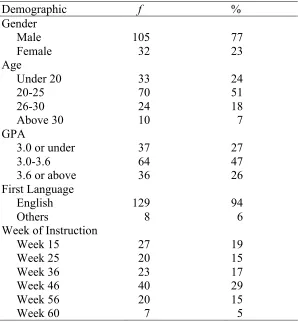
A total of 137 beginning to advanced students enrolled in the program
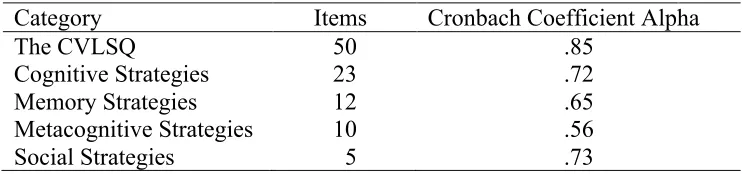
participated in the study. The strategy use of the students was measured by a 50-item
questionnaire, and students’ learning outcomes were measured by their end-of-semester
II Proficiency Progress Test, which includes a listening and a reading test. Interviews
with nine participants of different grade-point-averages (GPAs; high, middle, and low)
were conducted to gain a better understanding of the strategy use for more-successful and
less-successful students.
Descriptive data analysis revealed that the students in this study used 20 strategies
commonly in their vocabulary learning. Of the 20 strategies, most of them were
cognitive strategies and metacognitive strategies, and the majority of the commonly-used
iii
findings indicated that students with higher GPAs used more strategies and that certain
patterns of strategy use differentiated more-successful students from less-successful
students. Pearson product-moment correlation analyses revealed that several strategies
involving learning and using vocabulary words in an authentic context had a positive and
statistically significant association with students’ listening scores and reading scores,
whereas several strategies focusing on decontextualized memorization of vocabulary
words had a negative and statistically significant association with students’ listening
scores. Two orthographic-knowledge-based strategies were found to be correlated
positively with students’ reading scores.
The findings of the study suggest that orthographic-knowledge-based strategies
and metacognitive strategies such as selective attention are essential for CFL students in
vocabulary learning. Strategies involving learning and using Chinese vocabulary words
in an authentic context are important for CFL students to develop higher language
iv
This dissertation, written under the direction of the candidate’s dissertation committee
and approved by the members of the committee, has been presented to and accepted by
the Faculty of the School of Education in partial fulfillment of the requirements for the
degree of Doctoral of Education. The content and research methodologies presented in
this work represent the work of the candidate alone.
Yan Wang 8 May 2018
Candidate Date
Dissertation Committee
Dr. Patricia Busk 8 May 2018
Chairperson
Dr. Robert Burns 8 May 2018
v
Acknowledgements
I am grateful to all of those with whom I have had the pleasure to work during this project. First, I would like to thank Dr. Busk, my dissertation chair, for her expertise, support, and availability. She has been a great mentor for me, and I am especially thankful for her guidance in research design and statistical analyses and her timely feedback. Her dedication, kindness, and encouragement have been inspirational and motivating.
I would like to express my gratitude to Dr. Burns, who helped me with his insightful advice from the inception of the research proposal to the completion of this project. I am very grateful to him for believing in me and challenging me to do better. What I learned from his research classes and proposal seminar class is invaluable for this project and any future projects.
I would also like to thank Dr. Popal for sharing his expertise in second language acquisition. I benefited greatly from his guidance on conducting qualitative research, and the books that he recommended to me provided important insight into qualitative data analyses.
I am deeply indebted to the colleagues who generously offered their help in different aspects of this project, including data collection, validating the instrument, establishing interrater reliability, and reviewing the qualitative data analyses. I am also thankful to the students who voluntarily participated in this study—without them this research project would not have been possible. Lastly, my thanks go to my family and friends, who always supported and encouraged me in face of difficulties and
vi
TABLE OF CONTENTS
Page
ABSTRACT ... ii
SIGNATURE PAGE ... iv
ACKNOWLEDGEMENTS ... v
TABLE OF CONTENTS ... vi
LIST OF TABLES ... ix
LIST OF FIGURES ... xi
CHAPTER I. STATEMENT OF THE PROBLEM ... 1
Purpose of the Study ... 4
Significance of the Study ... 5
Theoretical Framework ... 6
Background and Need ... 9
Definition of Terms ... 18
Summary ... 20
II. REVIEW OF THE LITERATURE ... 22
Language-Learning Strategies ... 22
Classifications of second-language-learning strategies ... 22
Language-learning strategies and second-language-learning theories ... 26
Language-learning strategies and learner proficiency ... 32
Summary ... 38
Vocabulary Acquisition: Breadth and Depth of Vocabulary Knowledge ... 39
Breadth of vocabulary knowledge and language proficiency ... 39
Depth of vocabulary knowledge and language proficiency ... 42
Summary ... 45
Second-Language Vocabulary Development ... 46
Research on Vocabulary-Learning Strategies ... 50
Taxonomy of vocabulary-learning strategies ... 50
Vocabulary-strategy use and learner proficiency ... 52
Summary ... 62
Unique Features of Chinese Characters ... 63
Orthographic features of Chinese characters ... 63
Phonological features of Chinese characters ... 66
vii
TABLE OF CONTENTS CONTINUED
CHAPTER Page
Summary ... 70
Research on Chinese Vocabulary-Learning Strategies ... 70
Classification of Chinese-vocabulary-learning strategies ... 71
Frequently-used Chinese-vocabulary-learning strategies ... 73
The effectiveness of individual strategies ... 78
Chinese-vocabulary-strategy use and learning outcomes ... 84
Summary ... 87
III. METHODOLOGY ... 90
Research Design ... 90
Setting and Participants ... 92
Recruitment ... 95
Protection of Human Subjects ... 95
Instrumentation ... 97
Chinese Vocabulary Learning Strategy Questionnaire ... 97
Development of CVLSQ ... 98
Validity and reliability of CVLSQ ... 100
End-of-semester II proficiency tests ... 103
Interview ... 104
Procedures for Data Collection ... 105
Pilot Procedures ... 106
Data Analysis ... 110
Quantitative analysis ... 111
Qualitative analysis ... 113
The researcher’s Role ... 115
Validity and reliability ... 116
Summary ... 118
IV. FINDINGS ... 119
Research Question 1 ... 119
Research Question 2 ... 124
Quantitative findings ... 124
Qualitative findings ... 125
Theme 1 ... 126
Theme 2 ... 129
Theme 3 ... 130
Theme 4 ... 135
Theme 5 ... 140
Theme 6 ... 142
Research Question 3 ... 144
viii
TABLE OF CONTENTS CONTINUED
CHAPTER Page
V. SUMMARY, LIMITATIONS, DISCUSSION, CONCLUSIONS,
IMPLICATIONS, AND RECOMMENDATIONS ... 150
Summary of Study ... 150
Summary of Findings ... 155
Limitations ... 160
Discussion of Findings ... 161
Conclusions ... 176
Implications for Educational Practice ... 178
Recommendations for Future Research ... 182
Afterword ... 185
REFERENCES ... 187
APPENDIXES ... 199
A. Chinese Vocabulary Learning Strategy Questionnaire ... 200
B. The Taxonomy of Chinese Vocabulary Learning Strategies ... 206
C. Questionnaire Validation Rubric for Expert Panel ... 210
D. Codebook ... 212
ix
LIST OF TABLES
Table Page
1. Direct Strategies: Memory, Cognitive, and Compensation Strategies ...24
2. Indirect Strategies: Metacognitive, Affective, and Social Strategies ...25
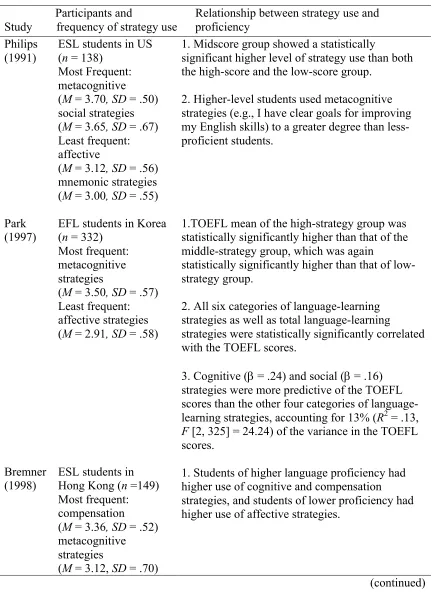
3. Studies on Language-Strategy Use and Learner Proficiency ...36
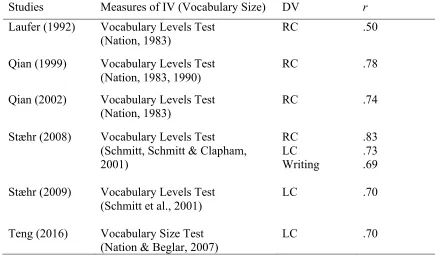
4. Correlations Between Vocabulary Size and Language Proficiency ...42
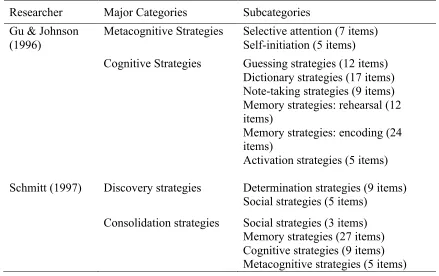
5. Summary of Two Taxonomies of Vocabulary-Learning Strategies ...51
6. Demographic Data for the Participants ...94
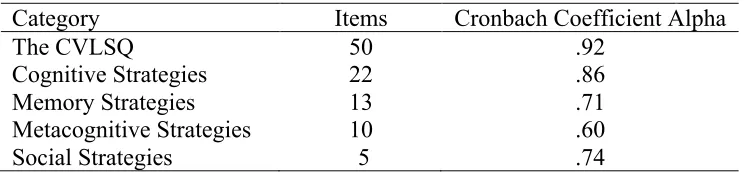
7. Reliability of the CVLSQ ...102
8. Pearson Product-Moment Correlation Coefficients of Four Strategy Categories ...102
9. Demographic Data for the Participants of Pilot Study 1 ...107
10.Demographic Data for the Participants of Pilot Study 2 ...108
11.Reliability of the CVLSQ from Pilot Study 2 ...109
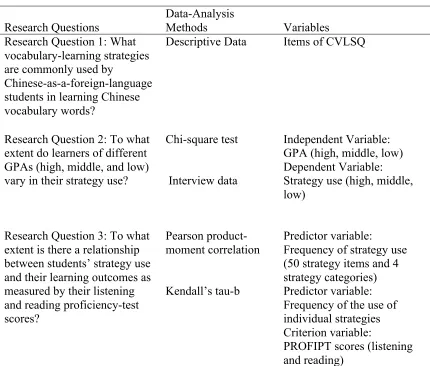
12.Overview of Research Methods ...110
13.Strategies Most-Commonly Used by Students in Learning Chinese Vocabulary Words ...120
14.Strategies Less-Commonly Used by Students in Learning Chinese Vocabulary Words ...122
15. Strategies Least-Commonly Used by Students in Learning Chinese Vocabulary Words ...123
16.Percentage of Four Types of Strategies by Groups ...123
17.Demographic Information for Nine Interviewees ...126
18.Strategy Use of Three GPA Groups ...127
x
LIST OF TABLES CONTINUED
Table Page
20.Pearson Product-Moment Correlations Between Strategy Use and Proficiency Tests ...145
21.Percentages for Listening and Reading Scores by Percentile Group ...145
xi
LIST OF FIGURES
Figure Page
1. Oxford’s language-learning strategy taxonomy ...9
CHAPTER I
STATEMENT OF THE PROBLEM
Vocabulary has been considered to be the core element of foreign-language
learning (Coady & Huckin, 1997; Nation, 2001; Read, 2000; Teng, 2016). Vocabulary
skills are related closely to almost all aspects of a learner’s second-language (L2)
proficiency, and a large vocabulary is essential for learners to use a second language
successfully (Meara, 1980; Nation, 2001; Schmitt, 2000). Studies on the relationship
between vocabulary and learners’ proficiency have provided empirical evidence that
statistically significant positive correlations exist between students’ vocabulary
knowledge and their reading comprehension (Qian, 1999, 2002), listening comprehension
(Stæhr, 2009; Teng, 2016), and the quality of their written work (Daller & Phelan, 2007).
The importance of vocabulary acquisition also is well reflected in the studies
conducted to investigate the percentage of lexical items in spoken or written discourses
that a learner needs to know in order to understand the discourses. Take English as a
second (ESL) or as a foreign language (EFL) for example. Researchers previously
thought that around 95% coverage was sufficient to understand a written text (Laufer,
1989), but a more recent study found that 98% coverage was needed for unassisted
comprehension of a fiction text (Hu & Nation, 2000). The current evidence suggests that
6,000 to 7,000 word families (e.g., the root form, inflections, and regular derivations of a
word) are required to understand spoken discourses if 98% coverage is needed. A reader
would need 8,000 to 9,000 word families to read a range of authentic texts such as novels
The statistics of the aforementioned studies suggest that learning a larger number
of lexical items is a great challenge for foreign-language learners. Schmitt (2008)
pointed out that vocabulary sizes of learners in several research studies (e.g., Laufer,
2000) typically fell short of the size requirements reported above. Learners, however, are
not likely to develop adequate vocabulary simply through their engagement in language
tasks that focus on either linguistic aspects or communication. Rather, “a more proactive,
principle approach” (Schmitt, 2008, p. 333) should be taken in promoting vocabulary
learning, and one component of such an approach is using vocabulary-learning strategies.
Indeed, the techniques and strategies that learners use when they learn vocabulary words
have been gaining much attention since the 1980s (e.g., O'Malley & Chamot, 1990;
Oxford, 1990; Rubin, 1981; Schmitt, 1997). Researchers hope to achieve a thorough
understanding of the complex learning process and to explore new ways to support
learners in their second- or foreign-language acquisition through the investigation of
learners’ strategy use in their vocabulary acquisition and its relationship to learning
outcomes and learner proficiency.
Several empirical studies on learners’ vocabulary-strategy use have shed light on
the connection between strategy use and language achievement (Lai, 2016). The major
findings of these studies include that successful learners use different types of strategies
than their less successful peers (Ahmed, 1989; Barcroft, 2009; Fan, 2003; Gu, 2010; Gu
& Johnson, 1996; Kojic-Sabo & Lightbown, 1999; Lawson & Hogben, 1996; Sanaoui,
1995) and use those strategies more frequently (Ahmed, 1989; Kojic-Sabo & Lightbown,
1999; Lawson & Hogben, 1996), that there is a strong positive relationship between
proficiency tests (Barcroft, 2009; Gu & Johnson, 1996; Kojic-Sabo & Lightbown, 1999;
Teng, 2015), and that vocabulary-learning strategies predict students’ vocabulary
development (Gu, 2010; Lai, 2016; Teng, 2015). The majority of the studies on
vocabulary-learning strategies have been conducted in the area of ESL and EFL, whereas
little research has been conducted regarding the vocabulary-learning strategies of less
commonly taught foreign languages such as Chinese.
In the Chinese written language, words consist of Chinese characters and
“learning characters cannot be separated from learning words, and learning both
characters and words contributes to learning vocabulary” (Shen & Xu, 2015, p. 83).
Therefore, the concept of vocabulary-learning strategies in this study encompassed the
strategies for learning Chinese characters as well as the strategies for learning Chinese
vocabulary words. For students whose first language uses an alphabetical system such as
English, it is particularly challenging for them to learn Chinese characters (Shen, 2005;
Sung, 2012, 2014). The linguistic complexity of Chinese characters, such as the lack of
sound-to-script correspondence, the large number of characters with the same
pronunciation but different graphic representations, and the irregularity of strokes, poses
a great challenge for English speakers learning Chinese (Shen, 2005). The challenge of
learning Chinese words by English speakers is evident in the study of Shen (2009), which
showed that after the completion of 3rd-year Chinese classes in college, the students’
average number of known words from the 8,500-word corpus was 2,229. The slow
progress in vocabulary building became a hindrance for students to develop their other
(CFL) to expand their vocabulary repertoire, effective vocabulary-learning strategies are
needed to inform vocabulary instruction in a Chinese language class.
Compared with the research in the vocabulary-learning strategies of ESL or EFL
learners, the number of studies (e.g., Ke, 1998; Shen, 2005; Shen & Ke, 2007; Sung,
2014; Wang, 1998) conducted on the vocabulary-learning strategies of CFL learners is
relatively small. Among the studies on Chinese vocabulary-learning strategies, the
majority focused on the strategies that learners use in encoding Chinese characters (e.g.,
Ke, 1998; Shen & Ke, 2007), some identified the character-learning strategies commonly
used by CFL students (Shen, 2005; Sung, 2012, 2014), and a few investigated the
relationship between character-learning strategies and students’ learning outcome as
measured by a vocabulary test (e.g., Sung, 2014). The endeavor of these studies provided
useful information on Chinese character-learning strategies; however, whether there is a
relationship between students’ strategy use and their learning outcomes as measured by
tests other than vocabulary tests and whether more successful and less-successful
students use strategies differently is unclear. Therefore, the current study was conducted
to provide data on these aspects regarding Chinese vocabulary-learning strategies.
Purpose of the Study
Learning Chinese characters, the constituents of the written Chinese words, has
posed a great challenge for CFL learners. A limited number of studies (e.g., Ke, 1998;
Shen, 2005) have been conducted to investigate the vocabulary-strategy use of CFL
learners; however, the findings generated from these studies were far from being
sufficient to understand how CFL learners’ vocabulary-strategy use is related to their
use of CFL students in learning Chinese vocabulary words and its relationship to
students’ learning outcomes.
To this end, the study first identified the vocabulary-learning strategies commonly
used by the CFL students in a military language institute. The study then investigated
whether students of varying grade-point-averages (GPAs), high, middle, and low, used
strategies differently. The study also examined the relationship between students’
vocabulary-strategy use and their learning outcomes as measured by their proficiency
tests in listening and reading. By investigating the Chinese vocabulary-learning
strategies of the CFL learners in the Chinese Basic Course, a 64-week
intensive-language-training program, this study was expected to generate findings that contribute to
the existing literature on vocabulary-learning strategies as well as inform the teaching
practice of CFL teachers.
Significance of the Study
This study was significant for two reasons. First, the study expanded the current
literature on Chinese vocabulary-learning strategies by examining the strategy use of
CFL students in an intensive-language-training setting. Prior research on Chinese
characters or Chinese vocabulary-learning strategies mostly have been conducted in
nonintensive-language-learning settings such as Chinese language programs in
universities in the US, where students receive on average 4 to 5 hours of language
training weekly, while studying other subjects. The current study was conducted in an
intensive-language-training setting, where students receive 6 hours of language training
on a daily basis for a total of 64 weeks and that is the only subject they are studying. The
vocabulary-learning strategies are used commonly by students in different learning
contexts. Accordingly, the CFL instructors could select the most relevant strategies to
teach to their students depending on specific learning situations.
Second, this study provided important information for Chinese language
programs that intend to incorporate vocabulary-strategy instruction into their curriculums.
The educational movement toward learner centeredness (Nunan,1988; Wenden, 2002)
has called for strategy instruction in a language-teaching curriculum. The focus of
language instruction has shifted toward the needs of individual learners, and the learners
are encouraged to take more responsibility for their learning and become autonomous by
learning how to learn a language (Cohen, 2000). As Cohen (2000) pointed out, however,
learners often do not develop adequate mastery of various strategies on their own, and
explicit strategy training is necessary to help the language learners become more aware of
and proficient with a wide variety of strategies so that they can use the strategies
consistently during the learning process. The findings of the current study provide CFL
instructors much needed information in designing a strategy-instruction curriculum, such
as what Chinese vocabulary-learning strategies are more useful for students’ skill
development in listening or reading and what strategies generally are found lacking in
less-successful students and, therefore, should be emphasized in the study plan for these
students.
Theoretical Framework
Oxford’s (1990) language-learning-strategy theory served as the theoretical
theory were learner autonomy and self-regulation. Oxford (1999) defined learner
autonomy as the
(a) ability and willingness to perform a language task without assistance, with adaptability related to the situational demands, with transferability to other relevant contexts, and with reflection, accompanied by (b) relevant action (the use, usually conscious and intentional, of appropriate learning strategies) reflecting both ability and willingness. (pp. 110-111)
According to Oxford (1999), language-learning strategies reflect the learner’s
degree of autonomy and are mechanisms by which the learner develops still greater
autonomy. The concept of autonomy in the foreign- and second-language field is often
known as self-regulation in the psychology field, which is an important component of the
sociocultural theory of Russian psychologist Lev Vygotsky (1978, 1986). Vygotsky’s
(1978, 1986) theory emphasized the importance of metacognition and insisted that
education should be concerned with learning to learn, developing learners’ skills and
strategies to continue to learn. In doing so, educators make learning experience
meaningful and relevant to the learner’s life and relate the learning experience to the
development of the learner as a whole person (Williams & Burden, 1997).
In addition, Vygotsky’s (1978, 1986) theory emphasized the social aspects of
learning such as learning from teachers or more capable peers. The theory postulated that
the goal of learning is to develop an independent, self-regulated, problem-solving
individual with the help of someone (e.g., teachers, parents, or more competent peers)
who can provide the learner the assistance needed for solving the problem.
Self-regulation was viewed as the process during which the learner plans, guides, and
monitors his or her attention and behavior. The behaviors involved in this process are
Learners internalize metacognitive strategies thorough interacting with more competent
people in the learning environment. Similarly, when interacting with more competent
people, the learner internalizes cognitive learning strategies such as analyzing,
synthesizing, and evaluating (Oxford, 1999).
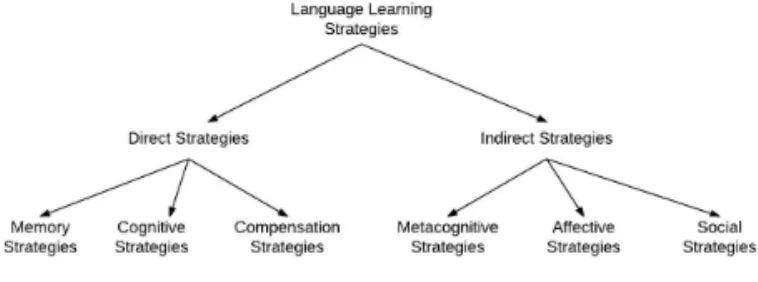
Oxford’s (1990) language-learning-strategy theory differentiates between direct
and indirect learning strategies. Direct strategies are defined as the ones that directly
involve the language being learned and indirect strategies as those that do not involve
directly the target language but are considered to be helpful for learning the language.
Direct strategies are further subcategorized into memory, cognitive, and compensation
strategies, and indirect strategies are subdivided into metacognitive, affective, and social
categories.
According to Oxford’s (1990) categorization system, memory strategies involve
remembering and retrieving information and relating new material to existing knowledge.
Examples of memory strategies include creating mental linkages or applying images and
sounds in remembering a new word. Social strategies improve language learning through
interacting with other people and managing discourse. Cognitive strategies manipulate
the reception and production of language, for example, repeating a word verbally or
creating word lists. Metacognitive strategies involve a conscious overview of the
learning process through planning, monitoring, and evaluating one’s learning.
Compensation strategies are used to overcome deficiencies in knowledge of the language
(e.g., guessing unknown meaning while listening and reading). Affective strategies
involve feelings, attitudes, and motivations related to learning. The model of Oxford’s
define the vocabulary-learning strategies and interpret the findings of the study. The two
strategy categories, compensation and affective, did not apply to the classification of
Chinese vocabulary learning strategies in the current study; therefore, only four strategy
categories, cognitive, memory, metacognitive, and social, were used to classify Chinese
vocabulary-learning strategies.
Figure 1. Oxford’s (1990) language-learning strategy taxonomy
Background and Need
Along with the growing political and economic status of China in the international
communities, Mandarin Chinese has been identified as a critical foreign language in the
US, and the number of students interested in learning Chinese has been increasing
rapidly, which is reflected in the statistics from enrollments in languages other than
English in United States institutions of higher education. For example, there were 412
institutions offering Chinese language programs in 1990, and this number doubled by the
year 2013, reaching 866. In terms of number of students, in 1960, there were only 679
students enrolled in Chinese, and this number has been increasing annually since then.
By the end of the year of 2013, the enrollment had risen to 61,055 (Furman, Goldberg, &
The increasing enrollment of CFL students in the US has made the indepth
investigation of Chinese vocabulary-learning strategies more important than ever, as the
unique orthographic and phonological features of the Chinese language are likely to pose
great challenges for English-speaking students. Unlike the alphabetical writing system of
English in which each letter approximately encodes a phoneme, Chinese is a logographic
language in that a character corresponds to a sound and meaning at the level of syllable
(Sun, 2006). A Chinese word usually consists of one or more characters and to acquire a
Chinese word means the mastery of the three aspects of the word: shape (character),
pronunciation, and meaning. Each character is formed in a three-tier manner: stroke,
radical, and character. The smallest units of characters are strokes, and the strokes are
configured in different ways to form radicals, which are combined with other radicals to
form different characters.
In addition, unlike English, Chinese generally is considered to be an
orthographically deep language, which means that there is a lack of one-to-one
correspondence between the sound and the script of the Chinese words (Katz & Feldman,
1983). In learning English, a learner usually can predict the pronunciation based on the
spelling of a word. In the case of Chinese, even though some characters have phonetic
components that cue the pronunciation of the characters, as the Chinese language has
evolved, many characters are no longer pronounced the same as their phonetic
components.
As far as phonology is concerned, one major challenge for English-speaking
students lies in the fact that Chinese is a tonal language. The spoken language of Chinese
example, without tones, the four characters 妈 (ma with the first tone, mother), 麻 (ma
with the second tone, num), 马 (ma with the third tone, horse), and骂 (ma with the fourth
tone, scold) all sound the same. The lack of tone feature in English makes it particularly
hard for English-speaking learners to acquire fully the tone skills and this challenge is
summarized in the study of Wang, Perfetti, and Liu (2003). According to the researchers,
even after studying Chinese for a semester, U.S. college students still encounter great
difficulty in acquiring tone skills. Relying on tones to distinguish meanings also results
in a large number of homophones in Chinese. For instance, typing in the electronic
dictionary the sound “li” with the second tone, a learner will see several characters with
this pronunciation such as 离 (to depart), 黎 (dawn), 梨 (pear), 蓠 (fence), 犂 (to plow).
Learners need to use their character knowledge and appropriate context to determine the
meaning of homophones (Sung, 2012, 2014).
Due to the previously mentioned orthographic and phonological features, learning
Chinese vocabulary words remains a great challenge for alphabetical learners such as
native English speakers. Shen (2009) reported that after the completion of 3rd-year
Chinese classes in college, the students’ average number of known words from the
8,500-word corpus was 2,229. The slow progress in vocabulary building became a hindrance
for students to develop their other language skills. Xing (2003) observed that some of the
students in advanced-level classes still had not found effective strategies to study Chinese
reading and writing. Many of them had difficulty applying high-level vocabulary in their
conversions, and instead they kept using the low-level vocabulary that they learned in the
In fact, whether it is learning Chinese or other languages as a foreign or second
language, learners are not likely to achieve higher levels of language proficiency without
mastery of a large vocabulary. As Meara (1980) pointed out, “learners themselves
readily admit that they experience considerable difficulty with vocabulary, and once they
have got over the initial states of acquiring their second language, most learners identify
the acquisition of vocabulary as their greatest single source of problems” (p. 100).
Meara’s (1980) conclusion is well supported by a series of studies investigating the
diverse aspects of vocabulary knowledge and the relationship between vocabulary
knowledge and learners’ language proficiency. These studies investigated vocabulary
breadth knowledge as well as the depth of vocabulary knowledge. Vocabulary breadth
knowledge refers to “the number of words the meaning of which one has at least some
superficial knowledge” (Qian, 2002, p. 515). The depth of vocabulary knowledge means
how well one knows about a word (Nation, 2001). These empirical studies (Ehsanzadeh,
2012; Nation, 2013; Schmitt, 2008; Stæhr, 2008; Teng, 2016) all found strong and
statistically significant relationships between the breadth and depth of vocabulary and
learners’ language proficiency. For example, some studies documented a strong and
statistically significant relationship between vocabulary knowledge and reading
comprehension (Ehsanzadeh, 2012; Qian, 2002; Stæhr, 2008). Other studies revealed the
important role that vocabulary knowledge plays in students’ listening proficiency
(Nation, 2013; Schmitt, 2008), and according to these studies, learners need to recognize
at least 95% of the total running words to have adequate listening-comprehension scores.
The aforementioned studies provided empirical evidence highlighting the
The mastery of the full range of word-knowledge aspects requires that the word will have
to be met in many different contexts, which entails the necessity for the learner to employ
different learning strategies to create such contexts, such as looking up new words in the
dictionary and reading the example sentences with the words or using new words in a
conversation with a native speaker. In addition, as Schmitt (2008) argued, “students need
the willingness to be active learners over a long period of time, for without this, they are
unlikely to achieve any substantial vocabulary size, regardless of the quality of
instruction” (p. 333). When students have effective vocabulary-learning strategies from
which they can choose freely, they are more likely to become active learners and achieve
better learning outcomes in their vocabulary acquisition.
Therefore, along with the research exploring the relationship between learners’
vocabulary knowledge and their language proficiency, vocabulary-learning strategies also
started to draw greater attention in vocabulary-acquisition studies. Several taxonomies
have been developed to categorize and describe the vocabulary-learning strategies used
by ESL or EFL learners (Fan, 2003; Gu & Johnson,1996; Nation, 2001; Schmitt, 1997).
Many of these taxonomies have drawn upon Oxford’s (1990) commonly used taxonomy
of language-learning strategies, which included six categories: metacognitive strategies,
cognitive strategies, memory strategies, social strategies, compensation strategies, and
affective strategies.
The establishment of vocabulary-learning-strategies taxonomies provided useful
tools for researchers to further explore learners’ vocabulary-strategy use and their
learning outcomes. The findings of several empirical studies have shed light on the
(Lai, 2016). The general findings of these studies include but are not limited to the
following: successful learners use a variety of strategies (Ahmed, 1989; Fan, 2003; Gu &
Johnson, 1996; Kojic-Sabo & Lightbown, 1999; Lawson & Hogben, 1996), there is a
strong positive relationship between students’ strategy use and the learning outcomes as
measured by vocabulary tests or proficiency tests (Barcroft, 2009; Gu & Johnson, 1996;
Kojic-Sabo & Lightbown, 1999; Teng, 2015), more-successful learners use strategies
differently than less-successful learners (Ahmed, 1989; Fan, 2003; Gu & Johnson, 1996;
Kojic-Sabo & Lightbown, 1999; Lai, 2016; Lawson & Hogben, 1996; Sanaoui, 1995),
and higher-achievement learners use more strategies than lower-achievement learners
(Ahmed, 1989; Fan, 2003; Gu, 1994; Lawson & Hogben, 1996; Schmitt, 1997).
Although previous studies have reached no consensus regarding which individual
strategies or strategy types are related closely to better learning achievement, some
studies (e.g., Ahmed, 1989; Gu & Johnson, 1996; Kojic-Sabo & Lightbown, 1999; Lai,
2016; Sanaoui, 1995; Teng, 2015) have found that certain strategy patterns differentiate
more-proficient learners from less-proficient learners (Lai, 2016). For example, Gu and
Johnson (1996) concluded that metacognitive self-regulation is crucial in vocabulary
learning. Kojic-Sabo and Lightbown (1999) reported that learner impendence and time
spent in learning and practicing vocabulary were most-closely related to successful
vocabulary learning and overall language achievement. Teng (2015) found that indirect
strategies such as self-planning and self-monitoring had a high level of correlation with
students’ vocabulary knowledge. The findings generated from these studies have
important pedagogical implications for second-language vocabulary teaching and
Compared with the research on vocabulary-learning strategies in ESL or EFL, the
research on Chinese vocabulary-learning strategies is rather limited in both scope and
depth. Among the studies on Chinese vocabulary-learning strategies, some focused on
identifying the strategies commonly used by CFL learners (Grenfell & Harris, 2015; Ke,
1996, 1998; McGinnis, 1999; Shen, 2005; Wang, 1998; Wang & Leland, 2011; Winke &
Abbuhl, 2007; Zahradníková, 2016), some investigated the effectiveness of individual
strategies such as the strategy of using semantic radical knowledge to encode characters
(Everson & Ke, 1997; Gamage, 2003; Guan, Liu, Chan, Ye, & Perfetti, 2011; Hayes,
1988; Shen, 2004; Taft & Chung, 1999 ), and others examined the relationship between
strategy use and learning outcomes (Ke, 1998; Sung, 2012, 2014). The major findings of
these studies include that cognitive strategies that are orthographic-knowledge-based
(e.g., applying radical knowledge when learning new characters) are used commonly by
students in learning Chinese vocabulary words (Grenfell & Harris, 2015; Ke, 1998; Shen,
2005; Zahradníková, 2016), that using orthographic-knowledge-based strategies
effectively can facilitate students’ vocabulary learning (Ke, 1998; Shen, 2004; Shen &
Ke, 2007; Sung, 2012, 2014; Taft &Chung 1999; Xu, Chang, & Perfetti, 2014), that input
and output strategies that create opportunities to learn and use vocabulary in context are
perceived helpful by learners (Wang & Leland 2011; Winke & Abbuhl, 2007), that
phonological strategies (e.g., saying a character while writing it) increase students’ level
of phonological comprehension of the words heard (Sung, 2014), but they are underused
by learners (Hayes, 1988; Ke, 1996; Zahradníková, 2016), and that metacognitive
strategies related to systematic reviewing and previewing of vocabulary words play an
Even though the findings of these studies provided important information
regarding CFL learners’ strategy use in learning vocabulary words, the relationship
between CFL learners’ vocabulary-strategy use and their learning outcomes remains
underresearched. Only three published studies investigated this relationship, and the
studies all took place in a nonintensive language setting. One study was conducted by Ke
(1998) who sought the relationship between students’ strategy use and their performance
in character recognition and production. The study found that learning strategies
associated with practicing characters in the context of vocabulary items and with
associating new characters with known characters in terms of graphic structure were the
two strategies with the largest statistically significant effect on character recognition after
controlling for site, explaining 6.65% of the variation on the scores of the Chinese
character recognition. The strategy of learning character components (semantic radical
and phonetic radicals) was found to predict students’ character production, explaining an
additional 3.04% of the variation in the scores of character production after controlling
for site.
Another study was conducted by Sung (2014), who replicated her earlier study
conducted in 2012. The study identified 20 most-frequently used strategies that had
averages higher than 3.5 on a 5-point Likert-type scale. The principal-component
analysis along with Varimax rotation conducted on these 20 strategies resulted in three
components. Component 1 was defined by the five strategies related to the phonetic
aspects of characters, Component 2 was defined by the four strategies related to
remembering a character’s or a word’s graphic information and its association with its
how a character or a word is written and used. The three components together explained
44% of the variance among the student ratings of strategies. The results of the multiple
regression analyses where students’ strategy use was regressed onto their Chinese
character performance showed that the participants using certain phonological strategies
more frequently performed better on the phonological-comprehension part of the test,
whereas the participants using orthographic strategies more-frequently performed better
on the graphic comprehension, graphic production, and phonological production parts of
the test.
Both Ke’s (1998) study and Sung’s (2014) study provided important empirical
evidence on what strategies are effective for learners’ vocabulary acquisition in learning
Chinese. Both studies, however, used only vocabulary tests to measure students’ learning
outcomes, and they were conducted in a nonintensive learning environment. In addition,
there was a lack of research on whether more-successful and less-successful students use
strategies differently in learning Chinese vocabulary words. Given the importance of
vocabulary knowledge in CFL students’ language-proficiency development and the need
to understand the role that vocabulary-learning strategies play in CFL students’ learning
outcomes, further studies on Chinese vocabulary-learning strategies, specifically CFL
students’ vocabulary-strategy use in an intensive-language-training setting and its
relationship to students’ learning outcomes, were merited.
To this end, the current study was conducted to answer the following research questions:
1. What learning strategies are commonly used by Chinese-as-a-foreign-
language students in learning Chinese vocabulary words?
in their strategy use?
3. To what extent is there a relationship between students’ strategy use and
their learning outcomes as measured by their listening and reading
proficiency-test scores?
Definition of Terms
The following is a list of the definitions for the terms used in the study. There
may be different definitions for these terms, but the definitions provided here are the ones
that apply to the study.
The Chinese Vocabulary Learning Strategies Questionnaire (CVLSQ) was administered
to collect information on students’ strategy use in learning Chinese vocabulary words in
this study. The CVLSQ is a 5-point Likert-type scale that measures the frequency of
CFL students’ strategy use with 5 representing “Always or almost always true of me,” 4
“Generally true of me,” 3 “Somewhat true of me,” 2 “Generally not true of me,” and 1
“Never or almost never true of me.” The questionnaire, adapted from Shen’s (2005)
Character Learning Strategy Inventory, has 50 items that are classified into four strategy
categories: (a) cognitive strategies, (b) memory strategies, (c) metacognitive strategies,
and (d) social strategies.
Cognitive Strategies are the strategies that learners use to manipulate the reception and
production of language (Oxford, 1990). Examples of cognitive strategies that CFL
students use in learning Chinese vocabulary words include saying the Chinese character
(or word) aloud or silently to oneself when writing it and using new words in e-mail or
journal writing. Cognitive strategies that CFL students in this study used in learning
Language-learning strategies are “the specific actions taken by the learner to make
learning easier, faster, more enjoyable, more self-directed, more effective, and more
transferable to new situations” (Oxford, 1990, p. 8); therefore, Chinese
vocabulary-learning strategies are such specific actions that the learners take in vocabulary-learning Chinese
vocabulary words.
Memory strategies involve remembering and retrieving information though relating new
material to existing knowledge or organizing mental information and transforming it in a
way that makes it memorable (Oxford, 1990). Examples of memory strategies that CFL
students use in learning Chinese vocabulary words include making a story of the
character (or word) and connecting the new word to one’s personal experience. Memory
strategies that CFL students use in learning Chinese vocabulary were measured by 12
items of the CVLSQ.
Metacognitive strategies involve a conscious overview of the learning process through
planning, monitoring, and evaluating one’s learning (Oxford, 1990). Examples of
metacognitive strategies that CFL students use in learning Chinese vocabulary words
include reviewing the words learned on a regular basis and summarizing one’s progress
in vocabulary learning periodically. Metacognitive strategies that CFL students use in
learning Chinese vocabulary words were measured by 10 items of the CVLSQ.
Orthographically deep language refers to a language that lacks regular sound to script
correspondence within its writing system. For example, among alphabetic languages,
English and French are considered to be orthographically deep languages, whereas
Spanish and German are considered to be orthographically shallow languages. Chinese is
Pinyin is a phonetic transcription system that uses Romanized spelling to assist students
in learning pronunciation of Chinese characters. It is used commonly in Chinese
textbooks for both first- and second-language learners. Diacritical signs marked above
the vowels of a pinyin indicate the tone of the word. The same syllable with different
tones is represented by different characters with different meanings (Lee & Kalyuga,
2011). For example, ma with first tone (妈, mā) means “mother” but with third tone (马,
mǎ) means “horse.”
Social strategies improve language learning through interacting with other people and
managing discourse (Oxford, 1990). Examples of social strategies that CFL students use
in learning Chinese vocabulary words include discussing with other students the methods
of learning characters (or words) and practicing using words by interacting with others
such as one’s teachers, classmates, or friends. Social strategies that CFL students use in
learning Chinese vocabulary were measured by 5 items ofCVLSQ.
The Proficiency Progress Test (PROFIPT) is a test that the students in this study take at
the end of Semester II to gauge their language proficiency in listening and reading.
PROFIPT includes a listening test and a reading test, each of which has 60
multiple-choice items. Students’ scores are the number of the correct answers that they choose, so
the minimum possible score for a student is 0 and the maximum possible score is 60, as
there is a total of 60 questions.
Summary
Given the importance of vocabulary for students’ overall language proficiency, a
considerable amount of research has been conducted to examine the role that
studies on vocabulary-learning strategies have been conducted in the area of teaching
English as a second language (ESL) or foreign language (EFL), whereas much less
research has been conducted regarding the vocabulary-learning strategies of CFL
learners, and the relationship between CFL learners’ vocabulary-strategy use and their
learning outcomes remained underresearched. Moreover, previous research on Chinese
vocabulary-learning strategies was conducted mainly in a nonintensive-learning setting.
Therefore, the current study was conducted to investigate the strategy use of CFL learners
and its relationship to the learning outcomes in an intensive-training setting in order to
better understand the role that vocabulary-learning strategies play in CFL students’
learning of the Chinese language. Literature relevant to the current study is synthesized
and summarized in Chapter II. The research design of the study is described in Chapter
III, the results of the data analyses are presented in Chapter IV, and the findings
CHAPTER II
REVIEW OF THE LITERATURE
The purpose of this study was to investigate the strategy use of
Chinese-as-a-foreign-language (CFL) students in learning Chinese vocabulary words and its
relationship to students’ learning outcomes. This chapter provides an overview of the
literature that serves as the theoretical foundation and background for the current study.
The chapter is divided into six parts: (a) language-learning strategies, (b) vocabulary
acquisition: breadth and depth of vocabulary knowledge, (c) second-language vocabulary
development, (d) research on vocabulary-learning strategies, (e) unique features of
Chinese characters, and (f) research on Chinese-vocabulary-learning strategies.
Language-Learning Strategies
As an important branch of research on language-learning strategies, the
classification of strategies and the methods used in the research on vocabulary-learning
strategies are similar to these used in research on language-learning strategies.
Addressed in this section are (a) the classification of language-learning strategies, (b) the
need for research on language-learning strategies in the framework of
second-language-learning theories, and (c) the findings of major studies on the relationship between
language-learning strategies and learner proficiency.
Classifications of second-language-learning strategies
Since the 1970s, researchers in second-language acquisition increasingly have
become interested in understanding individual differences in language learners. One
individual difference variable, second-language learning strategy, has been researched
Oxford, 2002; Nyikos & Oxford, 1993). Language-learning strategies, according to
Oxford (1990), are “specific actions taken by the learner to make learning easier, faster,
more enjoyable, more self-directed, more effective, and more transferable to new
situations” (p. 8). Various language-learning strategies have been identified and
classified in different systems. Among the various classification systems, the ones
proposed by Rubin (1981), O’Malley and Chamot (1990), and Oxford (1990) have been
influential in the research of language-learning strategies.
Rubin’s (1981) dichotomy classification system categorized learning strategies
into two broad types of strategies called direct and indirect strategies. Rubin (1981)
reported six direct strategies along with two indirect strategies. The six direct strategies
are clarification (or verification), monitoring, memorization, guessing (or inductive
inferencing), deductive reasoning, and practice. The two indirect strategies are creating
opportunities for practicing and employing production tricks. O’Malley and Chamot
(1990) distinguished three broad types of learning strategies: cognitive, metacognitive,
and social/affective. Metacognitive strategies include advance organizers, selective
attention, self-management, planning, self-monitoring, and self-evaluation. Cognitive
strategies refer to repetition, organization, inferencing, summarizing, deduction, imagery,
transfer, and elaboration. Social/affective strategies are cooperation, questioning for
clarification, and self-talk.
Oxford (1990) further developed Rubin’s (1981) direct and indirect dichotomy by
making the operational definition concrete. She defined direct strategies as the ones that
directly involve the language being learned and indirect strategies as those that do not
language. In Oxford’s (1990) classification system, direct strategies are subcategorized
into memory, cognitive, and compensation strategies, and indirect strategies are
subdivided into metacognitive, affective, and social categories. Oxford’s (1990) direct
strategies are presented in Table 1 and indirect strategies in Table 2.
Table 1
Direct Strategies: Memory, Cognitive, and Compensation Strategies (Oxford, 1990)
Memory Strategies Cognitive Strategies Compensation Strategies A. Creating mental linkages:
1. Grouping 2. Associating or elaborating
3. Placing new words into a context
B. Applying images and sounds:
1. Using imagery 2. Semantic mapping 3. Using keywords
4. Representing sounds in memory
C. Reviewing well: 1. Structured reviewing
D. Employing action: 1. Using physical response or sensation
2. Using mechanical techniques
A. Practicing: 1. Repeating
2. Formally practicing with sounds and writing systems
3. Recognizing and using formulas and patterns 4. Recombining
5. Practicing naturalistically
B. Receiving and sending messages:
1. Getting the idea quickly 2. Using resources for
receiving and sending messages
C. Analyzing and reasoning: 1. Reasoning deductively 2. Analyzing expressions 3. Analyzing contrastively (across languages) 4. Translating
5. Transferring
D. Creating structure for input and output: 1. Taking notes 2. Summarizing 3. Highlighting
A. Guessing intelligently: 1. Using linguistic clues 2. Using other clues
B. Overcoming limitation in speaking and writing: 1. Switching to the mother tongue
2. Getting help
3. Using mime or gesture 4. Avoiding communication partially or totally 5. Selecting the topic
6. Adjusting or approximating the message
7. Coining words
8. Using a circumlocution or synonym
Table 2
Indirect Strategies: Metacognitive, Affective, and Social Strategies (Oxford, 1990)
Metacognitive Strategies Affective Strategies Social Strategies A. Centering your learning:
1. Overview and linking with already known materials
2. Paying attention 3. Delaying speech
production to focus on listening
B. Arranging and planning your learning:
1. Finding out about language learning 2. Organizing 3. Setting goals and objectives
4. Identifying the purpose of a language task (purposeful listening, reading, speaking, or writing)
5. Planning for a language task
6. Seeking practice opportunities
C. Evaluating your learning: 1. Self-monitoring
2. Self-evaluating
A. Lowering your anxiety 1. Using progressive
relaxation, deep breathing, or meditation
2. Using music 3. Using laughter
B. Encouraging yourself: 1. Making positive statements 2. Taking risks wisely
3. Rewarding yourself
C. Taking your emotional temperature:
1. Listening to your body 2. Using a checklist
3. Writing a language learning diary
4. Discussing your feelings with someone else
A. Asking questions: 1. Asking for clarification or verification
2. Asking for correction
B. Cooperating with others: 1. Cooperating with others 2. Cooperating with proficient users of the new language
C. Empathizing with others: 1. Developing cultural understanding
2. Becoming aware of others’ thoughts and feelings
Based on her classification system, Oxford (1990) developed the Strategy
Inventory for Language Learning (SILL). Since its development, the SILL has been used
to assess the learning-strategy use of more than 10,000 learners worldwide and has been
translated into a number of languages such as Arabic, Chinese, French, and German.
systems, Oxford’s (1990) classification is concrete and comprehensive. In addition,
empirical studies provided further evidence to support Oxford’s (1990) classification
system as a valid and valuable tool in language-learning strategy research. Through a
confirmatory factor analysis, Hsiao and Oxford (2002) compared classification theories
of language-learning strategies. The researchers conducted confirmatory factor analysis
of the data collected from 517 college English-as-a-foreign-language (EFL) learners
whose strategy use was measured by the Strategy Inventory for Language Learning
(Oxford, 1900). The results indicated that of the strategy theories examined, Oxford’s
(1990) six-factor strategy taxonomy was the most consistent with learners’ strategy use.
Therefore, the taxonomy was used as the basis for developing the instrument for the
current study to measure learners’ strategy use in learning Chinese vocabulary.
Language-learning strategies and second-language-learning theories
Prior to the 1970s, when the cognitive theory of learning caught the attention of
second-language-acquisition (SLA) researchers, second-language-learning theories and
models had been constructed predominately from a linguistic perspective with little
attention paid to how students use language-learning strategies (Purpura, 1999). Late in
the 19th century, the Grammar Translation Method was the prevalent teaching method in
second- and foreign-language teaching. The Grammar Translation Method mainly
focused on explanation of grammatical rules and translation exercises. Vocabulary
typically was taught or learned out of context, and there was little emphasis on listening
and speaking skills. As Griffiths (2013) pointed out, grammar-translation theory tended
to assume that learning would happen naturally if students follow the method, and there
In the late 1940s and 1950s, the Audiolingual Method, a method originally
developed to produce military linguists with conversation fluency in the target language
at a relatively fast pace, caught the attention of language educators (Brown, 2014).
Grounded in behaviorist theories, the Audiolingual Method had the underlying
assumption that language learning is also the process of habit forming on a stimulus,
response, and reinforcement basis. Accordingly, pronunciation and pattern drills,
repetition, and substitution exercises comprised the main learning activities of the
Audiolingual Method (Brown, 2014). As with the Grammar Translation Method, the
Audiolingual Method paid little attention to what contribution learners can make in the
learning process (Griffiths, 2013).
In late 1970s and early 1980s, Krashen (1976, 1977, 1985) proposed five
hypotheses that had a great effect on second- and foreign-language methodology. In two
of his hypotheses, the Acquisition-Learning Hypothesis and the Monitor Hypothesis, he
argued that adult learners’ fluency was due to what they acquired, not what they learned.
Conscious learning had limited usefulness in learners’ language development, which
must be acquired naturally through communication in the target language. Monitoring
one’s output and other explicit or intentional learning should be avoided largely as they
may hinder acquisition. Based on Krashen’s (1976, 1977, 1985) theories, strategies have
a nonsignificant role to play in language acquisition (Griffiths, 2013).
Since 1970, studies conducted in the domains of cognitive psychology and
psycholinguistics have sparked the research interest in understanding second-language
acquisition from a cognitive approach. The cognitive theory postulates memory as
characterized by its limited capacity in processing incoming information, and conscious
effort is needed to maximize the capacity. In contrast, long-term memory is large in
capacity and operates in parallel fashion (Miller, 1956).
The theories of a few cognitive psychologists gained the attention of those
investigating language learning, such as Ausubel’s (1968) learning theory, Atkinson and
Shiffrin’s (1968) multistore model of memory, and Weinstein and Mayer’s (1986)
four-stage encoding process. Ausubel’s theory (1968) focused on meaningful learning.
According to his theory, meaningful learning occurs when the new information is
integrated into the existing cognitive structure and such information is stored in the
long-term memory so that it can be retrieved later when needed. Atkinson and Shiffrin’s
(1968) multistore model of memory explains how human memory works. According to
this model, human memory has three structural components: a sensory register, a
short-term store, and a long-short-term store. Stimulus input enters the sensory memory through
sense organs, and the information carried by the stimulus is kept in the sensory register.
If the information is attended to, it will be transferred to the short-term store. Otherwise,
the information decays and is lost. If the information is rehearsed actively (e.g., through
repetition) in the short-term store, it will be transferred into the long-term store. The
information held in the long-term store can be transferred back to the short-term store for
use.
Weinstein and Mayer (1986) proposed a four-stage encoding process that involves
selection, acquisition, construction, and integration. In the stage of selection, learners
focus their attention on specific information that they receive through sense receptors and
acquisition, the selected information is transferred from working memory into long-term
memory for permanent storage. In the construction stage, learners actively build
connections between ideas and concepts in working memory and long-term memory.
Finally, learners integrate the new information with the existing knowledge and store the
integrated information in long-term memory for later retrieval.
The cognitive theories cited above inspired new research directions in the
language-acquisition research. Second-language acquisition researchers started to
examine the language-learning process from a cognitive perspective. Instead of focusing
on learning itself, researchers now started to focus on individual differences such as the
use of learning strategies to determine how individual learners approach learning and
what contributions learners can make in the learning process (Takač, 2008). Several
second-language-acquisition models and theories that were based on the cognitive
theories highlighted the role of language-learning strategies in the process of learning
(e.g., Anderson, 1995; Bialystok, 1978; Ellis, 1995; McLaughlin, 1987; Selinker, 1972;
Skehan, 2000). Notable examples include Bialystok’s (1978) second-language-learning
model, McLaughlin’s (1987) information-processing model, and Skehan’s (2000) model
of individual differences in language learning.
Bialystok (1978) was one of the first theorists who recognized the important role
that learning strategies play in the process of second-language learning (Takač, 2008).
The language-learning model that she proposed was organized on three levels: input,
knowledge, and output. Input accounts for two language-learning experiences: formal
classroom learning experience and encountering the language in a communicative setting
sources of knowledge within the individual learners were differentiated: general
knowledge of the world or knowledge of languages other than the target language,
explicit linguistic knowledge of the target language, and implicit linguistic knowledge
acquired through the unconscious mastery of the target language. Output comprises the
comprehension and production of the target language. In this model, language-learning
strategies (practicing, monitoring, and inferencing) connect the various knowledge
sources to each other and to the learning outcomes. For example, when learning a
grammatical feature in the classroom setting, learners’ explicit linguistic knowledge of
the grammatical feature can become implicit through a strategy of formal practicing (e.g.,
using the grammatical feature in a sentence or in a writing task).
McLaughlin’s (1987) information-processing model also emphasized the
important role of language-learning strategies in learners’ language-learning process.
This model views language learning as the acquisition of a complex cognitive skill,
which involves the mastery of various component subskills. How well learners can
handle a language task is limited by both the task difficulty and their information
processing ability. Learners can extend this capacity through two ways: automatization
and restructuring. Automatization can be achieved by repeated practice of the subskills
of the task through controlled processing. The automatization of the component subskills
leads to learners’ fluent performance of the task. Restructuring occurs when learners go
beyond the mastery of the components of the task and “link previously isolated
procedures into a unified representational framework” (McLaughlin, 1987, p. 137).
Restructuring, the modification of knowledge organizational structures, “can be
Skehan’s (2000) model of individual differences in language learning
incorporated four categories of individual differences: modality preference (visual,
auditory, or kinesthetic), foreign-language aptitude, learning style, and learning
strategies. The model addresses the degrees to which the four categories of individual
differences are amenable to change through instruction. According to this model,
language aptitude and modality are comparatively inflexible features, and learning
strategies are the most amenable to change of all features. Skehan’s (2000) model
provided a good theoretical rationale for strategy-training programs. In addition, the
findings from studies on the effects of strategy training on learning outcomes (e.g.,
Plonsky, 2011) provided empirical evidence demonstrating the importance of
language-learning strategies for learner’s second-language language-learning.
The second-language learning theories presented above provided a strong
theoretical rationale for conducting the current research. Bialystok’s (1978) model
highlights the importance of using cognitive strategies to manipulate input and output
information to connect learners’ various knowledge sources to each other and the
importance of using metacognitive strategies to plan, monitor, and evaluate one’s
learning. McLaughlin’s (1987) information-processing model supports that memory
strategies help increase the number of information chunks learners can process
automatically by relating the new information to their prior knowledge. The usefulness
of these strategies was examined in the current study to better understand the role of
learning strategies in Chinese-as-a-foreign-language (CFL) students’ learning of Chinese
vocabulary words. In addition, Skehan’s (2000) model showed that it is promising to
the strategies that help good learners succeed. The precondition to providing such
strategy training is to identify the strategies associated with better performance, which
also was the aim of the current research.
Language-learning strategies and learner proficiency
The ultimate goal of research on language-learning strategies is to gain a better
understanding of the role that strategy use plays in learners’ proficiency. Many of the
early studies on language-learning strategies primarily focused on identifying the
strategies used by successful learners. The underlying assumptions of this line of
research was that learners’ strategies contribute to their success in learning and that these
strategies can be taught to unsuccessful learners to help them improve. The seminal
studies in this area of research include the three studies conducted by Rubin (1975), Stern
(1975), and Naiman, Frohlich, Stern, and Todesco (1978).
Rubin (1975) was among the first to suggest that “good language learners” might
process information in such a way as to contribute to their success. By means of
observing students in classrooms, talking to good language learners, and eliciting
observations from teachers, Rubin (1975) identified seven strategies characteristic of
good language learners: (a) having a high level of tolerance for ambiguity and
willingness to guess or infer by using contextual clues, (b) having the strong motivation
to communicate or to learn from a communication, (c) managing inhibitions (e.g.,
willingness to appear foolish if such behavior results in communication), (d) attending to
form in addition to focusing on communication, (e) seeking opportunities to practice the
language, (f) monitoring one’s own speech and the speech of others, and (g) attending to