ISSN: 2231-5381
http://www.ijettjournal.org
Page 82
Optimization of Machining Parameters for Cutting
AMMC’s on Wire Cut EDM using RSM
B. Naga Raju
#1, M. Raja Roy
2, S
.Rajesh
3, K.Ramji
4#Associate Professor, Mechanical Engineering Department, Anil Neerukonda Institute of Technology and Sciences
Sangivalasa, Bheemili, Andhra Pradesh, India 531162
Abstract— The usage of composite materials has been
increasing globally in all manufacturing industries. Non-traditional machining methods like electric discharge machining, ultrasonic machining, etc are used to accomplish better results in the machining of composite materials. In the present work, an attempt is made to study the study the effect of Wire Electric Discharge Machining (WEDM) parameters like pulse-on time, pulse-off time and peak current on Surface Roughness(Ra) and Material Removal Rate(MRR) in Aluminum Metal Matrix Composites(AMMCs). The composite material containing aluminum alloy as matrix, silicon carbide as reinforcement is produced by Stir casting technique. Experimentation was conducted in a series of tests called runs, in which changes are made in the input variables in order to identify the reasons for changes in the output response using Response Surface Methodology.
Keywords— Wire Cut EDM, Material Removal Rate, Surface
Roughness, Response Surface Method.
I. INTRODUCTION
Machining is an important manufacturing process to obtain various shapes of the components. Over the decades conventional machining has sufficed the requirement of industries. But new exotic work materials as well as innovative geometric design of products and components are putting pressure on capabilities of conventional machining processes to manufacture the components with desired tolerances economically. This has lead to the development of non-conventional manufacturing processes in the industry as efficient and economic alternatives to conventional ones. Wire Electrical Discharge Machining (WEDM) is one of the non-conventional manufacturing processes. As the metal removal is based on complex thermal and chemical phenomena in order to understand its effects on the machined components investigation has been made in this research.
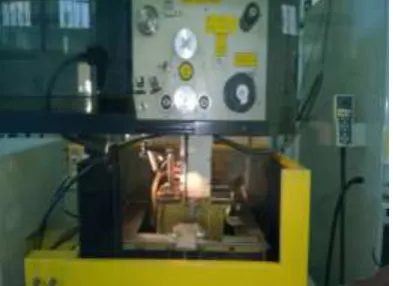
1.1 Electric Discharge Machining (EDM) and Wire EDM It is probably the most exciting and diversified machine tool developed for this industry in the last fifty years, and has many advantages to offer. Common materials such as tool steel, aluminum, copper, and graphite, to exotic space-age alloys including hastelloy, waspalloy, inconel, titanium, carbide, polycrystalline diamond compacts and conductive ceramics are routinely EDMed.[1,2] The Fig.1.2 shows the CNC Wire EDM and Fig.1.3 shows the Machining in Wire
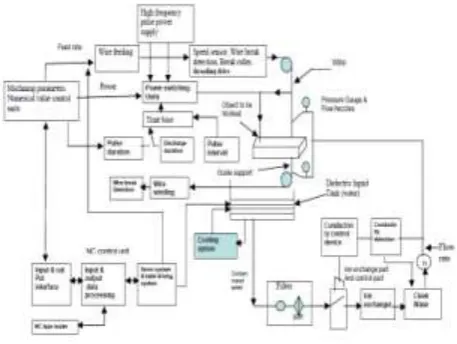
EDM. Fig.1.4 shows a typical block diagram of CNC Wire EDM Machine.
Fig.1.2 CNC Wire Cut EDM
Fig.1.3 Machining in Wire EDM
ISSN: 2231-5381
http://www.ijettjournal.org
Page 83
Fig 1.4 A Typical Block Diagram of CNC-Wire EDM Machine
Long running jobs are cut overnight or over the weekend, while shorter jobs are scheduled during the day. Many times, multiple jobs are set up on the worktable and linked together with multiple programs. For example, the die openings and dowel pin holes can be machined on a one-inch thick die block, and when these openings are completed, the machine moves to another location, automatically threads the wire and cut the punches required for the job in a much thicker piece of material.
II LITERATURE REVIEW
Karthikeyan et al [3] investigated the effect of pulse current and pulse duration on electrode wear rate, MRR and SR and also framed a mathematical model and concluded that the current affects the MRR and EWR proportionally, where as an increase in the pulse duration reduces both MRR and EWR.
Mohan et al [4] investigated the machinability study of the Al-SiC composite particle and electrode material on the surface roughness. The results show that the roughness value decreases with an increase in the current and with less SiC particles in the composite.
Suresh Kumar et al [5] carried the experimental investigation to identify the optimal combination of input parameters of electron discharge machining of Al(6351) matrix reinforced with 5wt% silicon carbide(SiC) and 10 wt% boron carbide(B4C) particles using grey relation analysis. The major input parameters selected to evaluate the process are electrode wear ratio, surface roughness and power consumption, and the corresponding machining parameters are pulse current, pulse on time, pulse duty factor and voltage. Further, ANOVA analysis was carried out to find the contribution of each parameter.
Ramesh et al [6] carried the experimental investigation of Al6061/SiCp/B4Cp hybrid MMCs in wire electrical discharge machine. In this study, an attempt is made to study the effect of wire electric discharge machining parameters like
voltage, pulse-on time, pulse-off time and current on material removal rate and surface roughness in hybrid metal matrix composites. The results show that increase in silicon carbide leads to decrease in material removal rate and surface finish and addition of boron carbide results decrease in machining performance. It is found that higher pulse on time results in poor the surface finish. It is also found that higher pulse off time resulted in lower surface roughness.
Rajesh et al [7] carried out a comparative study on mechanical properties of SiC and Graphite reinforced Aluminum MMC’s. it was found that increasing the SiC content within the aluminum matrix results in significant increase in the UTS, hardness and Young’s modulus, but a decrease in the ductility. The percentage of reinforcing particulates in the MMC is varied from 0% to 5% by weight and it was found that the reinforcing particulates beyond 7% and above lead to rejection from the melt.
Kathiresan and Sornakumar [8] conducted EDM studies on Aluminum Alloy Silicon Carbide Composites developed by Vortex Technique and Pressure Die Casting. They studied the effect of variation of SiC on the machinabilitiy characteristics like Surface roughness and MRR of AMMC. The MRR decreases with increase in the percent weight of silicon carbide. The surface finish of the machined work piece improves with percent weight of silicon carbide. The Material Removal Rate (MRR) and Surface roughness of the work piece increases with increase in the current. They did not include in their study the effect of pulse duration, pulse on and pulse off times on mach inability characteristics. Surface roughness is an important measure of the technological quality of a product and a factor that greatly influences manufacturing cost. Quality of the surface plays a very important role in manufacturing the components. A good quality surface significantly improves fatigue strength, corrosion resistance, creep life and wear resistance [9-12]. In addition, surface roughness also affects surface friction, light reflection, ability of holding a lubricant, electrical and thermal contact resistance [13].
III EXPERIMENTAL WORK
3.1 Manufacturing of Composites Using Stir Casting Technique
ISSN: 2231-5381
http://www.ijettjournal.org
Page 84
SiC particles into the vortex of molten alloy created by the rotating impeller. The molten slurry is poured into the mould and is allowed to cool in air. The AMMC of size 200x70x7mm3 was prepared for conducting experiments on WEDM as shown in Fig.3.1.
Fig. 3.1 Aluminum with 5% SiC prepared Metal Matrix composite
3.2 Experiments for Evaluating Machinability
Characteristics on WEDM
The experiments were conducted on a five axis high precision CNC-Wire Electrical Discharge Machine,
model number ULTRACUT 843, manufactured by
Electronica Machine Tools, India, shown in Fig.3.2. The basic parts of WEDM machine consists of wire, a work table, a servo control system, a power supply system and dielectric supply system, shown in Fig.3.3.
WEDM consists of several control variables such as pulse-on time, pulse-off time, peak current, wire feed rate, servo reference voltage, wire tension, and dielectric flow rate. The dimensions of the work piece and material also influence the process. Based on the literature survey and operator’s experience, the variables such as pulse on time, pulse off time, and peak current were considered as decision (control) variables as shown in Table.3.1.
Each an experiment was performed, with a particular set of input parameters were chosen and work piece (Al with 5% SiC Metal Matrix Composite) was cut with a dimension of 10mmx10mm, whose thickness is 7mm. The machined specimen and the pieces removed from specimen shown in Fig.3.4 and Fig.3.5
Fig.3.2 CNC-Wire Electrical Discharge Machine, model number ULTRACUT
Fig 3.3 – Controller with monitor
Table 3.1 Input parameter levels
S.No Parameters Symbol Levels
1 2 3
1 Pulse-on time
(micro secs) Ton 100 105 108
2 Pulse-off time
(micro secs) Toff 45 50 55
3 Peak current
(amp) Ip 10 11 12
ISSN: 2231-5381
http://www.ijettjournal.org
Page 85
Fig. 3.5 Pieces removed from specimen
3.3 Measurement of Surface Roughness
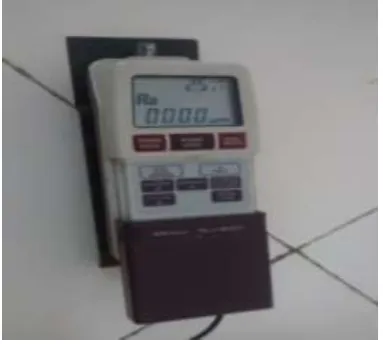
Surface Roughness has been measured by using surface roughness tester as show in Fig.3.6. Surface roughness values tabulated in Table 3.2 are the average values of surface roughness at 3 different locations.
Fig. 3.6 Surface roughness tester
3.4 Calculation of MRR
Material Removal Rate (MRR) is calculated as the ratio of amount of material removed to the time in which material is removed.[15]
MRR= (2Wg+D) *t* Vc mm3/min Where:
Wg = Spark gap,
D = diameter of the wire = 0.25mm t = Thickness of the work piece in mm Vc = Cutting speed in mm/min
The cutting speed data (Vc, mm/min) is directly displayed on computer monitor of the machine tool. From this data, MRR is calculated and the values are tabulated in Table 3.2.
Table 3.2 - Experimental Data
S.No Pulse-on
time
(µs)
Pulse-off
time
(µs)
Peak
current
(amp)
Ra
(microns)
MRR
(mm3/min)
1 100 45 10 1.1947 0.5237
2 100 45 11 1.2094 0.5282
3 100 45 12 1.2743 0.5647
4 100 50 10 1.0582 0.6358
5 100 50 11 1.0668 0.668
6 100 50 12 1.1152 0.7206
7 100 55 10 0.9418 0.8095
8 100 55 11 0.9561 0.8731
9 100 55 12 0.9816 0.8788
10 105 45 10 1.4551 0.3823
11 105 45 11 1.5008 0.3986
12 105 45 12 1.5178 0.3999
13 105 50 10 1.2501 0.4793
14 105 50 11 1.3361 0.5021
15 105 50 12 1.3643 0.5455
16 105 55 10 1.0769 0.6302
17 105 55 11 1.0971 0.6667
18 105 55 12 1.1061 0.6706
19 108 45 10 1.5267 0.2519
20 108 45 11 1.6186 0.2725
21 108 45 12 1.6394 0.2727
22 108 50 10 1.3305 0.3727
23 108 50 11 1.3754 0.4129
24 108 50 12 1.4488 0.4144
25 108 55 10 1.224 0.4948
26 108 55 11 1.2343 0.4956
27 108 55 12 1.3022 0.4979
IV RESUTS AND DISCUSSIONS
4.1 Response Surface Methodology
ISSN: 2231-5381
http://www.ijettjournal.org
Page 86
saddle-point for years. The engineers had not been able to afford to fit a cubic three-level design to estimate a quadratic model, and their biased linear-models estimated the gradient to be zero. Box's design reduced the costs of experimentation so that a quadratic model could be fit, which led to a (long-sought) ascent direction [14].
4.2 Mathematical model of Response Surface Methodology The Response Surface is described by an second order polynomial equation of the form
Y is the corresponding response (1,2, . . . , S) are coded levels of S quantitative process variables,
The terms are the second order regression coefficients, Second term is attributable to linear effect, Third term corresponds to the higher-order effects, Fourth term includes the interactive effects, The last term indicates the experimental error.
4.3 Mathematical Relationship between the Input
Parameters and Surface Roughness
The mathematical relationship for correlating the Surface Roughness and the considered process variables has been obtained as follows.
Ra = 11.87 + 0.210 Ton + 0.0653 Toff 0.164 IP
0.000686 Ton*Ton + 0.000369 Toff*Toff + 0.0010 IP*IP 0.001111 Ton*Toff + 0.00259 Ton*IP - 0.00180 Toff*IP The Table 4.1 gives the comparison of Ra predicted values with experimental values.
Table 4.1 Ra predicted values compared with experimental
Ton Toff
IP
Ra
Ra
Predicted
%Error
100
45
10 1.195
1.1994
-0.39351
100
45
11 1.209
1.2346
-2.08213
100
45
12 1.274
1.2718 0.194862
100
50
10 1.058
1.0556
0.24154
100
50
11 1.067
1.0818
-1.40989
100
50
12 1.115
1.1101 0.457944
100
55
10 0.942
0.9303 1.216566
100
55
11 0.956
0.9476 0.893655
100
55
12 0.982
0.9668 1.505226
105
45
10 1.455
1.4261 1.995676
105
45
11 1.501
1.4742 1.774531
105
45
12 1.518
1.5243
-0.43025
105
50
10
1.25
1.2545
-0.35334
105
50
11 1.336
1.2936
3.17785
105
50
12 1.364
1.3348 2.160824
105
55
10 1.077
1.1014
-2.27774
105
55
11 1.097
1.1316
-3.14185
105
55
12 1.106
1.1638
-5.21336
108
45
10 1.527
1.5456
-1.2379
108
45
11 1.619
1.6015 1.058816
108
45
12 1.639
1.6594
-1.21877
108
50
10 1.331
1.3574
-2.02054
108
50
11 1.375
1.4043
-2.09851
108
50
12 1.449
1.4532
-0.30358
108
55
10 1.224
1.1876 2.971968
108
55
11 1.234
1.2255 0.711376
108
55
12 1.302
1.2655 2.820503
4.3.1 Normal Probability Plot for Ra
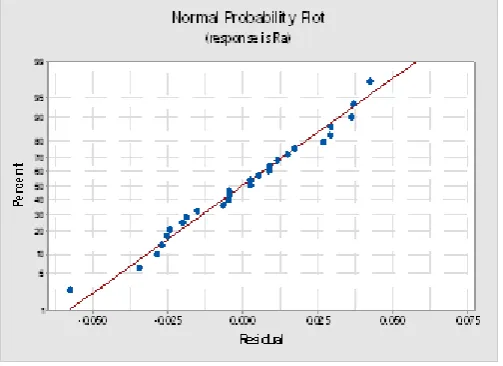
The normal probability plot as shown in Fig: 4.1 represents a clear pattern (as the points are almost in a straight line) indicating that all the factors and their interaction given in are affecting the Ra. In addition, the errors are normally distributed and the regression model is well fitted with the observed values
Fig: 4.1 Normal Probability Plot for Ra
4.3.2 Standardized Residual Vs Fitted Value for Surface Roughness
Fig: 4.2 indicate that the maximum variation which
ISSN: 2231-5381
http://www.ijettjournal.org
Page 87
Fig: 4.2 Residual Vs Fitted Value for Surface Roughness
4.3.3 Effect Of Input Parameters
108 104 100 1.45
1.40
1.35
1.30
1.25
1.20
1.15
1.10
55 50
45 10 11 12
Ton
M
e
a
n
o
f
R
a
Toff IP
M ain Effects Plot for Ra
Fitted M eans
All displayed terms are in the model.
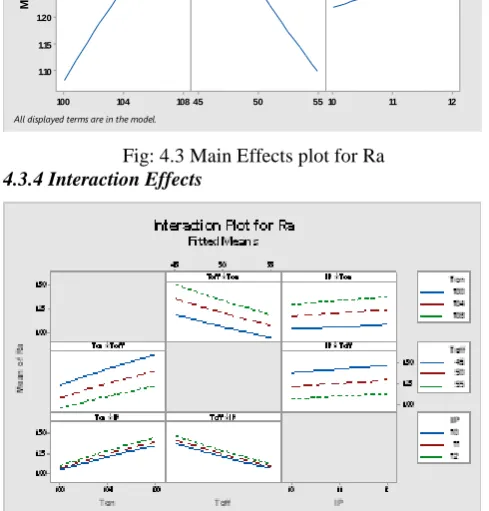
Fig: 4.3 Main Effects plot for Ra 4.3.4 Interaction Effects
Fig: 4.4 Interaction Effects plot for Ra
4.4 Mathematical Relationship between the Input
Parameters and Metal Removal Rate
The mathematical relationship for correlating the Metal removal rate and the considered process variables has been obtained as follows
MRR = -19.05+ 0.3077 Ton + 0.1068 Toff + 0.382 0.001266 Ton*Ton+ 0.000242 Toff*Toff- 0.00501 0.001056 Ton*Toff - 0.00266 Ton*IP + 0.000557 Toff*IP The Table 4.2 gives the comparison of MRR predicted values with experimental values.
Table 4.2 MRR predicted values compared with experimental
Ton Toff IP
MRR
MRR
Predicted
%
Error
100
45
10 0.5237
0.50188 4.1662
100
45
11 0.5282
0.53703
-1.672
100
45
12 0.5647
0.56217 0.4485
100
50
10 0.6358
0.65052
-2.315
100
50
11
0.668
0.68845
-3.062
100
50
12 0.7206
0.71637 0.5866
100
55
10 0.8095
0.81128
-0.22
100
55
11 0.8731
0.85200 2.4171
100
55
12 0.8788
0.88270
-0.444
105
45
10 0.3823
0.37192 2.7148
105
45
11 0.3986
0.39375 1.2165
105
45
12 0.3999
0.40557
-1.418
105
50
10 0.4793
0.49415
-3.098
105
50
11 0.5021
0.51876
-3.319
105
50
12 0.5455
0.53336 2.2246
105
55
10 0.6302
0.62850 0.2696
105
55
11 0.6667
0.65590 1.6203
105
55
12 0.6706
0.67328
-0.4
108
45
10 0.2519
0.26356
-4.628
108
45
11 0.2725
0.27740
-1.797
108
45
12 0.2727
0.28122
-3.126
108
50
10 0.3727
0.36994 0.7402
108
50
11 0.4129
0.38656 6.3786
108
50
12 0.4144
0.39317 5.1222
108
55
10 0.4948
0.48845 1.2841
108
55
11 0.4956
0.50785
-2.472
108
55
12 0.4979
0.51725
-3.885
4.4.1 Normal Probability Plot for MRR
The normal probability plot in the Fig: 4.5, shows a
ISSN: 2231-5381
http://www.ijettjournal.org
Page 88
Fig: 4.5 Normal Probability Plot for MRR
4.4.2 Standardized Residual Vs Fitted Value For MRR
Fig: 4.6 indicate that the maximum variation which
shows the high correlation that exists between fitted values and observed values.
Fig: 4.6 Residual Vs Fitted Value For MRR
4.4.3 Effect of Input Parameters
108 104 100 0.70
0.65
0.60
0.55
0.50
0.45
0.40
55 50
45 10 11 12
Ton
M
e
a
n
o
f
M
R
R
Toff IP
M ain Effects Plot for M RR
Fitted M eans
All displayed terms are in the model.
Fig: 4.7 Main Effects plot for MRR
4.4.4 Interaction Effects
Fig: 4.8 Interaction Effects plot for MRR
4.5 Optimisation Plot:
A Minitab Response Optimizer tool shows how different experimental settings affect the predicted responses for factorial, response surface, and mixture designs. Minitab calculates an optimal solution and draws the plot. The optimal solution serves as the starting point for the plot. This optimization plot allows to interactively changing the input variable settings to perform sensitivity analyses and possibly improve the initial solution.
Fig: 4.9 Optimisation plot for MRR and Surface Roughness
The optimization plot as shown in Fig:4.9 signifies the affect of each factor (columns) on the responses or composite desirability (rows). The vertical red lines on the graph represent the current factor settings. The numbers displayed at the top of a column show the current factor level settings (in red). The horizontal blue lines and numbers represent the responses for the current factor level. Minitab calculates the maximum metal removal rate and minimum surface roughness.
From the optimization plot it can be said that the maximum metal removal rate is 0.8790 mm3/min and the minimum surface roughness is 0.9640µm obtained when Ton=100 µs, Toff=55 µs, and IP=11.86A.
ISSN: 2231-5381
http://www.ijettjournal.org
Page 89
In the present work, Multi-Response Optimization problem has been solved by using an optimal parametric combination of input parameters such as Pulse on Time, Pulse off Time and Input Voltage. These optimal parameters ensures in producing high surface quality turned product.
Response Surface Methodology is successfully implemented for optimizing the input parameters.
This paper produces a direct equation with the combination of controlled parameters which can be used in industries to know the Values of MRR and Surface Roughness instead of machining.
Hence we conclude that the optimal solution for maximum metal removal rate is 0.8790 mm3/min and the minimum surface roughness is 0.9640µm obtained when Ton=100 µs, Toff=55 µs, and IP=11.86A.
REFERENCES
[1] M. A. Taha. 2001. Practicalization of cast metal matrix composites. Materials and Design, Vol. 22, no. 6, pp.431-441.
[2] J. Peronczyk. and J. Kozak. 1998. Electrical discharge machining (EDM) of the metal matrix composites (MMC). In: Proceedings of the 8th International Conference on Rotary Fluid-flow Machines. p. 391, Rzeszow-Bystre, Krakow, Poland.
[3] R. Karthikeyan, P. R. Lakshmi Narayanan, and R. S. Nagarazan, “Mathematical modelling for electric discharge machining of aluminium-silicon carbide particulate composites,” Journal of Materials Processing Technology, vol. 87, no. 1–3, pp. 59–63, 1999.
[4] B. Mohan, A. Rajadurai, and K. G. Satyanarayana, “Effect of SiC and rotation of electrode on electric discharge machining of Al-SiC composite,” Journal of Materials Processing Technology, vol. 124, no. 3, pp. 297–304, 2002.”
[5] S. Suresh Kumar, M. Uthayakumar, S. Thirumalai
Kumaran, P. Parameswaran, and E. Mohandas
“Electrical Discharge Machining of Al (6351)-5% SiC-10% B4C Hybrid Composite: A Grey Relational Approach” Journal of Modelling and Simulation in EngineeringVolume 2014 (2014), Article ID 426718. [6] S.Ramesh, N.Natarajan, V.Krishnaraj “Experimental
investigation of Al6061/SiCp/B4Cp hybrid MMCs in wire electrical discharge machine” Indian Journal of Engineering & Material Sciences, Vol.21, pp.409-417, 2014.
[7] Rajesh.S, A.Gopla Krishna, P.Rama Murthy Raju, D.Kondayya “Comparative study on Mechanical Properties of SiC and Graphite reinforced Aluminium MMCs” Proceedings of International Conference on Materials Processing and Characterization, 8th -10th March 2012.
[8] M.Katiresan and T.Sornakumar “EDM studies on
Aluminium Alloy Silicon Carbide Composites
developed by Vortex Technique and Pressure Die Casting” Journal of Minerals & Materials & Engineering, Vol.9,No.1,pp.79-88,2010.
[9] Guu Y. H. and Hocheng H. 2001. Improvement of fatigue life of electrical discharge machined AISI D2 tool steel by TiN coating. Mater Sci Eng A, pp. 155-162, Vol. 318.
[10] Jeelani S. and Collins M.R. 1988. Effect of electrical discharge machining on the fatigue life of Inconel 718. Int J. Fatigue, pp. 121-125, Vol. 10.
[11] Zeid O.A.A. 1997. On the effect of electro discharge machining parameters on the fatigue life of AISI D6 tool steel. J Mater Process Technol., pp. 27-32, Vol. 68.
[12] Ramulu A., Paul G and Patel J. 2001. EDM surface effects on the fatigue strength of a 15 vol% SiC/Al metal matrix composite material, Compos Struct., pp. 79-86, Vol. 54.
[13] Rashid Ab., Gan M.F.F. and Muhammad N.Y. 2009. Mathematical modeling to predict surface roughness in CNC Milling. World Academy of Science Engineering and Technology. pp. 393-396, Vol. 53.