DEVELOPMENT OF STRUCTURES AND RESULTS OF EXPERIMENTAL STUDIES
OF THE NEW MODULAR POWER UNIT
Prof. Eng. Volodymyr Bulgakov1, PhD., Prof. Eng. Volodymyr Kyurchev2, PhD., Prof. Eng. Volodymyr Nadykto2, PhD. Corresp. Member Prof. Eng. Hristo Beloev3, DHC, mult., Assoc. Prof. Eng. Georgi Mitev3, PhD.
1
National University of Life and Environmental Sciences of Ukraine 15, Heroyiv Oborony Str., Kyiv, 03041, Ukraine
2
Tavria State Agrotechnological University
18, Khmelnytskoho pr., Melitopol, 72312, Zaporozhye region, Ukraine
3
“Angel Kanchev” University of Rousse 8, Studentska Str., 7017 Ruse, Bulgaria
Abstract: The article presents the results of experimental studies of the soil tillage unit based on a new modular power machine of variable traction class. It includes the universal tractor of drawbar category 1.4 (2.0) and technological unit as an additional bridge, having active drive wheels from synchronous PTO-shaft of the tractor. The new modular power facility with experienced five-part plow has been investigated in wheat stubble plowing. Obtained operational and technological parameters are compared with the same regulatory parameters of the tillage unit as part of a tractor of class 1,4 and a three-part plow. It is found that the performance of a new replaceable unit is 1.9 times higher and the specific fuel consumption is 27.5% less in comparison with the standard unit.
Special laboratory and field experimental studies established the degree of influence of the wheels on the process of compaction of different initial moisture content (12.8...20.8%) after the passage of the wheels of the front and rear axles of the tractor of class 1,4.
KEYWORDS: TILLAGE UNIT, MODULAR POWER UNIT, PLOWING, SOIL DENSITY, TEST PERFORMANCE.
Formulation of the problem.
One of the most effective ways to solve the problems associated with the nomenclature of tractor power is the introduction of modular power resources, high versatility and adaptability of the technology which is provided by the variability of traction class [1, 2, 4, 5, 7, 8, 11, 12]. This is a fundamentally new direction of tractor development today and is true in almost all countries of the world. But it is especially topically for countries undergoing the reform of the agricultural production systems. These countries employ their specific tractors’ classification which is based not on the engine power, but on the draft force of the tractor measured by 1000 kg·m/s2. It is called ‘Drawing Class’. There is a lack of tractors of Drawing Class 2 and especially of Class 5.
The obvious at first glance, the way to solve this problem by purchasing the missing power assets abroad or independent of their production is quite problematic. The acquisition of foreign tractors, apart from dealing with financial matters, requires the
development of adaptation measures as their existing fleet of machines and tools, and adjustment to the specific climatic conditions. Practical experience shows that sometimes it is possible only by means of a significant change in the power structure.
In the case of own production of Drawing Class 2 and 5 tractors it is required to create new costly production capacity. In principle, this problem can be solved, but in the foreseeable future, as each country can set up production of its own power resources.
In our opinion, faster and more efficient way out of this situation is possible, by creating a modular power unit: general purpose cultivating tractors of Class 1,4-3 produced on the basis of wheeled tractors of Drawing Class 1,4 and general purpose tractors of class traction 3-5 based on standard tractors of Drawing Class 3.
The technical feasibility and economic viability of mobile power resources of traction class were confirmed by the results of years of research and testing, we have created a model sample of a new modular power unit [3, 6, 9].
а) b)
Fig. 1. Modular power units of variable Drawing Class 1,4-3 (a) and 3-5 (b)
For several years we have conducted our pilot studies and tests of new modular power units of variable Drawing Class 1,4-3 and this paper summarizes our recent results from laboratory and field studies of the experimental tillage unit on the basis of the power unit (Fig. 2).
Research methods.
The experimental modular power unit consists of Class
Fig. 2. The tillage unit on the basis of a modular power unit
The process of turning the module linked to the vehicle when driving on the headland and copy of the field profile in the cross-vertical plane is ensured by the presence of vertical and
horizontal joints. Matching the wheel rotational speeds on the technological module and rear wheels of the tractor is carried out by a special gear disposed on the frame tillage module.
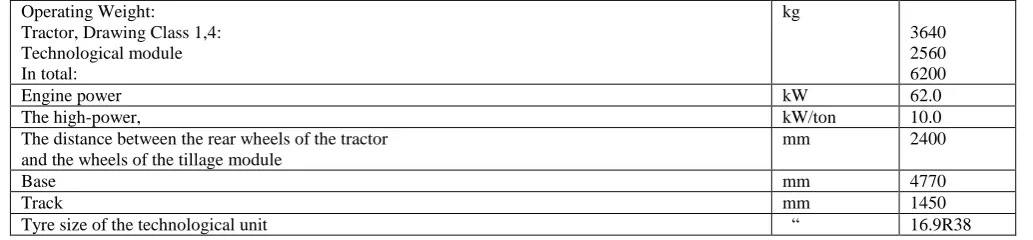
Table: Brief technical characteristics of technological module
Operating Weight: Tractor, Drawing Class 1,4: Technological module In total:
kg
3640 2560 6200
Engine power kW 62.0
The high-power, kW/ton 10.0
The distance between the rear wheels of the tractor and the wheels of the tillage module
mm 2400
Base mm 4770
Track mm 1450
Tyre size of the technological unit “ 16.9R38
Operational and technological tests of the plowing machine and tractor units on the basis of a modular power tool were carried out in accordance with the standard for testing of tractors and agricultural machinery. The modular power unit is packaged with the standard (five working bodies with a width of each hull of 35 cm) five hull plow (see. Fig. 2), which is used with tractors of Drawing Class 3.
The modular power unit moves the right wheels outside of the furrow on the rut. The distance from the wall to the starboard side of the wheels does not exceed 15 cm at the same time.
The experimental results and their discussion.
The complexity of the tillage module linked to the tractor is 0.2 man-hours. It was determined experimentally that two mechanics spent on this operation has not more than 6 minutes.
The plowing was carried out in the field after harvesting of winter wheat. Moisture in the soil horizon of 0...14 cm was 18.8%, and the density was 1.21 g/cm3. The standard deviation of the plowing depth of experienced tractor units was ± 2,2 cm and working width was ± 3,8 cm.
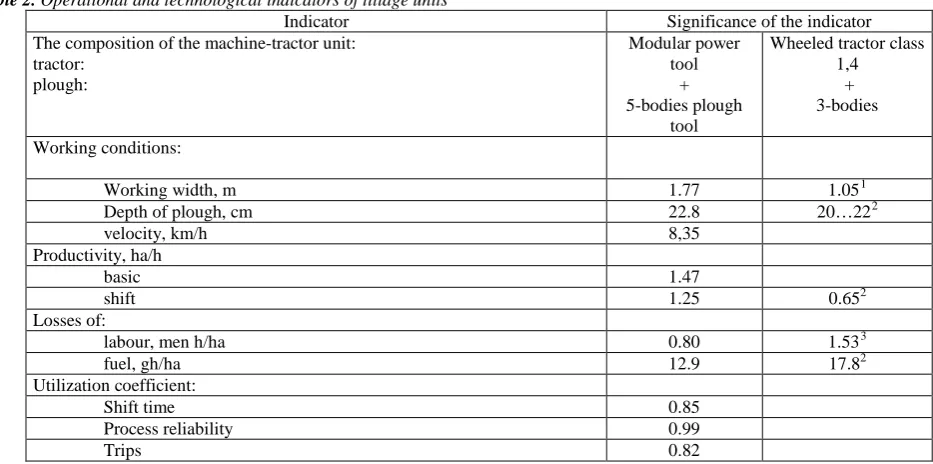
Table 2. Operational and technological indicators of tillage units
Indicator Significance of the indicator
The composition of the machine-tractor unit: tractor:
plough:
Modular power tool
+ 5-bodies plough
tool
Wheeled tractor class 1,4
+ 3-bodies
Working conditions:
Working width, m 1.77 1.051
Depth of plough, cm 22.8 20…222
velocity, km/h 8,35
Productivity, ha/h
basic 1.47
shift 1.25 0.652
Losses of:
labour, men h/ha 0.80 1.533
fuel, gh/ha 12.9 17.82
Utilization coefficient:
Shift time 0.85
Process reliability 0.99
Trips 0.82
1
– Constructive working width of the plow
2
– Performance of the standards 3
Specific fuel consumption of the new machine and the tractor unit decreased by 27.5% due to lower power slipping units. The actual value of this indicator for the modular power unit for five unit plow tools with a plow in a pilot study did not exceed 10%, indicating the relatively high potential of its traction characteristics.
In the model sample of the modular power unit a vertical hinge tillage module is placed midway between its thrusters and rear tractor wheels.
As a result, as shown by tests, the wheel production module practically fits into the rear track of the tractor propellers of Class 1.4. In addition, sufficient mutual angular mobility in the horizontal plane of the tractor and the tillage module do not impair the turning capacity of the modular power unit. The difference between the tractor turning radius of Class 1.4 and a technological unit is at least 3 cm.
As a result, the modular power unit provides the satisfactory maneuverability of the tillage tractor-operated machinery, as it was evidenced by the relatively high value of the coefficient of strokes of 0.82 (see Table 2.).
It should be noted that the presence of tillage units comprising power units leads to the increase in the minimum width of the headland, the machine and the tractor unit to 9...12% and increases the mobility time to 2...5%. The total overhead time in doing so, as shown by the results of our long-term research, is insignificant.
The soil compaction effect of power unit was studied during operational and technological tests of the new tillage machinery. The tests were carried out on the stubble of winter
wheat with two levels of soil moisture. In the same field (section 1) the soil moisture in the crop background horizon of 0...15 cm was 12.8%, and the second section (phase 2) was 20.8%.
The bulk density of the soil after the passage of each wheel axle of the modular unit was recorded in the horizon of 0...15 cm using a radiation unit PFR-2.
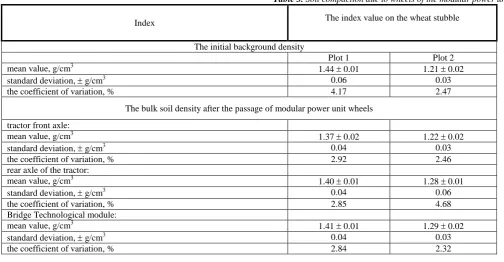
The analysis of experimental data has shown that when driving on wheat stubble wheels not only tractors but also the production module with modular power tools do not create an additional compaction effect on the soil (Table. 3).
Thus, after the tractor rear wheels moving, the average value of soil density was 1.40 g/cm3. The passage of the tillage unit increases soil density up to 1.41 g/cm3 (Table. 3). The difference of 0.01 g/cm3 is, however, negligible, because the statistical significance level of 0.05 has the least significant difference (NSR05) of 0.03 g/cm3.
Hence, the 95% confidence level can be argued that in this case, the null hypothesis of equality of the compared average density value deviates.
Thus, after moving the rear wheels of the tractor, the average value of soil bulk density is up to 1.40 g/cm3. The passage of the technological module increases bulk density to 1.41 g/cm3 (Table. 2). The difference of 0.01 g/cm3 is, however, negligible,
because the statistical significance level of 0.05 has less significant difference (NSR05) of 0.03 g/cm
3
.
Hence, with 95% confidence level it can be argued that in this case, the null hypothesis of equality of the compared average density value deviates.
Table 3. Soil compaction due to wheels of the modular power unit
Index The index value on the wheat stubble
The initial background density
Plot 1 Plot 2
mean value, g/cm3 1.44 ± 0.01 1.21 ± 0.02
standard deviation, ± g/cm3 0.06 0.03
the coefficient of variation, % 4.17 2.47
The bulk soil density after the passage of modular power unit wheels
tractor front axle:
mean value, g/cm3 1.37 ± 0.02 1.22 ± 0.02
standard deviation, ± g/cm3 0.04 0.03
the coefficient of variation, % 2.92 2.46
rear axle of the tractor:
mean value, g/cm3 1.40 ± 0.01 1.28 ± 0.01
standard deviation, ± g/cm3 0.04 0.06
the coefficient of variation, % 2.85 4.68
Bridge Technological module:
mean value, g/cm3 1.41 ± 0.01 1.29 ± 0.02
standard deviation, ± g/cm3 0.04 0.03
the coefficient of variation, % 2.84 2.32
In other words, the statistical characteristics of the soil bulk density after the passage of the rear wheels of the tractor and the wheels of technological modules of the modular power unit of new design are the same.
The impact of modular propulsion power units on the ground when they are driving on wet soils (Plot 2) is somewhat different. If the front axle of the tractor wheels does not substantially alter the soil density, the rear wheels have at least the small, but statistically non-random further compaction effect. When NSR05 = 0.024 g/cm3, the actual difference between the mean
values of the seals after the passage of the front and rear wheels of the tractor was 0.060 g/cm3 (see. Table. 3).
As for the wheels of the tillage module, their impact on the growth of the humid soil density is slight. The increase in this index, after the tillage module of the wheels was only 0.01 g/cm3. The statistical significance level of 0.05 is not significant.
Conclusions:
The experimental study of the tillage unit on the basis of a modular power unit allows to conclude that the power unit can be aggregated with a train of agricultural machinery and used with tractors of drawbar category 3. This, in turn, guarantees a number of advantages.
1. Having at its disposal a tractor of class 1,4 and the tillage module linked to it, one can dispense with a tractor of drawbar category 3 that is effectively from the economic point of view.
3. Through the use of technological module the annual download is significantly increased by universal cultivating tractors of Class 1.4. During the year, some of the time tillage modules cannot be used, but the loss of this, as shown by calculations, is about 5...7 times less than that of the Class 1.4 tractor downtime.
4. The probability of development of high-quality design mechanic power units of one brand instead of two ones or more is much higher, it has a positive effect on the effectiveness of its practical operation and maintenance.
References:
1. Ksenevich I.P., Kutkov G.M. Tehnologicheskie osnovyi i tehnicheskaya kontseptsiya traktora vtorogo pokoleniya // Traktoryi i selskohozyaystvennyie mashinyi, 1982, №12.
2. Kutkov G.M., Ksenevich I.P. Blochno-modulnyie MTA // Traktoryi i selskohozyaystvennyie mashinyi, 1990, №1.
3. Kutkov G.M., Roslavtsev A.V., Ivanitskiy V.G. i dr. Modulnoe energotehnologicheskoe sredstvo MES-300 kl.3-5// Traktoryi i selskohozyaystvennyie mashinyi, 1998, №2.
4. Nadyikto V.T. Snizhenie energozatrat pahotnyimi MTA na osnove MES // Traktoryi i selskohozyaystvennyie mashinyi, 1996, №10.
5. Nadyikto V.T. Upravlyaemost i ustoychivost dvizheniya agregata na osnove MES // Traktoryi i selskohozyaystvennyie mashinyi, 1998, №7.
6. Kutkov G.M. i dr. Issledovaniya modulnogo energeticheskogo sredstva// Traktoryi i selskohozyaystvennyie mashinyi, 1989, №12.
7. Kochev V.I., Nadyikto V.T. Ratsionalnoe agregatirovanie plugov s kolesnyimi energeticheskimi sredstvami // Mehanizatsiya i elektrifikatsiya selskogo hozyaystva. – Kiev: Urozhay, 1988. – №68.
8. Nadyikto V.T. Agregatirovanie MES s
perednenavesnyim plugom // Traktoryi i selskohozyaystvennyie mashinyi, 1994, № 7.
9. Nadyikto V.T. Osnovyi agregatirovaniya modulnyih energeticheskih sredstv. – Melitopol: KP “MMD”, 2003.
10. Tipovyie normyi vyirabotki i rashoda topliva na mehanizirovannyie polevyie rabotyi. – Kiev: Urozhay, 1991.
11. Bulgakov V.M., Kravchuk V.I., Nadyikto V.T. Agregatirovanie plugov. Monografiya. – Kiev: Agrarnaya nauka, 2008.