DOI: 10.14738/abr.78.6890.
Purba, C. B., & Budiyanto, H. (2019). Factors That Influence The Performance Of Volunteer Catechists With Commitment As Intervening Variable At The Jakarta Archdiocese. Archives of Business Research, 7(8), 300-314.
Factors That Influence The Performance Of Volunteer Catechists
With Commitment As Intervening Variable At The
Jakarta Archdiocese
Charles B. Purba
Lecturerof Doctor Management Human Resources Program Mercu Buana University, Jakarta, Indonesia
Hendro Budiyanto
Student of Doctor Management Human Resources Program Mercu Buana University, Jakarta, Indonesia
ABSTRACT
This study aims to determine how strong the effect of competency, motivation, commitment on catechists voluntary performances in Jakarta archbishop dioses integrated either partially or simultaneously. This study was a category of social management research that uses quantitative research methods. The population in this study are all volunteer Catholic religion teacher in the archdiocese parish that covers 8 areas or eight deaneries. The sampling method was done by using cluster sampling and a total sample was 200 respondents. Tehcnic analysis used is path analysis were previously tested with the classical assumtion test. Hypotesis testing using t-test and F test with confidence level of 5%. The result of this study indicate that competency, motivation and commitment significant influence on voluntary cathecis performance either partially or simultaneously, this is partially evidenced by t-test conducted on the four variable mentioned above and shown simultaneously by the F-test was also conducted to the above four variables. But motivation variable wasn’t effect to the performance of voluntary cathecis.
Keywords: Competence, Motivation, Commitment and Volunteer Catholic Teacher Performance
ABSTRAK
Penelitian ini menganalisis seberapa kuat pengaruh Kompetensi, Motivasi dan Komitmen terhadap Kinerja Katekis atau Guru Agama Katolik Relawan Paroki Keuskupan Agung Jakarta dengan mengambil kasus pada katekis atau guru agama Katolik relawan yang berkarya di Paroki-Paroki Keuskupan Agung Jakarta (KAJ) secara parsial maupun simultan. Penelitian ini menggunakan metode penelitian kuantitatif. Populasi penelitian ini seluruh katekis relawan paroki di KAJ yang mencakup 8 wilayah atau 8 dekenat. Teknik pengambilan sampel Cluster Sampling sebanyak 200 responden, teknik analisis jalur. Uji hipotesis menggunakan uji t dan uji F dengan tingkat kepercayaan 5%. Hasil penelitian mengungkapkan bahwa kompetensi dan motivasi secara parsial dan simultan berpengaruh signifikan terhadap komitmen. dan kinerja katekis relawan. Selanjutnya kompetensi, motivasi dan komitmen secara simultan berpengaruh signifikan terhadap kinerja, namun secara parsial kompetensi dan komitmen berpengaruh signifikan terhadap kinerja, namun tidak signifikan bagi motivasi. Selanjutnya komitmen tidak memediasi kompetensi dan motivasi.
Kata Kunci: Kompetensi, Motivasi, Komitmen dan Kinerja Guru Agama Katolik Relawan.
INTRODUCTION
In his introduction in the book Best Practices in Catholic Church Ministry of Performance
management science in ensuring that the service of Church institutions is fully responsible, both in financial and human resources aspects, even though The church is not a business organization. "Yes, the Church is not a business. It's work on the earth." (Zech, 2010):
1). The Jakarta Archdiocese or “Keuskupan Agung Jakarta” (KAJ) has 11 Commissions, one of which is the KAJ Catechetical Commission. Commissions are the diocesan apparatus whose task is to assist in the administration of pastoral dioceses in certain pastoral fields. In this context, pastoral care of the Catechetical Commission is carried out in the parish catechetical section, Catholic/catechist full-time teachers, Catholic teachers/catechists, Catholic/non-Catholic Catholic/non-Catholic teachers and Catholic/non-Catholic teachers at universities/colleges in Jakarta Archdiocese. Along with the movement of renewal and development of the KAJ Church services specifically the Catechetical Commission, it is increasingly recognized that there are still many aspects of human resource (HR) management that need to be managed, for example the entire HR management system of the Catechetical Commission which are interrelated in the planning, organizing, implementing and controlling stages; alignment of HR management with institutional strategic planning ( Dessler and Huat, 2009: 52-53; Aguinis, 2009: 52-54); and harmony between competency and motivation, commitment, between institutions (Catechetical Commission) and volunteer Catholic/catechist religious teachers (catechetical section). Who are the volunteer catechists and what are their tasks? Based on data from research conducted by the PPLK division (Advanced Catechist Development Program), the Catechetical Commission of the Association of Teachers in collaboration with the Faculty of Teacher Training at Theika Atmajaya Theology Education in Jakarta in 2004 found five kinds of understanding of volunteer Catholic teachers/Catechist, namely: (1) A person who feel called and has an obligation to give lessons or preaching; (2) A person who has special education in the field of catechesis and is knowledgeable about other religions, especially Protestantism; (3) Preaching field volunteers; (4) The assistant pastor in charge of the field of proclamation; (5) Migrant/side jobs and carrying out field technical tasks.
Problem Identification
The catechists who carry out these tasks are mostly voluntary Catholic teachers/catechists. Catholic teachers/Catechist as pastoral workers are one of the determining factors for the success of pastoral care for catechesis because religion teachers/catechists who correspond directly with catechetical participants to provide teaching and guidance will produce the expected output. Catholic teachers/Catechists are human resources who are planners, actors and determinants of achieving the goals of Catholic faith education as mandated in the General Catechetical Directory. In supporting the activities of Catholic teachers/catechists, a conducive parish climate and good relations between the elements in the parish are needed, with the pastor of the parish, the head of the catechetical section, the congregation and other sections.
Most catechists are volunteers even though their roles, duties and responsibilities are very important. Catechism performance is the result achieved by catechists in carrying out tasks assigned to him based on willingness, experience and sincerity and use of time. Efforts to improve the performance are carried out by giving competence training and increasing the motivation and the commitment.
there are still lack of understanding in the catechetical section and Catholic teachers/catechists of parish volunteers about performance assessment.
To find out an overview of the performance of Catholic teachers/catechist of parish volunteers, the initial questionnaire was distributed to 35 respondents who received teaching/coaching from Catholic teachers/catechist of parish volunteers. The performance of Catholic teacher/catechist of parish volunteers that the writer evaluated includes several dimensions, namely: quality, initiative, timeliness, ability, communication, quantity and contribution. Following are the respondents' responses to the performance of Catholic teachers/catechist of parish volunteers:
Table 1. Perfomance of Catholic Teachers/Catechist of Parish Volunteers
Performance Dimension
Good Fair Poor
Quality 91,4% 8,57% 0%
Initiative 85,7% 14,3% 0%
Timeliness 88,6% 11,4% 0%
Capability 82,9% 17,1% 0%
Communication 82,9% 14,3% 2,86%
Quantity 65,7% 28,6% 5,7%
Contribution 82,9% 17,1% 0%
Source: Catechist Commision of KAJ (2015)
Based on the data in Table 1, it was concluded that the respondents felt good performance on 7 (seven) existing performance dimensions. From these results the authors increasingly want to examine more about their performance. In other words, the writer wants to relate three variables: competence, motivation and commitment of the catechist to the extent of their influence on the performance of Catholic teachers/catechist of parish volunteers.
Bernaders and Russel (1993: 379) state that performance is defined as the record of outcomes produced on specified job function or activity during specified time period. This means that performance is generated from the function of a particular job or the results of an activity for a certain period of time. Based on the performance definition and comparing the initial data about the performance of voluntary catechists with the observations in the parishes, the author found following phenomena: 1). How big is the influence of competence, motivation and commitment of Catholic teachers/catechists on improving the performance of Catholic teachers/catechist volunteers? 2). How big is the causal relationship of competence, motivation and commitment of Catholic teachers/catechists to the performance of Catholic teachers/catechist volunteer? Therefore the author wants to examine the magnitude of the effect of three independent variables (competence, motivation and commitment) on the performance of the Catholic teacher of parish volunteers as the dependent variable.
performance; (4) To find out and explain the role of commitment in mediating competence and motivation for performance.
THEORITICAL REVIEW Performance
In the Contemporary English Indonesia Dictionary, the term performance is used if someone runs a process skillfully in accordance with existing procedures and conditions. Meanwhile according to Sedarmayanti (2001: 50) performance means work accomplishment, work implementation, work achievement or work performance. The concept of performance according to Dessler (1992) defines work performance as a comparison between work output and established work standards. Thus, performance focuses on the results of his work. Bernaders and Russel (1993: 379) defined performance as the record of outcomes produced on
specified job function or activity during a specified time period. This means that performance is
generated from the function of a particular job or the results of an activity for a certain period of time. From the description above, it can be said that the performance of voluntary catechists is related to catechist behavior, namely catechist activities in instructional or teaching processes related to catechist responsibilities and tasks, with indicators as follows: (1) Quality of work, (2) Quantity of work, (3) Timeliness, (4) Independence (5) Interpersonal relationships.
Competence
Competence by Durand (1996) in Palan (2007: 6) suggests that competence refers to characteristics that underlie behavior that describes motives, personal characteristics, self-concept, values, knowledge that is carried by someone who shows superior performance in the workplace. Spencer also said that in the personality or competence of someone has to have 5 characteristics including: Motive, traits, Self-Concept, Knowledge, Skill. In the process of competence processing it has also been developed in such a way to follow the time. One of them is assessment. The assessment of competence processing is more likely to provide feedback on the participants competence. This method uses motivation to encourage participants to correctly understand the competence they have and the work they have done.
Motivation
According to Mitchel (1997: 56), as quoted by Robbin and Judge (2011: 238), motivation is a process that measures the intensity, direction and perseverance/persistence of a person in achieving a goal. Abraham H. Maslow, as quoted by Robbin and Judge (2011: 239) proposes the Hierarchy of Needs to explain motivation. According to him, the unfulfilled one’s needs will motivate him to fulfill them. These needs are arranged hierarchically in five levels from the basic level: physiological needs (manifest in conditions of hunger, thirst, the need for shelter, sex, and other physical needs); safety needs (security, physical and emotional protection from hazards); social needs (affection, being part of community, acceptance, and friendship); the need for respect (respect, autonomy, achievement, recognition, attention); self-actualization needs (being someone like that can be achieved, including growth, realizing self potential, self-fulfillment). According to Maslow, if we want to motivate someone, we must know at what level their needs have not been fulfilled and focus their motivation to meet their needs at that level or a higher level (Robbin and Judge, 2011: 240).
Commitment
While according to Meyer and Allen (1997) as quoted by Biswas (2011: 93), commitment is an individual commitment in his work as a sign of his dedication to the organization, work team, team members and fellow workers. Employee commitment is more than just formal membership, because it includes the attitude of liking the organization and the willingness to seek a high level of effort for the interests of the organization to achieve its golas. In addition, employee commitment includes elements of loyalty to the organization, involvement in work, and identification of the values and goals of the organization. Furthermore, employee commitment contains an understanding of something that is more than passive loyalty, but implies an active relationship between the employee and the company. Because employees who show high commitment have the desire to provide more energy and responsibility to support the welfare and success of their organization.
Previous Research
As a reference theory, previous research related to the variables studied can be seen in Table 2.
Table 2. Matrix Originality of Researches of Competence Effect on Performance
No Author Variable/Title Conclusion
1 Sarmawa Competence, Competence have significant
(2015) Performance effect on performance
2 Arifin The Influence of Competence and external motivation (2013) competence and have significant effect on
External Motivation teachers’ performance
Factor Toward
Teachers Working
Performance
InJayapura-Papua
Indonesia
3 Abidin Impact of workers ‘ Workers’ competence have (2010) competence on their effect on performance
Performance in the
Malaysian private
Service sector
5 Raymond Theacher’s and learners Competence have significant signifikan (2013) Performance in The effect on teachers’ performance
Alternative Learning
System Toward an
Enriched Instructional
6 Amsir Pengaruh Kompetensi Positive and significant correlation
(2012) dan Motivasi Kerja terhadap between competence and motivation
Kinerja Guru PNS SMA and public teachers’s performance
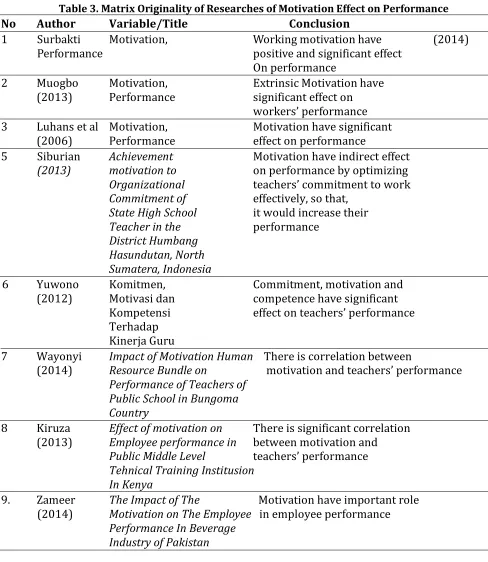
Table 3. Matrix Originality of Researches of Motivation Effect on Performance
No Author Variable/Title Conclusion
1 Surbakti Motivation, Working motivation have (2014)
Performance positive and significant effect
On performance
2 Muogbo Motivation, Extrinsic Motivation have
(2013) Performance significant effect on
workers’ performance
3 Luhans et al Motivation, Motivation have significant
(2006) Performance effect on performance
5 Siburian Achievement Motivation have indirect effect
(2013) motivation to on performance by optimizing
Organizational teachers’ commitment to work
Commitment of effectively, so that,
State High School it would increase their
Teacher in the performance
District Humbang Hasundutan, North Sumatera, Indonesia
6 Yuwono Komitmen, Commitment, motivation and
(2012) Motivasi dan competence have significant
Kompetensi effect on teachers’ performance
Terhadap
Kinerja Guru
7 Wayonyi Impact of Motivation Human There is correlation between
(2014) Resource Bundle on motivation and teachers’ performance
Performance of Teachers of
Public School in Bungoma
Country
8 Kiruza Effect of motivation on There is significant correlation (2013) Employee performance in between motivation and
Public Middle Level teachers’ performance
Tehnical Training Institusion
In Kenya
9. Zameer The Impact of The Motivation have important role (2014) Motivation on The Employee in employee performance
Performance In Beverage
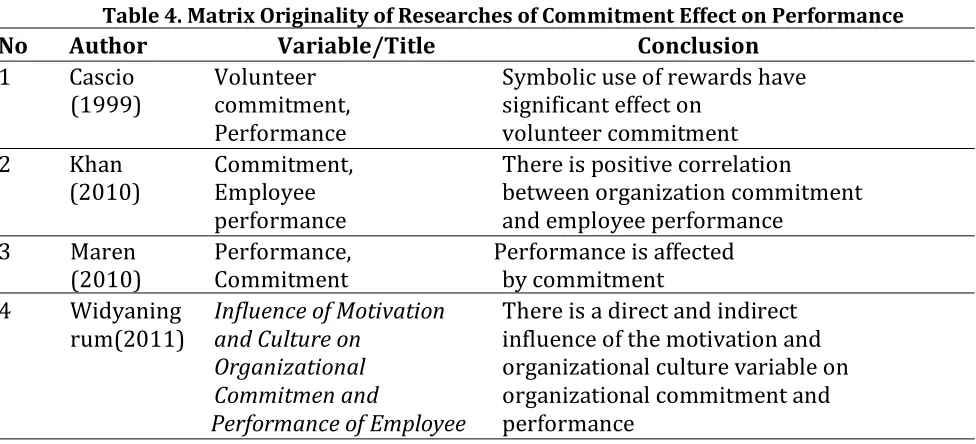
Table 4. Matrix Originality of Researches of Commitment Effect on Performance
No Author Variable/Title Conclusion
1 Cascio Volunteer Symbolic use of rewards have
(1999) commitment, significant effect on
Performance volunteer commitment
2 Khan Commitment, There is positive correlation
(2010) Employee between organization commitment
performance and employee performance
3 Maren Performance, Performance is affected
(2010) Commitment by commitment
4 Widyaning Influence of Motivation There is a direct and indirect rum(2011) and Culture on influence of the motivation and
Organizational organizational culture variable on
Commitmen and organizational commitment and
Performance of Employee performance
Table 5. Matrix Originality of Researches of Competence Effect on Commitment
No Author Variable/Title Conclusion
1 Fadli Competence, Competence have positive
(2012) Commitment effect on employee commitment
2 Sheth Competence, There is a positive correlation
(2001) Commitment between organizational commitment
and competence
3 Lory Competence, Commitment is highly influenced
(2008) Commitment by competence
4 Faizan Are Employee Motivation There is a positive correlation Mohsan, et.al Commitment and Job between motivation, commitment (2013) Involment Inter-related and among parts of works at
Evidence from Banking banking sector of Pakistan
Sector of Pakistan
Tabel 6. Matrix Originality of Researches of Motivation Effect on Commitment
No Author Variable/Title Conclusion
1 Sulasmi Commitment, There is a significant correlation
(2005) Motivation between commitment
and motivation
2 Yuwono Commitment, There is significant effect of
(2012) Motivation and commitment, motivation
Competence effect on and competence on
teachers’ performance teachers’ performance
3 Nina Sakina Normative commitment Male subject have higher organizational Affective commitment, and commitment. The older the subjects, Komitmen berkelanjutan the higher organizational commitment.
Furthermore, the higher the income,
The higher the commitment.
4 Funda Ozturk Job characteristics Job characteristics, Et al. Job satisfaction and Job satisfaction and
Organizational commitment Organizational commitment
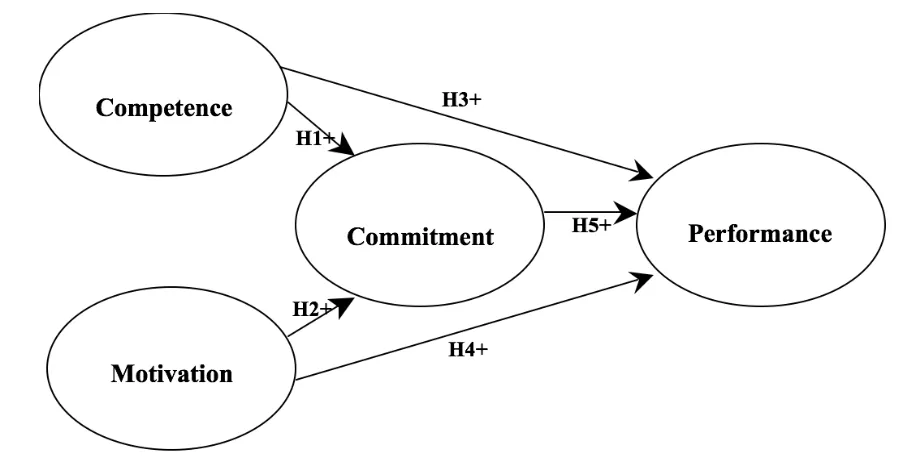
Based on the theory, the relationship model between variables as illustrated in Figure 1.
Figure 1. Research Framework
Based on the framework and a number of previous research above, a number of hypotheses to be tested in this study are as follows:
H1: Competence and Motivation partially and simultaneously have a significant effect on commitment
H2: Competence, Motivation and Commitment partially and simultaneously have a significant effect on Performance
H3: Commitment significantly mediates competence and motivation for performance
RESEARCH METHOD Type of research design
This type of research uses a survey, in the form of quantitative descriptive. Data are explained descriptively and analyzed for hypothesis testing (Effendi, 2003).
Research Variable
The research variables that will be observed are competence and motivation as the independent variable and the commitment of voluntary catechists and the performance of voluntary catechists as the dependent variable.
Operational Definition
Table 7. Variable Operationalization
No Variable Dimension Indicator Item
Number Scale
1 Competence Competence is a set of behavioral patterns held by office holders to be
practiced in a position in order to carry out their duties and functions competently. Syaiful F. Prihadi (2004:85) Motif Trait/Character Self-concept Knowledge Skill 1-4 5-8 9-11 12-16 17-20 Likert
2 Motivation Physiological Adequate clothing,
food and shelter 1-3 Likert
Safety Work equipment,
workspace condition, self-socialization, social interaction
4-7
Social Communication,
concentration, mutual respect, position
8-11
Appreciation Group recognition and
appreciation 12-14
Self-actualization Opportunity for
improvement 15-19
Work standard
(Abraham Maslow) Achieve work targets 20
3 Commitment Attitude that shows loyalty, confidence, interest and signifincancy of an organization for an employee, therefore he feels that he is part of the organization (Luthans, 1995)
Strong belief Involvement Interest Part of the organization Significancy of the organization 1-6 7-9 10-13 14-17 18-20 Likert
4 Performance the results of individual or group work both in quality and quantity accordance to their specific roles and duties to achieve organization goals at a certain time period
(Bernadin and Rusel, 2010)
Work quality Work quantity Timeliness Autonomy Interpersonal relationship 1-6 7-9 10-13 14-17 18-20 Likert
Population and Sample
2 deanery and the Tangerang deanery. Next, the other two deanaries are the South and Central deaneries. It is estimated that there are750 catechists; further details in Table 8.
Table 8. Number of Voluntary Catechist of 4 Deaneries or Regions
No Deanery No. of Catechist No. of Parish
1 Tangerang 295 12
2 West 2 201 9
3 South 155 6
4 Central 99 6
Total 750 33
Source: Catechist Commision (2013)
The sample in this study uses a sample size table from Isaac and Michael which provides simple way to determine sample size with margin of error of 10 percent. From the calculation, the number of sample obtained is 200 samples. Probabilty sampling with cluster system is being used for sample selection technique. For instrument test, we used 35 samples.
Type, Source and Data Collection Technique
The data are primary data from voluntary catechists of the Parishes in KAJ. Data were collected through closed questionnaires and validity-reliability tests were conducted. Statistical Product and Service Solutions (SPSS) 16 software is used for data analysis purposes. Research instruments are arranged in a number of statements and choice of answers using a Likert scale, consisting of: "Strongly Agree" (score 5), "Agree" with ( score 4), "Neutral" with (score 3), "Disagree" with (score 2), and "Strongly Disagree" with (score 1). For questions that use negative sentences, adjustments are made.
Data Analysis Method
Data analysis was performed to test research instruments, classical assumptions, and significance test of influence and correlation between variables (Path Analysis) (cf. Nisfiannoor, 2009:91).
Test of Significance of the Correlation (Path Analysis)
According to Robert D. Retherford (1993), path analysis is a technique used to analyze causal relationships that occur in multiple regression when the independent variables affect dependent variable either directly or indirectly (Suyoto, 2011: 1). While according to Paul Webley (1997), path analysis is a direct development of multiple regression form in order to estimate the magnitude and significance of hypothetical causal relationship in a set of variables (Sunyoto, 2011: 2). Whereas David Garson (2003) defined path analysis as an extended regression model that is used to test the alignment of matrix correlation between two or more models of causal relationships (Sunyoto, 2011: 2). Path analysis used in this study is Two Path Analysis that has two dependent variables where one of them being an intervening variable (Sunyoto, 2011: 35). This study examines the effect of Competence and Motivation (independent variables) on Performance (dependent variable) both directly and indirectly through catechist commitment (intermediate variables).
RESEARCH RESULTS AND DISCUSSION
Table 9. Respondent Characteristics
No Category Frequency %
1. Marital Status:
2. 3. 4. 5. 6. Married Celibate Single Sex Male Female Age 24-40 y.o. >40 – 50 y.o. >50 – 75 y.o.
Education High School Diploma Undergraduate Postgraduate Job Status Employee Employer Civil Servant Educator Priest/Monk Others
Working Period at Parish
1-6 months 7 months -1 year
1 – 2 years 2 – 3 years 3 – 4 years > 5 years
126 1 73 200 69 131 200 88 67 45 200 65 42 79 14 200 75 30 3 44 1 47 200 35 13 17 15 21 99 200 63% 0,5% 36,5% 100% 34,5% 65,5% 100% 44% 33,5% 22,5% 100% 32,5% 21% 39,5% 7% 100% 37,5% 15% 1,5% 22% 0,5% 23.5% 100% 17,5% 6,5% 8,5% 7,5% 10,5% 49,5% 100%
From the results of the validity and reliability test on all items, all four variables are declared valid and reliable. Likewise the classic assumption test, consisting of Kolmogorof normality test, heteroskedasticity test and multicollinearity test, fulfilled the classical assumption. In other words the regression equation obtained fulfills the provisions of Best Linear Unbias Estimator (Blue).
RESULTS AND DISCUSSION
Table 10. Summary results of Estimated Model Parameter
Model Path
Coeefficient
t p Adjusted R2
Sub structural 1 (X1 X2 ke X3) 0,442
X1 ( p X3 X1 ) 0,306 5,110 0,000
X2 ( p X3 X2 ) 0,468 7,811 0,000
Substructural 2 (X1 X2 X3ke X4) 0,434
X1 ( p X4 X1 ) 0,289 4.500 0,000
X2 ( p X4 X2) -0,032 - 463 0,644
X3 ( p X4X3 ) 0,487 6.785 0,000
Table 11. Summary Result of the Significance Analysis of the Variables Effect
Direct and Indirect Effect Effect Value t-value table Keterangan
t-Direct effect of X1 on X3
Direct effect of X2 on X3
Direct effect of X1 on X4
Direct effect of X2 on X4
Effect of X1 and X2 on X3
Direct effect of X3 on X4
Effect of X1 and X2 on X4
Indirect effect of X1 on X4
through X3
Indirect effect of X2 on X4
through X3
Total effect of X1 on X4 through
X3
Total effect of X2 on X4 through
X3
0,306 0,468 0,289 -0,032
0,442 0,487 0,434 0,149
0,228
0,438
0,196
5,110 7,811 4,500 -,463
6,785
2,021 2,021 2,021 2,021
2,021
Significant Significant Significant Not
Significant Significant Significant Significant
Analyzing the above calculation on table 24 and table 25, following calculation have been generated: 1). Relationship between competence (X1) and Motivation (X2); r12 = 0.47 (reciprocal relationship). 2). Relationship between competence (X1) and Catechists’ commitment (X3); r13 = 0.306. 3). Relationship between Motivational (X2) and Catechists’ commitment (X3); r23 = 0.468. 4). Relationship between competence (X1) and voluntary Catechists’ performance (X3); r14 = 0.289. 5). Relationship between Motivational (X2) and voluntary Catechists’ performance (X3); r24 = -0,032. 6). Relationship between voluntary Catechists’ commitment (X3) and voluntary Catechists’ performance (X3); r34 = 0.487.
Those calculation answers the formulation of the research problems from number 1 to number 6. The calculations are arranged in the correlation matrix below:
Table 12. Correlation Matrix
X1 X2 X3 X4
X1 1 0,47 0,31 0,289
X2 1 0,47 - 0,03
X3 1 0,49
Figure 2: Diagram of Result of Path Coeefficient Calculation
Based on Diagram on Figure 2, the path coefficient between X2 and X4 is -0,543 where P42 =
-0,543 < 0,05. Therefore the path from X2 to X4 is trimmed as seen in Figure 3.
Figure 3: New Diagram, the Shift of Path Diagram
The first hypothesis states that Competence and Motivation partially and simultaneously have a significant effect on commitment. The second hypothesis states that Competence, Motivation and Commitment partially and simultaneously have a significant effect on performance. The third hypothesis states that commitment significantly mediates competence and motivation for performance.
CONCLUSION
In general, most of voluntary Catholic teachers at Jakarta Archdiocese Parish or KAJ have good competence, motivation, commitment and performance. Based on the formulation of the research problems and research objectives that the author set above, the data and the result related to competence, motivation, commitment and performance variables have been found. Therefore, the author concludes as follows:
1. Competence directly has a positive and significant effect on increasing the commitment of Parish Catechists or Catholic teachers volunteer.
2. Motivation directly has a positive and significant effect on increasing the commitment of Parish volunteer Catholic teachers.
3. Competence and Motivation simultaneously have a positive and significant effect on increasing the commitment of Parish volunteer Catholic teachers.
4. Competence directly has a positive and significant effect on improving the performance of Parish volunteer Catholic teachers.
X1
X2
X3 X4
0,47
0,306
0,468
0,289
0,487
X1
X2
X3 X4
P21= 0,47
0,11
0,416
0,505
0,13 7
5. Motivation directly does not have a positive and significant effect on improving the performance of parish volunteer Catholic teachers because volunteer Catholic teacher work relates to devotion to God, but it indirectly affects the competence and commitment of volunteer Catholic teachers.
6. Commitment directly has a positive and significant effect on improving the performance of Parish volunteer Catholic teachers.
7. Competence and commitment directly influence the performance of volunteer Catholic teachers. In addition, competence indirectly affects the performance of volunteer Catholic teachers through the commitment of volunteer Catholic teachers.
8. Competence, Motivation and Commitment simultaneously have a positive and significant effect on improving the performance of Parish volunteer Catholic teachers. 9. The direct effect of both competence and commitment variables on the performance of
volunteer Catholic teachers is 0.154 and 0.440 respectively. They are greater than the indirect effect of competence on the commitment of volunteer Catholic teacher commitment where it is at 0.11. The influence of competence on the performance of volunteer Catholic teachers is 0.154 where it is smaller than the effect of the commitment on the performance at 0.440.
References
Amsir. (2012). Pengaruh Kompetensi dan Motivasi Kerja terhadap Kinerja Guru PNS Educational and Social Research, Vol. 3 (2), Mei (2013).
Arifin. (2013). “The Influence of Competence and External Motivation Factor Toward Teachers Working Performance In Jayapura-Papua Indonesia”.
Ar. Aisyah. Ar. (2011). “Pengaruh kepuasan kerja, motivasi dan komitmen organisasi terhadap kinerja guru di yayasan karya sejati palembang”. Tesis. Program Magister Pendidikan. Universitas Sriwijaya Palembang.
Asim, Masod (2013). “Impact of Motivation on Employee Performance with Effect of Training Specific to Education Sector of Pakistan”.
Babatope, (2013). “Principals’ Instructional Supervisory Role Performance and Teachers’ Motivation in Ekiti
Central Senatorial District of Ekiti State, Nigeria”. Journal of Educational and Social Research, Vol. 3 (2) May (2013).
Dimitris Manolopoulos (2006). “An Evaluation of Employee Motivation in the extended Public Sector in Greece. Employee Relation”. Vol. 30 No. 1. Emerald Group Publishing Limited.
Donovan, J.J. (2001). “Work Motivation”. in N. Anderson, D.S. Ones, & H.K. Sinangil (eds.). The Handbook of
Industrial, Work, and Organizational Psychology (pp. 53-76). London: Sage Publications.
Faizan Mohsan, et.al. (2013). “Are Employee Motivation Commitment and Job Involment Inter-related Envidence from Banking Sector of Pakistan”. International journal of Business and Social Science, Vol.2, No.17
Flippo, Edwin B, (1994). Manajemen Personalia. Erlangga. Jakarta.
Fuad Mas’ud, (2004), Survai Diagnosis Organisasional. Badan Penerbit Universitas Diponegoro. Semarang. George, Louis and Thara Sabapaty (2011). “Work Motivation of Teachers: Relationship with Organizational Commitment” : Canadian Social Science, Vol.7, No. 1, 2011, pp: 90-99.
Goleman, Daniel. (2002). Kecerdasan Emosional. Salemba Empat. Jakarta
Handoko, T. Tani, (1992), Manajemen Personalia & Sumber Daya Manusia. BPFE. Yogyakarta.
Hasibuan, Malayu SP, (1997), Manajemen Sumber Daya Manusia, Dasar dan Kunci Keberhasilan. Gunung Agung. Jakarta.
Kartono. (1985). Psikologi Social Untuk Manajemen, Perusahaan dan Industri. Luthans, Fred, (2006),
“Organizational Behavior”, 10th Edition, Boston: McGraw-Hill, Inc.
Kuncoro, Riduwan. (2013). Cara Menggunakan dan Memaknai Path Analysis. Alfabeta. Bandung. Kuncoro. 2009. Metode Sampling.Erlangga. Jakarta
Heuken, Adolf (2007). 200 Tahun Gereja Katolik di Jakarta. Cipta Loka Caraka. Jakarta.
Hidayat, Taufik, dan Nina Istiadah (2011). Panduan Lengkap Menguasai SPSS 19 untuk Mengolah Data Statistik
Penelitian. Media Kita.Jakarta.
Kiruza. (2013). “Effect of Motivation on Employee Performance in Public Middle Level Tehnical Training Institusion In Kenya”.
Lowney. (2005). Heroic Leadership. PT. Gramedia Pustaka Utama. Jakarta
Marbyana, Reza. (2009). Pengaruh stress kerja terhadap komitmen organisasi melalui kepuasan kerja pada PT. Industri Sandang Nusantara (Persero) Cabang Lawan.
Mowday, R. T., R. M. Steers and I. W. Porter, (1979), “The Measurement of Organizational Commitment”, Journal of Applied Psychology, 84, p. 408-414
Muhadi. (2007). “Analisis Pengaruh Kepuasan Kerja terhadap Komitmen Organisasional dalam Mempengaruhi Kinerja Karyawan (studi pada karyawan administrasi univeristas diponegoro)”. Tesis. Program Magister Manajemen. Universitas Diponegoro Semarang.
Palan, R. 2008. Competency Management. PPM. Jakarta
Raymond. (2013). Theacher’s and Learners Performance in The Alternative Learning System Toward an Enriched
Instructional.
Robbins, Stephen P and Timothy A. Judge, (2008). Perilaku Organisasi, 12th edition. Penerbit Salemba Empat.
Jakarta
Roe, R.A. (2001). Competencies and competence management. Paper European Conggres for W & O Psychology.
Prague, May 16-19, 2001
Saif. (2013). Competency based Job Analysis.
Sandjojo. (2011). Metode Analisis Jalur (Path Analysis) dan Aplikasinya. Pustaka Sinar Harapan. Jakarta Samsudin, H. Sadili. Manajemen Sumber Daya Manusia. Pusaka Setia. Bandung
Sarmawa, IWG. (2015). “Commitment and competency as an organizational citizenship behaviour Predictor and its effect on the performance”, International Journal of Economics, Commerce and Management United Kingdom, Vol. III, ISSN 2348 0386, Issue 1, Jan 2015.
Siburian. (2013). “Achievement Motivation to Organizational Commitment of State High School Teacher in The District Humbang Hasundutan, North Sumatra, Indonesia”
Sondang P. Siagian. (1996). Manajemen Sumber Daya Manusia. Bumi Aksara. Jakarta Sugiyono. (2007). Metode Penelitian Administrasi. Alfabeta. Bandung
________. (2012). Metode Penelitian Kombinasi (Mixed Methods). Alfabeta. Bandung
Surbakti Ronny Trian. (2014), “Pengaruh motivasi kerja terhadap kinerja karyawan Golongan 1 di universitas katolik parahyangan”. E-journal graduate Unpar Part a : Economics), |Vol. 1, No. 2 (2014), ISSN 2355-4304 Testa, Mark R., (1999), “Satisfaction with organizational Vision, Job Satisfaction and Service Effort: An Empirical Investigation”, Leadership and Organization Development Journal, Vol. 20, No. 3
Tim Karya Pastoral KAJ (2011). Arah Dasar Pastoral Keuskupan Agung Jakarta Tahun 2011-2015. KAJ. Sekretariat ______________________ (2011). Menuju Gereja KAJ yang Dicita-citakan: Peluang-peluang Implementasi Arah Dasar
Pastoral KAJ Tahun 2011-2015. Jakarta: Sekretariat KAJ.
Umar, Husein (2004). Metode Penelitian untuk Skripsi dan Tesis Bisnis. Cetakan ke-6. PT Raja Grafindo Persada. Jakarta
Us, Muogbo (2013), “The Impact of Employee Motivation On Organisational Performance (A Study Of Some Selected Firms In Anambra State Nigeria)”, The International Journal Of Engineering And Science (IJES), |Vol.2, ISSN(e): 2319 – 1813, Issue 7 Pages 70-80 (2013), pp 1805-2319