Determination Of The Actual Number Of Stages In A
Binary Distillation Column Using Excel
Yousuo Digieneni
, Osaribe Nelson A.
, ThankGod Erefagha Rufus
Department of Chemical Engineering, Niger Delta University,
P.M.B 071, Yenagoa, Bayelsa State, Nigeria
Abstract: The study highlighted the applications of distillation and explained the effect of the minimum number of stages in separation process in a distillation column. The study also looked at the design steps of a binary distillation column. The Excel software which is cheap, common and can be easily gotten was used to determine the minimum number of stages. The study showed that the minimum number of stages obtained were approximately seven. Thus a column with fewer than the minimum number of trays cannot achieve the desired separation, even at very high reflux.
.
Keywords: Determination, minimum number, stages, distillation, Excel
1.
Introduction
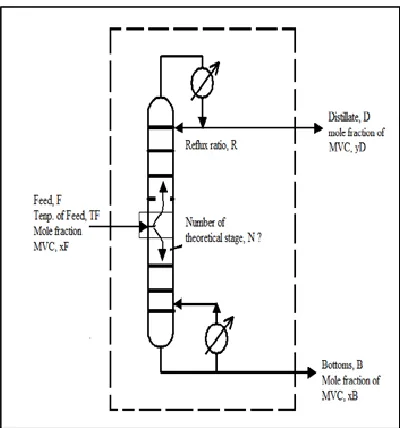
Distillation is one of the oldest unit operations and is the most widely used separation technique in process industry. Distillation is a separation process used to separate two or more components into an overhead distillate and bottoms where the bottoms product is liquid, and the distillate may be liquid or a vapor or both [11; 12; 14; 15]. Distillation is based on the fact that the vapor of a boiling mixture will be richer in the components that have lower boiling points. Distillation is applied in many areas (fermentation, desalination, fossil fuel industry, etc [19]. There are many types of distillation columns, each one of them is designed to be used in specific kind of separation. Depending on how they are operated they can be classified to: Continuous or Batch distillation columns [1; 2]. Binary distillation is a special distillation process. It is a multistage process for separating a mixture of two components [5; 8; 9]. The separation process requires that (i) a second phase be formed so that both vapor and liquid phases can contact each other on each stage within a separation column, (ii) the components have different volatilities so that they will partition between the two phases to different extents, and (iii) the two phases can be separated by gravity or other mechanical means [16]. A binary distillation column showing the number of stages is shown in Figure 1. Ideally, the more volatile component is separated as vapor and flows out from top. The less volatile component flows out at bottom as liquid. The product for a binary distillation process is a pure component, or technically a purer component. The component can be obtained by collecting the vapor flow or the liquid flow. There are two ways to do distillation calculations by McCabe Thiele method. One is graphical method and other way is by using any other commercial simulation software. The graphical method is by hand and is time consuming. The use of the commercial simulation software though is costly and requires license is the best especially when different mixtures are involved. In this paper, Ms –Excel is used to determine the minimum number of stages in a binary Distillation Column. The McCabe Thiele’s equations are given elsewhere [3; 11; 12; 13; 14; 20].
Figure 1. Binary distillation column showing the number of stages
2. Methodology
2.1 The Procedure
2.2 The Problem and specification
Suppose, we are going to design a distillation column to separate benzene-toluene mixture with feed flow rate 3000Kmole/hr, the feed is saturated liquid, the feed has 60% mol fraction of benzene and the over head product has 0.95 mol fraction of benzene and the bottom product contain 0.05 mol fraction of benzene. The system operates in partial reboiler and total condenser modes. The distillation column also operates at atmospheric pressure (p= 1atm) and the operating reflux ratio is 2. The design specifications are shown in table 1. The variables in table 1 that are not found in the design problem can be obtained from literatures [3; 10; 11; 12; 13; 14; 17; 18; 20].
Table 1: Design specifications
Feed rate 3000 Kmole/hr
Feed composition 60% benzene, 40% toluene
Column operating pressure Atmospheric (1atm) Column reboiler Partial
Column condenser Total Distillate composition, xd 95% benzene
Bottom composition, xb 95% toluene
Relative volatility of benzene to
toluene 2.3
Reflux ratio 2
Molecular weight of benzene, MWlk 78.114 kg/kmol
Molecular weight of toluene, MWHk 92.141 kg/kmol
Boiling point of benzene 80.1 0C Boiling point of toluene 110.6 0C Vapour density of benzene 2.77kg/m3 Vapou density of toluene 876kg/m3 Plate or tray spacing 0.5m
2.3 Assumptions
The McCabe-Thiele method of column design is used with the following assumptions inherent in the calculation:
Constant vapor and liquid flow rates in any given section of the tower.
The latent heat of evaporation is approximately constant with composition and also does not vary much as we proceed from tray to tray.
The system is non-foaming and non corrosive, and thus we can use carbon steel rather than stainless steel as our material of construction.
2.4 Stepstaken to determine the actual number of plates Though our concern in this study is the determination of the actual number of plates in a binary Distillation Column using excel, the following steps should be followed in the binary distillation column design [8; 13; 14; 15):
i. Determine the vapor-liquid equilibrium curve (x-y diagram) from Antoine data.
ii. Obtain the physical data of benzene and toluene required for the design.
iii. Calculate the flow rate of various stream through the column
iv. Calculate the minimum reflux ratio and the minimum number of trays required.
v. Using the physical data and flow rates calculate the reboiler and condenser duties.
vi. Calculate maximum and minimum liquid and vapor flow rates.
vii. To start the iteration, select reasonable plate spacing and using the trial plate spacing calculate the column diameter.
viii.Select a trial plate layout, select down-comer area, active, area and size, weir height and length.
ix. From this data check that the weeping rate is satisfactory.
x. Calculate the plate pressure drop.
xi. Check that the down-comer area backup is acceptable. xii. If at any stage some of the values are too high or low
select new trial values and repeat the iterations above.
2.4 Design Calculations of the TXY data and drawing the equilibrium curve (XY) diagram of a binary distillation column:
A detail design calculations of the TXY data and drawing of the equilibrium curve (XY) diagram of a binary distillation column has been done and reported elsewhere (Yousuo et al., 2019). In their study, they calculated the TXY data and plotted the equilibrium curve (X-Y) diagram using hand and excel. The TXY data is presented in table 2 and how the equilibrium curve (X-Y) diagram was ploted with MS Excel is shown in figure 2.
Table 2. TXY data for benzene and toluene [20]
Temp. (0C)
(mmHg) (mmHg) xb yb
Figure 2. How to obtain the equilibrium curve with excel [20]
2.5 Determination of the minimum number of stages in a binary Distillation Column using excel,
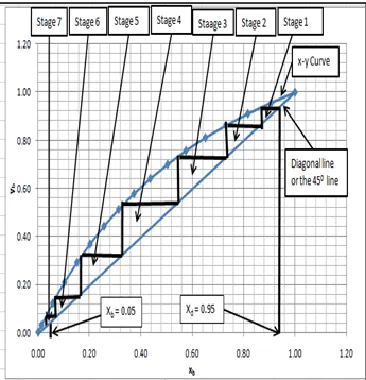
With the TXY (equilibrium curve) data, the equilibrium curve can be drawn or plotted as explained in section 2.4. The determination of the minimum number of stages in a binary distillation column using Excel is presented in figure 3.
Figure 3. Determination of the minimum number of stages.
2.5.1 Explanation for figure 3
Figure 2 has seven stages and so the minimum number of stages is seven (7).
1. Each stage is denoted by the horizontal (──) on a vertical line (│) as given by this shape
2. The horizontal and vertical lines can be drawn using Excel drawing tools.
3. The drawing starts from the point where xd = 0.95 meets the
diagonal line (450 line) and stops at the point where xb =
0.05 meets the diagonal line. Here the 7th stage is a little above the point where xb = 0.05 meets the diagonal line. So
the minimum number of stages or theoretical plates
required at which separation can be achieved is approximately seven (7).
2.6 Determination of the actual number of stages in a binary Distillation Column using excel,
2.6.1 Determination of the Theoretical number of stages in a binary Distillation Column using excel
By drawing the steps using MS Excel drawing tools between operating lines and the equilibrium line and count them. Those steps represent the theoretical plates (Nth) (or equilibrium
stages) as shown in figure 4.
Figure 4. Determination of the theoretical number of stages
2.6.2 Explanation for figure 4.
The operating line for the top section (the rectifying section) is given by equation (1)
(1)
This implies that in figure 4, the top operating line (TOL) must past through at point 1, the feed line (Xf = FB =
0.6) at point 2 and the intercept = 0.32 at point 3.
The operating line for the bottom section (the stripping section) is given by equation (2)
(2)
This implies that in figure 4, the bottom operating line (BOL) must past through and the intercept . It is important to note that both TOL and BOL must meet at Feed line (Xf =
FB = 0.6) at point 2The theoretical number of stages which is
2.6.3 Determination of the actual number of trays in a binary Distillation Column using excel
To determine the actual number of trays we use equation (3)
The actual number of trays = (3)
Note that is efficiency of tray [11; 12; 13; 14]
[ ( )] (4)
Where:
is Molar average liquid viscosity of feed evaluated at
average temperature of column.
is Average relative volatility of more volatile component
mNs/m2
So if the efficiency ( ) is 75% = 0.75
Then, the Actual number of trays =
2.6.4 Determination of the actual number of stages in a binary Distillation Column using excel
The actual number of stages is calculated from the actual number of trays. If we use partial reboiler and partial condenser, then the actual number of stages = but if we use total reboiler and total condenser, then the actual number of stages is the same as the actual number of trays So, the actual number of trays =13 and since we used in our calculation partial reboiler then the actual number of stages =13-1=12 stages.
3. Discussion and conclusion
Figure 2 shows how the minimum number of stages or theoretical plates can be determined using Excel. The minimum number of stages or trays to make a specified separation is found when an infinitely large reflux ratio is used. The L/V ratios in both sections of the column become unity and lie on the 45° line. This situation actually takes place in a column when it is operated under "total reflux" conditions. No feed is introduced and no products are withdrawn, but heat is added in the reboiler and all the overhead vapor is condensed and returned to the column as liquid reflux. Thus a column with fewer than the minimum number of trays cannot achieve the desired separation, even at very high reflux. At total reflux, the number of theoretical plates required is a minimum. As the reflux ratio is reduced (by taking off product), the number of plates required increases. The Minimum Reflux Ratio (R min) is the lowest value of reflux at which separation can be achieved even with an infinite number of plates. Further work will on the determination of the actual number of trays in a given binary distillation column using Excel and other commercial simulation softwares, though they are costly and requires license.
4 References:
[1] Aanab I. M., Fatima M.A., Sabrea Yousif Suliman. “Design of a Binary Distillation Column for Benzene-Toluene Mixture”, Graduation Project Submitted in Partial Fulfillments of the Requirements for award of BSC Degree in Refining and transportation
Engineering, College of Petroleum Engineering and technology, Sudan University of Science and Technology, 2014.
[2] APV. “Distillation Handbook”. S.I., USA : SPX Corporation, 2008.
[3] Dongare S.B., Shende A. C., Ganir V. N. and Deshmukh G. M. “Shortcut Design Method for Multistage Binary Distillation Via MS-Excel”, International Journal of Engineering Research and Application, Vol.6, Issue 10 (Part-3), PP.6-12, 2016.
[4] Himmelblau D. M. “Basic Principle and Calculations in Chemical Engineering”, 6th Edition, 1996.
[5] Jing Yan. “Robust Design of the parameters for a Distillation System”, a Thesis submitted to the graduate faculty of north Caroline State University in Partial Fulfillment of the Requirements for the Degree of Masters of Science in Industrial Engineering, 2012.
[6] Joan Lambert. “Microsoft MOS 2016 Study Guide, Microsoft Office Specialist, Exam 77- 727”, Pearson Education, Inc, 1st Edition, Pp 1-55, 2016.
[7] Kamal. M. Hamid, Gesmalseed G. A., Abdelrah Atif. “Manual Determination of the Number of Theoretical Plates by MCCAB-Theil and by using MATLAB”, International Journal of Engineering Science and Innovative Technology (IJESIT) Volume 5, Issue 5, Pp. 1-6, 2016.
[8] Kister Z., Henery R. “Distillation design”. New York: McCRaw-Hill, 1992.
[9] Khoury, Fouad M. “Multistage Separation Process”, Boca Raton: CRC Press, 2004.
[10]Meryers A., Robert B. “Handbook of petroleum refining process”, 3rd. S.I. : McCgRaw-Hill, 2008.
[11]Richardson J.F., Harker J. H. and Backhurst J. R. “Coulson and Richardson's chemical engineering”, 5th
Edition: Oxford, Vol. 2, 2002.
[12]Robert H. Perry and Don W. Green. “Perry’s Chemical Engineers’ Handbook”, McGraw-Hill, 7th
Edition, 1999.
[13]Sinnoth R.K. “Chemical Engineering”, 3rd Edition, Volume 6, 1999.
[14]Sinnott R. K, coulson and Richardon. “Chemical Engineering”, 2nd Edition: Butterworth Heinemann, 1997.
[16]Sohail Rasool Lone and Syed Aklaq Ahmed. “Modelling and Simulation of a Distillation Column using Matlab”, International Journal of Engineering Research and Science Technology, Volume 2, NO.4, Pp. 1-4, 2013.
[17]Wikipedia. “Benzene”, Retrieved on June 24, 2019 from http://en.wikipedia.org/wiki/bezene, 2019.
[18]Wikipedia. “Toluene”, Retrieved on June 25, 2019 from http://en.wikipedia.org/wiki/Toluene, 2019.
[19]Wikipedia (2019). Distillation. Retrieved on
November 05, 2019 from
https://en.wikipedia.org/wiki/Distillation
[20]Yousuo Digieneni. Design and Plant simulation, A Lecture Note for Master’s Students, Department of Chemical Engineering, Niger Delta University, Bayelsa State of Nigeria, Pp 1-50 (unpublished), 2019.
Author Profile
[21] <Author 1 Photo>
Author 1
![Table 2. TXY data for benzene and toluene [20] Temp.](https://thumb-us.123doks.com/thumbv2/123dok_us/8585429.1719796/2.612.340.546.381.592/table-txy-data-for-benzene-and-toluene-temp.webp)